
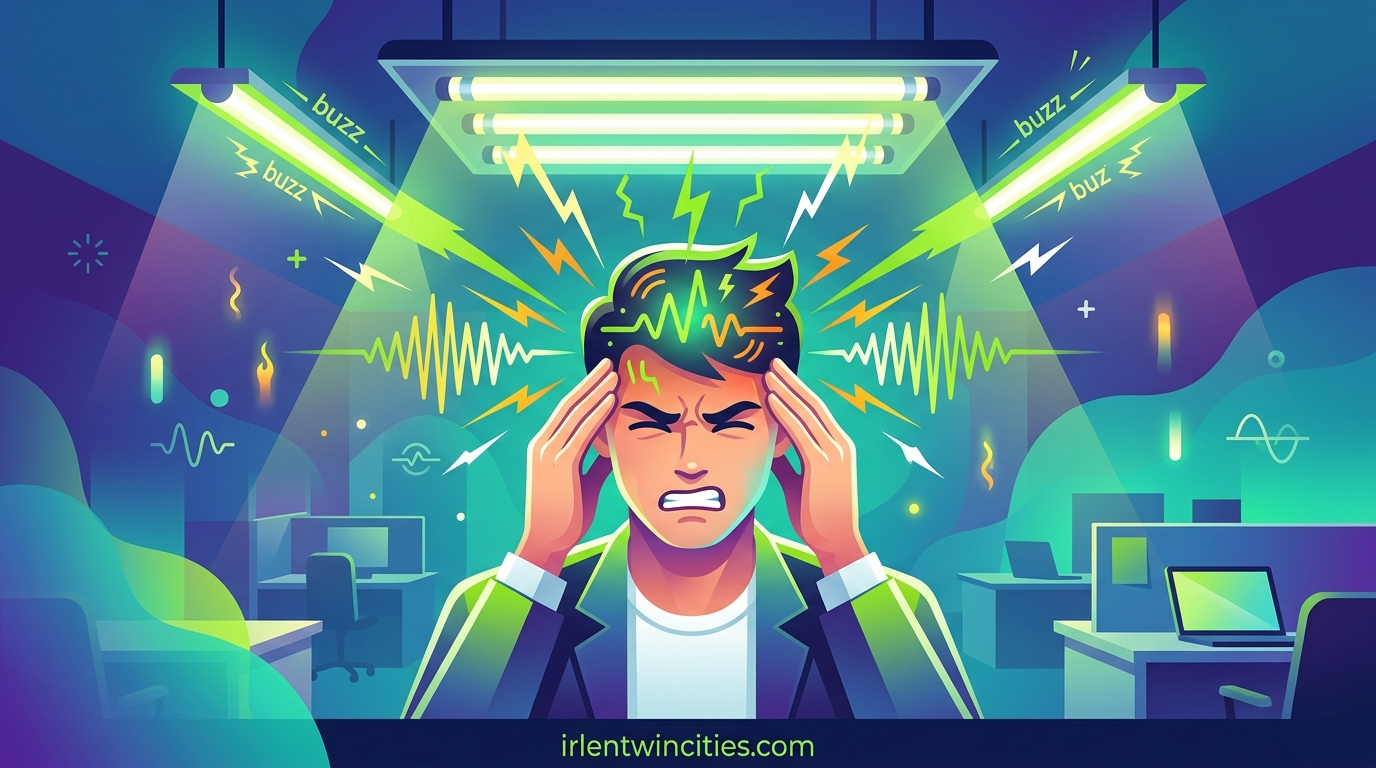
If you’ve ever walked into an office or classroom and felt your head start throbbing within minutes, you’re not alone. Fluorescent light headaches are a real medical phenomenon affecting millions of people worldwide. These headaches occur when your brain’s pain pathways are activated by the specific characteristics of fluorescent lighting, including invisible flickering, blue-green light wavelengths, and excessive glare.
This condition, known medically as photophobia or light sensitivity, can turn ordinary environments like workplaces, schools, and stores into sources of chronic pain and discomfort. Understanding why fluorescent lights trigger headaches is the first step toward finding relief and regaining control over your daily life.
Table of Contents
What Happens to Your Brain Under Fluorescent Lights
Your eyes contain specialized cells called intrinsically photosensitive retinal ganglion cells (ipRGCs) that respond to light independently of vision. These cells contain a photopigment called melanopsin, which is particularly sensitive to blue-green light wavelengths, the exact spectrum that fluorescent lights emit in abundance.
When these cells detect light, they send signals directly to the brain’s pain centers, including the thalamus and trigeminal system. For people with light sensitivity, this pathway becomes hyperactive, meaning even normal light exposure can trigger pain responses. Research shows that during a migraine, this sensitivity increases up to three-fold, making fluorescent lighting especially problematic for migraine sufferers.
The visual cortex also processes fluorescent light differently than natural light. Your brain must work harder to interpret the flickering and uneven light spectrum, leading to visual fatigue that can escalate into a full headache. This explains why you might feel fine in sunlight but experience pain under fluorescent lights, even when they appear equally bright.
Why Fluorescent Lights Cause Headaches
Invisible Flickering Effect
All fluorescent lights flicker, but not all flicker is visible to the naked eye. Older magnetic ballasts cause lights to flicker at 60 cycles per second (60 Hz), which some people can perceive as a subtle pulsing or strobing effect. Newer electronic ballasts operate at much higher frequencies (20,000 to 60,000 Hz), making the flicker invisible, but your brain still detects it.
This invisible pulsing creates cognitive load as your brain continuously works to fill in the gaps between light pulses. Over time, this constant processing drains your mental energy and triggers tension headaches. The effect is similar to the fatigue you feel after watching a poorly filmed video with frame rate issues, except it happens continuously while you’re under the lights.
The flicker rate also interacts with brainwave patterns. Some research suggests that certain flicker frequencies can disrupt normal brain activity, potentially triggering neurological responses that lead to headaches. This may explain why people with epilepsy, autism, or sensory processing disorders often report severe sensitivity to fluorescent lighting.
Blue-Green Light Wavelengths
Fluorescent lights emit a disproportionately high amount of blue-green light in the 480-520 nanometer range. This specific wavelength spectrum is problematic because it’s precisely what melanopsin in your retinal cells detects most efficiently. When these cells are activated, they signal the suprachiasmatic nucleus (your biological clock) and the trigeminal vascular system (your headache pathway).
Blue light also scatters more easily than other wavelengths, creating glare and reducing visual contrast. This forces your eyes to strain to maintain focus, leading to eye muscle fatigue that can radiate into headaches. The problem compounds when you’re trying to read or do detailed work under fluorescent lighting, as your eyes must work harder to overcome the poor light quality.
Many people with fluorescent light sensitivity report that natural daylight or warm LED lighting doesn’t bother them, confirming that the specific light spectrum of fluorescent bulbs is the culprit rather than brightness alone. This is why simply dimming fluorescent lights often doesn’t help, you need to change the light quality itself.
Excessive Brightness and Glare
Fluorescent tubes produce intense, diffuse light that can overwhelm your visual system. Unlike natural light, which varies throughout the day, fluorescent lights maintain constant high intensity that doesn’t give your eyes a break. This sustained brightness can cause pupil constriction and eye strain, particularly if you’re transitioning between different lighting environments.
Glare from reflective surfaces, computer screens, and glossy materials amplifies the problem. Fluorescent light reflects off white walls, desks, and other surfaces, creating secondary light sources from all directions. Your brain must process this complex lighting environment, which can trigger migraines in susceptible individuals.
The harsh quality of fluorescent light also reduces visual acuity. Edges appear less sharp, contrast is diminished, and colors may look washed out. Your visual system compensates by working harder, leading to fatigue that progresses to headaches, especially during prolonged exposure during work or school days.
Who Gets Fluorescent Light Headaches
People with migraine disorders are the most commonly affected group, with up to 80% reporting light as a trigger. Fluorescent lighting specifically triggers migraines in roughly 60% of migraine sufferers. The connection is so strong that photophobia is now considered a core diagnostic criterion for migraine by medical organizations.
Tension headache sufferers also experience increased frequency and severity under fluorescent lights. The constant eye strain and postural muscle tension from trying to avoid glare can trigger or worsen tension-type headaches. People with cluster headaches, though less common, frequently report fluorescent lights as an attack trigger during cluster cycles.
Those who have experienced traumatic brain injuries (TBI) or concussions often develop new light sensitivity afterward. The injury can alter how the brain processes visual information, making previously tolerable lighting suddenly painful. This sensitivity may persist for months or years after the initial injury, significantly impacting return to work or school.
Irlen Syndrome, a visual processing disorder also known as Meares-Irlen Syndrome or scotopic sensitivity, causes specific difficulty with fluorescent lighting. People with Irlen Syndrome may experience text distortion, eye strain, and headaches specifically under fluorescent lights, even though they have normal vision acuity. This condition is particularly relevant for children and adults who struggle with reading or academic performance in fluorescent-lit environments.
Sometimes, light sensitivity develops suddenly without any clear cause. Medical conditions like meningitis, lupus, and certain eye conditions can trigger photophobia. Medications, including some antidepressants and antibiotics, can also increase light sensitivity as a side effect. If you’ve suddenly developed light sensitivity, it’s worth discussing with a healthcare provider to rule out underlying causes.
How to Stop Fluorescent Light Headaches
FL-41 Tinted Glasses
FL-41 tinted lenses are specifically designed to block the blue-green light wavelengths that trigger photophobia. Developed in the 1980s, these rose-colored filters have been shown in clinical studies to reduce light sensitivity in 80% of migraine sufferers and many people with other light-sensitive conditions.
The tint works by absorbing the problematic wavelengths while allowing other light through, reducing the stimulation of melanopsin-containing cells without making your environment too dark. Unlike sunglasses, FL-41 lenses are designed for indoor use and don’t cause dark adaptation problems that can worsen sensitivity over time.
Many people report significant relief within days of wearing FL-41 glasses consistently under fluorescent lights. The lenses are available in prescription and non-prescription options, with varying tint intensities to match individual sensitivity levels. While they can be an investment, many users find they’re worth the cost for the ability to work and function comfortably in fluorescent-lit environments.
Workplace Accommodations
Requesting workplace accommodations for light sensitivity is your right under the Americans with Disabilities Act. Start by documenting your symptoms and their impact on your work performance. A letter from your healthcare provider explaining your medical need for lighting accommodations can strengthen your request.
Effective accommodations might include: replacing fluorescent tubes with LED alternatives, installing fluorescent light covers or diffusers, repositioning your desk away from direct overhead lighting, or allowing you to use your own task lighting. Many employers are willing to make these relatively simple changes once they understand the medical necessity.
If you encounter resistance, frame your request in terms of productivity, you’ll be able to work more effectively and take fewer sick days with appropriate lighting. The Job Accommodation Network (JAN) provides free consultation services to help employees and employers find appropriate accommodation solutions.
Lighting Modifications
Fluorescent light covers are an affordable solution that diffuses harsh light and reduces glare. These panels, which fit into standard ceiling fixtures, come in various styles including prismatic designs that scatter light more evenly and decorative options that mimic skylights or clouds. Many users report immediate improvement in headache frequency after installation.
Replacing fluorescent tubes with LED alternatives addresses both flicker and spectrum issues. Modern LEDs are available with color temperatures similar to natural daylight (5000K) or warmer tones (2700-3000K) that are generally better tolerated. Some LED bulbs are specifically marketed as “migraine-friendly” with reduced blue light output.
Personal task lighting gives you control over your immediate environment. A desk lamp with a warm-toned LED bulb allows you to turn off or dim overhead fluorescent lights while maintaining adequate lighting for your workspace. This approach is particularly effective if you can’t modify building-wide lighting systems.
Immediate Relief Strategies
When you feel a headache starting under fluorescent lights, take a break in natural light if possible. Even stepping outside for five minutes can reset your visual system and reduce pain progression. If you can’t go outside, find a window or an area with different lighting.
The 20-20-20 rule helps reduce eye strain: every 20 minutes, look at something 20 feet away for 20 seconds. This practice relaxes your focusing muscles and gives your brain a break from processing fluorescent light. Combine this with brief walks or movement to address tension-related headache components.
Stay hydrated and maintain stable blood sugar, as both factors can influence headache susceptibility. Some people find relief with cool compresses on their eyes or forehead, which can calm inflammation and reduce the sensation of light sensitivity. Over-the-counter pain relievers work best when taken at the very first sign of headache, rather than waiting until pain is severe.
Related Conditions That Cause Light Sensitivity
Beyond migraine and tension headaches, several medical conditions involve photophobia as a primary symptom. Blepharospasm, a condition causing involuntary eyelid spasms, often includes light sensitivity as a trigger for muscle contractions. Dry eye syndrome can make normal light feel painful due to corneal irritation.
Autoimmune conditions like lupus and rheumatoid arthritis can cause light sensitivity as part of their symptom profile. In these cases, photophobia may occur even without headache and can affect natural light as well as artificial sources. Working with your rheumatologist to manage underlying disease activity often improves light tolerance.
Neurological conditions including multiple sclerosis, Parkinson’s disease, and autonomic nervous system disorders (like POTS) frequently involve light sensitivity. The mechanism varies by condition but often relates to how the brain processes sensory information. Managing the primary condition typically helps reduce photophobia symptoms.
Irlen Syndrome deserves special mention because it specifically involves difficulty with fluorescent lighting and printed text. People with Irlen Syndrome may see words moving, blurring, or disappearing under fluorescent lights, leading to reading difficulties and associated headaches. Colored overlays or tinted lenses (different from FL-41) can dramatically improve reading comfort and academic performance for affected individuals.
Why Fluorescent Lights Give Me a Headache: Frequently Asked Questions
How do I stop my fluorescent lights from giving me headaches?
The most effective solutions include wearing FL-41 tinted glasses specifically designed for light sensitivity, installing fluorescent light covers or diffusers to reduce glare, replacing fluorescent tubes with LED alternatives, and using personal task lighting instead of overhead fixtures. Taking regular breaks in natural light and practicing the 20-20-20 rule can also help prevent headache onset.
Do fluorescent lights cause headaches?
Yes, fluorescent lights can cause headaches through three main mechanisms: invisible flickering that creates cognitive load, blue-green light wavelengths that activate pain pathways in the brain, and excessive brightness that causes eye strain. Scientific research confirms that fluorescent lighting triggers headaches in 60-80% of people with migraine disorders and many people with other light-sensitive conditions.
Why am I suddenly sensitive to fluorescent light?
Sudden light sensitivity can develop after a concussion or traumatic brain injury, as a side effect of certain medications, or due to new medical conditions like meningitis, autoimmune disorders, or eye problems. Hormonal changes, stress, and sleep deprivation can also temporarily increase light sensitivity. If your sensitivity is new and persistent, consult a healthcare provider to identify underlying causes.
What helps with fluorescent light sensitivity?
FL-41 tinted glasses are the most researched solution, providing relief for 80% of migraine sufferers. Other helpful interventions include fluorescent light covers, warm LED lighting alternatives, taking regular breaks from fluorescent environments, using desk lamps instead of overhead lights, and addressing any underlying medical conditions contributing to photophobia.
Can fluorescent lights cause migraines?
Yes, fluorescent lights are a well-documented migraine trigger. The flickering, blue-green light spectrum, and glare from fluorescent lighting can activate the trigeminal pain pathway and trigger migraine attacks in susceptible individuals. Up to 60% of migraine sufferers report fluorescent lights as a trigger, making it one of the most common environmental migraine triggers.
Are LED lights better than fluorescent for headaches?
Generally, yes. LED lights don’t flicker, can be chosen in warmer color temperatures with less blue light, and provide more consistent illumination without the glare issues of fluorescent tubes. However, some very bright or cool-toned LEDs may still trigger sensitivity. Warm LEDs (2700-3000K) are typically better tolerated than fluorescent lights by people with photophobia.
What are FL-41 glasses?
FL-41 glasses feature a rose-colored tint specifically designed to block the blue-green light wavelengths (480-520nm) that trigger light sensitivity and migraines. Developed in the 1980s, these lenses have been clinically shown to reduce photophobia in 80% of migraine sufferers. Unlike regular sunglasses, FL-41 lenses are designed for indoor use and don’t cause dark adaptation problems.
How to prevent headaches from fluorescent lights?
Prevention strategies include: wearing FL-41 tinted glasses when in fluorescent environments, installing light diffusers or covers on fixtures, taking regular breaks every 20 minutes, maintaining good hydration and stable blood sugar, positioning your workspace to avoid direct overhead lighting, and using warm-toned task lighting instead of relying solely on overhead fluorescent lights.
Conclusion
Fluorescent light headaches are a legitimate medical symptom, not imagination or oversensitivity. The science behind photophobia explains exactly why these lights trigger pain, from invisible flickering to specific light wavelengths that activate brain pathways. Understanding these mechanisms validates what you’ve been experiencing and points toward effective solutions.
You don’t have to choose between your health and your ability to function in modern environments. With the right combination of FL-41 tinted eyewear, environmental modifications, and strategic breaks, most people can significantly reduce their fluorescent light headaches. If your symptoms are new, severe, or accompanied by other neurological symptoms, consult with a healthcare provider to rule out other conditions and develop a comprehensive management plan.
Living with light sensitivity presents challenges, but understanding why fluorescent lights give you a headache is the first step toward finding relief and reclaiming comfort in everyday spaces.