
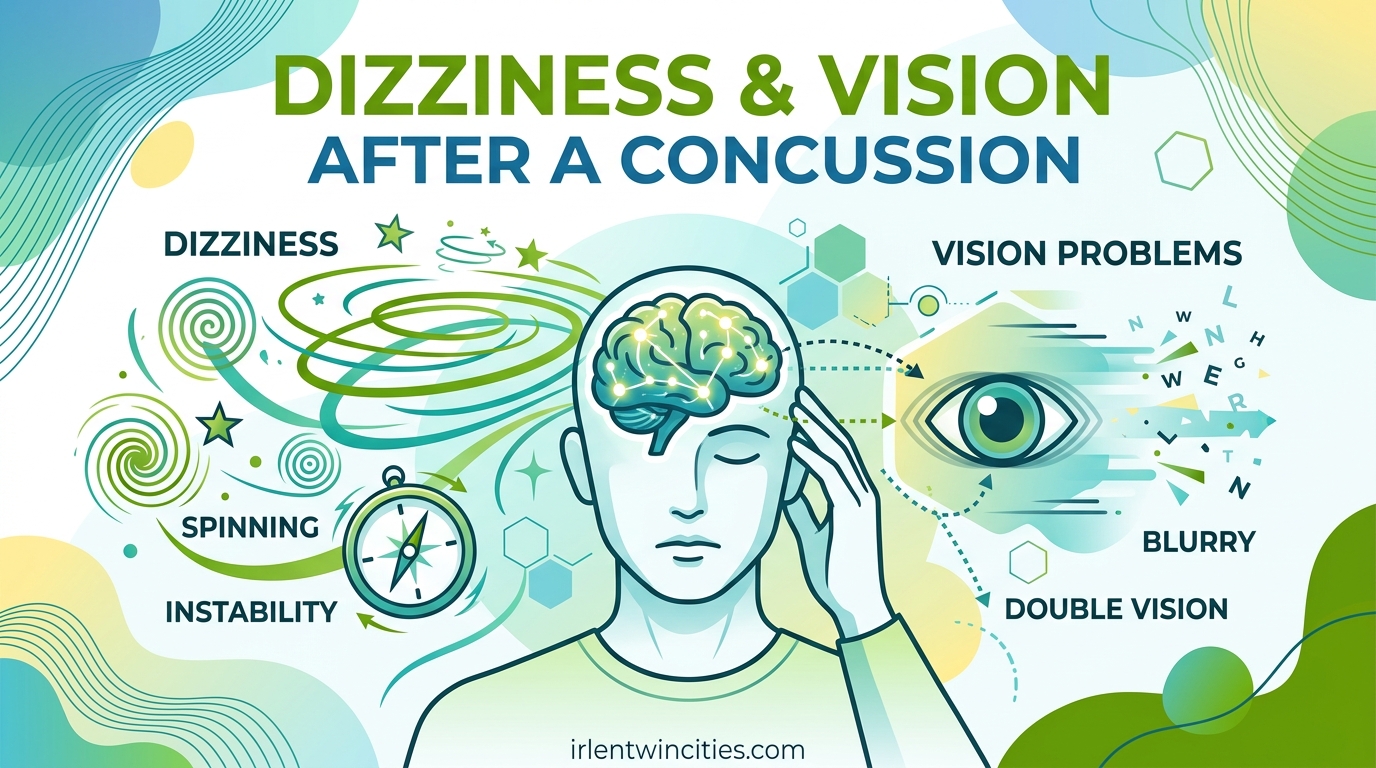
If you have ever hit your head and noticed the room starting to spin or your vision going blurry, you are not alone. These symptoms are among the most common complaints after a concussion, yet many people never get a clear explanation of why they happen together. The answer lies in how your brain processes balance and vision as one integrated system.
Post-concussion dizziness and vision problems occur when a head injury disrupts the communication between your visual and balance systems. This connection is not coincidental. Understanding why your head injury causes both dizziness and vision issues is the first step toward proper treatment and recovery.
In this guide, I will explain exactly how concussion affects the vision-dizziness connection, what types of symptoms you might experience, how long recovery typically takes, and what treatment approaches actually work. Our team has reviewed medical research and patient experiences to give you a complete picture of this frustrating but treatable condition.
Table of Contents
Understanding the Connection Between Concussion and Dizziness
When you experience a concussion, the impact rattles your brain inside your skull. This sudden movement stretches and damages nerve fibers and blood vessels at the cellular level, even when there is no visible injury. The consequences extend far beyond the headache you might expect.
Dizziness and vision problems after a concussion are connected through something called the vestibular system. Your vestibular system is your internal balance center, located in your inner ear. It works together with your visual system and proprioceptive sensors in your body to keep you oriented and stable. When a concussion disrupts any part of this network, you feel it as dizziness, imbalance, or visual disturbances.
Post-concussion syndrome refers to a collection of symptoms that persist weeks or months after the initial head injury. Dizziness appears in a significant percentage of concussion cases. Research suggests that experiencing dizziness is predictive of prolonged recovery. This is because dizziness often indicates that the vestibular system itself was affected, not just temporarily stunned.
One key mechanism involves neurovascular coupling, which is how blood vessels and neurons communicate to deliver energy exactly where your brain needs it. A concussion disrupts this precise coordination. When the systems responsible for balance and vision cannot get the resources they need, symptoms develop and persist. The brain regions most vulnerable to this disruption are those controlling balance, eye movements, and spatial orientation.
How Balance Systems Work Together
To understand why concussion causes these specific symptoms, you need to understand how your balance systems normally work together. Your body relies on three primary sources of balance information that operate constantly in the background of your daily life.
First, your vestibular system in your inner ear detects movement and gravity through fluid-filled canals and sensory hair cells. These structures sense rotation, linear acceleration, and head position relative to gravity. When you turn your head, these structures send signals that your brain interprets immediately. Second, your visual system provides information about where you are in space and whether things are moving around you. Your eyes constantly send updates about your environment. Third, proprioceptive sensors in your joints, muscles, and skin tell your brain about body position and ground contact. These sensors in your feet, ankles, and spine provide constant ground reference information.
These three systems feed information to your brainstem and cerebellum, which integrate everything into a seamless sense of balance. Your eyes stay stable because of the vestibular-ocular reflex, commonly called VOR. This reflex adjusts your eye position automatically when your head moves, keeping whatever you are looking at in focus even during walking, driving, or physical activity. When you walk and look around, your VOR keeps your gaze steady despite constant head movements.
The vestibular-ocular reflex works through a direct pathway from your inner ear to your eye muscles. When your head turns right, signals travel from your right inner ear through the vestibular nerve to your brainstem, then immediately to the muscles that move your eyes left. This happens in milliseconds and happens constantly whenever you are awake and moving. A concussion can disrupt this pathway at any point, causing your eyes and balance systems to fall out of sync.
When the vision-vestibular connection is disrupted, your brain receives conflicting information. Your eyes might report that the environment is stable while your inner ear insists you are moving. This mismatch creates the disorienting sensation of dizziness and is exactly why many concussion patients feel nauseous or unsteady when looking around busy environments like grocery stores or shopping malls.
Types of Dizziness After Concussion
Not all dizziness feels the same. The specific quality of your dizziness provides important clues about which systems were affected and how to treat them. Understanding the type of dizziness you experience helps target your treatment more effectively and sets realistic expectations for recovery.
Vertigo is the sensation that the room is spinning or moving around you, even when you are perfectly still. This typically indicates a problem with the vestibular system itself, specifically the semicircular canals in your inner ear. Benign paroxysmal positional vertigo, or BPPV, occurs when tiny calcium crystals called otoconia become dislodged and float into the wrong canals. A head injury can absolutely trigger BPPV, and it is one of the most treatable causes of post-concussion vertigo. The Epley maneuver and similar repositioning techniques can often resolve BPPV in one or two sessions.
Lightheadedness feels more like you might pass out or like the room is about to fade away. This sensation often relates to blood pressure regulation problems or migraine components rather than pure vestibular dysfunction. Many concussion patients experience lightheadedness when standing up too quickly, a condition linked to autonomic nervous system disruption called dysautonomia. This type of dizziness often improves with hydration, salt intake adjustments, and gradual postural changes.
Disequilibrium refers to a persistent sense of imbalance or unsteadiness when walking. Unlike vertigo, which comes in episodes, disequilibrium is constant. This typically points to problems with integration between the vestibular system and proprioceptive inputs, often accompanied by anxiety about falling. Patients describe this as feeling like they are walking on a boat or that the ground is unreliable under their feet.
The challenge is that these types often overlap. You might experience vertigo in the morning and lightheadedness by afternoon. Some days your balance feels almost normal, and the next day everything spins again. This fluctuation is actually a hallmark of post-concussion symptoms, not a sign that you are imagining things. Many patients in concussion support communities note that their symptoms vary significantly from day to day and even hour to hour.
Vision Problems After Concussion
Vision problems after concussion are remarkably common, affecting an estimated 30 to 50 percent of concussion patients. These issues extend far beyond simple blurred vision and can interfere with reading, driving, working, and daily life in ways that are hard to explain to someone who has not experienced them. The impact on daily life can be significant even when other concussion symptoms have improved.
Blurred vision is the most frequently reported visual symptom after concussion. You might notice that things look fuzzy, especially when trying to focus on something nearby or switch between looking at different distances. This often relates to convergence insufficiency, where your eyes have difficulty working together on close-up tasks like reading or using your phone. Your eyes might struggle to turn inward precisely enough to maintain single, clear vision at reading distance.
Double vision occurs when your eyes fail to align properly. Your brain receives two slightly different images and cannot fuse them into one clear picture. This creates significant strain and makes activities like driving or walking down stairs potentially dangerous. Many patients report that double vision worsens when they are tired, looking at screens, or in bright lighting conditions. Prism lenses prescribed by a neuro-optometrist can sometimes provide immediate relief while vision therapy works on permanent correction.
Light sensitivity, or photophobia, often develops after concussion. Bright environments, fluorescent lights, and screen glow can all trigger discomfort or pain. This symptom can be severe enough to limit your ability to go outside or work in typical office lighting. Some patients report carrying sunglasses everywhere, even indoors. FL-41 tinted lenses specifically designed for photophobia can help some patients function more comfortably.
Eye strain and tracking difficulties make reading particularly challenging. Your eyes might jump or skip over words, lose their place frequently, or feel exhausted after just a few minutes of page time. This happens because the oculomotor muscles that control precise eye movements can be damaged or inhibited by concussion. Patients frequently report that reading, which was effortless before the injury, becomes physically uncomfortable and mentally exhausting afterward.
Binocular vision dysfunction, or BVD, occurs when the eyes are slightly misaligned and must work harder to maintain single, clear vision. This extra effort leads to headaches, fatigue, and dizziness that many patients describe as their eyes working against each other. BVD often persists for months after the initial injury and responds well to specialized vision therapy. This condition is frequently missed on standard eye exams, which is why seeing a neuro-optometrist experienced with concussion is important.
Why Your Eyes Feel Weird After Hitting Your Head
Patients frequently describe their post-concussion visual symptoms in unusual ways. Phrases like “my eyes feel weird,” “my vision feels off,” or “everything looks wrong” are common in forums and support communities. These descriptions make sense once you understand what actually happens to your visual system after a concussion. The weird feeling is your brain struggling to integrate misaligned or disrupted visual information.
Oculomotor dysfunction is one of the primary culprits behind these unusual visual sensations. This term covers any disruption in the automatic, precise movements your eyes make dozens of times per second without conscious thought. These movements include saccades, which are quick jumps between targets like when you scan a page of text, pursuits, which are smooth following movements like tracking a ball, and vergence, which is the slight inward turning your eyes do for close work. After a concussion, any or all of these can be impaired.
When your saccades are disrupted, quick eye movements become inaccurate. You might miss what you are trying to look at, require extra movements to find something, or feel like things are jumping around unpredictably. When pursuits are impaired, tracking a moving object becomes difficult or impossible. When vergence is impaired, reading a book or checking your phone causes double vision, eye strain, and headaches that can last for hours afterward.
Visual midline shift syndrome is a less commonly discussed condition that can develop after concussion. Your brain establishes an internal sense of center or midline that defines your perceived body position in space. After a head injury, this midline can shift slightly, causing you to feel as though the visual center of your world has moved. You might lean to one side without realizing it, misjudge distances when reaching for things, or feel persistently off-balance even when standing straight. Physical therapy assessment can identify and treat this condition.
The frustrating reality is that these symptoms often do not show up on standard eye exams or neurological scans. Your eyes might test as healthy and normal according to standard criteria, yet you still experience significant daily dysfunction. This disconnect leads many patients to wonder if they are imagining their symptoms, a concern we hear often in concussion support communities. You are not imagining things. These are real, measurable dysfunctions that standard tests simply do not catch because they assess eye health, not visual processing function.
How Long Do Vision and Dizziness Symptoms Last?
Recovery timelines vary significantly from person to person, but some general patterns emerge from medical research and patient reports. Understanding these patterns helps set realistic expectations while maintaining hope for improvement. No two concussions are exactly alike, so your recovery may not match published averages precisely.
Most concussion symptoms, including dizziness and vision problems, resolve within the first few weeks. Studies suggest approximately 90 percent of patients see their symptoms fade within 7 to 10 days for simpler concussions. More complex injuries or cases with significant vestibular involvement may take longer, with substantial improvement typically visible by the 6-week mark. The remaining 10 percent will need more intensive intervention.
However, about 10 percent of concussion patients experience persistent symptoms that last three months or longer. When symptoms persist beyond this window, you may be diagnosed with post-concussion syndrome. This does not mean your symptoms are permanent, but it does indicate that your brain needs more targeted support to recover fully. The longer symptoms persist, the more important it becomes to seek specialized evaluation.
For vision-specific symptoms, improvement often follows a different timeline than general concussion recovery. Many patients report that their vision problems linger after headache, fatigue, and cognitive symptoms have improved. Vision therapy is typically needed when symptoms persist beyond the initial recovery phase. The brain can learn to compensate and restore function with proper therapeutic support.
In concussion support communities, patients commonly report needing 6 weeks or more before noticing meaningful improvement in vision and balance symptoms. Screen tolerance, which might be limited to 5 to 10 minutes initially, often gradually extends over weeks of careful, graded exposure and treatment. Most patients see continued improvement with consistent therapy and appropriate activity modification. Recovery is rarely linear. You might feel progress, then hit a plateau, then improve again. This pattern is normal and expected, not a sign that treatment is not working.
When Dizziness Becomes Persistent
For some patients, dizziness does not fade as expected. Instead, symptoms persist months or even years after the initial injury, significantly impacting quality of life, work capacity, and mental health. Understanding why some patients develop persistent symptoms can help you advocate for more aggressive treatment rather than simply waiting and hoping.
Long-term effects of concussion can include chronic vestibular dysfunction, persistent visual processing problems, and autonomic nervous system disorders. Dysautonomia, which is a dysfunction in the autonomic nervous system that controls blood pressure, heart rate, and digestion, appears more frequently in patients with persistent post-concussion symptoms. This condition can cause lightheadedness upon standing, exercise intolerance, and ongoing fatigue that compounds dizziness symptoms.
Delayed symptoms are an important consideration that many patients and even some healthcare providers overlook. Some patients do not experience significant dizziness or vision problems until days or even weeks after the initial injury. This delayed onset can make it difficult to connect symptoms to the original head injury, especially if the initial concussion seemed mild or if there was no loss of consciousness. If you hit your head and develop new symptoms days later, even if weeks have passed, mention this to your healthcare provider.
Three delayed symptoms that often surprise patients include mood and anxiety changes, sleep disruption, and cognitive fog. While these are not directly vision or dizziness symptoms, they frequently co-occur and can worsen your perception of balance problems. Anxiety about falling can itself cause hypervigilance about balance that feels like dizziness. Sleep disruption affects brain recovery capacity. Cognitive fog makes it harder to compensate for physical symptoms. Treating these underlying issues often improves dizziness as well.
Persistent dizziness that does not improve with time warrants further investigation. Conditions like chronic migraine associated with concussion, post-traumatic Meniere disease, or persistent postural-perceptual dizziness can mimic or accompany post-concussion symptoms. Getting the right diagnosis often requires referral to a specialist in concussion or vestibular disorders rather than waiting for family physician referral alone.
Treatment Approaches for Post-Concussion Dizziness and Vision Issues
The good news is that treatment options exist and are effective for most patients with post-concussion dizziness and vision problems. The key is addressing all affected systems rather than focusing on only one. Vestibular rehabilitation and vision therapy often work better together than either alone because they target the integrated systems that cause symptoms.
Vestibular rehabilitation therapy uses targeted exercises to retrain your balance system. A trained vestibular therapist will assess which specific components of your balance system were affected and design exercises to address those weaknesses. These exercises might include balance challenges while standing on foam or uneven surfaces, head movements designed to reset your VOR, or walking patterns that gradually re-challenge your integration systems. Most patients begin seeing improvement within 4 to 6 sessions.
Vision therapy involves working with an optometrist who specializes in neuro-optometric rehabilitation. Therapy sessions use specialized lenses, prisms, and eye exercises to improve coordination between the eyes and strengthen the visual processing pathways that concussion affects. Many patients who thought their vision problems were permanent experience significant improvement through dedicated vision therapy lasting several months. The exercises are designed to be done at home as well as in the clinic.
For BPPV specifically, a canalith repositioning procedure like the Epley maneuver can provide rapid, dramatic relief. This treatment involves a series of head movements guided by a trained clinician to reposition displaced otoconia crystals in your inner ear. Most patients feel improvement after just one or two sessions. The maneuvers are precise and must be performed correctly, so attempting them without professional guidance is not recommended.
Multidisciplinary care produces the best results for complex post-concussion cases. This means working with a team that might include a neurologist, optometrist, vestibular therapist, physical therapist, and possibly a concussion specialist. Each provider addresses a different piece of the puzzle. Communication between your providers ensures everyone understands the full scope of your symptoms and can coordinate treatment effectively. Some clinics specialize specifically in post-concussion syndrome and can coordinate all aspects of care.
At-home management plays a supporting role in recovery. Patients in forums frequently recommend limiting initial screen time to tolerance levels, which might be just 5 to 10 minutes at first, then gradually increasing as tolerated. Avoiding environments that trigger symptoms, like busy visual environments or fluorescent lighting, helps prevent symptom flares. Blue light filtering glasses can help some patients tolerate screens longer. Adequate hydration and sleep support overall brain recovery. Most importantly, be patient with yourself. Recovery happens, even when it feels impossibly slow.
Frequently Asked Questions
How long does post-concussion vision syndrome last?
Most vision problems after concussion improve within 7 to 10 days. Approximately 90 percent of patients see significant improvement within the first few weeks. For the 10 percent who experience persistent symptoms, vision therapy and vestibular rehabilitation can help, though recovery may take 6 weeks or longer.
Can dizziness be permanent after a concussion?
Permanent dizziness after concussion is rare. Most cases resolve within weeks to months. However, about 10 percent of patients develop persistent symptoms lasting three months or longer. These persistent cases often respond to targeted treatment like vestibular rehabilitation or vision therapy.
What does concussed vision look like?
Concussed vision commonly includes blurred vision, double vision, difficulty tracking moving objects, eye strain during reading, and light sensitivity. Some patients describe everything as feeling slightly off or wrong, even when standard eye exams appear normal. These symptoms result from oculomotor dysfunction and binocular vision dysfunction.
What are three delayed symptoms of a concussion?
Three delayed symptoms that often appear days to weeks after a concussion include mood and anxiety changes, sleep disruption, and cognitive fog. These symptoms frequently accompany vision and dizziness problems and can worsen the perception of balance issues. They may emerge even when initial symptoms seemed mild or absent.
What are the long term effects of a concussion?
Long term effects of concussion can include chronic vestibular dysfunction, persistent visual processing problems, autonomic nervous system disorders, and chronic migraine. These conditions can cause ongoing dizziness, balance problems, light sensitivity, and cognitive difficulties. Most patients improve significantly with proper treatment.
How is post-concussion syndrome treated?
Post-concussion syndrome is treated through a multidisciplinary approach that may include vestibular rehabilitation therapy, vision therapy, physical therapy, medication for specific symptoms like migraine or anxiety, and lifestyle modifications. The key is addressing all affected systems rather than focusing on only one symptom or system.
How to treat vertigo after a head injury?
Treatment for post-concussion vertigo depends on the cause. BPPV responds well to canalith repositioning procedures like the Epley maneuver. Vestibular rehabilitation helps with general vestibular dysfunction. If migraine is the cause, preventive medications and dietary modifications may help. An accurate diagnosis is essential for effective treatment.
Conclusion
The connection between dizziness and vision after a concussion is not coincidental. Both systems are deeply intertwined through the vestibular-ocular reflex and broader balance networks. When a concussion disrupts one component, symptoms frequently appear in both. Understanding this connection is crucial for getting proper treatment rather than pursuing fragmented care.
Most patients recover fully within weeks. The 10 percent who experience persistent symptoms can still improve significantly with targeted intervention. Vestibular rehabilitation, vision therapy, and multidisciplinary care address the root causes rather than simply managing symptoms in isolation. The brain has a remarkable capacity to restore function with appropriate support.
If you are experiencing dizziness and vision problems after a concussion, do not wait to seek evaluation. Early intervention produces better outcomes. Be patient with yourself during recovery, and remember that fluctuations in symptoms are normal, not a sign of failure. With proper support and treatment, the connection between your concussion and your symptoms can be effectively addressed.