
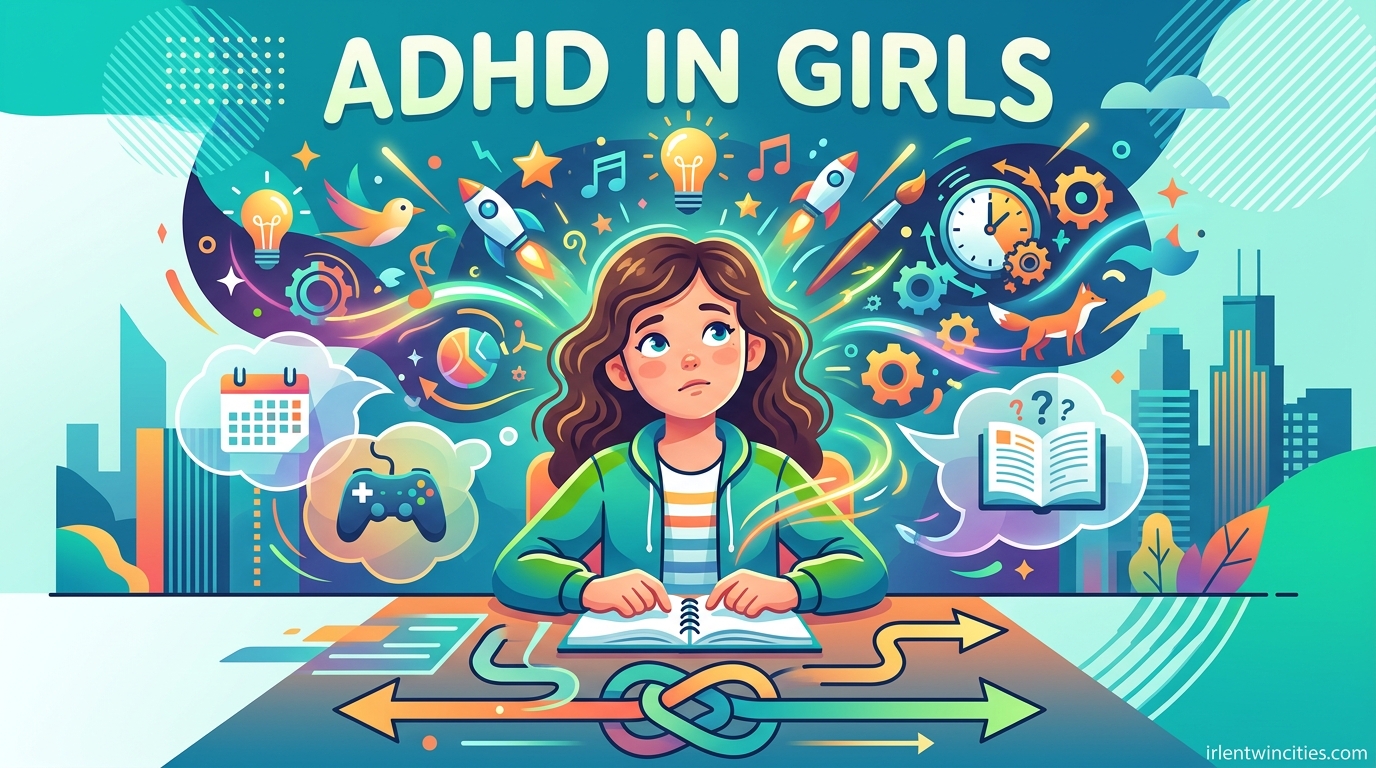
When I first learned about ADHD in girls, something clicked that I couldn’t quite articulate. All those years of feeling like I was working twice as hard as everyone else just to keep up, the constant mental fatigue, the shame of missing things that seemed so simple for others. Nobody had ever mentioned that girls experience ADHD differently. That the forgetfulness, the daydreaming, the overwhelming emotions, might not be character flaws at all.
If you’re a parent watching your daughter struggle, or a woman who has always felt like something was “off” but could never name it, this guide is for you. We’re going to walk through exactly why ADHD in girls so often gets missed for years, the specific signs to watch for, and what you can do about it. You are not imagining things, and you are not alone.
Table of Contents
Understanding the Gender Gap in ADHD Diagnosis
Here’s a number that stopped me when I first encountered it: only 6% of girls ages 3 to 17 have been diagnosed with ADHD, compared to 13% of boys the same age. That gap doesn’t reflect actual prevalence. It reflects diagnostic bias that has left millions of girls without the support they needed.
ADHD affects approximately 6 million young people in this country, and research consistently shows that the condition does not discriminate by gender. Yet our understanding of ADHD has been built primarily on studies of boys, who tend to display more overt hyperactive and impulsive symptoms. When I talk to adults who received late diagnoses, many describe the same pattern: they weren’t the “typical” ADHD kid bouncing off walls, so nobody thought to look deeper.
Girls are far more likely to present with inattentive ADHD, which looks like daydreaming, losing focus, failing to finish tasks, and seeming “spacey” rather than disruptive. This presentation is quieter, easier to dismiss, and far more likely to be attributed to personality traits rather than a neurodevelopmental condition. The result is years, sometimes decades, of struggling without understanding why.
Core Symptoms That Get Overlooked in Girls
When doctors and teachers think of ADHD, they often picture the hyperactive boy who can’t sit still. But the inattentive symptoms that girls typically experience are just as real and just as impactful. They just look different.
Daydreaming and Zoning Out
You might notice your daughter seeming to disappear into her own world. Teachers report that she stares out windows, loses track of conversations, or appears to be “somewhere else.” This isn’t laziness or rudeness. Her brain is literally struggling to maintain attention on things that don’t interest it strongly enough.
Forgetfulness and Lost Items
Forgetting assignments, losing track of personal items, or struggling with time management gets chalked up to being scatterbrained or disorganized. What parents and teachers often miss is that this forgetfulness isn’t volitional. The girl genuinely cares about these things, but her working memory makes it incredibly difficult to hold onto them.
Disorganization and Overwhelm
Many girls with undiagnosed ADHD carry immense mental load. They may be messy, have chaotic rooms, struggle to keep track of assignments, or appear overwhelmed by tasks that seem straightforward to others. This isn’t a motivation problem. It’s an executive function problem.
Internal Restlessness
Girls with ADHD often don’t show the physical restlessness we associate with the condition. Instead, they experience internal restlessness, a constant hum of mental activity they can’t turn off. They might feel like they have an “internal motor” running constantly.
Hyperfocus on Preferred Activities
Here’s one that confuses people: your daughter can focus intently for hours on things she loves, like drawing, reading, or video games. This is called hyperfocus, and it’s actually a hallmark of ADHD. The problem is that this intense focus only works for intrinsically rewarding activities, making it easy for others to dismiss her attention difficulties as selective.
Time Blindness and Chronic Lateness
Many girls with ADHD struggle to sense how much time is passing. They underestimate how long tasks take, run late consistently, and feel genuine panic when they realize they’ve lost track of time. This isn’t irresponsibility. It’s a neurological difficulty with time perception.
The Masking Phenomenon: How Girls Hide Their ADHD
This is where the biggest tragedy unfolds. Girls are socialized to be agreeable, helpful, and compliant. When they have ADHD, many instinctively develop sophisticated masking strategies that hide their struggles from everyone, including themselves. This is why so many women receive their diagnosis well into adulthood, often after years of thinking something was fundamentally wrong with them.
Perfectionism as Coping
Girls with ADHD frequently develop perfectionism as a survival strategy. If they can’t rely on innate ability, they’ll work twice as hard. They overprepare for tests, triple-check assignments, and become visibly anxious about making mistakes. Teachers often praise this effort, never realizing that it signals a deeper struggle. A girl who needs to study for eight hours to get an A isn’t lazy, but nobody flags her as potentially having ADHD.
People-Pleasing and Social Overcompensation
Social difficulties are common in ADHD girls, but many learn to mask them by becoming hyperaware of social cues. They become the “helper,” the person who always asks how others are feeling, the friend who remembers every birthday. This people-pleasing serves a dual purpose: it builds social capital and distracts others from noticing their underlying difficulties.
Overpreparation and Control
I’ve heard from women who would rewrite notes multiple times, arrive impossibly early to everything, or create elaborate organizational systems. This overpreparation is a compensation strategy, a way of controlling the chaos their brain creates. It works well enough that others see capability, not struggle.
The “High Functioning” Label
Perhaps the most damaging phrase for girls with ADHD is “high functioning.” This label implies that the person is fine, that their struggles must not be that serious if they can maintain good grades, hold conversations, and appear put-together. What it actually means is that the girl has developed such effective masking strategies that nobody recognizes how much energy she’s expending just to appear typical. Many women who identify as “high functioning” describe years of chronic exhaustion, anxiety, and eventual burnout.
Emotional Dysregulation: The Hidden Struggle
Emotional dysregulation is one of the most painful aspects of ADHD in girls, and it’s often the least discussed. The DSM doesn’t emphasize emotional symptoms in ADHD diagnostic criteria, but anyone who lives with or works with ADHD girls knows how central they are to the experience.
Mood Swings and Emotional Intensity
Girls with ADHD often experience emotions more intensely than their peers. Small disappointments can trigger profound sadness. Minor criticisms can lead to hours of rumination. These aren’t character flaws or dramatic tendencies. They’re neurological differences in how the ADHD brain processes and regulates emotion.
Crying Spells and Overwhelm
Many women I correspond with describe crying in the car after school or work, feeling unable to hold back tears at seemingly minor triggers. Parents describe daughters who become visibly distressed about things that seem inconsequential. What’s actually happening is emotional overflow, a genuine neurological inability to modulate emotional responses in the moment.
Rumination and Conversation Replay
After any social interaction that didn’t go perfectly, girls with ADHD often replay conversations for hours or days. They obsess over what they said, what the other person meant, whether they made a mistake. This rumination is related to working memory difficulties and the ADHD brain’s trouble letting go of unresolved social content.
The Mental Exhaustion of Emotional Overload
When your emotional responses are more intense and harder to regulate, every day requires more energy. Many girls with undiagnosed ADHD describe feeling emotionally exhausted by early afternoon, depleted by the effort of managing their inner world alongside school, friendships, and family expectations.
Age-Specific Signs of ADHD in Girls
ADHD presents differently across the lifespan. Understanding what to look for at each stage can help parents catch symptoms earlier.
Elementary School Age (6-11)
At this stage, girls may show consistent forgetfulness, losing homework or materials repeatedly. They might seem “in their own world” during class, have difficulty following multi-step instructions, and struggle to organize belongings. Many begin developing compensation strategies like excessive checking or seeking constant reassurance from teachers. Some girls become people-pleasers, prioritizing others’ needs to avoid criticism. The gifted child who works far harder than she should for good grades often hides inattentive ADHD at this age.
Middle School (12-14)
As academic demands increase, previously hidden struggles often surface. Girls may experience a marked drop in performance despite increasing effort. Social complexities multiply, and difficulties with peer relationships become more apparent. Many girls develop heightened self-awareness around this age, recognizing that they’re different from peers but not understanding why. Anxiety often begins or intensifies during this period as girls become more aware of their struggles without having language for them.
High School (15-18)
The transition to high school often proves a breaking point for many girls with undiagnosed ADHD. Increased independence, more complex academic requirements, and social pressures converge. Girls may procrastinate despite genuine intention to complete work, experience significant time blindness, and show declining grades despite consistent effort. Many develop serious self-esteem issues by this point, viewing themselves as lazy or broken. Eating disorders, self-harm, and anxiety disorders frequently co-occur during these years.
Adulthood
Many women receive their ADHD diagnosis in adulthood, often triggered by burnout, the demands of parenthood, or career challenges that exceed their compensation strategies. Adult women commonly report feeling constantly overwhelmed, unable to manage household responsibilities, struggling with time management, and experiencing intense emotional dysregulation. The late diagnosis often brings profound relief: finally understanding why everything felt so hard.
Co-occurring Conditions: Anxiety, Depression, and Eating Disorders
ADHD rarely travels alone. The brain differences that cause ADHD also increase vulnerability to other conditions, and for girls, these co-occurring diagnoses often mask the underlying ADHD for years.
Anxiety
Anxiety frequently develops in girls with ADHD as they grow older. The constant effort to appear normal, the chronic forgetfulness leading to criticism, and the neurological difficulty with emotional regulation create perfect conditions for anxiety. Many women describe decades of anxiety treatment before anyone suggested ADHD might be the root cause. The anxiety is real and deserving of treatment, but without addressing ADHD, it often persists despite therapy and medication.
Depression
Low self-esteem develops early in girls with ADHD. When you’re constantly being told to try harder, to pay attention, to remember things you genuinely cannot remember, you internalize the message that you’re lazy or broken. This chronic self-criticism frequently evolves into depression. Studies show that people with ADHD are at significantly higher risk for depression, and in girls, this connection is often overlooked.
Eating Disorders
The connection between ADHD and eating disorders is well-documented but rarely discussed. Girls with ADHD are at higher risk for binge eating disorder, bulimia, and anorexia. The reasons are complex: impulse control difficulties, dopamine-seeking behaviors, and the use of food restriction as a form of control in a life that feels chaotic. Many women with eating disorder histories later discover their ADHD was a driving factor nobody identified.
The Misdiagnosis Pattern
What concerns me most is how often girls receive treatment for anxiety, depression, or eating disorders without anyone investigating whether ADHD might be the underlying cause. This isn’t a criticism of mental health professionals. It’s a systemic blind spot that leaves many girls receiving incomplete treatment for years.
The 30% Rule for Executive Function
One of the most helpful concepts for understanding ADHD is the “30% rule.” Research suggests that executive functions in individuals with ADHD develop approximately 30% more slowly than in neurotypical peers. This means a 10-year-old with ADHD might have the executive function capabilities of a 7-year-old. A 16-year-old might function more like an 11-year-old in terms of executive control.
This isn’t an excuse or a limitation that can be overcome through discipline. It’s a neurological reality that affects planning, time management, working memory, emotional regulation, and impulse control. Understanding this helped many adults I work with stop viewing their struggles as moral failures and start seeing them as developmental differences requiring different strategies and accommodations.
The 30% rule also explains why girls who are intellectually capable often struggle significantly with practical daily tasks. They can understand calculus but can’t remember to turn in assignments. They can articulate complex thoughts but lose their phone five times a day. The discrepancy between verbal intelligence and executive function is a hallmark of ADHD in girls.
Getting Diagnosed: What Parents and Women Can Do
If recognition rings true for you or your daughter, the path forward starts with proper evaluation. Here’s what I recommend based on conversations with dozens of women who navigated late diagnosis.
Who to See
Look for a clinician experienced in ADHD, particularly in girls and women. This might be a psychiatrist, neuropsychologist, or developmental pediatrician. Avoid practitioners who dismiss ADHD based on academic performance alone; intelligence and ADHD coexist frequently, and good grades do not rule out the condition.
What to Expect
A comprehensive ADHD evaluation typically includes clinical interviews about current symptoms and childhood history, rating scales completed by multiple observers, and assessment of ruling out other conditions. For girls, it’s particularly important that the evaluator understands how ADHD presents differently in females, including the masking that often occurs.
Questions to Ask
Before your appointment, prepare a history of symptoms across multiple settings. Include examples of times when attention difficulties caused problems, how emotions have been harder to regulate than peers, and any compensation strategies you’ve noticed. For adult women, childhood examples are essential, as ADHD is a developmental condition that was present before it caused significant impairment.
Validating Your Experience
Whether you’re seeking diagnosis for your daughter or yourself, I want to name something important: your struggle is real. If you’ve spent years feeling broken, lazy, or inadequate, if you’ve worked harder than everyone around you just to achieve similar results, if you’ve hidden how much everything takes out of you, that exhaustion and difficulty are legitimate symptoms of a real condition. Diagnosis isn’t about finding an excuse. It’s about finding understanding and accessing appropriate support.
Frequently Asked Questions
What are the most overlooked signs of ADHD in girls?
The most overlooked signs include daydreaming and appearing zoned out, chronic forgetfulness despite caring deeply, disorganization and overwhelm with everyday tasks, internal restlessness rather than physical hyperactivity, hyperfocus on preferred activities, and time blindness causing chronic lateness. Girls often mask these symptoms through perfectionism and overcompensation, which is why they frequently go unrecognized.
What is the 30% rule for ADHD?
The 30% rule refers to the finding that executive functions in people with ADHD develop approximately 30% more slowly than in neurotypical individuals. A 10-year-old with ADHD may have the executive function capabilities of a 7-year-old. This explains why intellectually capable girls can struggle significantly with practical tasks like time management and organization.
How does ADHD get missed in girls?
ADHD gets missed in girls primarily because it typically presents as inattentiveness rather than hyperactivity, which is less disruptive and more easily dismissed. Girls also develop sophisticated masking strategies, using perfectionism and overcompensation to hide their struggles. Teachers and parents often see a hard-working, quiet girl rather than recognizing the neurological difficulties underneath.
How can ADHD go undetected for years?
ADHD can go undetected for years because girls learn to mask their symptoms from an early age. They develop compensatory strategies like overpreparation, people-pleasing, and excessive effort that hide their underlying difficulties. The high functioning label often applies, meaning others see capability rather than struggle. Many women only receive diagnosis in adulthood after years of chronic exhaustion and burnout.
Final Thoughts
Understanding ADHD in girls means recognizing that what looks like laziness is often exhaustion, what looks like carelessness is often executive function challenges, and what looks like a personality type is often a neurological condition requiring support. If you’ve spent your life feeling like you were failing at adulthood while working harder than everyone around you, that discrepancy between effort and outcome is a signal worth exploring.
Whether you’re seeking answers for your daughter or yourself, I encourage you to trust your instincts. The validation that comes with understanding your brain’s actual needs can be profound. Many women describe their late ADHD diagnosis as life-changing not because it gives them an excuse, but because it finally gives them a framework for understanding themselves and access to strategies that actually work.
You are not broken. You are not lazy. You are not incapable. Your brain works differently, and with the right understanding and support, you can learn to work with your ADHD rather than against it.