
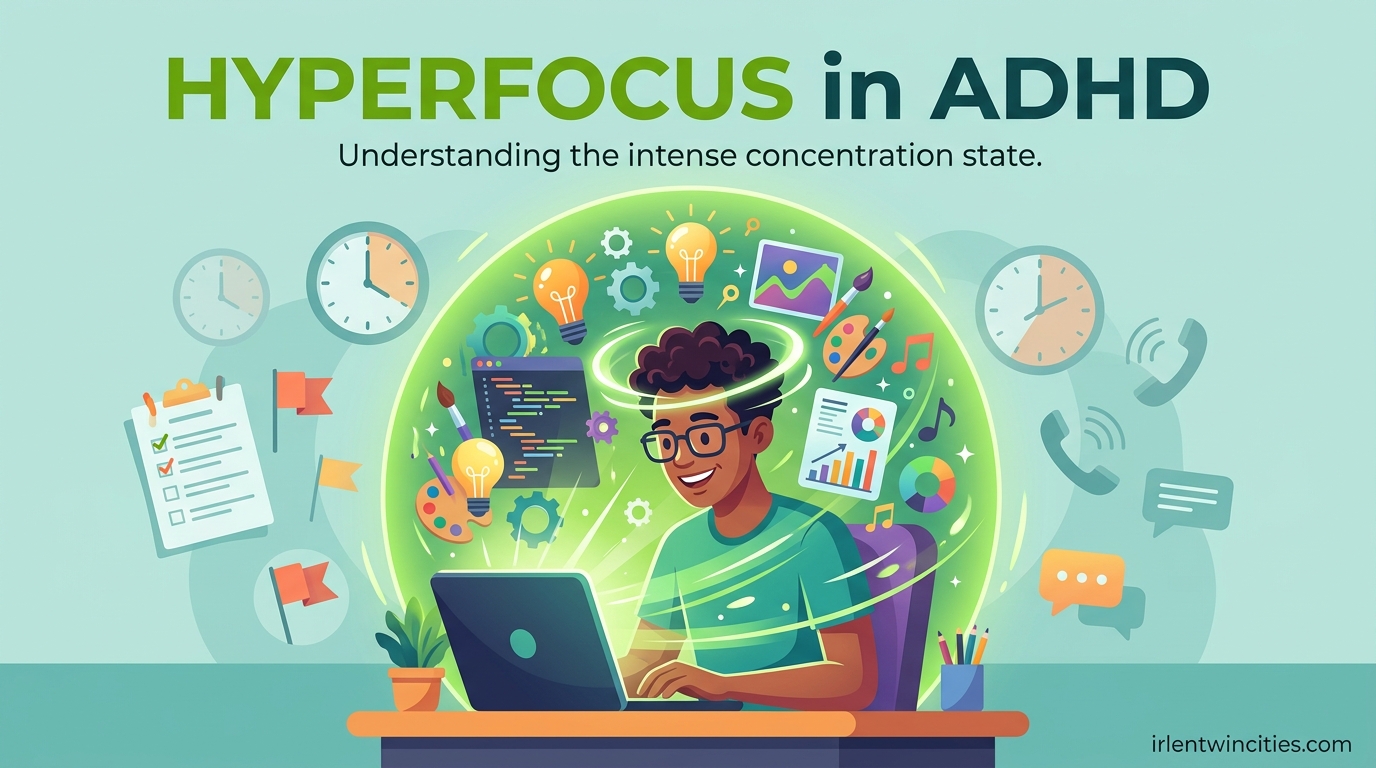
Is hyperfocus in ADHD a hidden superpower that lets you accomplish incredible things, or is it a trap that leaves you exhausted and missing deadlines? I have spent years researching ADHD and talking with hundreds of people who experience this phenomenon daily. The answer, like most things about the ADHD brain, is not simple.
Hyperfocus can feel like a magical state where time disappears and productivity soars. It can also feel like being trapped in a spell you cannot break, missing meals, ignoring loved ones, and waking up at 3 AM wondering where the day went. In this guide, we will explore both sides honestly so you can understand what hyperfocus really is, why it happens, and how to work with it rather than against it.
Table of Contents
What Is Hyperfocus in ADHD?
Hyperfocus is an intense state of concentration where a person becomes so absorbed in an activity that they lose awareness of time, surroundings, and basic needs. For people with ADHD, this is not just paying attention really hard. It is a fundamentally different mode of brain operation that can last for hours.
The experience often includes tunnel vision where nothing else exists except the task at hand. Sounds fade. Hunger disappears. Someone could stand next to you and you might not notice. This level of absorption is both the gift and the curse of the ADHD cognitive style.
The Experience of Hyperfocus
People describe hyperfocus in remarkably similar ways. It feels like falling into a different dimension where only the task matters. One software developer told me it is the only time his brain feels quiet. An artist described it as being fully alive. A student said she once wrote a 20-page paper in six hours without stopping.
Common symptoms and signs of hyperfocus include:
- Complete loss of time awareness – looking up to find four hours have passed
- Inability to hear when someone calls your name or enters the room
- Forgetting to eat, drink, or use the bathroom despite physical needs
- Physical tension from staying in one position too long
- Difficulty transitioning to a new task even when you want to
- Feeling irritable or disoriented when forced to stop
These symptoms can last anywhere from 30 minutes to 12 hours or more. Some people report entire days disappearing into hyperfocus on a video game, coding project, or creative pursuit.
Hyperfocus vs Hyperfixation
These terms get used interchangeably but they describe different experiences. Understanding the distinction matters for managing your attention.
Hyperfocus is task-based intense concentration. It happens when you are actively engaged in doing something. You might hyperfocus while painting, programming, playing a game, or writing. It is a state of absorption in the moment.
Hyperfixation is interest-based obsession with a topic, activity, or person. It can persist even when you are not actively engaged. You might think about your hyperfixation constantly, research it for hours, talk about it to anyone who will listen, and struggle to think about anything else.
The key difference is activity versus topic. Hyperfocus is about deep engagement in a task. Hyperfixation is about obsessive interest in a subject. Someone might hyperfixate on learning about a historical period and then hyperfocus while reading about it.
Both can be productive or problematic depending on context and control.
Hyperfocus vs Flow State
Flow state, popularized by psychologist Mihaly Csikszentmihalyi, describes a mental state of complete immersion in an activity with energized focus and enjoyment. It sounds similar to hyperfocus, and they do overlap.
The differences are important. Flow state typically involves a challenge-skill balance where the task is difficult enough to be engaging but not so hard it creates anxiety. Flow feels good. People seek flow deliberately.
Hyperfocus does not require this balance. It can happen during mindless activities like scrolling social media or playing simple mobile games. It often does not feel good. Many describe it as compulsive rather than enjoyable.
Flow state can be stopped when needed. Hyperfocus often resists interruption. The transition out of hyperfocus can feel physically and mentally uncomfortable in ways flow state does not.
When hyperfocus aligns with meaningful work and can be controlled, it resembles productive flow. When it locks onto low-value activities or cannot be disengaged, it becomes the trap many people with ADHD struggle against.
Why Do People with ADHD Hyperfocus?
The neuroscience behind hyperfocus reveals why it is so central to the ADHD experience. Understanding the mechanisms does not make it easier to control, but it does remove some of the shame and self-blame that many people carry.
The Dopamine Connection
ADHD brains differ in dopamine regulation. Dopamine is the neurotransmitter associated with motivation, reward, and pleasure. In typical brains, dopamine flows predictably in response to effort and achievement. In ADHD brains, dopamine regulation is inconsistent.
This creates what researchers call a dopamine deficiency state much of the time. Everyday tasks feel unrewarding. Starting mundane work feels physically difficult. The ADHD brain is constantly seeking stimulation that triggers dopamine release.
When an activity is inherently interesting, novel, or challenging, dopamine increases. The brain finally feels good. This creates a powerful pull toward continuing that activity. Hyperfocus is essentially the brain chasing the dopamine it has been missing.
Once locked into that dopamine-rewarding activity, the brain resists switching. Other tasks feel impossibly unappealing by comparison. This is not willpower failure. It is neurochemistry.
Executive Functioning and Attention Regulation
Executive functions are the brain processes that manage planning, prioritization, task switching, and impulse control. ADHD involves deficits in these areas. Attention regulation is one of the core executive functions affected.
Typical brains have an internal attention manager that shifts focus based on importance, urgency, and environmental cues. The ADHD brain lacks this manager. Attention either does not engage at all or locks on with too much force.
This creates the paradox of ADHD. You cannot focus on what you need to focus on, but you cannot stop focusing on what captures your interest. The same attention regulation system that fails to initiate focus also fails to terminate it appropriately.
Research from 2026 suggests that hyperfocus may be an adaptive response. When the brain cannot distribute attention flexibly, it compensates by going all-in on whatever activates the reward system. This is efficient for completing absorbing tasks but problematic for balanced living.
The Superpower Case: Benefits of Hyperfocus
Many people with ADHD fiercely defend hyperfocus as a genuine superpower. They are not wrong. When channeled appropriately, hyperfocus enables achievements that seem impossible to others.
Extraordinary Productivity
The most commonly cited benefit is sheer output. A programmer described completing a two-week project in 48 hours of sustained hyperfocus. A writer finished a novel draft in three weeks of intensive sessions. A student who struggled through semesters crammed entire courses into hyperfocus-powered weekends and passed.
This compressed productivity can create career advantages. Some industries, particularly tech and creative fields, value the ability to deliver exceptional work in short bursts. Several people told me they built entire careers around their capacity for hyperfocus on interesting problems.
The quality of hyperfocus work can also exceed normal standards. Without the constant task-switching and distraction typical of ADHD, the work produced during hyperfocus often shows depth, detail, and creativity that scattered efforts cannot match.
Creative Breakthroughs
Artists, musicians, writers, and designers frequently credit hyperfocus for their best work. The state allows sustained engagement with creative problems that normal attention cannot maintain. Solutions emerge from hours of uninterrupted exploration.
One painter told me her best pieces come from 6-hour hyperfocus sessions where she does not eat or speak. A composer described hearing entire symphonies during hyperfocus episodes. A game developer said his breakthrough mechanics always come from accidental hyperfocus while tinkering.
The creative benefits extend to problem-solving in technical fields. Engineers, scientists, and analysts report similar experiences of deep insight emerging from sustained hyperfocus on complex challenges.
Deep Learning and Skill Mastery
When hyperfocus locks onto learning, skill acquisition can be extraordinary. Language learners report intensive periods where they consume media, practice, and study for hours without feeling the usual resistance. Musicians describe similar experiences with instrument practice.
This intensity can compress years of casual learning into months. Someone might struggle with consistent 30-minute practice sessions but advance rapidly through occasional full-day hyperfocus marathons. The total hours matter less than the depth of engagement.
Many adults with ADHD have built impressive expertise through accumulated hyperfocus episodes. Their knowledge may be narrow but it runs deep. In a world of generalists, this specialist tendency can be genuinely valuable.
Real Stories from the Community
Forum discussions reveal how varied and powerful these experiences are. One person wrote, “Hyperfocus is the only time I feel truly myself. The rest of my life is waiting for the next hyperfocus episode.”
Another shared, “I built a successful business because I can code for 14 hours straight when I am interested. My neurotypical cofounders cannot match that intensity.”
A third said, “Yes it causes problems, but I would not give it up. My hyperfocus hours are the best part of my life. I have created things I am proud of because of it.”
These testimonials reveal something important. For many, hyperfocus is not merely a coping mechanism or compensation for ADHD deficits. It is a genuine cognitive strength that enables meaningful accomplishments.
The Trap Case: When Hyperfocus Becomes Problematic
For every person celebrating hyperfocus as a superpower, another describes it as a disabling trap. Both perspectives are valid. Understanding the risks is essential for managing this double-edged sword.
Lack of Control and Agency
The most painful aspect of hyperfocus for many is unpredictability. You cannot summon it when needed. It arrives unannounced and often at inconvenient times. The same person who hyperfocused through a deadline yesterday might stare blankly at the screen today.
This unpredictability makes planning difficult. Promises get broken. Commitments become uncertain. Professional reliability suffers even when capability is high. The superpower is unreliable.
Many describe feeling like a passenger in their own brain during hyperfocus. They want to stop but cannot. They need to transition to another task but feel physically stuck. The intensity becomes compulsive rather than chosen.
Time Blindness and Neglected Needs
The physical costs of hyperfocus accumulate silently. People report bladder infections from holding urine too long. Dehydration headaches after forgetting to drink water for hours. Back pain from maintaining rigid positions. Eye strain from unfocused screens.
One particularly harrowing forum story described someone who hyperfocused through chest pain, eventually requiring emergency medical care. The brain was so locked into the task that it suppressed even urgent bodily signals.
Sleep disruption is common. Late-night hyperfocus sessions lead to exhaustion the following day. Some people report entire sleep cycles destroyed by accidental all-nighters that felt like minutes.
Meals get skipped repeatedly. Social connections fray. Exercise disappears. The body accumulates damage while the mind remains absorbed elsewhere.
Relationship Strain and Social Impact
Partners and family members often experience hyperfocus as abandonment. A spouse might feel invisible for hours while their partner games, codes, or creates. Children describe parents who cannot hear them during hyperfocus episodes.
The social cost extends beyond intimate relationships. Friends get ignored. Messages go unanswered for days. Social obligations get forgotten. The person in hyperfocus might not even realize they have missed something important until later.
Several forum participants described relationship endings where hyperfocus was a contributing factor. Partners felt they could not compete with the absorbing power of the hyperfocus activity. They felt less important than a video game or coding project.
Hyperfocus Burnout
Intense hyperfocus extracts a recovery cost. After marathon sessions, many report a crash that includes physical exhaustion, emotional volatility, and mental fog. The superpower has a fuel tank, and when it empties, functioning becomes difficult.
This post-hyperfocus state can last hours or days. Some describe it as a hangover. Others compare it to the exhaustion after a panic attack. The intensity that powered achievement becomes a debt that must be paid.
Repeated cycles of hyperfocus and crash can create a boom-bust pattern in productivity and wellbeing. The highs are high but the lows are debilitating. Over months and years, this pattern can lead to chronic stress and health problems.
The Wrong Tasks Get Priority
Perhaps the most frustrating aspect of hyperfocus is that it rarely activates for important but boring tasks. The tax paperwork sits untouched while you research an obscure hobby for six hours. The deadline looms while you reorganize your digital photo collection.
This creates a painful gap between capability and achievement. You know you can focus intensely because you do it regularly. But you cannot direct that focus where it matters most. The brain chooses, not you.
Gaming and social media are particularly problematic traps. These platforms are engineered to trigger dopamine release, making them hyperfocus magnets. Important life maintenance becomes impossible while low-value consumption consumes days.
Understanding the Balance: It is Both
After examining both perspectives, the truth emerges clearly. Hyperfocus in ADHD is neither purely superpower nor purely trap. It is both simultaneously, and the balance shifts based on context, task, and your current life situation.
The Double-Edged Sword Reality
Scientific research increasingly supports this balanced view. Studies show that hyperfocus correlates with both exceptional achievement and significant functional impairment in different domains. The same cognitive pattern produces both outcomes.
This is not a contradiction. It is a feature of how the ADHD brain works. Intense, inflexible attention is powerful when aligned with valuable tasks. It is destructive when misaligned or uncontrollable.
Acknowledging both realities is important for self-concept. You are not failing when hyperfocus causes problems. You are not making excuses when you credit hyperfocus for successes. Both are true.
Context Matters
Hyperfocus behaves differently across life domains. In creative work or problem-solving, it often produces value. In relationship maintenance or routine self-care, it typically creates problems.
Work environments vary enormously. Some careers reward the hyperfocus pattern. Others punish it. Remote work has changed the equation for many, removing external structure that previously helped regulate attention.
Life stage affects hyperfocus impact. Students might thrive on hyperfocus for studying but struggle with time management. Parents find hyperfocus particularly challenging when children need attention. Retirement might bring more freedom to use hyperfocus positively.
Individual Variation
Not everyone with ADHD experiences hyperfocus. Research suggests roughly 60-70% of adults with ADHD report significant hyperfocus episodes. Among those who do, intensity and frequency vary widely.
Some people hyperfocus daily. Others experience it only during high-stress periods or specific mood states. Medication affects it differently for different people. Some find stimulants reduce hyperfocus by normalizing attention. Others find medication makes hyperfocus more controllable.
Comorbid conditions change the experience. Anxiety can amplify hyperfocus as an avoidance strategy. Depression might suppress it entirely. Autism can create different patterns of intense focus with distinct characteristics.
Your hyperfocus is yours. Comparing your experience to others, whether to celebrate or condemn it, misses the point. The question is whether your pattern works for your life.
How to Manage and Harness Hyperfocus
While you cannot fundamentally change how hyperfocus works, you can develop strategies to work with it more effectively. These approaches come from both research and lived experience in the ADHD community.
Strategies for Breaking Out When Needed
Setting multiple alarms with different sounds can pierce hyperfocus. Place one alarm across the room so physical movement is required. Some people use smart lights that change color as a cue.
Accountability partners can help. Tell someone when you are starting a hyperfocus-prone activity and ask them to check on you at a specific time. External accountability works better than internal intentions during hyperfocus.
Physical cues are powerful. Set a full glass of water where you will knock it over if you stay too long. The spill creates an interruption that breaks the spell. Some use hunger as a timer by not eating before starting, ensuring biology will eventually intervene.
Transition rituals help. Create a specific sequence that signals the end of hyperfocus time. Five minutes of stretching, a specific playlist, or a brief walk can help the brain shift modes more smoothly.
Tips for Triggering Productive Hyperfocus
While you cannot guarantee hyperfocus, you can increase the odds. Interest is the primary trigger. Find the aspect of a boring task that interests you most and start there. Novelty helps. Change your environment, tools, or approach to create freshness.
Challenge level matters. Tasks that are slightly too hard for normal focus often trigger hyperfocus. Gamify boring work by adding artificial constraints or scoring systems.
Environmental design supports hyperfocus. Remove distractions before starting. Use website blockers. Put your phone in another room. Create conditions where the only interesting thing available is your target task.
Body doubling, where you work alongside others, can sometimes induce productive hyperfocus. The presence of others provides enough external stimulation to satisfy the ADHD brain while allowing focus on the task.
Preventing Burnout
Schedule recovery after expected hyperfocus episodes. Block the following day for lighter tasks. Plan extra sleep. Stock healthy food that requires no preparation.
Hydration and nutrition during hyperfocus make a significant difference. Keep water and easy snacks within arm’s reach before starting. Set a recurring hourly alarm specifically for sipping water.
Physical movement between hyperfocus sessions reduces the physical toll. Even five minutes of stretching helps. Some people use standing desks or treadmill desks to maintain blood flow during long sessions.
Know your limits. Track how long you can hyperfocus before the crash becomes severe. Respect that limit even when it feels like you could continue. The cost comes due eventually.
Frequently Asked Questions
Is ADHD hyperfocus a superpower?
Hyperfocus can act as a superpower when it enables extraordinary productivity, creative breakthroughs, or rapid skill acquisition on meaningful tasks. However, it becomes problematic when uncontrollable, directed at low-value activities, or causing neglect of basic needs and relationships. Most experts and people with ADHD agree it is both – a genuine strength in some contexts and a significant challenge in others.
What is the 30% rule of ADHD?
The 30% rule suggests that people with ADHD typically demonstrate emotional and cognitive maturity approximately 30% below their chronological age. This means a 20-year-old with ADHD might function more like a 14-year-old in certain areas of executive functioning and emotional regulation. It helps explain why ADHD hyperfocus patterns might persist longer into adulthood than expected.
What does ADHD hyperfocus look like?
ADHD hyperfocus appears as intense, prolonged concentration where the person loses awareness of time, surroundings, and bodily needs. They may not respond when spoken to, forget to eat or use the bathroom, maintain rigid physical positions for hours, and experience difficulty transitioning to new tasks even when necessary. The activity can be productive work or unproductive scrolling, depending on what has captured their attention.
How long can ADHD hyperfocus last?
ADHD hyperfocus episodes typically last between 2 to 12 hours, though durations vary widely. Some people experience brief 30-minute hyperfocus sessions while others report marathon sessions lasting 16 hours or more. The length depends on the activity’s dopamine-rewarding properties, environmental interruptions, and physical needs eventually breaking through the mental absorption.
What is the 24 hour rule for ADHD?
The 24 hour rule for ADHD suggests waiting a full day before responding to emotionally charged situations or making important decisions. This accounts for the emotional dysregulation and impulsivity common in ADHD. It gives time for emotions to settle and executive functioning to recover before taking action that might have lasting consequences.
Can you control hyperfocus?
Complete control over hyperfocus is not possible for most people with ADHD, as it is driven by neurochemical processes involving dopamine regulation. However, you can influence it through environmental design, interest-based task selection, alarms and accountability systems, and medication. The goal is usually management and redirection rather than total control.
Does medication affect hyperfocus?
Stimulant medications affect hyperfocus differently for different people. Some find that medication reduces hyperfocus by normalizing their attention regulation, making focus more controllable but less intense. Others report that medication makes hyperfocus more predictable and easier to direct toward chosen tasks. Non-stimulant medications may have different effects. Individual response varies significantly.
Final Thoughts
Hyperfocus in ADHD is neither purely superpower nor purely trap. It is a cognitive pattern with genuine benefits and real costs that vary based on context, control, and life circumstances. Understanding this balance is the first step toward working with your brain rather than against it.
The goal is not to eliminate hyperfocus or celebrate it uncritically. The goal is awareness. Notice when hyperfocus serves you and when it harms you. Develop strategies to extend the benefits and limit the damage. Build a life that accommodates your cognitive style while meeting your responsibilities.
If you recognize yourself in this article, consider speaking with a mental health professional who understands ADHD. Medication, therapy, and coaching can all help manage hyperfocus patterns. Community matters too. Connecting with others who share this experience reduces isolation and builds practical knowledge.
Your hyperfocus is part of how your brain works. Learn to use it wisely.