
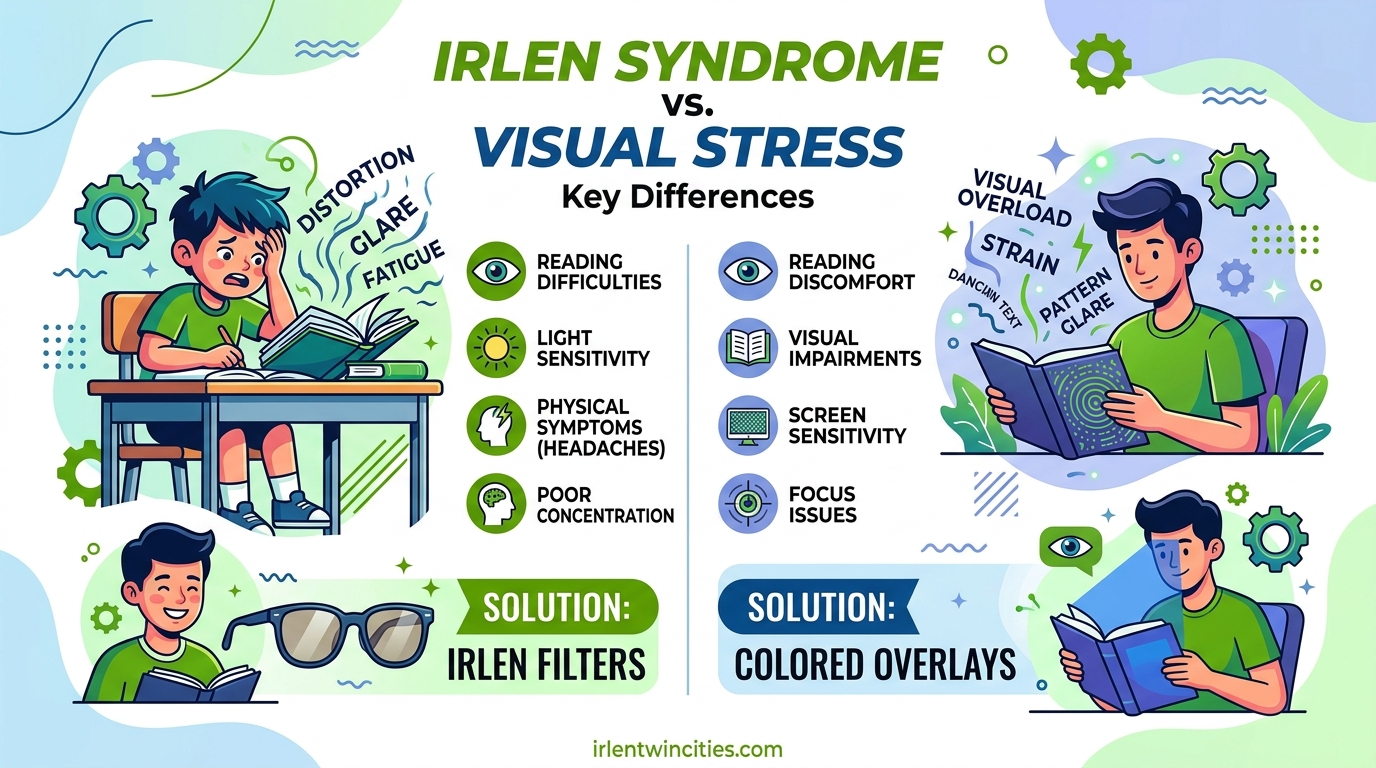
Are Irlen Syndrome and visual stress the same thing? Yes, they are essentially the same perceptual processing disorder with different naming conventions. Irlen Syndrome and visual stress describe the same underlying condition where the brain struggles to process visual information correctly, particularly when reading. The difference is mainly geographical and historical: Irlen Syndrome is the preferred term in the United States and Australia, while visual stress is the clinical term commonly used in the United Kingdom and Europe.
If you have experienced headaches while reading, words that appear to move on the page, or eye strain despite having normal vision test results, this guide will help you understand what these terms mean and why they matter for your daily life. Many people spend years frustrated because standard eye exams show perfect vision, yet reading remains uncomfortable or exhausting.
Table of Contents
What Is Irlen Syndrome?
Irlen Syndrome is a perceptual processing disorder characterized by the brain’s difficulty interpreting visual information, specifically light and contrast patterns. Your eyes may be completely healthy, yet your brain processes what you see in a way that causes discomfort, fatigue, and distortions. This condition was first identified and described by Helen Irlen in the early 1980s, giving the syndrome its current name.
The condition affects approximately 12-14% of the general population according to Irlen Institute research, though estimates vary across studies. For people with Irlen Syndrome, certain visual patterns trigger symptoms, with printed text being one of the most common triggers. The high contrast between black text on white paper creates visual stress that the brain struggles to manage.
What makes Irlen Syndrome particularly challenging is that it often goes undiagnosed for years. Standard vision tests measure eye health and visual acuity, but they do not test for perceptual processing problems. A person with 20/20 vision can still have significant Irlen Syndrome symptoms that make reading a daily struggle. The brain’s inability to filter specific wavelengths of light effectively leads to the characteristic symptoms.
What Is Visual Stress?
Visual stress is the term preferred by UK and European clinicians to describe the same condition known as Irlen Syndrome in other parts of the world. The UK-based Visual Stress Association and many NHS practitioners use this term when diagnosing and treating patients with pattern-related visual difficulties. In clinical and research frameworks across the UK, visual stress has become the standard terminology.
The term specifically emphasizes the stress that certain visual patterns place on the brain’s processing systems. Pattern glare from stripes, high-contrast text, and repetitive visual elements can trigger symptoms in susceptible individuals. Visual stress highlights that this is not a problem with the eyes themselves but rather with how the visual cortex processes information.
When healthcare providers in the UK discuss reading difficulties related to visual perception, they increasingly use visual stress rather than older terms. This shift reflects a broader move toward descriptive terminology that explains what is happening functionally rather than naming the condition after its discoverer. Both terms describe the same perceptual processing challenges and respond to the same treatments.
Irlen Syndrome vs Visual Stress: Understanding the Terminology
The different names for this condition reflect historical discovery, regional preferences, and evolving clinical understanding. Understanding why these terms exist helps when researching symptoms or seeking diagnosis and treatment across different healthcare systems. Here is how the terminology breaks down:
| Term | Region/Usage | Notes |
|---|---|---|
| Irlen Syndrome | United States, Australia | Named after Helen Irlen who identified the condition in 1980 |
| Visual Stress | United Kingdom, Europe | Preferred clinical term in NHS and UK educational settings |
| Meares-Irlen Syndrome | International (older usage) | Recognizes both Olive Meares and Helen Irlen’s contributions |
| Scotopic Sensitivity Syndrome | Historical/Older literature | Early name now largely replaced |
| MISViS | Medical/academic | Acronym for Meares-Irlen Syndrome/Visual Stress |
The regional differences can create confusion for people researching their symptoms online. Someone in the UK searching for Irlen Syndrome may not realize that local NHS services use the term visual stress. Conversely, Americans researching visual stress may not connect it to the extensive Irlen Syndrome resources available in the US. The conditions, symptoms, and treatments are identical regardless of which term is used.
Medical literature increasingly uses MISViS as a technical acronym that encompasses both naming traditions. This approach acknowledges the historical contributions of both Olive Meares, who first described symptoms in 1980, and Helen Irlen, who developed the colored lens treatment method. EyeWiki, the ophthalmology reference, uses MISViS specifically to bridge the terminology gap.
Other Names for Irlen Syndrome
Beyond the two main contemporary terms, this condition has accumulated several names over the decades as understanding has evolved. These historical names still appear in older literature and may be used by healthcare providers trained in earlier decades.
Scotopic Sensitivity Syndrome
Scotopic Sensitivity Syndrome was one of the earliest names given to this condition, referencing the scotopic visual system that handles low-light vision. Early researchers theorized that the problem involved the rod-dominated scotopic system functioning inappropriately in daylight conditions. While this specific theory has been refined over time, the name stuck in early Irlen Institute literature.
Meares-Irlen Syndrome
Meares-Irlen Syndrome recognizes that New Zealand teacher Olive Meares independently described similar symptoms and the benefits of colored overlays in 1980. Helen Irlen began her work around the same time, developing a more comprehensive diagnostic and treatment protocol. The combined name honors both pioneers who identified this perceptual processing problem.
Pattern-Related Visual Stress
Some specialists use this more descriptive term to emphasize that specific visual patterns trigger the symptoms. This name focuses on the trigger rather than the underlying neurological cause. Pattern glare from stripes, high-contrast edges, and repetitive visual elements characterizes the condition for diagnostic purposes.
Symptoms of Irlen Syndrome and Visual Stress
Recognizing the symptoms is the first step toward getting help. The signs of Irlen Syndrome and visual stress extend beyond simple reading difficulties and can affect multiple aspects of daily life. If you experience several of these symptoms, a professional screening may be worthwhile.
Reading and Perceptual Symptoms
Words appearing to move, shimmer, or float on the page is one of the most reported symptoms. Letters may seem to change size, swap positions, or create after-images that persist when you look away. Some people describe rivers of white running through text, halos around words, or the text appearing to fade in and out. Reading for extended periods becomes exhausting despite having normal vision.
Many people with this condition report that reading black text on white paper is particularly problematic. The high contrast creates visual stress that builds up over time. Some find that reading speed is significantly slower than their verbal comprehension would suggest, creating frustration in academic or professional settings.
Physical Symptoms
Headaches during or after reading are extremely common, often starting at the front of the head or behind the eyes. Eye strain, fatigue, and a general sense of visual tiredness can develop quickly when looking at printed materials or screens. Some people experience nausea or dizziness when exposed to certain visual patterns for extended periods.
Sensitivity to bright lights, glare, and fluorescent lighting represents another major symptom category. Many people with Irlen Syndrome find fluorescent tube lights particularly uncomfortable, leading to headaches and fatigue in offices or classrooms with this lighting. Sunlight reflecting off surfaces like snow, water, or white cars can also trigger symptoms.
Behavioral and Attention Symptoms
Difficulty concentrating when reading, frequent loss of place, and the need to reread passages multiple times are common. Some people develop avoidance behaviors around reading, unconsciously finding reasons to postpone tasks that involve extended text exposure. Children may be misdiagnosed with attention disorders when the underlying issue is actually visual stress.
Self-Assessment Indicators
Ask yourself these questions based on real experiences shared by people with Irlen Syndrome and visual stress. Do you find yourself rubbing your eyes frequently when reading even though your vision test is normal? Does reading in dim light feel more comfortable than bright light, contrary to what most people prefer? Do white backgrounds on computer screens or paper feel uncomfortably bright?
Have you ever noticed that text appears clearer when viewed through a colored transparency or sunglass lens? Do you struggle with stairs, sports, or judging distances in ways that seem different from others? These self-assessment indicators, drawn from forum discussions and patient reports, can suggest whether professional screening would be valuable.
Is Irlen Syndrome Real? Understanding the Controversy
Despite decades of research and countless patient reports, Irlen Syndrome and visual stress remain controversial in some medical circles. Understanding this debate helps you have informed conversations with healthcare providers and make decisions about pursuing treatment. The controversy does not mean the condition is imaginary, but rather reflects ongoing scientific discussion about mechanisms and measurement.
The Skeptical Perspective
Some ophthalmology organizations, particularly in the United States and Australia, have expressed skepticism about Irlen Syndrome as a distinct clinical entity. Critics point to mixed results in controlled studies, questioning whether colored lenses provide benefits beyond placebo effects. Some argue that symptoms attributed to Irlen Syndrome are better explained by other conditions like convergence insufficiency, dyslexia, or migraine aura.
A 2004 position statement by the American Academy of Ophthalmology raised concerns about the scientific evidence supporting Irlen lenses. Some controlled trials have found that while patients often report subjective improvement, objective measures of reading speed and accuracy do not always show statistically significant gains. This has led some professionals to dismiss the condition entirely.
The Supporting Evidence
Other research supports the existence of visual stress as a real perceptual phenomenon. Brain imaging studies have shown differences in how the visual cortex processes information in people with Irlen Syndrome symptoms. fMRI research published in peer-reviewed journals has identified neurological differences that correlate with symptom reports.
The mechanism most commonly proposed involves the magnocellular and parvocellular pathways in the visual system. These pathways process different aspects of visual information, and imbalances between them may contribute to the perceptual distortions reported. The lateral geniculate nucleus, which relays visual information to the cortex, shows differences in some studies of people with visual stress.
A Balanced View
As with many conditions at the intersection of neurology and perception, the evidence is complex. Individual responses to colored lenses vary significantly, suggesting that if Irlen Syndrome exists, it may represent a spectrum rather than a single uniform condition. Some people experience dramatic improvements with colored overlays, while others notice minimal change.
The controversy matters because it affects insurance coverage, educational accommodations, and how seriously symptoms are taken by employers and educators. Many people report feeling dismissed when describing their symptoms to skeptical healthcare providers. Finding professionals familiar with the condition, whether through the Irlen Institute network or UK visual stress specialists, can make a significant difference in getting appropriate help.
How Irlen Syndrome Relates to Dyslexia and ADHD
Understanding how Irlen Syndrome differs from and relates to conditions like dyslexia and ADHD is essential for proper diagnosis and treatment. These conditions can co-occur, meaning someone might have both Irlen Syndrome and dyslexia, but they are distinct issues requiring different interventions.
Irlen Syndrome vs Dyslexia
Irlen Syndrome is not dyslexia, though the two conditions can and often do exist together. Dyslexia is a language-based learning disability affecting phonological processing, word decoding, and reading comprehension at the linguistic level. Irlen Syndrome, by contrast, is a visual-perceptual problem that makes the physical act of looking at text uncomfortable regardless of language processing ability.
Someone with pure Irlen Syndrome may understand language perfectly but struggle to read because of visual distortions. Colored overlays or lenses may help them read comfortably while doing nothing for someone with pure dyslexia. However, research suggests that up to 30% of people with dyslexia also have visual stress symptoms that overlay treatment may help address.
The distinction matters for educational support. Dyslexia interventions focus on phonics, multisensory learning, and reading strategies. Irlen Syndrome interventions focus on reducing visual stress through color, lighting modifications, and reading environment adjustments. Getting the right diagnosis ensures the right support.
Connection to ADHD
Irlen Syndrome can mimic or overlap with attention-deficit symptoms in significant ways. When reading causes headaches, eye strain, and visual distortions, anyone would struggle to maintain focus. Children particularly may appear inattentive or hyperactive when actually reacting to visual discomfort. Some parents report that their child’s “ADHD behaviors” improve dramatically after Irlen treatment.
That said, Irlen Syndrome is not ADHD, and many people have both conditions independently. The attention difficulties caused by visual stress are situational, typically appearing during reading or screen use rather than across all activities. True ADHD involves broader executive function challenges. Proper assessment can distinguish between visual stress affecting attention and primary attention disorders.
Treatment Options for Irlen Syndrome and Visual Stress
Several treatment approaches can help manage Irlen Syndrome and visual stress symptoms. While there is no cure that eliminates the underlying perceptual processing difference, proper management can dramatically improve comfort and reading ability.
Colored Overlays
Colored overlays are transparent plastic sheets placed over reading material to reduce the high contrast between text and background. Many people find immediate relief with the right color. Overlays are the most affordable first step and can help determine whether color might help before investing in tinted lenses.
Precision-Tinted Lenses
Irlen Spectral Filters are precision-tinted lenses created through a detailed color assessment process. Unlike standard colored sunglasses, these lenses are customized to the individual’s specific color needs for reading comfort. The assessment involves testing multiple color combinations to find the optimal tint that reduces perceptual distortions.
These lenses must be obtained through certified Irlen screeners or diagnosticians who conduct the comprehensive color assessment. While expensive and not typically covered by insurance, many users report significant quality of life improvements.
Environmental Modifications
Simple changes can reduce visual stress without specialized equipment. Using natural lighting or warm-toned LED bulbs instead of fluorescent lighting helps many people. Printing on colored paper rather than white, adjusting screen backgrounds to softer colors, and taking regular visual breaks during reading tasks can all reduce symptoms.
Some people find that larger text sizes reduce the pattern glare that triggers symptoms. E-readers with adjustable backgrounds and contrast settings may be more comfortable than traditional books. Experimenting with these environmental factors costs little and may provide meaningful relief.
FAQ
Is visual stress the same as Irlen Syndrome?
Yes, visual stress and Irlen Syndrome are essentially the same condition with different names. Irlen Syndrome is the term commonly used in the United States and Australia, while visual stress is the preferred clinical term in the United Kingdom and Europe. Both describe a perceptual processing disorder where the brain struggles to interpret visual information, particularly when reading.
What is another name for Irlen Syndrome?
Irlen Syndrome has several alternative names including visual stress, Meares-Irlen Syndrome, Scotopic Sensitivity Syndrome, and MISViS (Meares-Irlen Syndrome/Visual Stress). The historical name Scotopic Sensitivity Syndrome is now less commonly used, while Meares-Irlen Syndrome recognizes both Olive Meares and Helen Irlen who independently identified the condition.
Is Irlen linked to ADHD?
Irlen Syndrome is not the same as ADHD, but the two can overlap and Irlen symptoms can mimic attention difficulties. When reading causes headaches, eye strain, and visual distortions, maintaining focus becomes difficult. Some children diagnosed with ADHD may actually have undiagnosed visual stress affecting their attention during reading tasks. However, many people have both conditions independently.
Is Irlen Syndrome considered a disability?
Whether Irlen Syndrome is considered a disability depends on context and severity. In the UK, visual stress may be covered under the Equality Act 2010 if it substantially impacts daily activities. In educational and workplace settings, it is often recognized as a condition requiring accommodations such as colored overlays, adjusted lighting, or extended time for reading tasks. However, medical and legal recognition varies by region and specific circumstances.
What is Meares-Irlen Syndrome?
Meares-Irlen Syndrome is another name for the same condition as Irlen Syndrome and visual stress. The name recognizes both Olive Meares, a New Zealand teacher who first described similar symptoms in 1980, and Helen Irlen, an American researcher who developed the colored lens treatment method around the same time. The combined name honors both pioneers who independently identified this perceptual processing disorder.
Can visual stress cause dyslexia?
Visual stress does not cause dyslexia, but the two conditions can co-occur and visual stress can complicate reading difficulties. Dyslexia is a language-based learning disability affecting phonological processing, while visual stress is a visual-perceptual problem. Research suggests up to 30% of people with dyslexia also have visual stress symptoms. Treating visual stress with colored overlays or lenses may improve reading comfort even when dyslexia is also present.
Conclusion
Irlen Syndrome vs visual stress is not a question of different conditions but rather different names for the same perceptual processing disorder. Whether your healthcare provider uses the American-preferred Irlen Syndrome, the UK-preferred visual stress, or the historical Meares-Irlen Syndrome, they are describing the same underlying issue: a brain that struggles to process certain visual patterns comfortably.
If you recognize the symptoms described in this guide, consider seeking professional screening, particularly if standard eye exams have not explained your reading difficulties. The Irlen Institute maintains a network of certified screeners internationally, while UK residents can seek visual stress assessment through NHS services or specialist optometrists. Understanding that these terms describe the same condition can help you navigate resources across different countries and healthcare systems.
While controversy exists in the medical community, the real-world experiences of people who find relief through colored overlays, tinted lenses, and environmental modifications speak to the validity of their symptoms. Whether you call it Irlen Syndrome or visual stress, the discomfort is real, and help is available.