
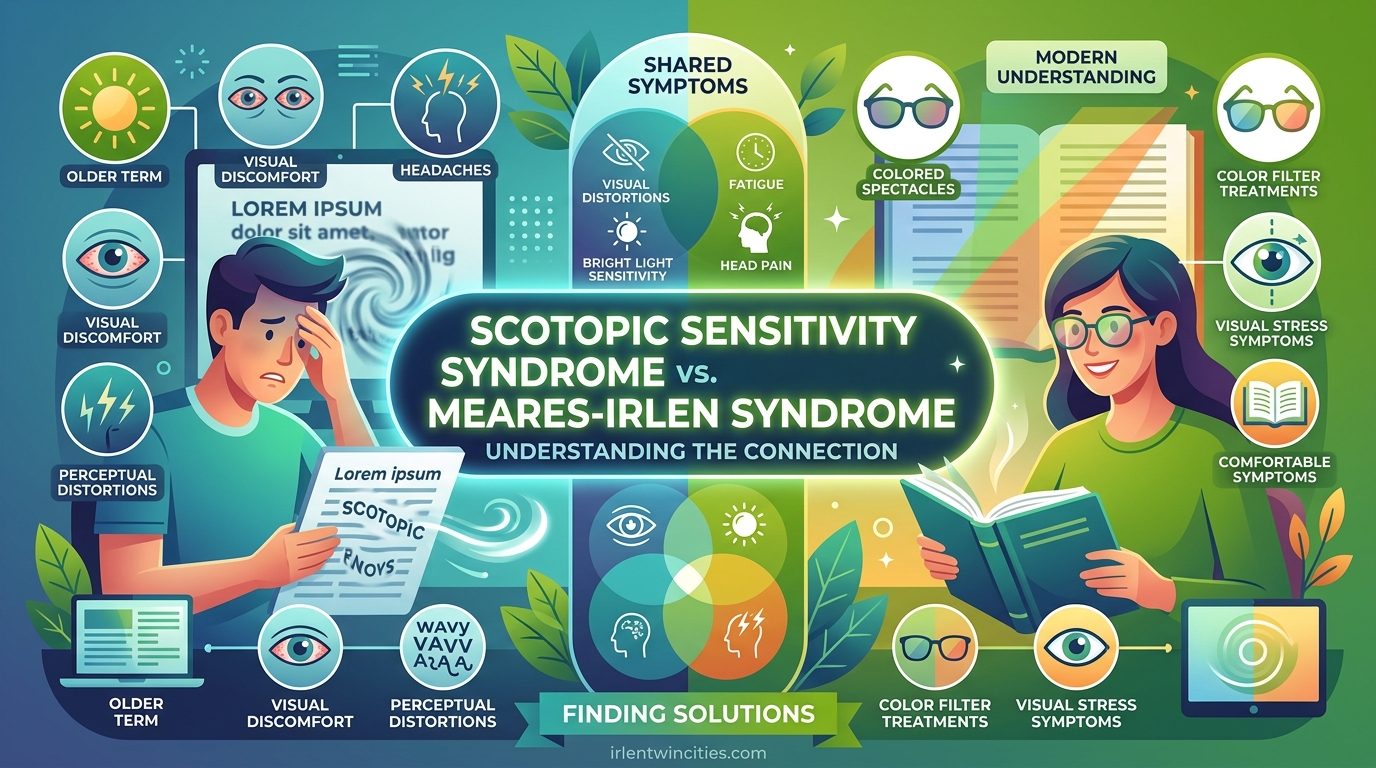
Scotopic Sensitivity Syndrome and Meares-Irlen Syndrome are the same visual processing condition with different names. This creates confusion for patients, parents, and educators seeking help for reading difficulties and light sensitivity. Understanding the relationship between these terms helps you navigate diagnosis and treatment more effectively.
Our team at Irlen Twin Cities has helped hundreds of individuals understand these terminology differences since 2026. In this guide, we explain the history, compare the terms, and show you what matters most for getting proper support.
Table of Contents
Understanding the Terminology Landscape
Multiple names exist for this visual processing disorder. Each term reflects different aspects of discovery, geography, and clinical approach.
The five main terms you will encounter are Scotopic Sensitivity Syndrome, Meares-Irlen Syndrome, Irlen Syndrome, Visual Stress, and MISViS. These all describe the same neurological condition where the brain struggles to process visual information correctly.
| Term | Origin | Common Usage | Key Characteristics |
|---|---|---|---|
| Scotopic Sensitivity Syndrome | Helen Irlen, 1983 | Historical/Early literature | Original name based on scotopic vision theory |
| Meares-Irlen Syndrome | Combined attribution | UK and academic sources | Acknowledges both Meares and Irlen |
| Irlen Syndrome | Irlen Institute | US and practitioner community | Current preferred term in North America |
| Visual Stress | Arnold Wilkins | UK and Europe | Broader term, includes light sensitivity |
| MISViS | Medical abbreviation | Clinical documentation | Meares-Irlen Syndrome/Visual Stress |
This table shows how the same condition carries different labels depending on who you talk to and where you live. The symptoms remain identical regardless of which name your doctor uses.
The History Behind the Names
The story begins with two researchers working independently on opposite sides of the world. Both discovered that certain individuals experience significant visual discomfort when reading that could not be explained by standard vision tests.
Olive Meares and the 1980 Discovery
Olive Meares was a schoolteacher in New Zealand who first documented these symptoms in 1980. She noticed that some of her students complained about text appearing to move, blur, or shimmer on the page despite having normal eyesight.
Meares found that these students often experienced headaches, eye strain, and fatigue when reading. She described the condition in educational journals, bringing attention to what she called “pattern glare sensitivity.” Her work laid the foundation for understanding visual processing difficulties unrelated to acuity problems.
Her observations focused primarily on educational settings and reading difficulties. She noted that students with these symptoms often avoided reading and showed poor comprehension despite adequate intelligence.
Helen Irlen and the Irlen Method
Helen Irlen, an educational psychologist in California, independently identified similar symptoms in 1983. Working with adult college students who struggled with reading, she discovered that colored overlays and filters significantly reduced their visual discomfort.
Irlen developed a systematic method for identifying the specific color wavelengths that helped each individual. She originally called the condition Scotopic Sensitivity Syndrome, believing the difficulties related to processing light within the scotopic range of vision.
Her work led to the creation of the Irlen Method, a proprietary diagnostic and treatment protocol. The Irlen Institute, founded in [cy-41], continues to train diagnosticians worldwide and uses the term Irlen Syndrome as their preferred designation.
Evolution of Terminology Over Time
The terminology has shifted significantly since the 1980s. Understanding this timeline helps explain why so many names exist today.
- 1980: Olive Meares publishes her observations about pattern glare sensitivity in New Zealand educational journals.
- 1983: Helen Irlen identifies Scotopic Sensitivity Syndrome and begins developing colored filter treatments in California.
- 1980s-1990s: Both researchers work independently with minimal cross-communication.
- 1990s: Medical community begins using Meares-Irlen Syndrome to acknowledge both contributors.
- 1990s-2000s: Research by Arnold Wilkins in the UK introduces “Visual Stress” as a broader term.
- 2000s-present: Irlen Syndrome becomes the dominant term in North America, while Visual Stress prevails in the UK.
- 2026: MISViS emerges as clinical shorthand for Meares-Irlen Syndrome/Visual Stress.
This evolution shows how scientific understanding develops through multiple contributors across different regions and time periods.
Scotopic Sensitivity Syndrome vs Meares-Irlen Syndrome: What’s the Difference?
Scotopic Sensitivity Syndrome and Meares-Irlen Syndrome describe the exact same condition. The difference lies entirely in naming conventions and geographic preference rather than any medical distinction.
Scotopic Sensitivity Syndrome was Helen Irlen’s original term based on her theory about scotopic vision processing. Meares-Irlen Syndrome emerged later as a way to recognize both Olive Meares and Helen Irlen’s contributions to understanding the condition.
The symptoms, diagnostic criteria, and treatment approaches remain identical regardless of which term you encounter. Both describe a neurological condition where the brain struggles to process visual information, particularly high-contrast patterns like black text on white paper.
Geographic Terminology Differences
Where you live significantly affects which terminology you will encounter. Understanding these regional preferences helps when researching information or seeking diagnosis.
In the United States, Canada, and Australia, Irlen Syndrome dominates. The Irlen Institute’s extensive training programs and marketing have made this the most recognized term in North America. Practitioners trained by the Irlen Institute almost exclusively use this terminology.
In the United Kingdom, Ireland, and much of Europe, Visual Stress is more commonly used. This term, popularized by researcher Arnold Wilkins, encompasses a broader range of light sensitivity issues beyond just reading difficulties. Meares-Irlen Syndrome also appears frequently in UK medical literature.
In New Zealand and Australia, you may still encounter references to Meares’ original work, though Irlen Syndrome has largely superseded it in clinical practice.
Why the Names Differ
Several factors contribute to the persistent multiplicity of names for this single condition. These include attribution preferences, branding considerations, and clinical utility.
The Irlen Institute maintains Irlen Syndrome as their preferred term because it connects directly to their proprietary diagnostic method and colored filter products. This creates brand recognition and distinguishes their specific approach from other practitioners.
Academic and medical communities often prefer Meares-Irlen Syndrome or Visual Stress because these terms remain neutral and do not imply endorsement of any particular treatment method. This allows for more objective discussion of research findings and treatment efficacy.
Clinical Recognition and Controversy
The terminology confusion extends into how medical systems recognize and classify this condition. Understanding the clinical landscape helps patients navigate diagnosis and treatment options.
Recognition Status by Country
Recognition varies dramatically depending on your location and healthcare system. This affects insurance coverage, educational accommodations, and access to specialized services.
In the United Kingdom, visual stress receives partial recognition within the National Health Service. Some NHS trusts fund colored overlay assessments for children with reading difficulties. However, it remains classified as a learning support issue rather than a medical diagnosis.
In the United States, Irlen Syndrome lacks formal recognition by major medical bodies like the American Medical Association or American Academy of Ophthalmology. Individual practitioners may diagnose and treat it, but insurance rarely covers specialized Irlen assessments or tinted lenses.
Australia recognizes Irlen Syndrome more formally than many other countries, with some educational funding available for assessments and colored overlays in certain states.
The Scientific Debate
Controversy surrounds this condition in medical literature. Understanding why helps patients approach diagnosis and treatment with appropriate expectations.
Skeptics point to inconsistent research results regarding the effectiveness of colored filters. Some studies show significant improvement for certain individuals, while others find no benefit beyond placebo effects. This inconsistency makes many ophthalmologists reluctant to formally recognize the condition.
The lack of clear physiological mechanism also fuels skepticism. Unlike conditions with identifiable anatomical or biochemical markers, visual processing disorders rely primarily on reported symptoms. This makes objective diagnosis challenging and leads some professionals to question whether it represents a distinct medical entity.
However, many educational psychologists, optometrists, and occupational therapists report consistent positive outcomes when patients use appropriate colored filters. The divide often separates eye doctors focused on ocular health from professionals addressing functional vision and learning.
Current Research Status
Research continues to explore the neurological basis of visual processing difficulties. Recent studies using brain imaging show differences in visual cortex activation between individuals with and without these symptoms.
A [cy-4] systematic review published in PubMed examined the evidence base for Irlen Syndrome interventions. The review found moderate support for colored overlays improving reading speed and comfort for some individuals, though emphasized the need for more rigorous controlled trials.
Current research focuses on identifying subtypes of visual processing difficulties that might respond differently to various interventions. This precision medicine approach may eventually resolve some of the controversy by showing that specific patient profiles benefit predictably from colored filters.
Relationship to Dyslexia, ADHD, and Autism
Scotopic Sensitivity Syndrome and Meares-Irlen Syndrome frequently co-occur with other neurodevelopmental conditions. Understanding these relationships helps with comprehensive assessment and support.
Research estimates that 30-40% of individuals with dyslexia also experience visual stress symptoms. However, visual processing difficulties remain distinct from dyslexia. Dyslexia primarily involves phonological processing, while visual stress affects how the brain interprets visual information. Some individuals have both conditions, others have only one.
ADHD shows similar overlap, with many individuals reporting that colored overlays or filters help them focus and reduce distractibility when reading. The mechanism may relate to reduced cognitive load when visual processing becomes easier.
Autism spectrum disorder also commonly co-occurs with visual processing sensitivities. Many autistic individuals report extreme sensitivity to fluorescent lighting, high-contrast patterns, and busy visual environments. Colored filters sometimes provide significant relief from sensory overwhelm.
What This Means for Patients and Parents
The terminology confusion has real-world implications. Understanding how to navigate this landscape saves time, money, and frustration when seeking help.
When researching online, try multiple search terms. If searching for Irlen Syndrome yields limited local results, try Visual Stress, Meares-Irlen Syndrome, or Scotopic Sensitivity Syndrome. The same practitioners may appear under different terminology depending on their training background.
For educational accommodations, emphasize functional impact rather than specific terminology. Schools respond better to documented reading difficulties and light sensitivity than to disputed diagnostic labels. An educational psychologist’s report describing visual stress symptoms often carries more weight than a non-medical diagnosis.
Cost varies dramatically depending on who you see. Irlen Institute diagnosticians typically charge 2026 rates for comprehensive assessments. Behavioral optometrists may assess visual stress as part of a broader vision therapy evaluation. Some educational psychologists include visual processing assessment in their testing.
Before investing in expensive tinted lenses, try inexpensive colored overlays available from educational suppliers. These cost under $20 and let you test whether color helps before committing to custom lenses costing several hundred dollars.
Frequently Asked Questions
Is meares-irlen Syndrome the same as Scotopic Sensitivity Syndrome?
Yes, Meares-Irlen Syndrome and Scotopic Sensitivity Syndrome are different names for the same visual processing disorder. Both describe difficulties with processing visual information, particularly text and high-contrast patterns. The terms differ only in origin and geographic usage, not in medical meaning.
Is Irlen linked to ADHD?
Many individuals with ADHD also experience Irlen Syndrome or visual stress symptoms, though they are separate conditions. Research suggests significant overlap between the two, with colored filters sometimes helping ADHD individuals focus better while reading. The exact relationship remains under study, but both conditions involve neurological processing differences.
What does Meares-Irlen Syndrome look like?
Meares-Irlen Syndrome causes text to appear unstable, with words seeming to move, blur, or shimmer on the page. Sufferers often report that white paper glows or hurts their eyes, lines of text appear wavy, and reading triggers headaches or eye strain. Symptoms worsen under fluorescent lighting and when tired. Many affected individuals avoid reading despite having normal intelligence and vision.
Is Irlen Syndrome considered a disability?
Recognition varies by location. In the UK, visual stress may qualify for learning support accommodations but not as a standalone disability. In the US, Irlen Syndrome lacks formal disability status under the ADA, though related symptoms might qualify if they substantially limit reading or learning. Educational accommodations depend on documented functional impact rather than specific diagnostic labels.
Why are there different names for this condition?
Different names reflect the condition’s independent discovery by multiple researchers, geographic variations in terminology preference, and differing approaches to treatment. Olive Meares in New Zealand and Helen Irlen in California both identified similar symptoms in the early 1980s. The UK uses Visual Stress while North America prefers Irlen Syndrome, creating multiple legitimate names for the same condition.
What is the current preferred term?
In the United States and Australia, Irlen Syndrome has become the preferred term among practitioners trained by the Irlen Institute. In the United Kingdom and much of Europe, Visual Stress dominates medical and educational literature. Meares-Irlen Syndrome remains common in academic contexts wanting to acknowledge both original researchers. No single term has universal acceptance.
Conclusion
Scotopic Sensitivity Syndrome vs Meares-Irlen Syndrome is ultimately a comparison of identical conditions with different names. Understanding this terminology landscape empowers you to navigate diagnosis and treatment more effectively.
Remember that the specific term matters less than finding appropriate support. Whether your practitioner uses Irlen Syndrome, Visual Stress, or Meares-Irlen Syndrome terminology, effective treatment depends on proper assessment and appropriate colored filter selection.
If you experience reading difficulties, light sensitivity, or visual distortions, seek assessment from a qualified professional. The Irlen Twin Cities team offers comprehensive evaluations using the latest diagnostic protocols. Contact us to schedule an assessment and discover whether colored filters can improve your visual comfort and reading ability.