
Watching your child struggle to read can feel heartbreaking. You see them mix up letters, guess at words, and grow frustrated with books that seem effortless for their classmates. If this sounds familiar, you have likely stumbled across the term Orton-Gillingham in your search for answers. I have spent years researching reading interventions, and I can tell you that Orton-Gillingham stands as one of the most effective approaches for helping students with dyslexia overcome their literacy challenges.
In this guide, I will explain exactly what Orton-Gillingham is, how it works, and why it has become the gold standard for dyslexia intervention. You will learn the five key principles that make this approach unique, understand the science behind its effectiveness, and discover how to determine if it might help your child or student.
Table of Contents
What is Orton-Gillingham?
Orton-Gillingham is a structured, multisensory approach to teaching reading, writing, and spelling. Dr. Samuel Orton, a neuropsychiatrist, and Anna Gillingham, an educator and psychologist, developed this method in the 1930s based on Dr. Orton’s groundbreaking research into how the brain processes language.
Dr. Orton studied children who struggled with reading despite having normal intelligence. He hypothesized that these difficulties stemmed from neurological differences in how the brain organized and processed language. Working with Anna Gillingham, he created a teaching method that explicitly trained students to connect sounds with letters using multiple sensory pathways simultaneously.
It is important to understand that Orton-Gillingham is not a specific curriculum or program you can buy off the shelf. Instead, it represents a set of instructional principles and techniques that trained educators apply flexibly to meet each student’s needs. Think of it as an approach rather than a boxed product.
How Does Orton-Gillingham Help Dyslexia?
Orton-Gillingham helps dyslexia by directly addressing the neurological differences that make reading difficult for dyslexic learners. Research has shown that individuals with dyslexia process phonological information differently than typical readers. Their brains do not automatically connect sounds to letters the way most children’s brains do.
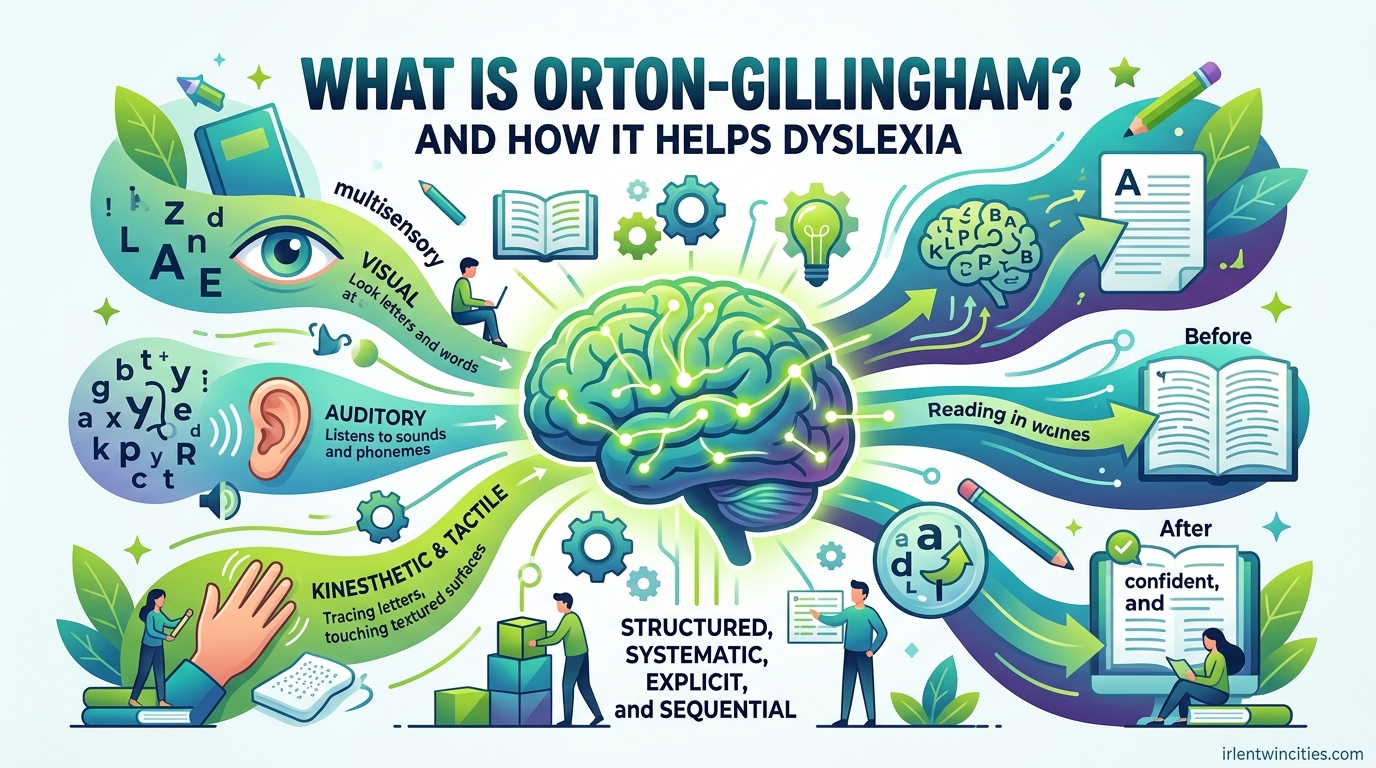
The multisensory nature of Orton-Gillingham creates multiple pathways in the brain for learning these connections. When a student sees a letter while simultaneously saying its sound and tracing it in sand or shaving cream, they engage visual, auditory, kinesthetic, and tactile processing simultaneously. This multi-pathway approach helps build stronger neural connections than traditional single-sense instruction.
Our team has observed that students who receive consistent Orton-Gillingham instruction typically show measurable improvements in decoding accuracy, reading fluency, and spelling skills. The explicit, structured nature of the approach eliminates the guessing strategies that many dyslexic students develop as coping mechanisms. Instead of guessing based on pictures or context, students learn systematic strategies for attacking unfamiliar words.
The 5 Key Principles of Orton-Gillingham
The Orton-Gillingham approach rests on five foundational principles that distinguish it from other reading instruction methods. Understanding these principles helps explain why this approach works so effectively for struggling readers.
1. Structured and Sequential
Orton-Gillingham presents reading and spelling concepts in a carefully planned, logical sequence. Instruction begins with the simplest sound-letter relationships and progressively builds to more complex patterns. Students master each skill before moving to the next, creating a solid foundation that prevents the gaps that often plague struggling readers.
2. Explicit and Direct
Nothing is left to chance or implicit learning in Orton-Gillingham instruction. Teachers directly explain every concept, rule, and pattern. Students do not need to infer spelling rules from exposure to words. Instead, they learn rules explicitly and practice applying them systematically.
3. Multisensory Engagement
This principle lies at the heart of the Orton-Gillingham approach. Students simultaneously use visual, auditory, kinesthetic, and tactile senses to learn each concept. They might trace letters while saying sounds, tap out syllables, or use arm movements to demonstrate syllable division. This whole-brain engagement strengthens memory and recall.
4. Diagnostic Teaching
Orton-Gillingham instructors continuously assess student performance during every lesson. They do not wait for end-of-unit tests to identify problems. Instead, they watch carefully for errors, analyze what caused them, and adjust instruction immediately. This constant monitoring ensures that misunderstandings get corrected before they become entrenched habits.
5. Prescriptive and Individualized
Trained Orton-Gillingham practitioners adapt every lesson to address the specific needs of each student. While the overall sequence remains consistent, the pace, emphasis, and practice activities get customized based on continuous diagnostic assessment. No two students receive identical instruction because no two students have identical learning needs.
The Multisensory Approach Explained
The VAKT technique forms the cornerstone of Orton-Gillingham instruction. VAKT stands for Visual, Auditory, Kinesthetic, and Tactile. Each lesson engages all four pathways to create robust learning that sticks.
A typical Orton-Gillingham lesson might proceed like this. The student looks at a card showing the letter combination “th” while saying the sound aloud. Simultaneously, they trace the letters in a sand tray, feeling the texture and movement. They might also tap out the sound pattern on their arm or desk. This four-way simultaneous engagement helps the brain form multiple associations with the sound-symbol connection.
Research supports this multisensory approach. Brain imaging studies have shown that multisensory instruction activates more brain regions than unisensory methods. For students with dyslexia, who often show underactivation in typical reading networks, this broader brain engagement can help compensate for neurological differences and build stronger reading circuits over time.
Who Can Benefit from Orton-Gillingham?
While Orton-Gillingham was originally developed for students with dyslexia, its benefits extend to a wide range of learners. The explicit, systematic nature of the instruction helps anyone who struggles with reading, regardless of the underlying cause.
Students diagnosed with dyslexia represent the primary beneficiaries. These students often have average or above-average intelligence but struggle with phonological processing. Orton-Gillingham directly targets this weakness with systematic phonics instruction that leaves nothing to chance.
Struggling readers without a formal dyslexia diagnosis also benefit significantly. Many students fall through the cracks of traditional reading instruction, developing poor strategies and growing gaps in their skills. Orton-Gillingham can fill these gaps and rebuild reading confidence.
English language learners find Orton-Gillingham helpful because it explicitly teaches the sound-spelling relationships that native speakers often pick up implicitly. Students with other learning disabilities, attention difficulties, or memory challenges also benefit from the structured, multisensory approach that reduces cognitive load and strengthens retention.
Orton-Gillingham vs Traditional Phonics
Traditional phonics instruction and Orton-Gillingham share some similarities, but important differences distinguish them. Both teach letter-sound relationships, but the approach, intensity, and methodology differ significantly.
Traditional classroom phonics often presents multiple concepts simultaneously. Students might encounter various vowel patterns, sight words, and decoding strategies in the same week. Orton-Gillingham isolates concepts, ensuring mastery before introducing new material.
Classroom instruction frequently relies heavily on visual and auditory channels. Students see words on the page and hear the teacher pronounce them. Orton-Gillingham deliberately incorporates movement and touch, engaging the whole body in learning.
Perhaps most importantly, traditional instruction often assumes that students who do not grasp concepts need more repetition of the same material. Orton-Gillingham assumes that struggling students need different instruction, not just more of the same. The diagnostic-prescriptive principle ensures that instruction changes based on what the student actually needs.
What the Research Says
The evidence supporting Orton-Gillingham and structured literacy approaches has grown substantially over the past two decades. Multiple research studies have demonstrated the effectiveness of systematic, explicit phonics instruction, particularly for students with reading disabilities.
The National Reading Panel’s comprehensive review found that systematic phonics instruction produces significant benefits for students in kindergarten through sixth grade, especially for those having difficulty learning to read. While the panel did not specifically endorse Orton-Gillingham by name, they emphasized the principles that define it: explicit, systematic, structured instruction in phonemic awareness and phonics.
A 2026 review by the International Dyslexia Association noted that structured literacy approaches, which include Orton-Gillingham, produce stronger outcomes for dyslexic students than non-structured methods. The organization specifically recommends multisensory, structured instruction for students with dyslexia.
Individual studies have shown that students receiving Orton-Gillingham instruction make gains in word recognition, spelling, and reading comprehension that exceed those made by students receiving standard classroom instruction. These gains persist over time, suggesting that the approach builds lasting skills rather than temporary improvements.
How Long Does It Take to See Results?
Parents and educators naturally want to know how quickly Orton-Gillingham instruction produces results. The honest answer varies depending on several factors, including the severity of the reading difficulty, the intensity of instruction, and the student’s age.
Most students receiving intensive Orton-Gillingham instruction, defined as sessions at least twice weekly for 45-60 minutes, begin showing measurable improvement within 8 to 12 weeks. Early gains often appear in spelling accuracy and sound-symbol recognition before fluency improvements become obvious.
Significant reading progress typically requires sustained instruction over 1 to 3 years. Students with severe dyslexia may need 2 to 3 years of consistent intervention to reach grade-level reading skills. The investment proves worthwhile, as gains made through Orton-Gillingham tend to stick, giving students tools they can use throughout their academic careers and beyond.
Frequently Asked Questions
Is Orton-Gillingham effective for dyslexia?
Yes, Orton-Gillingham is highly effective for dyslexia. Research consistently shows that the structured, multisensory approach helps dyslexic students build neural pathways for reading that they may not develop through traditional instruction. The International Dyslexia Association specifically recommends structured literacy approaches like Orton-Gillingham for students with dyslexia.
What are the 5 principles of Orton-Gillingham?
The 5 key principles are: 1) Structured and Sequential – concepts taught in logical order building from simple to complex, 2) Explicit and Direct – nothing left to chance, all rules taught clearly, 3) Multisensory Engagement – using visual, auditory, kinesthetic, and tactile senses simultaneously, 4) Diagnostic Teaching – continuous assessment and error analysis during lessons, and 5) Prescriptive and Individualized – instruction adapted to each student’s specific needs.
What are 5 signs of dyslexia?
Five common signs include: 1) Difficulty learning letter sounds and names despite normal intelligence, 2) Trouble blending sounds into words when reading, 3) Guessing at words based on first letter or context rather than decoding, 4) Slow, laborious reading with many errors, and 5) Poor spelling that does not reflect phonetic attempts. If you notice these signs consistently, consider seeking an evaluation from a qualified professional.
Is Orton-Gillingham only for students with dyslexia?
No, Orton-Gillingham benefits many types of learners. While originally developed for dyslexia, the approach helps struggling readers, English language learners, students with other learning disabilities, and anyone who needs explicit, systematic reading instruction. The structured, multisensory nature makes it effective for any student who has not thrived with traditional classroom methods.
How is Orton-Gillingham different from other reading programs?
Orton-Gillingham differs from typical reading programs in three key ways. First, it is an approach rather than a boxed curriculum, allowing trained educators to adapt instruction to individual needs. Second, it explicitly teaches all concepts rather than expecting students to infer patterns through exposure. Third, it engages multiple senses simultaneously, creating stronger neural connections than programs relying only on visual and auditory input.
Orton-Gillingham represents a proven pathway for students who struggle with reading. The structured, multisensory approach directly addresses the neurological differences that make reading difficult for dyslexic learners. By engaging multiple senses simultaneously and teaching concepts explicitly, this method helps build the neural pathways necessary for skilled reading.
If you suspect your child has dyslexia or struggles with reading, seeking an evaluation from a qualified professional represents an important first step. With proper diagnosis and access to Orton-Gillingham instruction, most students make significant gains in reading accuracy, fluency, and confidence. The investment in quality intervention pays dividends throughout a child’s academic career and beyond, opening doors that might otherwise remain closed.