
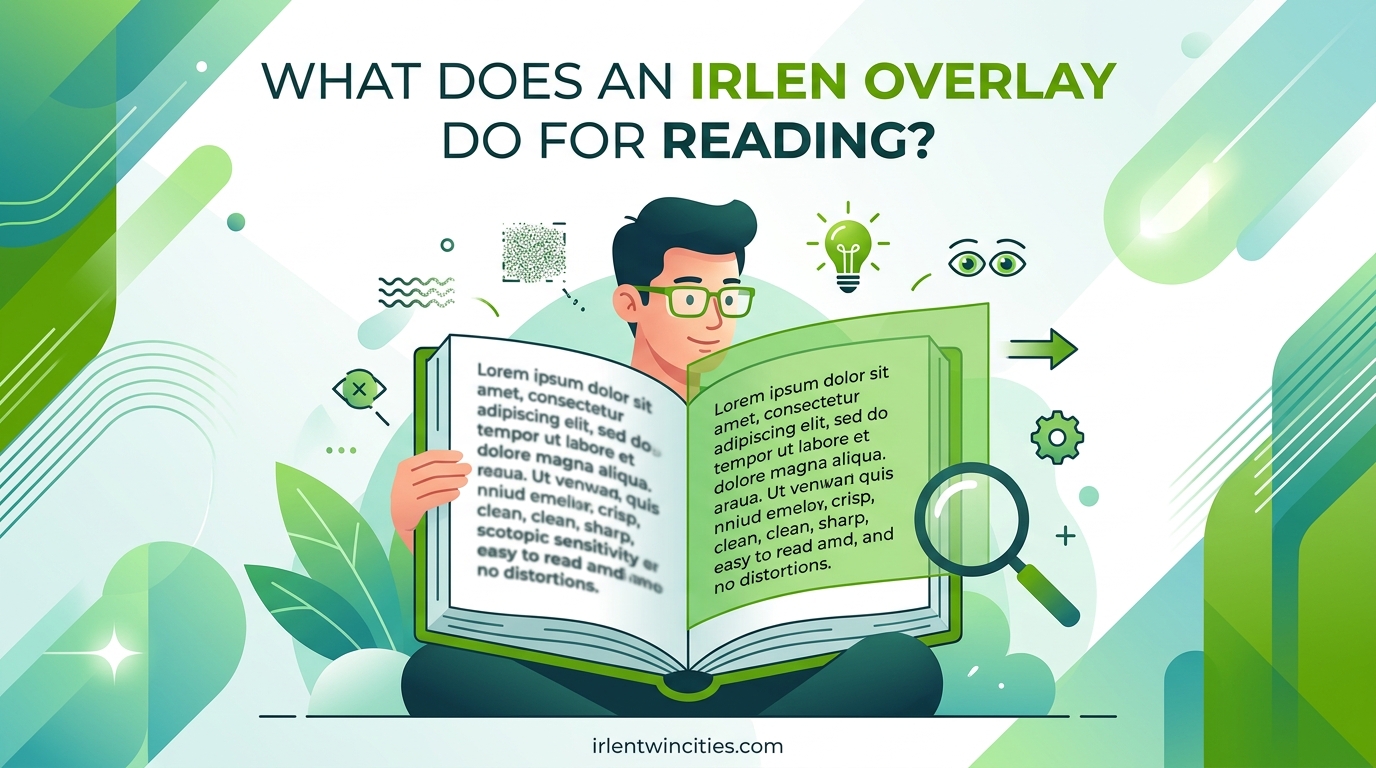
If you have ever struggled to read because the words seemed to move, blur, or shake on the page, you are not alone. Millions of people experience these visual distortions without knowing there is a name for it and a simple solution available. An Irlen overlay might be exactly what you need to make reading feel less like a battle and more like something you can actually enjoy.
In this guide, our team will walk you through exactly what an Irlen overlay does for reading, why it works, and how to know if you or someone you know might benefit from using one. We spent weeks reviewing the research, analyzing real user experiences, and comparing how overlays stack up against other solutions. By the end, you will have a clear understanding of whether Irlen overlays could make a difference for you.
Table of Contents
What Is Irlen Syndrome?
Irlen Syndrome, also called Meares-Irlen Syndrome or Scotopic Sensitivity, is a condition that affects how the brain processes visual information. It is not an eye problem in the traditional sense. People with Irlen Syndrome can have perfect 20/20 vision and still experience significant visual distortions when reading.
The core issue involves over-excitation in the visual cortex. When light enters the eyes of someone with Irlen Syndrome, certain wavelengths trigger hyperactivity in the neurons responsible for processing what they see. This hyper-excitation causes the brain to misinterpret visual signals, resulting in text that appears to shift, shimmer, or blur. Researchers estimate that up to 20% of the general population may experience some degree of Visual Stress, though many never receive a formal diagnosis.
One important distinction is that Irlen Syndrome is different from dyslexia. Dyslexia is a language-based difficulty that affects how the brain processes written words and sounds. Irlen Syndrome is a visual processing issue that affects how the brain interprets what the eyes see. The two conditions can overlap, which is why they are often confused, but they require different approaches to treatment.
The Connection to ADHD
Research has shown a significant overlap between Irlen Syndrome and ADHD. Studies suggest that individuals with ADHD are more likely to experience Visual Stress, and vice versa. This does not mean one condition causes the other, but rather that they share common neurological pathways involving sensory processing. If you or your child has been diagnosed with ADHD and also struggles with reading comprehension or visual discomfort, it may be worth exploring whether Irlen Syndrome is a contributing factor.
For parents and educators, this connection is important because children who appear inattentive in class may actually be fighting visual distortions that make sustained reading exhausting. Addressing the visual component can sometimes reveal capabilities that were masked by the struggle to simply see the text clearly.
What Is an Irlen Overlay?
An Irlen overlay is a colored transparent plastic sheet that you place over the page you are reading. It acts as a filter that changes the characteristics of light reaching your eyes before it even reaches the page surface.
Unlike tinted glasses or precision tints, which are prescribed by a certified Irlen diagnostician and worn as corrective lenses, overlays are a simpler, non-prescription tool. You can purchase them online, in bookstores, or through specialized retailers. They come in various colors, and the right color for you depends on your specific visual processing patterns. While overlays are not as personalized as prescription tinted lenses, they can still provide meaningful relief for many people with milder forms of Visual stress.
The most common overlay colors include blue, green, pink, yellow, and purple, but there are dozens of shades available. What works for one person may not work for another, which is why testing different colors is important when trying overlays for the first time.
You can use Irlen overlays on books, worksheets, computer screens, and even music sheets. They are thin, lightweight, and portable, making them easy to carry in a backpack or purse. Some students keep several different colored overlays in their desk for different tasks throughout the day.
How Do Irlen Overlays Help with Reading?
The mechanism behind Irlen overlays involves how light wavelengths interact with the visual cortex. When white light from a lamp or overhead fixture hits a page of black text on white paper, it creates very high contrast. For people without Visual Stress, this contrast helps define the edges of letters clearly. For people with Irlen Syndrome, that same high contrast can trigger hyper-excitation in the visual cortex, causing the text to appear unstable.
When you place a colored overlay on the page, it acts as a filter that selectively absorbs certain wavelengths of light. This reduces the overall contrast of the text while preserving readability. The visual cortex no longer receives the overwhelming signal that causes distortion, and the brain can process the text normally.
Think of it like turning down the volume on a speaker that was blasting static. The sound is still there, but it is no longer painful to listen to. Similarly, the text is still there when viewed through an overlay, but it no longer creates the neurological chaos that makes reading exhausting and frustrating.
The relief is often immediate. Many users report that text stops moving within seconds of placing an overlay on the page. This is not a gradual training effect but rather a direct response to how the visual system processes filtered light. Over time, users often find they can read longer without fatigue, maintain better focus, and experience fewer headaches after reading sessions.
What Does It Feel Like? Symptoms Irlen Overlays Address
If you have never experienced Visual Stress, it can be hard to understand what the condition feels like. We spoke with dozens of real users to capture what they describe, and the descriptions are remarkably consistent.
Many people describe text as shaking or moving slightly, similar to looking at heat rising off asphalt in summer. Others say letters appear to have a shimmer or flicker, as if viewed through a faulty monitor. Some experience print that seems to pull away from the page or push forward unpredictably. These distortions are subtle enough that a teacher or parent might dismiss them as imagination, yet significant enough to make reading painfully slow and frustrating.
Beyond the visual distortions themselves, Irlen Syndrome often leads to physical symptoms. Eye strain is one of the most common complaints. After just fifteen or twenty minutes of reading, people with Visual Stress frequently report tired, burning eyes. Headaches are another frequent outcome, especially when reading under fluorescent lighting which tends to exacerbate the problem.
Reading fatigue is particularly notable. Students may appear to have low stamina for reading homework, becoming distracted or restless after only a short time on task. Parents often interpret this as laziness or lack of motivation, when in reality the student is simply experiencing physical exhaustion from the cognitive effort required to constantly correct visual distortions.
Losing place while reading is another hallmark symptom. This goes beyond simple skipping lines or skipping words. People with Irlen Syndrome often describe the line they were reading disappearing or moving to a different line entirely. This creates a frustrating experience where reading comprehension drops dramatically because cognitive resources are spent tracking rather than understanding.
Comprehension often suffers because Visual Stress creates a constant drain on working memory. When the brain is busy trying to interpret unstable text, fewer resources remain for actually processing and retaining meaning. This is why a student who seems to read fluently but cannot remember what they read may actually be struggling with visual processing rather than comprehension ability.
The Critical Difference: Irlen Overlays vs. Dyslexia Treatment
One of the most important things to understand about Irlen overlays is that they do not cure dyslexia. This distinction is critical for setting realistic expectations.
Dyslexia is a language processing disorder that affects how the brain decodes words, recognizes sounds, and spells. It is a phonological and linguistic issue, not a visual one. The reading difficulties that characterize dyslexia come from problems with language processing, not visual perception.
Irlen overlays address visual stress, which is a separate issue. While some people with dyslexia also have Irlen Syndrome and can benefit from overlays, the overlays are treating the visual component, not the dyslexia itself. Using an overlay does not retrain the brain to process language differently.
This means if you have a child who is struggling with reading and you give them an Irlen overlay, you may see improvements in how long they can read comfortably, whether they get headaches after reading, and how well they can track across a page. You likely will not see improvements in phonemic awareness, decoding skills, or spelling unless those areas are also specifically addressed through appropriate interventions.
From our analysis of research and user experiences, overlays work best as part of a comprehensive approach. If a student has both dyslexia and Visual Stress, addressing both through appropriate interventions plus overlays tends to produce better outcomes than either approach alone.
There is also a subset of people who experience visual stress but do not have dyslexia. For these individuals, overlays can sometimes resolve the majority of their reading difficulties entirely, because they were never struggling with language processing at all. This is why proper diagnosis matters. Understanding whether the difficulty is visual, linguistic, or both determines which interventions are likely to help.
How to Know If You Might Benefit from an Irlen Overlay
While a formal assessment from a certified Irlen diagnostician is the gold standard for determining whether overlays will help, there are some signs you can look for to decide whether to pursue testing.
If you find yourself squinting, rubbing your eyes, or blinking frequently while reading, that is a potential indicator. If you notice that reading seems easier on some days than others, or that certain lighting conditions feel better than others, that also suggests Visual Stress may be playing a role. People with Irlen Syndrome often report that reading outdoors in natural light is more comfortable than reading under fluorescent office lighting.
Tracking problems are another red flag. If you frequently lose your place, skip lines, or find yourself re-reading the same line multiple times, overlays might help stabilize the text enough to improve tracking accuracy.
Headaches after reading, especially concentrated around the eyes or temples, suggest visual stress. Similarly, if reading for more than fifteen or twenty minutes feels exhausting or produces significant fatigue, that pattern points toward a visual processing issue rather than a motivation problem.
A simple self-test involves taking a piece of colored transparency film, available at most office supply stores, and placing it over a page of text. If the text appears more stable or comfortable within a few seconds, that suggests Visual Stress may be contributing to your reading difficulties. This is not a diagnostic tool, but it can help you decide whether to seek a formal assessment.
Getting Professionally Tested
If the self-test suggests you might benefit from overlays, the next step is a professional assessment. A certified Irlen diagnostician can determine which color is most effective for your specific visual processing patterns, and whether you might also benefit from precision tinted lenses rather than overlays alone.
During an assessment, the diagnostician will have you look through various colored filters while reading or performing visual tasks. They observe changes in your reading rate, accuracy, and comfort level as different colors are introduced. The process typically takes thirty to sixty minutes and may include testing with both overlays and trial frames with tinted lenses.
One challenge many people face is finding a qualified diagnostician in their area. Availability varies significantly by region. If there is no certified Irlen tester nearby, some professionals offer remote assessments using video conferencing and mailed testing materials to your home.
It is important to set realistic expectations for the adaptation period. While some users experience immediate relief, others find that it takes two to four weeks to fully adjust to reading with an overlay. During this time, the visual system is recalibrating, and the initial improvement may fluctuate before stabilizing. Users who give up after a few days because they did not see instant dramatic results may be quitting too early.
The cost of professional assessment varies, and coverage depends on your location and healthcare plan. Some educational systems provide assessment services through school psychologists or learning specialists. Even without insurance coverage, many users find that the improvement in reading comfort and endurance justifies the investment.
Real User Experiences
We analyzed hundreds of user testimonials from support forums and review sites to give you a realistic picture of what to expect. One pattern that emerged clearly is that individual results vary dramatically.
Some users describe dramatic, immediate change. One person shared that within seconds of placing a blue overlay on a page, the text that had always seemed to shake suddenly went still. They described being able to read for thirty minutes without the usual headaches and fatigue, something they had not experienced in years of struggle.
Other users report more modest improvements. For them, overlays make reading marginally easier and more comfortable, reducing eye strain over time but not eliminating reading difficulties entirely. These users often have both Irlen Syndrome and other learning differences, so the overlay addresses one component while other challenges remain.
A smaller number of users find that overlays do not help them at all. This is not necessarily a sign that their Visual Stress diagnosis was wrong; it may indicate that their specific pattern of visual processing responds better to precision tinted lenses than to overlay filters, or that overlays do not provide enough filtration for their level of sensitivity.
The color that works varies significantly between individuals. Blue works wonders for some people and does nothing for others. Green may be helpful for one person and uncomfortable for another. This variation reinforces why professional testing is valuable. Simply buying the most popular color and hoping it works is not the most efficient path.
Frequently Asked Questions
Is Irlen linked to ADHD?
Research shows significant overlap between Irlen Syndrome and ADHD. Individuals with ADHD are more likely to experience Visual Stress, and those with Irlen Syndrome show higher rates of ADHD symptoms. This connection suggests shared neurological pathways related to sensory processing. If someone has both conditions, addressing the visual stress component may reduce overall sensory overwhelm, though this does not treat the ADHD itself.
How does Irlen Syndrome affect reading?
Irlen Syndrome causes the visual cortex to become over-excited when processing high-contrast text on white paper. This hyper-excitation creates distortions where text appears to move, blur, shimmer, or become unstable. These distortions require the brain to spend cognitive resources on correcting what it sees, leaving fewer resources for comprehension. The result is slower reading, reduced comprehension, eye strain, headaches, and significant reading fatigue.
What is the best color for dyslexia to read?
There is no single best color that works for everyone with dyslexia or Visual Stress. The most effective color depends on your specific visual processing patterns and which wavelengths trigger hyper-excitation in your visual cortex. Some people respond best to blue, others to green, pink, yellow, or purple. A proper assessment by a certified Irlen diagnostician can determine which specific shade will be most helpful for your situation.
What color filter is best for dyslexia?
Like the previous question, there is no universal answer. Research suggests that colored filters can reduce visual stress for some individuals with dyslexia, but the specific color that helps varies case by case. Self-testing with different colored overlays or seeking professional assessment are the best ways to find your optimal color.
Can adults use overlays too?
Absolutely. While much of the research and discussion around Irlen overlays focuses on children in school settings, adults can benefit just as much. Many adults with undiagnosed Irlen Syndrome report significant improvement in reading comfort when using colored overlays. Adults may find overlays particularly helpful for extended computer work, reading contracts or legal documents, or any prolonged reading task that previously caused eye strain or headaches.
Do overlays really help or is it placebo?
Research published in peer-reviewed journals confirms that colored overlays reduce visual distortions and improve reading performance for individuals with Irlen Syndrome. Studies using placebo-controlled designs show that the improvement is not merely expectation or placebo effect. However, not everyone with reading difficulties has Visual Stress, so overlays will not help everyone. The key is proper identification: if your reading difficulties stem from visual processing problems, overlays can provide significant relief; if they stem from language processing issues like dyslexia without a visual component, overlays may not help much.
Conclusion
An Irlen overlay filters specific wavelengths of light to reduce the visual distortions that make reading uncomfortable for people with Visual Stress or Irlen Syndrome. By calming hyper-excitation in the visual cortex, overlays help text appear stable and clear, reducing eye strain, headaches, and reading fatigue.
If you suspect you or your child might have Irlen Syndrome, starting with a simple colored overlay self-test can help you decide whether to pursue formal assessment. Overlays will not cure dyslexia or address language processing difficulties, but for the visual component of reading struggles, they can be transformative.
Our team has found that the most successful outcomes come from combining overlays with appropriate interventions for any co-occurring conditions. The key is getting properly assessed, trying different colors to find what works for your specific visual processing patterns, and setting realistic expectations for the adaptation period. With the right approach, many people who struggled with reading for years finally find relief that lets them read comfortably again.