
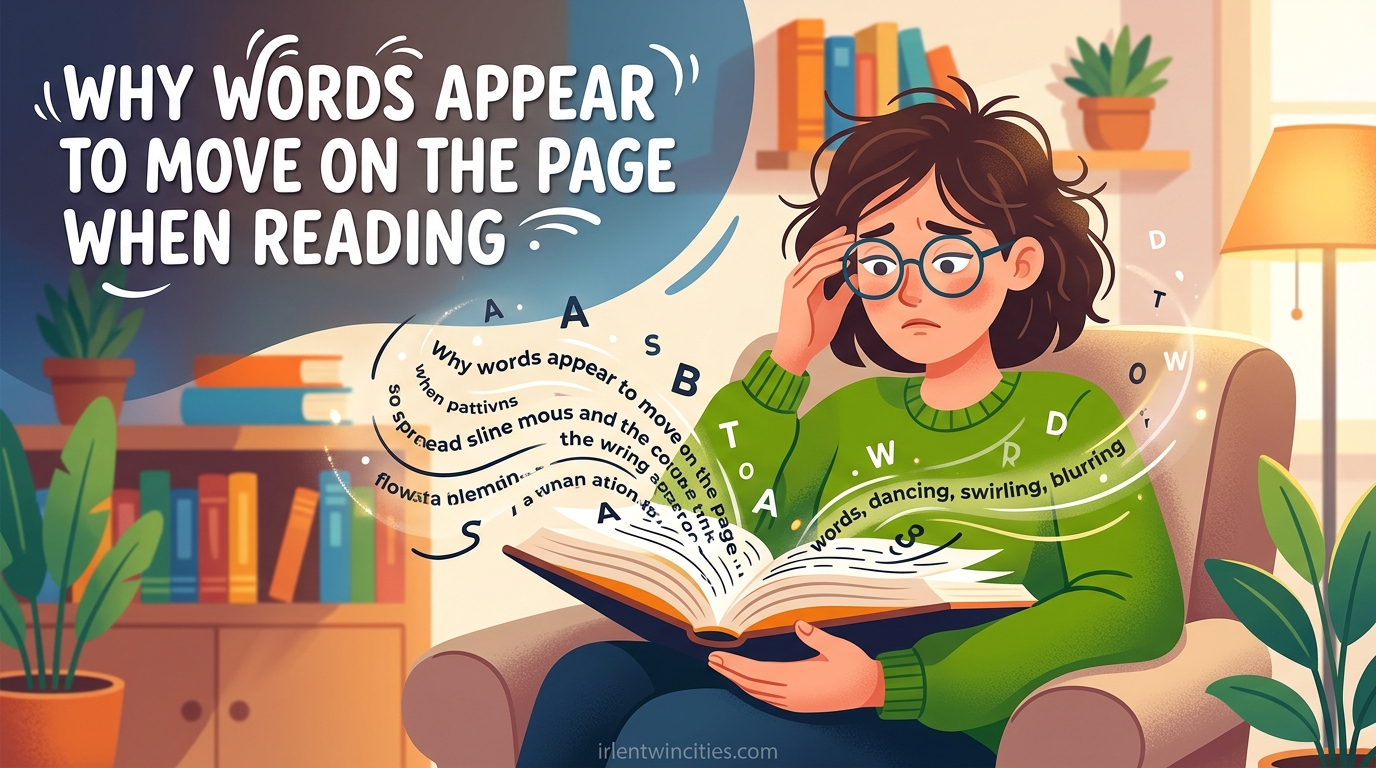
Why words appear to move on the page when reading is a question that millions of people ask themselves every day, often wondering if what they experience is real. I have spent years researching visual perception and speaking with readers who describe exactly what you are going through. The good news is that what you see is absolutely real, and there is a scientific explanation for it.
If you have ever felt like the text on a page is shifting, swimming, or moving while you try to read, you are not imagining it. This phenomenon affects both children and adults, and it can significantly impact reading speed, comprehension, and overall enjoyment of reading. Understanding why this happens is the first step toward finding relief.
In this guide, I will walk you through the science behind words appearing to move, explain how visual stress plays a role, and share practical strategies that can help. By the end, you will have a clear understanding of what is happening and what steps you can take next.
Table of Contents
What Is Visual Stress?
Visual stress is a condition where the visual cortex, the part of your brain that processes what you see, struggles to interpret written text accurately. This is not a problem with your eyes themselves but rather with how your brain processes visual information. When you read, your eyes send signals to your brain, and for people with visual stress, those signals get distorted along the way.
The most common trigger is pattern glare, which occurs when high-contrast patterns like black text on white paper create visual interference. This interference causes the brain to work harder to process each letter and word. Over time, this extra cognitive load leads to the perception that text is moving, blurring, or even disappearing altogether. Many people describe the sensation as words “swimming” across the page or appearing to shimmer.
Research shows that visual stress affects approximately 20% of the general population, though the percentage is significantly higher among people with dyslexia. The condition often goes undiagnosed because many people assume that what they experience is just “normal” reading difficulty. If you have always struggled with reading and noticed movement in the text, visual stress could be the underlying cause.
The Science Behind Words Moving
To understand why words appear to move, you need to understand how your eyes work during reading. Your eyes do not glide smoothly across a page. Instead, they make small, rapid movements called saccades. These movements allow your brain to take in different parts of the text in quick succession.
For most people, these saccadic movements are automatic and smooth. But for individuals experiencing visual stress, the coordination between both eyes can become disrupted. When your eyes do not work together properly, your brain receives conflicting signals about where each word is located. This mismatch is what creates the perception of movement.
Pattern Glare and Visual Distortions
Pattern glare is one of the primary culprits behind text that appears to move. This happens because the visual system is highly sensitive to contrast and edges. When you look at black text on a white background, the sharp boundaries between letters and the white space around them create visual noise in your brain.
Some people describe seeing “white rivers” running vertically through text when reading, or noticing that letters seem to vibrate or shimmer. Others report that lines of text appear to ripple like water. These are not hallucinations. They are real visual distortions caused by pattern glare overwhelming the visual cortex.
The intensity of these distortions varies from person to person. Some only notice movement in certain lighting conditions, while others experience it every time they try to read. Font choice, letter spacing, and line height can all influence how severe pattern glare becomes.
Binocular Vision Problems
Another major factor is binocular vision problems. When your eyes do not converge properly, each eye sends a slightly different image to your brain. Normally, your brain combines these two images into one clear picture. But when convergence is weak or inconsistent, your brain struggles to fuse the images together.
This is called convergence insufficiency, and it is surprisingly common. Research indicates that children with reading difficulties are more likely to have convergence insufficiency than their peers without reading challenges. The effort your brain expends trying to keep words single and clear can cause them to appear to jump or float on the page.
Connection to Dyslexia and Reading Difficulties
Many people who experience words moving on the page also have dyslexia, though the two are not the same thing. Dyslexia is a language-based learning difference that affects how your brain processes written words. Visual stress, on the other hand, is a perceptual issue that affects how your visual system interprets text. The two conditions frequently overlap, which is why they are often confused.
If you have dyslexia, you may be more susceptible to visual stress. This does not mean that visual stress causes dyslexia, but rather that the additional visual processing challenges can make reading even more difficult for someone who already struggles with language-based reading tasks.
5 Signs of Dyslexia Related to Visual Issues
Understanding the connection between visual problems and dyslexia can help you identify whether you or your child might be experiencing visual stress rather than or in addition to dyslexia. Here are five signs that visual issues may be contributing to reading difficulties:
1. Words appear to move or blur while reading. This is one of the most common visual symptoms reported by people with dyslexia. Text may seem to shift position, vibrate, or even duplicate on the page.
2. Frequent eye strain or headaches after reading. When your brain is working overtime to process distorted visual information, it leads to physical fatigue. If you find yourself developing headaches or feeling exhausted after just a few minutes of reading, visual stress could be to blame.
3. Skipping lines or losing your place while reading. Eye tracking difficulties, which often accompany visual stress, can make it hard to follow from one line to the next. You might find yourself accidentally reading the same line twice or skipping over sections entirely.
4. Difficulty copying from a board or book. Transferring information from one source to another requires precise eye-to-hand coordination. If words appear to be moving, this task becomes nearly impossible.
5. Reduced reading comprehension. When so much mental energy goes toward deciphering what the letters say, little remains for understanding the meaning of the text. Many people with visual stress find that they can read words but have no idea what they just finished reading.
Meares-Irlen Syndrome Explained
Meares-Irlen Syndrome is a specific type of visual stress that was first identified by Olive Meares and Helen Irlen in the 1980s. It is sometimes called Irlen Syndrome, and it refers specifically to the visual distortions and reading difficulties that occur when pattern glare is present. Unlike general visual stress, Meares-Irlen Syndrome has a particular relationship with the contrast and spacing of text.
People with Meares-Irlen Syndrome often report that colored overlays or tinted lenses significantly reduce or eliminate their visual distortions. This is because certain colors help reduce the pattern glare that triggers the visual disturbances. The specific color that works best varies from person to person, which is why a systematic assessment is important.
If you suspect you have Meares-Irlen Syndrome, it is worth seeking an evaluation from a trained Irlen screener or an optometrist who specializes in visual stress. The use of colored overlays or precision tinted lenses has helped thousands of people return to reading without the discomfort and distortion they have experienced for years.
When to Seek Professional Help
Not everyone who experiences words moving needs to see a specialist. Some people manage their symptoms with simple accommodations like using colored overlays, adjusting font choices, or taking regular breaks. However, there are situations where professional help is warranted.
You should consider seeing an optometrist if you experience persistent eye strain, headaches that occur regularly after reading, or if you notice that words are frequently blurry or double. A developmental optometrist or a specialist in vision therapy can assess whether binocular vision problems like convergence insufficiency are contributing to your symptoms.
If your reading difficulties are severe, or if you also experience visual snow (tiny flickering dots across your field of vision), you may want to consult a neurologist. Visual snow syndrome is a neurological condition that can co-occur with visual stress and requires different treatment approaches. Getting the right diagnosis ensures you get the right treatment.
The most important thing to remember is that you do not have to accept reading difficulty as just part of life. There are real, evidence-based approaches that can help, and seeking help is the first step toward reclaiming your ability to read comfortably.
FAQ
Is it normal for words to move when reading?
No, it is not normal for words to move when reading. While occasional eye fatigue is common, consistent movement, blurring, or swimming of text is a sign of visual stress or underlying vision problems. This perception is real and has a neurological basis. Many people who experience this never report it because they assume it is normal, but it is not.
What causes words to move on the page?
Words appear to move on the page primarily due to visual stress, which involves pattern glare and binocular vision problems. Pattern glare occurs when high-contrast text creates visual interference in the brain. Binocular vision issues like convergence insufficiency mean your eyes do not work together properly, sending conflicting signals to your brain. This combination causes the perception of movement.
What are 5 signs of dyslexia?
Five signs of dyslexia related to visual issues include: 1) Words appearing to move or blur during reading; 2) Frequent eye strain or headaches after reading; 3) Skipping lines or losing your place frequently; 4) Difficulty copying from a board or book; 5) Reduced reading comprehension despite being able to decode words.
How come when I read text it looks like it is moving?
When you read text and it looks like it is moving, your visual system is experiencing interference from pattern glare or binocular vision dysfunction. Your eyes make rapid movements called saccades while reading, and when they do not work together smoothly, your brain receives distorted signals about where words are positioned. This mismatch creates the perception of movement.
Conclusion
If you have been wondering why words appear to move on the page when reading, I want you to know that your experience is valid and has a real explanation. Visual stress, pattern glare, and binocular vision problems all contribute to this phenomenon, and you are not alone in experiencing it.
The first step toward finding relief is understanding what is happening in your visual system. From there, you can explore solutions like colored overlays, tinted lenses, vision therapy, or simple environmental adjustments. Many people see significant improvement once they identify the root cause of their reading difficulties.
If you have struggled with this issue for years without finding answers, I encourage you to seek a professional evaluation. A developmental optometrist or an Irlen specialist can help determine whether visual stress or Meares-Irlen Syndrome is at the root of what you experience. With the right support, reading can become comfortable and enjoyable again.