
Your child comes home from school frustrated again. They have been struggling with reading, losing their place on the page, and complaining that words seem to move around. Yet the school vision screening came back perfect: 20/20 vision. You are left wondering what you are missing.
This scenario plays out in countless households every year. The confusion between behavioral optometrist vs regular optometrist care leaves many parents unsure where to turn. I have seen this struggle firsthand through families in our community who needed answers about why their child was falling behind despite having “perfect eyesight.”
Understanding the difference between these two types of eye care professionals could be the key to solving vision problems that standard eye exams simply do not catch. This guide explains everything you need to know to make an informed decision about your family’s eye care.
Table of Contents
What Is a Behavioral Optometrist?
A behavioral optometrist, also known as a developmental optometrist or neuro-optometrist, is an eye doctor who has completed specialized post-doctoral training in how vision integrates with learning, behavior, and brain function. These practitioners look far beyond whether you can read the bottom line of an eye chart.
The key credential to look for is FCOVD (Fellow of the College of Optometrists in Vision Development). This certification requires completing extensive postgraduate coursework, passing rigorous examinations, and demonstrating clinical competence in vision therapy. Earning the FCOVD typically takes optometrists 3-5 years beyond their doctoral degree.
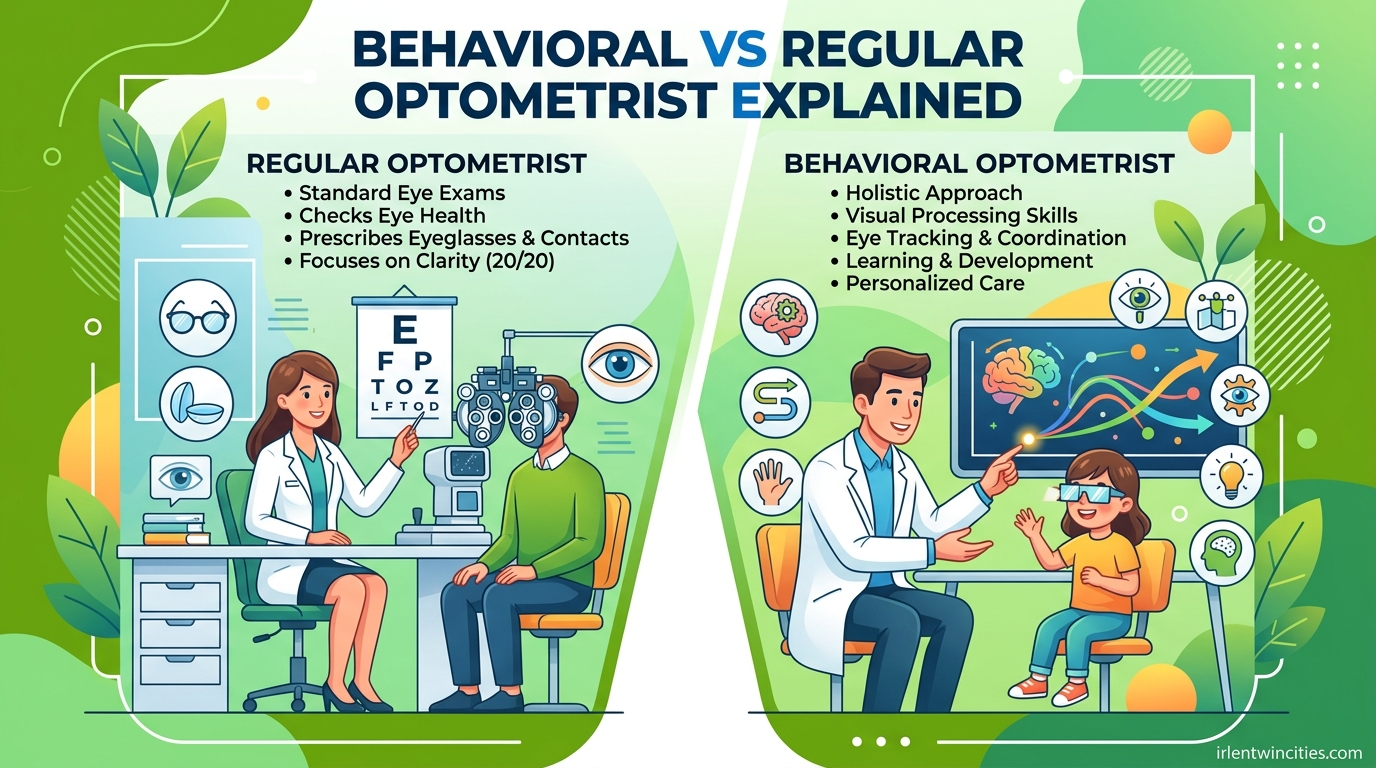
Behavioral optometrists focus on what they call “functional vision” rather than just visual acuity. They examine how the eyes work together as a team, how they track moving objects, how they shift focus between distances, and how visual information gets processed by the brain. Think of it this way: a regular optometrist checks if your eyes can see clearly, while a behavioral optometrist checks if your eyes can perform all the complex tasks needed for reading, learning, and daily life.
The philosophy centers on the brain-eye connection. These specialists believe vision is a learned skill that develops over time and can be improved with proper training. They see vision as part of the overall neurological system rather than an isolated function.
What Does a Regular Optometrist Do?
A regular optometrist, sometimes called a traditional or general optometrist, provides primary eye care focused primarily on visual acuity and eye health. These doctors complete four years of optometry school after college and are licensed to diagnose and treat a wide range of eye conditions.
During a standard comprehensive eye exam, your regular optometrist will check your visual acuity (how clearly you see at various distances), determine your prescription for glasses or contact lenses, screen for eye diseases like glaucoma and cataracts, and examine the overall health of your eyes. Most routine exams take 20-30 minutes.
Regular optometrists excel at what most people need from eye care: clear vision correction and disease detection. They can manage many eye conditions, prescribe medications for eye diseases, and refer to ophthalmologists when surgical care is needed. For the majority of the population with straightforward refractive errors, this level of care is completely appropriate.
The key distinction is that standard optometry focuses primarily on the structural health of the eyes and achieving 20/20 clarity. While excellent for glasses prescriptions and disease screening, this approach may not fully assess the functional skills that impact reading, learning, and daily visual tasks.
Behavioral Optometrist vs Regular Optometrist: Key Differences
Understanding the distinction between these two types of eye care requires looking at several key areas: their training, their exam approach, what they assess, and how they treat problems. Let me break this down clearly.
| Aspect | Regular Optometrist | Behavioral Optometrist |
|---|---|---|
| Primary Focus | Visual acuity (clarity) and eye health | Functional vision and visual processing |
| Standard Exam | 20-30 minutes | 45-90 minutes |
| What They Test | Visual acuity, prescription, disease screening | Tracking, teaming, focusing, visual perception |
| Specialized Certification | Standard OD degree | FCOVD (Fellow of COVD) or similar |
| Primary Treatment | Glasses, contacts, medications | Vision therapy, specialized lenses |
| Typical Cost (Initial Exam) | $75-200 | $200-400+ |
| Insurance Coverage | Usually covered | Often limited/out-of-network |
Training and Education Differences
Both types of optometrists start with the same foundation: four years of optometry school earning their Doctor of Optometry (OD) degree. The divergence happens after graduation. A regular optometrist may pursue continuing education in areas like contact lenses, disease management, or pediatric care.
A behavioral optometrist undertakes years of additional specialized training through the College of Optometrists in Vision Development or similar organizations. They study oculomotility (eye movements), accommodative skills (focusing ability), binocular vision (eye teaming), and visual processing. This extra training allows them to assess vision as an integrated system rather than isolated functions.
Exam Approach and Duration
When you visit a regular optometrist for a comprehensive eye exam, you can expect to be in and out within 30 minutes for most routine visits. The process is efficient and standardized: read the chart, look at the puff test for eye pressure, get dilated if needed, and receive your prescription.
A behavioral optometrist exam is a different experience entirely. Plan for 60-90 minutes, sometimes longer for complex cases. The extended time allows for detailed assessment of eye tracking (following moving objects), eye teaming (how well eyes work together), focusing flexibility (shifting between near and far), and visual perceptual skills (how the brain interprets what the eyes see). They may also assess visual-motor integration and visual-vestibular function.
Treatment Philosophy
Regular optometrists treat vision problems primarily through corrective lenses or medication. If you are nearsighted, you get glasses. If you have an eye infection, you get drops. This approach works excellently for refractive errors and structural eye problems.
Behavioral optometrists offer vision therapy as their primary treatment approach. This is essentially physical therapy for the visual system: a structured program of exercises and activities designed to improve how the eyes and brain work together. Treatment may include in-office sessions with specialized equipment, home exercises, and therapeutic lenses including prisms or colored filters.
What Is Vision Therapy?
Vision therapy is a customized treatment program designed to improve visual skills and retrain the brain-eye connection. Unlike eye exercises you might find online, professional vision therapy is doctor-supervised, evidence-informed, and tailored to each patient’s specific deficits.
A typical vision therapy program involves weekly in-office sessions lasting 45-60 minutes, combined with daily home exercises that take 15-20 minutes. Treatment duration varies widely based on the condition being addressed: straightforward convergence insufficiency might resolve in 12-16 weeks, while complex post-concussion vision problems could require 6-12 months or longer.
Vision therapy activities target specific visual skills. Eye tracking exercises might involve following a moving target smoothly. Eye teaming activities use specialized equipment to train both eyes to work together. Focusing exercises train the eyes to shift quickly between near and far objects. Visual processing activities help the brain make better sense of the information coming from the eyes.
Modern vision therapy often incorporates computer-based programs, virtual reality systems, and specialized therapeutic lenses alongside traditional tools like prisms, filters, and balance boards. The combination of in-office professional guidance and consistent home practice produces the best outcomes.
Conditions Each Type Treats Best
Knowing which conditions fall under each specialist’s expertise helps you choose the right provider. Some problems clearly belong in one category, while others might benefit from either approach.
When to See a Regular Optometrist
Regular optometrists are your go-to professionals for standard vision and eye health needs. Visit them for routine eye exams, glasses or contact lens prescriptions, red eye or infection concerns, dry eye management, glaucoma screening and monitoring, cataract evaluation, and diabetic eye exams. They also handle acute problems like foreign body removal and eye injuries.
If your child passed a school vision screening with 20/20 results and has no complaints about reading, learning, or visual comfort, a regular optometrist is the right choice for annual checkups.
When to See a Behavioral Optometrist
Behavioral optometrists specialize in functional vision problems that standard exams often miss. They treat convergence insufficiency (eyes not teaming together properly), accommodative dysfunction (focusing problems), oculomotor dysfunction (poor eye tracking), amblyopia (lazy eye), strabismus (eye turn), and visual processing disorders.
They also work extensively with patients experiencing learning-related vision problems, post-concussion vision syndrome, computer vision syndrome, and certain types of motion sensitivity or dizziness related to visual-vestibular dysfunction.
The BVD and ADHD Connection
One area where behavioral optometry has gained significant attention is the overlap between binocular vision dysfunction (BVD) and attention difficulties. Research suggests that children with undiagnosed BVD often display symptoms that mimic ADHD: trouble concentrating, avoiding near work, frequent headaches, and behavioral issues during reading or desk work.
The connection makes sense when you consider how uncomfortable vision would make anyone feel restless. If words swim on the page, if your eyes tire after five minutes of reading, or if you constantly lose your place, you would find excuses to avoid those activities too. Some studies indicate that a subset of children diagnosed with ADHD may actually have underlying vision problems contributing to their symptoms.
This does not mean vision problems cause all attention difficulties. ADHD is a real neurological condition. However, ruling out functional vision problems before or alongside an ADHD evaluation is prudent, especially when reading complaints are present.
Who Should See a Behavioral Optometrist?
While anyone can benefit from a functional vision evaluation, certain groups see particularly strong results from behavioral optometry care. Understanding whether you or your child fall into these categories can guide your decision.
Children Struggling with Reading or Learning
The classic candidate for behavioral optometry is a child who struggles with reading despite having normal intelligence and 20/20 vision. Warning signs include losing place while reading, skipping words or lines, poor reading comprehension despite adequate decoding skills, avoiding reading or homework, rubbing eyes frequently, and short attention span for near work.
Children labeled as “lazy” about schoolwork who actually avoid reading because it gives them headaches or makes them dizzy often respond well to vision therapy. Occupational therapists frequently refer children with developmental delays or sensory processing issues for functional vision evaluations.
Post-Concussion Patients
After a traumatic brain injury or concussion, many patients experience vision problems that do not show up on standard eye exams. Post-concussion vision syndrome can include sensitivity to light, difficulty with screen use, trouble reading, balance problems, and motion sensitivity. Behavioral optometrists specializing in neuro-optometric rehabilitation help retrain the visual system after injury.
Adults with Computer Vision Issues
Adults who spend long hours on computers sometimes develop functional vision problems even if they have always had good vision. Computer vision syndrome symptoms include eye strain, headaches, blurred vision when shifting from screen to distance, and difficulty maintaining focus. Vision therapy can often restore comfortable visual function.
Signs You Should Consider a Functional Vision Exam
Watch for these red flags: covering or closing one eye when reading, head tilting while doing near work, complaining that words move or blur on the page, poor hand-eye coordination, difficulty copying from the board, and frequent reversals of letters or words beyond the normal age. These symptoms warrant evaluation by a behavioral optometrist even if standard vision tests are normal.
Understanding the Evidence and Controversy
Behavioral optometry exists in a complicated space within eye care. Some ophthalmologists and traditional optometrists question certain claims, while patients and therapists report life-changing improvements. Understanding the actual evidence helps you make an informed decision.
What Research Supports
The strongest evidence exists for treating convergence insufficiency. Multiple randomized controlled trials, including the Convergence Insufficiency Treatment Trial (CITT), show that office-based vision therapy with home reinforcement is effective for this condition. The American Optometric Association and American Academy of Optometry recognize vision therapy as appropriate treatment for certain diagnosed binocular vision disorders.
Evidence also supports vision therapy for certain types of amblyopia, strabismus, and accommodative dysfunction. Post-concussion vision rehabilitation has growing research support, though more studies are needed.
Areas of Controversy
More controversial are claims about vision therapy improving learning disabilities, dyslexia, or general academic performance. Major organizations including the American Academy of Pediatrics, American Academy of Ophthalmology, and American Association for Pediatric Ophthalmology and Strabismus have issued statements cautioning that vision problems are not the primary cause of learning disabilities. They emphasize that children with reading problems need educational intervention, not just vision therapy.
The honest assessment is that vision therapy helps some children with reading difficulties, particularly those with underlying functional vision problems, but it is not a cure for dyslexia or learning disabilities. Children with reading struggles need comprehensive evaluation including educational assessment, not just vision testing.
Red Flags to Watch For
Be cautious of providers who claim vision therapy can treat autism, ADHD, or learning disabilities directly. Be wary of any practitioner who guarantees results or pushes lengthy expensive treatment plans without clear goals. Legitimate behavioral optometrists recognize the limits of their field and work collaboratively with other professionals.
Cost, Insurance, and What to Expect
Practical concerns about cost and coverage often determine whether families pursue behavioral optometry care. Understanding the financial realities helps you plan appropriately.
Typical Cost Comparison
Initial functional vision evaluations with a behavioral optometrist typically range from $200 to $400, roughly double a standard comprehensive eye exam. Vision therapy sessions run $100-200 per in-office visit. A full treatment plan might cost $2,000-5,000 depending on duration and location. Specialized therapeutic lenses add additional expense.
By comparison, standard eye exams usually cost $75-200, often fully covered by vision insurance. Glasses or contact lenses are the primary ongoing expense for regular optometric care.
Insurance Realities
Most vision insurance plans (VSP, EyeMed, Davis Vision) cover standard exams and glasses but do not cover functional vision evaluations or vision therapy. Some medical insurance plans may cover portions of care if there is a diagnosed medical condition like convergence insufficiency or post-concussion syndrome. However, coverage is inconsistent and often requires extensive documentation.
Many behavioral optometrists operate outside insurance networks because of these limitations. Some offer payment plans or package pricing for vision therapy programs. Always verify costs and coverage before beginning treatment.
Questions to Ask Before Starting
Before committing to vision therapy, ask these important questions: What specific diagnoses will you be treating? How long do you expect treatment to take? What are the goals and how will progress be measured? What is the total anticipated cost? What happens if progress is slower than expected? Do you coordinate with other professionals like occupational therapists or educational specialists?
A reputable behavioral optometrist welcomes these questions and provides clear, honest answers without pressure or guarantees.
Frequently Asked Questions
Why would you see a behavioral optometrist?
You would see a behavioral optometrist if you or your child experience functional vision problems that standard eye exams do not address. Common reasons include reading difficulties despite 20/20 vision, eye tracking problems, convergence insufficiency, post-concussion vision symptoms, and learning-related vision issues. They specialize in how vision integrates with learning and behavior.
Is behavioral optometry legit?
Yes, behavioral optometry is a legitimate specialty within optometry recognized by professional organizations including the American Optometric Association. Behavioral optometrists hold valid OD degrees plus additional FCOVD or similar certifications. However, like all medical fields, claims vary in evidence strength. Convergence insufficiency treatment is well-supported by research, while claims about treating learning disabilities remain more controversial.
Is behavioral optometry evidence-based?
Behavioral optometry has evidence-based support for specific conditions. Strong research backs vision therapy for convergence insufficiency, certain accommodative disorders, and some forms of amblyopia and strabismus. Evidence for treating learning disabilities or dyslexia is weaker. The field contains both well-supported treatments and more controversial claims. Reputable practitioners focus on conditions with solid evidence bases.
What is the difference between an optometrist and a developmental optometrist?
A regular optometrist focuses on visual acuity, glasses prescriptions, and eye disease screening through standard 20-30 minute exams. A developmental optometrist (same as behavioral optometrist) has additional FCOVD training and examines functional vision including eye tracking, teaming, focusing, and visual processing. Their exams last 45-90 minutes and they offer vision therapy as primary treatment rather than just glasses.
Can BVD be mistaken for ADHD?
Yes, binocular vision dysfunction (BVD) symptoms sometimes overlap with ADHD, particularly in children. Both can cause trouble concentrating, avoiding close work, restlessness during reading, and behavioral issues. Some children diagnosed with ADHD may have undiagnosed vision problems contributing to symptoms. This is why comprehensive evaluation including functional vision assessment is important when reading difficulties accompany attention concerns.
Is BVD hard to diagnose?
BVD can be challenging to diagnose through standard eye exams because basic vision screenings only check visual acuity, not how well eyes work together. Specialized tests like the cover test, near point of convergence, and fusional vergence measurements are needed. Many children with BVD have 20/20 vision and pass school screenings, delaying proper diagnosis until a behavioral optometrist performs comprehensive functional testing.
Is developmental optometry legitimate?
Developmental optometry is a legitimate specialty within optometry, also called behavioral optometry. Practitioners are licensed Doctors of Optometry with additional post-doctoral training and FCOVD certification. The field is recognized by major optometric organizations. However, the evidence base varies by condition. Legitimate developmental optometrists treat diagnosed functional vision problems and collaborate with other professionals rather than making unsubstantiated claims.
Conclusion
Understanding the behavioral optometrist vs regular optometrist distinction empowers you to seek the right care for your specific needs. Regular optometrists provide excellent care for glasses, contact lenses, and eye disease screening. Behavioral optometrists offer specialized expertise for functional vision problems affecting learning, reading, and daily life.
If your child struggles with reading despite normal vision tests, or if you experience visual discomfort that standard care does not resolve, a functional vision evaluation with a FCOVD-certified behavioral optometrist may provide answers. Look for practitioners who communicate honestly about evidence, set realistic expectations, and collaborate with other professionals when needed.
Vision is more than 20/20 clarity. It is a complex system that, when not functioning properly, can impact every aspect of learning and daily life. Choosing the right eye care professional ensures you address not just how clearly you see, but how effectively your visual system serves your needs.