
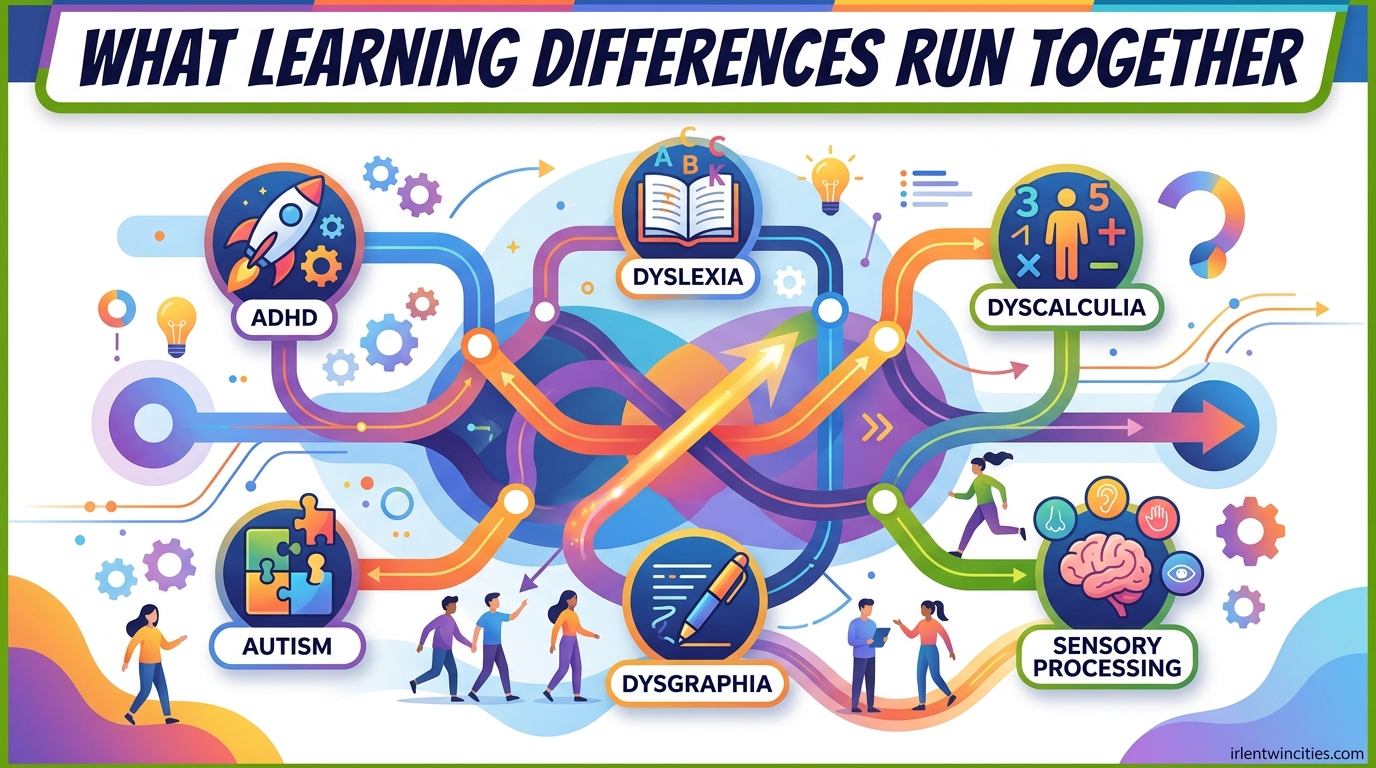
When your child receives one diagnosis like dyslexia or ADHD, you might feel like you finally have answers. Then additional testing reveals another learning difference, and suddenly everything feels more complicated. Understanding learning differences comorbidity helps explain why having multiple learning disabilities is not only common but expected for many individuals.
As someone who has worked with families navigating these diagnoses, I have seen the relief that comes from understanding why conditions cluster together. This guide will walk you through what comorbidity means, which learning differences commonly co-occur, and how to support someone with multiple conditions.
By the end of this article, you will understand the science behind co-occurring learning disabilities, know which combinations appear most frequently, and have practical strategies for comprehensive support.
Table of Contents
What Are Comorbidities in Learning Differences?
Comorbidity refers to the presence of two or more medical conditions or disorders occurring simultaneously in the same person. In learning differences, comorbidity means an individual has multiple learning disabilities or neurodevelopmental conditions that affect their ability to process information, learn, or communicate effectively.
Researchers often use the term “co-occurrence” interchangeably with comorbidity when discussing learning disabilities. Both terms describe the same phenomenon: learning differences rarely exist in isolation. Studies consistently show that 40% to 60% of individuals diagnosed with one specific learning disability also meet criteria for at least one additional learning or developmental condition.
This high rate of overlap surprises many parents who initially believe their child has “just” dyslexia or “just” ADHD. Understanding that comorbidity is the norm rather than the exception helps families prepare for comprehensive assessment and support. When you know that multiple conditions often travel together, you can advocate more effectively for thorough evaluations that examine all potential areas of difficulty.
Common Comorbidity Pairs in Learning Differences
Certain combinations of learning differences appear together with remarkable frequency. Research from the Colorado Learning Disabilities Research Center and other institutions has identified specific pairs that co-occur at rates far higher than chance would predict.
ADHD and Dyslexia
The most well-documented comorbidity involves attention deficit hyperactivity disorder and dyslexia. Studies show that 25% to 40% of individuals with ADHD also have dyslexia, and conversely, 25% to 40% of individuals with dyslexia also have ADHD. This bidirectional relationship makes it one of the strongest comorbidity patterns in learning disabilities.
Both conditions affect similar brain systems. Dyslexia primarily impacts phonological processing, the ability to recognize and manipulate sounds in language. ADHD affects attention regulation and executive function. When these conditions coexist, reading becomes doubly challenging because the individual struggles both with decoding words and maintaining focus long enough to comprehend them.
Children with both conditions often show slow reading progress despite intensive intervention. They may appear to daydream during reading tasks or avoid books entirely. Teachers and parents sometimes interpret this as lack of motivation when it actually reflects the compounded difficulty of managing two neurological differences simultaneously.
Dyslexia and Dyscalculia
Dyslexia and dyscalculia, the specific learning disability affecting mathematical reasoning, co-occur in approximately 40% of cases. This pairing makes sense when you consider that both conditions involve difficulties with symbol processing and working memory.
Reading and math both require the brain to hold information actively while manipulating it. A child with working memory deficits struggles to remember the sequence of sounds in a word while simultaneously blending them. The same working memory limitations make it difficult to hold numbers in mind while performing calculations or remembering the steps in multi-step math problems.
Students with both conditions often experience math anxiety that compounds their difficulties. They may avoid math homework, develop negative self-concepts about their abilities, or fall significantly behind peers despite average or above-average intelligence in other areas.
Dyslexia and Dysgraphia
Dysgraphia, which affects writing ability, frequently accompanies dyslexia. Written expression requires the integration of multiple skills: fine motor control for letter formation, language processing for spelling and grammar, and executive function for organizing ideas. When dyslexia affects the language processing component, writing becomes laborious and frustrating.
Students with this combination often produce written work that does not reflect their actual knowledge or verbal abilities. They may know the answer to a question but struggle to get it onto paper. Spelling errors, poor handwriting, and disorganized paragraphs combine to create work that appears careless when it actually represents significant effort.
This comorbidity particularly impacts academic performance because so much schoolwork requires written output. Essays, worksheets, and even math problems requiring written explanations become major obstacles. Accommodations like speech-to-text software, scribes, or oral testing become essential for demonstrating true understanding.
ADHD and Executive Function Deficits
While ADHD includes executive function difficulties as part of its diagnostic criteria, many individuals experience additional executive function weaknesses that extend beyond typical ADHD presentation. Executive function encompasses working memory, cognitive flexibility, and inhibitory control, the brain’s ability to manage and regulate itself.
When ADHD and severe executive function deficits coexist, daily life becomes challenging in ways that surprise many families. Affected individuals may struggle to initiate tasks, estimate time accurately, organize materials, switch between activities, or remember multi-step instructions. These difficulties affect not only academics but also social relationships, household responsibilities, and eventually workplace performance.
Support for this combination requires explicit teaching of executive function skills alongside ADHD management. External tools like visual schedules, checklists, time timers, and organizational systems become necessary accommodations rather than optional supports.
Irlen Syndrome and Other Learning Differences
Irlen Syndrome, also known as visual stress or scotopic sensitivity syndrome, frequently co-occurs with dyslexia, ADHD, and autism spectrum conditions. This condition affects how the brain processes visual information, particularly high-contrast patterns like black text on white paper. Individuals with Irlen Syndrome experience perceptual distortions, eye strain, headaches, and fatigue when reading.
Unlike other learning differences that have received extensive research attention, Irlen Syndrome remains underrecognized in many educational and clinical settings. This means many individuals receive diagnoses for dyslexia or ADHD without anyone identifying the visual processing component that may be contributing significantly to their reading difficulties.
When Irlen Syndrome coexists with other learning differences, the visual stress can compound existing challenges. A student with both dyslexia and Irlen Syndrome faces phonological processing difficulties plus physical discomfort and visual distortions when attempting to read. Addressing only the dyslexia through phonics instruction while ignoring the visual component leaves a significant barrier in place.
Screening for Irlen Syndrome should be part of any comprehensive assessment for learning differences, particularly when individuals report headaches, eye strain, or that words appear to move on the page. Colored overlays or precision tinted lenses can significantly reduce visual stress and improve reading comfort for those affected.
Why Do Learning Disabilities Overlap?
The high rates of comorbidity are not coincidental. Research has identified several underlying factors that explain why learning differences cluster together in the same individuals. Understanding these mechanisms helps demystify the experience of having multiple learning disabilities.
Shared Brain Systems and Neural Pathways
Many learning differences affect overlapping brain networks. Reading, math, writing, and attention all rely on executive function systems, working memory capacity, and processing speed. When these underlying systems function differently due to neurological variation, multiple skill areas may be affected.
Neuroimaging studies show that phonological processing areas in the left hemisphere are active during both reading and mathematical reasoning. Working memory networks engage whenever we hold and manipulate information, whether that information involves language, numbers, or spatial relationships. When these shared systems develop or function atypically, the effects appear across multiple academic domains.
This shared infrastructure explains why treating one learning difference often benefits others. Interventions that strengthen working memory, improve processing speed, or develop phonological awareness can have cross-domain benefits because they target the underlying systems rather than surface skills alone.
Genetic and Hereditary Factors
Twin studies provide compelling evidence for genetic contributions to comorbidity. When researchers compare identical twins, who share 100% of their DNA, with fraternal twins, who share approximately 50%, they find that learning disabilities show strong heritability. More importantly, the same genetic factors influence multiple learning abilities rather than affecting just one isolated skill.
The Colorado Learning Disabilities Research Center has conducted longitudinal twin studies showing that genetic correlations between reading and math disabilities range from 0.6 to 0.9. This means that genes affecting reading ability substantially overlap with genes affecting math ability. When parents pass these genetic variations to their children, they pass predispositions for multiple learning differences rather than single, isolated conditions.
Family history often reveals this pattern. Parents who remember their own struggles with reading may also recall math difficulties or attention challenges. Siblings of children diagnosed with one learning difference have elevated risk for the same condition plus related conditions. This genetic clustering makes comorbidity predictable based on family patterns.
The Generalist Genes Hypothesis
Researcher Robert Plomin proposed the “generalist genes” hypothesis to explain why genetic influences on learning abilities are so widespread. According to this theory, most genes that affect learning influence multiple abilities rather than specific, isolated skills. The same genetic variations that contribute to reading difficulties also tend to affect math, writing, and attention.
This hypothesis contrasts with older views that assumed separate genes for separate abilities. Instead of dozens of specific genes each affecting one discrete skill, generalist genes create correlations across all cognitive abilities. The result is that difficulties rarely occur in isolation. A child who inherits genetic variations affecting neural development will likely show effects across multiple domains requiring those neural systems.
From a practical standpoint, the generalist genes hypothesis suggests that comprehensive intervention approaches work better than isolated, skill-specific remediation. Rather than treating reading, math, and writing as completely separate problems requiring separate solutions, integrated approaches that strengthen underlying cognitive systems address the root causes shared across conditions.
Assessment Challenges with Comorbid Learning Differences
Identifying multiple learning differences presents significant challenges for clinicians, educators, and families. The interaction between conditions creates complexities that standard assessments may miss, leading to incomplete or delayed diagnoses.
Masking Effects Between Conditions
Sometimes one learning difference masks another, making the second condition invisible until the first is addressed. This phenomenon, called diagnostic overshadowing, occurs when obvious symptoms of one condition draw attention away from subtler symptoms of another.
A classic example involves ADHD masking dyslexia. A child with both conditions may show such significant attention problems that teachers attribute all academic struggles to inattention. The underlying phonological processing deficits causing reading difficulties go unrecognized because everyone assumes the child would read fine if they could just focus. Only after treating the ADHD might the persistent reading difficulties become apparent.
Conversely, severe dyslexia can mask ADHD. A child who reads far below grade level may not show obvious attention problems because they are genuinely struggling with decoding. Once reading instruction improves and the text becomes more accessible, attention difficulties may suddenly become apparent as the child now has the capacity to notice distractions or lose focus.
Masking also occurs between learning differences and mental health conditions. Anxiety can develop as a result of untreated learning disabilities, or anxiety can worsen the apparent severity of learning difficulties. Untangling these relationships requires careful, comprehensive assessment by professionals who understand comorbidity patterns.
Compounding Effects
When multiple learning differences coexist, their effects often compound rather than simply adding together. The whole becomes greater than the sum of its parts. A child with dyslexia alone may struggle with reading. A child with ADHD alone may struggle with focus. A child with both conditions faces reading difficulties magnified by attention challenges, creating a steeper barrier than either condition alone would predict.
This compounding explains why students with comorbid conditions sometimes show more significant gaps between ability and achievement than those with single diagnoses. They are not less intelligent or less capable. They are managing multiple neurological differences that interact in ways that amplify academic challenges.
Understanding compounding effects helps set appropriate expectations and supports. A student with comorbid dyslexia and dyscalculia may need more intensive math intervention than a student with dyscalculia alone because the working memory limitations affect both reading and math simultaneously. Recognition of this compounding justifies comprehensive support rather than minimal intervention.
The Importance of Comprehensive Evaluation
Given the high rates of comorbidity, comprehensive assessment that examines all cognitive domains represents best practice for evaluating learning concerns. Narrow assessments that test only reading or only attention may miss co-occurring conditions that significantly impact functioning.
A comprehensive evaluation should include assessment of intellectual abilities, academic achievement across all subjects, phonological processing, working memory, processing speed, attention and executive function, and language skills. For individuals reporting visual symptoms, screening for Irlen Syndrome or other visual processing differences should be included.
Multidisciplinary teams provide the most thorough evaluations. Psychologists can assess cognitive and academic functioning. Speech-language pathologists evaluate language processing. Occupational therapists examine sensory and motor components. When these professionals collaborate, they create a complete picture of an individual’s strengths and challenges across all domains.
Parents should advocate for comprehensive assessment when seeking evaluations through schools or private providers. Asking specifically about assessment of all areas, not just the obvious concern, helps ensure comorbid conditions are identified early when interventions are most effective.
Support Strategies for Comorbid Learning Differences
Supporting someone with multiple learning differences requires integrated approaches that address all conditions simultaneously. Treating each condition in isolation, as if it existed alone, misses opportunities for efficient intervention and may leave significant barriers unaddressed.
Integrated Intervention Approaches
Effective intervention for comorbid conditions coordinates support across domains rather than fragmenting treatment into separate, unconnected therapies. A student with dyslexia, dysgraphia, and ADHD benefits most when reading instruction, writing support, and attention strategies work together.
This integration might involve occupational therapists working on fine motor skills for handwriting while simultaneously addressing sensory needs that affect attention. Reading specialists can teach phonological awareness while incorporating movement breaks that help with ADHD. Speech-language pathologists can work on language processing skills that support both reading comprehension and written expression.
The key is communication among team members. When therapists, teachers, and parents share information about what strategies work across settings, they create consistent support that reinforces skills throughout the day. A child who learns a specific organizational system at school can use the same system at home, creating efficiency and reducing cognitive load.
IEPs and 504 Plans for Multiple Conditions
For students in public schools, Individualized Education Programs and Section 504 plans provide legal frameworks for accommodations and services. When multiple learning differences exist, these documents become even more important for ensuring all needs are met.
An effective IEP or 504 plan for comorbid conditions lists every diagnosis and explains how each affects educational performance. Accommodations address all conditions, not just the primary diagnosis. For a student with dyslexia, ADHD, and dyscalculia, accommodations might include extended time for tests, assistive technology for reading and writing, reduced distraction testing environments, reference sheets for math, and alternative formats for assignments.
Annual reviews provide opportunities to adjust supports as needs change. Some conditions respond well to intervention and may require fewer accommodations over time. Others may become more apparent as academic demands increase. Regular review ensures the plan remains appropriate throughout the educational career.
Parents should participate actively in IEP and 504 meetings, bringing information about how their child functions across all settings. Home observations about attention, executive function, and emotional well-being provide crucial data for creating comprehensive support plans.
Practical Accommodations That Help Multiple Conditions
Certain accommodations provide benefits across multiple learning differences simultaneously. These multi-purpose supports should be prioritized because they offer the greatest impact for students with comorbid conditions.
Multi-sensory instruction helps students with dyslexia, dyscalculia, and ADHD by engaging multiple pathways for learning. When students see, hear, touch, and move while learning, they create stronger memory traces and maintain engagement. Orton-Gillingham based reading instruction, hands-on math manipulatives, and kinesthetic learning activities all support multiple conditions.
Extended time for tests and assignments reduces pressure for students with processing speed differences, working memory limitations, and attention challenges. When the brain needs extra time to decode text, hold information, or maintain focus, rigid time limits create artificial barriers to demonstrating knowledge.
Assistive technology offers powerful support for comorbid conditions. Text-to-speech software helps students with dyslexia access content while reducing visual fatigue for those with Irlen Syndrome. Speech-to-text supports students with dysgraphia and ADHD by bypassing handwriting difficulties. Graphic organizers assist with executive function, writing organization, and comprehension simultaneously.
Environmental modifications reduce visual stress and support attention. Colored overlays or tinted lenses for Irlen Syndrome can reduce headaches and eye strain. Reduced visual clutter in worksheets and classrooms minimizes distractions for students with ADHD. Preferential seating, away from distractions but close to instruction, benefits attention and processing.
The Emotional Impact of Multiple Learning Differences
Beyond academic challenges, comorbid learning differences carry significant emotional weight for individuals and families. Understanding and addressing this emotional component is essential for comprehensive support.
Many individuals feel overwhelmed when they receive multiple diagnoses. One parent described their child’s situation as having “dyslexia, dysgraphia, and dyscalculia on top of autism and ADHD, and every time I bring it up it really sounds so unlikely.” This feeling of having an improbable combination of conditions is common but based on a misconception. Comorbidity is statistically normal, not unusual.
Validation that multiple learning differences commonly coexist brings relief to many families. Learning that 40% to 60% of individuals with one learning disability have another helps reframe the experience from “my child is unusually affected” to “my child fits the typical pattern.” This normalization reduces isolation and self-blame.
Self-esteem often suffers when children struggle academically despite effort. When multiple learning differences create barriers across most school subjects, students may develop global negative self-concepts. They need explicit support to recognize their strengths, understand that their challenges reflect neurological differences rather than character flaws, and develop self-advocacy skills for requesting accommodations.
Parents also need support when navigating multiple diagnoses. The process of obtaining comprehensive assessment, coordinating multiple therapies, and advocating for appropriate school services can be exhausting. Connecting with other parents who have similar experiences, either through local support groups or online communities, provides practical advice and emotional validation.
Frequently Asked Questions About Learning Differences Comorbidity
What are the comorbidities of learning disabilities?
The most common comorbidities of learning disabilities include ADHD co-occurring with dyslexia in 25-40% of cases, dyslexia co-occurring with dyscalculia in approximately 40% of cases, and dyslexia co-occurring with dysgraphia in many individuals. Other frequent combinations include ADHD with executive function deficits, autism spectrum disorder with various learning disabilities, and Irlen Syndrome with dyslexia or ADHD. Research shows that 40-60% of individuals with one learning disability have at least one additional condition.
What are the 4 D’s of learning disabilities?
The 4 D’s of learning disabilities refer to dyslexia (reading disability), dysgraphia (writing disability), dyscalculia (math disability), and dyspraxia (developmental coordination disorder affecting motor skills). These four conditions commonly co-occur and share underlying neurological factors. While each affects a specific academic or motor domain, they often appear together in the same individual due to shared genetic influences and affected brain systems.
What are the 7 types of learning disabilities?
The seven recognized types of learning disabilities are: 1) Dyslexia affecting reading and language processing, 2) Dyscalculia affecting mathematical reasoning, 3) Dysgraphia affecting writing ability, 4) Auditory processing disorder affecting sound interpretation, 5) Language processing disorder affecting comprehension and expression, 6) Nonverbal learning disabilities affecting visual-spatial and social skills, and 7) Visual perceptual or visual motor deficits affecting visual information processing. These types frequently overlap and co-occur in individuals with learning differences.
Can a child have multiple learning disabilities?
Yes, having multiple learning disabilities is common rather than rare. Research consistently shows that 40-60% of individuals diagnosed with one specific learning disability also meet criteria for at least one additional condition. Comorbidity is the norm, not the exception. Children can have combinations such as dyslexia and ADHD, dyslexia and dyscalculia, or even three or more co-occurring conditions. Comprehensive assessment is important because identifying all conditions ensures appropriate support for each area of difficulty.
How common is comorbidity in learning disabilities?
Comorbidity in learning disabilities is very common, affecting 40-60% of individuals with a diagnosed learning disability. The most frequent co-occurrence is between ADHD and dyslexia, with 25-40% of individuals having both conditions. Dyslexia and dyscalculia co-occur in approximately 40% of cases. The high comorbidity rates reflect shared genetic factors and overlapping brain systems that affect multiple academic and cognitive domains.
What is the most common learning disability combination?
The most common learning disability combination is ADHD and dyslexia, with studies showing 25-40% co-occurrence in both directions. This means 25-40% of people with ADHD also have dyslexia, and 25-40% of people with dyslexia also have ADHD. This strong relationship exists because both conditions affect attention regulation, working memory, and phonological processing, creating significant overlap in symptoms and underlying neurological factors.
Conclusion: Embracing the Complexity of Learning Differences
Understanding that learning differences comorbidity is common transforms how we approach diagnosis and support. Rather than viewing multiple conditions as an unusual burden, we can recognize them as the typical pattern for many individuals with learning disabilities. This shift in perspective brings both validation and practical guidance.
The research is clear: 40% to 60% of people with one learning disability have another. ADHD and dyslexia co-occur in 25-40% of cases. Dyslexia and dyscalculia overlap in 40% of individuals. These patterns reflect shared genetic influences and overlapping brain systems that affect multiple domains of learning.
For families, this knowledge means advocating for comprehensive assessment that examines all potential areas of difficulty. It means seeking integrated interventions that address multiple conditions simultaneously. It means understanding that your child’s combination of learning differences is not improbable or overwhelming, but rather a recognized pattern with established support strategies.
If you suspect your child or student has multiple learning differences, the next step is pursuing thorough evaluation through qualified professionals. Look for assessors who understand comorbidity patterns and will examine all domains, including attention, executive function, language, reading, math, writing, and visual processing. Do not settle for narrow assessments that might miss co-occurring conditions.
The journey with comorbid learning differences may be complex, but it is navigable. With proper identification, appropriate accommodations, and integrated support, individuals with multiple learning disabilities can thrive academically and personally. The key is recognizing that these conditions run together, and our support systems must address them together as well.