
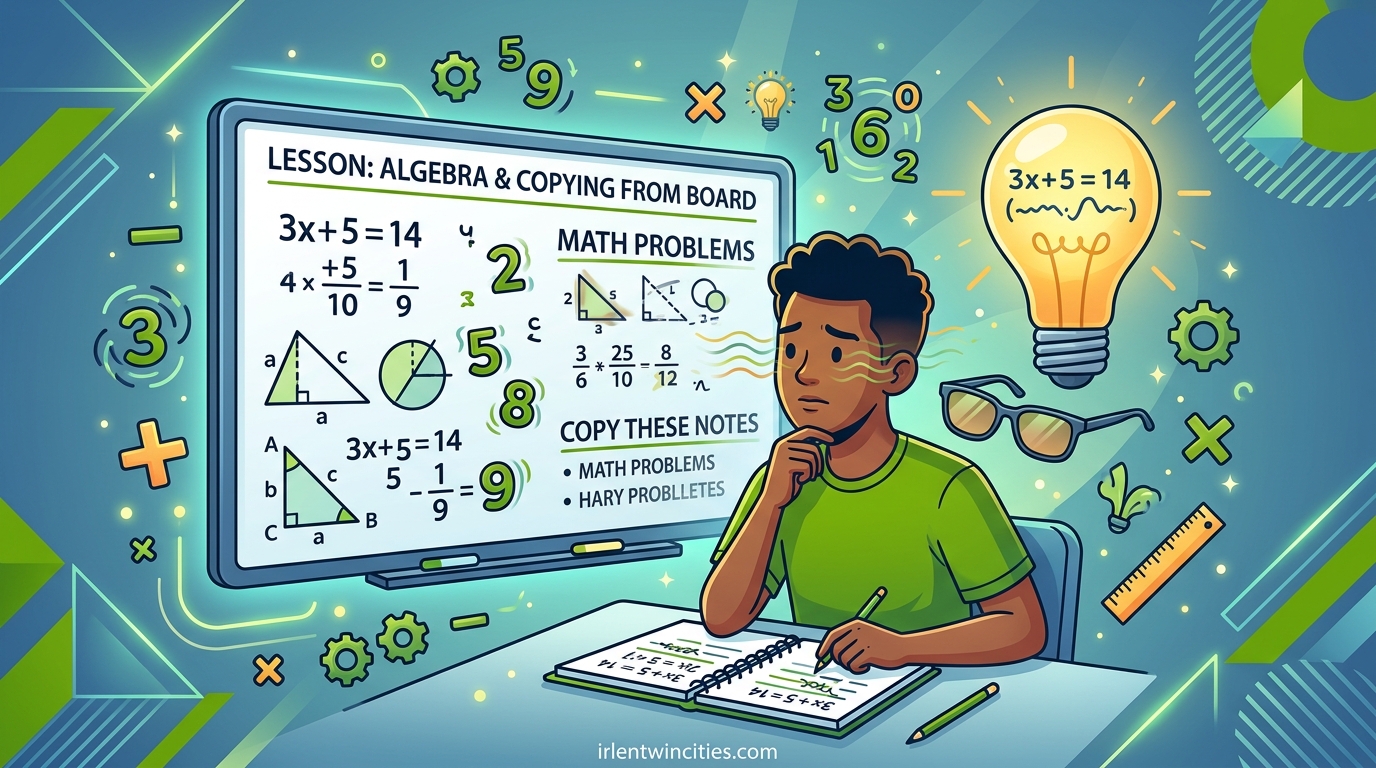
Imagine sitting in a classroom watching numbers and symbols shift, blur, and move on the page right before your eyes. For students with Irlen Syndrome, this is not an imagination exercise but a daily reality that makes math class feel like an impossible challenge. This visual processing disorder affects the way the brain interprets visual information, creating obstacles that extend far beyond reading difficulties into every aspect of academic life.
When someone has Irlen Syndrome, their brain overreacts to specific wavelengths of light and visual stimuli. This neurological condition causes the visual cortex to become over-active, leading to distortions that can make text appear to move, blur, or distort. For students trying to learn mathematics, these visual disruptions transform simple equations into confusing puzzles that have nothing to do with their actual mathematical abilities.
Understanding how Irlen Syndrome affects math and copying from the board is essential for parents, teachers, and anyone working with struggling students. Without this understanding, these children are often misdiagnosed as having dyslexia, ADHD, or simply being lazy. The reality is far more complex, and the solution starts with recognizing the problem for what it truly is.
Table of Contents
What Is Irlen Syndrome?
Irlen Syndrome, also known as Scotopic Sensitivity Syndrome, is a visual processing disorder that affects how the brain interprets visual information. Unlike eye problems that can be corrected with glasses or contact lenses, Irlen Syndrome originates in the brain’s visual cortex rather than in the eyes themselves. The condition causes certain visual stimuli, particularly those related to light, contrast, and specific wavelengths, to trigger an over-active response in the brain.
People with Irlen Syndrome experience a range of visual distortions that can include print appearing to move or blur, difficulty tracking lines of text, problems with depth perception, and heightened sensitivity to light. These symptoms are often most pronounced under fluorescent lighting, when reading from white paper, or when viewing high-contrast patterns. The condition exists on a spectrum, meaning some individuals experience mild symptoms while others face severe distortions that impact nearly every visual task.
Research indicates that Irlen Syndrome frequently co-exists with other conditions including dyslexia, ADHD, autism spectrum disorder, and traumatic brain injuries. This overlap often leads to misdiagnosis or incomplete diagnosis, as the visual processing issues become masked by the more well-known characteristics of these other conditions. Many individuals struggle for years without understanding why reading, writing, and mathematical tasks remain so challenging despite their best efforts and even above-average intelligence.
How Irlen Syndrome Affects Math Performance
Mathematics presents unique challenges for students with Irlen Syndrome that go beyond simple calculation errors. The subject requires sustained visual focus, pattern recognition, symbol differentiation, and spatial organization. When any of these elements become distorted by visual processing difficulties, the entire mathematical foundation begins to crumble.
Number Confusion and Symbol Mixing
Students with Irlen Syndrome frequently report confusing similar-looking numbers and symbols. The digits 2 and 5, 6 and 8, or 3 and 8 may appear nearly identical or may seem to swap positions when a student is trying to process mathematical expressions. This creates a fundamental barrier to accurate computation because the student literally cannot see the difference between the numbers they are working with.
The confusion extends beyond single digits to mathematical symbols themselves. Students may struggle to distinguish between addition and multiplication signs, confuse less-than and greater-than symbols, or misread equals signs as plus signs. These are not errors born from lack of understanding but rather from genuine visual distortion that makes accurate symbol recognition impossible. One student described the experience as “knowing that 6 and 8 are different numbers but watching my brain insist they look the same on the page.”
Graph Paper and Visual Distortions in Math
Graph paper presents a particularly severe challenge for students with Irlen Syndrome. The grid lines that help typical students organize mathematical thinking become visual traps that can cause numbers and data points to appear misaligned or to shift positions. A student attempting to plot coordinates may find that their carefully placed points drift across the grid lines, making accurate graphing nearly impossible.
Working through multi-step problems becomes exhausting as the visual effort required to track each step compounds. Students report losing their place frequently, having to re-read problems multiple times to extract the same information, and experiencing increasing distortion as they become fatigued. This fatigue factor is especially important because mathematics often requires longer sustained effort than other subjects, meaning students with Irlen Syndrome may start strong but deteriorate significantly as a class period continues.
The Homework Fatigue Factor
Perhaps one of the most insidious aspects of Irlen Syndrome in mathematics is how fatigue compounds throughout the day. Morning math classes might be manageable, but by afternoon, when brain fatigue sets in, visual distortions often intensify. Students who could barely complete morning assignments may find afternoon homework virtually impossible not because their mathematical understanding has changed but because their visual processing resources have been depleted.
This homework fatigue creates a frustrating pattern for parents and teachers. A child who demonstrates understanding during class may be completely unable to complete the same problems at home. Parents often describe spending hours trying to teach concepts their child seemed to grasp just hours earlier, not realizing that the child’s visual processing system has reached its daily limit. The result is frustration for everyone involved and a deepening sense that the student is not trying hard enough.
Why Copying from the Board Is So Difficult
Copying from the board requires a complex set of visual skills that many of us take for granted. The student must fixate on a point on the board, track across to gather information, hold that visual information in working memory, shift attention to their paper, and then execute the motor planning to reproduce what they saw. This process must be repeated for every symbol or word, with precision and accuracy required for the copied material to be useful.
For students with Irlen Syndrome, every step of this process is compromised. The information on the board may appear to shift or blur, making accurate visual capture difficult. The act of tracking across the board becomes exhausting as the eyes struggle to maintain fixation on moving or distorting text. Working memory becomes overloaded not just by the cognitive demands of the task but by the additional visual processing effort required to simply see accurately. By the time the student looks down at their paper, they may have already forgotten what they saw or may be so fatigued that errors multiply.
Visual Span and Tracking Issues
Students with Irlen Syndrome often have a reduced visual span, meaning they can only accurately process a smaller area of their visual field at any given moment. While a typical student might be able to take in an entire short word or several characters at a glance, students with Irlen Syndrome may need to focus on individual characters or smaller groups. This dramatically slows the copying process and increases the cognitive load of the task.
Tracking, or the ability to smoothly move the eyes across a line of text or across a board, is also compromised. Students may lose their place frequently, skip lines, or experience discomfort when attempting to follow along. This creates a labor-intensive copying process where even copying a single problem from the board can take several times longer than it would for a typically-developing peer.
The Physical Toll: Headaches and Eye Strain
The effort required to copy from the board when experiencing Irlen Syndrome symptoms often results in significant physical discomfort. Eye strain develops as the visual system works overtime to compensate for distortions. Headaches are common, ranging from mild tension headaches to debilitating migraines that can sideline a student for the remainder of the day. Facial tension, shoulder stiffness, and general fatigue round out the physical toll of what should be a simple classroom task.
Teachers may notice that students with Irlen Syndrome rush through copying assignments not because they are eager but because they are trying to minimize the time spent in visual distress. The resulting copied material is often incomplete, inaccurate, or illegible. Students develop avoidance strategies that may be misinterpreted as behavioral problems or lack of motivation when they are actually desperate attempts to reduce visual discomfort.
Classroom Accommodations That Help
The good news is that students with Irlen Syndrome can succeed in mathematics and can copy from the board with appropriate accommodations. These strategies do not cure the condition but effectively reduce or eliminate symptoms for most students, allowing their true abilities to emerge. The key is early identification and consistent implementation of helpful strategies.
Seating and Lighting Adjustments
Where a student sits in the classroom can make a significant difference in their ability to function. Students with Irlen Syndrome often benefit from seating that reduces glare and minimizes exposure to fluorescent lighting. Sitting near windows where natural light is available can help, as can positioning that places the board at a more comfortable angle. Some students find relief by moving away from the center of the room where fluorescent lights are typically brightest.
Reducing fluorescent lighting exposure is one of the most impactful accommodations available. This may mean allowing the student to work in areas with natural light, using desk lamps with full-spectrum bulbs, or advocating for classroom lighting upgrades. Even simple measures like allowing the student to wear a cap or sunglasses indoors when lighting cannot be modified can provide meaningful relief.
Copying Strategies
Rather than expecting students to copy directly from the board, teachers can provide copies of notes and materials in advance. This eliminates the visual burden of copying and allows the student to focus on the actual content being taught. When copying must occur, allowing students to copy from a peer who has already completed the task onto colored paper can be significantly easier than copying from a white board.
Increasing the distance between the student and the board can also help. When the board content appears larger but remains clear, the student may experience less distortion. Some students benefit from using a colored overlay on their paper to reduce contrast, while others find that using paper with a colored background rather than white reduces visual stress.
Math Accommodations
For mathematics specifically, providing graph paper with reduced grid lines, using larger-sized paper, and allowing the use of calculators for computation rather than memorization can all reduce the visual processing burden. Breaking multi-step problems into smaller segments, providing written instructions in addition to verbal ones, and allowing extended time on tests and assignments all acknowledge the additional effort required from students with Irlen Syndrome.
Colored overlays or tinted lenses prescribed specifically for the student’s pattern of Irlen Syndrome can dramatically reduce or eliminate visual distortions in many cases. These spectral filters work by blocking the specific wavelengths of light that trigger the over-active response in the brain. For students who respond well to this intervention, the change can be immediate and profound, with math problems suddenly appearing clear and stable rather than shifting and distorted.
Co-Existing Conditions to Consider
When evaluating a student for Irlen Syndrome, it is important to consider and assess for co-existing conditions that frequently accompany this visual processing disorder. Research indicates that the majority of individuals with Irlen Syndrome also experience one or more related conditions, and addressing only one aspect may leave remaining challenges unaddressed.
Dyslexia and Irlen Syndrome share many overlapping symptoms, particularly in reading and language processing. A student may have both conditions, requiring intervention for both the phonological processing difficulties of dyslexia and the visual processing difficulties of Irlen Syndrome. Similarly, ADHD frequently co-exists with Irlen Syndrome, with some researchers suggesting that the constant visual effort required may contribute to attention difficulties and fatigue.
Autism spectrum disorder, traumatic brain injuries, and sensory processing disorders may also co-exist with Irlen Syndrome. For students with these conditions, the visual processing difficulties add another layer of challenge to an already complex profile. Comprehensive assessment that considers all potential contributing factors leads to more complete understanding and more effective intervention strategies.
Frequently Asked Questions
Does Irlen Syndrome affect spelling?
Yes, Irlen Syndrome can affect spelling abilities. The visual distortions that make reading difficult also impact the ability to accurately perceive and remember letter sequences. Students may reverse letters, transpose word orders, or struggle to detect spelling errors because the words on the page do not appear the way they expect them to. This is particularly true when spelling depends on visual memory rather than phonetic decoding.
Is Irlen Syndrome an intellectual disability?
No, Irlen Syndrome is not an intellectual disability. It is a visual processing disorder that affects how the brain interprets visual information. Individuals with Irlen Syndrome typically have normal or above-average intelligence, and their difficulties with reading, math, and copying stem from visual processing challenges rather than cognitive limitations. With appropriate accommodations and interventions, individuals with Irlen Syndrome can achieve at levels consistent with their intellectual abilities.
Does Irlen Syndrome affect memory?
Irlen Syndrome can appear to affect memory because of the cognitive load required to process visual information. When a student’s brain is working overtime just to see accurately, fewer cognitive resources remain available for encoding and recalling information. Additionally, if visual information is being distorted or misinterpreted during initial exposure, the information stored in memory may itself be inaccurate. This is not true memory impairment but rather a consequence of competing cognitive demands.
Can you get disability for Irlen Syndrome?
Irlen Syndrome can qualify as a disability under certain circumstances, particularly when it significantly impacts a person’s ability to perform academic, professional, or daily living activities. In educational settings, students may be eligible for accommodations under Section 504 or special education services. In the workplace, reasonable accommodations may be required under disability discrimination laws. Documentation from qualified professionals is typically required to establish eligibility for accommodations and protections.
Conclusion
How Irlen Syndrome affects math and copying from the board reveals the significant impact that visual processing difficulties can have on academic performance. Students struggling with these challenges are not lazy, unintelligent, or unwilling to learn. They are fighting against a neurological condition that distorts their visual world and exhausts their cognitive resources in ways that are invisible to observers.
If you suspect that a student in your life may be experiencing Irlen Syndrome, seek a comprehensive assessment from a qualified professional. Early identification and appropriate intervention can transform academic outcomes and restore confidence in learners who have been struggling in silence. With understanding, accommodations, and when appropriate, spectral filters or colored overlays, students with Irlen Syndrome can access their full potential in mathematics and beyond.