
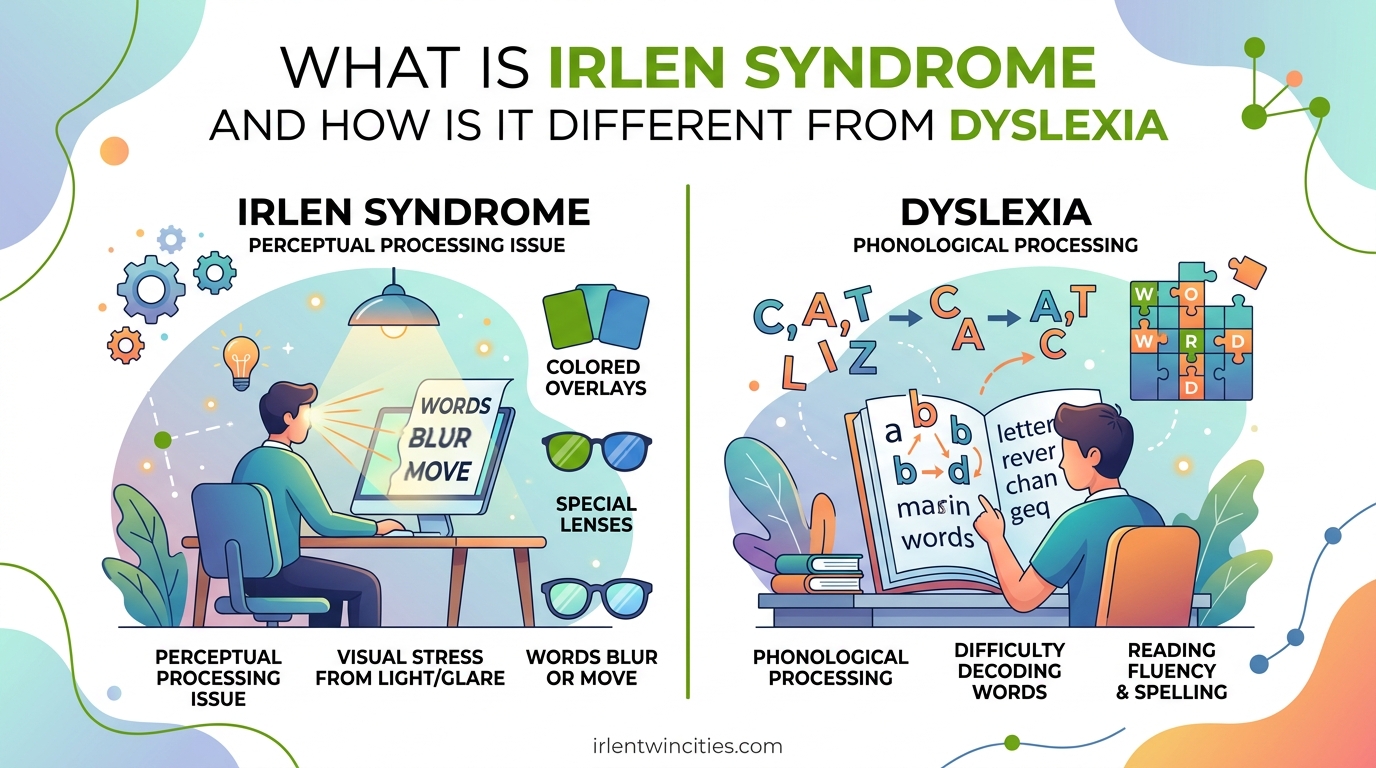
Many parents and educators use the terms Irlen Syndrome and dyslexia interchangeably. This creates confusion when trying to understand why a child struggles with reading. What is Irlen Syndrome and how is it different from dyslexia? The answer is simpler than most people realize.
Irlen Syndrome is a perceptual processing disorder. Dyslexia is a language-based learning disability. While both conditions affect reading, they originate in different parts of the brain and require different treatment approaches.
Our team has worked with hundreds of families navigating these diagnoses. We have seen how proper identification changes everything. In this guide, we will explain each condition clearly and show you exactly how to tell them apart.
Table of Contents
Understanding Dyslexia: A Language-Based Disorder
Dyslexia affects how the brain processes language. It is a neurobiological condition rooted in the phonological component of language processing.
Research shows that dyslexia involves the left temporal lobe of the brain. This is the area responsible for connecting sounds to written symbols. People with dyslexia struggle to decode words because their brains process phonological information differently.
Common Misconceptions About Dyslexia
The biggest myth is that dyslexia means seeing words backward. This is not true. People with dyslexia see words exactly as everyone else does.
The difficulty lies in manipulating the sounds within words. A child might read “cat” as “cut” because they struggle to hold the vowel sound in memory. This is a phonological deficit, not a visual problem.
Core Symptoms of Dyslexia
Dyslexia primarily affects reading accuracy and fluency. Common signs include slow reading, difficulty sounding out new words, and problems with spelling. Many people with dyslexia also struggle with rapid automatic naming tasks.
Writing can also be challenging. Organizing thoughts on paper and remembering spelling patterns takes extra effort. However, intelligence is not affected. Many people with dyslexia have average or above-average IQs.
What is Irlen Syndrome?
Irlen Syndrome is a perceptual processing disorder. It was first identified by Helen Irlen in the 1980s and is also known as Meares-Irlen Syndrome or Scotopic Sensitivity Syndrome.
The condition affects how the brain processes visual information. Specifically, the visual cortex becomes overactive when exposed to certain light wavelengths. This over-reaction causes the brain to struggle with processing visual stimuli efficiently.
The Science Behind Irlen Syndrome
Unlike dyslexia, which affects language processing areas, Irlen Syndrome involves the visual cortex. Brain imaging studies show increased activity in the visual cortex when affected individuals look at certain visual patterns.
This neurological difference means the problem is not with the eyes themselves. Eye exams typically come back normal for people with Irlen Syndrome. The difficulty is in how the brain interprets what the eyes see.
Who Can Have Irlen Syndrome?
Irlen Syndrome can affect anyone. It often runs in families, suggesting a genetic component. The condition can also be acquired through head injuries, high fevers, or certain medical conditions.
Estimates suggest that approximately 12-14% of the general population has Irlen Syndrome. Among people with reading difficulties, that number jumps to 46%. This high overlap explains why the conditions are so often confused.
Symptoms of Irlen Syndrome
The symptoms of Irlen Syndrome extend far beyond reading problems. This is one key way to distinguish it from dyslexia. While dyslexia primarily affects language tasks, Irlen Syndrome affects how someone experiences the visual world.
Reading and Visual Distortions
People with Irlen Syndrome often report that text appears unstable on the page. Words may seem to move, blur, or swirl. Some describe rivers of white running between lines of text.
Tracking from line to line can feel exhausting. The page might appear too bright or glaring. Some people see halos around words or shadows that make reading feel like a physical battle.
Physical Symptoms
Reading triggers real physical discomfort for people with Irlen Syndrome. Headaches are common, especially after reading for short periods. Eye strain and fatigue develop quickly.
Some people feel nauseous or dizzy when looking at certain visual patterns. Others experience sleepiness or an inability to concentrate. These physical symptoms are strong indicators that Irlen Syndrome might be present.
Light Sensitivity and Environmental Triggers
Fluorescent lights are a major trigger for many people with Irlen Syndrome. The flickering and glare cause significant discomfort. Bright sunlight, computer screens, and high-contrast patterns can also trigger symptoms.
Many people find relief by wearing sunglasses indoors or preferring dim lighting. They may avoid bright stores or struggle with driving at night due to headlight glare.
Beyond Reading: Sports, Driving, and Daily Life
Irlen Syndrome affects more than academics. Depth perception problems can make sports challenging. Judging distances while driving feels uncertain.
Some people struggle with stairs or curbs. Estimating heights and depths becomes difficult. These challenges set Irlen Syndrome apart from dyslexia, which primarily affects reading and writing.
Irlen Syndrome vs Dyslexia: Key Differences
Understanding the fundamental differences helps explain why these conditions require different interventions. Let us break down the core distinctions.
Dyslexia is a language-based learning disability. It affects phonological processing, reading accuracy, and spelling. Irlen Syndrome is a visual processing disorder. It affects how the brain interprets visual input and causes light sensitivity.
Neurological Basis Comparison
Dyslexia originates in the left temporal lobe. This brain region handles language processing, connecting sounds to letters. When this area functions differently, reading becomes a decoding challenge.
Irlen Syndrome involves the visual cortex. This is the back of the brain where visual information is processed. Overactivity here creates the distortions and discomfort that characterize the condition.
How Reading is Affected Differently
With dyslexia, the words on the page look fine. The person can see them clearly. The challenge is figuring out what the sounds and words mean.
With Irlen Syndrome, the words may look distorted or uncomfortable. The person can understand language perfectly. The challenge is that the visual input itself feels painful or unstable.
Assessment Methods
Dyslexia is typically assessed through comprehensive educational evaluations. These tests examine phonological awareness, decoding skills, reading fluency, and comprehension. Speech-language pathologists and educational psychologists often lead this testing.
Irlen Syndrome requires a specific screening by a certified Irlen diagnostician. The assessment involves testing with colored overlays to see if symptoms improve. Not all eye doctors or learning specialists are trained in this method.
Can You Have Both Irlen Syndrome and Dyslexia?
Yes, you absolutely can have both conditions. They are what medical professionals call comorbid conditions. This means they frequently occur together in the same person.
Research suggests that nearly half of people with reading difficulties have Irlen Syndrome. Many of these individuals also have dyslexia. Having one condition does not prevent having the other.
Why Comorbidity Matters
When both conditions are present, treating only one may not solve reading difficulties. A child might receive excellent dyslexia intervention yet still struggle because untreated Irlen Syndrome makes the page uncomfortable to look at.
We have heard from parents who spent years on phonics programs with limited success. Once their child tried colored overlays, reading suddenly clicked. The dyslexia was being addressed, but the Irlen Syndrome was blocking progress.
Signs You Might Have Both
If you or your child has diagnosed dyslexia but continues to struggle despite good intervention, consider Irlen Syndrome. Physical symptoms like headaches or eye strain are strong indicators.
Reports of words moving on the page or discomfort with fluorescent lighting suggest visual processing issues. These symptoms warrant an Irlen screening even if dyslexia is already diagnosed.
Treatment Approaches for Each Condition
Because Irlen Syndrome and dyslexia are different conditions, they require different treatments. Using the wrong intervention wastes time and frustrates everyone involved.
Treating Dyslexia
Dyslexia responds best to structured literacy approaches. These programs are explicit, systematic, and multisensory. They teach phonological awareness, decoding strategies, and sight word recognition.
Orton-Gillingham based programs are well-researched and effective. Wilson Reading System and Barton Reading are popular options. These interventions require consistency and typically take 2-3 years for significant improvement.
Treating Irlen Syndrome
Irlen Syndrome treatment is remarkably different and often immediate. The most common intervention is using colored overlays or specially tinted lenses.
During an Irlen screening, the diagnostician tests dozens of color combinations. They look for the specific spectral filter that reduces visual stress for that individual. When the right color is found, symptoms often disappear instantly.
Colored overlays are thin sheets placed over reading material. Irlen lenses are glasses with precision-tinted filters. Both work by filtering out the specific light wavelengths that trigger the visual cortex overactivity.
Real User Experiences
Despite skepticism from some medical professionals, people who use colored overlays report real benefits. One parent shared that her son finally read for pleasure after years of resistance. The words simply stopped moving.
Another adult described being able to work under fluorescent lights without headaches for the first time. These experiences suggest that while Irlen Syndrome remains controversial in some circles, the symptom relief is genuine for many users.
How Irlen Syndrome Differs from ADHD and Other Conditions
Irlen Syndrome is often misdiagnosed as ADHD. The reasons for this confusion are understandable but important to clarify.
Children who cannot focus on reading may appear inattentive. They might fidget, avoid schoolwork, or seem easily distracted. These behaviors look like ADHD, but they stem from visual discomfort rather than attention regulation problems.
Is Irlen Syndrome Like ADHD?
No, Irlen Syndrome is not the same as ADHD. ADHD is a neurodevelopmental condition affecting executive function and attention regulation. It involves different brain systems and requires different treatments.
However, the two conditions can look similar in a classroom setting. A child who cannot track text or feels nauseous looking at worksheets will naturally avoid reading. This avoidance behavior mimics the inattention seen in ADHD.
Other Conditions Mistaken for Dyslexia
Several conditions can mimic dyslexia and should be ruled out during assessment. Vision problems like convergence insufficiency affect reading but are treatable with eye exercises. Hearing impairments can affect phonological development.
Speech and language disorders, intellectual disabilities, and lack of educational opportunity can all present as reading difficulties. A thorough evaluation should consider these possibilities before diagnosing dyslexia or Irlen Syndrome.
Is Irlen Syndrome an Intellectual Disability?
No, Irlen Syndrome is not an intellectual disability. It is a specific visual processing disorder that affects how information enters the brain, not how the brain processes that information cognitively.
People with Irlen Syndrome have normal intelligence. In fact, many are highly capable learners who simply need the visual stress removed. Once that happens, they can demonstrate their true abilities.
Frequently Asked Questions
Can you have Irlen Syndrome and dyslexia?
Yes, these conditions frequently coexist. Research suggests up to 46% of people with reading difficulties have Irlen Syndrome, and many of those also have dyslexia. Having one condition does not prevent having the other. This comorbidity means both conditions may need treatment for reading to improve.
Is Irlen Syndrome like ADHD?
No, Irlen Syndrome and ADHD are different conditions. ADHD affects attention regulation and executive function. Irlen Syndrome affects visual processing and causes light sensitivity. However, they can look similar because children with untreated Irlen Syndrome may appear inattentive or avoidant during reading tasks due to visual discomfort rather than attention problems.
Is Irlen Syndrome an intellectual disability?
No, Irlen Syndrome is not an intellectual disability. It is a visual processing disorder that affects how visual information is interpreted, not cognitive ability. People with Irlen Syndrome have normal intelligence. The condition creates barriers to demonstrating knowledge through reading, but does not affect intelligence itself.
What gets mistaken for dyslexia?
Several conditions are commonly mistaken for dyslexia. Irlen Syndrome is frequently misdiagnosed as dyslexia because both cause reading difficulties. ADHD, vision problems like convergence insufficiency, hearing impairments, and speech-language disorders can also mimic dyslexia. Proper assessment is essential to identify the true cause of reading struggles.
Is Irlen Syndrome real?
While controversial in some medical circles, Irlen Syndrome is recognized by many educational professionals and researchers. Brain imaging shows increased visual cortex activity in affected individuals. Thousands of people report symptom relief with colored overlays and Irlen lenses. The condition is listed in international health classification systems, though debate continues about its prevalence and diagnostic criteria.
Conclusion
Understanding what is Irlen Syndrome and how is it different from dyslexia empowers you to seek the right help. These conditions are not the same thing, though they can occur together. Dyslexia is a language-based learning disability affecting phonological processing. Irlen Syndrome is a visual processing disorder causing light sensitivity and visual distortions.
Proper assessment makes all the difference. A child struggling with reading needs evaluation for both conditions, not just one. Treating only dyslexia when Irlen Syndrome is present leaves a significant barrier in place. Treating only Irlen Syndrome when dyslexia is present leaves underlying decoding problems unresolved.
If you or someone you love struggles with reading, headaches, or light sensitivity, consider scheduling assessments for both conditions. The path to easier reading might be simpler than you think. For some, it is as straightforward as finding the right color.