
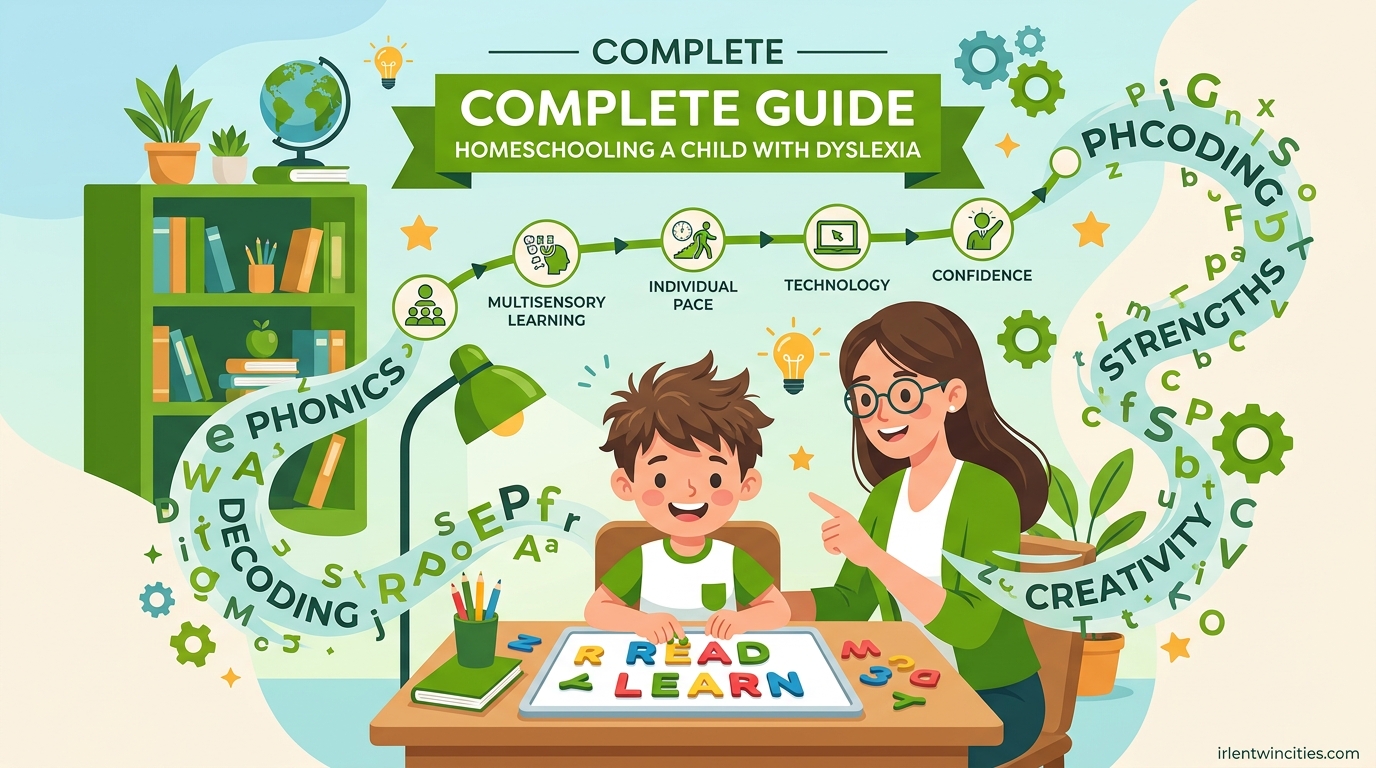
When our family first received the dyslexia diagnosis, I stared at the paperwork wondering if I was qualified to teach my own child. That was seven years ago. Today, my daughter reads at grade level and actually enjoys books. Homeschooling a child with dyslexia is not only possible; it can be the best educational decision you ever make. This guide walks you through exactly where to start, what to expect, and how to build a learning environment where your child can thrive.
The overwhelm you feel right now is completely normal. I have spoken with hundreds of parents navigating this journey, and nearly every one asks the same questions. Am I capable? Will I damage our relationship? What if I choose the wrong curriculum? By the end of this guide, you will have a clear roadmap and the confidence to take the first step.
Table of Contents
Understanding Dyslexia Before You Begin
Before diving into curriculum catalogs and state requirements, you need to understand what dyslexia actually is. Misconceptions about this learning difference can derail your homeschooling before it even starts. Let us clear those up first.
What Dyslexia Really Is (And Is Not)
Dyslexia is a language-based learning difference that affects how the brain processes written language. It has absolutely nothing to do with intelligence. Children with dyslexia often have average or above-average IQs. Their brains simply process phonological information differently, making it harder to connect sounds with letters and blend those sounds into words.
This is not a vision problem. Reversing letters like b and d is common in all young learners, not just dyslexic children. Dyslexia is neurological, rooted in brain structure and function. It affects reading, spelling, writing, and sometimes speech. Understanding this helps you choose teaching methods that work with your child’s brain rather than against it.
The Hereditary Factor
Dyslexia runs in families. If you struggled with reading, spelling, or learning a foreign language, there is a good chance you share this trait with your child. Neither parent is more likely to pass it on; it can come from either side of the family. This genetic connection is actually helpful. Parents who understand dyslexia personally often make excellent homeschool teachers because they truly get it.
I have worked with mothers who finally understood their own childhood struggles only after researching their child’s diagnosis. This shared experience can build an incredibly strong bond between you and your student. You become fellow travelers on the same journey rather than adversaries at the kitchen table.
Common Signs and Getting Evaluated
Early signs include difficulty learning letter sounds, trouble rhyming, and struggles with phonemic awareness. School-age children might read slowly, guess at words based on context, or avoid reading altogether. Spelling is often wildly inconsistent, with the same word spelled differently within the same paragraph.
A formal evaluation by a psychologist or educational diagnostician provides documentation that serves two purposes. First, it confirms what you suspect and rules out other issues. Second, it creates a paper trail for any future educational needs, including possible accommodations for standardized testing or college. Many states accept homeschool portfolios for these evaluations, making the process easier than you might expect.
Benefits and Challenges of Homeschooling a Child With Dyslexia
Deciding to homeschool is deeply personal. For families dealing with dyslexia, the decision often comes after watching a child struggle in traditional classrooms. Understanding both the benefits and challenges helps you prepare realistically.
Why Homeschooling Can Be the Right Choice
Individualized pacing is the greatest advantage. Your child can spend three months mastering short vowel sounds if that is what they need. There is no pressure to keep up with classmates or hide difficulties to avoid embarrassment. This freedom removes the shame that often accompanies dyslexia in group settings.
Multisensory instruction works best for dyslexic learners, and homeschooling allows you to incorporate movement, touch, and visual elements into every lesson. You can take breaks when frustration builds. You can repeat lessons without anyone knowing. Most importantly, you can preserve your child’s confidence while building skills at their own pace.
I have seen children who cried at the mention of reading become book lovers after just one year of patient, individualized instruction at home. The transformation happens when children feel safe to fail and try again without judgment.
Challenges to Prepare For
Time demands top the list. Teaching reading to a dyslexic child requires consistent, daily instruction. It is not a subject you can hand off to a workbook. Parents often spend 45 minutes to an hour daily on reading instruction alone, especially in the early years.
The emotional toll surprises many parents. Watching your child struggle triggers feelings ranging from frustration to grief. You may question your methods daily. Progress often feels slow or non-linear, with sudden leaps followed by apparent regression. Record-keeping adds another layer of responsibility, as you will need to document your child’s work for state requirements or future transitions back to traditional school.
Socialization concerns come up frequently, though they are usually manageable. Dyslexic children often benefit from social environments where reading is not the central activity. Sports, art classes, and hands-on clubs provide social interaction without the academic pressure that can damage self-esteem.
How to Start Homeschooling a Child With Dyslexia
Starting your homeschooling journey requires more than buying a curriculum. These five steps create the foundation for success. Take your time with each one.
Step 1: Research Your State’s Homeschool Laws
Every state has different requirements for homeschooling. Some require notification to the school district. Others mandate standardized testing or portfolio reviews. A few have minimal regulations. You need to understand your legal obligations before withdrawing your child from school.
Contact your state homeschool organization for the most current information. These groups stay updated on legislative changes and can guide you through the paperwork. Many offer templates for letters of intent, attendance records, and portfolio formats. Knowing you are compliant with state law removes significant stress from the process.
Step 2: Get a Professional Evaluation (If You Haven’t Already)
If your child has not had a comprehensive educational evaluation, consider getting one. A thorough assessment identifies your child’s specific strengths and weaknesses. It reveals whether additional learning differences like ADHD or dysgraphia are present. The results guide your curriculum choices and teaching strategies.
Evaluations typically include tests of cognitive ability, academic achievement, phonological processing, and working memory. The report you receive becomes a roadmap for instruction. Some insurance plans cover educational testing, and some university psychology departments offer reduced-cost evaluations through their training clinics.
Step 3: Choose Your Curriculum and Approach
This decision paralyzes many parents. The options seem endless, and every program promises results. For dyslexic learners, look for curriculum based on the Orton-Gillingham approach. This method uses multisensory techniques, teaches phonics systematically, and progresses at a pace that allows mastery before moving forward.
Structured literacy is another term to search for when evaluating programs. This approach explicitly teaches the structure of language, including phonology, sound-symbol correspondence, syllable types, morphology, and syntax. Programs that use this method align with what research shows works best for dyslexic brains.
Start with reading and spelling instruction. These are the core areas affected by dyslexia. You can add other subjects gradually as your child gains confidence. Many parents find that focusing intensively on reading for the first year produces better long-term results than trying to cover every subject at once.
Step 4: Set Up Your Learning Environment
Your learning space does not need to look like a classroom. In fact, it probably should not. Dyslexic children often learn better in comfortable, low-pressure settings. A kitchen table, couch, or even the backyard can work beautifully. The key is consistency, not location.
Minimize distractions during reading instruction. Turn off screens, silence phones, and keep younger siblings occupied elsewhere. Consider noise-canceling headphones if your home is naturally noisy. Good lighting helps reduce eye strain, especially for children who work hard to decode text.
Set up assistive technology early. Text-to-speech software reads digital text aloud, allowing your child to access content above their reading level. Speech-to-text lets them compose writing without the physical struggle of spelling. Audiobooks open entire libraries of content. These tools are not cheating; they are accommodations that level the playing field.
Step 5: Create a Flexible Daily Schedule
Routine helps dyslexic children feel secure, but rigidity backfires. Plan your days with structure and built-in flexibility. Reading instruction happens best when your child is fresh, usually in the morning. Keep lessons short; 20 to 30 minutes of focused work beats an hour of frustration.
Build movement into your schedule. Dyslexic learners often have excellent spatial reasoning and physical coordination. Physical activity before or after reading lessons can improve focus and retention. Do not skip recess. Do not eliminate art or music to make more time for phonics. These subjects build the neural connections that support reading development.
Choosing the Right Dyslexia Homeschool Curriculum
Not all curriculum marketed for dyslexia actually follows evidence-based methods. Learning to identify truly effective programs saves you money and prevents frustration for your child.
What Makes a Curriculum Dyslexia-Friendly?
Look for programs that explicitly teach phonological awareness. This is the ability to hear, identify, and manipulate sounds in spoken language. It is the foundation of reading, and most dyslexic children need direct, systematic instruction in this area. Phonics-based instruction should be explicit, not embedded or incidental.
Multisensory learning is essential. The best programs incorporate visual, auditory, kinesthetic, and tactile elements simultaneously. Your child might trace letters in sand while saying the sound aloud, then write the letter while looking at it. This multi-channel approach creates stronger neural pathways than single-sensory methods.
The curriculum should progress systematically from simple to complex concepts. It should not jump around or assume prior knowledge. Each lesson should build on the previous one, with plenty of review built in. Mastery, not exposure, should be the goal.
Popular Orton-Gillingham Based Programs
All About Reading consistently receives positive feedback from dyslexia homeschooling families. It is open-and-go for parents, requiring no special training. The program uses multisensory activities, decodable readers, and built-in review. It is also one of the more affordable comprehensive options.
Logic of English combines phonics, spelling, handwriting, and grammar into a unified program. It works well for families who want an all-in-one language arts curriculum. The Foundations level covers ages 4 to 7, while Essentials works for ages 8 and up, including struggling readers of any age.
Barton Reading and Spelling is considered the gold standard by many reading specialists. It is comprehensive, systematic, and extremely thorough. However, it is also one of the most expensive options and requires significant parent training. Some families use Barton for their primary struggling reader and a less intensive program for siblings.
Nessy Learning offers an affordable online option based on Orton-Gillingham principles. It works particularly well for children who enjoy game-based learning. Many families use Nessy as a supplement or for practice between formal lessons. It requires less parent involvement than book-based programs, which can be helpful for working parents.
Free and Budget-Friendly Resources
Homeschooling does not require expensive curriculum. The International Dyslexia Association provides free fact sheets and resource lists. Many public libraries carry Orton-Gillingham based programs or can borrow them through interlibrary loan. The Reading and Spelling Pure Sounds videos on YouTube offer free, systematic phonics instruction.
Progressive Phonics is a free, downloadable program that teaches reading and handwriting together. It is particularly good for younger children just starting out. The Barton Tutor Screening, while designed for potential tutors, gives parents a free introduction to the Orton-Gillingham approach.
For spelling, Spelling City offers free practice games. Librivox provides free audiobooks of classic literature. Your library likely partners with apps like Hoopla or Libby for free digital content. With creativity, you can build an entire program for under one hundred dollars.
When to Use a Tutor Instead
Sometimes the parent-child dynamic makes home instruction difficult. If every reading lesson ends in tears for either of you, consider hiring a tutor. An Orton-Gillingham trained tutor provides professional reading instruction while you maintain homeschooling for other subjects. This hybrid approach works well for many families.
Look for tutors certified in programs like Wilson Reading System, Barton, or Lindamood-Bell. Ask about their experience specifically with dyslexia, not just general reading tutoring. Many tutors offer online sessions, expanding your options beyond your local area. Some families do tutoring twice weekly and practice at home on other days.
Effective Teaching Strategies for Dyslexic Learners
How you teach matters as much as what you teach. These strategies transform frustrating lessons into productive learning experiences.
The Power of Multisensory Instruction
Multisensory teaching engages multiple senses at once. When your child sees a letter, says its sound, and writes it in the air simultaneously, they create three neural pathways instead of one. This redundancy strengthens memory and retrieval.
Simple multisensory activities include writing in sand, shaving cream, or on textured surfaces. Use magnetic letters for building words. Have your child tap out sounds on their arm while saying them aloud. Incorporate movement by jumping on letter cards or throwing a ball while practicing sight words. These techniques feel like play but build serious reading skills.
I encourage parents to make multisensory activities part of every lesson, not just occasional treats. The tactile and kinesthetic elements are not extras; they are essential components of effective dyslexia instruction.
Assistive Technology That Actually Helps
Technology can be a game-changer for dyslexic learners. Text-to-speech apps like Voice Dream Reader or NaturalReader convert written text to spoken words. This allows children to access grade-level content even when their reading skills lag behind. They can learn history, science, and literature without being limited by decoding ability.
Speech-to-text tools like Dragon NaturallySpeaking or built-in phone dictation let children compose writing without spelling anxiety. For many dyslexic students, their vocabulary and ideas exceed their spelling ability. Dictation removes the mechanical barrier to written expression.
Audiobooks through Audible, Learning Ally, or your local library provide access to literature that would otherwise be impossible. Learning Ally specifically serves individuals with print disabilities and offers textbooks as well as pleasure reading. Do not reserve audiobooks for pleasure only; use them for school subjects too.
Apps like ModMath provide grid-based paper for math work, eliminating the organizational challenges of lining up numbers. Grammarly catches spelling and grammar errors in writing. Graphic organizers created in Google Docs or specialized apps help with writing structure. These tools do not make your child dependent; they make them independent.
Teaching Reading Comprehension
Once decoding skills develop, do not assume comprehension follows automatically. Dyslexic children often focus so intensely on reading the words that they lose track of meaning. Explicit comprehension instruction remains important.
Teach comprehension strategies directly. Show your child how to visualize what they read, make predictions, ask questions, and summarize. Use graphic organizers to map story elements or sequence events. Read aloud together and discuss what is happening. Model your own thinking by talking through your comprehension process.
Vocabulary instruction deserves special attention. Dyslexic children often have smaller reading vocabularies because they read less. Explicitly teach word meanings, word parts, and relationships between words. Use the words in conversation. Create word walls or personal dictionaries. Strong vocabulary supports comprehension at every level.
Preserving Your Relationship While Teaching
This is the part no curriculum covers but every parent worries about. Can you teach your child without damaging your relationship? The answer is yes, but it requires intentionality.
Watch for frustration signals in both of you. When your child starts rubbing their eyes, slumping, or giving one-word answers, the lesson is over regardless of what the schedule says. When you feel your own patience wearing thin, stop. Better to end early than to create negative associations with learning.
Celebrate small wins constantly. Your child spelled three words correctly after struggling with two. Celebrate that. They read a sentence without guessing. Celebrate that. They tried a new strategy when the first one failed. Celebrate that effort above all. Progress with dyslexia is measured in millimeters, not miles.
Maintain perspective by keeping non-academic parts of your relationship strong. Read aloud for pleasure without asking comprehension questions. Play games that have nothing to do with phonics. Spend time together that does not involve instruction. You are parent and child first, teacher and student second.
A Day in the Life: Sample Schedules
Concrete examples help more than abstract advice. Here are two sample schedules that work for real families.
Elementary Age Dyslexic Learner
Morning starts with breakfast and physical play. At 9:00 AM, we begin with a 30-minute reading lesson using All About Reading. This is our hardest cognitive work, done when focus is strongest. We follow with a 10-minute movement break.
At 9:45 AM, we do spelling instruction for 20 minutes. Then another break. Math happens at 10:30 AM for 30 minutes, using manipulatives and visual supports. By 11:00 AM, formal academics end. The afternoon includes read-alouds, science projects, art, or nature study. Audiobooks accompany quiet play or car rides.
Total formal instruction time is under two hours. The rest of the day includes free play, household routines, and extracurricular activities. This schedule prioritizes reading instruction while preserving childhood.
Middle School and Beyond
Older students need more content coverage but still require reading support. Our day starts at 8:30 AM with an hour of intensive reading and spelling instruction using Barton. This remains non-negotiable even in high school because remediation continues to work.
At 10:00 AM, we move to content subjects using audiobooks, videos, and hands-on materials. History and science happen through documentaries, read-alouds, and projects. Math uses computer-based instruction with built-in supports. Writing instruction happens twice weekly using assistive technology.
By early afternoon, formal work ends. The teen pursues interests like coding, art, or working with animals. Extracurriculars happen in late afternoon or evening. High school planning begins in eighth grade, focusing on colleges with strong disability services and test accommodations.
Essential Resources and Support for Parents
You cannot do this alone, and you should not try. These resources provide education, encouragement, and community.
Books Every Parent Should Read
The Dyslexic Advantage by Brock and Fernette Eide reframes dyslexia as a different pattern of brain organization with real strengths. Overcoming Dyslexia by Sally Shaywitz provides the science behind effective instruction. The Dyslexia Empowerment Plan by Ben Foss offers practical strategies from a dyslexic adult’s perspective.
For teaching guidance, The Orton-Gillingham Approach by Marcia Henry helps parents understand the methodology. Uncovering the Logic of English by Denise Eide explains our language’s patterns, helping you answer those endless “why” questions. These books transform you from a worried parent into a confident educator.
Online Communities and Local Support
Facebook groups like Homeschooling with Dyslexia provide daily encouragement and practical advice. The Well-Trained Mind forums have active special needs sections. Reddit communities offer honest, unfiltered experiences from other parents in the trenches.
Local support matters too. Search for Decoding Dyslexia chapters in your state; these parent advocacy groups offer resources and community. Some areas have homeschool cooperatives specifically for special needs learners. Connecting with other dyslexia families provides normalization and friendship for both you and your child.
When to Seek Professional Help
Sometimes you need outside support. If your child is not making progress after six months of consistent instruction, consult an educational therapist or reading specialist. They can assess your teaching approach and identify barriers you might have missed.
Educational therapists provide one-on-one intervention using specialized methods. They are different from general tutors; they have specific training in learning differences. If your budget allows, combining periodic therapist sessions with daily home practice can accelerate progress significantly.
Update evaluations every two to three years, especially before high school or college planning. Updated testing documents current skill levels and supports accommodation requests for SAT, ACT, or college disability services. Professional guidance during these transitions prevents costly mistakes.
Frequently Asked Questions
Should kids with dyslexia be homeschooled?
Many children with dyslexia thrive in homeschool environments because they receive individualized, multisensory instruction at their own pace. However, homeschooling is not the only option. Some children do well in traditional schools with proper support and accommodations. The best setting depends on your family’s resources, your child’s personality, and the quality of local school services. Homeschooling offers unique advantages for dyslexic learners, including the ability to use evidence-based methods without fighting for services.
What is the best homeschool curriculum for dyslexia?
The best curriculum follows the Orton-Gillingham approach with structured literacy principles. Popular options include All About Reading for its open-and-go format, Logic of English for comprehensive language arts coverage, and Barton Reading for intensive remediation. Nessy Learning offers an affordable online alternative. The best choice depends on your budget, your child’s age, and how much parent training you are willing to complete. Free options like Progressive Phonics can work for families with limited resources.
What is the best school setting for a child with dyslexia?
The best setting provides systematic, explicit instruction in reading and spelling using evidence-based methods. For some children, this happens in public school with a skilled special education team. For others, private schools specializing in learning differences provide the right environment. Many families find that homeschooling offers the most control over instruction quality and pacing. There is no universal best setting; there is only the best setting for your specific child and family situation.
Is dyslexia inherited from mother or father?
Dyslexia can be inherited from either parent. It is not gender-linked to either mothers or fathers. The condition runs in families, so if one parent has dyslexia, children have a higher chance of having it too. Both parents can carry genetic factors that contribute to dyslexia. Family history of reading difficulties, spelling problems, or trouble learning foreign languages often indicates a genetic component.
How long does it take to see progress with dyslexia remediation?
Progress with dyslexia remediation is typically slow but steady. Most families see noticeable improvement after six to twelve months of consistent, daily instruction. Significant gains often appear after two to three years of structured teaching. Individual results vary based on severity, consistency of instruction, and any coexisting conditions like ADHD. The key is consistent daily practice rather than intensive bursts followed by breaks. Progress is rarely linear; expect periods of plateau followed by sudden leaps forward.
Can I homeschool my dyslexic child without special training?
Yes, many parents successfully homeschool dyslexic children without formal teaching credentials. Programs designed for homeschoolers, like All About Reading, provide scripted lessons that require no special training. Parent education through books and online courses builds understanding of effective methods. Some families use tutors for intensive reading instruction while handling other subjects themselves. Your dedication and willingness to learn matter more than formal credentials. Many parents find their personal experience with their child’s struggles makes them particularly effective teachers.
Your Homeschooling Journey Starts Now
Homeschooling a child with dyslexia is one of the most rewarding challenges you will ever take on. The path is not always easy, but the destination is worth every difficult moment. You do not need to be a reading specialist. You do not need an education degree. You need patience, consistency, and a willingness to learn alongside your child.
Start with understanding your state’s homeschool laws. Get an evaluation if you have not already. Choose one curriculum and commit to it for at least six months. Set up your space, create a flexible routine, and begin. Progress will come. It may be slower than you hope, but it will come.
Connect with other dyslexia homeschooling families for support. Read the recommended books. Use assistive technology without guilt. Most importantly, protect your relationship with your child. You are not just teaching reading; you are raising a learner who will carry these skills and memories into adulthood.
Your child is not broken. Their brain simply works differently. Homeschooling allows you to teach to that different brain, building on strengths while remediating challenges. The confidence they gain from your patient, individualized instruction will serve them long after the phonics lessons end. Take a deep breath. You can do this. And your child is going to be okay; in fact, they are going to thrive.