
Medical Disclaimer: This article is for informational purposes only and does not constitute medical advice. Always consult with a qualified healthcare provider for diagnosis and treatment of concussion-related vision problems. If you experience sudden vision loss, severe headache, or other emergency symptoms, seek immediate medical attention.
Convergence insufficiency after concussion is the most common visual dysfunction following a brain injury, affecting approximately 47% of post-concussion patients. This condition occurs when your eyes cannot properly turn inward together to focus on near objects like books, screens, or faces during conversation. The vestibular and oculomotor systems are commonly affected in post-concussion syndrome, leading to symptoms that significantly impact reading, work performance, and quality of life during recovery.
Understanding convergence insufficiency is critical for anyone recovering from a concussion. Many patients receive clear standard eye exams yet continue experiencing debilitating visual symptoms that delay their return to school, work, and normal activities. This guide explains the signs, diagnostic process, and evidence-based treatments that help patients recover their visual function after a brain injury.
Table of Contents
What Is Convergence Insufficiency After Concussion?
Convergence insufficiency (CI) is an oculomotor dysfunction that affects your ability to coordinate both eyes when looking at nearby objects. In a healthy visual system, your eyes automatically turn inward (converge) when focusing on something close to your face. This convergence works together with accommodation (focusing the lens) and pupil constriction as part of the near triad reflex.
After a concussion, the diffuse axonal injury and neurovascular coupling disruption can damage the neural pathways controlling these eye movements. The result is an inability to maintain proper eye alignment during near tasks, causing one or both eyes to drift outward instead of turning inward together. This creates significant visual stress and functional impairment during activities requiring sustained close focus.
Research published in the Journal of Optometry and peer-reviewed studies on PubMed Central confirms that convergence insufficiency is the most frequent oculomotor disturbance in post-concussion syndrome. Unlike refractive errors that glasses can correct, CI is a functional vision problem involving the brain’s control of eye movements.
Signs and Symptoms of Convergence Insufficiency After Concussion
Recognizing the symptoms of convergence insufficiency helps patients seek appropriate care and avoid the frustration of being told their vision is “fine” despite experiencing significant daily challenges. Symptoms typically worsen during close work and improve with rest.
Visual Symptoms During Close Work
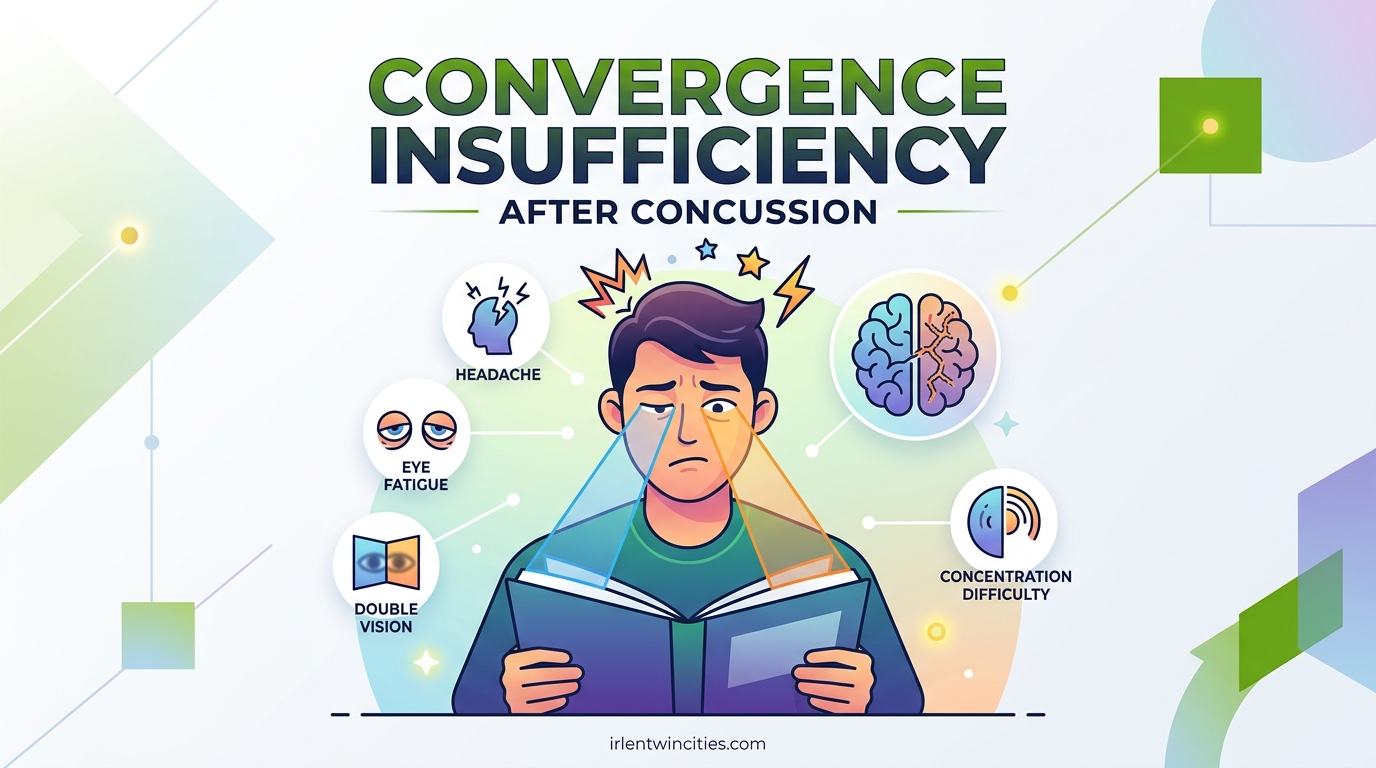
The hallmark symptom of CI is double vision (diplopia) when reading or looking at nearby objects. This double vision may appear as overlapping images, ghosting, or words that seem to split apart on the page. Many patients describe words that appear to swim, float, or move on the page when trying to read.
Blurred vision at near distances is another common complaint, even when distance vision remains clear. Patients frequently report losing their place while reading, skipping words or lines, and needing to use their finger to track text. These symptoms create significant reading difficulty that affects academic performance and work productivity.
Physical Discomfort and Headaches
Eye strain (asthenopia) develops quickly during close work, often within minutes of starting to read or use a screen. Many patients experience a persistent headache in the back of the head or behind the eyes after visual tasks. This discomfort differs from typical tension headaches and specifically relates to the effort required to maintain eye alignment.
Eye fatigue manifests as burning, watering, or a sensation of heavy eyelids during near work. Motion sensitivity may also develop, making it uncomfortable to track moving objects or tolerate visual motion in the environment. Some patients report feeling dizzy or nauseated when moving their eyes between near and far objects.
Functional Impact on Daily Activities
Reading becomes exhausting and inefficient, requiring significantly more effort than before the concussion. Many patients report that reading a single page now takes as much effort as reading an entire chapter previously required. Screen intolerance develops, making computer work, smartphone use, and television viewing uncomfortable or impossible for extended periods.
Depth perception issues may affect spatial awareness and coordination, particularly during sports or activities requiring precise hand-eye coordination. Some patients struggle with copying notes from a board to paper, as this requires rapid shifts between distance and near focus that the damaged vergence system cannot perform efficiently.
Symptom Triggers and Patterns
Exercise-induced visual dysfunction is common, with symptoms worsening during or after physical activity. This pattern frustrates athletes eager to return to play and patients trying to resume fitness routines. The mechanism involves the connection between the visual system, vestibular system, and autonomic nervous system during exertion.
Prolonged near work intensifies symptoms throughout the day. Morning reading may feel manageable, but afternoon computer work becomes unbearable. Poor lighting conditions, particularly fluorescent lights or glare, can exacerbate visual stress. Many patients also notice symptoms worsen when tired, stressed, or when experiencing other post-concussion symptoms like headache or dizziness.
Symptom Self-Assessment Checklist
Consider whether you experience these common indicators of convergence insufficiency after your concussion:
- Double vision when reading or looking at your phone
- Headaches that start within minutes of close work
- Words that appear to move, swim, or overlap on the page
- Needing to close one eye to read comfortably
- Difficulty concentrating on visual tasks
- Eye fatigue that forces you to stop reading
- Losing your place frequently while reading
- Closing cover test reveals an eye drifting outward
- Symptoms improve when looking at distant objects
If you identify with multiple items on this checklist, particularly symptoms that began or worsened after your concussion, evaluation by a neuro-optometrist or developmental optometrist is warranted.
Why Concussions Cause Convergence Insufficiency
Understanding the mechanisms behind post-concussion convergence insufficiency helps patients appreciate why standard eye exams may miss their condition and why specific treatments are necessary. The brain injury disrupts multiple systems involved in coordinated eye movement.
The Neurovascular Coupling Disruption
Concussions cause diffuse axonal injury that damages the brain’s white matter connections. These injuries disrupt neurovascular coupling, the process by which neural activity triggers appropriate blood flow to active brain regions. When this coupling fails, brain areas controlling eye movements receive insufficient oxygen and nutrients during visual tasks.
The result is functional impairment even when structural imaging appears normal. A patient may have a clear CT scan or MRI yet experience significant oculomotor dysfunction because the injury affects neural communication rather than anatomical structure. This explains the invisible nature of many post-concussion visual symptoms.
Brain Regions Affected by Concussion
Multiple brain areas contribute to convergence control, and concussions frequently affect them all. The occipital lobe processes visual input and communicates with other regions to coordinate responses. The parietal lobe integrates visual information with spatial awareness and attention systems. The frontal eye fields initiate and control voluntary eye movements including convergence.
The brainstem houses the cranial nerve nuclei that directly control the extraocular muscles. The cerebellum coordinates timing and precision of eye movements. When a concussion disrupts communication between these regions, the vergence system cannot function properly. Shear forces during the impact particularly affect long white matter tracts connecting these distributed brain areas.
The Vision-Vestibular Connection
The vestibulo-ocular reflex (VOR) keeps your eyes stable during head movement by coordinating the vestibular system with eye movements. Concussions frequently damage both systems simultaneously, creating a complex interaction between balance problems and visual dysfunction. Many patients with convergence insufficiency also experience dizziness, motion sensitivity, and difficulty with visually demanding activities like grocery shopping or driving.
This connection explains why exercise often triggers visual symptoms. Physical exertion challenges the vestibular system, which in turn affects visual stability. Successful treatment of post-concussion convergence insufficiency often requires addressing both the oculomotor dysfunction and any concurrent vestibular impairments through multidisciplinary care.
How Convergence Insufficiency Is Diagnosed After Concussion
Accurate diagnosis of convergence insufficiency requires specialized testing beyond standard visual acuity screening. Many patients undergo normal comprehensive eye exams yet continue experiencing significant CI symptoms, leading to frustration and delayed treatment.
The Near Point of Convergence Test
The near point of convergence (NPC) test is the primary diagnostic tool for CI. During this test, the examiner moves a small target (often a penlight or printed card) toward the patient’s nose while the patient attempts to maintain single, clear vision of the target. The examiner observes the eyes for outward drift and asks the patient to report when the target doubles or when they can no longer maintain single vision.
Normal NPC is typically 6 centimeters or less from the nose. Values between 6 and 10 centimeters indicate borderline function, while values beyond 10 centimeters strongly suggest convergence insufficiency. Some post-concussion patients demonstrate NPC values of 15 centimeters or greater, indicating severe dysfunction. The test also assesses recovery after the target is removed, with normal recovery occurring within a few seconds.
Why Standard Eye Exams Often Miss CI
Standard comprehensive eye exams focus primarily on visual acuity (clarity of vision) and ocular health (structure of the eye). These exams measure whether you can see clearly at distance and near, whether you need glasses, and whether your eyes are healthy. However, they typically do not assess functional vision skills like eye teaming, tracking, or sustained convergence.
A patient can have 20/20 vision in each eye individually yet experience significant binocular vision dysfunction when using both eyes together. Standard exams may include a brief cover test but rarely include the extended near point of convergence testing or vergence range assessment necessary to detect CI. This creates the frustrating situation where patients are told their vision is normal despite experiencing debilitating symptoms.
Specialists Who Diagnose and Treat CI
Neuro-optometrists and developmental optometrists specialize in functional vision problems like convergence insufficiency. These professionals complete additional training beyond standard optometry education to assess and treat binocular vision disorders, accommodative dysfunction, and oculomotor problems. They perform comprehensive functional vision examinations that evaluate all aspects of the visual system.
Some ophthalmologists, particularly neuro-ophthalmologists, also diagnose and manage post-concussion vision problems. Vision therapists work under optometric supervision to provide rehabilitative treatment. When seeking care, look for providers who specifically mention experience with traumatic brain injury, post-concussion syndrome, or neuro-optometric rehabilitation.
Additional Vision Tests for Post-Concussion Patients
The Vestibular/Ocular Motor Screening (VOMS) assessment evaluates smooth pursuit, saccades (rapid eye movements between targets), convergence, and vestibular-ocular function. This screening tool helps identify patients who need further evaluation. Accommodative amplitude testing measures the eye’s ability to focus at near distances, as accommodative insufficiency frequently co-occurs with convergence insufficiency after concussion.
Additional assessments may include vergence facility testing (speed of convergence and divergence shifts), convergence accommodation measurements, and eye tracking evaluations. The King-Devick test assesses rapid eye movement function and can indicate oculomotor impairment. These tests create a comprehensive picture of the patient’s functional vision status and guide treatment planning.
Treatment Options for Convergence Insufficiency After Concussion
Multiple evidence-based treatment approaches address convergence insufficiency after concussion. The optimal approach depends on symptom severity, co-existing conditions, patient age, and practical factors like access to specialized care.
Vision Therapy and Neuro-Optometric Rehabilitation
In-office vision therapy represents the gold standard treatment for convergence insufficiency, with success rates between 85% and 100% for appropriately selected patients. This therapy involves weekly sessions with a vision therapist using specialized equipment to train the brain’s control of eye movements. Activities may include computerized vergence training, prism activities, lens flippers, and 3D viewing tasks.
Neuro-optometric rehabilitation specifically addresses post-TBI vision problems by integrating visual training with other sensory-motor activities. Treatment typically spans 12 to 24 weeks, with most patients attending weekly 45-minute sessions. The therapy progresses from basic convergence skills to complex tasks integrating eye movements with balance, coordination, and cognitive demands. Research demonstrates significant improvement in symptoms and functional outcomes following this approach.
Home-Based Exercise Programs
Home exercises serve as either primary treatment for mild cases or adjunctive therapy supporting in-office vision therapy. The pencil push-up exercise involves focusing on a small letter on a pencil while slowly bringing it toward the nose until double vision occurs, then repeating this process. Patients typically perform 10-15 repetitions, several times daily.
While convenient and free, home exercises alone show lower success rates than in-office therapy, with studies indicating approximately 40-50% improvement compared to 85-100% for office-based treatment. Home programs work best for motivated patients with mild CI and good self-awareness of their symptoms. Patients should stop exercises and consult their provider if symptoms worsen significantly.
Prism Glasses and Optical Aids
Base-in prism glasses reduce the demand on the convergence system by optically decreasing the amount the eyes must turn inward. These glasses provide symptomatic relief for some patients but do not treat the underlying dysfunction. Prisms may be incorporated into regular prescription glasses or provided as reading-only lenses.
The American Academy of Ophthalmology clinical statement notes that prism glasses offer temporary relief for some patients but emphasizes that vision therapy addresses the root cause. Some patients use prisms during the initial treatment phase while undergoing vision therapy, eventually reducing or eliminating prism power as convergence improves.
The Role of Multidisciplinary Care
Post-concussion recovery often requires coordinated care across multiple specialties. Concussion clinics integrate vision therapy with vestibular rehabilitation, physical therapy, occupational therapy, and neuropsychology services. This approach addresses the interconnected nature of post-concussion symptoms, where visual problems, balance issues, and cognitive difficulties interact and compound each other.
Vestibular therapy specifically targets the connection between vision and balance that many CI patients experience. Occupational therapists address visual processing and integration during daily activities. Neuropsychologists evaluate cognitive impacts of visual dysfunction on attention and learning. This team approach maximizes recovery outcomes for complex post-concussion cases.
Recovery Timeline and What to Expect
Understanding the expected recovery timeline helps patients set realistic expectations and recognize when additional intervention is needed. While every concussion is unique, general patterns guide recovery planning.
Acute Phase: 0-2 Weeks Post-Injury
During the initial two weeks following concussion, the brain requires rest to begin healing. Visual symptoms may fluctuate significantly during this period. Standard recommendations include brief periods of cognitive and physical rest followed by gradual reintroduction of normal activities as tolerated.
Many patients experience convergence-related symptoms during this phase but may attribute them to general concussion effects. Vision typically stabilizes as other acute symptoms resolve. If visual symptoms persist beyond two weeks or significantly interfere with return to school or work, evaluation by a vision specialist becomes appropriate.
Recovery Window: 2-6 Weeks
Between two and six weeks post-injury, significant natural healing occurs. Many patients with mild convergence difficulties experience spontaneous resolution during this window. For those whose symptoms persist, this period marks the transition from acute concussion management to targeted treatment of specific post-concussion syndrome symptoms.
Patients should monitor whether visual symptoms are improving, staying the same, or worsening. Gradual improvement suggests continued natural recovery. Persistent or worsening symptoms indicate the need for professional evaluation and potential intervention.
Persistent Symptoms: 6+ Weeks
When convergence insufficiency symptoms continue beyond six weeks, the diagnosis becomes post-concussion syndrome with oculomotor dysfunction. This stage requires active treatment rather than waiting for natural resolution. The longer symptoms persist without treatment, the more likely patients are to develop compensatory habits that can complicate recovery.
However, even patients months or years post-injury can achieve significant improvement with appropriate vision therapy. The brain retains neuroplasticity that allows functional vision rehabilitation regardless of time since injury, though earlier intervention typically produces faster results.
School and Work Accommodations for Convergence Insufficiency
Practical accommodations reduce visual demands during recovery, allowing patients to maintain academic or work responsibilities while undergoing treatment. These modifications do not replace treatment but provide essential support during the healing process.
Classroom and Workplace Modifications
Position seating away from windows and direct light sources to reduce glare. Request preferential seating closer to presentation materials to minimize the visual effort required to see clearly. Reduce visual clutter by keeping workspaces organized and minimizing decorations or distractions in the visual field.
Allow frequent breaks during visually demanding tasks. Permit students to close their eyes briefly or look away from near work periodically. Provide printed materials rather than requiring extensive copying from boards. Allow use of a finger or ruler to maintain place while reading.
Technology and Screen Accommodations
The 20-20-20 rule recommends taking a break every 20 minutes to look at something 20 feet away for 20 seconds. This simple practice reduces cumulative eye strain during screen use. Increase text size and contrast on digital devices to reduce visual effort. Use text-to-speech software for extended reading assignments.
Consider blue light filtering or FL-41 tinted lenses for screen intolerance and light sensitivity. Adjust monitor position to promote proper posture and viewing angle. Print documents when possible to reduce screen time. Use voice-to-text for writing assignments to reduce computer interaction time.
Return-to-Learn Protocol for Students
Students recovering from concussion with convergence insufficiency benefit from a gradual return to academic demands. Begin with minimal visual requirements, such as listening to lectures without note-taking. Progress to attending class with a scribe or audio recording. Gradually introduce reading assignments starting with brief passages.
Accommodations may include extended time for tests and assignments, reduced homework load, permission to use audio books, and exemption from visually demanding activities like certain physical education requirements. Formal 504 Plans or IEPs document these accommodations for students who need long-term support.
Home Exercise Program for Convergence Insufficiency
Home exercises support professional treatment and help maintain gains between therapy sessions. These activities require minimal equipment and can be performed in minutes throughout the day.
Pencil Push-Ups
Hold a pencil with a small letter or detail at arm’s length. Focus your vision on the letter while slowly bringing the pencil toward your nose. Stop when the letter doubles or you can no longer maintain single, clear vision. Hold for a few seconds if possible, then return to the starting position.
Perform 10-15 repetitions, three to five times daily. As your convergence improves, you should be able to bring the pencil closer before experiencing double vision. Never force your eyes past the point of double vision, as this creates additional strain.
Brock String Exercises
The Brock string provides vergence training using a string with colored beads at various distances. Secure one end of the string to a wall or door at nose height. Hold the other end to your nose. Focus on each bead in sequence, observing whether you see one bead or two strings (indicating proper vergence) or two beads (indicating convergence insufficiency).
Practice convergence by focusing on near beads, then divergence by focusing on far beads. This trains the full range of vergence function. Perform these exercises for 5-10 minutes, twice daily. A vision therapist can provide specific guidance on bead placement and progression.
Exercise Guidelines and Precautions
Stop exercises immediately if you experience significant headache, nausea, dizziness, or worsening of concussion symptoms. Mild eye fatigue is normal, but significant symptom increase indicates you are pushing too hard. Quality of convergence matters more than quantity of repetitions.
Perform exercises when well-rested and not experiencing other significant post-concussion symptoms. Consistency matters more than intensity. Brief, frequent practice sessions produce better results than occasional lengthy sessions. Track your progress by noting how close you can bring the target before double vision occurs.
The Connection Between Convergence Insufficiency and Irlen Syndrome
Convergence insufficiency and Irlen Syndrome (also known as scotopic sensitivity or visual stress) frequently co-occur in post-concussion patients, creating a complex interaction of visual symptoms that requires comprehensive assessment.
Understanding the Overlap
Both conditions cause reading difficulties, eye strain, and headaches during visual tasks. Irlen Syndrome specifically involves sensitivity to certain wavelengths of light that create visual stress and perceptual distortions. Many patients with post-concussion convergence insufficiency report light sensitivity and visual discomfort that extends beyond the mechanical eye teaming problems of CI.
The diffuse brain injury of concussion can simultaneously damage the oculomotor pathways controlling convergence and the neural processing systems affected in Irlen Syndrome. This explains why some patients improve significantly with vision therapy for CI yet continue experiencing visual stress symptoms that colored overlays or filters may address.
Colored Overlays and Filters for CI Patients
While vision therapy treats the mechanical eye teaming dysfunction of convergence insufficiency, colored overlays or precision-tinted lenses may address concurrent visual stress symptoms. These interventions are not alternatives but rather complementary approaches that address different aspects of post-concussion visual dysfunction.
Patients who continue experiencing visual discomfort, light sensitivity, or perceptual distortions despite improved convergence after vision therapy may benefit from Irlen screening. The combination of functional vision rehabilitation and appropriate color intervention addresses the full spectrum of post-concussion visual symptoms.
Frequently Asked Questions
Can a concussion cause convergence insufficiency?
Yes, convergence insufficiency is the most common visual dysfunction after concussion, affecting approximately 47% of post-concussion patients according to research. The vestibular and oculomotor/visual systems are commonly affected in post-concussion syndrome due to diffuse brain injury that disrupts neural pathways controlling eye movements.
What does convergence insufficiency feel like?
Convergence insufficiency causes symptoms including: double vision when reading, eyestrain or headaches within minutes of close work, words appearing to swim or overlap on the page, losing your place while reading, difficulty concentrating on screens or books, and eye fatigue that forces you to stop visual tasks. Many patients describe needing way more effort to read than before their concussion.
What is the 20 20 20 rule for concussions?
The 20-20-20 rule recommends taking a break every 20 minutes to look at something 20 feet away for 20 seconds. This helps reduce eye strain during concussion recovery by giving the visual system periodic rest from sustained near work. While helpful for general eye strain, convergence insufficiency requires specific treatment beyond this rule.
What are three signs of post-concussion syndrome?
Three common signs of post-concussion syndrome are: (1) Persistent headaches, particularly with visual or cognitive tasks, (2) Visual problems including blurred vision, double vision, or eye strain, and (3) Difficulty with concentration, memory, or cognitive processing. These symptoms lasting beyond 2-4 weeks after concussion indicate post-concussion syndrome requiring professional evaluation.
How long does convergence insufficiency last after concussion?
Convergence insufficiency duration varies significantly. Some patients recover naturally within 2-6 weeks as the brain heals. Others experience persistent symptoms lasting months or longer without treatment. With appropriate vision therapy, most patients show significant improvement within 12-24 weeks. Even patients years post-injury can achieve improvement through neuro-optometric rehabilitation.
Can convergence insufficiency be fixed?
Yes, convergence insufficiency can be successfully treated. Vision therapy achieves 85-100% success rates for appropriately selected patients. Home exercises help mild cases. The brain’s neuroplasticity allows functional vision rehabilitation even after significant time has passed since the initial injury. Treatment requires persistence but produces meaningful functional improvement for most patients.
Does vision therapy work for convergence insufficiency?
Research and clinical evidence demonstrate that vision therapy is highly effective for convergence insufficiency, with success rates of 85-100% reported in studies. Office-based vision therapy with a trained therapist produces better outcomes than home exercises alone. Treatment typically requires 12-24 weeks of weekly sessions to achieve lasting results.
Is convergence insufficiency permanent after concussion?
Convergence insufficiency is typically not permanent after concussion. While symptoms may persist indefinitely without treatment, appropriate vision therapy or neuro-optometric rehabilitation can restore normal convergence function for most patients. Even chronic cases months or years after injury can improve significantly with proper intervention.
Convergence insufficiency vs accommodative insufficiency – what’s the difference?
Convergence insufficiency affects the eyes’ ability to turn inward together for near focus. Accommodative insufficiency affects the eye’s ability to change focus (accommodation) for different distances. These conditions frequently co-occur after concussion as both involve the near triad system. Both cause near vision problems but require slightly different testing and treatment approaches.
When should I see a doctor for post-concussion vision problems?
See a doctor if vision problems persist beyond 2-4 weeks after concussion, significantly interfere with reading or screen use, cause frequent headaches, or affect school or work performance. Seek emergency care for sudden vision loss, severe eye pain, or vision changes accompanied by severe headache or neurological symptoms. For persistent convergence insufficiency, consult a neuro-optometrist or developmental optometrist specializing in post-TBI vision rehabilitation.
Conclusion: Taking Action on Convergence Insufficiency After Concussion
Convergence insufficiency after concussion represents one of the most common yet under-recognized complications of brain injury, affecting nearly half of all post-concussion patients. The good news is that this condition responds excellently to appropriate treatment, with vision therapy success rates between 85% and 100% giving patients a clear path to recovery.
If you are experiencing double vision, reading difficulties, eye strain, or headaches during close work after a concussion, trust your symptoms even if standard eye exams appear normal. Seek evaluation from a neuro-optometrist or developmental optometrist who understands functional vision problems. The combination of professional vision therapy, appropriate home exercises, and practical accommodations during recovery can restore your visual function and return you to the activities you enjoy.
Recovery from convergence insufficiency requires patience and persistence, but the brain’s remarkable neuroplasticity means improvement is possible at any stage post-injury. Do not accept persistent visual symptoms as your new normal. With proper care, you can overcome convergence insufficiency and complete your concussion recovery.
Important: This article provides educational information about convergence insufficiency after concussion. Always consult with qualified healthcare providers for personalized medical advice and treatment recommendations.