
Do you find yourself re-reading the same paragraph three times just to understand it? Have you spent decades feeling like you’re “faking it” at work, terrified someone will discover you struggle with tasks others complete easily? You’re not alone. Millions of adults are discovering they have undiagnosed dyslexia — a learning difference that often hides behind intelligence, determination, and elaborate coping strategies.
The signs of dyslexia in adults who were never diagnosed can be subtle. Many bright, capable people have made it through school and built successful careers without anyone realizing their brain processes language differently. In fact, research suggests that the majority of adults with dyslexia remain unidentified, often labeled as careless, unmotivated, or simply not applying themselves.
This guide will walk you through the signs of dyslexia in adults, why so many cases get missed, and what you can do about it. Whether you’re questioning your own experiences or seeking answers for someone you love, understanding these patterns is the first step toward validation and support.
Table of Contents
What Does Undiagnosed Dyslexia Look Like in Adults?
Adult dyslexia often wears a mask. Many adults have developed sophisticated compensating strategies that hide their difficulties from others — and sometimes from themselves. The underlying challenges remain, but they’ve learned to work around them through sheer effort and determination.
Here’s a quick checklist of common signs. Do you:
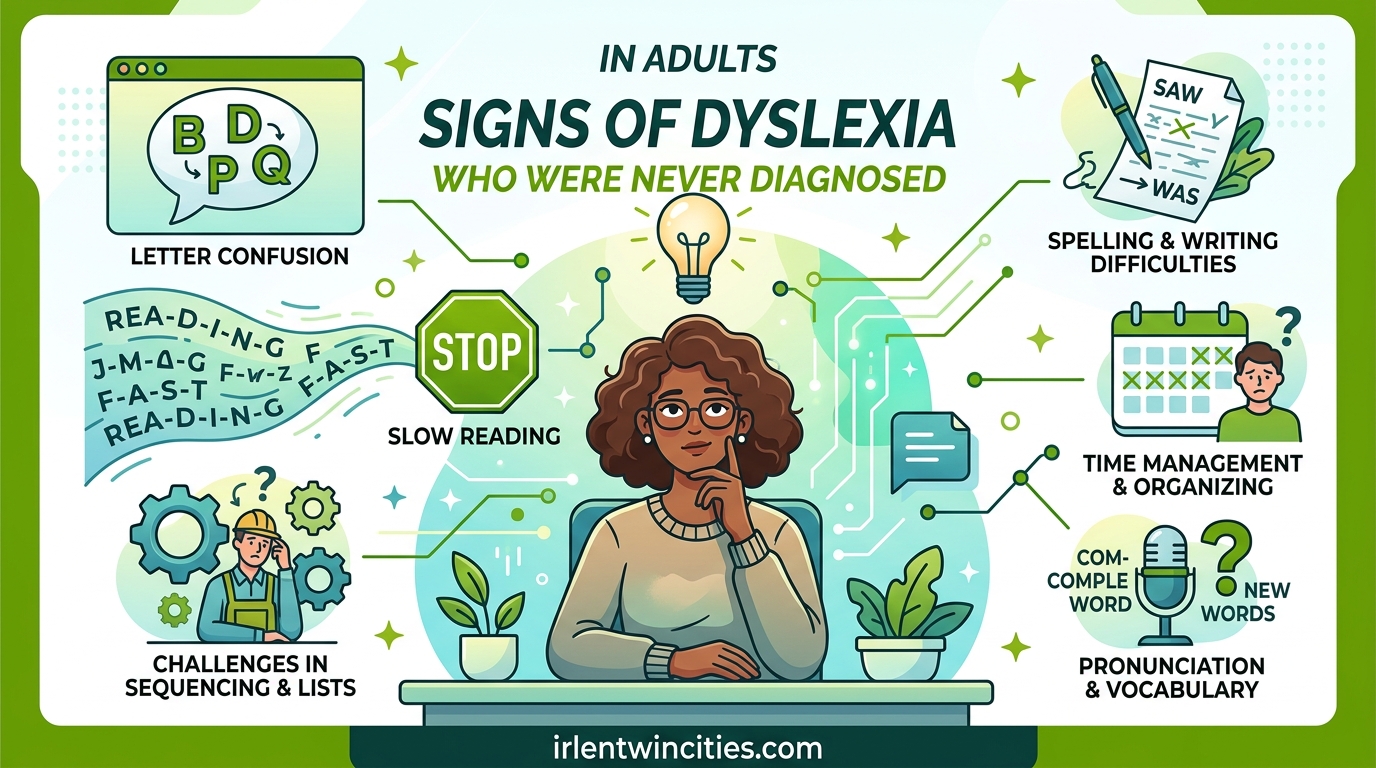
• Read slowly and need to re-read text multiple times to understand it?
• Confuse visually similar words like “cat” and “cot” or “on” and “no”?
• Spell the same word differently each time you write it?
• Find it difficult to scan or skim text when looking for information?
• Avoid reading aloud whenever possible?
• Struggle to follow multi-step instructions without writing them down?
• Mix up left and right, even as an adult?
• Have trouble remembering names, appointments, or sequences?
• Experience mental exhaustion after reading that others don’t seem to share?
• Feel intense anxiety about sending emails with spelling or grammar mistakes?
If you answered yes to several of these questions, dyslexia may be the missing piece of your story. Let’s explore the signs in more detail.
Signs of Dyslexia in Adults: A Comprehensive Checklist
The signs of dyslexia in adults extend far beyond simply “being bad at reading.” Dyslexia is a language processing difference that affects how the brain handles written information, despite normal or above-average intelligence. Understanding the full range of symptoms can help you recognize patterns you may have dismissed or hidden for years.
Reading Difficulties That Persist Into Adulthood
Reading challenges are the hallmark of dyslexia, but they don’t always look like the struggling reader you might imagine. Many adults with undiagnosed dyslexia can read — they just work much harder at it than others realize.
Slow reading speed. You read significantly slower than peers, often needing two or three times as long to get through the same material. What takes a colleague 30 minutes might take you 90 minutes of intense concentration.
Re-reading and poor comprehension. You frequently re-read the same sentence or paragraph multiple times. The words go in, but the meaning doesn’t stick. You might finish a page and realize you have no idea what you just read.
Reading aloud anxiety. The thought of reading aloud in meetings, classes, or social situations triggers intense anxiety. You may avoid opportunities that require public reading or develop strategies to dodge them.
Phonological processing challenges. Breaking words into sounds and blending sounds together feels difficult. You might struggle to sound out unfamiliar words or pronounce complex names you’ve never seen before.
Visual confusion. Letters seem to move, blur, or swap places on the page. Words like “saw” and “was” get mixed up. You may lose your place frequently while reading or skip lines without realizing it.
Decoding difficulties. Unlike fluent readers who recognize words automatically, you may still need to actively decode many words, especially longer or less common ones. This makes reading feel like work rather than something that flows naturally.
Spelling and Writing Challenges
Spelling difficulties don’t disappear when childhood ends. Many adults with undiagnosed dyslexia have developed workarounds, but the underlying challenges persist.
Inconsistent spelling. You might spell the same word three different ways in a single document. Spell-check helps, but it can’t catch every error — especially when you accidentally type a real word that’s wrong in context.
Phonetic spelling patterns. You spell words exactly as they sound, leading to creative variations like “fone” for phone or “wensday” for Wednesday. These patterns persist even though you know the correct spelling exists somewhere in your memory.
Writing anxiety. Professional emails, reports, and even simple messages cause disproportionate stress. You may re-read and edit emails multiple times before sending, or delay responding because crafting written communication feels overwhelming.
Grammar and punctuation struggles. Remembering grammar rules and applying them consistently is challenging. You might know the rules intellectually but struggle to execute them while writing, especially under time pressure.
Poor handwriting. Some adults with dyslexia also have dysgraphia — difficulty with the physical act of writing. Your handwriting may remain messy or difficult to read, or writing by hand may feel physically uncomfortable.
Organization and Time Management Struggles
Dyslexia affects more than language. Many adults experience difficulties with executive function — the mental skills that help us plan, focus, remember instructions, and juggle multiple tasks.
Working memory challenges. You struggle to hold information in your mind while working with it. Following multi-step directions, remembering a phone number long enough to dial it, or keeping track of where you are in a complex task all feel difficult.
Time management difficulties. Estimating how long tasks will take, prioritizing effectively, and meeting deadlines consistently are ongoing challenges. You might be chronically late or underestimate the time needed for reading-intensive projects.
Organization struggles. Your workspace, home, or digital files may feel perpetually disorganized despite your best efforts. You might develop elaborate organizational systems that eventually collapse under their own complexity.
Prioritization problems. Knowing what to tackle first and sticking to priorities feels overwhelming. Everything can seem equally urgent, leading to paralysis or working on less important tasks while critical ones wait.
Following instructions. Verbal instructions in particular can be challenging. You may need to write everything down or ask people to repeat themselves, and following written instructions with multiple steps requires intense focus.
Childhood Signs That Were Often Missed
If you have undiagnosed dyslexia, there were likely signs during childhood that were dismissed, misinterpreted, or simply missed entirely. Understanding why these signs went unnoticed can help explain why you’re only now recognizing the pattern.
Compensating strategies that masked difficulties. You may have been a bright child who developed sophisticated workarounds. You memorized whole words instead of sounding them out. You listened carefully in class to avoid reading. You used context clues to fake your way through texts. These strategies worked well enough to keep you passing — but they hid the underlying processing difference.
Gender differences in diagnosis. Girls and women are diagnosed with dyslexia at significantly lower rates than boys. Why? Girls often have better verbal skills and behavior regulation, allowing them to compensate more effectively. They work harder to please teachers and hide struggles. Meanwhile, boys with dyslexia often externalize their frustration through behavior problems, drawing attention that leads to assessment.
Misdiagnosis or alternative labels. Instead of dyslexia, you might have been labeled as careless, unmotivated, not applying yourself, or lazy. Some adults report being told they had ADHD when dyslexia was the primary issue, or being dismissed as “just not academic” despite clear intelligence in other areas.
Schools missing subtle cases. Schools often lack resources for comprehensive assessments. If you were passing — even while struggling — you might never have triggered intervention thresholds. Teachers with 30 students simply couldn’t give you the individual attention that would have revealed your reading differences.
Strengths that camouflaged weaknesses. Maybe you excelled in math, art, or hands-on activities while struggling with reading. Strong performance in some areas can make weaknesses in others seem like isolated problems rather than part of a pattern.
Co-occurring Conditions to Consider
Dyslexia rarely travels alone. Many adults with undiagnosed dyslexia also have other neurodevelopmental differences that complicate the picture — or that were diagnosed while dyslexia was overlooked.
ADHD (Attention-Deficit/Hyperactivity Disorder). Research suggests 30-50% of people with dyslexia also have ADHD. The inattention, impulsivity, and hyperactivity of ADHD can overshadow reading difficulties. If you were diagnosed with ADHD but reading remains a particular struggle, dyslexia may be a co-occurring condition worth exploring.
Dysgraphia. Difficulty with handwriting and the physical act of writing often accompanies dyslexia. If writing by hand feels physically uncomfortable, exhausting, or produces illegible results, dysgraphia may be present alongside dyslexia.
Dyscalculia. Sometimes called “math dyslexia,” dyscalculia involves difficulty with numbers, mathematical reasoning, and arithmetic. The same brain differences that affect language processing can also impact numerical processing.
Anxiety and depression. Years of unexplained struggle take a toll. Many adults with undiagnosed dyslexia develop anxiety around reading and writing tasks, or depression from the cumulative effects of feeling inadequate. These mental health challenges are consequences of undiagnosed dyslexia, not causes.
What can mimic dyslexia? Vision problems, hearing difficulties, inadequate instruction, and intellectual disability can all cause reading struggles. A proper assessment rules these out and identifies whether dyslexia is the true source of your difficulties.
The Hidden Emotional Cost of Undiagnosed Dyslexia
The invisible burden of undiagnosed dyslexia extends far beyond reading struggles. Years — sometimes decades — of unexplained difficulty leave emotional scars that many adults carry without understanding why.
Imposter syndrome and self-doubt. You’ve succeeded in many areas of life, yet you feel like you’re constantly faking competence. You dread the moment someone will discover you can’t read as well as they assume. This persistent fear of being “found out” is exhausting and can limit your willingness to pursue opportunities.
Decades of feeling “stupid.” Without knowing about dyslexia, you likely internalized messages that you weren’t trying hard enough, weren’t smart enough, or simply weren’t good at “academic” things. These beliefs become part of your identity, affecting confidence long after school ends.
Avoidance behaviors. To protect yourself from embarrassment, you’ve probably developed elaborate avoidance patterns. You dodge reading-intensive tasks, decline opportunities that involve public reading, or find reasons to skip social situations where your difficulties might be exposed.
Social withdrawal and anxiety. Fear of making mistakes in written communication can lead to withdrawing from relationships or professional opportunities. Some adults report extreme anxiety around email, text messages, or any situation where their spelling or reading might be judged.
Relief and validation. Despite these challenges, there’s hope. Many adults describe profound relief upon finally understanding dyslexia is the cause of their struggles. Learning that your brain works differently — not worse — can be transformative. Your difficulties have a name, they’re real, and they’re not your fault.
Understanding the emotional impact is just as important as recognizing the cognitive signs. Acknowledging these feelings is part of the healing process.
How Undiagnosed Dyslexia Affects Work and Relationships
Dyslexia doesn’t stay at school. It follows you into the workplace, into relationships, and into every area of adult life where reading and writing are required — which is nearly everywhere.
Workplace Challenges and Accommodations
Modern workplaces run on written communication. Emails, reports, documentation, and presentations are daily requirements. For adults with undiagnosed dyslexia, this environment can feel like navigating a minefield.
Email anxiety. Many adults report spending excessive time crafting professional emails, terrified of typos or awkward phrasing that might undermine their credibility. Simple messages become major undertakings.
Meeting and presentation struggles. Taking notes during meetings while also listening feels nearly impossible. Reading from notes during presentations triggers anxiety. You may avoid speaking up because processing written materials in real-time is challenging.
Documentation and paperwork. Forms, compliance training, and written procedures are exhausting. You might put off paperwork until the last minute, make errors on forms, or need excessive time to complete written tasks that colleagues finish quickly.
Workplace accommodations that help. If you choose to disclose dyslexia at work, several accommodations can make a significant difference: speech-to-text software for writing, text-to-speech for reading documents, extra time for reading-intensive tasks, written materials provided in advance, and permission to record meetings rather than take notes.
Relationship and Family Impact
Dyslexia affects how you communicate with partners, family, and friends. The same challenges that make work difficult can strain personal relationships.
Communication misunderstandings. Difficulty processing verbal instructions or following complex conversations can lead to misunderstandings. Partners may feel you don’t listen, when actually you’re struggling to process what’s being said.
Parenting challenges. Parents with undiagnosed dyslexia may struggle to help children with homework, read school communications, or complete forms for activities. This can trigger shame and anxiety about being “unable” to handle basic parenting tasks.
Social situations. Reading menus, following game instructions, or participating in activities that require reading can feel stressful. You might avoid certain social situations or develop strategies to hide your difficulties from friends.
Understanding these impacts helps you develop strategies and, if you choose, explain your needs to the people close to you.
How to Get Tested for Dyslexia as an Adult
If you recognize yourself in these descriptions, you may be wondering about formal assessment. Getting diagnosed with dyslexia as an adult is possible, though it comes with challenges many don’t anticipate.
Types of assessments available. Adult dyslexia assessments typically fall into two categories: screening tools and comprehensive evaluations. Screenings — often available online or through dyslexia organizations — can indicate whether further assessment is warranted. Comprehensive evaluations, conducted by psychologists or educational therapists, provide a formal diagnosis and detailed profile of your strengths and challenges.
Finding qualified assessors. Look for professionals with specific experience in adult dyslexia. Educational psychologists, neuropsychologists, and some speech-language pathologists conduct these assessments. The International Dyslexia Association and British Dyslexia Association maintain directories of qualified professionals.
Cost and insurance considerations. Adult dyslexia assessments can be expensive — often ranging from $500 to $2000 or more. Many insurance plans don’t cover learning disability assessments for adults, viewing them as “educational” rather than “medical.” However, some coverage is available if dyslexia is affecting mental health or if the assessment is part of broader neuropsychological testing.
Is formal diagnosis necessary? Not always. Some adults find that self-identification — recognizing the pattern and understanding dyslexia explains their experiences — is sufficient. Others need formal documentation to access workplace accommodations or educational support. The choice depends on your specific situation and goals.
Self-screening options. Several validated screening tools exist for adults questioning dyslexia. These include online checklists from reputable dyslexia organizations and standardized screening instruments. While not diagnostic, they can help you decide whether to pursue formal assessment.
It’s never too late. Whether you’re 25, 45, or 65, understanding your dyslexia can change your life. Neuroplasticity means the brain can develop new pathways at any age. While dyslexia is lifelong, strategies and support can significantly improve your experience.
Frequently Asked Questions
What are three warning signs of dyslexia?
Three key warning signs of dyslexia in adults include: 1) Reading slowly and needing to re-read text multiple times to understand it, 2) Spelling the same word inconsistently or spelling phonetically, and 3) Difficulty with phonological processing — breaking words into sounds and blending sounds together. Other warning signs include left-right confusion, poor working memory, and anxiety around reading aloud.
What does undiagnosed dyslexia look like in adults?
Undiagnosed dyslexia in adults often looks like intelligence and capability paired with unexplained struggles in reading, spelling, and written communication. Adults may have developed sophisticated compensating strategies that hide their difficulties. Common signs include slow reading, inconsistent spelling, difficulty following multi-step instructions, organization challenges, and anxiety around written communication. Many adults experience imposter syndrome and have been labeled as careless or unmotivated as children.
Can you have dyslexia and be smart?
Absolutely. Dyslexia is unrelated to intelligence. Many adults with dyslexia have average or above-average intelligence and excel in areas like problem-solving, creativity, big-picture thinking, and spatial reasoning. Dyslexia is a specific language processing difference, not a general intelligence deficit. Some researchers suggest dyslexic brains may have unique strengths in certain cognitive areas, even while processing written language differently.
Is it too late to treat dyslexia in adults?
It is never too late to address dyslexia. While dyslexia is lifelong and cannot be cured, adults can develop strategies, access accommodations, and use assistive technology to significantly improve their reading and writing experiences. Neuroplasticity means the brain continues to change and adapt throughout life. Many adults report substantial improvement with targeted interventions, cognitive training, and appropriate support — along with the profound benefit of understanding why they struggle.
What can mimic dyslexia in adults?
Several conditions can mimic dyslexia or cause similar reading difficulties. These include vision problems like convergence insufficiency, hearing difficulties, inadequate reading instruction, intellectual disability, ADHD, anxiety disorders, and traumatic brain injury. Depression and certain medications can also affect reading and concentration. A comprehensive assessment helps rule out these alternative explanations and determine whether dyslexia is the primary cause of reading difficulties.
How does dyslexia affect adults at work?
Dyslexia affects adults at work through challenges with written communication, including email anxiety and slow report writing. Adults may struggle with taking notes during meetings, reading aloud in presentations, completing forms and paperwork, and processing written instructions quickly. Time management and organization can also be affected. However, workplace accommodations like speech-to-text software, extra time for reading tasks, and advance access to materials can make a significant difference. Many adults with dyslexia excel in roles that leverage their strengths while minimizing reading-intensive tasks.
Understanding the signs of dyslexia in adults who were never diagnosed is the first step toward a more empowered future. Whether you pursue formal assessment or simply recognize yourself in these descriptions, know that your struggles are real, they have a name, and you’re not alone.
Thousands of adults discover their dyslexia every year — in their 30s, 40s, 50s, and beyond. Many report that understanding their dyslexia was the most liberating experience of their lives. The exhaustion, the self-doubt, the constant compensation — it all makes sense now.
If you see yourself in this article, consider reaching out to a dyslexia organization or qualified professional. The journey of understanding starts with a single step. And remember: dyslexia is a different way of processing language, not a deficit of intelligence or character. Your brain is capable of remarkable things — it just processes written information differently.
You’ve already shown incredible resilience by navigating a text-heavy world without knowing why it was harder for you. Imagine what you can do with understanding, support, and strategies designed for how your brain actually works.