
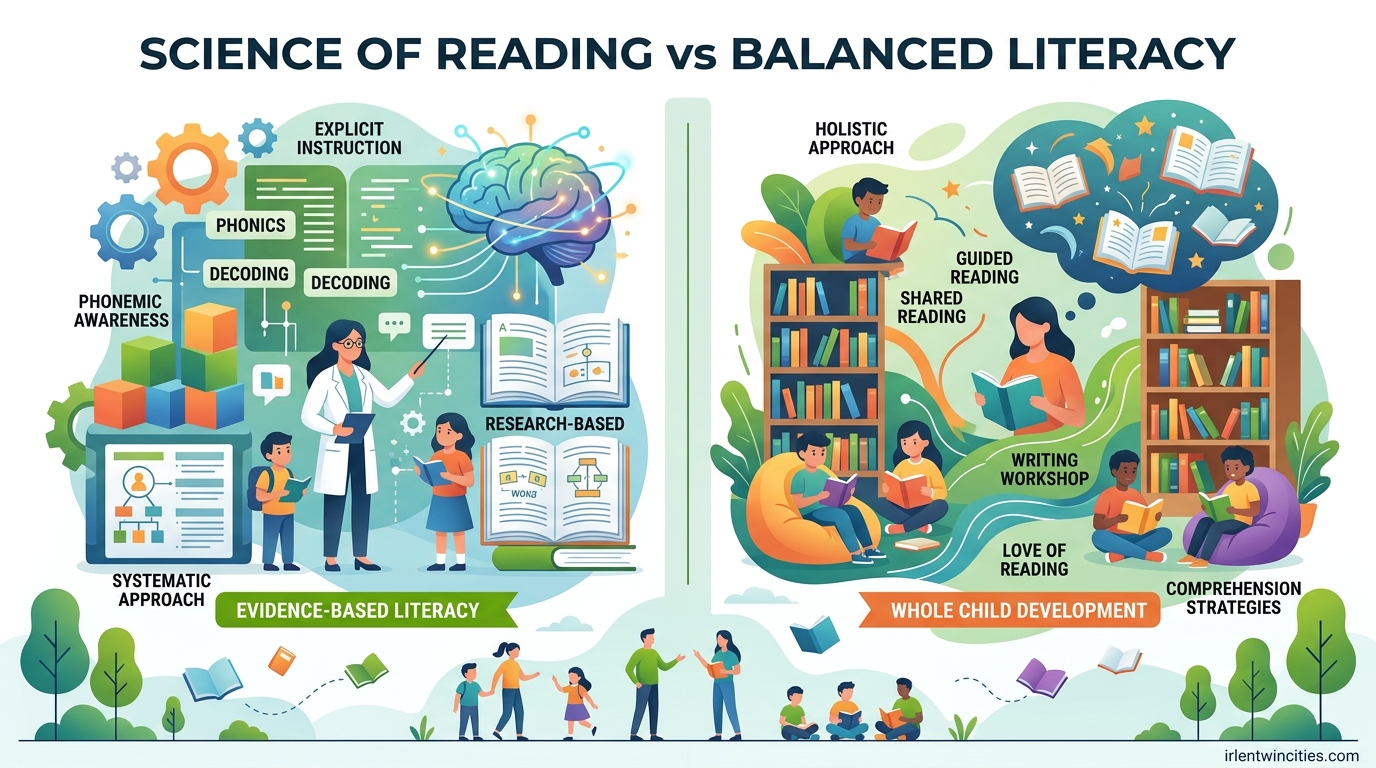
If you have been trying to understand how your child is being taught to read, you have probably encountered two phrases that seem to be everywhere right now: the Science of Reading and balanced literacy. These terms get thrown around in parent groups, school board meetings, and education articles, often leaving parents more confused than when they started. I have spent months researching this topic, listening to Emily Hanford’s Sold a Story podcast, and talking with teachers, parents, and reading specialists to bring you a clear explanation of what these approaches actually mean for your child in 2026.
The truth is that how reading gets taught in your child’s classroom matters enormously. Research shows that 95% of children can learn to read at grade level when they receive explicit, systematic instruction based on what we know about how the brain learns to read. Yet many schools still use methods that leave too many children guessing at words rather than truly decoding them.
In this guide, I will break down exactly what parents need to know about Science of Reading vs balanced literacy. You will learn how to identify which approach your school uses, why experts prefer one method over the other, and what questions you should ask your child’s teacher. By the end, you will have the knowledge you need to advocate effectively for your child’s reading education.
Table of Contents
What Is the Science of Reading?
The Science of Reading is not a specific curriculum or program you can buy. Instead, it refers to a vast body of research from cognitive science, neuroscience, developmental psychology, and education that tells us exactly how the human brain learns to read and which teaching methods actually work.
This research has been building for decades, starting in the 1980s with studies using brain imaging to watch what happens when people read. Scientists discovered that reading is not natural or innate like speaking. Our brains were never designed to read. Instead, reading requires creating new neural pathways that connect the visual, language, and phonological processing areas of the brain.
The Science of Reading identifies five essential components that every child needs to become a proficient reader. These are often called the Five Pillars of Reading, established by the National Reading Panel in 2000. They include phonemic awareness, phonics, fluency, vocabulary, and comprehension. Skip any one of these pillars, and a child’s reading foundation becomes shaky.
How the Science of Reading Actually Works
Instruction based on the Science of Reading follows specific principles that align with how brains process written language. The approach is explicit, meaning teachers directly show students how sounds connect to letters and how to blend sounds together. It is systematic, following a carefully planned sequence from simple concepts to more complex ones. And it is cumulative, with each lesson building on what students have already mastered.
The core of Science of Reading instruction is explicit phonics teaching. Children learn that letters represent sounds, and they practice blending those sounds to read words. They use decodable books containing words they can actually sound out with the skills they have learned, rather than guessing based on pictures or context. This approach creates the neural pathways necessary for fluent, automatic reading.
Research consistently shows that this method works for nearly all children, including those with dyslexia and other learning differences. When schools implement Science of Reading-based instruction, reading scores improve dramatically. States that have passed laws mandating these evidence-based approaches have seen significant increases in reading proficiency rates.
What Is Balanced Literacy?
Balanced literacy is an approach to reading instruction that emerged in the 1990s as a compromise between phonics-based teaching and whole language methods. Proponents believed that children learn to read naturally through exposure to rich literature, with phonics playing a supporting role rather than taking center stage.
The balanced literacy approach typically includes some phonics instruction, but it is usually brief, embedded within literature-based activities, and not taught systematically. The emphasis falls heavily on encouraging children to love reading through exposure to engaging books, using context and pictures to figure out unfamiliar words, and developing reading strategies through guided reading groups organized by ability levels.
Classrooms using balanced literacy often rely on leveled books that categorize readers from level A to Z based on complexity. Children progress through these levels as they develop, but the books at each level often contain words with spelling patterns the child has not yet been taught. This creates a situation where children must use other strategies to read, which brings us to one of the most problematic aspects of balanced literacy: the three-cueing system.
The Three-Cueing System Explained
The three-cueing system is a cornerstone of balanced literacy instruction, though you might not hear it called by this name in your child’s classroom. This system teaches children to use three types of cues or clues when they encounter an unfamiliar word: semantic cues (meaning from context or pictures), syntactic cues (grammar and sentence structure), and graphophonetic cues (letter-sound relationships, or phonics).
In practice, this means children are taught to look at the picture, think about what word would make sense, check if it sounds right grammatically, and only then look at the actual letters. You might hear teachers prompting students with phrases like: “Look at the picture. What would make sense? Does it look right? Get your mouth ready for the first sound.” These prompts encourage guessing rather than decoding.
Research has consistently shown that the three-cueing system is ineffective and actually harmful for struggling readers. When children guess based on context or pictures, they are not building the neural pathways needed for fluent reading. The strategy might work for simple predictable texts, but it falls apart completely when children encounter more complex texts in upper grades where pictures disappear and context becomes more abstract.
Science of Reading vs Balanced Literacy: Key Differences Every Parent Should Know
Understanding the differences between these approaches is crucial for advocating for your child. The contrasts go far beyond simple teaching preferences. They represent fundamentally different understandings of how children learn to read and what skills matter most in early literacy development.
The most significant difference lies in how each approach treats phonics instruction. Science of Reading uses explicit, systematic phonics teaching where children learn sound-letter relationships in a carefully planned sequence and practice those skills until automatic. Balanced literacy typically includes phonics but teaches it implicitly and incidentally, believing children will pick up patterns through exposure to text rather than direct instruction.
Another critical difference involves the types of books children read. Science of Reading classrooms use decodable books that contain only the phonics patterns children have been explicitly taught, allowing them to practice actual decoding. Balanced literacy classrooms use leveled readers that often include words children cannot decode, forcing reliance on the three-cueing system and guessing strategies.
Instructional Approach Comparison
Science of Reading instruction follows a scope and sequence where teachers introduce phonics concepts in a logical order, from simple to complex. Every child receives the same explicit instruction, with additional support provided for those who need it. Teachers assess regularly to ensure students master each concept before moving forward. This cumulative approach ensures no gaps develop in a child’s reading foundation.
Balanced literacy instruction is typically less structured, with phonics taught as mini-lessons or embedded within reading workshops. Children spend significant time in independent reading with books they choose, often selecting texts far above their actual decoding ability. Teachers facilitate reading through guided groups where they prompt children to use strategies rather than teaching specific skills.
The assessment methods also differ significantly. Science of Reading uses diagnostic assessments that identify exactly which phonics skills a child has mastered and which need work. Balanced literacy typically uses running records that track how accurately children read leveled texts, often miscategorizing guessing as successful reading when children use picture and context clues correctly.
Why Science of Reading Is Preferred by Experts
The shift toward Science of Reading is not just a trend or preference. It is backed by decades of rigorous research and increasingly supported by state legislation across the country. Understanding why experts now overwhelmingly favor this approach will help you make informed decisions about your child’s education.
Multiple large-scale studies have demonstrated that explicit, systematic phonics instruction produces better reading outcomes than implicit approaches. The National Reading Panel’s 2000 meta-analysis of over 100,000 studies found that systematic phonics instruction significantly improved reading achievement. Subsequent research has only strengthened these findings, with brain imaging studies showing that explicit phonics instruction actually changes how the brain processes written language.
The reading scores tell a compelling story. States that have implemented Science of Reading-based reforms have seen dramatic improvements. Mississippi, often cited as a success story, went from ranking near the bottom in national reading assessments to reaching the national average after overhauling their reading instruction based on scientific research. Other states following similar paths are seeing comparable results.
The HMH Curriculum Controversy and Legal Challenges
Recent years have brought significant controversy to some of the most popular balanced literacy curriculum programs. HMH’s Into Reading and other widely adopted curricula have faced increasing scrutiny as more parents and educators learn about the Science of Reading research.
In 2026, lawsuits and formal complaints have emerged against districts using curricula that rely heavily on the three-cueing system. Parents of children with dyslexia have been particularly vocal, noting that balanced literacy approaches fail to provide the explicit phonics instruction their children desperately need. Some families have successfully pressured districts to change curricula or have secured private tutoring reimbursements when schools refused to provide appropriate instruction.
The Lucy Calkins Units of Study, one of the most popular balanced literacy programs used in thousands of American schools, has undergone significant revision after years of criticism. Emily Hanford’s reporting exposed serious flaws in the program’s approach to phonics, leading the publisher to release updated versions that include more phonics instruction. However, critics argue these changes do not go far enough to align with the Science of Reading.
Fountas and Pinnell: Are They Aligned with Science of Reading?
Fountas and Pinnell’s Leveled Literacy Intervention and Guided Reading programs have been staples in American elementary schools for decades. However, these programs have come under intense scrutiny as the Science of Reading movement has gained momentum.
The short answer is no: Fountas and Pinnell materials are not aligned with the Science of Reading. Their programs rely heavily on leveled readers and the three-cueing system, both of which contradict what research tells us about how children learn to read. While the company has made some modifications in response to criticism, the fundamental approach remains rooted in balanced literacy principles rather than evidence-based practices.
Parents should be aware that if their child’s school uses Fountas and Pinnell materials, their child is likely receiving balanced literacy instruction. This includes the Benchmark Assessment System used to determine reading levels, which relies on the three-cueing system and may provide misleading information about a child’s actual decoding abilities.
What Is Structured Literacy?
You might hear the term “structured literacy” mentioned alongside the Science of Reading, and understanding this connection is helpful for parents navigating curriculum discussions. Structured literacy refers to instructional approaches that align with the Science of Reading research, providing a framework for how evidence-based reading instruction should look in practice.
Structured literacy is characterized by several key features. It is systematic and cumulative, following a logical scope and sequence. It is explicit, with teachers directly teaching skills rather than hoping children discover them. It is diagnostic, with regular assessment to identify and address gaps immediately. And it is multisensory, engaging visual, auditory, and kinesthetic pathways to reinforce learning.
While the Science of Reading tells us what the research says about reading acquisition, structured literacy tells us how to implement that research in the classroom. The Orton-Gillingham approach, Wilson Reading System, and other well-known interventions are examples of structured literacy in action. These approaches work particularly well for students with dyslexia but benefit all learners.
What This Means for Your Child
Understanding these different approaches matters because the method your child’s school uses directly impacts their reading success. If your child is in a balanced literacy classroom using the three-cueing system, they might appear to be reading well in early grades only to struggle significantly when texts become more complex in third grade and beyond.
Many parents do not realize there is a problem until their child hits the “third grade wall,” where pictures disappear, vocabulary becomes more abstract, and guessing strategies no longer work. By that point, children may have developed years of ineffective habits that are difficult to unlearn. Early intervention based on Science of Reading principles can prevent this common scenario.
The good news is that you can identify which approach your school uses with some simple observation and questions. You can also supplement at home if needed, though this should not replace proper classroom instruction. Understanding what to look for puts you in a position to advocate effectively for your child.
Signs Your Child’s School Uses Science of Reading
Schools implementing Science of Reading typically show several clear characteristics. Children bring home decodable readers containing words they can actually sound out with the phonics skills they have learned. Teachers use explicit phonics instruction daily, typically 45-60 minutes of structured lessons. You might see sound walls or phonics charts displayed in classrooms rather than word walls organized alphabetically.
Homework focuses on specific phonics skills and includes practice with letter sounds and blending. Assessments measure whether children can decode unfamiliar words rather than memorizing sight words through repetition. When you ask about reading instruction, teachers mention explicit phonics, systematic scope and sequence, and decodable texts.
Red Flags That Indicate Balanced Literacy
Signs of balanced literacy instruction include reliance on leveled readers (A-Z levels), emphasis on using pictures to figure out words, and prompts encouraging children to think about what “makes sense” rather than looking at all the letters. You might hear teachers or administrators talk about “reading strategies” like looking at the first letter and thinking about context.
Other warning signs include extensive use of sight word memorization, children bringing home books they cannot actually decode independently, and reading assessments that seem to measure guessing ability rather than actual decoding skills. If your child frequently says “I forgot that word” or points to pictures when stuck, they may be in a balanced literacy classroom.
Questions to Ask Your Child’s Teacher or School
Armed with the knowledge from this guide, you are now ready to have productive conversations with your child’s teacher or school administrators. The questions you ask can reveal a great deal about the reading instruction your child receives and help you determine whether advocacy is needed.
Start by asking directly about the curriculum: “What phonics program does the school use?” and “Can you walk me through the scope and sequence of phonics instruction from kindergarten through third grade?” Schools using Science of Reading approaches should be able to answer these questions clearly and provide documentation showing the systematic progression of skills.
Ask about assessment methods: “How do you determine my child’s reading level?” and “What specific phonics skills has my child mastered?” If the school uses Fountas and Pinnell Benchmark Assessments or similar tools based on the three-cueing system, this indicates balanced literacy influence. Schools aligned with Science of Reading use diagnostic assessments that identify specific skill gaps.
Other important questions include: “Do you use decodable texts or leveled readers?” “How much time is spent on explicit phonics instruction daily?” “What do you do when a child struggles to read a word?” The answers to these questions will tell you whether your child’s school emphasizes decoding or guessing strategies.
Questions for School Administrators
If you discover your school uses balanced literacy approaches, consider meeting with administrators to understand their perspective and share your concerns. Ask: “What professional development do teachers receive in the Science of Reading?” “Has the district considered curriculum changes based on recent research?” and “What support is available for children who are not responding to the current reading approach?”
You can also ask about state legislation: “How is the district responding to 2026 state requirements for evidence-based reading instruction?” Many states have recently passed laws mandating Science of Reading approaches, and schools should have plans for compliance. If administrators seem unaware of these requirements or resistant to change, this signals a need for broader advocacy.
How to Advocate for Change
If your school uses balanced literacy and your child is struggling, or if you simply want to advocate for evidence-based instruction, you have options. Start by gathering information and connecting with other concerned parents. The more voices raising these concerns, the more likely schools are to listen.
Share resources like Emily Hanford’s Sold a Story podcast, which provides an accessible explanation of why balanced literacy fails many children. Reference state reading scores and research showing the effectiveness of explicit phonics instruction. Consider attending school board meetings or requesting presentations about reading curriculum.
Remember that teachers are often doing their best with the training and materials they have been given. Many educators are themselves learning about the Science of Reading for the first time and are eager to implement more effective methods. Approach conversations with curiosity and collaboration rather than accusation.
Signs Your Child May Need Additional Support
Even with excellent instruction, some children need extra support to become proficient readers. Knowing the warning signs of reading difficulties allows you to intervene early, when support is most effective. Early intervention can prevent the frustration and self-esteem damage that often accompanies prolonged reading struggles.
Watch for these warning signs in early elementary years: difficulty learning letter names and sounds, trouble rhyming or breaking words into sounds, avoiding reading or expressing anxiety about reading time, guessing at words based on first letters rather than sounding through them, and difficulty remembering sight words despite repeated exposure. These signs suggest your child may need explicit, systematic phonics instruction.
By second and third grade, additional red flags include slow, labored reading, significant difficulty with spelling, avoiding reading aloud, frustration with grade-level texts, and reading that sounds choppy rather than fluent. If your child exhibits these signs and their school uses balanced literacy methods, you may need to seek supplemental support outside of school.
Resources for Struggling Readers
If you suspect your child has dyslexia or significant reading difficulties, seek a comprehensive evaluation from a qualified professional. Schools can provide assessments, but parents can also seek private evaluations from educational psychologists or speech-language pathologists specializing in literacy.
Consider supplemental tutoring using structured literacy approaches like Orton-Gillingham, Wilson Reading System, or similar evidence-based methods. Many tutors now offer virtual sessions, making specialized help more accessible than ever. Look for tutors certified in these specific approaches rather than general reading tutors.
At home, you can support your child by reading aloud to them daily, exposing them to rich vocabulary and complex ideas even if they cannot yet read independently. Practice phonemic awareness through word games and rhyming activities. Most importantly, maintain your child’s confidence by celebrating effort and progress while ensuring they receive proper instruction.
Frequently Asked Questions
Is balanced literacy the same as the Science of Reading?
No, balanced literacy and the Science of Reading are fundamentally different approaches. The Science of Reading is based on decades of research from cognitive science and neuroscience showing how the brain learns to read, emphasizing explicit, systematic phonics instruction. Balanced literacy is an instructional approach that minimizes phonics in favor of strategies like the three-cueing system, which teaches children to guess words using pictures and context rather than decoding them.
What is the HMH curriculum controversy?
The HMH curriculum controversy refers to growing criticism of Houghton Mifflin Harcourt’s Into Reading and similar balanced literacy programs that rely on the three-cueing system. In 2026, parents and educators have raised concerns that these curricula fail to provide the explicit phonics instruction research shows children need. Some families have pursued legal action against districts using these materials, particularly when children with dyslexia are denied appropriate reading instruction.
Are Fountas and Pinnell aligned with Science of Reading?
No, Fountas and Pinnell programs are not aligned with the Science of Reading. Their Leveled Literacy Intervention and Guided Reading approaches rely on leveled readers and the three-cueing system, which contradicts research on effective reading instruction. While the company has made some modifications in response to criticism, their materials remain rooted in balanced literacy principles rather than evidence-based practices.
What is the 70-30 rule in teaching?
The 70-30 rule refers to an approach in balanced literacy where 70% of reading instruction time is spent on authentic literature and comprehension activities, while only 30% is devoted to phonics and word study. This ratio reflects the balanced literacy belief that children learn to read primarily through exposure to books. Science of Reading advocates argue this ratio is backwards, as beginning readers need substantially more explicit phonics instruction to build decoding skills before they can effectively comprehend text.
What are decodable books and why do they matter?
Decodable books are texts written using only the phonics patterns that children have been explicitly taught, allowing them to practice actual decoding rather than guessing. Unlike leveled readers, which often contain words with spelling patterns children have not learned, decodable books give children the opportunity to successfully sound out every word. This builds confidence, reinforces phonics skills, and helps create the neural pathways necessary for fluent reading.
How can I help my child at home if school uses balanced literacy?
If your child’s school uses balanced literacy, you can supplement at home with explicit phonics instruction. Use decodable readers for daily practice, work on phonemic awareness through sound games, and teach your child to sound through words rather than guess. Consider structured literacy tutoring if your child struggles. Most importantly, ask your school about their reading curriculum and advocate for evidence-based instruction with other parents and administrators.
Conclusion: Science of Reading vs Balanced Literacy What Parents Should Know
Understanding the difference between Science of Reading and balanced literacy empowers you to make informed decisions about your child’s education. The research is clear: explicit, systematic phonics instruction based on scientific evidence helps 95% of children learn to read successfully. Balanced literacy methods, while well-intentioned, leave too many children guessing at words rather than developing the decoding skills they need for long-term reading success.
As a parent in 2026, you now have the knowledge to identify which approach your school uses and the questions to ask to ensure your child receives evidence-based instruction. Remember that most teachers want what is best for their students and may themselves be learning about the Science of Reading. Approach advocacy with facts, resources, and a collaborative spirit.
If your child is struggling, do not wait to seek help. Early intervention based on structured literacy principles can make the difference between a child who dreads reading and one who loves it. Whether that means working with your school to improve instruction, seeking supplemental support, or a combination of both, you now have the foundation to advocate effectively for your child’s reading success.