
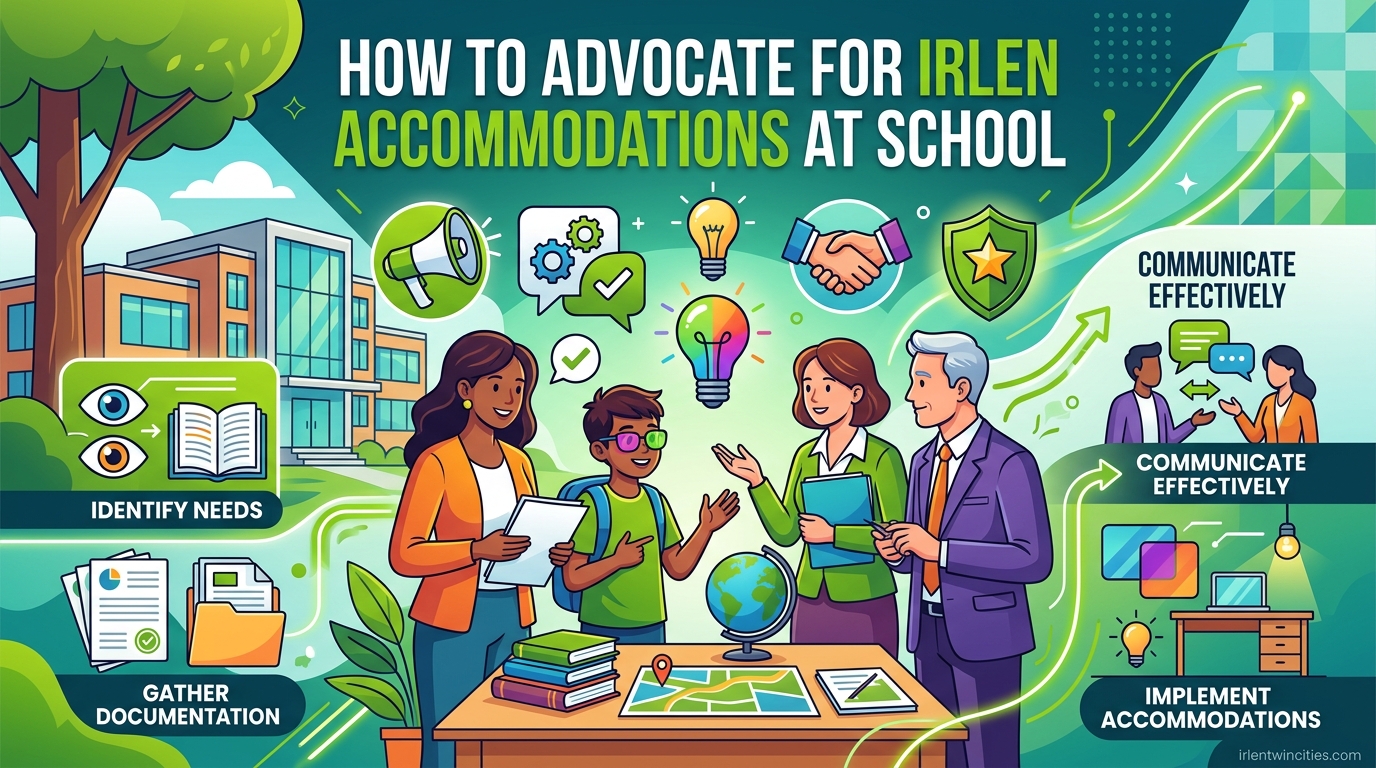
If your child has been diagnosed with Irlen Syndrome, you already know how frustrating school can be. Bright lights cause headaches. Reading feels exhausting. Assignments take twice as long as they should. You have the documentation. You know what helps. But getting the school to actually provide those accommodations? That is where many parents hit a wall.
This guide walks you through exactly how to advocate for Irlen accommodations at school. We cover the step-by-step process, specific accommodations to request, the difference between IEPs and 504 plans, and scripts you can use in meetings. You do not have to figure this out alone.
Table of Contents
What is Irlen Syndrome and Why Accommodations Matter
Irlen Syndrome is a visual processing disorder where the brain struggles to interpret visual information correctly. This is not a problem with the eyes themselves. The issue lies in how the brain processes what it sees. For students, this creates real barriers to learning that have nothing to do with intelligence.
Students with Irlen Syndrome commonly experience headaches and eye strain, particularly under fluorescent lighting. They may skip lines when reading, mix up words, or lose their place frequently. Physical symptoms like fatigue, restlessness, and difficulty concentrating often accompany academic struggles. These students may have normal intelligence but still fall behind because the visual demands of the classroom overwhelm their processing ability.
Without proper accommodations, students with Irlen Syndrome may struggle with reading comprehension despite putting in extra effort. They experience headaches and fatigue that makes school draining. Keeping up with assignments becomes difficult when the brain has to work twice as hard to process visual information. These challenges do not reflect effort or intelligence. They reflect a neurological difference that environmental adjustments can address.
Step-by-Step Process to Advocate for Irlen Accommodations at School
The advocacy process follows a clear path from initial diagnosis to implemented accommodations. Here is how to navigate each stage.
Step 1: Gather Documentation
Before requesting accommodations, collect all relevant documentation. This includes the Irlen Syndrome diagnosis from a certified Irlen diagnostician. Keep records of how symptoms affect learning, such as reading fluency reports or teacher observations. Document any previous interventions and their results. Schools respond more positively when families come prepared with clear evidence rather than general concerns.
Step 2: Request a Formal Meeting
Submit a written request for an accommodation meeting. Send this to the school principal and special education coordinator. Use certified mail or email with read receipts so you have proof of delivery. The request should be specific but brief. State that your child has a diagnosed condition requiring accommodations and request a meeting to discuss implementing appropriate support.
Step 3: Prepare for the Meeting
Before the meeting, create a one-page summary of your child’s diagnosis and recommended accommodations. Bring multiple copies for each team member. Review your rights under Section 504 and IDEA. Practice your talking points. Parents in forum discussions consistently report that preparation makes a significant difference in how schools respond.
Step 4: Attend the Meeting with Confidence
Attend the meeting ready to collaborate but firm about your child’s needs. Start by expressing appreciation for the school’s time. Present your documentation clearly. Describe specific examples of how the current environment affects your child. Listen to the school’s perspective. Work toward a written agreement that specifies exactly what accommodations will be provided, who is responsible, and when implementation begins.
Step 5: Follow Up in Writing
After the meeting, send a summary email recapping what was agreed upon. This creates a paper trail. If anything changes or implementation lags, document each communication. Schools often require parent persistence to stay on track with accommodations. Forum discussions confirm that follow-up is not optional. It is how accommodations actually get implemented.
Specific Classroom Accommodations for Irlen Syndrome
Effective accommodations address the specific ways Irlen Syndrome affects learning. Request these modifications in writing and ensure they are included in your child’s official plan.
Lighting Accommodations
Lighting modifications often provide the most immediate relief. Request that fluorescent lights be turned off or replaced with LED lighting in your child’s classroom. Your child should be seated near windows where natural light is available. If full lighting changes are not possible, ask for seating away from fluorescent light banks. Some students benefit from wearing a hat with a dark underbrim to reduce overhead glare. These changes sound simple but can dramatically reduce headaches and fatigue.
Reading Accommodations
Reading requires the most visual processing, so accommodations here are essential. Provide Irlen colored overlays for all reading materials. These overlays reduce visual stress and help students track lines more accurately. Request that handouts and worksheets be provided on colored paper rather than bright white. A bookstand or reading slope reduces the visual distortion that occurs when looking down at flat pages. For longer reading assignments, allow breaks or provide audio alternatives when possible.
Paper and Writing Accommodations
Written assignments present significant challenges. Request that tests, homework, and assignments be provided on colored or non-glare paper. Off-white, cream, or pastel colors often reduce visual stress. Graph paper for math can help with number alignment. Some students need larger font sizes or increased line spacing. Allow the use of colored pencils or markers for written work if this reduces visual confusion.
Testing Accommodations
Standard testing conditions often disadvantage students with Irlen Syndrome. Request extended time to compensate for slower reading and visual processing. Ask that tests be administered in a separate location with reduced lighting. Provide tests on colored paper matching the overlays your child uses. Allow frequent breaks during long tests. These accommodations do not change what the test measures. They simply remove the visual barriers that would otherwise skew the results.
IEP vs 504 Plan: Which is Right for Your Child
Understanding the difference between an IEP and a 504 plan helps you pursue the right documentation for your child’s needs. Both provide legal protections, but they work differently.
A 504 Plan provides accommodations under Section 504 of the Rehabilitation Act. It covers students with disabilities that limit major life activities, including learning. 504 plans require less formal documentation than IEPs. They do not include measurable goals or specialized instruction. They focus solely on providing equal access to education through environmental adjustments. For many students with Irlen Syndrome, a 504 plan provides sufficient accommodation without the complexity of special education services.
An IEP (Individualized Education Program) falls under IDEA, the special education law. It is more comprehensive and legally binding than a 504 plan. IEPs include annual goals that are measurable and specific. They provide access to specialized instruction and related services. IEPs offer stronger accountability because schools must demonstrate progress toward goals. If your child needs more than environmental accommodations, or if you have encountered significant resistance, an IEP may provide the structure and enforcement mechanisms you need.
The choice depends on your child’s specific needs and the level of support required. Some students with Irlen Syndrome thrive with 504 accommodations. Others need the stronger protections and accountability of an IEP. You can request evaluation for either option. Schools must consider both paths seriously when documentation supports the need.
How to Request Irlen Accommodations from School
Knowing what to say in school meetings makes a real difference. Here are practical scripts and templates parents can adapt for their situations.
Opening Statement for Accommodation Meetings
When you begin the meeting, a clear opening sets a collaborative tone. Consider saying: “Thank you for meeting with us today. Our child has been diagnosed with Irlen Syndrome by a certified Irlen diagnostician. This is a documented visual processing disorder that affects how the brain interprets visual information. We want to work with you to identify accommodations that will help our child access learning effectively. We have documentation and some specific recommendations.”
Requesting Specific Accommodations
When requesting specific accommodations, be concrete and solution-focused. Say: “Based on our diagnostician’s recommendations and our child’s experience, we are requesting the following accommodations. First, seating near natural light and away from fluorescent lighting. Second, providing reading materials on colored paper with appropriate overlays. Third, extended time on tests and assignments due to increased visual processing demands. We have these recommendations in writing from our diagnostician and would be happy to share that documentation.”
When Facing Resistance
Schools sometimes push back with comments like “We need to conduct our own assessment” or “We do not provide accommodations without our own testing.” Respond calmly: “We understand the school wants to verify the need. We are happy to share the comprehensive diagnostic evaluation we already have from a certified specialist. Under Section 504, the school cannot require a different assessment. Our documentation from a qualified professional is sufficient to initiate accommodations. Can we focus today on implementing the accommodations our child needs while we discuss any additional information the school requires?”
Common Challenges and How to Overcome Them
Forum discussions and parent experiences reveal consistent challenges when advocating for Irlen accommodations. Here is how to address them.
Schools Requesting Their Own Assessment
Schools often ask to conduct their own evaluation before providing accommodations. This is a delay tactic in many cases. While schools have some evaluation rights, they cannot use this to deny immediate accommodations while the evaluation occurs. Provide your documentation. Request that current accommodations be implemented while formal evaluation proceeds. If the school insists on evaluation, ask for a timeline in writing and follow up aggressively.
Lack of Teacher Awareness
Many teachers have never heard of Irlen Syndrome. This lack of awareness can lead to skepticism or dismissal. Provide educational resources. Share articles from Irlen.com or other reputable sources. Offer to provide overlays for the teacher to try. Sometimes helping teachers understand the science behind Irlen Syndrome changes their perspective. If a teacher remains resistant, escalate to the administrator with specific examples of how the current situation affects your child.
Resistance to Colored Overlays
Some schools resist providing colored overlays, viewing them as unnecessary or “special treatment.” Address this directly. Explain that overlays are a documented intervention for a documented condition, similar to eyeglasses for vision problems. They are not a preference but a necessity for accessing text. If resistance continues, reference the legal requirements under Section 504. Document each instance of denial in writing.
Inadequate Implementation
Even when accommodations are approved, implementation often falls short. Teachers forget. Policies change mid-year. Accommodations that worked last year disappear. Create a simple one-page accommodation summary and provide it to each teacher at the start of every term. Schedule quarterly check-ins to verify implementation. Document any gaps. If problems persist, request a meeting to review and revise the accommodation plan.
Frequently Asked Questions
How do I help a student with Irlen Syndrome in the classroom?
Start with lighting modifications by moving seating away from fluorescent lights toward natural light. Provide colored overlays for all reading materials and request worksheets on colored paper. Allow frequent breaks during reading-heavy activities and consider a bookstand to reduce visual distortion. Extended time on tests and assignments helps compensate for slower visual processing.
Is Irlen Syndrome considered a learning disability?
Irlen Syndrome is not classified as a traditional learning disability under IDEA, but it qualifies as a disability under Section 504 because it affects learning and major life activities. Students with Irlen Syndrome can receive accommodations through either a 504 plan or an IEP depending on their specific needs and the level of support required.
What are the classroom accommodations for visual processing issues?
Effective accommodations include seating near windows and away from fluorescent lighting, providing colored overlays and colored paper for all materials, using a reading stand or slope, allowing extended time on tests, permitting breaks during extended reading tasks, using larger font sizes and increased line spacing, and providing a quiet testing environment with reduced visual distractions.
Can you get disability benefits for Irlen Syndrome?
For children in school, Irlen Syndrome qualifies for accommodations under Section 504 and IDEA. For adults, disability benefits may be available if Irlen Syndrome significantly limits major life activities, though this requires substantial documentation. Most families pursue school accommodations through 504 plans or IEPs rather than disability benefits.
Is an IEP or 504 plan better for Irlen Syndrome?
For most students with Irlen Syndrome, a 504 plan provides sufficient accommodations without the complexity of special education services. However, if your child needs more than environmental modifications, has coexisting conditions requiring specialized instruction, or has encountered significant school resistance, an IEP may offer stronger legal protections and accountability through measurable annual goals.
Conclusion
Advocating for Irlen accommodations at school requires persistence, preparation, and knowledge of your rights. You now have a clear roadmap for that process. Document your child’s diagnosis thoroughly. Request formal meetings with written requests. Come prepared with specific accommodation requests and supporting documentation. Understand the difference between 504 plans and IEPs to choose the right path for your child. Use the scripts provided to communicate effectively in meetings. Follow up consistently because implementation rarely happens without ongoing engagement.
When you learn how to advocate for Irlen accommodations at school effectively, you become your child’s most powerful ally in the education system. Your child deserves an education that does not come with constant headaches and exhaustion. The accommodations that help exist. Schools are legally required to provide them under Section 504. Your role as your child’s advocate is to make that happen. The process takes effort, but the results are worth it. When your child can read without pain, when tests reflect actual knowledge instead of visual processing barriers, when school stops being a daily struggle, that progress makes every meeting and follow-up worthwhile.