

Frozen water is the fastest way to lose a flock in winter. A hen that cannot drink stops eating, stops laying, and in deep cold can dehydrate in a matter of hours. That makes picking the right heated waterer less of a gadget purchase and more of a survival decision for the birds.
Short answer: the best heated chicken waterers for winter come down to three architectures. An all-in-one heated waterer handles small flocks, a thermostatic heated base under a metal fount handles medium and large flocks, and a de-icer disc or an unpowered insulated fount covers off-grid coops and mild winters. Match the wattage to your coldest expected night, not to the marketing claim.
We compared ten heated waterers and heated bases, then read the owner feedback on each one, because the failure patterns tell you more than the spec sheet does. The recurring reports are nipple lines freezing in exposed runs, plastic containers cracking in hard cold, short power cords, and heaters that last one season instead of five. I flagged each of those where they appear below. If you are still building out your setup, our guide to chicken coops tested and compared covers the housing side that matters just as much in freezing weather.
Table of Contents
Top 3 Picks for Heated Chicken Waterers

Farm Innovators HB-60P 2-Gallon 60W
- Thermostatically controlled 60W element
- Side-mounted drip-free nipples
- Removable top for fast refills
- Rated for up to 15 chickens

Farm Innovators HP-125 Heated Base 125W
- Activates below 35F
- Protective bottom cover over element
- Fits 3 and 5 gallon metal founts
- Wide 17 inch pan
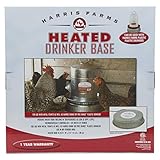
Harris Farms Heated Poultry Drinker Base
- 125W thermostatic control
- Works with metal and plastic
- 3 and 5 gallon compatibility
- Rated freeze protection to 10F
Heated Chicken Waterers for Winter in 2026
All ten waterers and heated bases below are electric. Ratings are the current Amazon averages and review counts, and they are worth reading carefully: the highest review counts in this category sit on products that have been on the market for a decade or more, which means their ratings include a long tail of old-model complaints. Every option also requires a safe outdoor power connection, so plan that before you buy anything.
| Product | Specifications | Action |
|---|---|---|
| Farm Innovators HB-60P Heated Poultry Waterer 2-Gal 60W |
|
Check Latest Price |
| Farm Innovators HP-125 Heated Base 125W |
|
Check Latest Price |
| Harris Farms Heated Poultry Drinker Base 125W |
|
Check Latest Price |
 Premier 1 All-Season Heated Waterer 3 Gallon 100W Premier 1 All-Season Heated Waterer 3 Gallon 100W |
|
Check Latest Price |
 Farm Innovators C-50P De-Icer 150W Farm Innovators C-50P De-Icer 150W |
|
Check Latest Price |
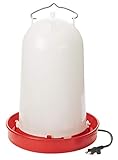 API 3 Gallon Heated Waterer 100W API 3 Gallon Heated Waterer 100W |
|
Check Latest Price |
 Myodal 62W Metal Heater Base 13 Inch Myodal 62W Metal Heater Base 13 Inch |
|
Check Latest Price |
 K&H Thermo-Poultry Waterer 2.5 Gallon 60W K&H Thermo-Poultry Waterer 2.5 Gallon 60W |
|
Check Latest Price |
 Zoblise 5 Gallon Heated Waterer Base 125W Zoblise 5 Gallon Heated Waterer Base 125W |
|
Check Latest Price |
 GUEOQTC Heated Waterer Base 2-Pack 110W GUEOQTC Heated Waterer Base 2-Pack 110W |
|
Check Latest Price |
1. Farm Innovators HB-60P Heated Poultry Waterer – Best All-in-One for Small Flocks
Farm Innovators HB-60P Heated Poultry Waterer Drinker, 2-Gal, 60W
2 gallon reservoir
60 watt thermostatic element
Side-mounted drip-free nipples
12 x 12 x 11 inches
Pros
- Most reviewed option in the group
- Reservoir and heater combined in one unit
- Drip-free nipples suit up to 15 chickens
- Removable top for fast refills
Cons
- Nipple lines can ice up in exposed cold
- Plastic reservoir can be damaged if run dry
This is the unit I recommend first for most backyard flocks. It has been on the market for well over a decade, has the deepest review history of anything in our roundup, and it does one thing: it holds two gallons of water above freezing with a 60-watt thermostatic element. The sides carry drip-free, freeze-free nipples, so the birds drink from a small metal tube rather than from an open trough.
Capacity is the limiting factor. Two gallons covers up to 15 chickens on a cold day, which makes it right for the typical 6 to 12 bird hobby flock. Bigger flocks need a second waterer or a different unit entirely.
Owner feedback is heavily positive on the thermostat. It cycles on near freezing and off when the water is warm, so it does not run continuously through a mild week. The removable top means you can refill without wrestling with a frozen lid, and the metal handle lets you hang it or set it on the ground.
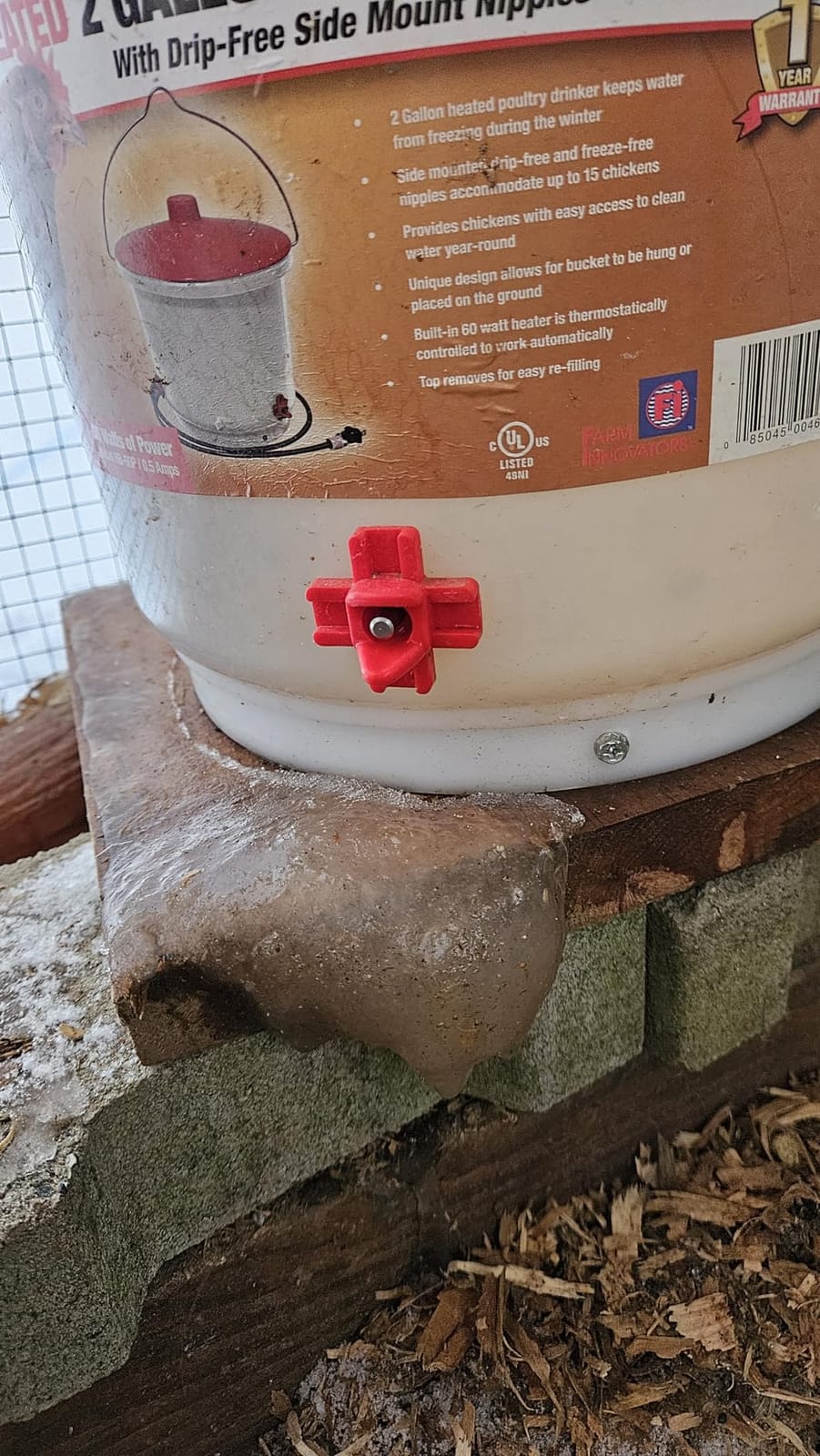
The same feedback carries two honest warnings. First, nipple lines are the weak point: in deep cold with wind exposure, ice forms at the outlet faster than it forms in the reservoir, and a frozen nipple means no water even though the tank is still liquid. Second, the container is plastic, and running the element with an empty reservoir can damage it.
What capacity means for a 10-bird flock
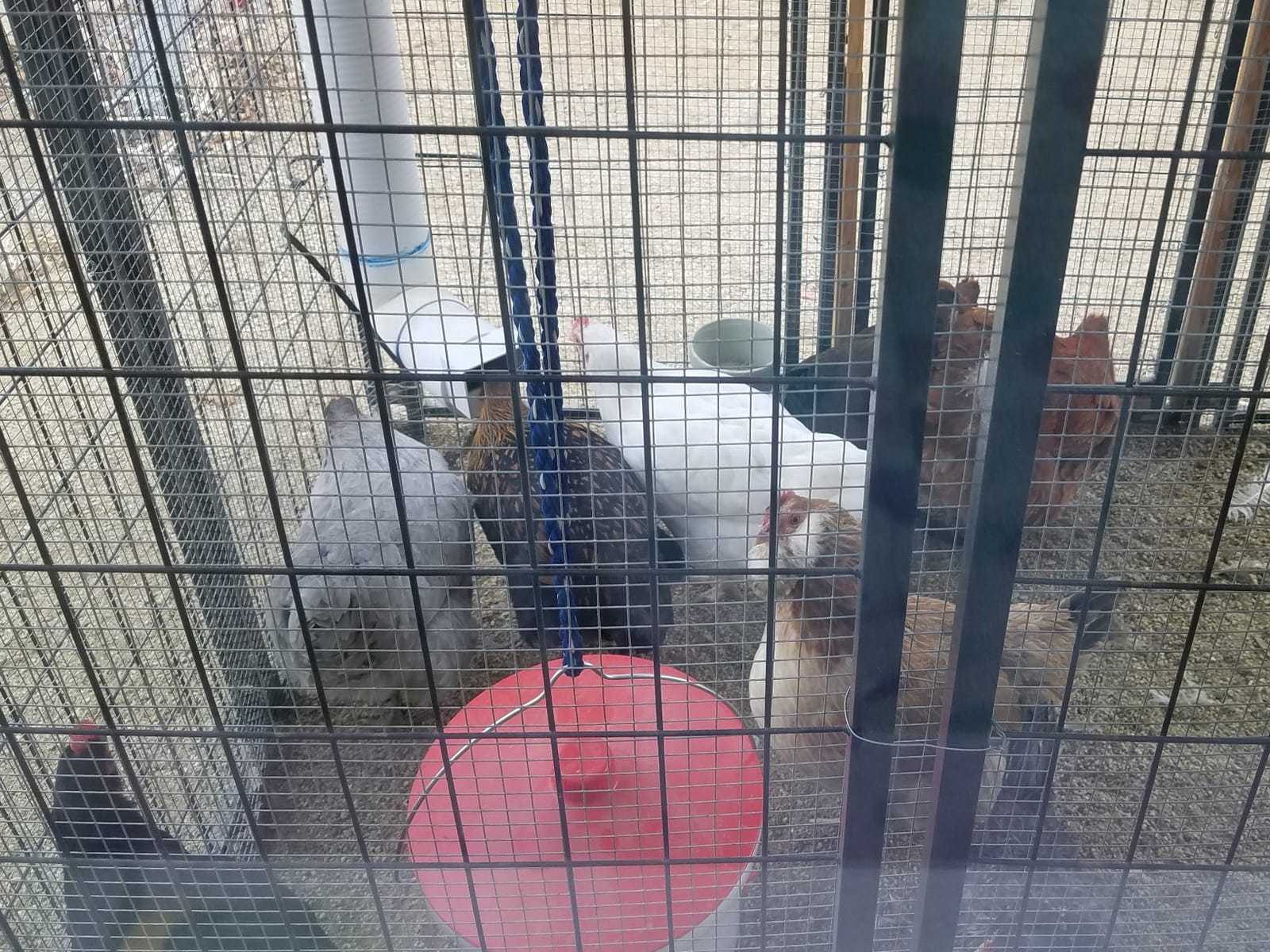
A hen drinks roughly a pint a day in winter, and considerably more when the weather is cold enough to burn energy staying warm. Ten birds at a pint each is about 1.25 gallons, so a 2 gallon reservoir is a single day of supply with headroom. That headroom matters more in winter than in summer.
If your run is exposed to wind, plan on filling it twice during a hard freeze. The nipples are recessed and side-mounted, which helps a little, but wind chill at the drinking surface is the limiting factor, not the air temperature at the tank.
When to skip this one
Skip it if you have more than about 15 birds, or if you already own a good galvanized double-wall fount and would rather add heat than replace a whole waterer. In that case a heated base costs less and serves more birds per dollar.
Also skip it if your coop has no safe outdoor power nearby. This is a plug-in unit with a short cord, and stretching a cord across a run is where people create real electrical problems.
2. Farm Innovators HP-125 Heated Base – Best Value for Metal Founts
Farm Innovators HP-125 Heated Base for Metal Poultry Founts, 125W
125 watt thermostatic base
17 x 16.5 x 4.25 inches
Fits double-wall metal founts
Activates below 35F
Pros
- Wide 17 inch pan fits most 3 and 5 gallon founts
- Bottom cover keeps element clear of debris
- Long production history with deep review data
- Reports of freeze protection far below 10F
Cons
- Short cord that birds peck at
- Surface runs warmer than some expect
- A minority arrive dead and need recalibration
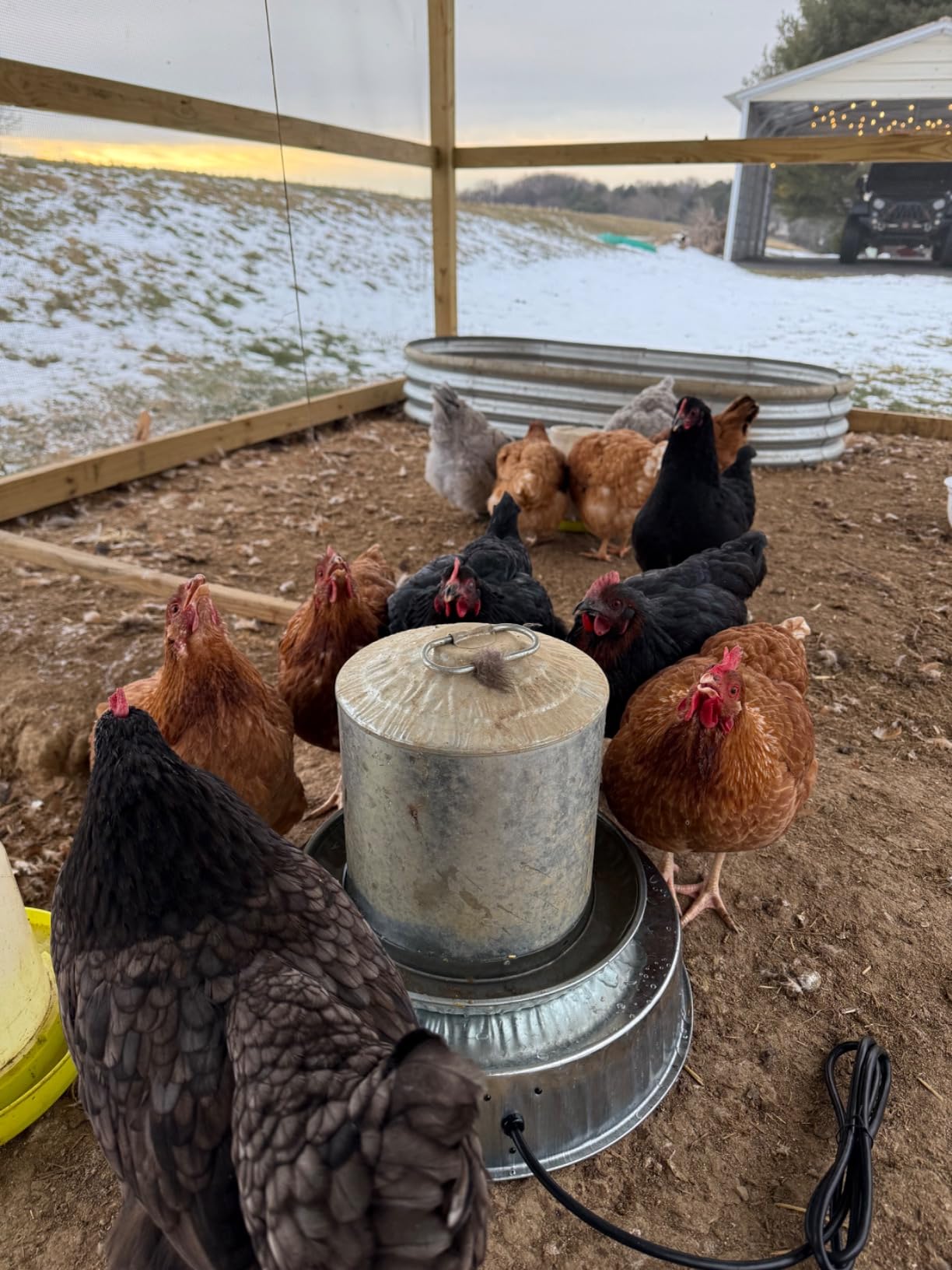
This is the community favourite setup, and the pattern shows up again and again on BackyardChickens: a galvanized double-wall metal fount sitting on a thermostatically controlled heated base. One owner described running a 30-year-old metal base heater that still holds a 5 gallon fount thawed at -8F. That kind of service life is exactly why the base-plus-fount route keeps winning long-term favour among keepers.
The HP-125 has been manufactured for well over a decade, and at 17 inches across the pan it sits under most 3 gallon and 5 gallon metal founts. It activates automatically below 35F, which is the correct cut-in point: it starts heating before the water reaches a problem state rather than after.
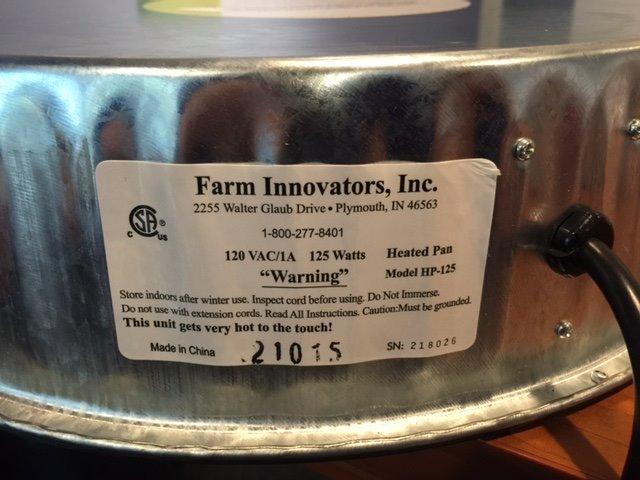
The protective bottom cover matters more than it sounds. Without it, bedding, droppings, and grit sit directly on the heating element, and that combination is what kills these units over time. With the cover, the element stays cleaner and transfers heat more predictably into the metal above it.
The manufacturer claims freeze protection in temperatures as low as 10F, and buyers report far colder performance. Owners in enclosed runs describe keeping water liquid into the minus 30s. Treat those as field reports rather than guarantees, since wind, snow cover, and water volume all change the outcome.
Why the base-plus-fount route outlasts all-in-one units
Because the fount and the heater are separate pieces. When the plastic reservoir cracks in year three, you replace a bucket, not a full assembly with electronics inside it. Metal founts outlast plastic buckets by years, and the base is the only part with a heating element in it.
A second reason is capacity. A 5 gallon metal fount under this base serves a much larger flock than a 2 gallon all-in-one unit, and galvanized double-wall construction does not shatter in deep cold the way plastic can.
When to skip this one
Skip it if your only waterer is plastic. Owners report the surface running hotter than expected, and that is not a good combination with a thin plastic bucket that can warp or crack. Harris Farms or the Myodal base below are better choices for plastic containers.
Skip it if you cannot protect the cord. The cord is short, birds peck at cords, and a chewed cord on a 125-watt element in a wet run is an electrical hazard. Route the cord inside a conduit or along the wall.
3. Harris Farms Heated Poultry Drinker Base – Top Rated for Sub-Zero Climates
Harris Farms Heated Poultry Drinker Base for Chicken Waterers & Coops
125 watt thermostatic base
16.34 x 16.34 x 3.5 inches
Works with metal and plastic
Rated to 10F
Pros
- 4.6 average rating
- the highest in this group
- Accepts both metal and plastic drinkers
- Accurate thermostat warms only on cold days
- Owners report three-plus winters of service
Cons
- Needs covered or dry placement
- Occasional unit that never powers on
- Warranty tied to matching Harris Farms drinkers
This base carries a 4.6 average across more than a thousand reviews, which is the strongest rating in the roundup, and the feedback describes owners in Canada and the northern United States getting three or more winters out of a single unit. For a category where lifespan is the number one complaint, that consistency matters more than any wattage figure.
It runs 125 watts and is thermostatically controlled, switching on as conditions require. The key practical difference from the Farm Innovators base is material compatibility: this one is rated for both metal founts and plastic drinkers, so it does not force you into a bucket swap.
Rated freeze protection goes down to 10F, which lines up with owners describing water staying liquid through subzero snaps. At 16.34 inches square, the footprint is a little smaller than the Farm Innovators pan, so check the diameter of your fount before buying.
There is one placement condition that catches people out. The unit is specified for indoor use, or outdoor use in a dry covered area. That is fine in a coop or an enclosed run, but it is the wrong tool for a fully exposed yard where rain and snow hit the base directly.
Why material compatibility decides it
Most failure reports in this category trace back to putting a 125-watt element under a container it was not designed for. Plastic waterers can crack or deform under prolonged contact with a warm base, and a warped base loses the seal it needs to transfer heat evenly.
Because this base is approved for both, you can use whatever container you already own. If your current waterer is a 3 or 5 gallon plastic bucket, this is one of the safer bases to pair with it.
When to skip this one
Skip it if the waterer has to sit in the open. The dry covered placement requirement is not a formality, and a unit that fails after one snowy season is not worth the swap.
Also weigh the warranty. It applies to the matching Harris Farms drinker, so if you already own a different brand of container you are relying on the base alone, and you should keep your receipt.
4. Premier 1 All-Season Heated Waterer – Premium Pick for Clean Water Year-Round
Premier 1 All-Season Heated Poultry Waterer for Chickens & Ducks – 3 Gallon
3 gallon reservoir
100 watt element
Hinged quick-fill cap
16 ft detachable cord
Pros
- Heater reservoir and nipples in one unit
- Quick-fill cap avoids removing a frozen lid
- Three recessed nipples cut cleaning
- Detachable cord allows summer use without heat
Cons
- Most expensive option in the roundup
- Nipple drinkers need training for new birds
- Some frozen-nipple reports in exposed setups
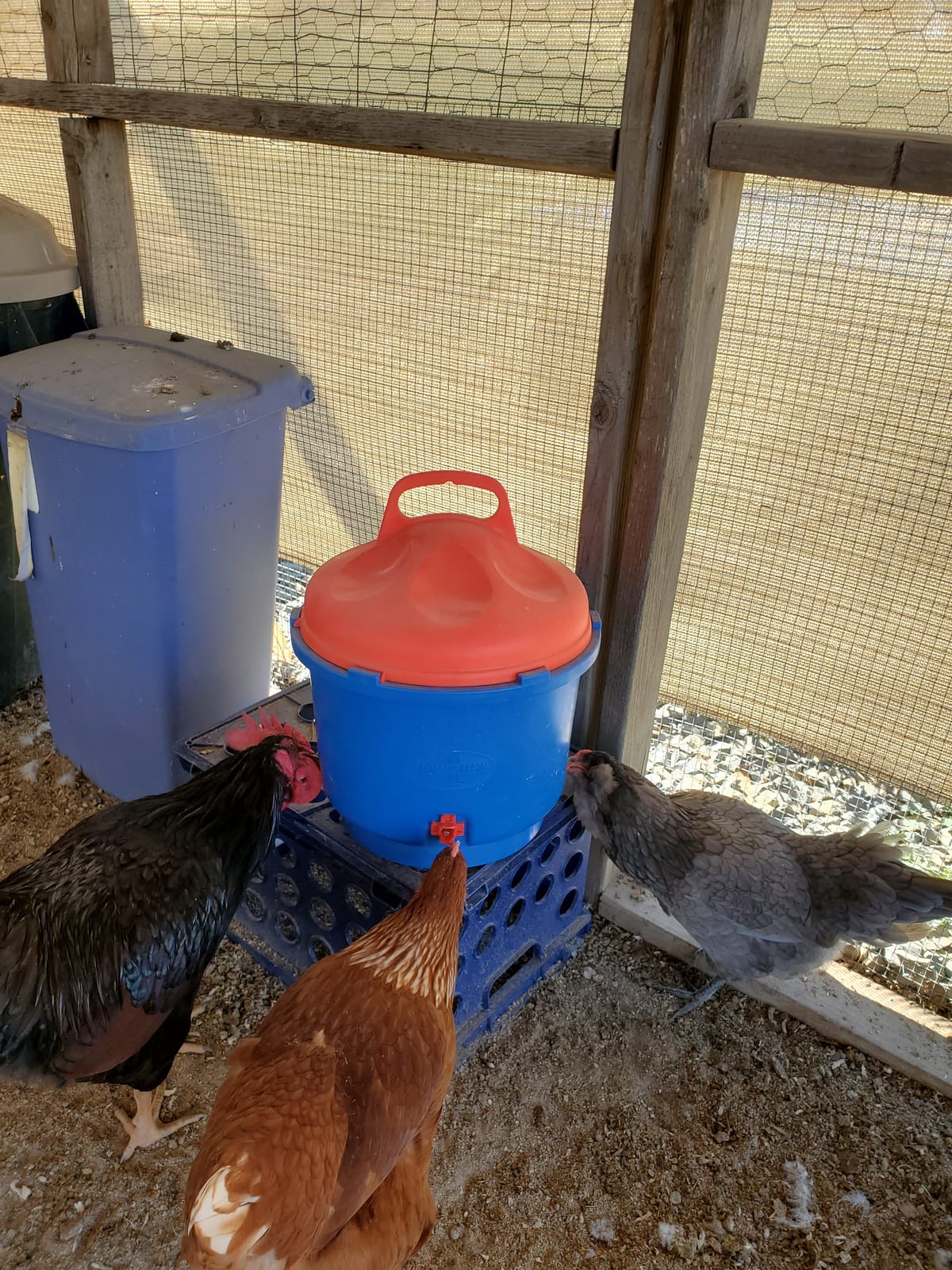
This is the one I recommend for keepers who want one waterer for all four seasons rather than a winter-only gadget. The 100-watt element switches on below 40F and off at 60F, the reservoir holds 3 gallons, and the detachable 16 foot cord lets you run it as a plain waterer in summer once the heat is unplugged.
Three recessed nipple drinkers come with three spare nipples, and the manufacturer rates it for up to 35 adult chickens. The nipples keep birds off the water, which means less droppings and much less cleaning than an open trough through the winter.
The hinged quick-fill cap is the feature owners mention most. In a hard freeze, a screw-off lid is often frozen shut, and owners describe chiselling at lids before giving up. This one swings open and takes a hose or a watering can.
Its thermostat band is narrower than some competitors, cutting out at 60F rather than the 70s. That is a sensible design: warm rather than hot water reduces evaporation and keeps the element from working harder than it needs to.
Who this capacity actually serves
Three gallons is a genuine step up from the 2 gallon units. At roughly a pint per bird per day in cold weather, that is close to a full day for a 20 bird flock and a comfortable day for a small one. You still refill, but you refill once a day instead of twice.
For a 30-plus bird flock, this becomes borderline. In that situation two units spaced apart in the run is safer than one large unit, because if the power fails you still have a partial supply.
When to skip this one
Skip it if your birds have never used nipple drinkers. Training takes patience, and you do not want to introduce a new drinking method in the same week you introduce freezing weather. Nipple-trained flocks, on the other hand, tend to rate this very highly.
Skip it for a no-electricity coop, and note that the replacement power cord is not sold through the marketplace. That matters if the detachable cord is the part most likely to be damaged by pecking or a frozen nip.
5. Farm Innovators C-50P De-Icer – Best for Existing Buckets and Nipple Systems
Farm Innovators C-50P Chicken Waterer De-Icer, 150W, Teflon Coated
150 watt thermostatic disc
Teflon coated metal
7.5 inch diameter
Operates at 120V
Pros
- Highest wattage in the roundup
- Compact disc drops into a standard bucket
- Teflon coating resists winter corrosion
- Thermostatic operation limits wasted power
Cons
- 7.5 inch footprint heats only a small area
- Not a complete waterer on its own
- Listings are inconsistent about wattage
This is a different shape of solution. Instead of heating a base or building the element into a reservoir, the C-50P is a 150-watt thermostatically controlled disc that drops into a bucket or poultry fountain. At 150 watts it has the highest output of anything in this roundup, which makes it the pick for genuinely cold nights.
The Teflon-coated surface resists corrosion in winter conditions and rinses clean easily. It is sized for nipple-drinker bucket setups, which is the configuration it works best in: a 5 gallon bucket, a de-icer disc near the bottom, and nipples drilled near the base.
Owners like it because it is simple. There is no base to level, no fount to align, and no shell to trap moisture. You set it in the bucket, plug it in, and fill around it.
The limitation is physical. A 7.5 inch disc only warms the volume of water directly above it, so in a large bucket the water near the top can still cool toward freezing. It works best in smaller volumes or where the water circulates around the disc.
When a bucket system beats a fount system
Buckets win when you want nipple drinkers. Nipples only work reliably when the water head pressure is consistent, and a straight-sided 5 gallon bucket gives you a predictable column. Founts are better for open trough-style drinking and for birds that have not been nipple-trained.
The de-icer also wins when you already own deep cold hardware and want to keep it. Forum users running large flocks pair a higher-wattage de-icer with a plain bucket rather than replacing a working container with a purpose-built one.
When to skip this one
Skip it if you are buying a complete winter water solution, because this is an add-on. You still need a bucket, a cord, and a safe place to run power.
Skip it if you have a very large water volume to protect and only one disc. The heat transfer area is simply too small for a 5 gallon bucket in deep cold without help, and listings are inconsistent about whether the unit is 150 or 200 watts, so do not plan around a specific output.
6. API 3 Gallon Heated Waterer – Best for Roost-Proof Lids
API 3 Gallon Heated Chicken or Bird Waterer with Overheating Protection, Galvanized Steel Handle, and Easy to Fill Funnel Design, White
3 gallon gravity fill
100 watt thermostatic heater
Ice-free rated to -5F
4 foot power cord
Pros
- Rounded top keeps birds off the water
- Alloy steel construction with galvanized handle
- Thermostatic cycling with overheating protection
- Easy-fill funnel design
Cons
- 4.0 average
- the lowest rated here
- 4 foot cord is short for most coops
- Reports of intermittent heating
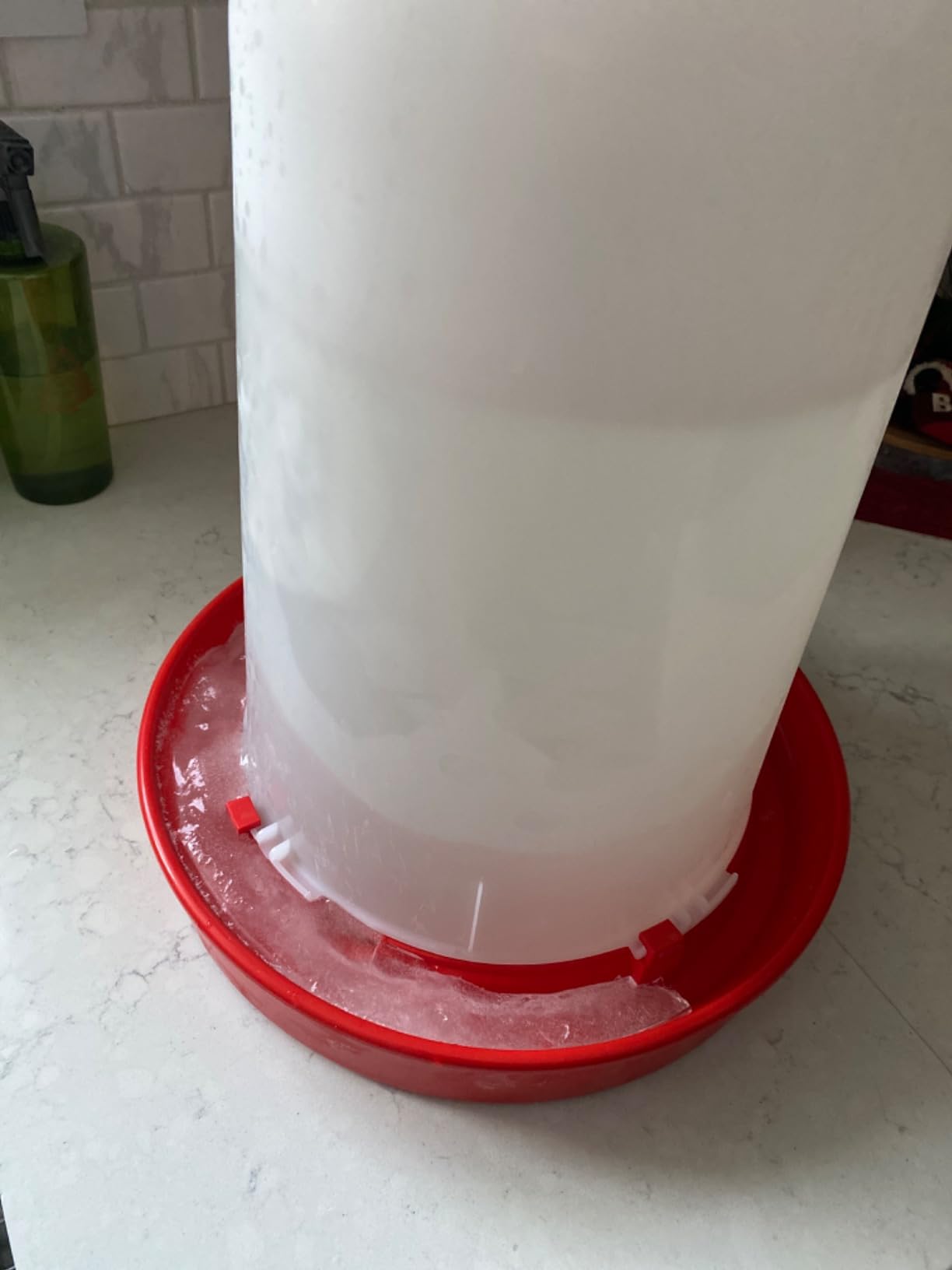
This is a 3 gallon gravity-fill waterer with a 100 watt thermostatically controlled heater pad that distributes heat across the base, and it carries built-in overheating protection. The manufacturer rates it to keep water ice-free down to -5F, which is a reasonable claim for a 100 watt unit in most temperate winters.
The rounded top is its distinguishing feature. Chickens like to roost on flat surfaces, and a flat lid becomes a perch that collects droppings directly above your water supply. This one is shaped so they cannot settle in.
Construction is alloy steel with a galvanized steel handle, which matters in freezing weather for a simple reason: an all-steel waterer does not shatter. Owners in cold climates report plastic waterers that simply shatter rather than crack, and once you have seen a 3 gallon bucket break into pieces in a run, steel starts to look like the safer default.
It is also gravity-fill, which some keepers prefer over nipple systems because new birds understand an open water surface immediately. The easy-fill funnel design is aimed at the same thing.
Reading a 4.0 rating honestly
This unit sits at 4.0 with 565 reviews, and about 13 percent are one-star. Looking at what those reviews describe, the complaints cluster around heating that stops working after months, and a 4 foot cord that rarely reaches from a wall outlet to a waterer sitting in the middle of a run.
Neither complaint is unusual for the category, but both are more common here than with the higher-rated bases. If you buy it, check the cord route on day one rather than discovering the problem in a cold snap.
When to skip this one
Skip it if you have a flock that already drinks from nipples, since the roost-proof lid advantage only matters for open-trough drinkers. Skip it if your outlet is far from the waterer, because the 4 foot cord is the single most common practical complaint.
Skip it for sub-zero northern winters. The -5F rating leaves little margin, and a 100 watt element in an exposed run is the wrong tool when temperatures run much colder.
7. Myodal 62W Metal Heater Base – Budget Pick with Wide Container Compatibility
62W Metal Chicken Water Heater for Winter, 13” Thermostat Chicken Waterer Heater Base for 1-5 Gallon Metal or Plastic Poultry Waterer, Outdoor Weatherproof Poultry Water Heaters for Turkey Goose Duck
62 watt thermostatic base
13 x 13 x 1.1 inches
Stainless steel base
Cold-resistant 6.56 ft cord
Pros
- 4.6 average across 250+ reviews
- Works with plastic metal glass or ceramic
- Base supports over 120 lbs
- Only mildly warm to the touch
Cons
- 6.56 ft cord is short for distant outlets
- A few units stopped heating within months
- Less margin in sustained wind chill
This is a recent listing and it already holds a 4.6 average. At 62 watts it is deliberately modest, which makes it a better match for mild winters and small waterers than for a hard northern climate. The thermostat reheats below 35F and cycles off around 68F, so it idles most of the season.
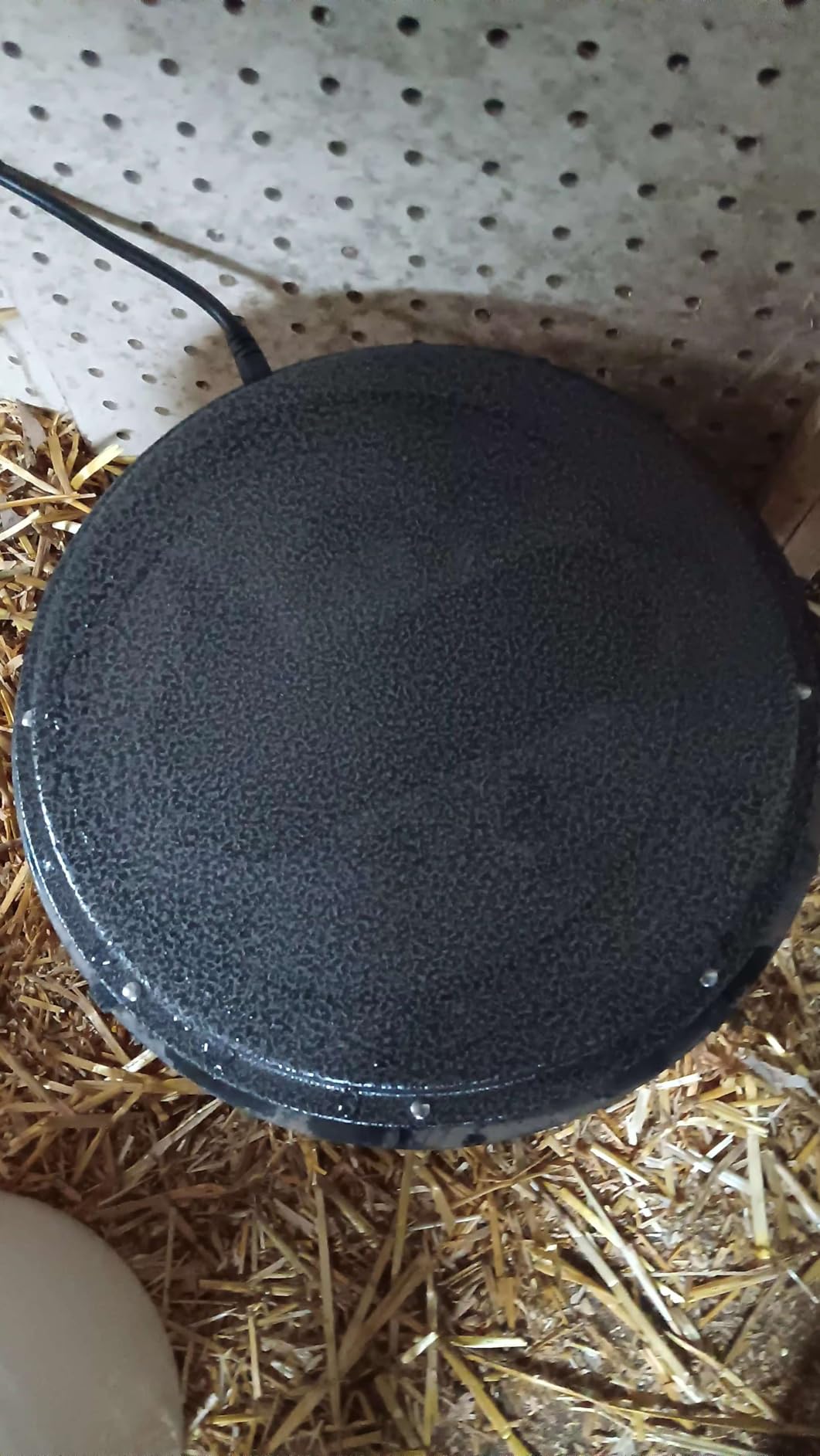
The stainless steel base is rated to support over 120 pounds and measures 13 inches square, and it is one of the few bases here that works with plastic, metal, glass, or ceramic containers. That flexibility is unusual at this size.
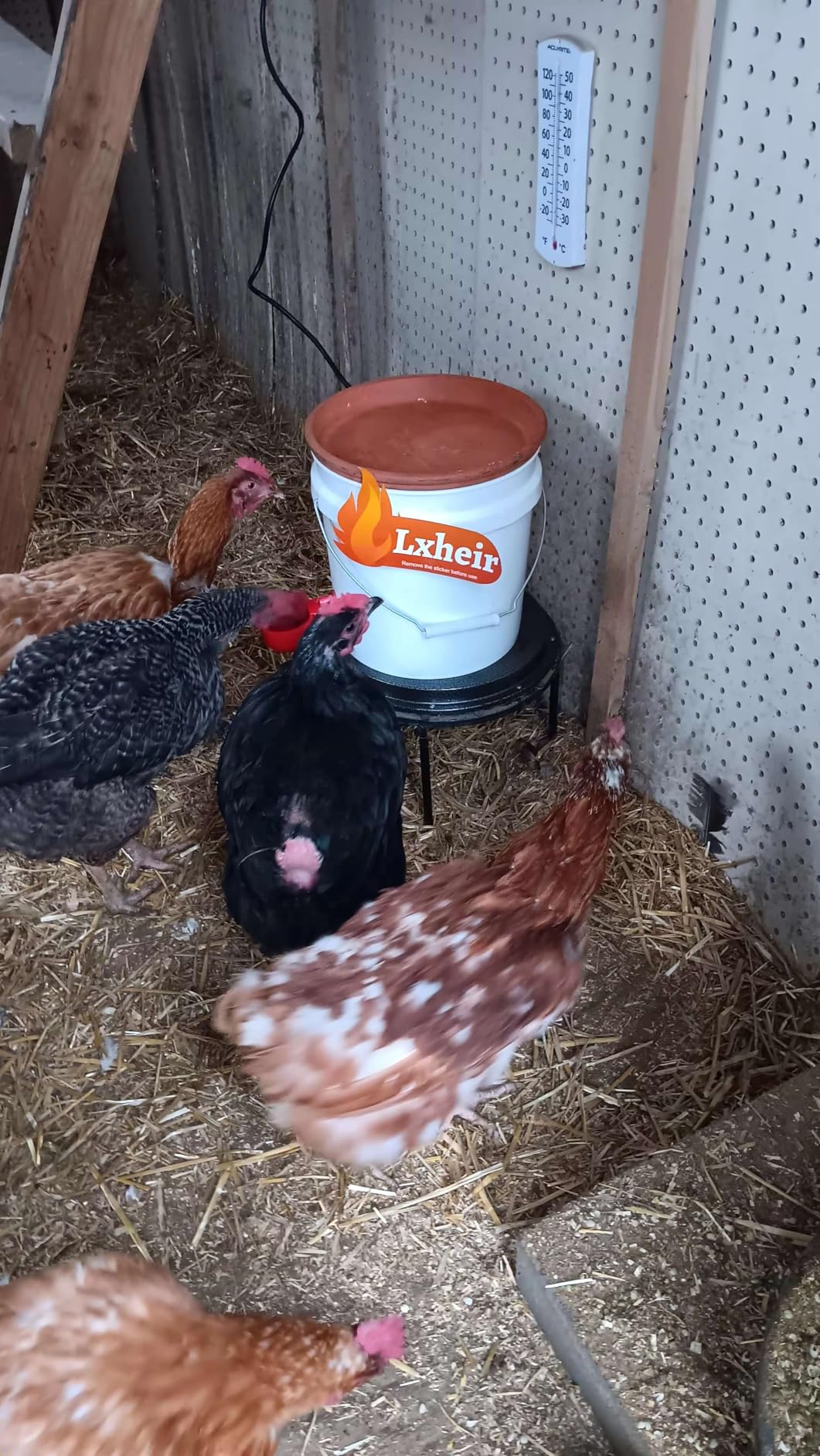
Owners in Alberta and northern New England report keeping water liquid into the minus 30s with it. That is field experience rather than a rating, and it usually comes with a caveat: a small water volume, a sheltered spot, and not much wind.
One detail that matters more than expected: the plate is only mildly warm to the touch. Birds that perch or stand near the base are not scalded, which removes a problem that shows up with hotter-running bases.
How 62 watts compares to 125 watts
Wattage is about how fast heat replaces what the water loses. At 62 watts, the base is fine for a 1 to 3 gallon container in temperatures that dip to freezing and rebound. At 125 watts you have real margin for a 5 gallon container or a week of single-digit nights.
The practical rule: pair 62 watts with small volume and a sheltered position, and pair 100 to 150 watts with large volume or exposed placement. The same base behaves very differently with five gallons above it versus one.
When to skip this one
Skip it for a large flock in an exposed run. At 62 watts, wind chill drives heat loss faster than the element can replace it, and the owners reporting freezing are almost all the ones with a big bucket and an open location.
Also weigh the short review history against a 4.6 score. A newer listing with 252 reviews has not yet survived a full decade of owners testing it, so the number tells you more about who bought it than about how it ages.
8. K&H Thermo-Poultry Waterer – Best Familiar Trough for Traditional Flocks
K&H Pet Products Thermo-Poultry Waterer 2.5gal. (Heated) Gray 60 Watts – No Roost Top & Non-Spill Refill
2.5 gallon tank
60 watt thermostatic element
No-roost rounded shape
Spill-proof refill cap
Pros
- Familiar trough style many flocks already use
- No-roost shape keeps droppings out
- Spill-proof cap for easy refills
- Removable filter ring catches debris
Cons
- 4.0 average with 11 percent one-star
- 60W is the lowest output in the group
- Reports of heater failure after one or two seasons
If your flock already drinks from an open trough and you want to keep that arrangement, this is the K&H unit to look at. It holds 2.5 gallons, runs a 60 watt thermostatic element, and weighs 2.51 pounds, so it is easy to lift for a refill or a clean-out.
The rounded no-roost tank shape keeps birds from perching on the rim, and the spill-proof refill cap means you can carry it to the spigot without a splash. A removable filter ring sits inside to catch debris, which matters more in winter because solids in the water encourage ice formation at the surface.
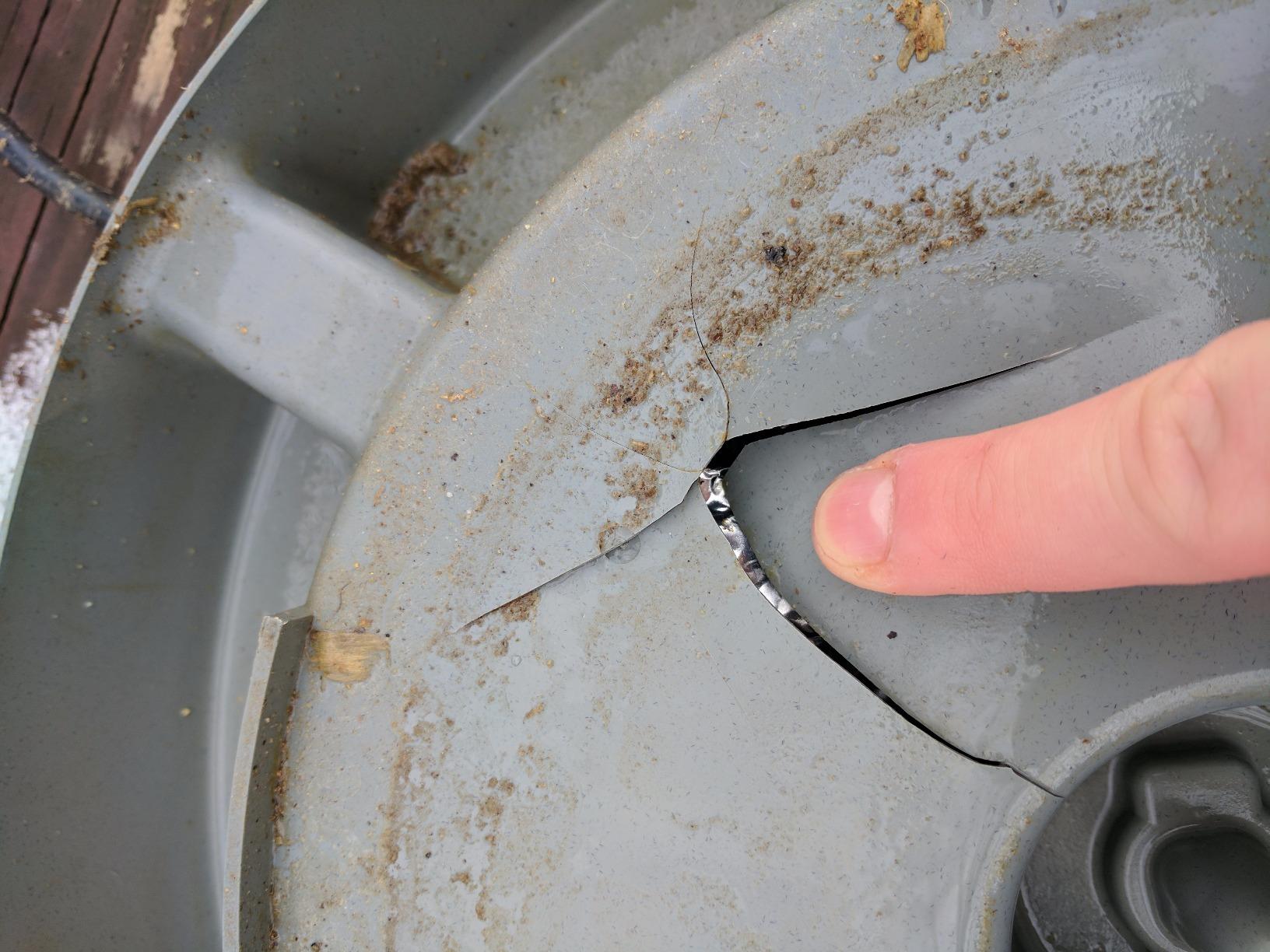
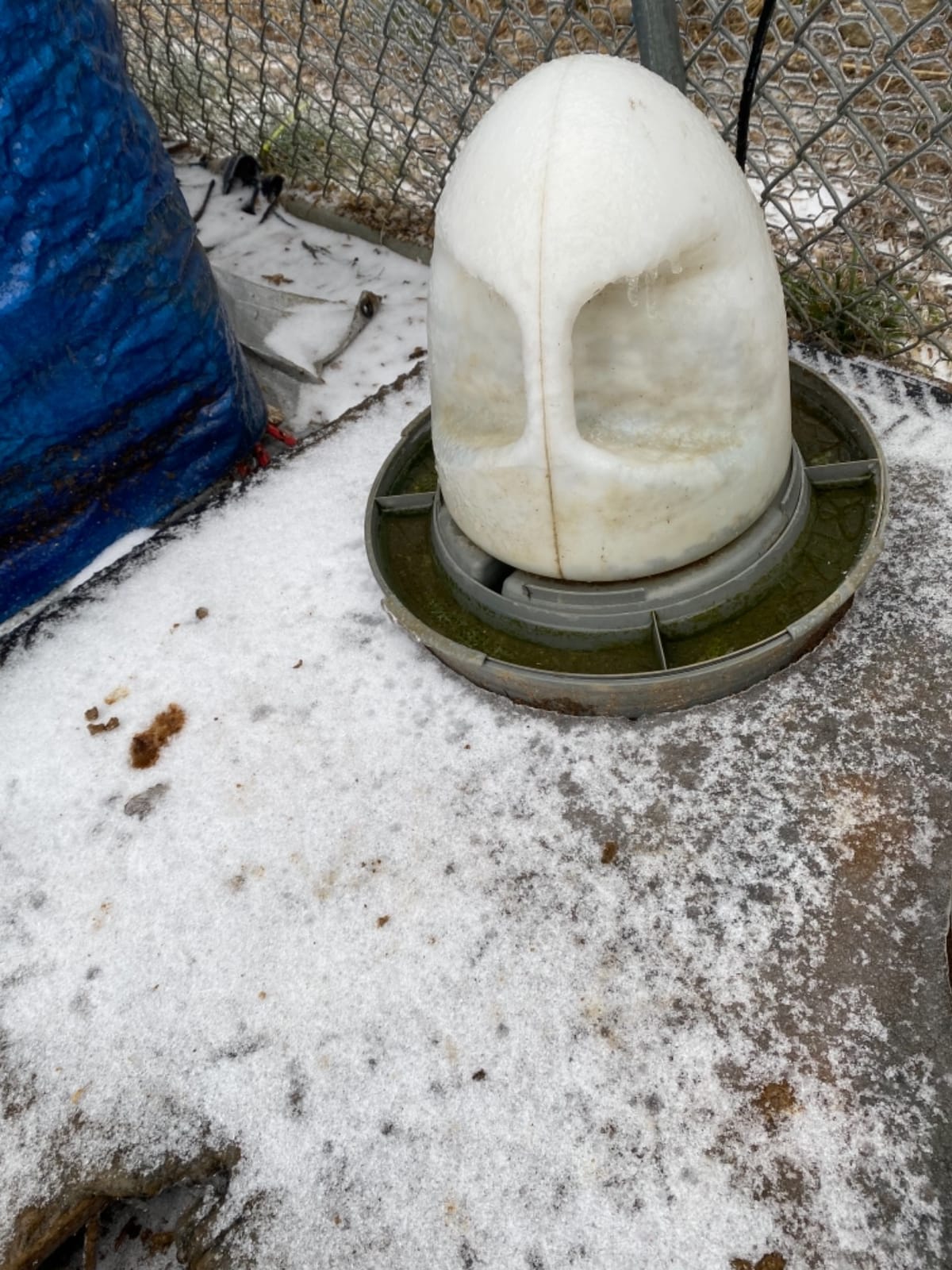
Owner feedback is comfortable on the design and critical on the element. The recurring complaint is durability: several buyers report the heater failing after one or two seasons, and roughly 11 percent of reviews are one-star. At 4.0, it is tied for the lowest average in the roundup.
The 60 watt element is the other issue. It is the lowest output here alongside the Farm Innovators HB-60P, and it is paired with a larger 2.5 gallon tank than that unit carries, so the water-to-wattage ratio is tighter.
Why the filter ring matters in cold weather
Debris in a waterer is a freezing problem before it is a cleanliness problem. Floating droppings and bedding fragments give ice something to nucleate around, which is how a thin ice layer forms at the surface even while the water below is still liquid.
A removable filter ring intercepts most of that material before it reaches the tank. If you keep any open waterer through a winter, pull the ring and rinse it every week, whether or not it looks dirty.
When to skip this one
Skip it if you have never had heater trouble before and want the longest life you can get. The pattern of element failure after one or two seasons is consistent enough in the reviews that I would not choose this unit first for someone who wants a set-and-forget solution.
Skip it in sustained sub-zero weather. A 60 watt element under a 2.5 gallon tank has limited margin, and the tank material is not described as cold-rated steel the way some competitors are.
9. Zoblise 5 Gallon Heated Waterer Base – Best for Full-Size Buckets
Chicken Water Heater Base for Winter, Heated Chicken Waterer 5 Gallon 125W
14.6 inch galvanized base
125 watt element
Cut-in 35F cut-out 77F
6 foot power cord
Pros
- Large base stays stable under a 5 gallon bucket
- Galvanized steel transfers heat and resists rust
- Sensible thermostat band limits evaporation
- Owners report getting through Northeast winters
Cons
- 6 foot cord is short
- Top layer can freeze if filled past halfway
- Several dead-on-arrival reports
This base is built around one job: holding heat under a full-size 5 gallon bucket. At 14.6 inches square it is the widest base here apart from the Farm Innovators HP-125, and the galvanized steel construction both transfers heat efficiently and resists the rust that eventually ruins uncoated steel in a wet run.
The thermostat cycles on below 35F and off above 77F. That 42 degree band is the standard arrangement across this category, and it is wide enough to keep water lukewarm without cooking off a meaningful amount through evaporation.
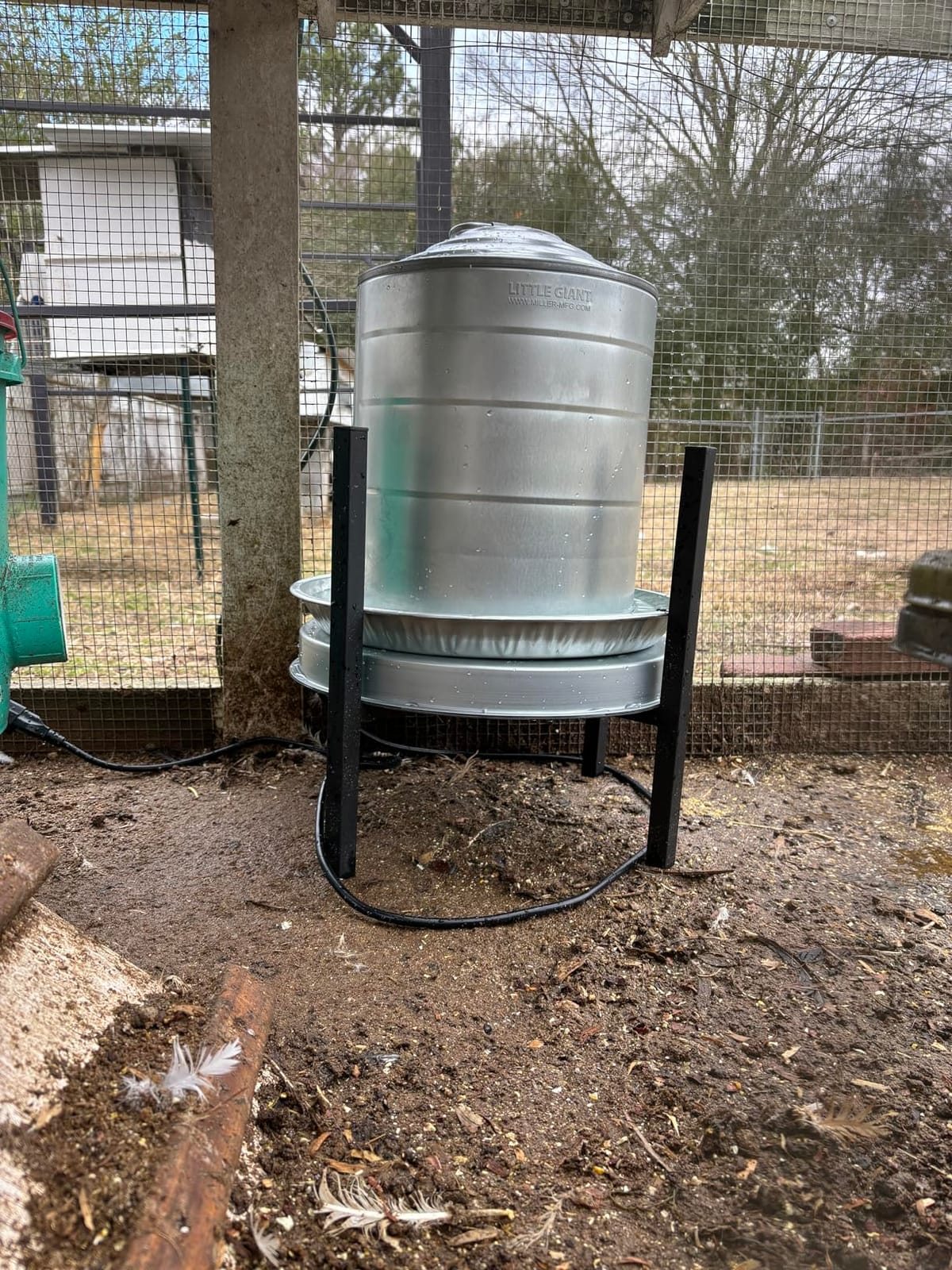
Owner reports describe New England and Northeast winters passed without the bucket freezing, and the large plate is what makes that plausible. A base that a 5 gallon bucket can actually rest on transfers heat across the whole floor of the container rather than just a ring underneath it.
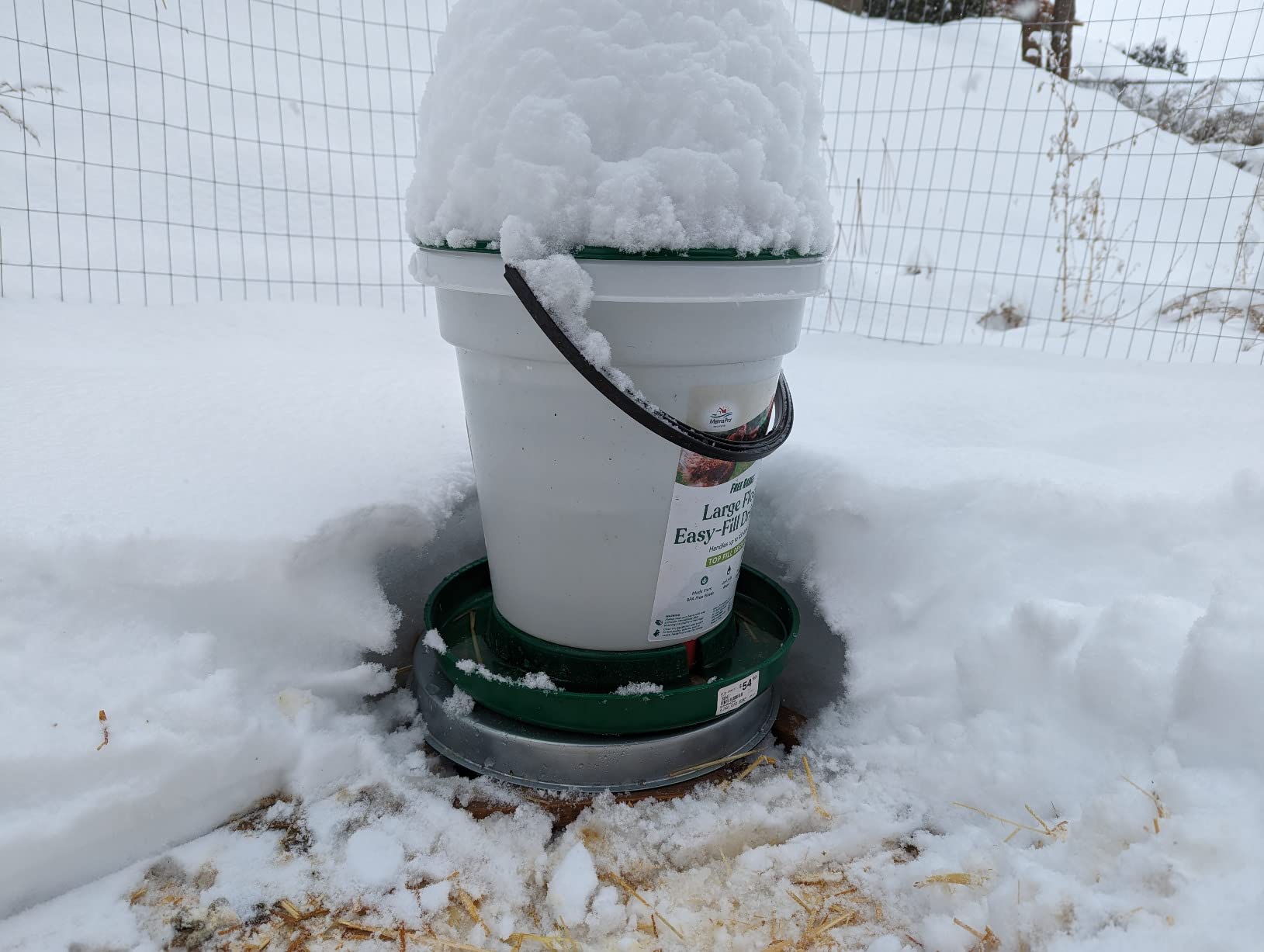
Quality control is the mixed part. About 15 percent of reviews are one-star and several of those describe units that arrived dead or failed early. A handful of owners also note that filling the bucket past halfway leaves the top layer prone to freezing, which suggests the base is doing its job lower down but not throughout a full column.
Why base diameter decides whether a bucket stays warm
Heat moves through the water from the base upward, and it moves fastest when the heated footprint covers most of the container floor. A base that is noticeably smaller than the bucket leaves a cold ring of water around the edge, and that is where ice starts.
Measure the bucket before you buy any base, and check the listed diameter against the widest part of the container. This model comes in 11 inch and 15 inch sizes, so you can match the footprint to the volume.
When to skip this one
Skip it if you are sensitive to defect rates, since the dead-on-arrival pattern is the loudest complaint here. If you buy it, test it indoors in a tub of water for a day before you rely on it in a hard freeze.
Skip it if your outlet is more than a few feet from the waterer. The 6 foot cord is short, and extension cords are workable outdoors only if they are rated for wet locations and protected from pecking.
10. GUEOQTC Heated Waterer Base 2-Pack – Best for Two-Area Flocks
GUEOQTC 2Pack Chicken Water Heater for Winter,Heated Poultry Waterer Base,with Thermostat and 9.8ft Power Cord, Dia.11in
Two 11 inch bases
110 watt element each
9.8 ft three-prong cords
Thermostat 35F to 77F
Pros
- Two bases in one box for separate flock areas
- Longest cord in the roundup at 9.8 ft
- Sealed body tolerates spilled water
- Stops heating above 77F
Cons
- 11 inch diameter is too small for 5 gallon waterers
- One review reports a shock from a failed component
- Plastic waterers should not run on it while empty
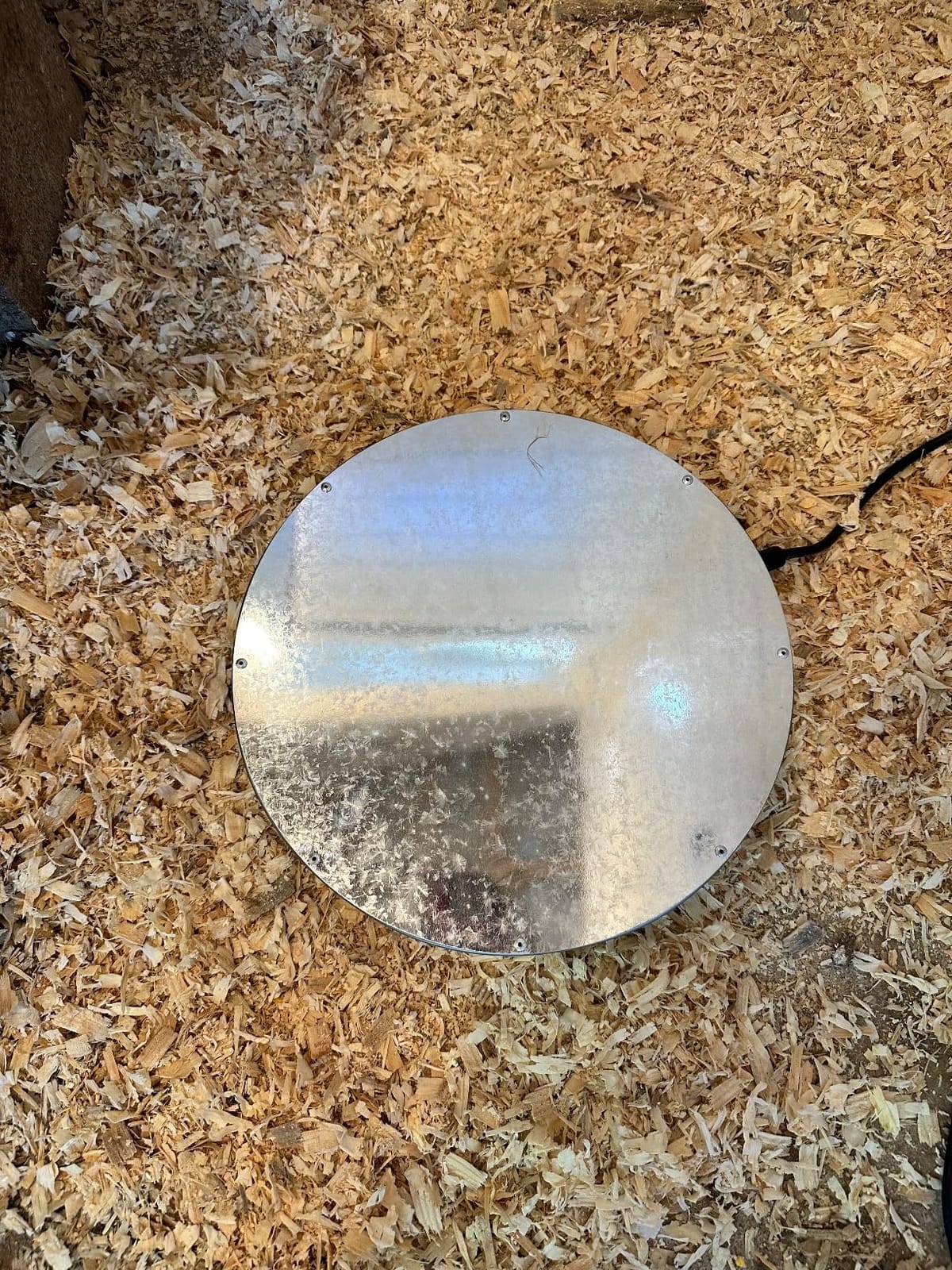
This box contains two 11 inch heated bases at 110 watts each, which solves a specific problem: flocks split across a coop and a run, or birds housed in two areas that should never share a single water source. Two independent units also mean a single failure does not take out the whole flock’s supply.
The 9.8 foot cord is the longest in this roundup by a wide margin, and extension cords are permitted. That single feature removes a lot of installation friction, since most cord problems in this category are really placement problems.
The body is sealed ABS and iron and tolerates spilled water and muddy floors, and owners confirm the plate never becomes uncomfortably hot. Buyers report no icing at 16F, which is a reasonable result for a 110 watt element under a 3 gallon container.
Size is the trade-off. At 11 inches in diameter, this base is sized for buckets and small founts, and it will not support a full-size 5 gallon waterer. Owners say exactly that, and it is the most common sizing note in the reviews.
Why two independent units beat one big one
Redundancy is the real argument. If a single base dies quietly in an unheated run on a cold night, one frozen waterer means one water supply for the entire flock. Two units in separate areas mean a failure is inconvenient rather than an emergency, and birds in the other area keep drinking.
Placing them apart also reduces crowding. Chickens crowd around a single waterer in cold weather because they want to drink and stand near each other, and splitting the supply spreads the flock and cuts the trampling you get at a busy point.
When to skip this one
Skip it if your waterer is a 5 gallon bucket, because the 11 inch diameter cannot support it properly. Skip it if you only need one base, since the two-pack format adds a unit you will not use.
One owner reported receiving an electrical shock from a component that failed within a month. One report does not condemn the product, but it is the reason we list this base after the units with longer service records, and the reason to plug any heated base into a GFCI-protected outlet rather than a bare one.
How to Match Heated Waterer Wattage to Your Winter
Wattage is not a quality ranking, it is a match to volume and exposure. A rule that works well: 60W handles a 1 to 3 gallon container in mild frosts, 100 to 125W handles 3 to 5 gallons or single-digit nights, and 150W belongs in an exposed run where the temperature drops well below freezing. Volume of water and wind exposure both increase heat loss, so a 5 gallon bucket outdoors needs more watts than a 1.5 gallon bucket in a sheltered coop.
Thermostat quality matters more than raw wattage. Owners on BackyardChickens consistently favour thermostatically controlled units with a built-in sensor over raw-output heaters, because an unthermostatted element either wastes power or fails to trigger at the right temperature. The cut-in and cut-out figures on the products here cluster around 35F and 70 to 77F, which is the correct range.
Choosing Between a Heated Base, an All-in-One Waterer, and an Insulated Fount
If you already own a good metal fount, a heated base is the cheapest path to a winter water supply, and the fount outlives the heater. If you are buying everything fresh, an all-in-one heated waterer is simpler and gives you a matched reservoir and heater with fewer parts to fail. If you have no reliable power at the coop, an unpowered galvanized double-wall insulated fount plus manual checks is the honest answer, not a heated unit. Placement matters as much as the device, so treat the housing side as part of the freeze plan, the way we do in our chicken coop comparison.
One important limit applies to every heated reservoir, and no competitor mentions it: heated water does not mean warm nipples. Automatic waterers still freeze at the drinking outlet, because cold water sitting in a metal tube exposed to the air will ice even while the tank stays liquid. Horizontal nipple lines fare better than vertical ones, and wrapping the outlet section with insulation held on by tape helps. If freezing at the nipple is your recurring problem, a trough with a heated base underneath solves it better than any heated reservoir does.
Keeping Water Liquid Without Electricity
Number one: switch to a galvanized double-wall insulated fount. The air gap between the walls is what does the insulating, and it buys you many hours in single-digit temperatures without a cord.
Number two: move the waterer into an unheated but protected space, such as a corner of the coop or a shed where wind cannot reach it. Shelter is worth more than most heaters.
Number three: use hot water top-ups at dawn and dusk. Warmer water holds heat far longer than cold water, and two minutes of your time buys hours of safe drinking water.
Number four: keep a spare waterer and rotate. The simplest freeze plan is having a second filled container ready to swap in.
Number five: insulate a plastic container itself. Bubble wrap wrapped around the body and held with tape slows heat loss, and forum owners use this on nipple lines as well as on containers. If you use a plastic waterer, choose a heavy gauge one, because thin plastic shatters rather than cracks in deep cold. If the same cold snap is hitting the rest of your property, our heated cat bed picks cover the pet side of the same problem, though nothing substitutes for water.
Safe Installation and Winter Setup
Place the waterer on a level, sheltered surface with the power routed to a GFCI-protected outlet. Outdoor-rated extension cords are fine when they are rated for wet locations, and they should be run along a wall or inside conduit rather than across open run where chickens peck at them. A chewed cord on a wet heating element is the most serious avoidable risk in this whole category.
Check the base every day for the first week of hard weather. Look for bedding and droppings on the element cover, water sloshing over the top, and any ice forming at the drinking outlet rather than the tank. Most first-week problems are placement problems, not product problems.
Have a power-outage plan, because a frozen waterer is the consequence of an outage. Keep a spare unheated waterer filled and indoors, know where your breaker is, and if your flock is large enough, use two waterers in separate areas so a single failure is not a total loss. While you are checking the setup, it is worth confirming the coop is dry and draft-free, since shelter cuts heat loss before any heater does. The same applies to your own early-morning checks, which is where a heated blanket is a far more sensible comfort investment than a second heater for the water.
Heater Lifespan and Maintenance
Most electric heated waterers last one to three winters, and honesty here buys credibility. A heated base that has been in service for a decade is the exception, not the rule. Common failure causes are element corrosion, a thermostat that stops switching, and running a plastic container empty, which can cook the element.
Weekly maintenance during freezing weather: pull the filter ring or strainer if the unit has one, rinse debris, and check the base cover. Monthly: inspect the cord from the plug to the element for cracking or pecking damage, and confirm the GFCI still trips. Before storing for summer, unplug, clean, dry fully, and store the unit somewhere dry. Leaving a heater plugged in an empty waterer all summer is the fastest way to kill one.
Frequently Asked Questions
Do heated chicken waterers work?
Yes. A thermostatically controlled heated waterer or heated base keeps drinking water from freezing through normal winter conditions, and most owners report no ice-breaking needed across a full season. They work best when wattage is matched to water volume and the unit is sheltered from wind. Remember that a heated reservoir does not warm the drinking nipples, so automatic waterers can still freeze at the outlet.
What is the best chicken water heater for winter use?
For most backyard flocks, an all-in-one heated waterer with a 2 to 3 gallon reservoir and side-mounted nipples is the simplest choice, because the heater and reservoir are matched parts. If you already own a metal fount, a 125 watt thermostatic heated base under it is the better value and lasts longer. In sub-zero climates, step up to 100 to 150 watts.
How long can chickens go without water in freezing temperatures?
A healthy hen can go roughly a day without water, but dehydration accelerates quickly in freezing weather, and the risk of harm rises sharply beyond 24 hours. Water that freezes removes supply at the exact time birds are burning the most energy staying warm, so a frozen waterer should be treated as urgent rather than an overnight inconvenience.
How can I keep my chicken’s water from freezing without electricity?
Use a galvanized double-wall insulated fount, move the waterer into a sheltered but unheated space, top up with hot water at dawn and dusk, wrap the container in bubble wrap held with tape, and keep a spare filled waterer ready to rotate in. Combining insulation with shelter reliably carries water through most frosts without power.
What device can prevent chicken water from freezing?
Three device types do the job. A heated base sits under a standard fount and heats it from below, an all-in-one heated waterer has the element built into the reservoir, and a de-icer disc drops into a bucket to warm a small area of water. A submersible aquarium heater is sometimes used, but it burns out if the water level drops below it, and a chicken waterer empties through the day.
Final Winter Waterer Verdict
For a typical backyard flock in ordinary winter conditions, the Farm Innovators HB-60P is the pick we would install first: it has the deepest review history in the category, it handles up to 15 birds, and it needs no separate fount. Keep a galvanized double-wall fount on a 125 watt thermostatically controlled base if you run more birds, if you already own a good fount, or if you want a cheaper path with a longer-lived container.
Whatever you choose, plan the power route and the outage plan before the first freeze, not during it. Water is the one winter item your flock cannot skip.