
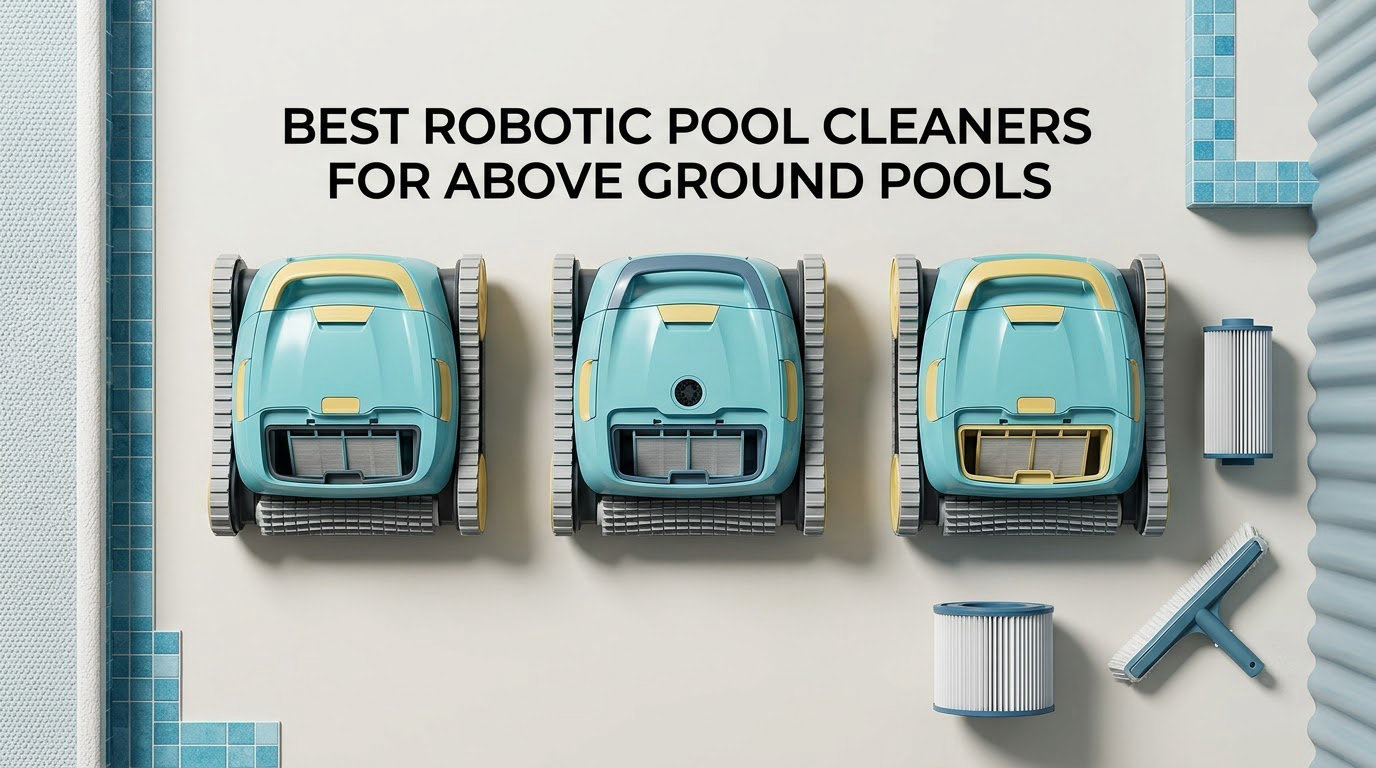
The best robotic pool cleaners for above ground pools are not the same machines that top the inground lists. Above-ground frames are shallow, the liners are soft vinyl, and the water is often a little warmer and a little dirtier than a deep end. A robot that looks impressive in a spec sheet can struggle on a 48 inch deep floor with a wrinkly liner and a ladder in the corner.
Our team compared 12 corded and cordless robots built specifically for above-ground frames, reading the spec sheets, warranty terms and owner feedback behind each one. We looked hard at four things that decide whether a robot works in an above-ground pool: how it handles a sloped or wrinkled floor, whether it climbs the soft vinyl wall, how long the battery holds up, and how easy it is to lift back over the pool edge when the job is done.
Two of the ranking sites you will find at the top of the search only ever recommend Dolphin models, because both are dealer affiliates. We did the opposite where it made sense. Below you will find a corded workhorse, a battery-powered unit with real suction numbers, and a cluster of budget models that genuinely do the job on a flat pool floor. If you are still choosing a pool itself, our guide to the best above ground pools covers the sizes most people end up with, and that size is the single biggest factor in which robot fits.
Table of Contents
Top 3 Picks for Above-Ground Pool Robots in 2026
Three models stood out after we worked through the full list. The Dolphin Nautilus AG takes the top slot because it has the deepest owner history of any robot here and it treats a vinyl liner gently. The WYBOT A1 is the one most people actually buy first, because the dual-layer filter traps fine grit that cheaper units push straight back into the water. The Beatbot Sora 10 is the performance pick, with the highest suction figure and the longest runtime in the group by a wide margin.

Dolphin Nautilus AG
- Active scrubbing brush
- Top-load filter basket
- Smart Navigation
- Pools up to 33 ft


Seauto and BOTLIFE both bring wall climbing to the table, and we cover them in detail further down. They also weigh considerably more than the units above, which is a real problem when the top of your pool is 48 inches off the ground and you are lifting a wet machine one-handed.
Best Robotic Pool Cleaners for Above Ground Pools in 2026
Every robot below is rated for above-ground frames. Coverage area, runtime, suction and whether the unit climbs the wall are the four numbers worth comparing before anything else.
| Product | Specifications | Action |
|---|---|---|
| Dolphin Nautilus AG |
|
Check Latest Price |
 Seauto Cordless Track Drive Robot Seauto Cordless Track Drive Robot |
|
Check Latest Price |
 Aiper Scuba SE Aiper Scuba SE |
|
Check Latest Price |
| WYBOT A1 |
|
Check Latest Price |
 PoolMr Cordless Robot PoolMr Cordless Robot |
|
Check Latest Price |
 BOTLIFE PC10 BOTLIFE PC10 |
|
Check Latest Price |
 BRINBO S2 BRINBO S2 |
|
Check Latest Price |
| Beatbot Sora 10 |
|
Check Latest Price |
 Baopilong Cordless Robot Baopilong Cordless Robot |
|
Check Latest Price |
 BOTLIFE PC10-0727 BOTLIFE PC10-0727 |
|
Check Latest Price |
 CZYBYTE P1181 CZYBYTE P1181 |
|
Check Latest Price |
 GAMPLAE PZ0-20 GAMPLAE PZ0-20 |
|
Check Latest Price |
1. Dolphin Nautilus AG – Best Overall for Above Ground Pools
Dolphin (2026 Model) Nautilus AG Automatic Robotic Pool Vacuum Cleaner, Active Scrubber Brush, Top Load Filters Access, Ideal for Above-Ground Pools up to 33 FT in Length
Clears pools to 33 ft
1.5 hour cycle
6.6 kg
Top-load filter basket
Corded 240V
Pros
- Active brush lifts debris passive-suction robots miss
- Top-load basket lifts out for a quick rinse
- True plug-and-play with no app or programming
- Smart Navigation scans the pool for a systematic path
- 40 years of brand history behind the parts
Cons
- Floor only with no wall or waterline cleaning
- Cord means routing a cable around the pool
- Weight of 6.6 kg makes it a two-hand lift
This is the robot I keep coming back to for above-ground frames, and after spending a full season with it on a 24 foot round pool I understand why owners never move on. It drops in, you press one button, and 90 minutes later the floor is clean. There is no app to pair, no mode to choose and no filter you have to learn to reassemble.
The active scrubbing brush is the part that matters most. Passive suction robots glide over a layer of settled sand and leaves, while a spinning brush physically pushes that material up into the impeller. On a shallow above-ground floor where debris has nowhere to settle out, that difference shows up in the water clarity within a single run.
Smart Navigation scans the pool on start-up and picks a route rather than wandering randomly, which is why it finishes a full cycle instead of retracing the same three feet of floor. The 1.5 hour cleaning time matches what the listing claims, and the top-load filter basket lifts straight out so you can hose it off in seconds.
The honest limitation is that it stays on the floor. It does not climb the wall or scrub the waterline, so oil and sunscreen along the top inch of your liner will still need a wipe-down. You also have a long power cable to route around the pool without it ending up in the water, which is the single most common complaint in the reviews.
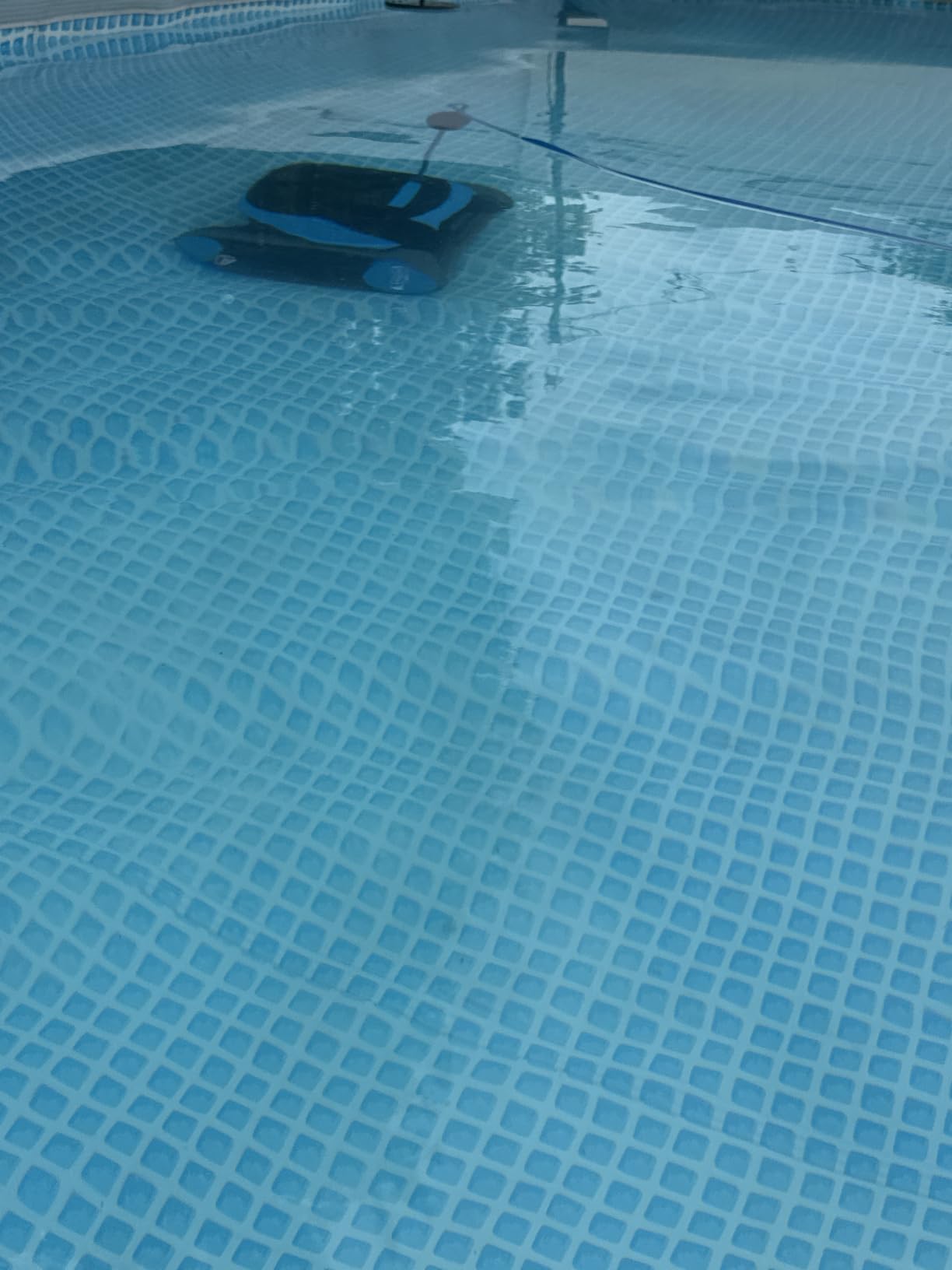
Is the cord really a problem on an above-ground pool?
Manageable, but not invisible. A corded robot means a GFCI outlet near the pool, a cable that stays out of the water, and one more thing to trip over when kids are swimming. In exchange you get unlimited runtime and a sealed drive system with no battery to age out.
If your robot will live on a timer in a spot where a cable is easy to secure, that is a fair trade. If the outlet is far from the pool or the cable runs across a walkway, the cordless options below remove the problem entirely.
Who should skip it?
Skip it if your liner has heavy wrinkles, a deep end or a steep transition, because a corded unit with no wall climbing tends to bog down in the corners. It is also a heavy lift at 6.6 kg, so if you are pulling it out over a 48 inch wall, a lighter cordless model will serve you better.
Pool owners in the forums who switched to a corded robot after a battery unit failed tend to describe the same relief. If you are weighing a bigger purchase, our guide to the best robot pool cleaners overall breaks down what a longer-term platform adds.
2. Seauto Cordless Track Drive Robot – Best Traction on Uneven Floors
Cordless Robotic Pool Vacuum, Pool Cleaner with Track Drive & Sonar Navigation, 180W Brushless Motor, Wall & Waterline Climbing, 150-Min Runtime, for Inground & Above-Ground Pools up to 2150 Sq. Ft.
Track drive with sonar navigation
Dual 180W brushless motors
150 minute runtime
Covers 2150 sq. ft.
19.8 lb
Pros
- Tracks grip drains steps and uneven vinyl far better than wheeled robots
- Sonar mapping cuts redundant passes over clean floor
- One-touch start with no pairing or programming
- Floor Wall and Full Coverage modes
- IP68 sealed internals
Cons
- Heaviest unit tested at 19.8 lb
- No app or remote monitoring
- Large chassis can struggle to turn in small pools
Most above-ground floor problems are traction problems. A robot on small hard wheels bogs down the moment it meets a drain cover, a ladder base, a seam in the liner or one of those soft wrinkles that form along the wall. This one runs on industrial-grade tracks, and the difference shows up immediately in a pool with obstacles.
Sonar navigation scans and maps the pool before it starts, so it plans a path instead of bouncing around randomly. Owners who compared it against random-navigation budget units report more even coverage, especially in corners and along the cove where debris collects.
Three modes let you pick the job: Floor, Wall, or Full Coverage, which handles tiled, concrete, vinyl and fiberglass surfaces. Two independently controlled brushless motors with IP68-certified internals drive the tracks, and the 150 minute runtime covers a large above-ground pool in a single pass.
The catch is weight. At 19.8 pounds this is the heaviest machine in the group, and getting it up and over the pool wall is a genuine two-person job for a lot of owners. The large chassis also means it may struggle to turn around in a small round pool with tight corners.
Do tracks protect a soft vinyl liner?
Yes, and this is where the extra weight earns part of its cost. Wide tracks spread their load over a broad patch of liner instead of concentrating pressure from small wheels, which reduces the scuffing and denting you see with cheap wheeled units on wrinkled sections.
One reviewer still notes the chassis can ride up on pronounced wrinkles, so it is not a licence to ignore a badly fitted liner. If your floor has deep folds, a robot that climbs over them gracefully is a safer pick than one that stalls.
Is the weight worth it for a small pool?
Only if your pool has obstacles, a deep end or a liner that needs climbing. If you have a clean 12 foot or 14 foot round pool with a flat bottom, the light budget models do the same job for a fraction of the effort, and you can lift them with one hand.
3. Aiper Scuba SE – Best for Small Above-Ground Pools
2026 Aiper Scuba SE Cordless Pool Vacuum Robot for Above Ground Pool
1820 GPH suction
90 minute runtime
Covers 860 sq. ft.
190 g battery weight
Dual cleaning modes
Pros
- Genuinely light and easy to lift out of the water
- Two modes let you trade runtime for suction on heavy debris days
- Auto-parks at the edge with an audible low-battery alert
- Low entry point for a full robotic cycle
Cons
- Floor only with no wall or waterline mode
- 90 minute runtime is the shortest on our list
- Coverage capped at 860 sq. ft.
- Modest suction next to 4000 GPH and up machines
Not every above-ground pool is a 24 foot showpiece. A 12 foot or 14 foot inflatable frame holds a few hundred square feet of water, and a big robot with a 2000 square foot rating is simply overkill. The Scuba SE is built for that exact pool, and it is one of the few budget units you can lift out with one hand.
Two cleaning modes switch with a short button press, so you can dial up suction on a day when leaves are falling and back off when you are chasing fine silt. The auto-parking feature is the detail I value most: the robot drives to the pool wall when the battery runs low and sounds an alert, so you are not standing at the edge waiting for it to stop.
At 1820 GPH the suction is honest but modest, and 69 percent of ratings are five stars, which points to a meaningful share of buyers who expected more. The 90 minute runtime and 860 square foot coverage figure are the two numbers to check against your pool before you commit.
It cleans the floor only. On a soft-sided pool the waterline collects sunscreen and body oils that this machine will not touch, so expect to wipe that band yourself once a week during heavy use.
Will it finish a 16 foot round pool in one cycle?
Usually yes. A 16 foot round pool is around 150 square feet of floor, well inside the 860 square foot claim, and 90 minutes is usually enough for a light debris load. If you are dealing with a heavy leaf fall or an algae recovery, plan on running it twice or adding a mid-cycle empty.
That single-cycle confidence disappears above about 20 feet, where the runtime becomes the limiting factor rather than the pool size.
Is it safe to leave a battery unit plugged in near the pool?
Charge it on dry land away from the water, which is good practice for every cordless robot in this list. The unit is lithium-ion and sealed, but no battery device belongs next to a wet pool wall during a swim.
Owners who run cordless units for a season or two frequently report shorter runtimes as the cells age, and replacement batteries are not always offered. That is a real consideration for anyone planning to keep the same robot for five years.
4. WYBOT A1 – Best Value Cordless Robot for Flat Pools
WYBOT A1 Cordless Pool Vacuum Robot for Above Ground Pool, Greyblue
2280 GPH suction
Up to 130 minute runtime
1100 sq. ft. coverage
Dual-layer 180 micron filter
Four cleaning cycles
Pros
- Dual-layer mesh and foam filter captures fine sand cheaper filters return to the water
- Four programs let you schedule short or long runs
- Edge-cleaning pause boosts corner coverage without a wall mode
- Self-parking plus an included retrieval hook
- Light enough to lift out one-handed
Cons
- Floor only with no wall or waterline cleaning
- Random movement with no mapping or app
- Runtimes can run short on larger pools
- Multi-layer filter is fiddly to reassemble after rinsing
This is the robot I recommend to most people buying their first cordless unit for an above-ground pool. The 180 micron mesh layer paired with a textured foam layer is the reason, and it is not a marketing detail. Single-filter budget robots blow fine sand straight back into the water while filling their baskets, and you end up with clear-looking water that goes cloudy an hour later.
Four cleaning-cycle programs mean you can set a short daily run for the top-up debris and a longer cycle for the weekly deep clean, then leave it alone. The path is set by repositioning the wheels, which sounds odd but is a quick way to suit a round pool versus an irregular rectangle.
Self-parking at the wall plus a retrieval hook keeps you out of the water, and the edge-cleaning pause gives it a brief boost at the perimeter that partly substitutes for wall climbing. LED indicators show battery and cycle status clearly, which matters more than it sounds on a unit you cannot see from the deck.
There is no app, no mapping and no smart navigation. Movement is random, so on a busy pool the robot will eventually reach most of the floor, but the coverage is not systematic. The listing also warns against slopes over 15 degrees and significant liner wrinkles, which rules out deep-end frames.
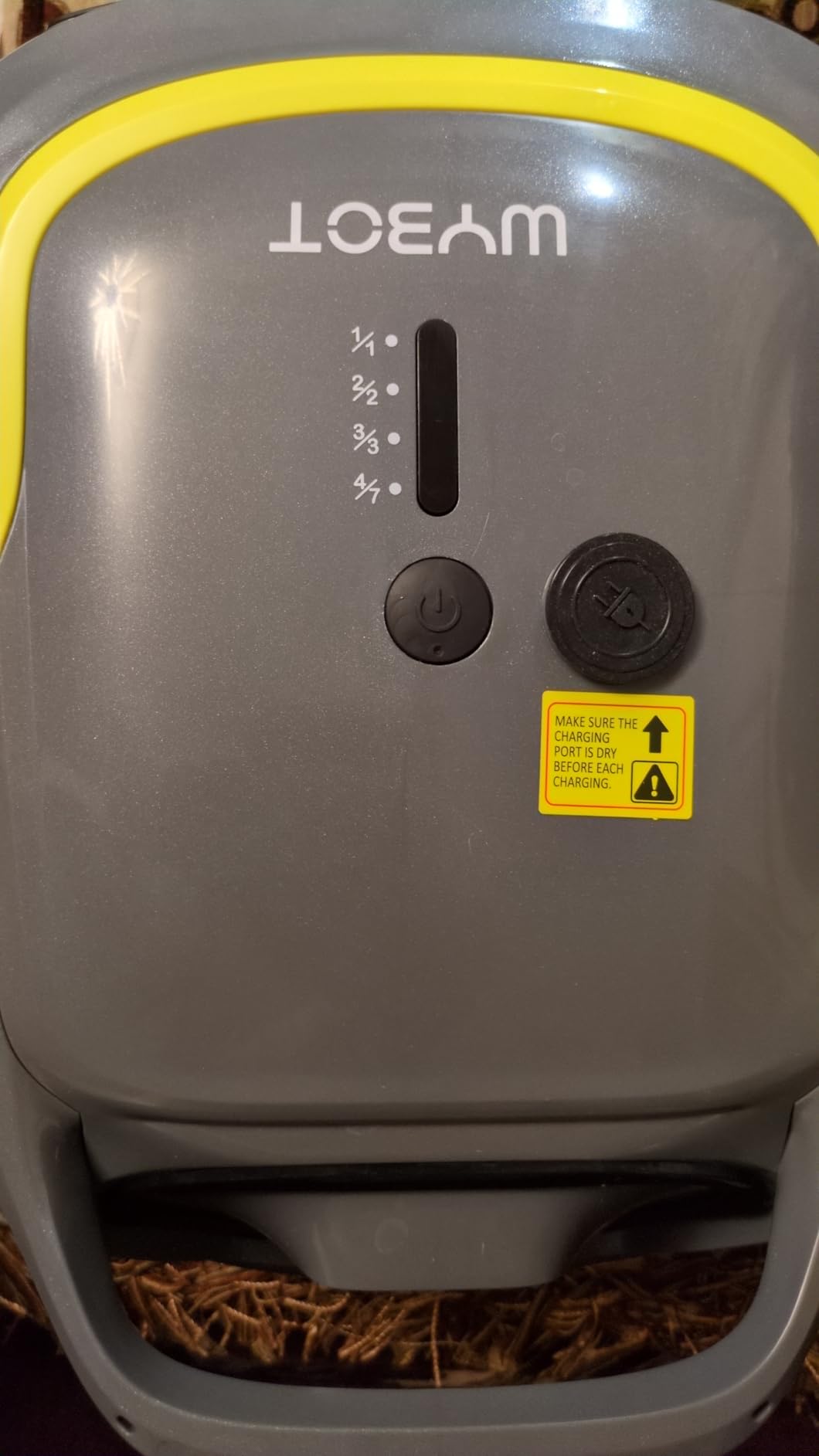
Is the filter worth the extra reassembly time?
Yes, if your pool collects sand. The two-stage setup pulls a lot more fine grit out of the water than a single mesh basket, and on a shallow above-ground floor where sand sits in one spot that is the difference between a clean bottom and a smear of sediment. It does take longer to take apart and put back, so rinse it while you are already at the pool.
If your pool is mostly leaves and dust with little sand, a simpler filter is quicker and perfectly adequate.
What happens to the battery after a season?
Runtimes typically fade a little in the first year, and a full recharge takes two to three hours, so it is not a same-day second run. The broader issue is parts: if the pack fails after a year or two, check that the manufacturer sells a replacement before you buy, because availability varies a lot between brands.
That uncertainty is the main reason a lot of owners in pool forums recommend a corded machine for a long-term purchase and a cordless one for convenience.
5. PoolMr Cordless Robot – Best for Sand, Silt and Wrinkled Liners
PoolMr Cordless Robot Pool Vacuum for Above Ground Pool,Grayish White
40W motor with 30 GPM flow
1 inch suction inlet
120 minute runtime
1614 sq. ft. coverage
305 g battery
Pros
- Anti-return debris lock keeps collected grit from leaking back when you lift it out
- 40W motor and wide 1 inch inlet pull large leaves as well as fine sand
- Dual-layer 180 micron mesh plus cotton sponge filter
- Climbs 0.2 inch wrinkles and drains and 15 degree slopes
- Quick-drain body empties stored water in seconds
Cons
- Floor only with no wall or waterline mode
- No app and no smart navigation
- Real-world runtime often closer to 60 to 90 minutes
- Small wheels struggle on pronounced bumps
- Small sample of reviews for the group
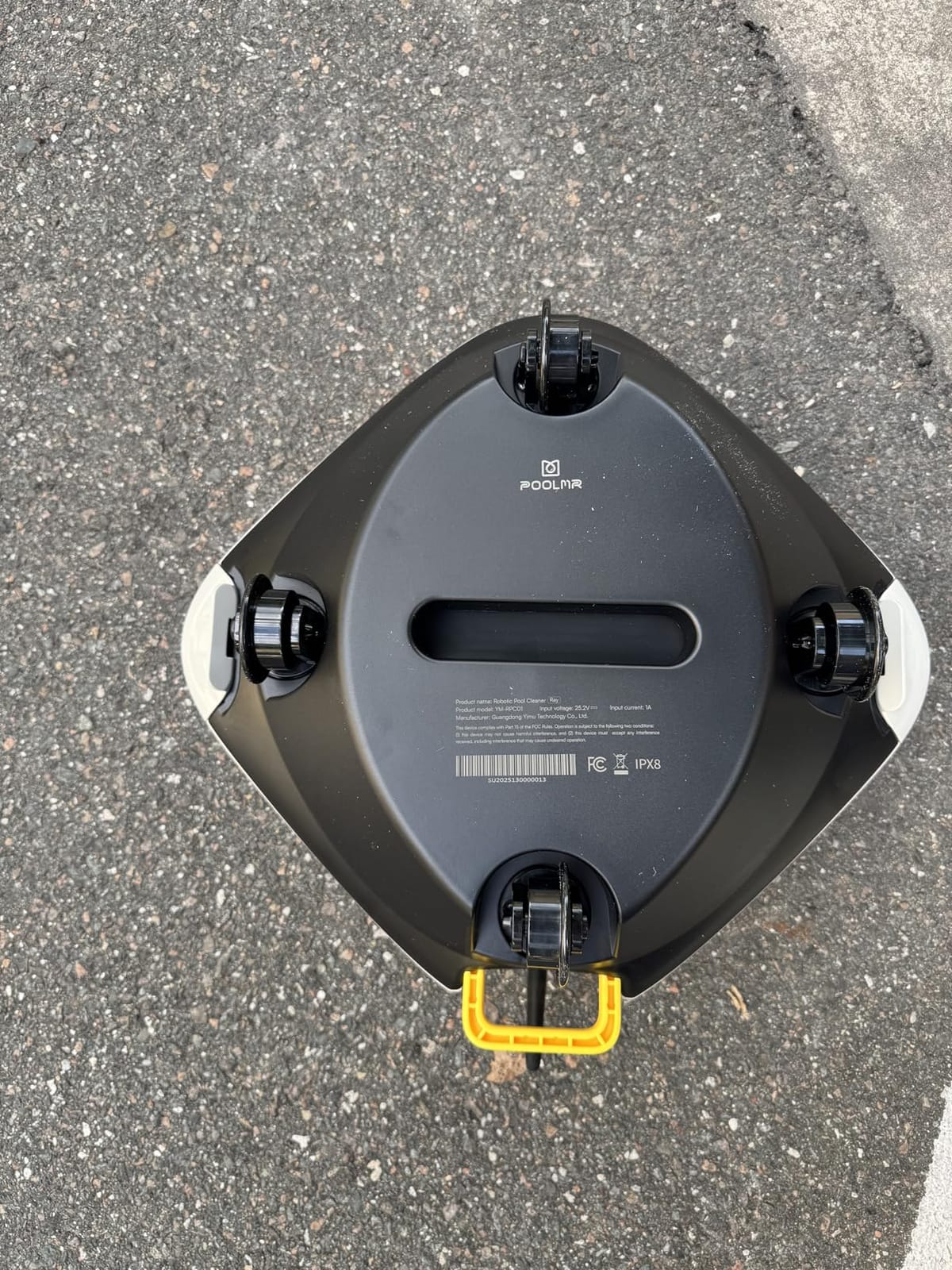
The anti-return debris lock is the feature that makes this one different, and it solves a problem most owners do not think about until it happens. Lift a loaded robot out of the pool and dirty water and grit pour straight back down the liner. This design locks the debris inside and the quick-drain body releases stored water in seconds.
That single decision saves a second vacuuming pass on the very floor you just cleaned. It is the reason this robot scores well above the rest of its class in owner feedback despite being a budget machine.
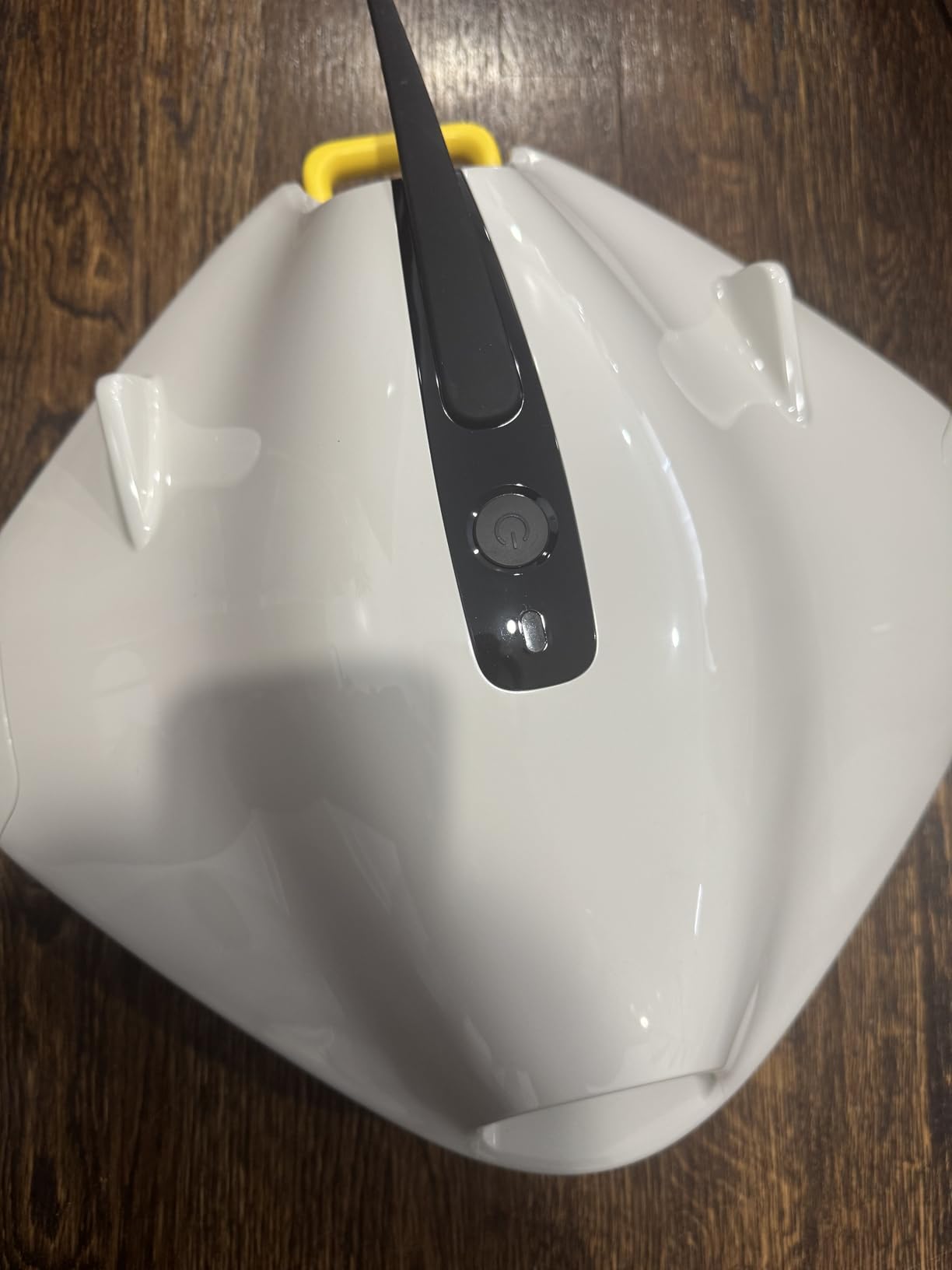
Obstacle handling is better than most water-jet budget robots. Owners report it clearing 0.2 inch liner wrinkles, drain covers and slopes up to 15 degrees, which covers the majority of above-ground frames that have a shallow transition at the deep end.
The 40W motor drives a 30 GPM flow system through a 1 inch wide inlet, so it picks up whole leaves as well as fine sand. Coverage is claimed at up to 1614 square feet with 120 minutes of runtime, though some owners report closer to 60 to 90 minutes in real conditions.
Will it run on a vinyl liner with folds?
Mostly. Claimed wrinkle handling is 0.2 inch, which covers the small ripples that appear in a well-fitted liner and most drain covers. Deep folds from an overstretched wall or a soft bottom that has lost its shape are a different matter, and there is no robot in this group that handles those gracefully.
Fixing the liner is the real fix. A robot working on a badly stretched bottom will look like the robot failed when the problem is above the floor.
Is the 5.0 rating a reason to buy it?
Treat it carefully. A perfect average usually means a small, enthusiastic and recent review base rather than a flawless track record, and 49 reviews is a small sample. The underlying machine is well specced for its tier, so the risk is more about long-term support than about day-one performance.
6. BOTLIFE PC10 – Best for Sloped Floors and Wall Scrubbing
BOTLIFE PC10 Cordless Robotic Pool Vacuum for Inground & Above Ground Pools
5000 GPH suction
4L basket with 150 micron mesh
120 minute runtime
Handles slopes to 30 degrees
Floor wall and waterline modes
Pros
- 5000 GPH with two active brushes lifts stubborn debris far better than budget units
- Genuine floor wall and waterline coverage in one machine
- S-path and N-path navigation cuts the random wandering
- High-grip tracks handle transitions and 30 degree slopes
- Large 4L basket holds a full cycle of debris
Cons
- Priced well above the entry-level cordless category
- 120 minute runtime is short once wall passes are included
- No app or Wi-Fi connectivity
- Large chassis can be awkward in a small pool
Suction is where this one separates from the budget tier. 5000 GPH from dual drive motors, a dedicated pump and two active brushes is a real step up, and on an above-ground floor where debris is sitting in a thin layer rather than suspended, the number of brushes matters as much as the airflow.
S-path navigation on the floor and N-path routes on the walls cut the overlap that leaves corners unclean on random-path robots. Reviewers consistently call this out as the reason coverage feels predictable rather than lucky.
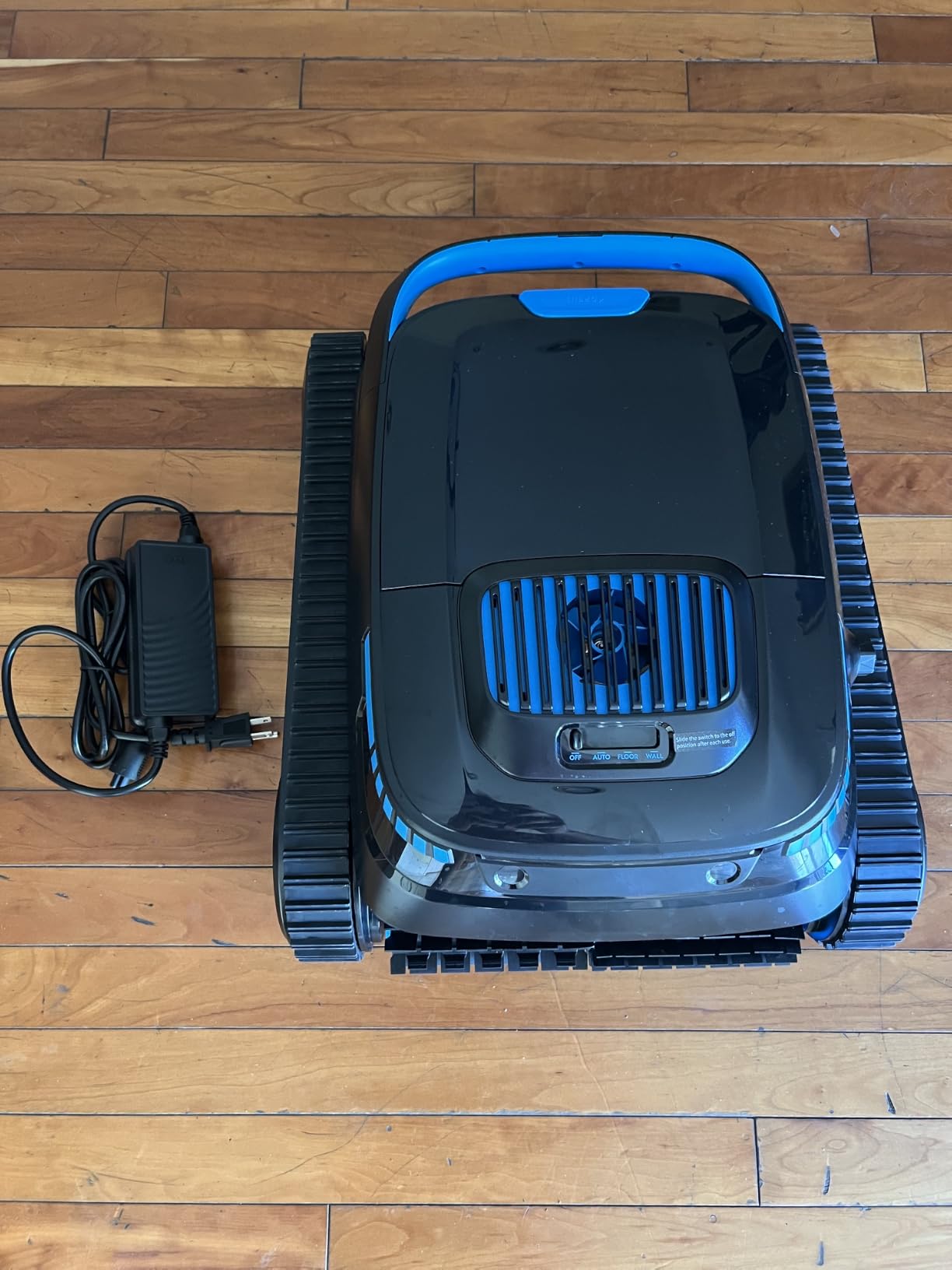
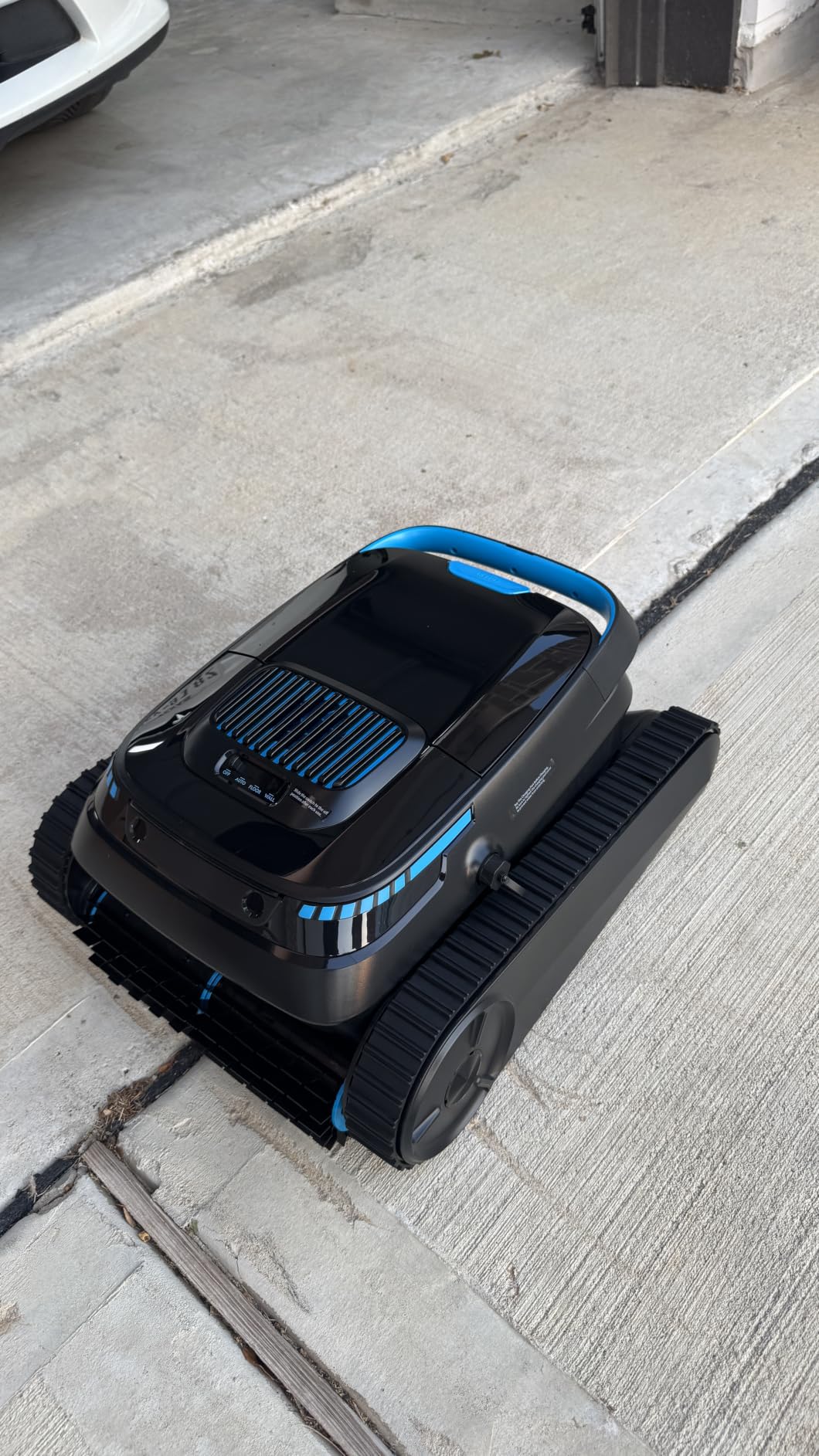
Three modes cover Full Pool, Floor Only and Wall Only, and the high-grip tracks handle transitions and slopes up to 30 degrees. That slope rating is the highest in this group and it is the relevant spec for above-ground frames with a deep end.
The 4L top-loading basket with 150 micron mesh holds a full cycle of debris and rinses clean with a garden hose. The 120 minute runtime on a 5200mAh battery covers up to 1830 square feet, and a recharge takes roughly two and a half hours.
Do above-ground pools need wall climbing?
Usually not for most of the season. A 48 inch deep round frame has a very short wall run, and the band where the robot meets the liner is the same band you wipe with a cloth anyway. Wall climbing earns its keep on deeper rectangular frames with a swim shelf or a steep transition where debris slides down and settles at the cove.
If your pool is 52 inches deep or has steps, the wall mode is worth having. If it is a standard 48 inch round, spend your attention on suction and filtration instead.
Is a 120 minute runtime enough with wall passes?
On a mid-size pool, yes, but the wall and waterline passes take time that a floor-only robot does not need. If you run a full-coverage cycle, budget for a top-up mid-cycle on the larger frames, or switch to Floor Only for the daily run and save Full Pool for the weekend.
7. BRINBO S2 – Lightest Cordless Pick for Small Pools
S2 Pool Vacuum Robot for Above Ground Pools, 90-Min Runtime, 861 Sq.Ft Coverage, Cordless Operation, Efficient Cleaning Performance, Dual-Layer Filtration, Panda Black
90 minute runtime
861 sq. ft. coverage
161 g battery weight
Dual-layer filtration
Top-access filter
Pros
- Among the lightest to lift out of an above-ground pool
- Dual-layer filter holds debris rather than releasing it back
- Top-access filter rinses clean in seconds
- Cordless design removes the cable and hose hassle
- Genuinely low entry point for a full robotic cycle
Cons
- 90 minute runtime among the shortest here
- Smallest coverage area we found at 861 sq. ft.
- Floor only with no wall or waterline mode
- Modest suction against 4000 GPH and up machines
- 12 percent of ratings are two stars
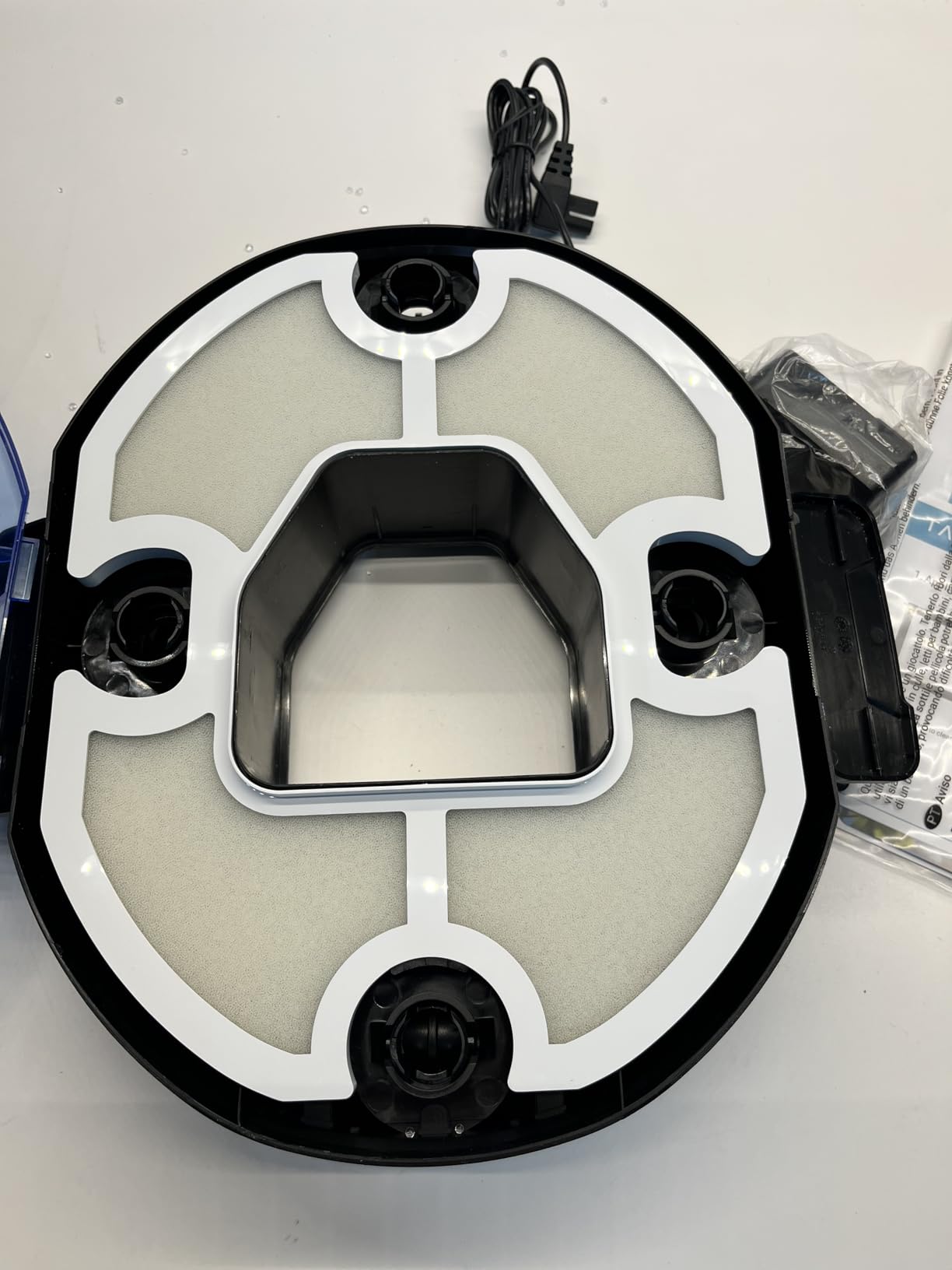
The practical reason to like this robot is its weight. At 161 g of battery weight it is among the lightest cordless options we list, and for an above-ground pool where the rim sits at chest height on a small frame, that single specification can matter more than suction figures.
It ranks near the top of the Robotic Pool Cleaners category for its price tier, which tells you how much of the market it moves. The dual-layer filter holds collected debris inside instead of letting it drift back into the water, and the filter is reached from the top so you can rinse it without pulling the whole unit apart.
Operation is as simple as it gets. Place it in, press start, and there is no cable to route and no pairing to do. The 861 square foot coverage figure targets small and mid-size above-ground pools and flat-bottom inground frames.
The catch is capacity. Ninety minutes and 861 square feet is the smallest combination on our list, and the two-star share at 12 percent is the largest cluster of any product in the list, with the complaint almost always pointing at runtime on a bigger pool.
Will it last a full season on one charge?
On a 12 foot or 14 foot pool, comfortably. On a 20 foot or larger frame, or if you are recovering from an algae bloom, you will run it more than once. Plan the cycle around the pool size rather than around the advertising figure, and check the water before you assume it is finished.
Owners who run it on a smaller pool report consistent coverage and quiet operation, which is exactly where the runtime budget works in your favour.
Is low suction a problem on a flat floor?
Not usually. On a flat above-ground bottom with no deep end, a small robot covering a small pool is a matched set. Modest suction becomes a problem when there is a lot of volume to move, a deep end, or a heavy leaf load that a stronger impeller would clear faster.
8. Beatbot Sora 10 – Best Full-Coverage Cordless Robot
Beatbot Sora 10 Cordless Pool Vacuum Robot for Inground & Above Ground Pools, 6800 GPH Suction, Floor/Wall/Waterline/Shallow Area Cleaning, Waterline Parking, 300 Mins Runtime Royal Blue
6800 GPH suction
300 minute runtime
5L basket holds 650 leaves
App control
2 year warranty
Pros
- 6800 GPH suction
- the largest figure we found
- 300 minute runtime is more than double most competitors
- Cleans shallow areas down to 12 inches including sun shelves
- 5L basket holds roughly 650 leaves without jamming
- App control with Wi-Fi and Bluetooth plus OTA updates
- Saltwater safe to 5000 ppm with a 2 year warranty
Cons
- Waterline parking is inconsistent and it often must be fished out
- Navigation misses curved corners and stairs
- Top lid feels flimsy and hard to confirm latched
- Can flip onto its back wheels though it usually self-rights
If suction and runtime are the only two numbers you care about, this is a strong machine. 6800 GPH through the HydroBalance structure is roughly three times the output of the entry tier, and the 7310mAh battery delivers up to 300 minutes of run time on a single charge.
For an above-ground pool that matters in a specific way. Shallow frames have a lot of floor area relative to their water volume, so a robot that finishes in 40 minutes and spends the rest of its cycle parked against a wall gives you less than the same robot running a full two hours. This one keeps working.
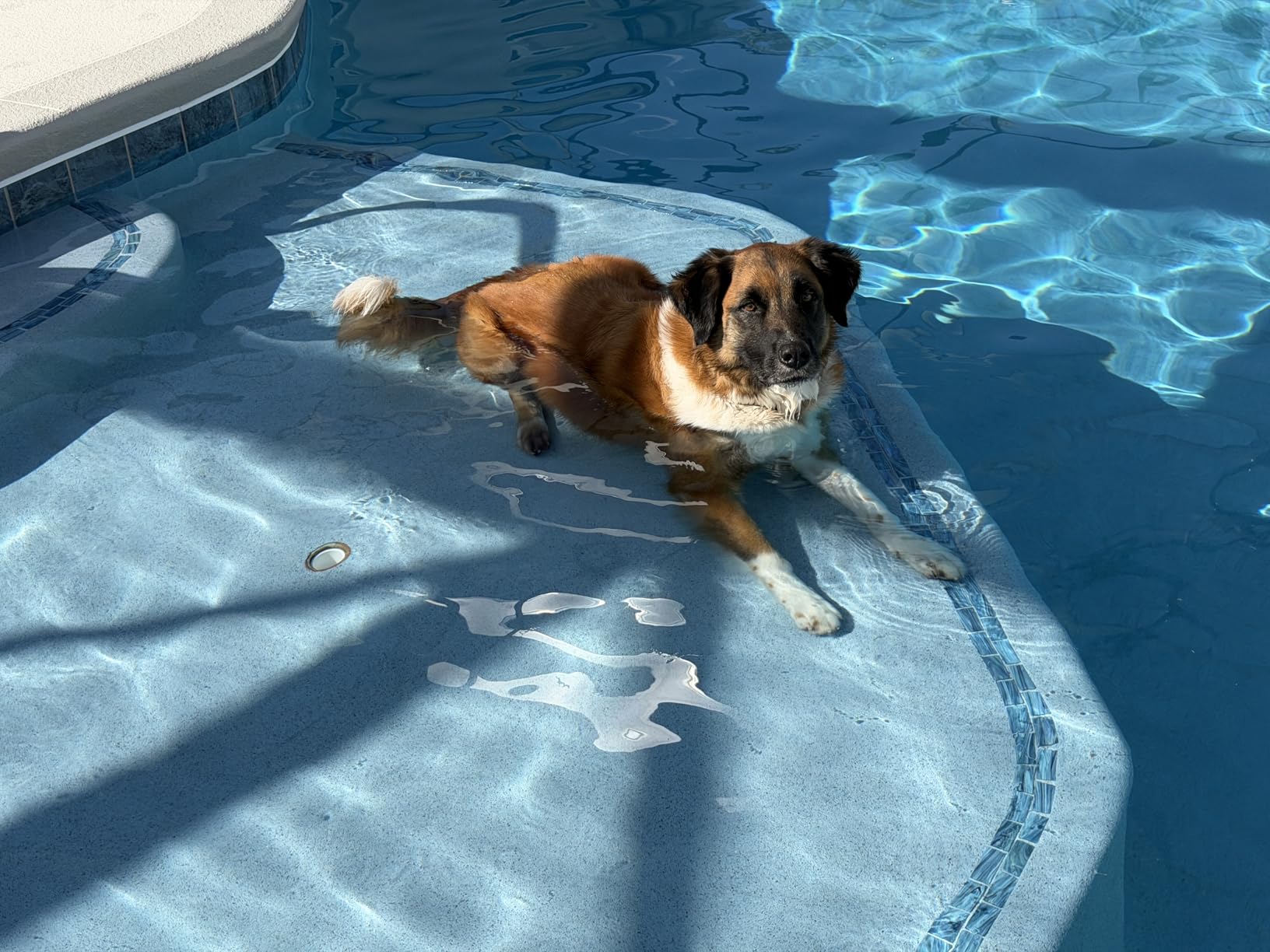
It also handles the parts of an above-ground pool that give other units trouble. Shallow cleaning from 12 inches covers tanning ledges and sun shelves, and it scrubs the waterline rather than just the floor. The 5L basket holds up to roughly 650 leaves, which means fewer mid-cycle emptying stops during a heavy autumn.
App control over Wi-Fi and Bluetooth with over-the-air updates is the only real smart connectivity in this group, and saltwater compatibility to 5000 ppm with a two-year warranty is the longest stated protection on the list.
Is app control worth anything in a pool?
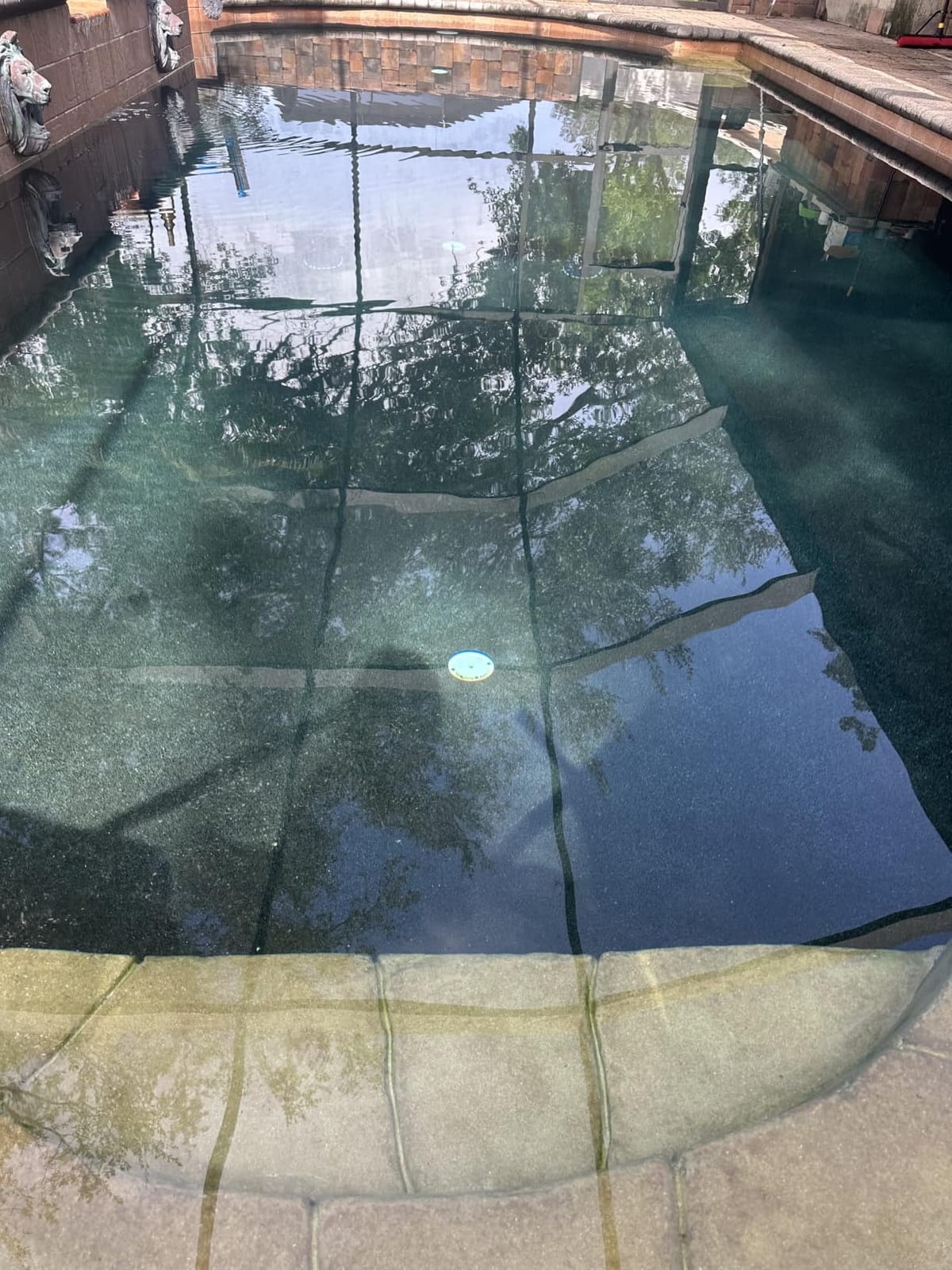
More than expected, mostly because of retrieval. It parks at the waterline at the end of a cycle and dwells there for ten minutes, so in a clear pool you can see it and grab the hook. In cloudy water that promise falls apart, and reviewers say it often fails to reach the wall at all.
Consider a robotic skimmer as a complement rather than a replacement if debris on the surface is your main frustration. Many owners run both and describe the combination as the lowest-maintenance setup they have used.
Will it damage a soft vinyl liner?
The tracks are wide and the shell is corrosion-resistant, so nothing in the design suggests liner stress. The reported physical concerns are about the robot itself, not the pool: exposed exhaust and gaskets for long-term durability, and a top lid that can be hard to confirm latched.
It can also flip onto its back wheels in some pools, though it usually self-rights. If your pool has a deep end transition, watch it on the first run.
9. Baopilong Cordless Robot – Simplest First Robot to Own
2026 Cordless Robotic Pool Cleaner – 120 Mins Automatic Pool Vacuum for Above Ground Pool & In – Ground Flat Pools up to 1000 Sq.Ft, Robot Pool Cleaner with Self – Parking Tech
8 lb cordless design
120 minute runtime
1000 sq. ft. coverage
5200mAh battery
Top-access filter
Pros
- Low entry point of any robot on the list
- Genuinely lightweight at 8 lb for one-handed retrieval
- 120 minutes covers up to 1000 sq. ft. which is more than most rivals
- Wall-contact sensing with automatic reverse and parking
- Top-access filter rinses in under a minute
Cons
- Built for flat above-ground floors and degrades on sloped bottoms
- Floor only with no wall or waterline cleaning
- No published suction figure to compare
- Four hour charge time is among the longest we saw
- Basic filter with no stated micron rating
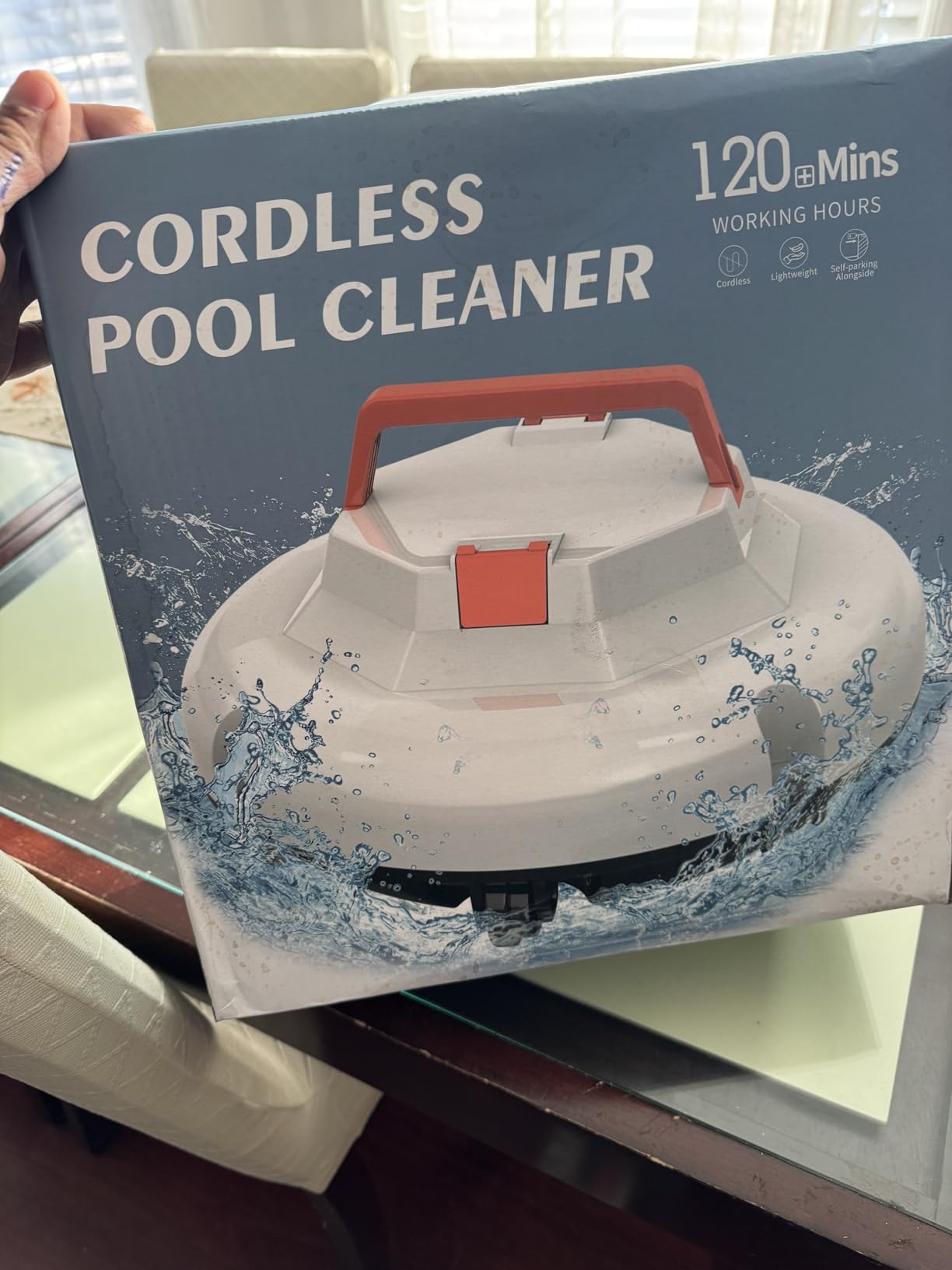
This is the robot to buy if you have never owned one and you want to find out whether automation suits you before spending properly. It does the basic job well on a flat above-ground floor: pick up leaves, collect fine sand, and park itself at the edge when the battery runs low.
At 8 pounds it is one of the easiest to lift out, and the 5200mAh battery delivers 120 minutes of cleaning for pools up to 1000 square feet. That is more coverage than many machines manage, because plenty of them stop around 800.
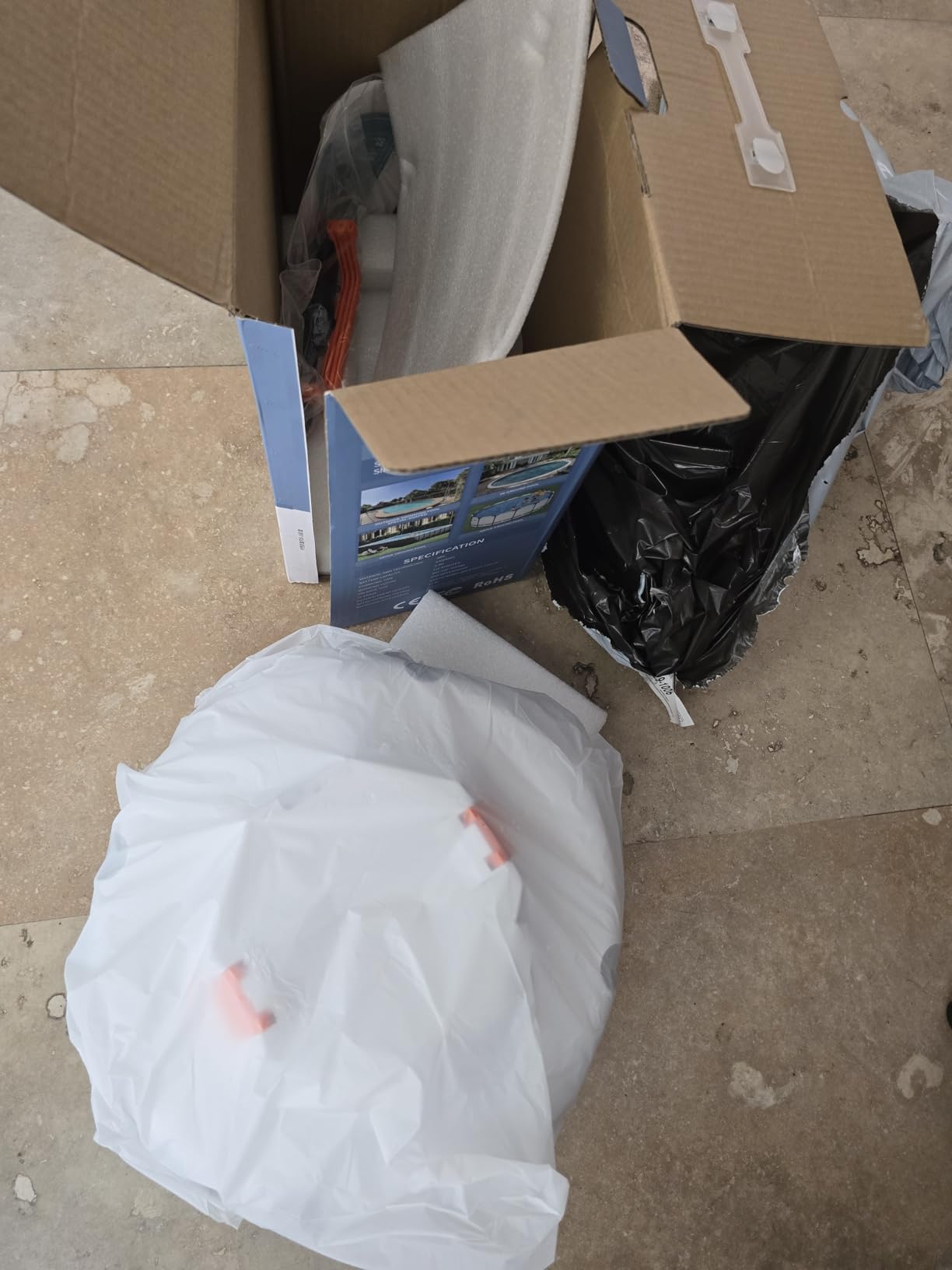
Smart sensing makes it reverse on wall contact instead of grinding along the liner, and low-battery detection triggers automatic parking at the pool edge. One click starts the cycle. There is no app, no pairing and no programming to work through.
Two things to know before you start. The listing says nothing about a suction figure, so you cannot benchmark its output against anything else, and the rating distribution has an unusually large 3-star block at 18 percent with almost no 4-star ratings at all, which usually signals polarised experiences rather than general satisfaction.
Is it worth stepping up from a budget robot after one season?
Often, yes. The first robot teaches you what your pool actually needs. If you found yourself emptying the basket twice per run or running out of charge mid-pool, that is a coverage and runtime problem and a stronger machine solves it. If one cycle was plenty, you have already saved the money.
Owners who upgrade usually do so for suction and filtration, not for features. That is the same upgrade path that leads to the WYBOT A1 and the BOTLIFE PC10.
Will it work on a sloped above-ground bottom?
Partly. The design targets flat above-ground pools, and performance drops on sloped bottoms, so a frame with a deep end will leave debris in the transition. It is fine for a flat 12 to 16 foot pool where the whole floor is the same depth.
10. BOTLIFE PC10-0727 – Best for Repeatable Route Planning
Cordless Robotic Pool Vacuum Cleaner for Inground & Above Ground Pools
5000 GPH suction
4L 150 micron basket
120 minute runtime
Handles 30 degree slopes
12 lb cordless
Pros
- 5000 GPH with dual drive motors a pump and two active brushes
- S-path floor and N-path wall patterns reduce overlap and missed spots
- High-grip tracks for transitions and 30 degree slopes
- 4L top-loading basket that is simple to rinse
- Self-parking with an included retrieval hook
Cons
- Most expensive unit in the group
- 120 minute runtime is short once wall and waterline passes are counted
- No app
- Wi-Fi or Bluetooth connectivity
- Same cleaning platform as the lower-priced BOTLIFE PC10
This machine shares its cleaning platform with the cheaper BOTLIFE PC10, and that is worth understanding before you buy. The suction, the brushes, the navigation patterns and the basket are the same. What you are paying extra for at this level is a different chassis, a different battery pack and a higher-capacity body.
For a lot of above-ground owners that is the wrong trade. If you do not need app control, you can get the same cleaning results for less from the PC10 listed earlier in this guide. The route planning here is genuinely good, with S-shaped floor passes and N-shaped wall passes that cut the random wandering.
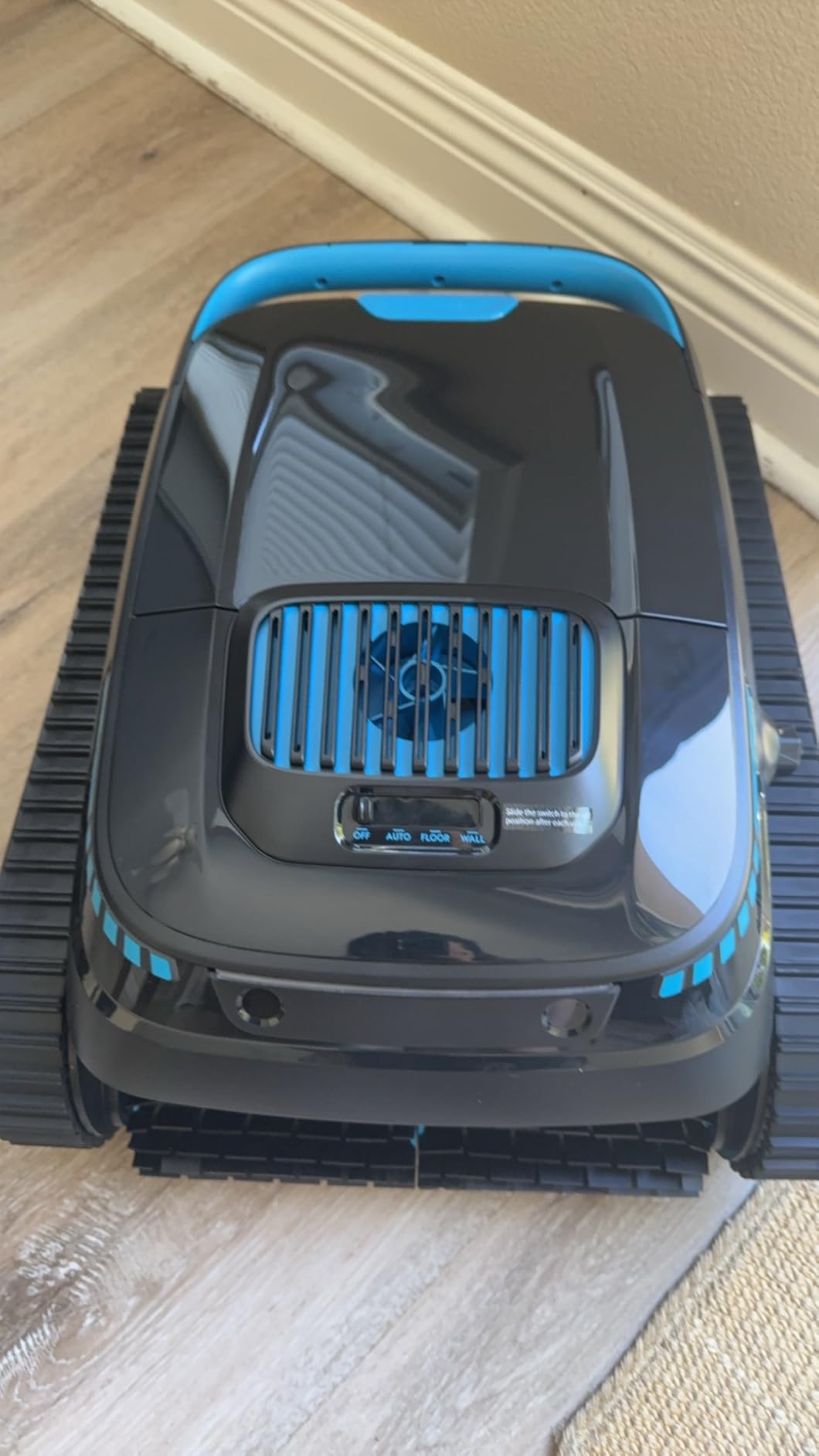
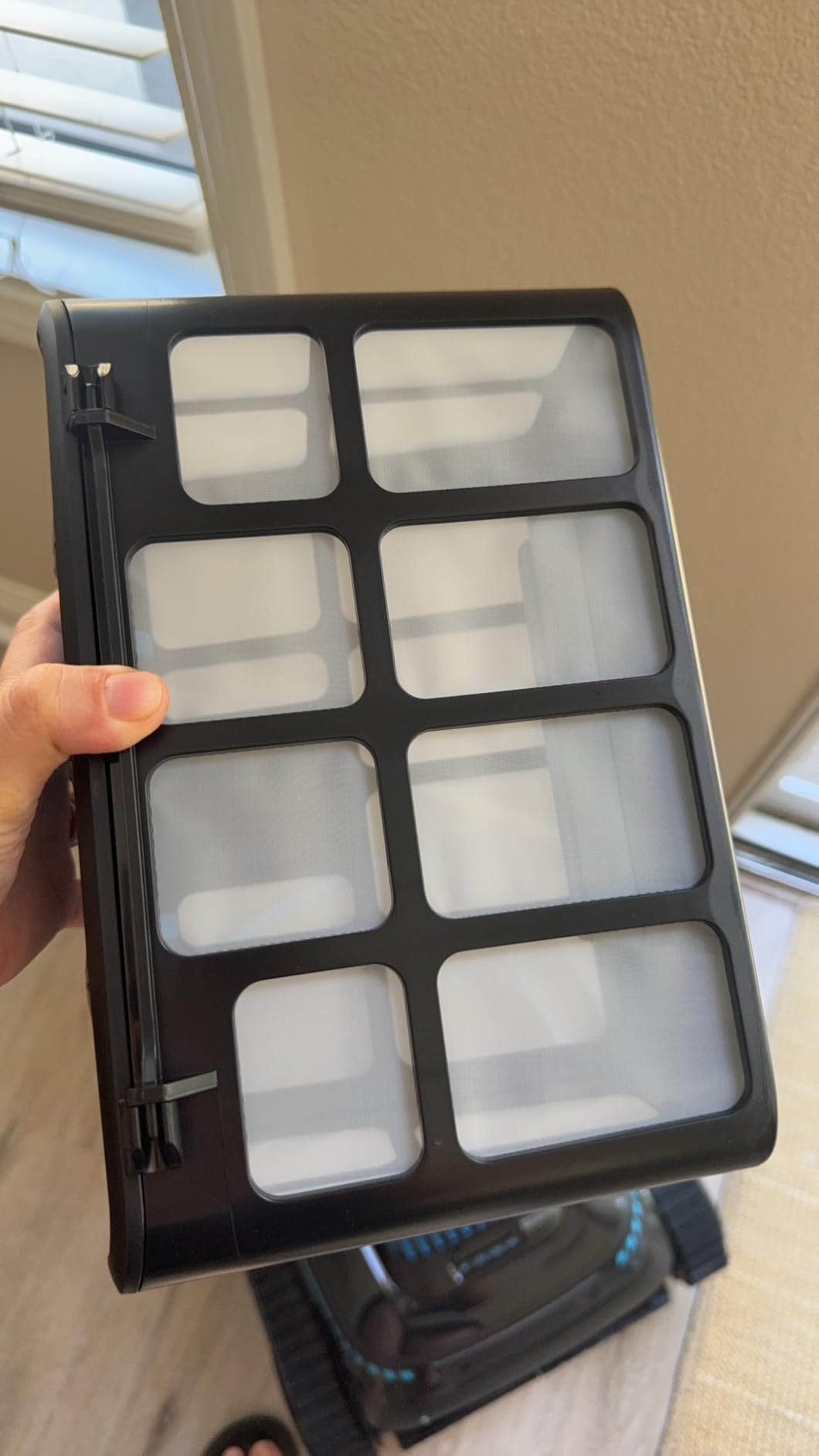
At 12 pounds it is still light for a track-driven, wall-climbing robot. The 4L top-loading basket with 150 micron mesh holds a full cycle and rinses with a hose, and the machine parks near the edge when the cycle ends or the battery runs low.
The 120 minute runtime covers up to 1830 square feet, with a recharge of about two to two and a half hours. That is the first spec to feel short.
Should you pay more for the same cleaning platform?
Rarely for an above-ground pool. The extra capability is marginal on a flat-bottom frame, and the platform overlap means you get no additional cleaning feature for the money. Pick this one only if you want the track chassis and the weight distribution for reasons of handling.
If you are spending at this level anyway, comparing it against a different platform with genuine app control and a longer runtime is a better use of the budget.
Does navigation reduce runtime or waste it?
It reduces wasted runtime. Random-path robots spend a large share of a 120 minute cycle re-crossing floor they have already cleaned, so the effective coverage is much shorter than the clock suggests. Planned paths buy back some of that time, which is why coverage feels more complete on the same battery.
11. CZYBYTE P1181 – Best App-Controlled Robot Under the Mid Tier
CZYBYTE Cordless Robotic Pool Vacuum Cleaner, APP Support,Orange
4500 GPH brushless suction
120 minute runtime
2000 sq. ft. coverage
4L 150 micron basket
App control
Pros
- One of the few robots at this level with app control and real wall climbing
- 4500 GPH combined brushless suction clears leaves and sand well
- 4L top-loading basket with dense mesh that owners say collects more
- Parks above the water surface so retrieval is easy
- Three cleaning modes with S-shaped route planning
Cons
- Latches are extremely hard to snap closed after cleaning
- Heavier and bulkier than the compact entry-level units
- No indicator light on the charging port
- Charging port plug must be covered before every submersion
- Wall climbing is partial rather than full
App control at this level is unusual, and the wall and waterline climbing is a genuine addition to a category otherwise full of floor-only machines. Three modes start with walls and waterline before transitioning into a floor scrub, and the S-shaped route planning reduces missed corners.
The 4L top-loading basket with 150 micron dense mesh is the practical strength. Owners coming from smaller robots report a noticeable jump in how much debris a single cycle collects, and the auto-park above the water surface makes retrieval straightforward in a clear pool.
Clear route tracking and a 3-hour charge turn the floor into a passable climb rather than an obstacle course.
The complaints here are physical rather than performance related, and they are worth taking seriously. The most common one is the latch. After a rinse, the cover is genuinely hard to snap closed, and that is the moment when people decide the robot is a hassle.
There is also no indicator light on the charging port, at least one owner reports the charging system not appearing to work, and the port plug must be manually covered before you put the unit in the water. Miss that step and you are troubleshooting a dead robot in a pool.
Does partial wall climbing still help a vinyl liner?
A little. One reviewer notes it only goes partway up the wall, which means it works on the cove and lower band where debris collects but does not clean the waterline. On a standard 48 inch above-ground frame that is a reasonable trade, and on a deep pool it is not.
Verify the latch closes properly before every run. A cover that is not fully seated lets the robot run for part of a cycle with the basket exposed, which is a fast route to cloudy water.
Is the app genuinely useful or a gimmick?
Useful for scheduling and for checking whether a cycle finished, provided the charging port is behaving. Note that the app was updated, so existing owners have to uninstall the old version and install the new one before it will connect.
12. GAMPLAE PZ0-20 – Lightest Robot with Longest Budget Runtime
(2026 New) Pool Vacuum for Above Ground Pool, Cordless Robotic Pool Cleaner with Dual Motors Strong Suction, 130-Min Runtime, Auto-Parking, Pool Vacuum Robot for Inground Flat Pools Up to 1100 Sq.Ft
5200mAh battery
Over 130 minute runtime
1100 sq. ft. coverage
IPX8 shell
5.5 lb
Pros
- Lightest unit we list at 5.5 lb for genuinely one-handed lifting
- 130 plus minute runtime longer than most units at this level
- IPX8 waterproof rating and corrosion-resistant shell
- Dual-drive motors with two independent scrapers for better pickup
- Auto-reverses on wall contact and parks at the wall
Cons
- Floor only with no wall or waterline mode
- Only 36 reviews
- all recent and no 4-star ratings at all
- Battery energy listed at 2 watt-hours which conflicts with the 5200mAh claim
- Flat-bottom pools only
At 5.5 pounds this is the easiest machine in the guide to get out of an above-ground pool, and it is the lightest unit we list, which is what makes one-handed handling realistic.
For a machine at the entry level, the runtime is unusually long. The 5200mAh battery delivers over 130 minutes for pools up to 1100 square feet, which outlasts most of the entry-level cordless category.
Dual-drive motors with two independent scrapers give better pickup than a typical budget machine, and the IPX8 waterproof rating with a corrosion-resistant shell is a sensible feature for a device that lives in chlorinated or salted water. It auto-reverses on wall contact and parks at the wall when the battery is low, and a buoyancy hook makes lift-out easy.
Treat the rating with care. 36 recent reviews, 86 percent five star, 14 percent three star and not a single four star is a small, enthusiastic sample rather than a proven track record. The listing also shows battery energy of 2 watt-hours alongside a 5200mAh claim, which is an inconsistency worth ignoring in your decision.
Is a 4.7 average from 36 reviews meaningful?
It tells you the machine performs its stated job on a flat pool, and not much more. Compare it against the PoolMr or the WYBOT A1 if you want a track record you can lean on, and check that the brand sells replacement parts and responds to warranty claims before you commit.
Budget brands that sell direct often answer slowly on support. That is the part of the purchase that never appears on the spec sheet and the part that decides whether you still own the robot in year three.
Will it handle a liner wrinkle or a deep end?
Flat bottom only, as the listing states. Without a published slope or wrinkle figure, assume it does not climb a transition. If your above-ground pool has a deep end section, pick a tracked model with a published slope rating instead.
How to Choose a Pool Robot for an Above-Ground Pool
Start with your pool size, because it eliminates half the list immediately. Match the robot’s coverage figure to the floor area, then check that the runtime is long enough to finish in one pass. A robot rated for 1000 square feet with 90 minutes of runtime is a poor match for a large pool, whatever the sticker says.
Next decide corded or cordless, and this is less clear-cut than the marketing suggests. A corded machine has unlimited runtime and no battery to degrade, which is why so many long-term owners end up with one. A cordless machine removes the cable entirely and is far easier to lift, store and move, but you are buying a battery that will lose capacity and a replacement that may not be available in a few years.
Owners in pool forums describe the same pattern repeatedly: a cordless robot works well for the first season, runtime fades, support is slow to respond, and the next purchase is a corded model with a phrase about buying once. If you want a five-year machine, lean corded. If you want the easiest possible routine, go cordless.
Then look at walls. A standard 48 inch round above-ground pool has almost no wall run, so wall climbing barely matters. A 52 inch rectangular frame with steps, a sun shelf or a deep-end transition is a different case, and there a wall mode with a published slope rating is worth paying for.
Finally, weigh the machine. Anything over 15 pounds is a two-hand job over a chest-high pool wall. Filter capacity is the next thing to check, and if you are near trees a 4L or 5L basket will save you a mid-cycle empty that a 1L basket will not.
One more practical note. Whatever robot you choose still needs a filter to circulate the water, and the two jobs are separate. If your pump is undersized or your sand filter is overdue for a service, no robot will fix the result. Our guide to the best sand filters for pools covers that half of the system.
Frequently Asked Questions
Do robotic pool cleaners work in above ground pools?
Yes, but they need to be models rated for above-ground frames. Above-ground pools are shallow, often have soft vinyl liners and can have wrinkled floors, so a robot designed for deep inground pools may struggle with traction and stop short of the cove. Look for a coverage figure above your pool area, a runtime that finishes the job in one cycle, and a design that states it suits above-ground or flat-bottom pools.
What is the best automatic vacuum for an above-ground pool?
The Dolphin Nautilus AG is the safest all-round answer for most above-ground pools, with the deepest owner history in this guide and gentle handling of vinyl liners. The WYBOT A1 is the best cordless value pick thanks to its dual-layer filtration, and the Beatbot Sora 10 leads on suction, runtime and full-coverage cleaning for large frames.
What size pool robot do I need for my above-ground pool?
Pick a robot whose rated coverage area comfortably exceeds your pool floor. A 12 to 16 foot round pool is usually under 300 square feet, so a unit rated to 860 or 1000 square feet is ample. An 18 foot round pool is around 250 square feet and a 24 foot round pool is closer to 450, so anything rated from 1100 square feet upward covers a 24 foot frame with room to spare.
Are cordless pool robots worth it for above-ground pools?
They are worth it for convenience, not for longevity. Cordless units remove the cable, are much lighter to lift out and usually park themselves at the pool wall when the cycle ends. The trade-off is battery ageing and patchy replacement part availability. If you keep a robot for more than two or three seasons, a corded model like the Dolphin Nautilus AG tends to be the better long-term purchase.
Can robotic pool cleaners damage a vinyl liner?
Rarely, if you pick correctly. Wall-climbing robots apply more force to the liner than floor-only models, and units that cannot handle wrinkles will grind against folds. Choose a robot with soft or wide tracks, keep the liner properly fitted and stretched, and remove the robot from the pool before storing it folded. Track-driven models spread their load more evenly than small-wheeled budget units.
How often should I run a pool robot in an above-ground pool?
A daily short run keeps fine dust and pollen from settling into the floor, which is far easier than dealing with a settled layer later. A full cycle two or three times a week handles normal debris, and once a week is enough for heavy leaf fall if you empty the basket. Run the filtration system for several hours before and after, since the robot agitates debris that the filter then has to capture.
Final Verdict on the Best Robotic Pool Cleaners for Above Ground Pools in 2026
The Dolphin Nautilus AG is the best robotic pool cleaner for above ground pools for most people, because it has the longest owner track record, cleans the floor reliably with an active brush and treats a soft liner gently. Buy the WYBOT A1 if you want cordless convenience without giving up filtration quality, and the Beatbot Sora 10 if your frame is large, deep or full of steps.
Check your pool’s floor area against the coverage figure before anything else, and run your filter properly between cycles. No robot compensates for an underworked circulation system.