
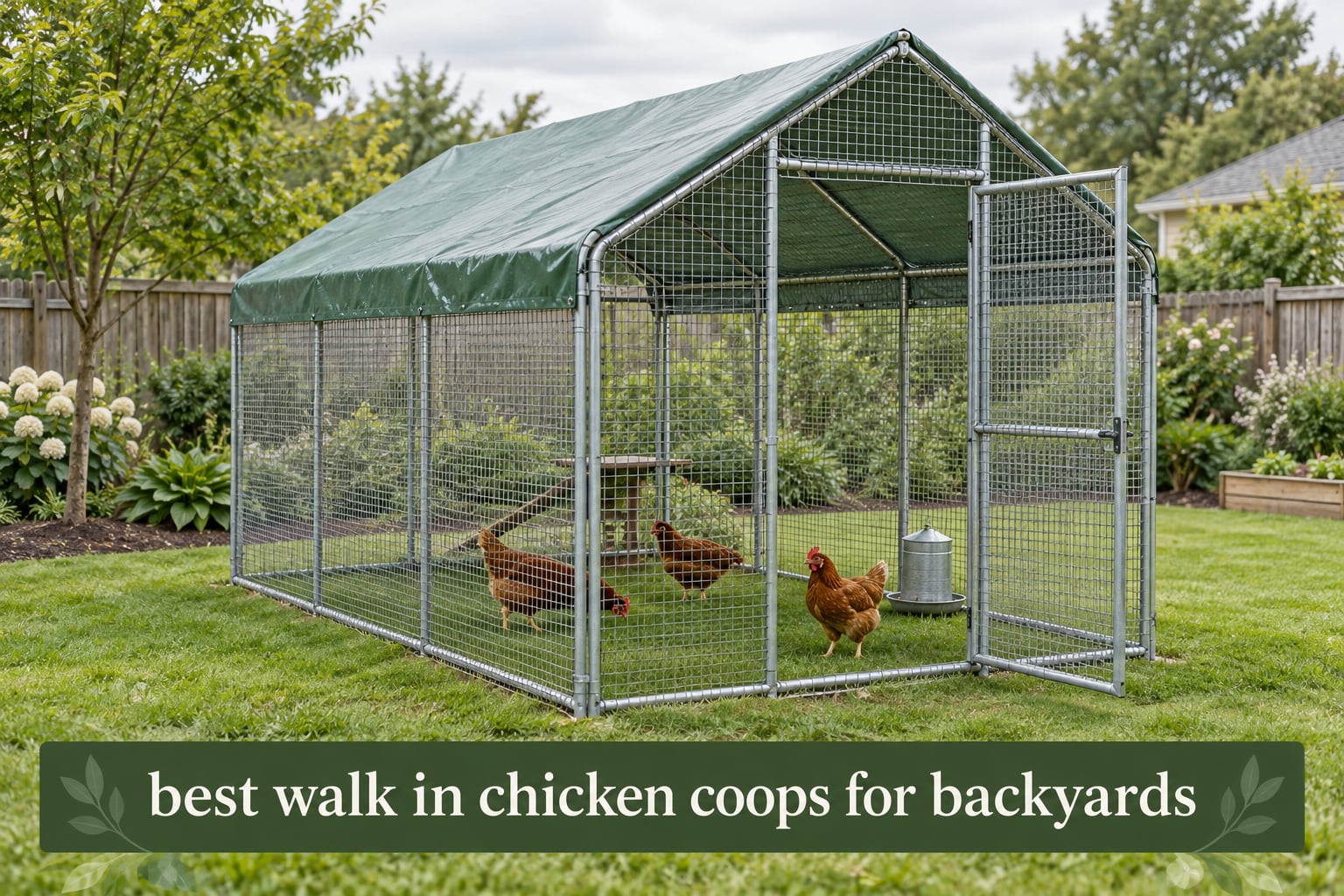
The best walk in chicken coops for backyards are the units where you can stand upright inside the enclosure instead of crouching through a hatch. That single design choice changes the daily job: you can carry a bucket in, shovel bedding out, catch a loose hen, and reach a high roost bar without a ladder.
We spent weeks reading manufacturer specs, weighing build thicknesses, and going through thousands of owner reviews across ten large-format walk-in coops and runs. What emerged is a category that is far more consistent than the marketing suggests, and also far more misunderstood.
Here is the thing nobody tells you first. Almost every product sold as a walk-in chicken coop is actually a walk-in run: an outdoor enclosure with a person-sized door and a fabric canopy, but no enclosed, insulated house inside it. That is a genuinely useful thing for a backyard flock, especially if your birds free-range during the day and only need a dry roosting space at night. It is not the same product as a cedar walk-in house you can insulate and heat. Our general chicken coop guide covers the smaller traditional house format if that is what you are after.
Here is what we cover: the ten best walk-in coops and runs for backyard flocks, a sizing method that works from four hens to thirty, a predator-proofing checklist, and material guidance for hot, cold, and wet climates. If you also like walk-in structures, we have a guide to walk-in greenhouses that uses similar space-planning logic.
Table of Contents
What Is a Walk-In Chicken Coop?
A walk-in chicken coop is a backyard poultry enclosure built at human height, with a full-size door and enough interior headroom that you can stand upright to clean, feed, collect eggs, and catch birds instead of kneeling and reaching in through a small hatch.
The practical threshold is about 6 feet of interior height. Below that you are still stooping, and you are still bending over a bucket of droppings on a wet January morning.
Two different products get sold under this name, and buying the wrong one is the most common expensive mistake in this category. A walk-in run is an open-sided outdoor enclosure with a canopy roof: birds are contained, you can enter, and you can service the flock in minutes. A true walk-in coop is a sealed, insulated building inside that enclosure, with nesting boxes, roosting bars, and a weatherproof door that the birds can close behind them at night. Most of the products we ranked are walk-in runs, which is why every one of them has a fabric or PE canopy rather than a shingled roof.
That distinction matters most if you live somewhere with hard winters. A run in a Minnesota January is a windbreak and a dry roosting shell. A sealed cedar house is the difference between laying eggs and stopping for the week.
Top 3 Walk-In Chicken Coops for Backyards

HITTITE 19.19 x 9.84 ft Walk-In Metal…
- 0.8mm reinforced galvanized pipe
- PVC coated hexagonal mesh
- Lockable metal latch door

CHIKENCOOP 9.8 x 6.5 ft Metal Walk-In…
- 59 lb published build weight
- Two-hour assembly
- Eucalyptus roosting perch included

Betterhood 19 ft Round-Top Walk-In Metal Run
- 19 x 9 x 6.5 ft enclosure
- Click-together steel poles
- 240D Oxford cloth canopy
Quick Overview: Best Walk-In Chicken Coops for Backyards in 2026
| Product | Specifications | Action |
|---|---|---|
| HITTITE 19.19 x 9.84 ft Walk-In Metal Coop and Run |
|
Check Latest Price |
| CHIKENCOOP 9.8 x 6.5 ft Metal Walk-In Coop and Run |
|
Check Latest Price |
| Betterhood 19 ft Round-Top Walk-In Metal Run |
|
Check Latest Price |
 VEVOR 19.7 x 9.8 ft Walk-In Chicken Run and Pen VEVOR 19.7 x 9.8 ft Walk-In Chicken Run and Pen |
|
Check Latest Price |
 NUGRIART Walk-In Metal Coop with Lockable Latch NUGRIART Walk-In Metal Coop with Lockable Latch |
|
Check Latest Price |
 Quictent Walk-In Run for 30+ Poultry with Hardware Cloth Quictent Walk-In Run for 30+ Poultry with Hardware Cloth |
|
Check Latest Price |
 Morngardo 10 x 10 ft Square Walk-In Coop Morngardo 10 x 10 ft Square Walk-In Coop |
|
Check Latest Price |
 HEYTOWN 25mm Galvanized Walk-In Poultry Cage HEYTOWN 25mm Galvanized Walk-In Poultry Cage |
|
Check Latest Price |
 Outvita 13 x 10 ft Walk-In Run with Wide Access Door Outvita 13 x 10 ft Walk-In Run with Wide Access Door |
|
Check Latest Price |
 Xbrigh 20 x 10 ft Extra Large Walk-In Run Pen Xbrigh 20 x 10 ft Extra Large Walk-In Run Pen |
|
Check Latest Price |
1. HITTITE 19.19 x 9.84 ft Walk-In Metal Coop and Run
HITTITE Large Metal Chicken Coop with Run, 19.19 x 9.84 x 6.56 ft Walk in Poultry Cage Chicken Run Pen, Outdoor Chicken Runs for Yard with Waterproof & Anti-UV Cover
Footprint: 230 x 118 x 79 in
Frame: 0.8mm galvanized pipe
Weight: 113 lb
Roof: spire with PE tarp
Pros
- Highest average rating in this set at 4.4 stars
- Thicker 0.8mm pipe than the 0.6mm most rivals use
- Lockable metal latch door
- Good size-to-footprint ratio
Cons
- Mesh is containment rather than true predator protection
- Heavy at 113 lb so two people are needed
- Canopy must be cleared or removed in heavy snow
This is the one we kept coming back to. HITTITE specifies 0.8mm galvanized pipe for the frame, and that number is the whole story. When we sorted the ten kits in this roundup by stated pipe thickness, most landed at 0.6mm or 1 inch nominal, which is a different measurement entirely. A 0.8mm wall is a genuinely heavier tube than the thin-wall tubing used in the budget end of the category, and you feel it the moment you pick up a corner.
At 230 x 118 x 79 inches, the footprint gives you roughly 19 feet of run length across a 9.84 foot width. For a household of 8 to 10 hens that is generous outdoor space, and the manufacturer rates the frame for a two-person assembly, which we think is honest rather than a warning.
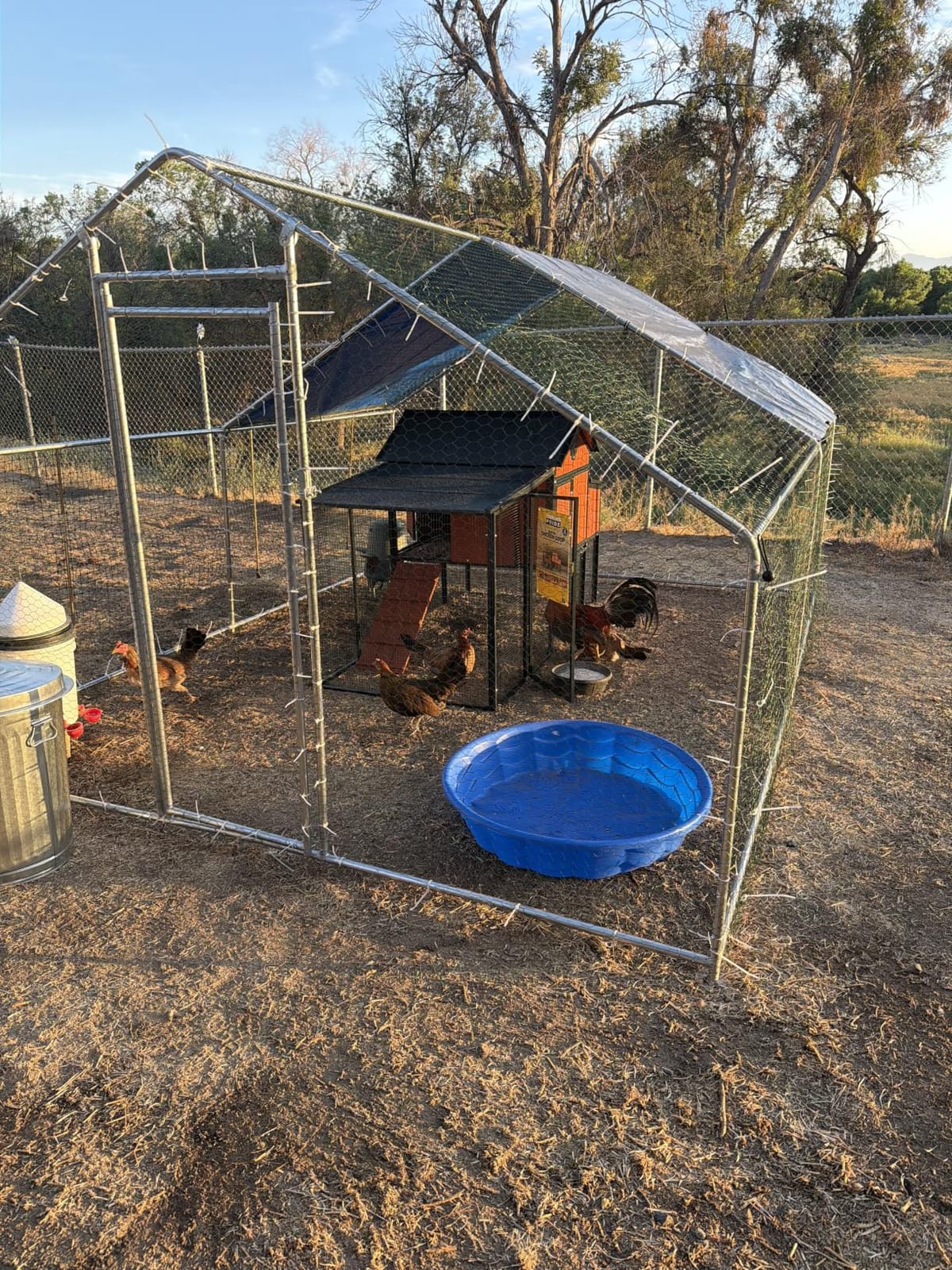
The roof is a spire profile under a waterproof, anti-UV PE tarp, and the brand advises removing the cover during heavy snow. That advice is unusual in this category and worth taking seriously: a sagging tarp on a loaded frame is how these structures fail, not the frame itself.
Owners rate this at 4.4 stars across 927 reviews, with 68 percent five-star ratings, the strongest rating profile in the set. The product spec is model LMCC-326, and the review data consistently credits the heavier gauge tubing and the lockable latch as feeling sturdier than expected.
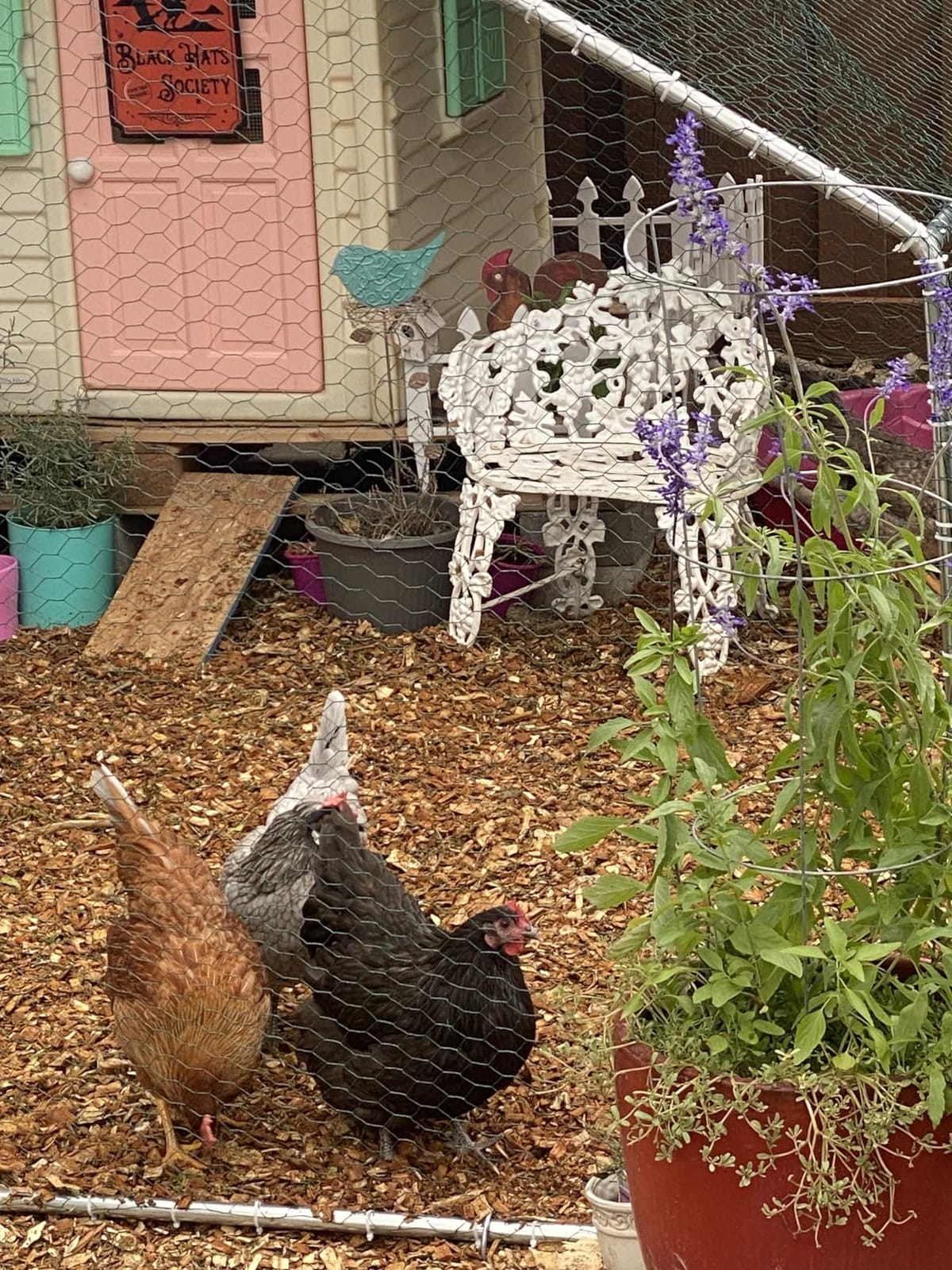
What to check before you buy this run
Confirm you have a second person and roughly three hours. At 113 pounds spread across that many poles, one person will not get the frame square, and a slightly out-of-square frame is the root cause of most latching and sag complaints we saw in this category.
Also decide your plan for the mesh. The supplied PVC coated hexagonal mesh has small gaps and is fine for containment, but the brand itself notes it is not completely predator-proof. Budget for hardware cloth if raccoons or foxes live within a mile of you.
Where this one falls short
There is no enclosed house inside the run. If your winters are severe, you are still buying a separate roosting box or a converted shed, and that is the single biggest reason people end up spending twice what they planned.
The canopy is a tarp, not a hard roof, so it needs periodic re-tensioning after wind, and it will need replacing eventually in high-UV regions. The lockable door is a genuine improvement over the slide-bolt latches used on most budget kits, but it is still not the equal of a two-step carabiner or a screw-eye latch.
2. CHIKENCOOP 9.8 x 6.5 ft Metal Walk-In Coop and Run
CHIKENCOOP 9.8 x 6.5 x 6.5 ft Metal Chicken Coop, Chicken Run with Cover
Footprint: 118 x 80 x 80 in
Frame: metal poles with wire mesh
Weight: 59 lb
Roof: peaked with detachable cover
Pros
- Largest review base in this set at 1622 reviews
- Lightest published build weight at 59 lb
- Roosting perch included out of the box
- Same family offered in many length variants
Cons
- Included mesh is not predator-proof on its own
- Bundled zip ties and stakes are low quality
- Numbered-only instructions with poorly marked parts
If you have never kept chickens and you want the least intimidating first build, this is the one. The manufacturer quotes roughly two hours of assembly with clearly labelled frame components, and at 59 pounds it is the only kit in this roundup most people will put up alone without a second set of hands.
It is also the smallest footprint here at 118 x 80 x 80 inches, which sounds modest until you realise the height is a full 6.5 feet. You are walking into a low-ceilinged room rather than crawling under a shed, and that is the difference that makes cleaning a five-minute job instead of a twenty-minute one.
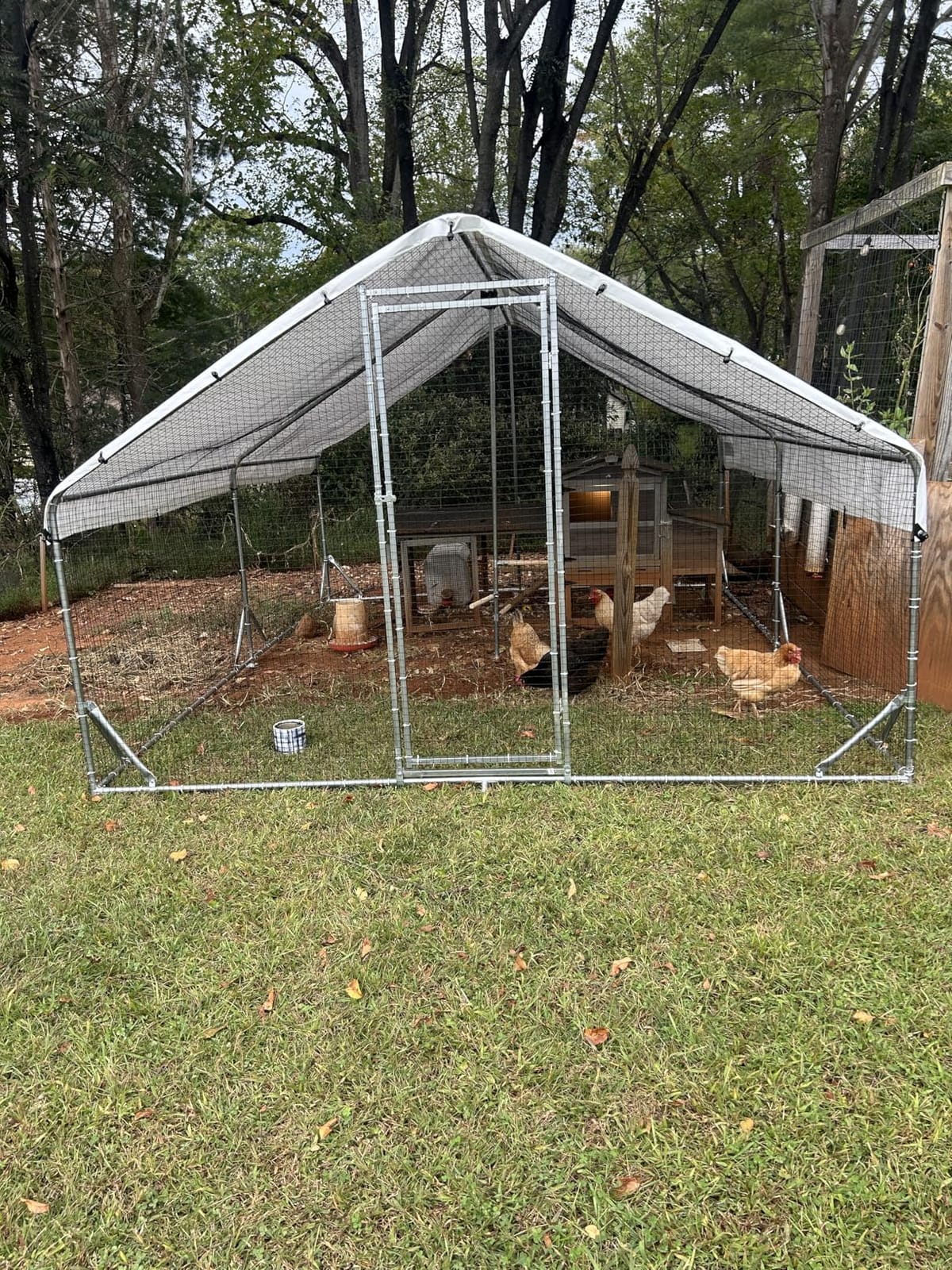
Two details stand out. The frame has reinforced bottom corner braces plus an additional rear support pole, which is a targeted fix for the frame wobble that plagues pole-built runs. And the kit includes a natural eucalyptus roosting perch measuring 47 x 40 inches, which is a real bonus since separate roosts are an extra purchase almost everywhere else.
What you get is a waterproof, UV-resistant peaked cover on a detachable mount, so you can take the whole roof off in summer or for access. Buyers rate it at 4.2 across more than 1600 reviews, and owners consistently mention responsive customer service when parts arrive missing.
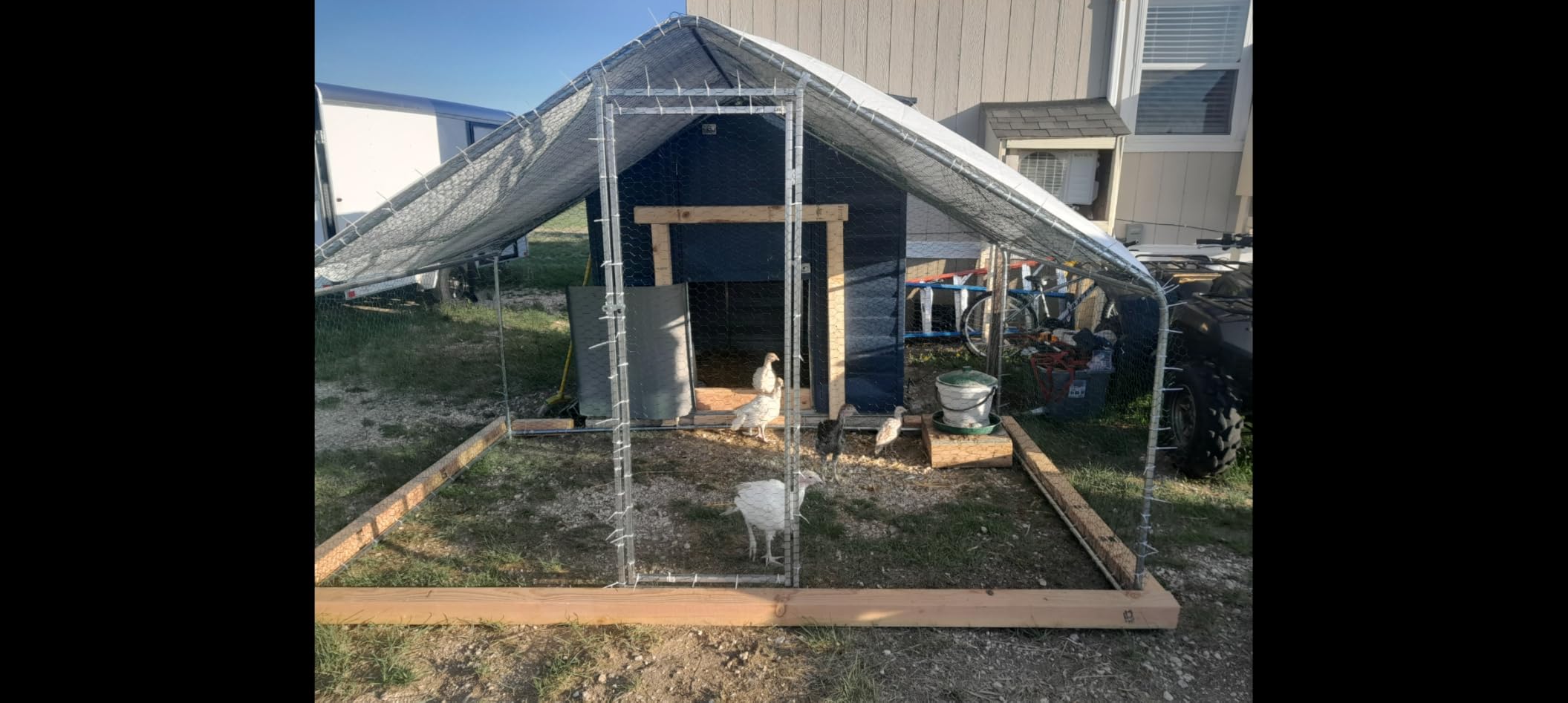
What to check before you buy this run
Measure your square footage honestly. 9.8 by 6.5 feet is a good run for 4 to 6 hens in mild weather, but it is a marginal footprint for a 10-bird flock in a hot climate. If you want headroom and light weight, this one wins; if you want square footage, keep looking.
Plan your hardware cloth retrofit before the birds arrive. The bundled zip ties are widely reported as low quality, so buy your own 0.2 inch heavy-duty ties rather than relying on the ones in the box. The same goes for the ground stakes, which owners describe as too short or too weak to hold the frame in wind.
Where this one falls short
The latch only opens fully in one direction, which is an annoyance every single time you reach for it with a full bucket in the other hand. The instructions use numbers rather than part names, so mark your poles as you unpack, or the assembly becomes a guessing game.
There is no enclosed house and no nesting boxes, so this is strictly a run. If your priority is a structure that keeps birds dry and warm through a wet winter, you need to pair it with something else entirely.
3. Betterhood 19 ft Round-Top Walk-In Metal Run
Large Metal Chicken Coop Round Top Upgrade Tri-Supporting Wire Mesh Chicken Run,Chicken Pen with Water-Resident and Anti-UV Cover,Duck Rabbit House Outdoor(19’L x 9’W x 6.5’H)
Size: 19 ft L x 9 ft W x 6.5 ft H
Frame: galvanized steel with tri-supports
Canopy: 240D Oxford cloth
Pros
- 19 ft of run length for large flocks
- Click-together poles mean almost no screwing
- Coated mesh is easier to cut and handle
- Length options let you join runs together
Cons
- Included wire is thin and not predator-proof
- Netting and wire ties loosen over time
- Cheap single-sided latch leaves a gap
- Stakes bend in hard ground
The round top is the visual signature here, and it is not purely cosmetic. A curved 240D Oxford cloth canopy sheds water and light snow toward both sides instead of concentrating load on one seam, and the 19 foot length is among the longest straight-line runs in the set, only the VEVOR and Xbrigh builds are longer.
Assembly is where this kit wins. The rods click together, so there is very little screwing involved, and the frame uses extra support columns plus triangular supports at the joints. Owners report the frame holding up through a full Canadian winter, which is a more useful data point than most manufacturers publish.
The manufacturer lists the same product family in lengths from 78 inches all the way to 374 inches, roughly 31 feet. That matters more than it sounds: you can build a long L-shaped or straight run over an existing area instead of trying to squeeze a square footprint into a small yard.
Rated 4.2 across 1536 reviews, it sits just behind the CHIKENCOOP on volume and is one of the better-reviewed kits in the category. The model number is 001, and the material spec is a galvanized steel frame with coated hexagonal wire mesh.
What to check before you buy this run
Confirm the pole holes are all on the same side. Some reviewers report poles arriving drilled on the wrong side, which turns a two-hour build into a frustrating afternoon. Check every pole before you begin rather than halfway through.
Also read the diagrams skeptically. Reviewers note the instructions are poor and the drawings are not to scale, so plan to spend extra time labelling parts, and lay out the frame footprint with a tape measure before snapping anything together.
Where this one falls short
The wire is thin and serves containment rather than predator defense. Nearly every long-term owner in this product’s reviews upgrades the mesh to hardware cloth and replaces the latch and stakes, so treat the hardware bill as part of the real cost.
A round top also means less usable vertical clearance at the edges, which makes the corners poor roosting and nesting spots. And a smaller group of owners reports early rusting at the base and repeated escapes through worn netting, so inspect the galvanizing where poles meet the ground.
4. VEVOR 19.7 x 9.8 ft Walk-In Chicken Run and Pen
VEVOR Large Metal Chicken Coop, 19.7×9.8×6.5ft Walk-in Chicken Runs for Yard with Cover, Spire Roof Hen House with Security Lock for Outdoor and Backyard, Farm, Duck Rabbit Cage Poultry Pen
Living area: 9.88 x 19.29 x 6.53 ft
Frame: 1 inch galvanized pipe
Weight: 85.32 lb
Roof: spire with PE canopy
Pros
- Best sales rank in the category
- 1 inch galvanized pipe that holds up in wind
- Salt-spray tested corrosion resistance
- Lockable security door
- Four-sided ventilation
Cons
- Lowest average rating in this set at 4.0 stars
- Highest share of 1-star reviews of the ten
- Mesh needs hardware cloth for predators
- Longer build with more poles than smaller kits
VEVOR sells the most units in this category, and the reason is straightforward: this is the largest run you can get for the money without stepping up to a hardware-cloth build. The living area is listed at 9.88 by 19.29 by 6.53 feet, and at 85 pounds it is meaningfully lighter than the two heaviest kits here.
The frame uses 1 inch galvanized steel pipe with precise welding, and the manufacturer states the tubing was salt-spray tested for corrosion resistance. That claim matters for anyone in a coastal or high-humidity region, where cheaper tubing corrodes at the base within a couple of seasons.
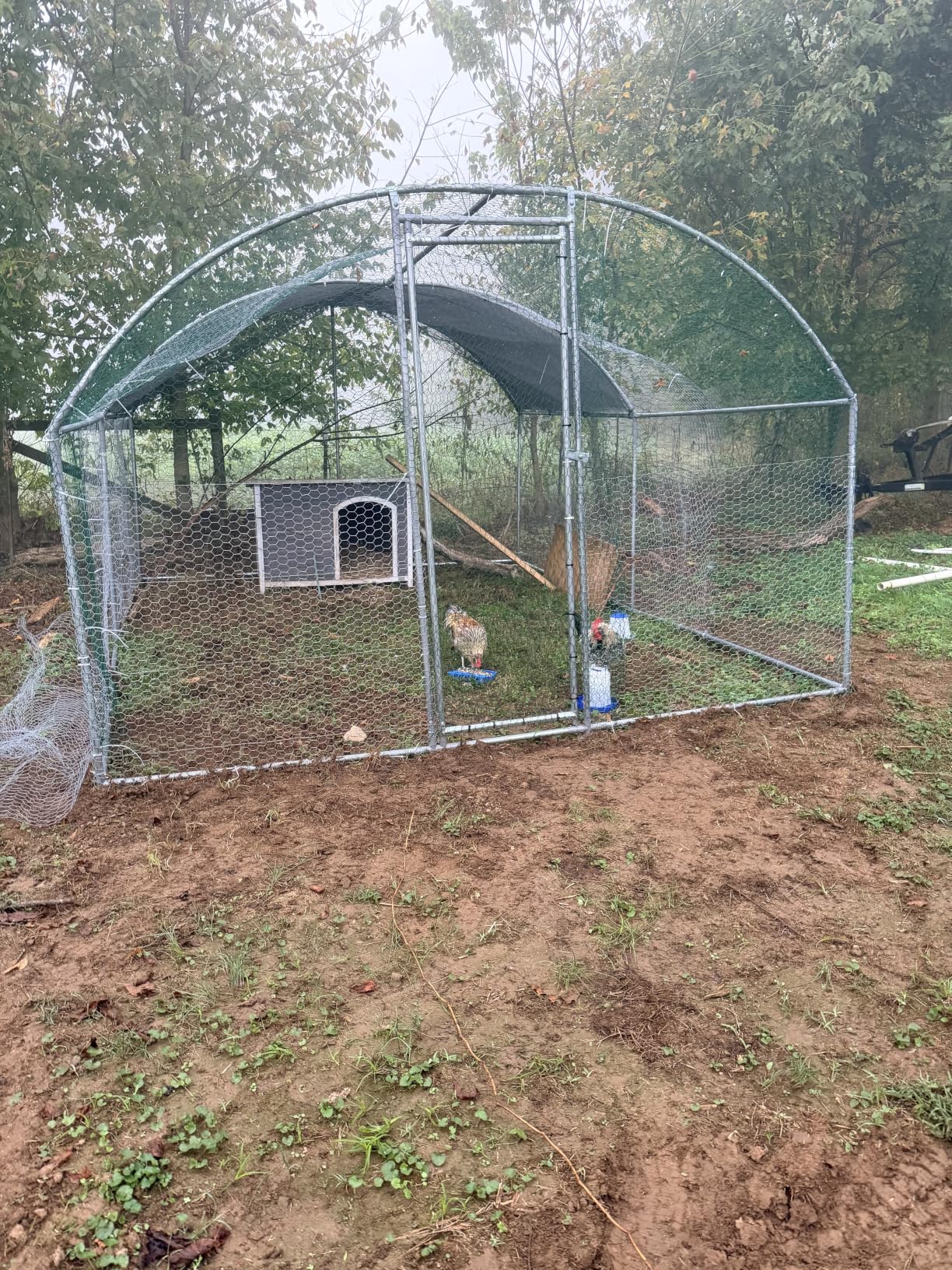
Model RA362 includes a spire roof with a PE-coated canopy rated for tear resistance, four-sided ventilation, and a lockable security door for feeding and cleaning access. Those are the three features that separate it from the cheapest kits, and all three are things owners single out in reviews.
Here is the honest caveat. It carries a 4.0 average across 1137 reviews, the lowest rating in this group, and the review analysis shows a higher share of 1-star feedback than any other product we ranked. Most of that feedback is durability and wind related rather than assembly related.
What to check before you buy this run
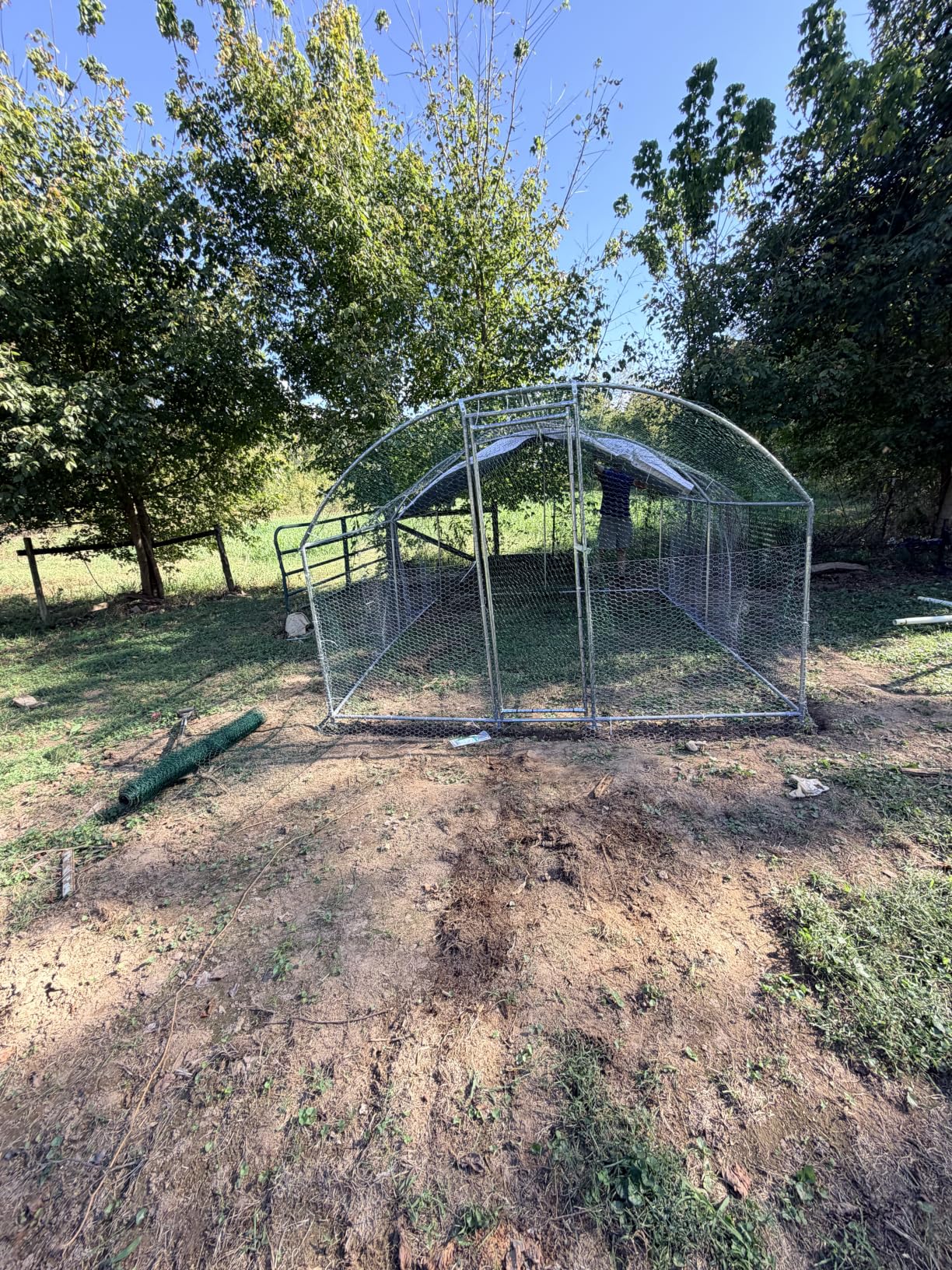
Buy heavier ground anchors than the ones supplied. With a footprint this large and a canopy that catches wind like a sail, the failure mode is the whole frame shifting or lifting, not the pipe bending. The manufacturer itself recommends reinforcing the base with wood or stones and adding a galvanized wire fence against raccoons.
Set aside real assembly time. There are simply more poles than in a 10 by 10 kit, and doing it in one focused afternoon with two people is more sensible than stretching it over a weekend.
Where this one falls short
The hexagonal protective mesh is not predator-proof on its own, so a hardware cloth retrofit is effectively mandatory in raccoon country. This is the kit most likely to disappoint a first-time owner who assumes the word galvanized covers everything.
At 4.0 stars, it also sits close to the durability complaints the wider category generates. If your priority is build longevity rather than square footage, spend the difference on a welded hardware cloth kit instead.
5. NUGRIART Walk-In Metal Coop with Lockable Latch
NUGRIART Large Metal Chicken Coop Walk-in Poultry Cage Hen Duck Run House with Waterproof & Anti-UV Cover Galvanized Rabbits Habitat Spire Shaped Cage for Outdoor Yard Farm Use
Footprint: 118 x 79 x 79 in
Frame: 1 inch galvanized steel
Mesh: PVC coated hexagonal
Roof: spire PE cover
Pros
- Best value entry point in the category
- 1 inch diameter galvanized steel tubing
- 4.3 star average with 67 percent five-star ratings
- Lockable latch and drain-friendly spire roof
Cons
- Smallest footprint of the walk-in options here
- Mesh gaps still need added hardware cloth
- Connection joints are the trickiest part of assembly
If you want walk-in height and a lockable door without spending a lot, this is the pick. NUGRIART uses 1 inch diameter galvanized steel tubing, which is a heavier wall than most of the kits at this entry level, and the 4.3 average across 651 reviews is the second-strongest rating profile in the set.
Model CCRS2 measures 118 x 79 x 79 inches and uses a spire-shaped frame under a waterproof, anti-UV PE cover. The spire design is there to drain rain, snow, and debris rather than letting them accumulate on a flat roof, which is a meaningful advantage in a wet climate.
Sixty-seven percent of its reviews are five-star, and buyers consistently describe this as the budget entry point for a walk-in metal run rather than as a compromise. A lockable metal latch is included for feeding and cleaning access.
What to check before you buy this run
This is the smallest footprint among the walk-in options we ranked, at just under 10 feet by 6.5 feet. For 4 to 6 hens in a temperate climate that is workable. For 8 or more birds you will want to plan on a larger run, because crowding a small enclosure is the fastest route to feather damage and disease.
The same product family comes in lengths from 13.1 feet up to 26.2 feet, so you can start small and add a section later rather than buying a whole new enclosure.
Where this one falls short
The connection joints are the hard part of assembly. Owners flag them specifically, and the manufacturer suggests wearing gloves during installation. The mesh still needs added hardware cloth for real predator protection, exactly as with the other kits at this level.
No weight figure is published for this model, which makes planning a two-person install harder than it should be. If you are buying this in a windy area, treat anchoring as a priority from day one rather than a later upgrade.
6. Quictent Walk-In Run for 30+ Poultry with Hardware Cloth
Quictent Large Metal Chicken Coop Run for 30+ Poultry w/Side Hardware Cloth
Footprint: 214.5 x 107.3 x 78 in
Weight: 112.2 lb
Side walls: 20 gauge welded hardware cloth
Pros
- Only kit here with real welded hardware cloth on the sides
- Rated for 30+ poultry
- 750 heavy-duty zip ties included
- Dual-latch door and extended ground skirt
- Replacement parts program included
Cons
- Side and back weather covers are not included
- Heaviest build in the set at 112.2 lb
- Enclosure upgrades cost extra
This is the pick if predators are your primary concern, and it is the only kit in this roundup that comes with actual welded hardware cloth on the side walls. Model 189 uses 1 x 1 inch 20 gauge square welded hardware cloth with a thickened PVC coating, which is the same material a careful owner would retrofit onto every other run here.
It is also the only one with an extended ground skirt mesh designed to deter digging, and the door has a dual latch with a narrow gap rather than a single cheap bolt. The frame uses 1 inch rust-free poles with 8 support bars and triangular corner poles, and the stated capacity is 30 or more poultry.
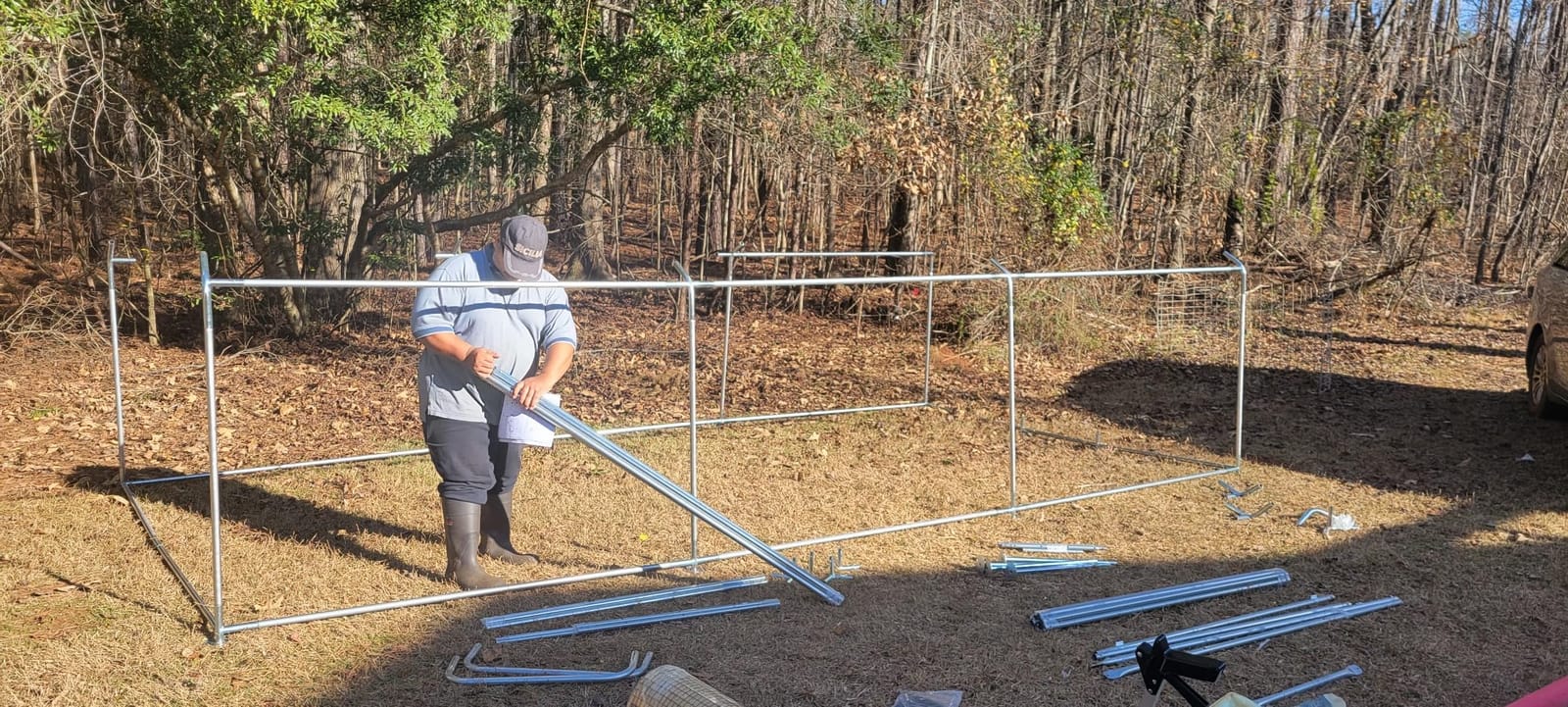
The accessory list is unusually generous: 750 zip ties at 0.2 inch width, when most kits include a fraction of that. Quictent also backs the frame parts for 365 days and the cover and hardware cloth parts for 180 days, with ongoing parts support after that window.
The 4.1 average across 387 reviews reflects one consistent expectation gap rather than quality problems: buyers assume the side and back weather covers are included, and they are not. The frame is designed to accept them as optional add-ons.
What to check before you buy this run
Ask yourself whether you are in raccoon, fox, or weasel country. If yes, this is the only kit here you can set up without immediately planning a hardware cloth retrofit, and that alone justifies the premium over the cheaper runs.
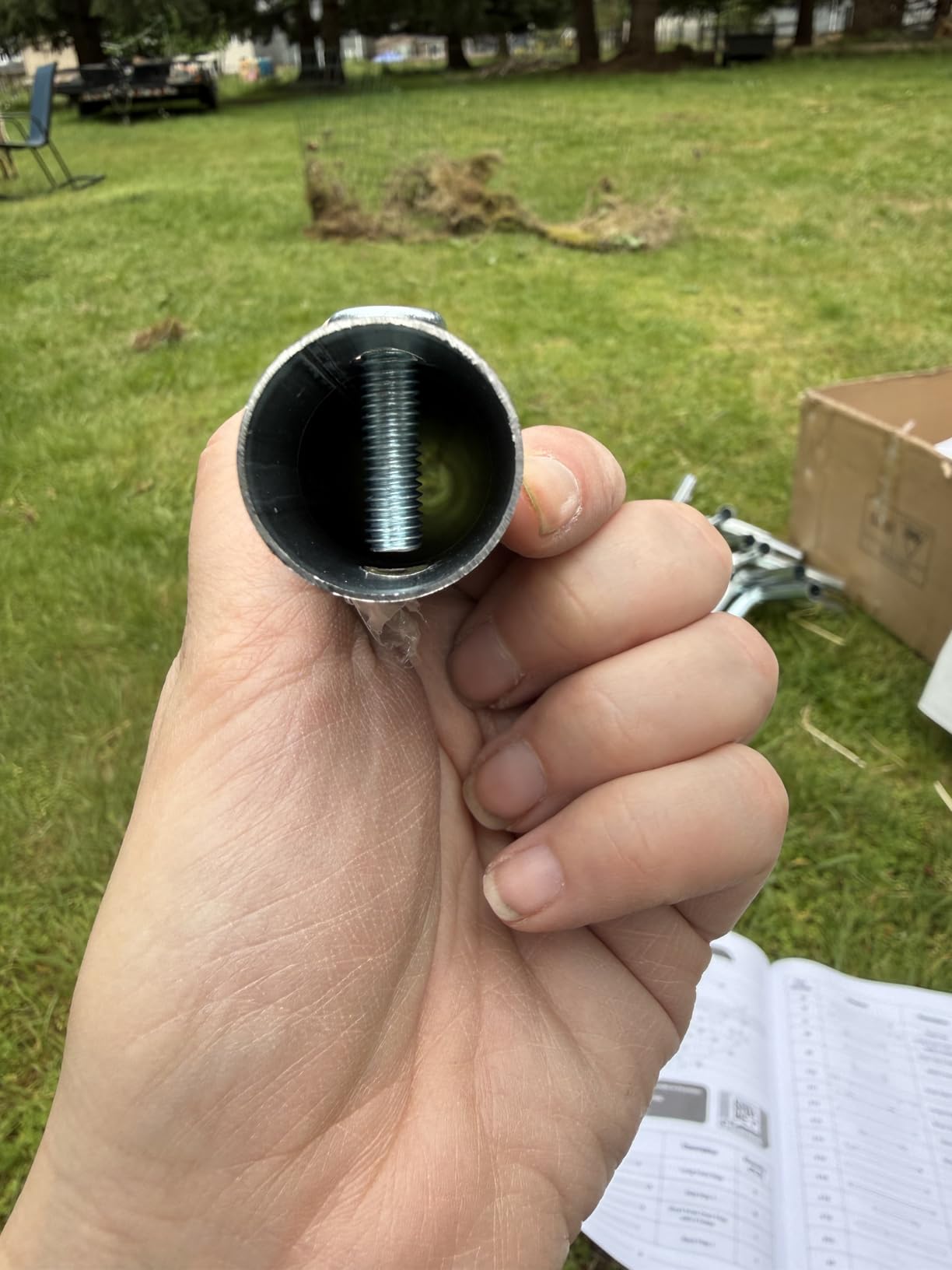
Budget for a two-person build at 112.2 pounds over a 214.5 by 107.3 inch footprint. It is a long structure with triangular bracing, so the geometry takes longer than a simple rectangular snap-together kit.
Where this one falls short
Side and back covers are supported by the frame but not supplied, and that is where most of the rating friction comes from. If you are buying this for a rainy climate, factor the cost of the covers into your decision from the start.
It carries the heaviest build alongside the HITTITE, at 112.2 pounds, and at 387 reviews the feedback pool is thinner than most. The build quality signals are strong, but you are relying on a smaller set of long-term owner reports than with the top two picks.
7. Morngardo 10 x 10 ft Square Walk-In Coop
Large Metal Chicken Coop 10×10 Walk-in for 20 Chickens, Predator-Proof
Footprint: 118 x 118 x 78 in
Weight: 82 lb
Frame: 1 inch galvanized tube
Assembly: tool-free snap-pin
Pros
- Square footprint maximizes usable floor area
- Stated capacity for up to 20 chickens
- Tool-free assembly in one to two hours
- 180-degree door opening catches birds easily
Cons
- The 0.6 inch mesh gaps are wide for predator defense
- Category sales rank trails the others here
- Thirteen percent of reviews are 3-star
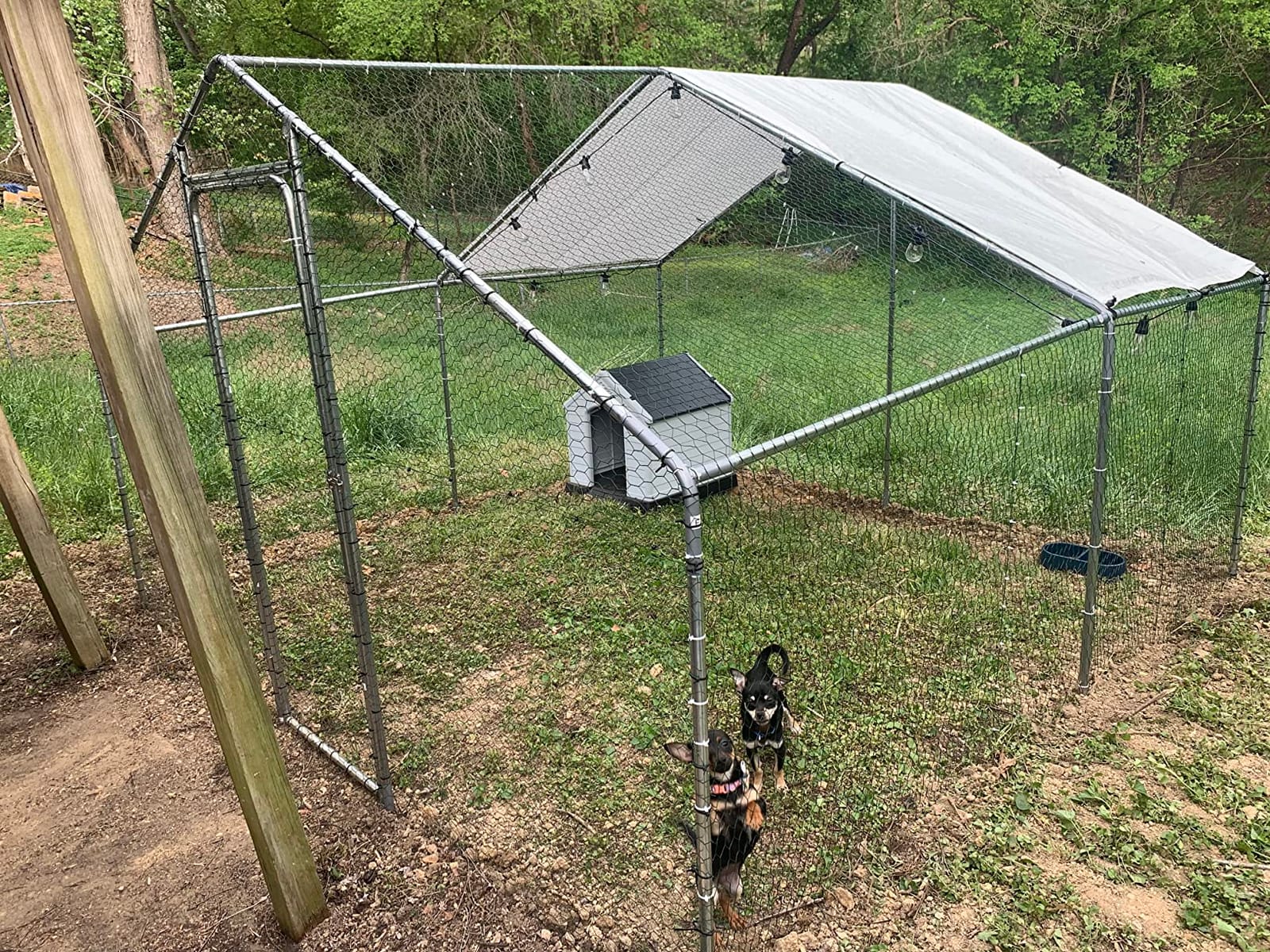
Most walk-in runs are long and narrow, which is awkward on a small suburban lot. This one is a true 10 by 10 square, listed at 96.8 square feet, and that shape is the entire reason to pick it. A square footprint uses the same yard area far more efficiently and gives birds usable space in every direction rather than a long narrow strip.
Model JJ-332 uses 1 inch galvanized steel tubes with reinforced support columns and a 240D UV-resistant waterproof tarp roof. The open mesh sides keep air moving, which buyers highlight as the main summer benefit, and the frame is rated to stay stable in wind and weather.
Assembly is genuinely fast. The tool-free snap-pin tubes go together in one to two hours, and the kit includes larger and wider cable ties than typical for attaching mesh. The door opens 180 degrees, which is a small detail that makes catching a hen dramatically easier than a half-open gate.
Stated capacity is up to 20 chickens depending on breed, and we would size well below that for a run-only setup. At 4.1 stars across 375 reviews it sits mid-pack, with 13 percent three-star feedback.
What to check before you buy this run
Check your yard shape, not just the area. If your usable space is wider than it is deep, a square 10 by 10 will not fit where a 10 by 20 rectangle would, and the reverse is true for narrow side yards. Measure the actual clear space including access paths.
Also decide how many birds you will really keep. 96.8 square feet sounds huge for a flock of 8, but that is outdoor run space, not indoor coop space, and the birds still need somewhere enclosed to roost overnight.
Where this one falls short
The 0.6 inch mesh gaps are wide enough that determined predators can work at them, and on a square run you have more surface area to cover than on a narrow one. For most yards a hardware cloth retrofit is not optional, and plan for that cost before you buy.
Treat this as a footprint-driven choice for small yards rather than a build-quality choice. The square shape solves a real space problem, and the mesh gauge is where the trade-off sits.
8. HEYTOWN 25mm Galvanized Walk-In Poultry Cage
HEYTOWN Large Metal Chicken Coop Chicken Pen with Water-Resident and Anti-UV Cover Walk-in Poultry Cage Chicken Runs for Yard with Cover Duck Rabbit Dog House Outdoor
Footprint: 157.2 x 117.6 x 78 in
Frame: 25mm galvanized steel pipe
Roof: spire with anti-UV PE cover
Pros
- 25mm galvanized steel pipe diameter
- Spire roof drains rain and snow cleanly
- Four length variants for joining runs
- Suits rabbits ducks cats dogs and birds
Cons
- Thinner evidence base than most kits here
- Hexagonal mesh needs added hardware cloth
- Two-person assembly required
- Assembly time not published
HEYTOWN specifies 25mm galvanized steel pipe, which is very close to the 1 inch nominal tubing used by most kits here, and it states the diameter as the reason for stability in wind and rain. Pipe diameter and wall thickness are different measurements, so treat the diameter figure as a frame-geometry signal rather than a direct strength comparison.
The footprint is 157.2 by 117.6 by 78 inches, which is a squarer proportion than most of the long runs here and works better in a yard that is not a long thin strip. The spire roof drains rainwater, snow, and debris cleanly, and the galvanizing process is specified for rust resistance.
What owners mention most is versatility. The manufacturer lists chickens, ducks, rabbits, cats, dogs, and birds as suitable residents, and at 4.2 stars across 274 reviews the average holds up even on a fairly small review base.
What to check before you buy this run
The listing runs from 78 inches to 314.4 inches in length, so you can pick a size that matches your space and add sections later. Confirm the length variant you actually receive, since the review analysis suggests fit and finish vary more between variants than the star average implies.
Plan for two people. Installation is documented as requiring two, and no assembly time is published, so allow a full afternoon rather than the two hours some competitors advertise.
Where this one falls short
At 274 reviews, this has a smaller evidence base than most of the kits we ranked. That is not a dealbreaker for a straightforward steel run, but it does mean you have less long-term owner data to lean on than with the higher-volume kits.
Like the rest of the category, the PVC coated hexagonal mesh is containment rather than defense and needs hardware cloth added. The four-sided open mesh also gives you no shaded interior, so in a hot climate you will want to add a shade sail or a dust bath area inside the footprint.
9. Outvita 13 x 10 ft Walk-In Run with Wide Access Door
Outvita Chicken Coop, 13×10 FT Large Metal Chicken House, Poultry Habitat Cage with Waterproof Cover, Walk-in Chicken Run Pen for Small Animals, Yard, Farm, Patio
Footprint: 156 x 120 x 78 in
Weight: 85.76 lb
Door: 24.8 x 68.9 in
Roof: sloped 180g PE
Pros
- Widest access door in this roundup
- Spring-bolt quick-connect at every junction
- Fixable metal feet make repositioning easy
- Sloped roof drains water and snow
- Available in silver and black
Cons
- Fewer reviews than most kits here
- Mesh still needs added hardware cloth
- Two-person assembly required
The thing that stands out here is the door. At 24.8 by 68.9 inches it is the widest single opening in this roundup, and on a 13 by 10 foot run that is a genuinely walk-in aperture rather than a person-sized gate. You can carry a wheelbarrow through it. That is not a small quality-of-life detail when you are moving bedding twice a week.
The frame is 1 inch galvanized steel with full-coverage PVC coated hexagonal steel wire mesh, and every junction uses a spring-bolt quick connection. Owners credit that design with making assembly fast, and the sloped 180g PE waterproof cover sheds rain and snow without buildup.
Model dimensions are 156 by 120 by 78 inches at 85.76 pounds. Outvita also ships it with fixable metal feet, which is the feature that makes this the most practical option for anyone who wants to move the run around the yard to follow grass growth or shift shade.
What to check before you buy this run
If you plan to relocate the run seasonally, this is the pick. The fixable feet let you lift and reposition without dismantling the frame, which is a real chore on snap-together kits with bolted base plates.
Choose your colour deliberately. It is available in silver and black, and the darker cover absorbs noticeably more heat in summer, which matters more than people expect in a hot climate.
Where this one falls short
At 203 reviews this has a smaller feedback base than the rest of this group, and 11 percent of those reviews are 1-star. We would call the durability complaints typical of the segment rather than disqualifying, but it is less proven than the alternatives.
It is also a run, not a coop, and the mesh still needs hardware cloth for predator protection. There is no enclosed interior, so this does nothing on its own to keep birds dry overnight in cold weather.
10. Xbrigh 20 x 10 ft Extra Large Walk-In Run Pen
20×10 FT Extra Large Metal Chicken Coop, Walk-in Poultry Run Pen
Footprint: 236.5 x 120.1 x 76.9 in
Roof: 210D Oxford fabric
Tubing: galvanized with anti-corrosion coat
Pros
- Largest footprint in the roundup at 20 x 10 ft
- Heavier 210D Oxford cover than rival tarps
- Anti-corrosion galvanized coating
- Eight size variants including a 26 ft model
- Manufacturer warranty with fast support
Cons
- Bolted assembly is slower than snap-together kits
- Newer listing with a shorter owner record
- Mesh needs reinforcement for determined predators
Xbrigh takes a different approach to the cover. Instead of the 180g PE tarp used on most of the category, model ROOST-25JD362 uses a 210D Oxford fabric with reinforced stitching, and that is a materially heavier and better-sealed cover. In a wet, high-rain region that difference decides the longevity of the whole structure.
The footprint is 236.5 by 120.1 by 76.9 inches, the largest in this roundup, on galvanised steel tubing with an anti-corrosion coating specified for year-round outdoor use and harsh climates. Walls are PVC-coated hexagonal mesh, and the manufacturer offers a warranty with a 24-hour response promise through Amazon messages.
At 208 reviews, this has a smaller feedback base than most of the group, and the reviews skew recent because the listing is newer than the rest. Buyers rate the frame and cover positively, with the slower bolted assembly being the most common criticism.
What to check before you buy this run
Do not expect a quick build. The components are bolted rather than snapped together, so the two-hour assembly claim you will see on competing listings does not apply here. Budget a full day, ideally with two people, for a 20 by 10 foot frame.
Check your available footprint carefully. At more than 230 inches long, this needs either a long side yard or a rear yard where you can give it the whole run. It will not fit in a typical narrow suburban side lot.
Where this one falls short
Mesh still requires added reinforcement for determined predators, and because the listing is newer than the others here, the owner record covers a shorter stretch of real weather. We would want to see a year of summer and winter cycling before treating it as a proven long-term build.
Its height of 76.9 inches is at the low end of the walk-in range here, so if you are tall you may find yourself ducking slightly at the peak of the frame rather than standing fully upright.
How to Size a Walk-In Coop for Your Flock
Start with a number most keepers have already heard: about 4 square feet of indoor coop space per hen and 8 to 10 square feet of run space per hen. The r/BackYardChickens consensus puts it the same way, and it is the sizing rule we used to sanity-check every product in this roundup.
The catch is that almost nothing on the market today is a true indoor coop. These are runs. So do the math twice. If you plan to keep your flock outside during the day, the run footprint is your primary number, and you should budget 8 to 10 square feet per bird. If the birds will live in this structure full time, add the enclosed house space on top, at 4 square feet per bird, because birds standing still in a crowded run winter or summer is where disease starts.
Use this table to match a flock size to a run footprint, then check it against the picks above.
4 to 6 hens: 32 to 60 square feet of run. The NUGRIART and CHIKENCOOP builds both land in this range at roughly 65 to 78 square feet, giving you headroom for a small free-range flock.
8 to 12 hens: 64 to 120 square feet of run. The Morngardo 10 by 10 square, the Outvita 13 by 10, and the HEYTOWN unit sit here. The Morngardo spreads that area evenly instead of stretching it in one direction, which suits a yard that is not a long strip.
16 to 20 hens: 128 to 200 square feet. The HITTITE, VEVOR, and Betterhood 19 ft runs are the right size, and the Morngardo and Quictent both carry stated capacities up to 20 and 30 birds respectively.
More than 20 birds: 200 square feet and up, which means joining two runs together rather than buying a single larger one. This is where the Betterhood and NUGRIART length variant systems pay off, since both are offered in lengths beyond 20 feet. If you are at this scale and want a genuine indoor house, move up to a cedar walk-in coop or a converted shed rather than trying to force an open run to do indoor work.
How tall should a walk-in chicken coop be?
Aim for at least 6 feet of interior headroom so an adult can stand upright, and treat anything under 5 feet 6 inches as a crawl-in rather than a walk-in, regardless of how the product is labelled. Every run in this roundup sits at 78 to 80 inches on the outside, so interior clearance is slightly less than that. Measure before you buy if you are tall or if you plan to use a wheelbarrow.
For interior fittings, the community standard is 8 to 12 inches of roost bar per hen and one nesting box per 3 to 4 hens. None of the kits in this roundup includes roosts or nest boxes except the CHIKENCOOP, which ships with a 47 by 40 inch eucalyptus perch. Everything else you add yourself.
Interior features that matter
On the roost question that comes up constantly, keepers generally prefer a flat or slightly rounded board over a perfectly round dowel, because a flat surface gives better footing and fewer foot injuries. A 3 by 4 inch pine board on brackets is the common recommendation over PVC pipe.
Place roosts above the nest boxes rather than beside them, so nesting birds are not disturbed by birds moving to and from the roost at dusk. A gradual ramp up to the roost helps heavier breeds like Orpingtons and Australorps.
Finally, a removable litter tray is the feature that makes a walk-in genuinely easier to live with. Because you can stand up, you can lift bedding out in a bucket instead of shovelling it through a hatch, and that is the practical difference a walk-in access point buys you every single week.
Predator-Proofing Checklist for Walk-In Coops
The number one predator of chickens depends on where you live, and raccoons top the list in most suburban areas, with foxes, hawks, weasels, coyotes, opossums, and loose neighborhood dogs behind them. Raccoons are the ones owners complain about most because they are persistent, they work at latches, and they are often underweighted at first.
The r/BackYardChickens advice on this is unambiguous: avoid chicken wire, because raccoons can pull it apart, and use 1/4 inch or 1/2 inch hardware cloth instead. Chicken wire keeps chickens in and does essentially nothing to keep predators out, which is why most of the kits in this roundup need a retrofit.
1. Replace the mesh. Wrap the entire frame in 1/2 inch hardware cloth, not just the chicken-facing panels. Most owners in the review data for these products plan exactly this retrofit. Budget for the full surface area of whichever run you buy, which is much more than you think at purchase time.
2. Bury an apron. Lay 12 to 18 inches of hardware cloth flat on the ground around the perimeter, then bury or pin it. Digging is how most determined predators defeat a run, and the Quictent is the only kit here with a ground skirt mesh built in.
3. Upgrade the latches. Slide bolts, spring gates, and hook-and-eye closures are all defeatable. Use a screw-eye latch with a carabiner, or a two-step latch where the second element cannot be operated by a raccoon. Only the Quictent ships a genuine dual-latch, so treat this as a universal upgrade.
4. Bury or mesh the roof. If your canopy is fabric, a raccoon can climb onto the spire and try to enter from above. Overlap the top with a length of hardware cloth weighted down, or restrict the canopy to a section of the run and enclose the roosting house properly.
5. Anchor the frame. This is the step nobody puts on a product page. A 19 foot canopy catches a lot of wind, and a run that shifts an inch is a run with a new gap at ground level. Use ground stakes rated for the soil, or bolt the base to pavers or a pressure-treated sill.
6. Close the door every night. Manually or with an automatic chicken door. Even a lockable latch is worthless if the door is propped open because someone forgot.
7. Check for physical wear monthly. Reviewers report wire ties loosening, netting tearing, and poles arriving with the wrong hole orientation. A five-minute walk around the perimeter catches problems before they become losses.
Materials and Climate: Metal, Plastic, and Wood
Every product in this roundup is metal and mesh, which is the honest reality of the walk-in run category in 2026. Cedar and fir walk-in houses are a different product entirely, with a different set of tradeoffs, so treat this section as guidance for the structures you are actually comparing here.
Galvanized steel runs are the sweet spot for most climates. They do not rot, they are impossible for a dog to chew through, and they shed heat better than wood once the sun is on them. The two weak points are the base, where galvanizing can fail if the coating is scratched at soil level, and the canopy, which becomes a greenhouse effect in summer.
In hot, sunny climates, the dominant problem with these runs is heat load from the tarp, not from the air temperature. Light-coloured covers reflect more; dark covers cook the interior. Add a shade sail over the top and a dust bath area inside the footprint, and provide water that is shaded and cool. The open mesh sides that make these runs cheap are genuinely helpful here, since they move air continuously.
In cold, snowy climates, the dominant problem is wind-driven moisture and drafts at ground level rather than cold air. Canvases that sag hold snow against the frame, so clear them promptly, and the HITTITE manufacturer’s advice to remove the cover during heavy snow is worth adopting across the category. Seal the base gap with a strip of hardware cloth or a windbreak, and remember that a run is not a heated space.
In wet, coastal, or humid climates, corrosion decides how long the frame lasts. The VEVOR’s stated salt-spray testing and the Xbrigh’s anti-corrosion coating are the specifications to look for, and you should inspect the base of the poles each spring for early rust. Galvanized tubing outlasts painted steel because the coating is baked on rather than sprayed on.
Where walk-in coops have a real edge over these runs is insulation. A cedar or fir house with double-wall panels holds heat far better than a fabric canopy, and for keepers above roughly USDA zone 5 that is the deciding factor. If you are in that range and serious about year-round laying, plan to pair any of these runs with an enclosed house, which is a common route, or convert a shed. We have covered the size and layout logic in our walk-in closet layout guide, and the space planning translates directly.
Where to Place a Walk-In Coop in a Suburban Backyard
Drainage first. A 19 foot metal run sitting on flat ground will hold water at the base, and standing water at soil level is the fastest route to both rot and rust. Choose a spot on a slight rise, and confirm where water actually flows after a heavy rain before you assemble anything.
Shade matters more than sun in most climates, and it interacts with the canopy directly. A run in full afternoon sun with a dark tarp gets markedly hotter inside than the same run in partial shade, which in summer is the difference between birds crowding into one corner and birds using the whole footprint.
Setbacks and zoning are worth checking before you buy anything. Many municipalities treat a poultry structure under a certain footprint as an accessory building with setback rules, and a larger walk-in run can push you over a threshold. HOA rules are another matter entirely, and neighbours are a third. The conversation that avoids trouble is a short one in advance, not after a rooster starts up at 4am.
On access, think about the route from the coop to wherever you store feed and bedding. A wide door like the Outvita’s 24.8 inch opening only helps if there is a path wide enough to roll a wheelbarrow to it. Our guide to walk-behind lawn mowers covers the yard routing and tight-access maneuvering that matters when a large frame has to be moved into a side yard.
One last practical point: a walk-in run is a fixed structure, and moving one later means dismantling the frame. If you want your flock to follow fresh grass the way a chicken tractor does, decide that now rather than after the birds have settled in.
Frequently Asked Questions
Is there a chicken coop I can walk in?
Yes, but what is sold as a walk-in chicken coop is usually a walk-in run: an open-sided metal enclosure about 6.5 feet tall with a person-sized door, so you can stand up to feed, clean, and catch birds. A true walk-in coop is rarer and more expensive. It has a sealed, insulated house inside the enclosure with nesting boxes and roost bars, which is what you need for hard winters.
How tall should a walk-in chicken coop be?
Aim for at least 6 feet of interior headroom so an adult can stand upright rather than stoop. Below about 5 feet 6 inches it is effectively a crawl-in space no matter how the product is labelled. Most walk-in runs measure 78 to 80 inches on the outside, so interior clearance is slightly less, and you should measure if you are tall or plan to wheel a barrow through.
How much space does a walk-in chicken coop need per hen?
The standard guidance is about 4 square feet of indoor coop space per hen and 8 to 10 square feet of run space per hen. Since most walk-in products are runs rather than indoor coops, size the run at 8 to 10 square feet per bird and add the indoor space separately if your birds will live in the structure full time.
What is the number one predator of chickens?
Raccoons are the most commonly reported threat in suburban backyards, with foxes, hawks, weasels, coyotes, opossums, and loose dogs behind them. Chicken wire does not stop any of them, so wrap the frame in 1/2 inch hardware cloth, bury a 12 to 18 inch apron around the perimeter, and replace slide-bolt latches with a screw-eye and carabiner.
Are walk-in chicken coops worth it?
For a flock of 6 or more birds, yes. A person-sized door turns a 20-minute crouching cleanup into a 5-minute standing job, you can move a wheelbarrow in and out, you can catch escaped hens without dismantling anything, and you can reach high roost bars and nest boxes without a ladder. The gain is much smaller if you only keep two or three birds.
Do chickens prefer round or flat roosts?
Most keepers recommend a flat or slightly rounded board over a perfectly round dowel, because it gives better footing and reduces foot injuries. A 3 by 4 inch pine board mounted on brackets is the common choice, with 8 to 12 inches of roost per hen and the roost positioned above rather than beside the nesting boxes.
Conclusion
After working through ten of the best walk in chicken coops for backyards, the HITTITE 19.19 x 9.84 foot build takes the top spot. It has the strongest rating profile in the set, the heaviest specified pipe gauge, and a lockable latch, which is the combination that matters most for a structure you will stand inside for a decade.
For a first flock, the CHIKENCOOP is the gentlest introduction, and the NUGRIART is the value pick if budget is the deciding factor. Where raccoons are a real risk, the Quictent is the only one of the ten you can set up without a hardware cloth retrofit on day one.
Whichever you choose, plan the hardware cloth, the latches, and the ground anchors before the birds arrive rather than after. Those three upgrades are what separate a walk-in run that lasts from one that becomes a problem in its second winter.