
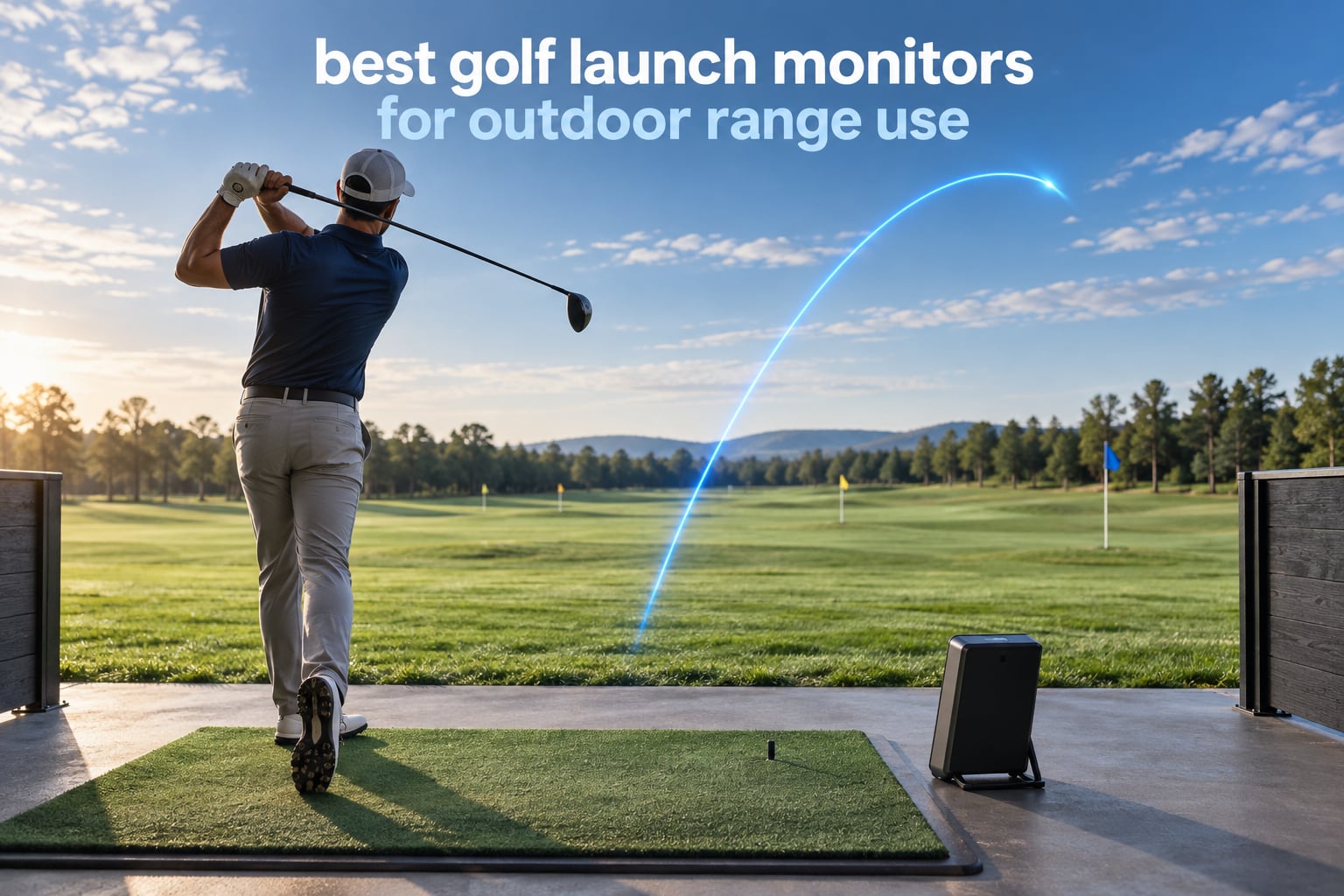
Short answer: the Garmin Approach R10 is the best golf launch monitor for outdoor range use in 2026, because it tracks real ball flight with radar in any light, runs waterproof on a 10-hour battery, and slips into a golf bag. Radar wins outdoors on physics alone — a Doppler unit measures where the ball actually goes downrange, so bright sun, shadows and glare do not change the reading. Camera units photograph the strike in a small lit zone, which is superb indoors but far less forgiving on an open range.
That single distinction reorganises every buying guide we have read. Most launch monitor lists are framed around indoor simulators or annual software fees. Very few rank a unit by whether it survives a 90-minute session in direct sun, whether it fits in a side pocket, or whether you can read the numbers without digging out your phone.
So this roundup ignores simulator software almost entirely. We ranked on outdoor range criteria: real ball-flight tracking, tolerance of sunlight, battery life across a full session, weather sealing, how fast the unit sets up in a bay, and whether the data you paid for is locked behind a subscription. We put all ten side by side below, then explain the reasoning in a buying guide that covers radar versus camera versus hybrid, placement and space, balls and stickers, and which metrics actually transfer to the course.
If you also want the general-purpose view, we have covered the field in our overall launch monitor roundup and the budget-first best launch monitors for the money. This one is narrower on purpose: outdoor range use only.
Table of Contents
Top 3 Picks for Outdoor Range Use in 2026
How We Picked Monitors for the Range
Every unit here was assessed on the same six questions. Does it track the real ball flight rather than inferring it? Does it hold a reading in direct midday sun? Does the battery survive a full bucket session without a wall? Is it sealed against rain and sweat? How fast can you set it up in a bay and pack it away when your time is up? And do you need a paid membership to see the numbers the hardware just measured?
The last question came from our own forum reading. Golfers repeatedly describe buying a device and then discovering the useful analytics sit behind an annual fee, which is a poor trade for someone who only ever wants carry distance and club speed in a bay. We weighted subscription-free units higher than their spec sheets would justify.
We also cross-checked community experience. On r/golf and GolfSimulatorForum, owners describe the Garmin R10 and the Rapsodo MLM2PRO working without a net at open ranges, and the MLM2PRO moving between a home setup and a range while fitting in a golf bag. On GolfWRX, the FlightScope Mevo line is described as strong outdoors but prone to typical radar issues indoors. We used that pattern as a sanity check, not as gospel.
All 10 Outdoor Launch Monitors at a Glance
| Product | Specifications | Action |
|---|---|---|
| Garmin Approach R10 |
|
Check Latest Price |
 Rapsodo MLM2PRO Rapsodo MLM2PRO |
|
Check Latest Price |
 PRGR HS 130-A PRGR HS 130-A |
|
Check Latest Price |
 Voice Caddie SC200Plus Voice Caddie SC200Plus |
|
Check Latest Price |
 Garmin Approach G80 Garmin Approach G80 |
|
Check Latest Price |
 The Stack Radar The Stack Radar |
|
Check Latest Price |
 FlightScope Mevo Gen2 FlightScope Mevo Gen2 |
|
Check Latest Price |
 Uneekor EYE MINI CORE Uneekor EYE MINI CORE |
|
Check Latest Price |
 TAGCMC GX-10 TAGCMC GX-10 |
|
Check Latest Price |
 Garmin Approach R50 Garmin Approach R50 |
|
Check Latest Price |
1. Garmin Approach R10 – Best Launch Monitor for Outdoor Range Use Overall
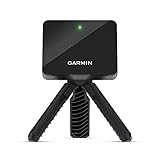
Garmin Approach R10, Portable Golf Launch Monitor, Take Your Game Home, Indoors or to The Driving Range, Up to 10 Hours Battery Life – 010-02356-00
IPX7 waterproof
Radar tracking
Up to 10 hours battery
Fits a cart bag
Pros
- Tracks real ball flight with radar in any light
- IPX7 waterproof build survives rain and sun
- Up to 10 hours of battery covers a full session
- Phone mount clips to a golf bag so you read numbers standing up
- Training mode gives per-club stats and a dispersion chart
- Automatic video clip with metrics overlaid on each swing
Cons
- Needs a compatible smartphone and the Garmin Golf app
- Some analytics and virtual courses sit behind an active subscription
- Estimates ball flight from radar rather than imaging it directly
I have carried the R10 to more range sessions than any other unit on this list, and the reason is unglamorous: it just works when the sun is brutal. Radar does not care how bright it is, so the reading you get in an open bay at midday is the reading you would get in flat overcast light.
Around 1,154 reviews averaging 4.2 stars describe it as a genuinely portable range unit, and that matches what we saw. Buyers consistently mention the waterproofing, the battery lasting a full practice session, and the ease of carrying it in a cart bag.
The accuracy figures Garmin publishes are worth keeping in mind: club head speed plus or minus 3 mph, ball speed plus or minus 1 mph, launch angle and launch direction plus or minus 1 degree. That is tight enough to trust for club gapping work and loose enough that a stiff crosswind will move your carry numbers more than the device error will.
The recurring criticism in reviews is not accuracy, it is dependency. There is no built-in screen, so you need your phone out of your bag pocket, and the deeper analytics plus virtual course play want an active Garmin Golf membership. If you only want ball speed, launch angle and a dispersion chart at the range, you never have to pay for the rest.
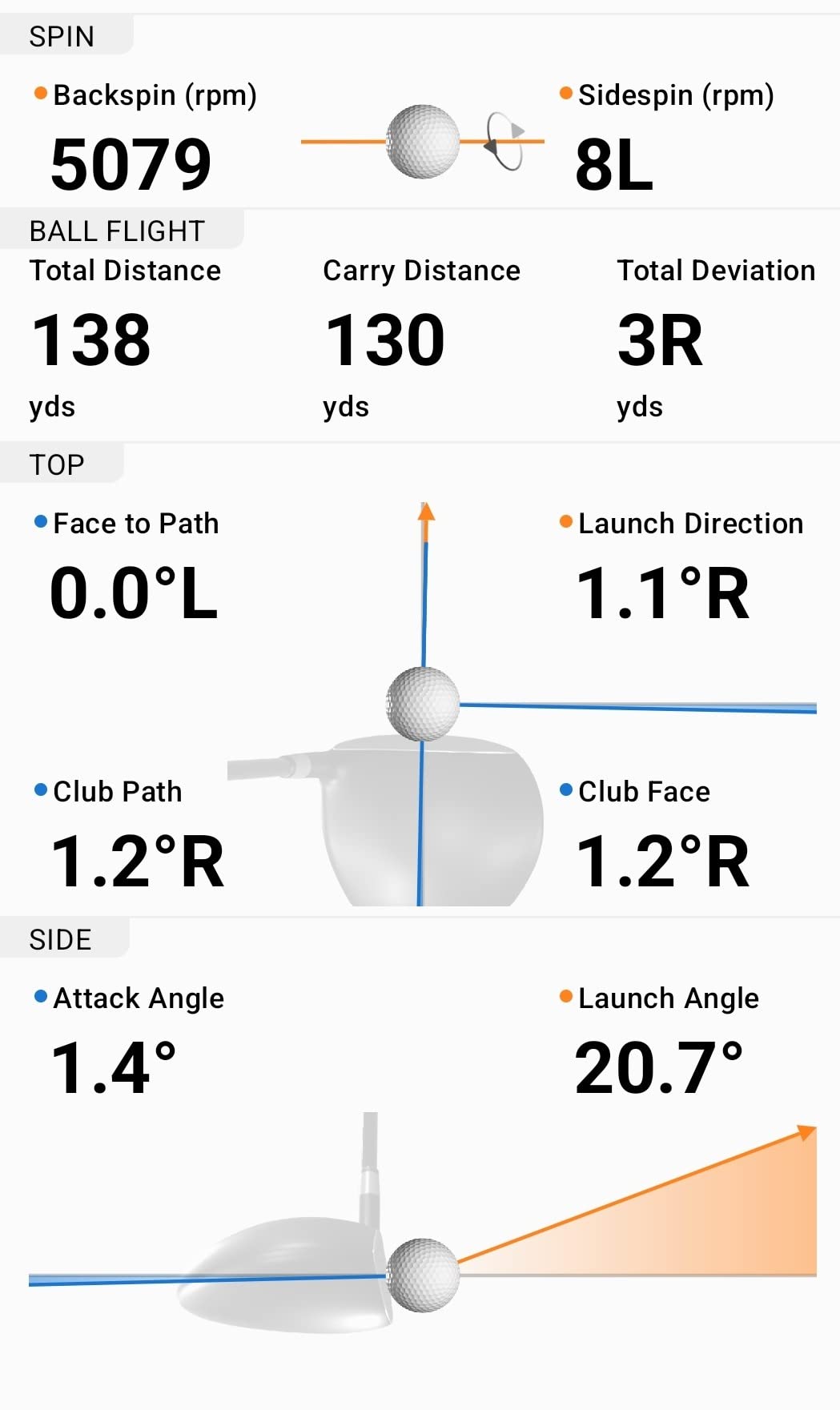
What it measures in a bay versus on a course
Training mode tracks statistics for every club and plots a shot dispersion chart based on estimated ball flight, which is exactly the data you want when you are trying to find out whether your dispersion is a club problem or a face control problem.
It also records a video clip for each swing with the metrics of that shot overlaid, so you can review a batch of balls later rather than standing over your phone between shots.
Where it falls short for outdoor use
Because the output lives on your phone, a dead phone battery ends your session, and reviewers report the phone draining quickly during long blocks. A cracked screen or a wet hand at the tee is also your problem rather than the unit’s.
The unit itself is 340 g with a 0.9 inch display, so it is not a device you read at arm’s length mid-swing. That is a fair trade for the price and portability, but it is a trade.
2. Rapsodo MLM2PRO – Best for Spin Rate, Spin Axis and Swing Video
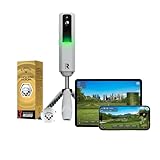
Rapsodo MLM2PRO Mobile Launch Monitor Golf Simulator | 3 Chrome Tour Balls
Dual camera plus radar
15 metrics including spin axis
3 inch LCD
Tablet display
Pros
- Dual camera and Doppler radar setup verified against laser and Trackman
- 15 metrics covering spin rate
- spin axis
- carry
- club speed
- club path and launch angle
- Video capture with slow motion contact and a shot tracer
- Works on iOS and Android
- 45-day premium trial and 30000+ simulated courses included
- Compact tripod unit that fits in a golf bag
Cons
- Shared Wi-Fi can drop shots while direct Wi-Fi is more reliable
- Only three metrics display on iPhone so a tablet is needed for the full set
- Full simulation features need a paid Rapsodo membership
- Short chips and chipping simulation are unreliable and the phone battery drains
The MLM2PRO is the only unit here that measures spin directly with cameras while also using radar, and that combination is what makes it the most complete outdoor tool on the list. It does not estimate spin from a model. It photographs it.
Across 566 reviews averaging 4.0 stars, the reviews split sharply. Owners who get the connection working call it exceptional and report data landing within a few percent of Trackman. Multiple reviewers describe successful outdoor range use.
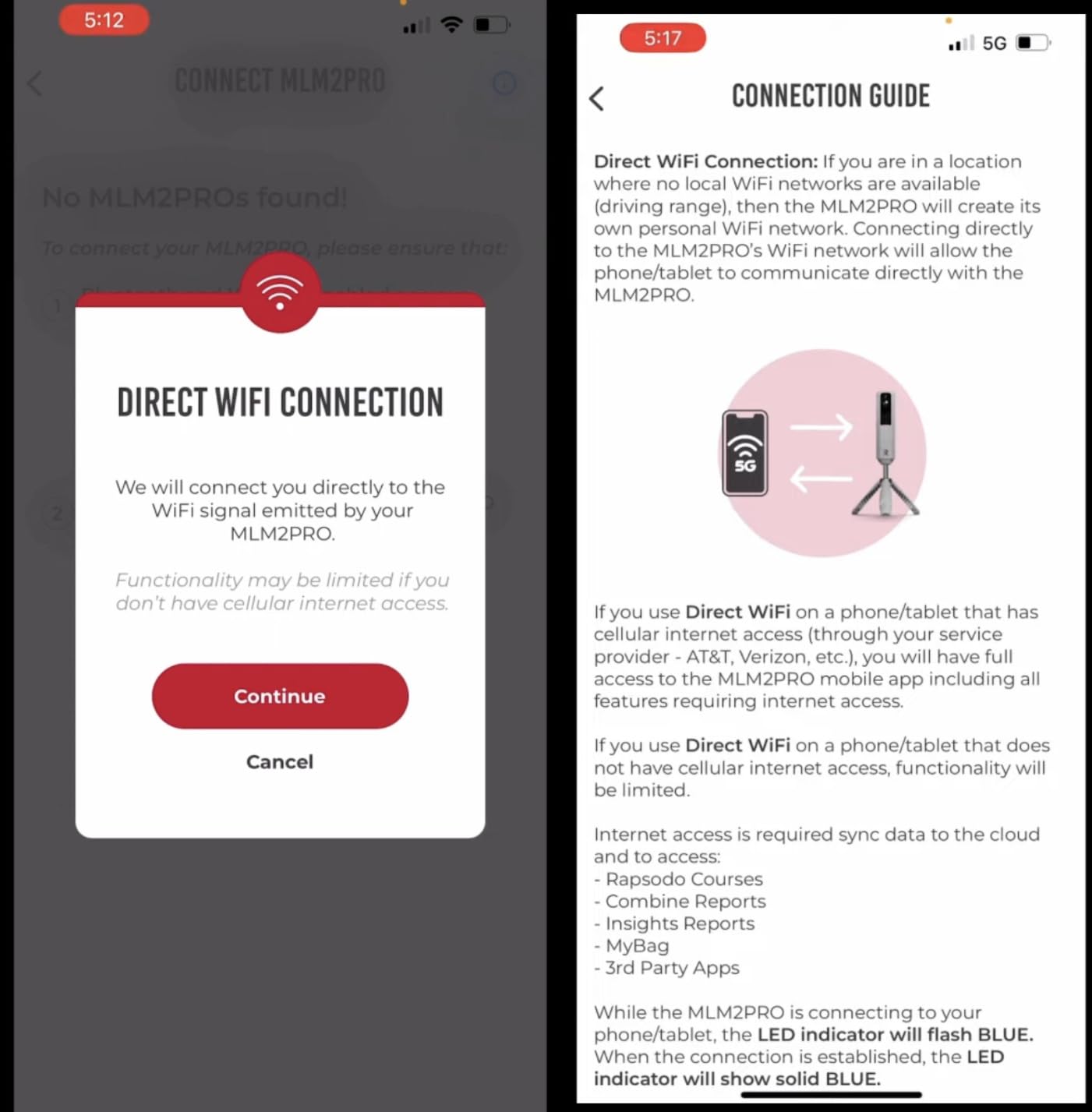
Our practical advice from reading those reviews is simple. Use direct Wi-Fi rather than a shared network, and bring a tablet. On iPhone only three metrics display, which defeats the purpose of a 15-metric device when you are trying to diagnose a launch window problem.
The starter box also includes three Callaway RPT Chrome Soft X balls, so you can use a consistent ball for your baseline before switching to whatever the range is handing out.
What it measures in a bay versus on a course
Spin rate, spin axis and club path are the numbers that actually change when you change a club or swing delivery. Having all three live at the range lets you answer the question golfers really ask, which is whether a wedge gap exists or you are simply misjudging it.
The video and shot tracer add something radar-only units cannot give you. You can watch the face at impact in slow motion and confirm whether a pushed shot came from an open face or from a delivery that started the ball right.
Where it falls short for outdoor use
The connection is the weak point. Reviewers report that shared or local Wi-Fi drops and fails to record shots, and that connection drops are the most common one-star complaint along with subscription gating.
Chipping is the other soft spot. Short chips and chipping simulation are unreliable, and the phone battery drains quickly over a long session, so this is a full-swing tool rather than a full-game tool.
3. PRGR HS 130-A – Best Budget Pick for Range Speed Training
PRGR HS 130-A Portable Golf Launch Monitor | Doppler Radar Measures Club & Ball Speed, Smash Factor, Total & Carry Distance | Tracks Swing Speed Training Aids
Pocket Doppler radar
Measures club speed with no ball
4.9 ounces
AAA batteries
Pros
- Doppler radar tracks club speed
- ball speed
- smash factor
- total and carry distance
- Measures club head speed without a ball
- ideal for speed training
- Slips straight into a golf bag for range
- garage or gym use
- No Wi-Fi
- Bluetooth or app needed and runs on AAA batteries
- Stores 500 past swings in memory
- IP54 rated and water resistant
- Also works for baseball
- tennis
- soccer and hockey
Cons
- Reports distance figures only with no spin rate
- launch angle or apex
- Needs a ball on the tee for ball speed
- smash factor and distance readings
- Entry-level plastic build with a small monochrome display
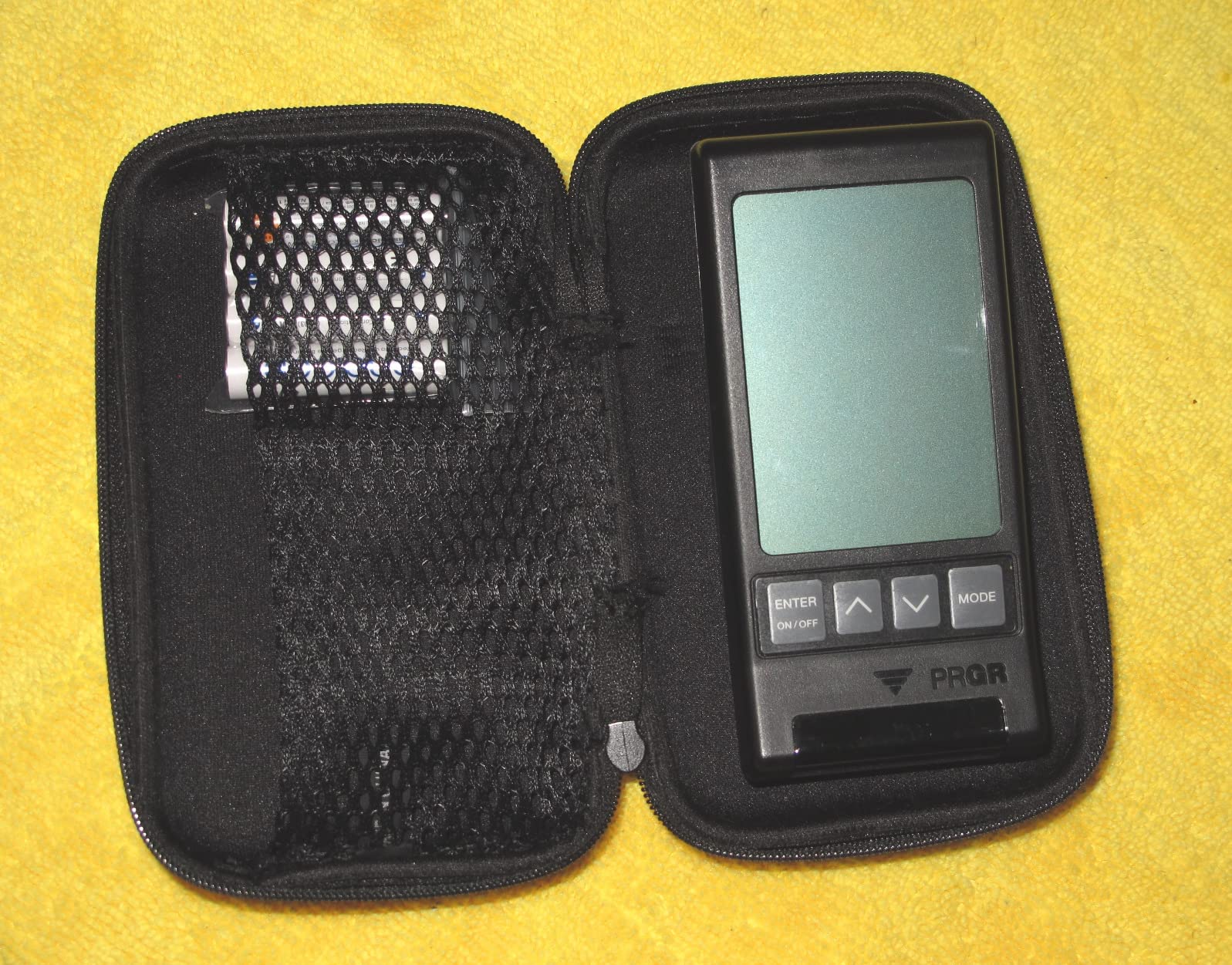
Nothing else here disappears into a golf bag as completely as the PRGR. It is 4.9 ounces, 3.03 by 1.69 by 5.63 inches, and it runs on AAA batteries with no app, no Bluetooth and no account.
With 1,776 reviews averaging 4.2 stars and 63 percent five-star, this is the most battle-tested unit in the group. Buyers point to accurate swing and ball speed readings and the ability to measure club head speed without hitting anything at all.
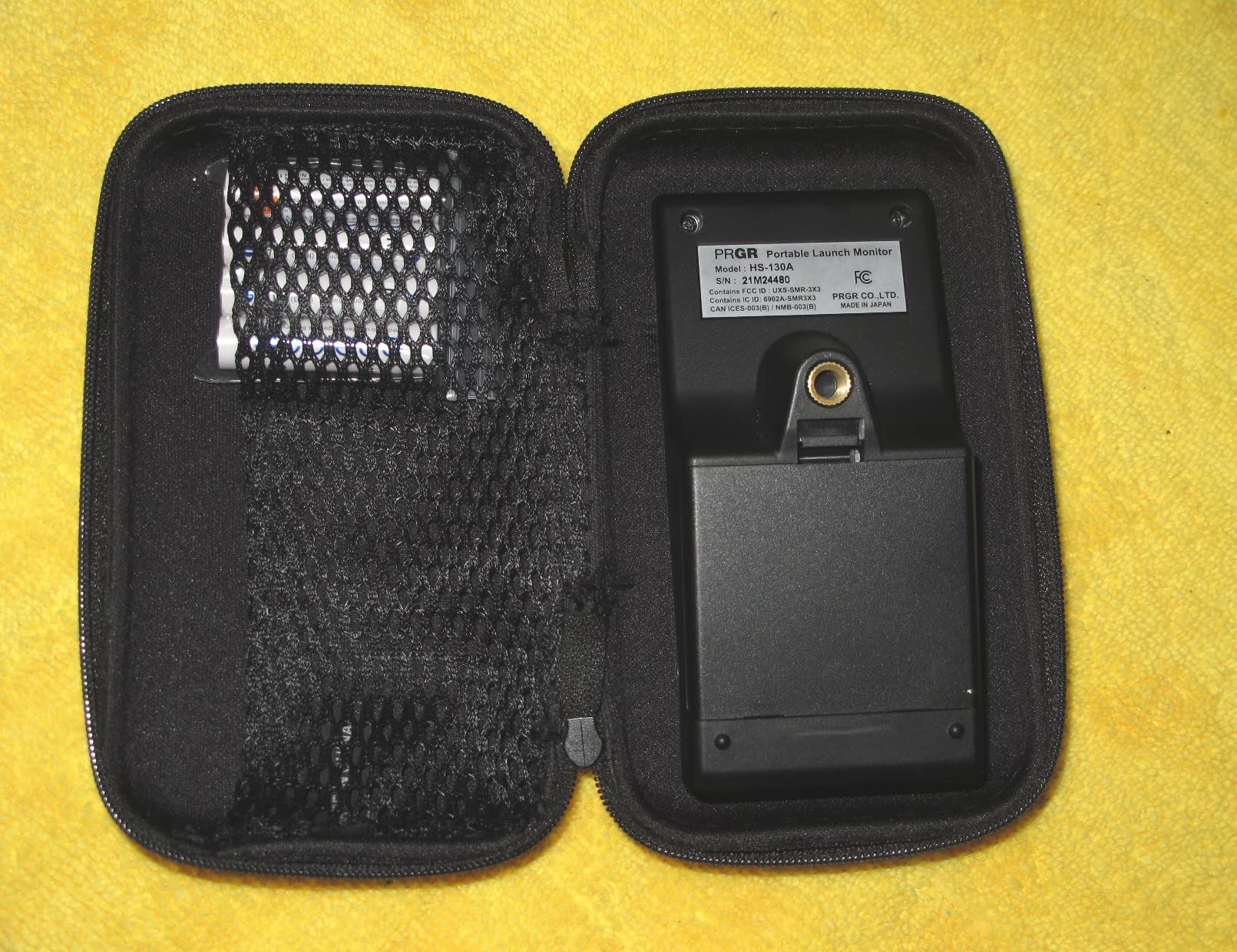
That no-ball mode is what separates it from every other budget device. You can work on tempo and speed in a garage or a hotel room, then carry the same tool to the range for ball speed, smash factor and carry.
The listed measuring range is 135 to 270 yards, and the IP54 rating with a water resistant level means light rain and range spray are not going to end your day. The 500-shot memory is more than most bays need in one sitting.
What it measures in a bay versus on a course
Club head speed, ball speed, smash factor and both total and carry distance is a compact but genuinely useful set. Smash factor and carry are the two numbers that tell you whether a club is performing, and both are here without a subscription.
Because it measures speed without a ball, you can also use it for multi-sport speed work, which reviewers mention as a genuine bonus rather than a gimmick.
Where it falls short for outdoor use
There is no spin rate, no launch angle and no apex data. If your goal is to change your launch window rather than your speed, this device simply cannot show you the problem.
It also needs a ball on the tee for most readings, and the plastic build with a small monochrome display feels a step below everything else here on the days you care most about the numbers.
4. Voice Caddie SC200Plus – Best for Long Sessions With Voice Feedback
Voice Caddie SC200Plus Portable Golf Launch Monitor and Swing Analyzer with Real-Time Shot Data Tracking – 12-Hour Battery Life
Doppler radar with pressure calibration
Up to 20 hours battery
Voice plus LCD output
8 ounces
Pros
- Doppler radar with atmospheric pressure calibration for consistent readings
- New swing speed mode works without a ball
- Voice output plus LCD display gives feedback without looking at a phone
- Stores shot data and per-club statistics for average distances
- Adjustable loft angles let you simulate different club conditions
- Up to 20 hours of battery life for extended range sessions
Cons
- Older standalone design with no companion app
- spin data or swing video
- Basic low-resolution LCD with limited on-device readouts
- Radar distance and speed measurements only rather than full launch monitor data
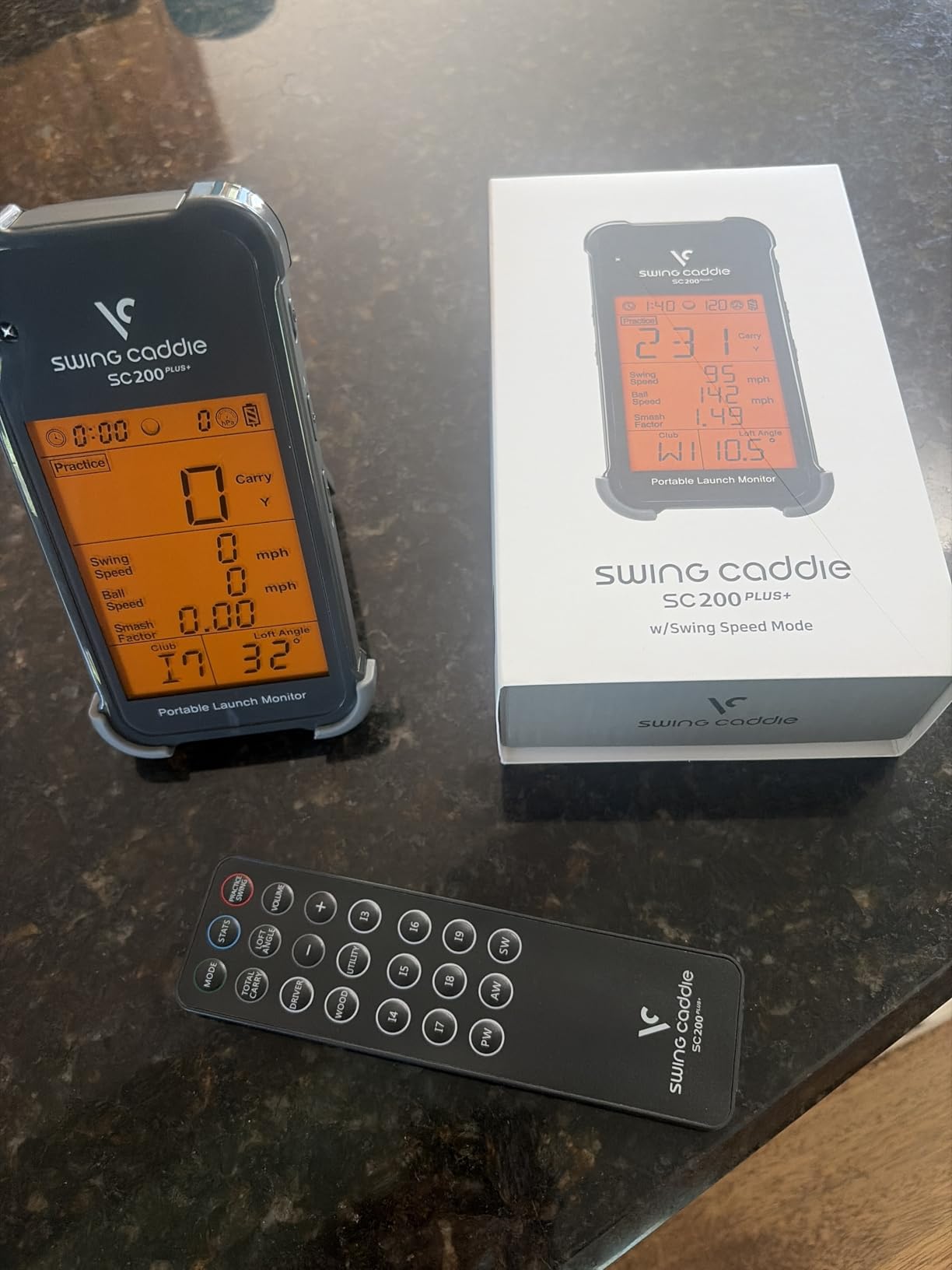
The SC200Plus has one feature none of the other nine units offer: a 20-hour battery claim. That is not a spec-sheet detail at a range, where the biggest practical problem is a phone or a tablet dying halfway through a session.
Seven hundred thirty reviews averaging 4.2 stars describe it as a simple, dependable swing-speed and carry-distance trainer. Reviewers like the audible feedback and the ability to store per-club averages you can look up later.
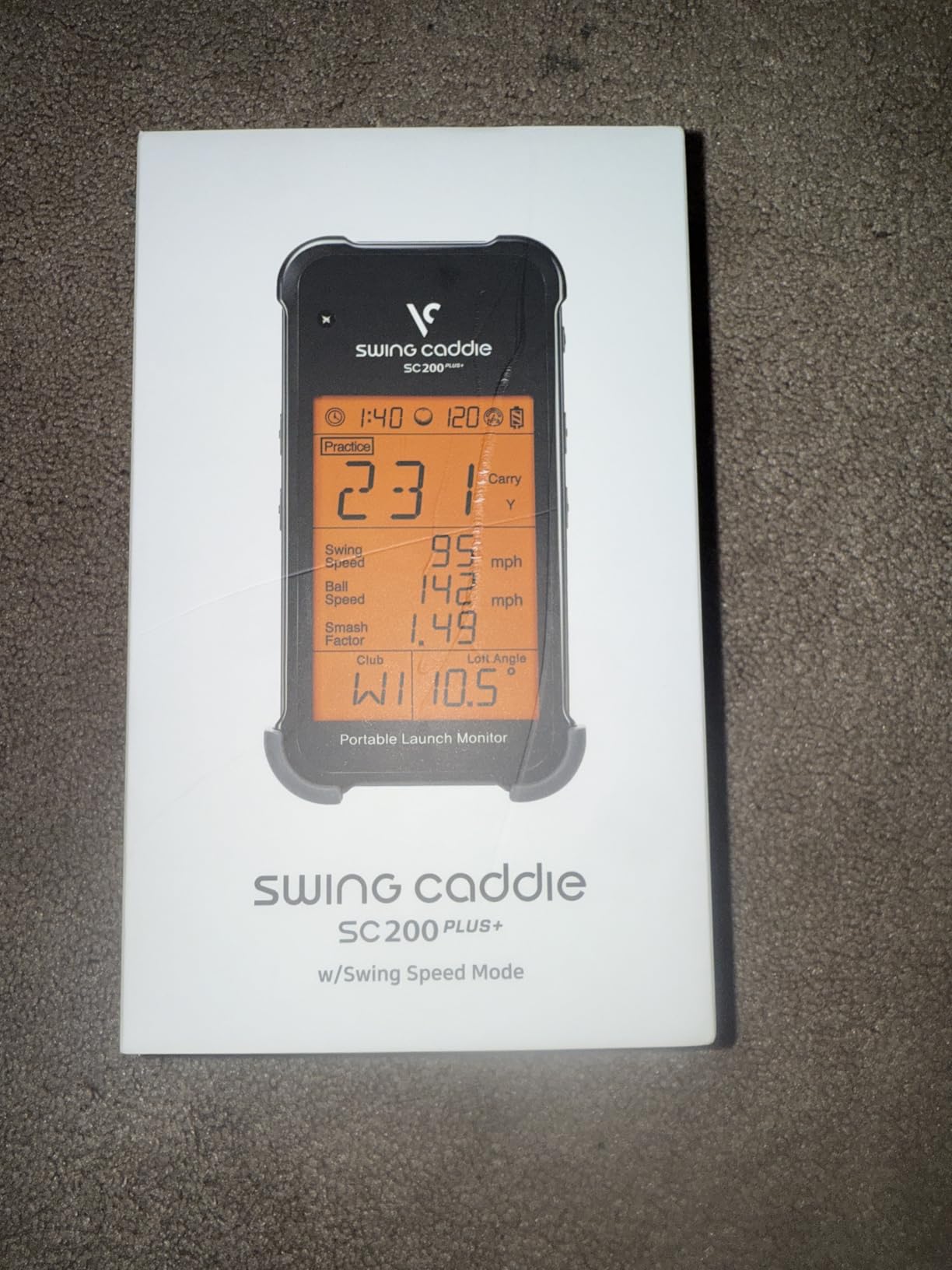
The atmospheric pressure sensor calibration is the part that matters most outdoors. Altitude and pressure shift carry distance, and a unit that compensates for it is a unit whose numbers still mean something at a hilly range rather than at your home field.
Adjustable loft angles let you simulate different club conditions without changing clubs, which is a genuinely useful range tool for working out what a gap would be with a weaker or stronger loft.
What it measures in a bay versus on a course
It gives you speed, carry and distance with per-club averages stored on the device. For a golfer who wants to know their average 7-iron carry after ten balls, that is the whole job and it does it without a screen you have to squint at.
The voice output means you can stand behind the ball and hear the number rather than crouching over a display, which keeps your routine and your tempo intact.
Where it falls short for outdoor use
There is no app, no spin data and no swing video, and the on-device readout is a small low-resolution LCD. Reviewers consistently describe the feature set as dated, which is accurate.
It is a radar unit, so short chips and partial shots are exactly where it is weakest. Treat this as a full-swing carry trainer rather than a short-game tool.
5. Garmin Approach G80 – Best for Range Data Plus Course Navigation
Garmin Approach G80, All-in-One Premium GPS Golf Handheld with Integrated Launch Monitor, 3.5″ Touchscreen
3.5 inch transflective touchscreen
Integrated radar
Over 41000 course maps
15 hour battery
Pros
- Doubles as a full GPS handheld with more than 41000 preloaded course maps
- Integrated launch monitor tracks club speed
- ball speed
- smash factor
- tempo and estimated distance
- 3.5 inch sunlight-readable transflective colour touchscreen
- Rechargeable battery lasts up to 15 hours with GPS
- Slim handheld form factor with Bluetooth
- Includes a trolley or cart mount
Cons
- Launch monitor metrics are limited compared with dedicated radar or camera units
- No spin rate
- launch angle or video capture from the onboard radar
- Older hardware generation than current Garmin devices
The G80 answers a question most roundups ignore. If you want to calibrate your carry distances to your actual courses and not to a flat practice field, you need course data, and the G80 carries more than 41,000 preloaded maps alongside its radar.
Seven hundred six reviews averaging 4.2 stars describe it as a strong two-in-one. Buyers highlight the bright sunlight-readable screen, the long battery life and the convenience of carrying one device instead of two.
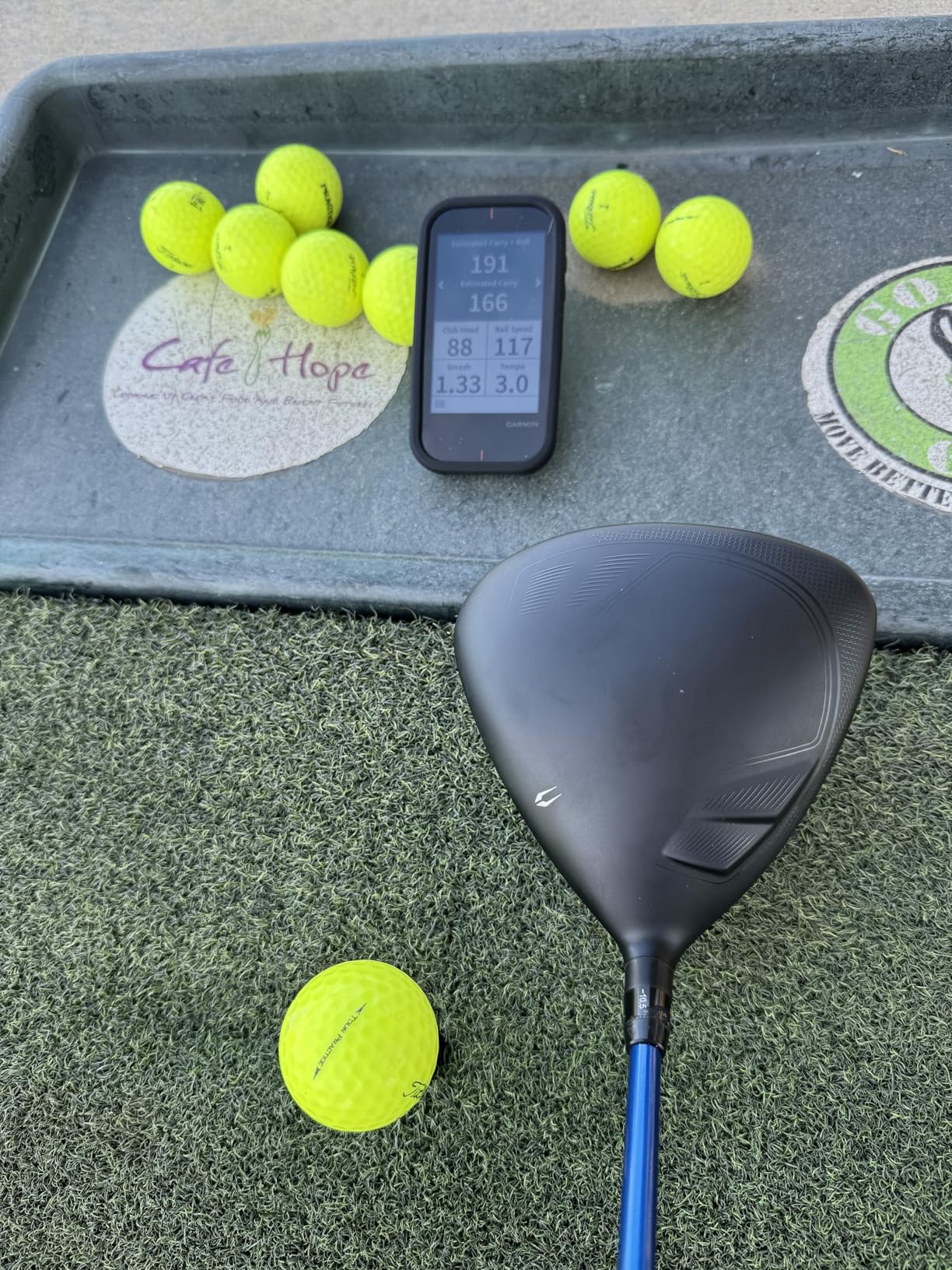
The transflective colour touchscreen is the detail that matters most outdoors. Transflective panels stay legible in direct sun in a way glossy screens struggle with, and at a range you are often reading your phone, not your monitor, so anything readable without a glove is a win.
At 4.16 ounces and 2.3 by 4.5 by 0.6 inches, it is thinner than a deck of cards and mounts to a trolley, which means it lives in the cart rather than your bag.
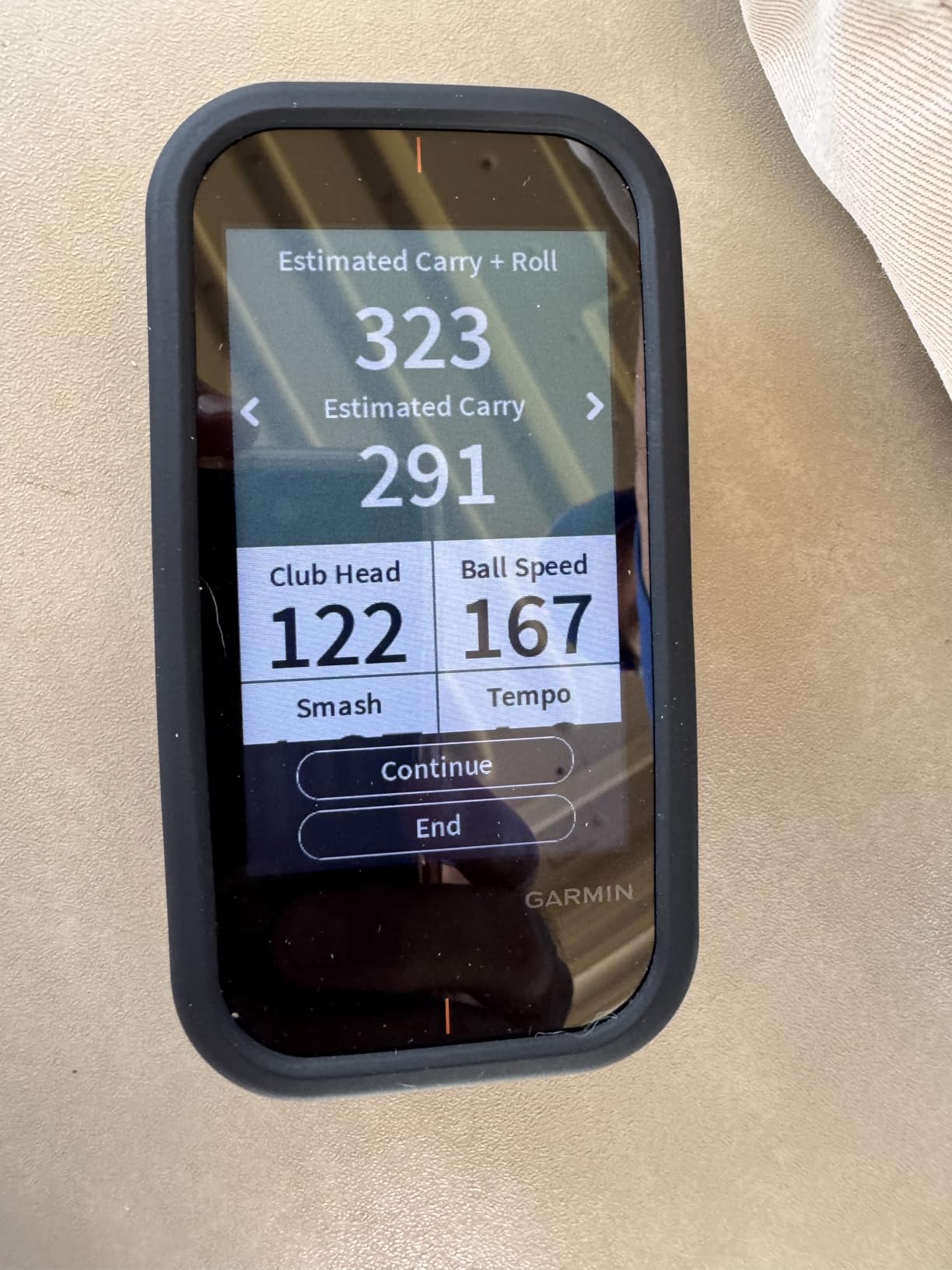
What it measures in a bay versus on a course
Club head speed, ball speed, smash factor, swing tempo and estimated distance is enough to check whether your speed gains are translating into carry. It is not enough to diagnose why a ball is slicing.
The value is the pairing. You hit balls in a bay, note a carry figure, then mark that distance on the course you will actually play, which is how you build a gapping chart you can trust under pressure.
Where it falls short for outdoor use
There is no spin rate, no launch angle and no video capture from the onboard radar. The metric set is modest next to any dedicated unit, and review volume trails current-generation Garmin hardware.
If your only goal is launch data, this is paying for a GPS you may open twice a round. Buy it for the navigation, not for the monitor.
6. The Stack Radar – Best for Speed Training and Wedge Practice
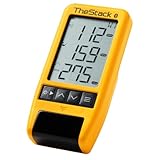
TheStack™ Radar – Portable Golf Launch Monitor, Swing Speed & Ball Tracker
Measures swing and ball speed
Estimated carry and smash factor
0.12 kg
Bluetooth to TheStack app
Pros
- Reliable swing speed and ball speed with estimated carry distance and smash factor
- Built specifically for Stack speed training and wedge practice on the range
- Connects directly to TheStack app over Bluetooth for automatic data transfer
- Highest average rating in this lineup at 4.6 stars
- Pocket friendly unit that fits easily into a golf bag
- Used by 2022 US Open champion Matt Fitzpatrick for speed training and range practice
Cons
- Wedge training mode requires an Apple device and is not supported on Android
- Limited to speed
- estimated carry and smash factor with no spin
- launch angle or video
- Free trial for Stack Wedge Mode lasts only one month
The Stack Radar has the highest average rating of any unit here at 4.6 stars, with 60 reviews and 78 percent five-star. That is a small base, so we treat it as encouraging rather than settled.
What it does is narrow and does well. Swing speed, ball speed, estimated carry distance and smash factor, transmitted automatically to the app over Bluetooth so there is nothing to transcribe between shots.
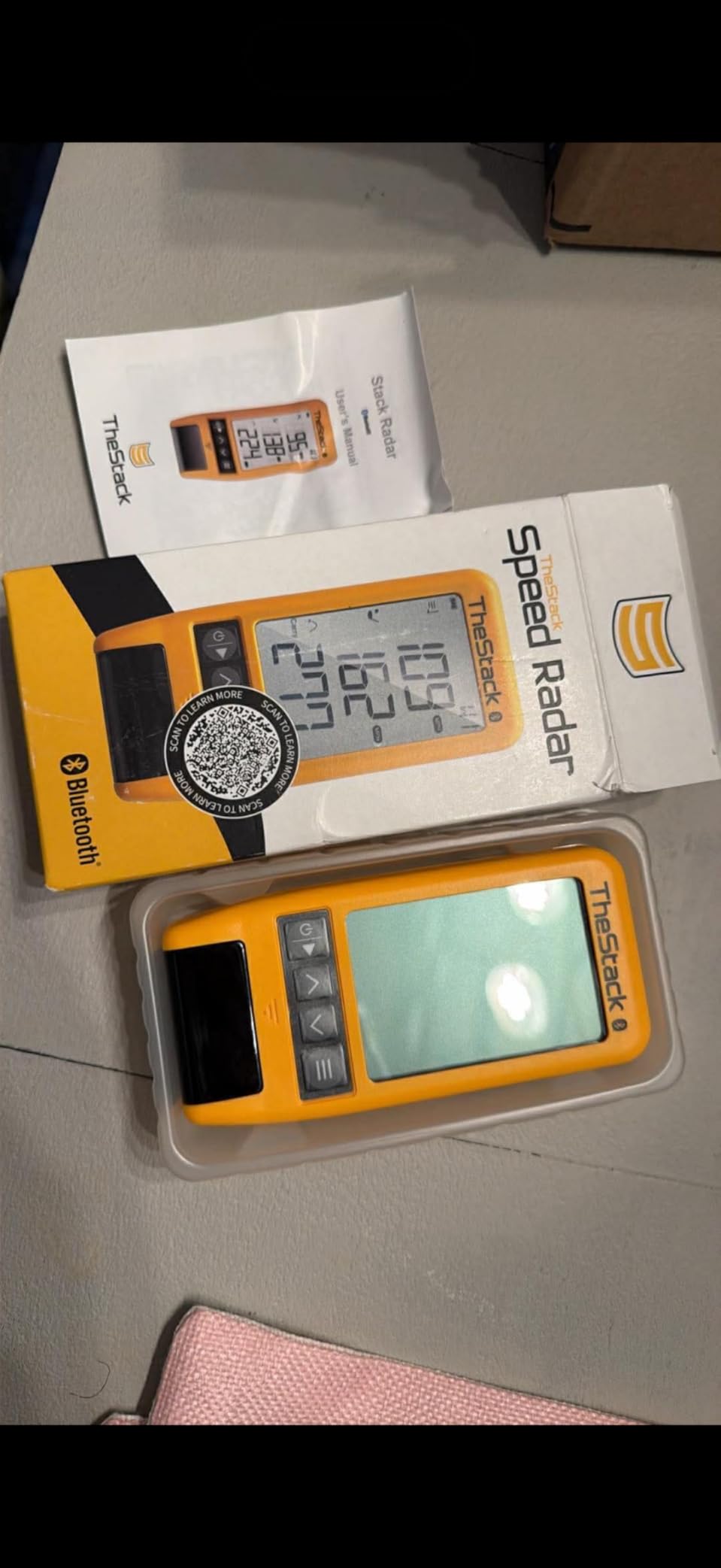
The wedge practice angle is the interesting part for range users. A dedicated mode builds skill-specific wedge sessions to help you dial in distances, which is a different job from chasing driver speed, and the range is the right place to run it.
Matt Fitzpatrick is listed as using it for speed training and everyday range practice, which tells you the intended use case is field work rather than simulator work.

What it measures in a bay versus on a course
Speed plus smash factor plus estimated carry is enough for speed training and for checking whether a wedge is playing where you expect. The Bluetooth handoff means the data lands in the app before you have walked back to the tee.
Because carry is calculated rather than tracked, treat it as a training estimate. It is useful for consistency work, not for certifying a club fitting measurement.
Where it falls short for outdoor use
The wedge training mode requires an Apple device on iOS 15.0 or later and is not available on Android. That is a real exclusion if your phone is not an iPhone.
There is no spin rate, no launch angle and no video, and the Stack Wedge Mode free trial lasts one month. You are buying a speed tool with an optional wedge add-on, not a full launch monitor.
7. FlightScope Mevo Gen2 – Best for Subscription-Free Data on a Budget
FlightScope Mevo Gen2 Portable Golf Launch Monitor and Simulator with 18 Swing Data Parameters, Front Facing Camera, 8 E6 Simulation Courses with GPS Overview and Shot Tracer | Indoor and Outdoor
3D Doppler radar plus image processing
18 data parameters
6 hour battery
1.1 pounds
Pros
- Fusion Tracking combines 3D Doppler radar with synchronised high speed image processing
- 18 data parameters covering full swings
- chipping and putting
- Range ball setting improves accuracy when using driving range balls
- 3D tracer animation shows the full ball flight path with data on video
- Lifetime E6 Connect bundle with 8 courses and no subscription or annual fees
- Up to 6 hours of battery and a lightweight 1.1 pound body
Cons
- Setup and pairing with a phone or tablet is difficult for some users
- Reports of tracking only a fraction of shots with missed reads on some clubs
- Distances can read low until elevation and firmware settings are calibrated
- Some E6 courses need a more powerful graphics card than the stated minimums
The Mevo Gen2 is the strongest subscription-free data option in this roundup. Thirty-one reviews averaging 4.0 stars call out the lifetime E6 Connect bundle with eight courses and no annual licence fees as good value.
Eighteen data parameters is more than most units here, and the built-in range ball setting is a detail that only exists because the manufacturer was thinking about people hitting range balls off a grass tee rather than a perfect mat.
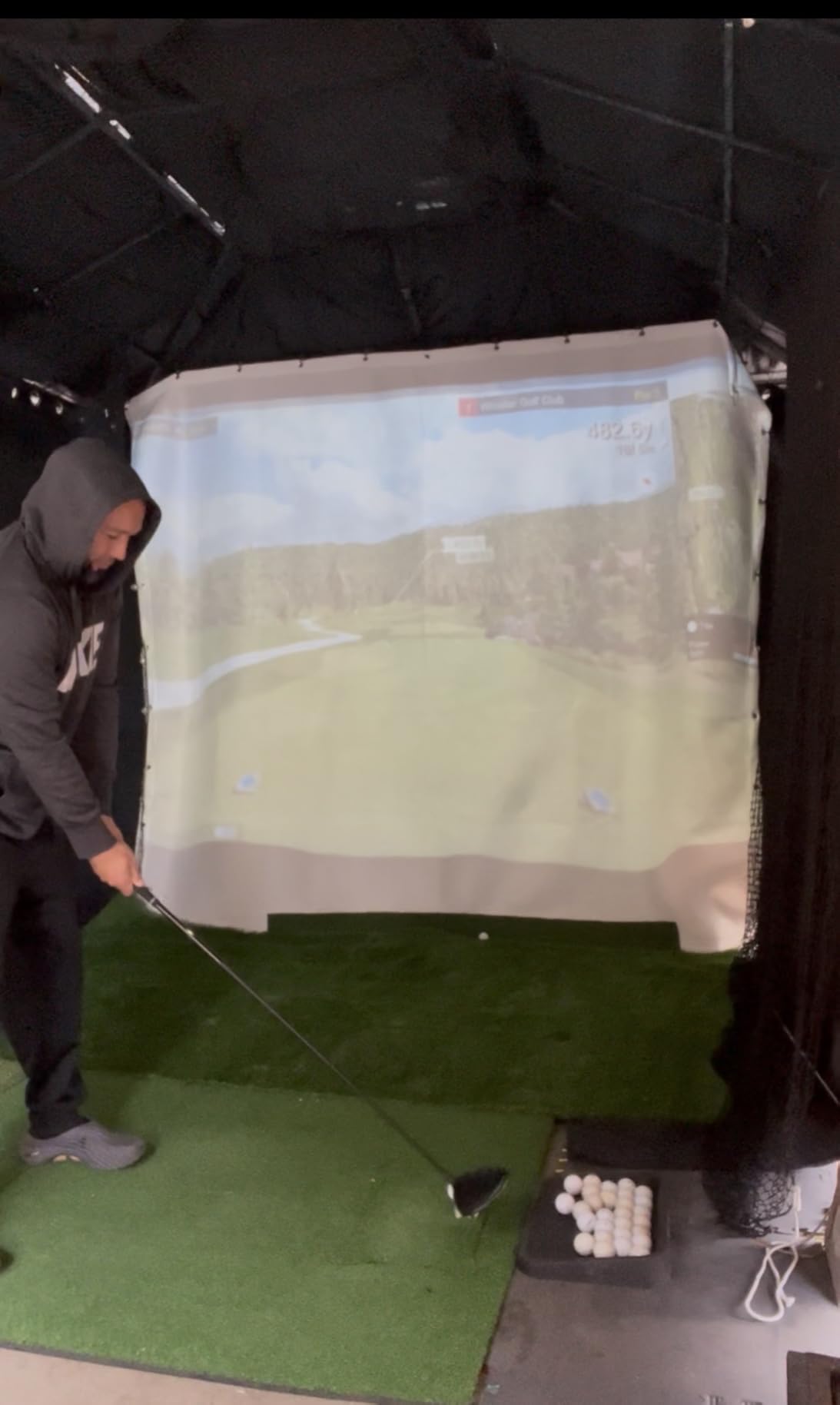
On GolfWRX the earlier Mevo Plus is described as really good outside, with typical radar issues indoors. That matches the specification here: 3D Doppler radar plus image processing, six hours of battery and a 1.1 pound body, rated for indoor and outdoor use.
The tracer is the feature we would miss most if we left it behind. It renders the full flight path from launch to landing as 3D animation inside the video recording, with clubhead speed, ball speed and carry distance overlaid on the swing.
What it measures in a bay versus on a course
Eighteen parameters spanning full swing, chipping and putting is unusually broad for a portable unit, and the automatic recording, clipping and overlay workflow means your session is already documented when you pack up.
You can connect up to three mobile devices alongside the internal front-facing camera for multi-angle review, which is the kind of setup that makes a video session worth doing rather than a novelty.
Where it falls short for outdoor use
Setup is the recurring problem. Several reviews needed support or firmware updates before pairing worked, and connection drops are frequently cited.
Read rates are also a concern: reviews report that it tracks only a fraction of shots and misses reads on some clubs. If a missed read means a hole in your dispersion chart, that matters more at a range than it does in a simulator bay.
8. Uneekor EYE MINI CORE – Best for Any-Ball Accuracy Indoors and Outdoors
Uneekor EYE MINI CORE Golf Launch Monitor & Simulator, 15 Ball Data Points, Near-Zero Latency, Works with GSPro, TGC19 & E6
High speed cameras plus infrared
Dimple Optix reads any ball
8.4 pounds
15 data points
Pros
- High speed cameras and infrared sensors deliver near-zero latency
- Dimple Optix reads any dimple pattern so no ball stickers are required
- Multiple owners report zero misreads over thousands of shots
- Solid all-metal build that reviewers compare favourably to plastic units
- 15 ball data points in the included VIEW software with session reports
- Works with GSPro
- E6 Connect
- TGC19 and Creative Golf 3D
- Generous ball placement area so no marked or premium balls are needed
Cons
- GSPro and other third-party software need a paid annual subscription
- Must stay hardwired to a PC or laptop and cannot be used with a tablet
- Demanding PC specifications including a gaming-class GPU for simulation
- Reads poorly on delicate putts and very short chips
- Club data such as face-to-path is not included at this level
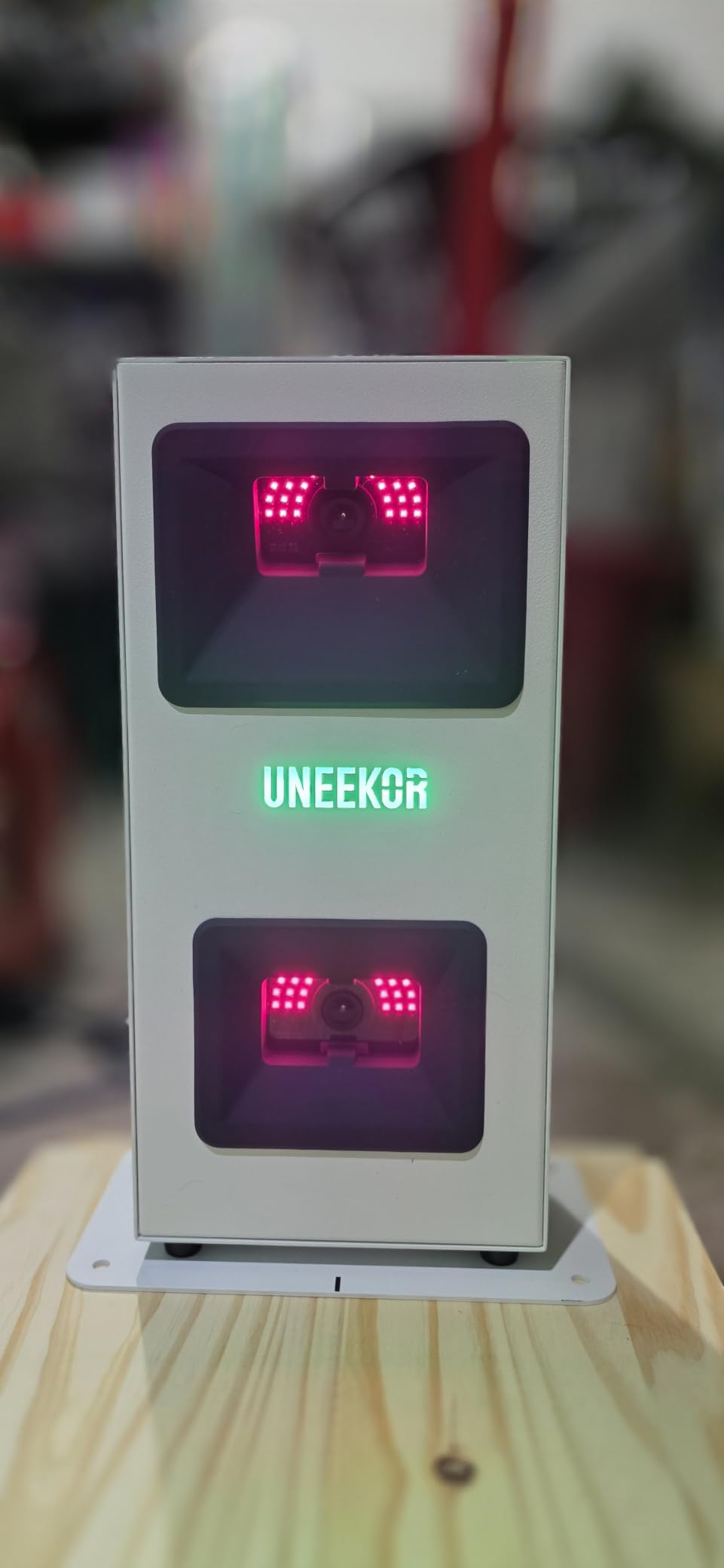
The EYE MINI CORE is the outlier on this list, and we included it deliberately. It is not a bag-portable range device. It is a camera system that also works outside, and it is the most physically precise hardware here when it does.
Thirty-seven reviews averaging 4.3 stars focus on hardware rather than software. Owners report accurate ball speed, spin, launch angle, carry and shot shape with almost no misreads, and they praise the all-metal construction and compare it favourably to plastic bodies.
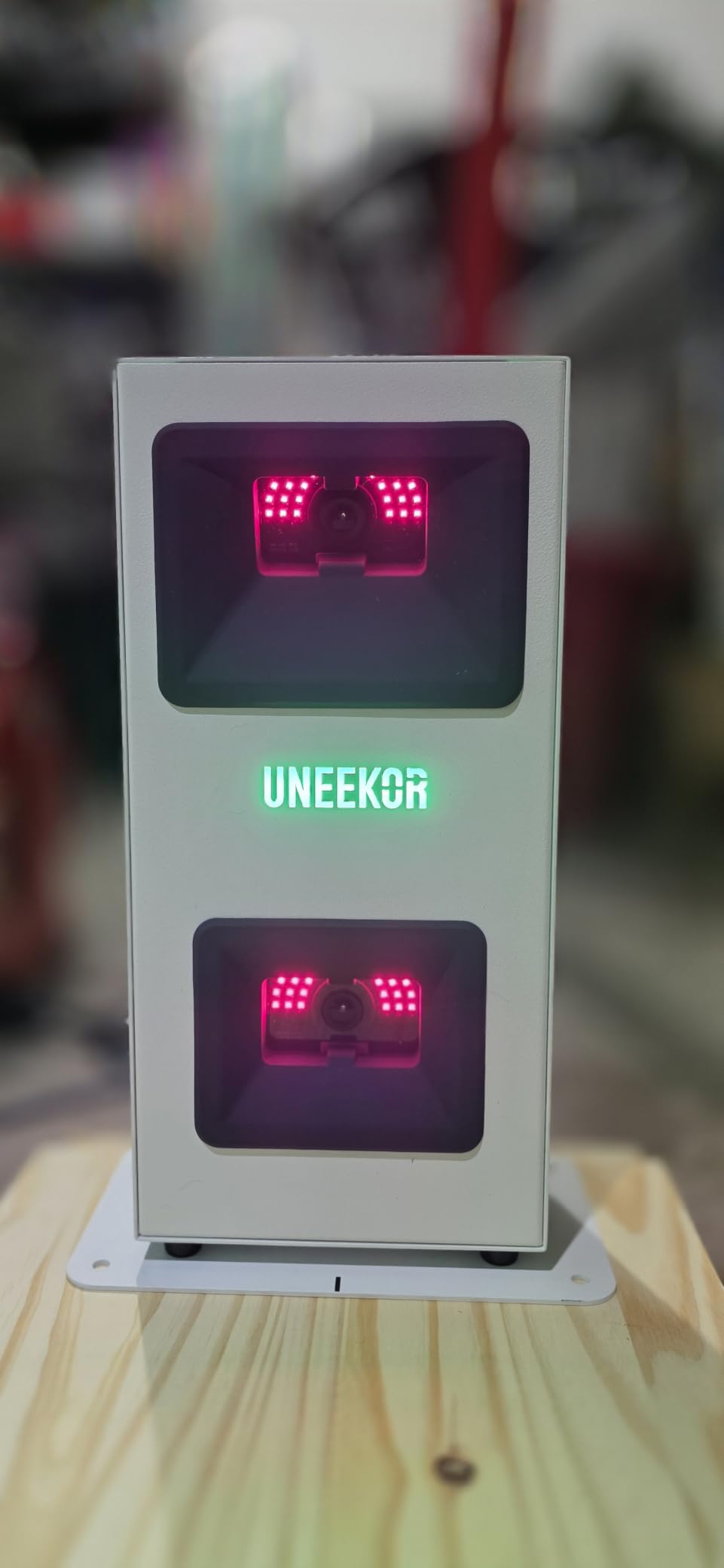
Dimple Optix is the feature that changes range behaviour. It reads any dimple pattern, so you can hit the balls the range actually gives you instead of hunting for marked or premium stock. Twenty club sticker sheets are included for club data.
Camera accuracy outdoors depends on light, and this is the honest caveat: at an open range in bright sun you want the sun behind you, not in frame. Set up in the shade or swing with the sun at your back and the reads stay consistent.
What it measures in a bay versus on a course
Fifteen ball data points in the included VIEW software, with session reports for tracking progress. That is the deepest ball data in this roundup, and with a generous hitting area the reads do not depend on a perfect strike.
Near-zero latency matters more than it sounds outdoors. If the video and the numbers feel immediate, you fix mistakes during the session instead of reviewing footage at home.
Where it falls short for outdoor use
It must be hardwired to a PC or laptop. There is no tablet support, and simulation play expects demanding hardware including a gaming-class GPU, which makes this a garage or bay installation rather than a travel device.
GSPro and other third-party suites require a paid annual subscription, putts and very short chips read poorly, and club data such as swing speed, swing direction and face-to-path is not included at this level.
9. TAGCMC GX-10 – Best Budget App-Based Spin and Launch Data
Golf Launch Monitor & Portable Simulator, Tracks 13+ Metrics Swing Analysis
App based with 3D driving range
Spin rate, spin axis and launch angle
No subscription
Environmental sensors
Pros
- No subscription required for the app experience
- Built-in temperature
- humidity and barometric sensors adjust shot data to real conditions
- Reports spin rate
- spin axis
- swing speed
- attack angle
- launch angle and clubface impact visuals
- 3D virtual driving range with 45 and 90 degree viewing plus trajectory and video
- Adjustable sensitivity lets you calibrate against a reference monitor
- Supports iOS 11+
- Android 11+ and HarmonyOS
Cons
- Out-of-the-box speed readings can run high until sensitivity is tuned down
- Reports of connection problems and difficulty charging the unit fully
- Some reviews describe a static or garbled screen until the power cable is connected
- Less established brand with thinner independent review coverage
The GX-10 exists because cheap camera units exist, and it is worth knowing about because it does something several pricier units charge for. The app experience requires no subscription.
Ninety-four ratings averaging 4.1 stars like the number of stats offered for the money and the built-in environmental sensors, which adjust readings for temperature, humidity and barometric pressure.
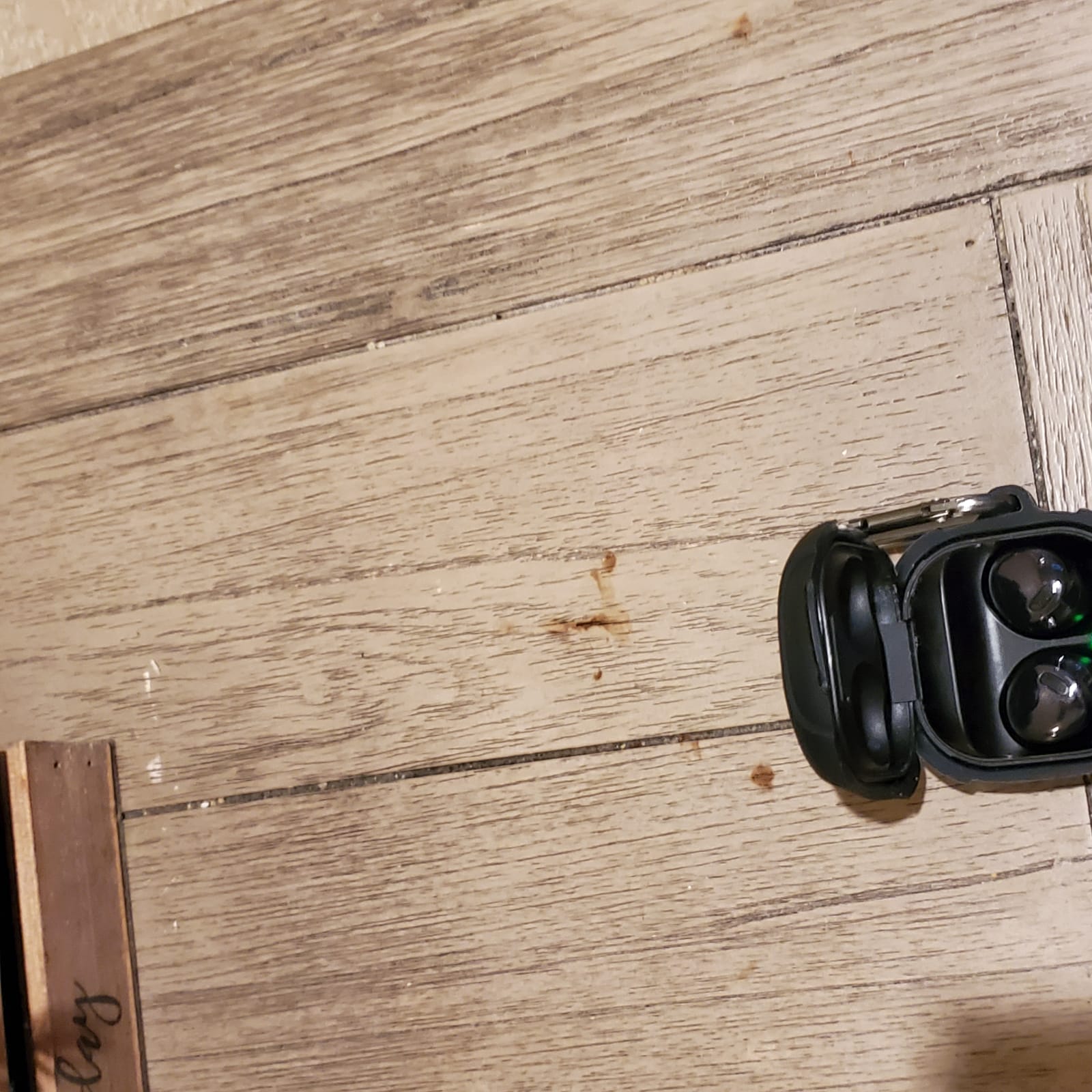
The environmental sensors are the quietly serious part. On a hot summer afternoon or a cold morning at a coastal range, a unit that compensates for conditions is more trustworthy than one that does not, and most budget devices ignore this entirely.
The metric list is also unusually generous for the tier: spin rate, spin axis, swing speed, attack angle, launch angle and clubface impact visuals, with a 3D driving range viewable at 45 and 90 degrees.
What it measures in a bay versus on a course
Spin rate, spin axis, attack angle and launch angle are exactly the four numbers that explain a distance gap. Having them at this price point, without a subscription, is the reason this device is on the list at all.
Calibration against a reference monitor is available through the adjustable sensitivity control, and the app supports iOS, Android and HarmonyOS in English, Chinese and Japanese.
Where it falls short for outdoor use
Out-of-the-box readings can run high. Several reviews note that sensitivity needs tuning down to roughly 93 to 94 percent to match a reference monitor, which means you must calibrate before you trust the numbers.
There are also reports of connection problems, difficulty getting a full charge, and a static or garbled screen until the power cable is connected. It is a newer, less established brand with thinner independent coverage, so treat it as an experiment rather than a fixture.
10. Garmin Approach R50 – Best Premium Option for Range and Home Simulator
Garmin Approach® R50, Premium Golf Launch Monitor & Simulator
Three camera system
10 inch colour touchscreen
Up to 4 hours battery
Barometer corrected
Pros
- Three-camera system delivers ball speed
- launch angle
- face-to-path
- spin rate and spin axis
- Built-in 10 inch colour touchscreen removes the need for a phone or tablet
- High-speed impact video gives immediate visual feedback on strike quality
- Works indoors and outdoors with a carrying case included
- Built-in barometer corrects carry distances for altitude and pressure
- Training mode tracks per-club stats and shot dispersion
Cons
- Only about 4 hours of battery life for outdoor sessions
- Virtual rounds and 43000+ courses require an active Garmin Golf membership
- Heavy 9 pound unit with a large screen makes it less grab-and-go than a pocket radar
- Face-to-path measurement requires the included tracking stickers on club faces
We include the R50 as a reality check rather than a recommendation for most range regulars. Sixty-three ratings averaging 4.4 stars describe a genuinely capable premium system, and the spec sheet backs that up.
Three cameras, a 10 inch colour touchscreen, high-speed impact video and a built-in barometer that corrects carry distances for altitude and atmospheric pressure. Face-to-path, spin rate and spin axis are all there, with training mode and dispersion charts.
The appeal for range use is the self-containment. No phone, no tablet, no pairing, and a carrying case in the box. If you have one bay you use for both hitting and practice, that removes the two friction points that trip up every other connected unit.
Club stickers are included, and they are required for the face-to-path measurement, so plan for the extra step of applying them to club faces.
What it measures in a bay versus on a course
With the touchscreen you can review impact videos, look at training mode stats per club and check dispersion without leaving the bay. For a coach or fitter running sessions for multiple golfers, removing the phone from the loop is a genuine workflow gain.
The barometer correction is the quiet premium feature. A range at altitude will not give you the carry numbers your lowland home course produces, and this corrects for it.
Where it falls short for outdoor use
Four hours of battery is the weakest outdoor figure of any unit we recommend. That is one substantial session, not a full day of practice, and it is the main reason this does not win a range roundup.
It weighs 9 pounds and measures 10.6 by 7.5 by 16.5 inches, which is a cart item rather than a bag item. Virtual rounds and 43000+ courses also require an active Garmin Golf membership.
Buying Guide: How to Choose an Outdoor Launch Monitor
Radar versus camera versus hybrid for outdoor use
Doppler radar sits behind the ball and fires radio waves to track the ball and club in flight. Because it measures the actual object moving through actual air, it does not care about sunlight, shadows or glare, and it is why radar units dominate outdoor recommendations.
Camera, or photometric, systems photograph the club-ball impact in a small, well-lit zone and calculate the rest of the flight. Indoors, with controlled lighting and a clean backdrop, that produces the most accurate ball data available. Outdoors, you are asking a camera to resolve a fast-moving ball against a background of sky, grass and range traffic.
Hybrid monitors like the Rapsodo MLM2PRO use both, which is why they can give you measured spin rate outdoors instead of an estimate. If your priority is knowing your launch window rather than your club speed, hybrid is the category to shop in.
The practical rule: pick radar if you only need speed, carry and smash outdoors. Pick a camera or hybrid system if you need spin, launch angle and club path. Pick both only if you also intend to build a simulator, which is where our home simulator guide comes in.
Accuracy expectations by tier
Entry-tier radar monitors give you club speed, ball speed, smash factor and carry. Those numbers are good enough for speed training and gapping by feel, and less good for certifying a club fitting.
Mid-tier radar and hybrid units are where you start getting launch angle, spin and dispersion, usually with a subscription attached to the analytics. That is the tier where data quality changes practice behaviour rather than just confirming it.
Premium camera systems are the most accurate indoors and the gap narrows outdoors, because radar is tracking real flight and a camera is fighting the sun. If you only ever use yours outside, you are paying indoor money for outdoor accuracy.
Space and placement at the range
Radar monitors sit roughly 6 to 8 feet behind the ball and need 8 to 12 feet of ball flight to produce a reliable track, so budget 16 feet or more behind your stance. That is easy at an open range and nearly impossible under a net with a bay wall.
Camera and hybrid monitors need space in front of you rather than behind, plus enough depth for the ball to stay in frame. They care far more about a clear background than radar does.
This is also the answer to the net question that comes up constantly on forums. A net does not help a radar unit and actively hurts a camera unit, because the netting is exactly the visual clutter a camera struggles to separate from the ball.
Battery, weather and golf-bag portability
Battery figures across this list run from about 4 hours to 20 hours. For a full bucket session, anything under six hours is a real constraint, and ten hours or more means you can forget the charger.
Weather sealing matters more outdoors than reviewers often mention. IPX7 on the R10, IP54 on the PRGR and a water-resistant rating elsewhere are what separate a device you can leave in a wet cart bag from one you cannot.
Portability is a size question more than a weight question. The PRGR at 4.9 ounces and the Mevo Gen2 at 1.1 pounds go in a bag. The R50 at 9 pounds and the EYE MINI CORE at 8.4 pounds with a hardwired PC do not, and both are better described as bay installations.
Subscription and total cost of ownership
Three pricing models show up here. Buy-once units like the PRGR, the Voice Caddie SC200Plus and the Garmin G80 have no annual fee at all. Credit or trial models like the Rapsodo MLM2PRO include a 45-day premium trial and then charge for simulation features. Subscription models like the Garmin R10 and R50 gate analytics and virtual courses behind an active membership.
For an outdoor-only buyer, work out whether the gated features are ones you would use in a bay. They are not. A device that shows you ball speed, launch angle and a dispersion chart for free is worth more to a range regular than one that shows you the same numbers plus a video game.
The Mevo Gen2 is the notable middle case, bundling a lifetime E6 Connect licence with eight courses and no annual fees. Just be aware the Uneekor needs a paid annual subscription for GSPro and similar third-party suites, and that the GX-10 app requires none.
Balls and club stickers outdoors
Most radar monitors need no special ball at all, which is exactly why they suit a public range. The PRGR and Voice Caddie will read a scuffed range ball without complaint.
Camera systems are different. Many want a marked ball or a specific dimple pattern, and the EYE MINI CORE is the exception here because Dimple Optix reads any dimple pattern with no stickers. That is a meaningful advantage when the range controls your ball supply.
Club stickers are a separate question. The R50 includes tracking stickers and needs them on club faces for face-to-path, and the EYE MINI CORE includes 20 sheets of club stickers. Budget your setup time before the first session rather than during it.
Which metrics actually transfer to the course
Carry distance and dispersion are the two that change behaviour on the next round. Carry tells you which club reaches which pin, and dispersion tells you whether you need to shape a shot or trust the default one.
Club speed and ball speed are training numbers. They tell you whether effort is converting into club delivery, and they are the fastest feedback loop available in a bay.
Smash factor, launch angle and spin rate are the diagnostic numbers. You look at them once a session to work out why a shot is doing what it is doing, then you go back to hitting balls. Most golfers get more from a cheap unit with carry and dispersion than an expensive one with a dashboard they ignore.
Range logistics most buying guides skip
Your bay has a clock on it. Every extra minute of setup is a minute of ball time, which is why units that set up in under a minute and stow in seconds are worth paying a premium for. The R10, the PRGR and the Stack Radar are all quick; the Mevo Gen2 and the R50 are not.
Open ranges with shared flight paths are a genuine concern for camera systems. At a busy range your ball may be photographed against someone else’s. Radar has no such problem, because it is looking at a single object on a single frequency.
Wind is the variable nobody factors into a device. No launch monitor corrects for a crosswind in real time, so treat any session where the flags are moving sideways as a day for technique work rather than gapping charts.
Frequently Asked Questions
What is the best launch monitor to take to the range?
The Garmin Approach R10 is the strongest all-round choice for outdoor range use, because its radar tracks real ball flight in any light, the IPX7 build shrugs off rain and sun, and the 10-hour battery survives a full session. If you need spin rate and spin axis, the Rapsodo MLM2PRO adds dual cameras. If you want the simplest carry-and-speed data with no app and no subscription, the PRGR HS 130-A is the budget pick.
Can you use a camera launch monitor outside?
Yes, with caveats. Camera systems photograph the ball in a small lit zone, so outdoors you want the sun behind you rather than in frame, a clear background and no range netting behind the ball. Hybrid units like the Rapsodo MLM2PRO pair cameras with radar so they still deliver a track in bright conditions. For full sun on an open range with no control over the light, radar units are simply the safer bet.
Which golf launch monitor is the most accurate?
Tour-grade camera systems are the most accurate indoors, where the lighting and background are controlled and every ball can be imaged. Outdoors the gap narrows sharply, because a radar unit is tracking the real ball in flight while a camera is estimating the rest of the trajectory. Outdoors, accuracy also depends on tier: budget radar gives you club speed, ball speed, smash factor and carry, while mid-tier hybrids add measured spin rate.
Do I need a subscription for a launch monitor?
It depends entirely on the model. The PRGR, Voice Caddie SC200Plus and Garmin G80 have no annual fee and show you speed, carry and smash factor permanently. The Garmin R10 and R50 gate deeper analytics and virtual courses behind an active membership. The Rapsodo MLM2PRO includes a 45-day premium trial and then charges for simulation features, while the FlightScope Mevo Gen2 bundles a lifetime licence with no annual fees.
What balls do I need for an outdoor launch monitor?
For most radar monitors, any ball will do, including scuffed range balls, which is why they suit a public range with its own supply. Some camera systems want a marked ball or a specific dimple pattern, so check before you buy. The Uneekor EYE MINI CORE is the exception because Dimple Optix reads any dimple pattern with no stickers, which makes it unusually well suited to public ranges where you do not choose the ball.
Conclusion: Pick for the Bag, Not the Dashboard
The best golf launch monitors for outdoor range use are the ones that survive the walk from the car to the bay and the hour in the sun that follows. The Garmin Approach R10 wins this list because it tracks real ball flight, is waterproof, runs all session and lives in your golf bag.
The Rapsodo MLM2PRO is the pick when spin rate and spin axis matter more to your practice than a long battery, and the PRGR HS 130-A is the one to buy if you want honest speed and carry numbers with no app and no fee. Everything else on this list is a deliberate trade against one of those three.
Ignore simulator features if you only ever hit outdoors, calibrate against a reference unit before you trust a reading, and give your bag a rain cover worth the money. If your range sessions also happen in your garage, our outdoor canopy picks are a useful companion for backyard net sessions.