
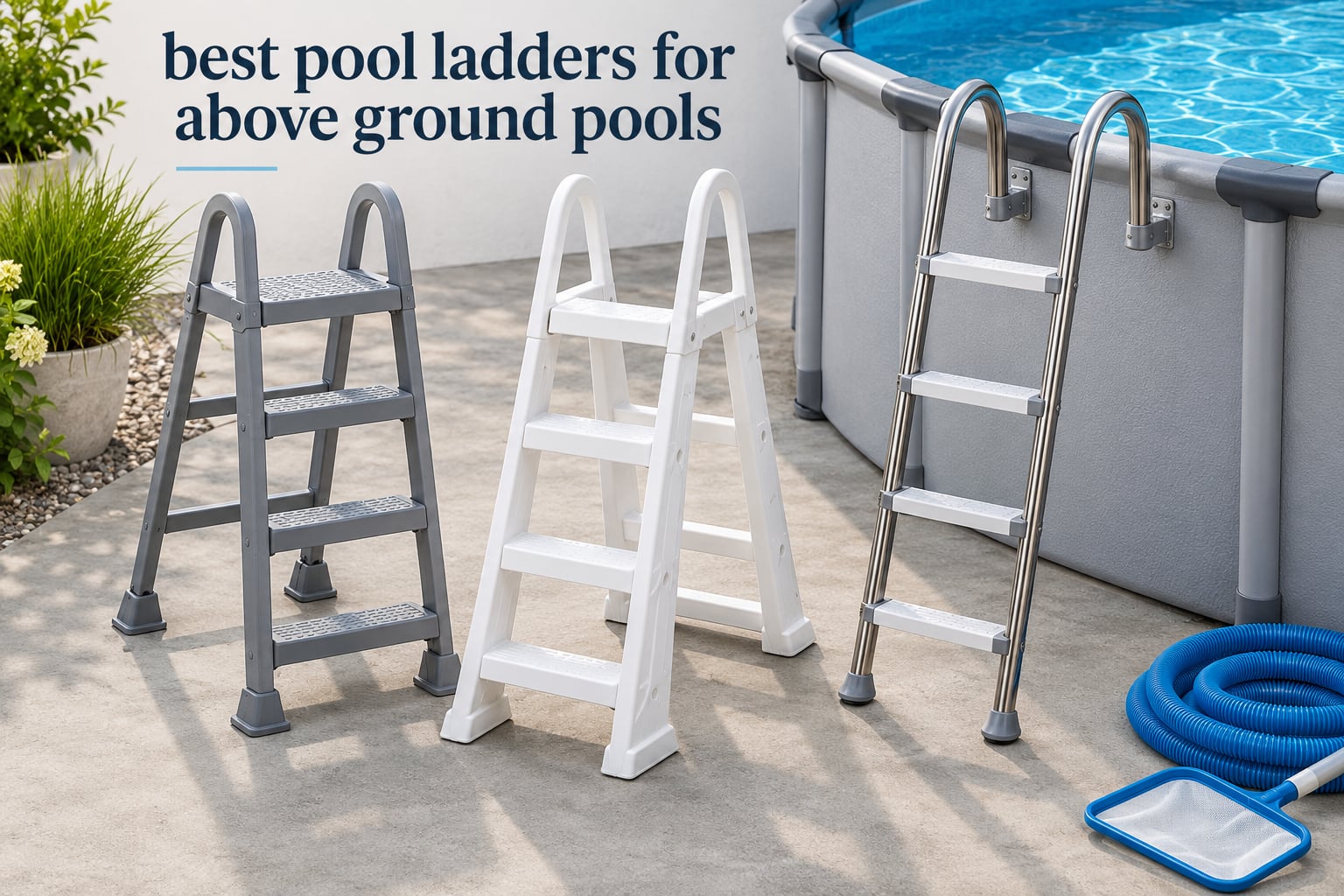
The ladder that ships inside the box with most above-ground pools is the single reason owners start shopping for a replacement. It is narrow, wobbly, made of thin plastic, and after two summers the treads crack and the frame softens. If you have ever tried to help a 70-year-old parent out of a factory ladder, you already know the whole setup is only as good as its entry point.
We spent weeks comparing the best pool ladders for above ground pools across three things that matter more than brand name: whether the ladder actually fits your pool wall, how it is stabilized in the water, and what happens to it after two full seasons of sun and chlorine. Everything below states the wall height range, the weight capacity and the material up front, because those three numbers decide whether a ladder works in your setup or becomes another return.
This roundup covers 12 ladders that span every common situation: freestanding A-frame ladders for pools with no deck, wide step units for anyone who wants to walk in rather than climb, and deck-mounted in-pool ladders for owners who built a deck around the pool. If you have not settled on a pool yet, start with our guide to the best above ground pools, then come back here to match the entry system to it.
Table of Contents
Top 3 Pool Ladders for Above Ground Pools
These three cover the widest range of households. The first is the safest default for a steel-frame pool with no deck, the second is the easiest entry of the group, and the third is the most direct replacement part on the market.

Confer 7200 Roll Guard A-Frame
- Fits 48-56 inch walls
- 300 lb capacity
- Lockable roll-guard barrier

Confer Step-1X Wide Step Unit
- 400 lb capacity
- 27-inch wide steps
- Dual handrails and slip-resistant treads

Bestway Flowclear 52 Inch
- Stainless steel frame
- 300 lb capacity
- Dual handrails and wide treads
Which Above Ground Pool Ladder Type Do You Need?
Match your situation to one of these five types before you look at any product page. Most buyer returns happen because the ladder type was wrong, not because the ladder was bad.
A-frame ladder
A-frame ladders straddle the pool wall with steps on both sides, so they work without a deck and can be walked around to whichever side has clearance. Look for a lockable or removable outer barrier if children use the pool, and check that the top rails are wide enough to clamp onto.
A-frame step unit
A step unit adds a wide stair inside the pool with handrails on both sides and a platform on deck. It is the easiest way to get a walk-in entry, and it suits anyone with knee, hip or back trouble who would struggle with narrow rungs. Expect to ballast it, because wide plastic steps float.
Wedding cake or freestanding interior steps
Wedding cake steps are the wide stair units sold as a complete entry system that sits against the wall with nothing on the outside. They take up more deck space than an A-frame and cost more, but nobody climbs over a ladder to get in. Our picks below cover this style with four-step units rated to 400 pounds.
Deck-mounted in-pool ladder
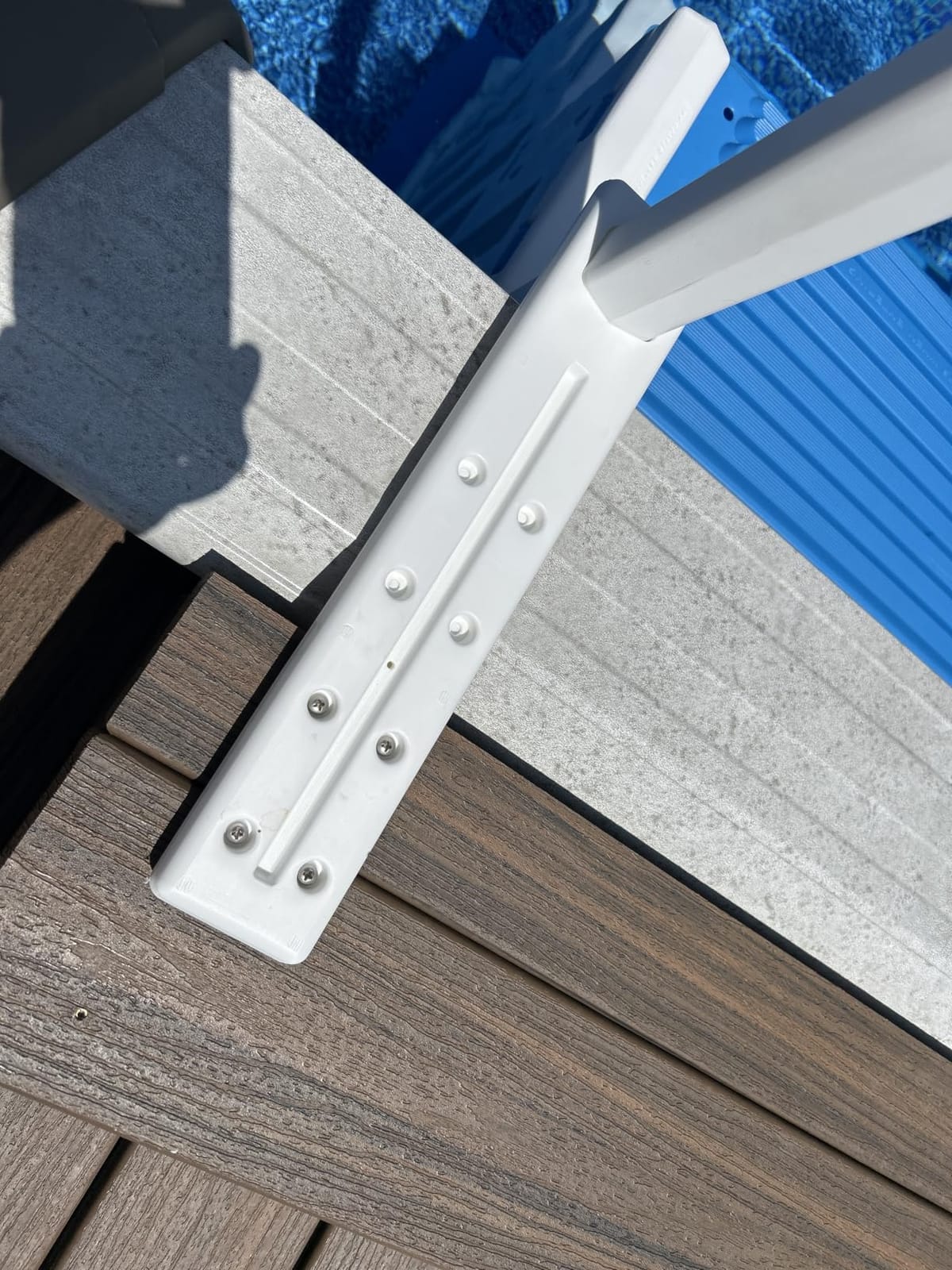
Deck-mounted ladders bolt to the deck through two flanges and only have steps inside the water. Nothing sits on your deck, no sand gets tracked indoors, and the ladder removes easily for winter. A 1.5 inch hole saw and a bit of drilling are usually required.
Removable seasonal ladder
If your pool goes up for a few months and comes down again, a lightweight steel ladder with removable steps is the practical answer. It clears the pool for winter storage and costs a fraction of a permanent system, at the price of a narrower tread and a lower capacity.
Short on wall height?
Owners of 42-inch shallow-wall pools keep hitting the same wall online: most heavy-duty ladders are listed for 48-inch walls and up. The workable answers for a 42-inch wall are a 42-inch steel ladder, the Funsicle 36-inch model for lower walls, and any ladder with a wide adjustment range such as the XtremepowerUS unit listed at 42.2 inches with a taller variant available.
All 12 Pool Ladders Compared for 2026
Every ladder below is listed with the same specs so you can scan for the one that matches your wall height and your household.
| Product | Specifications | Action |
|---|---|---|
| Confer 7200 Roll Guard A-Frame |
|
Check Latest Price |
| Confer Step-1X Wide Step Unit |
|
Check Latest Price |
 Confer 6000X In-Pool Ladder Confer 6000X In-Pool Ladder |
|
Check Latest Price |
| Bestway Flowclear 52 Inch |
|
Check Latest Price |
 Intex 28067E Entry Step Ladder Intex 28067E Entry Step Ladder |
|
Check Latest Price |
 XtremepowerUS 4-Step Entry System XtremepowerUS 4-Step Entry System |
|
Check Latest Price |
 Blue Wave Stainless In-Pool Ladder Blue Wave Stainless In-Pool Ladder |
|
Check Latest Price |
 Funsicle 36 Inch SureStep Funsicle 36 Inch SureStep |
|
Check Latest Price |
 Intex 28077E Removable Steps Ladder Intex 28077E Removable Steps Ladder |
|
Check Latest Price |
 VEVOR 5-Step Inclined Stair VEVOR 5-Step Inclined Stair |
|
Check Latest Price |
 UPHYB 4-Step Pool Stairs UPHYB 4-Step Pool Stairs |
|
Check Latest Price |
 WDOT A-Frame Safety Ladder WDOT A-Frame Safety Ladder |
|
Check Latest Price |
1. Confer Plastics 7200 Roll Guard A-Frame Ladder, 48-56 Inch Walls, 300 lb
Confer Plastics 7200 Roll Guard fits Above-Ground Pool Heights from 48″ to 56″ A Frame Safety Ladder for Above Ground Outdoor Patio Swimming Pool Platform Ladder with Step Barrier Warm Grey
Wall fit 48-56 in
Load rating 300 lb
Plastic, 56 lb unit
Pros
- Lockable roll-guard barrier with lock included
- Large 5 by 18 inch Comfortread steps
- Extra-large platform adds stability
- Attaches to the pool frame with no sand
Cons
- Steel-frame pools only
- Two-step design is minimal for limited mobility
- In-pool conversion needs a separate kit
This is the ladder we keep coming back to because it solves the two problems owners complain about most: children climbing in behind the ladder, and rails that feel like they will flex under an adult. It fits above-ground pool walls from 48 to 56 inches, carries a 300 pound rating, and ships with a lock for the roll-guard barrier.
The steps are the reason it feels solid. Each tread measures 5 inches by 18 inches, which is a genuinely wide surface for wet feet, and the extra-large platform means you are not stepping straight off the top tread onto the deck. It also mounts directly to the pool frame, so you are not carrying sand across the yard to keep it upright.
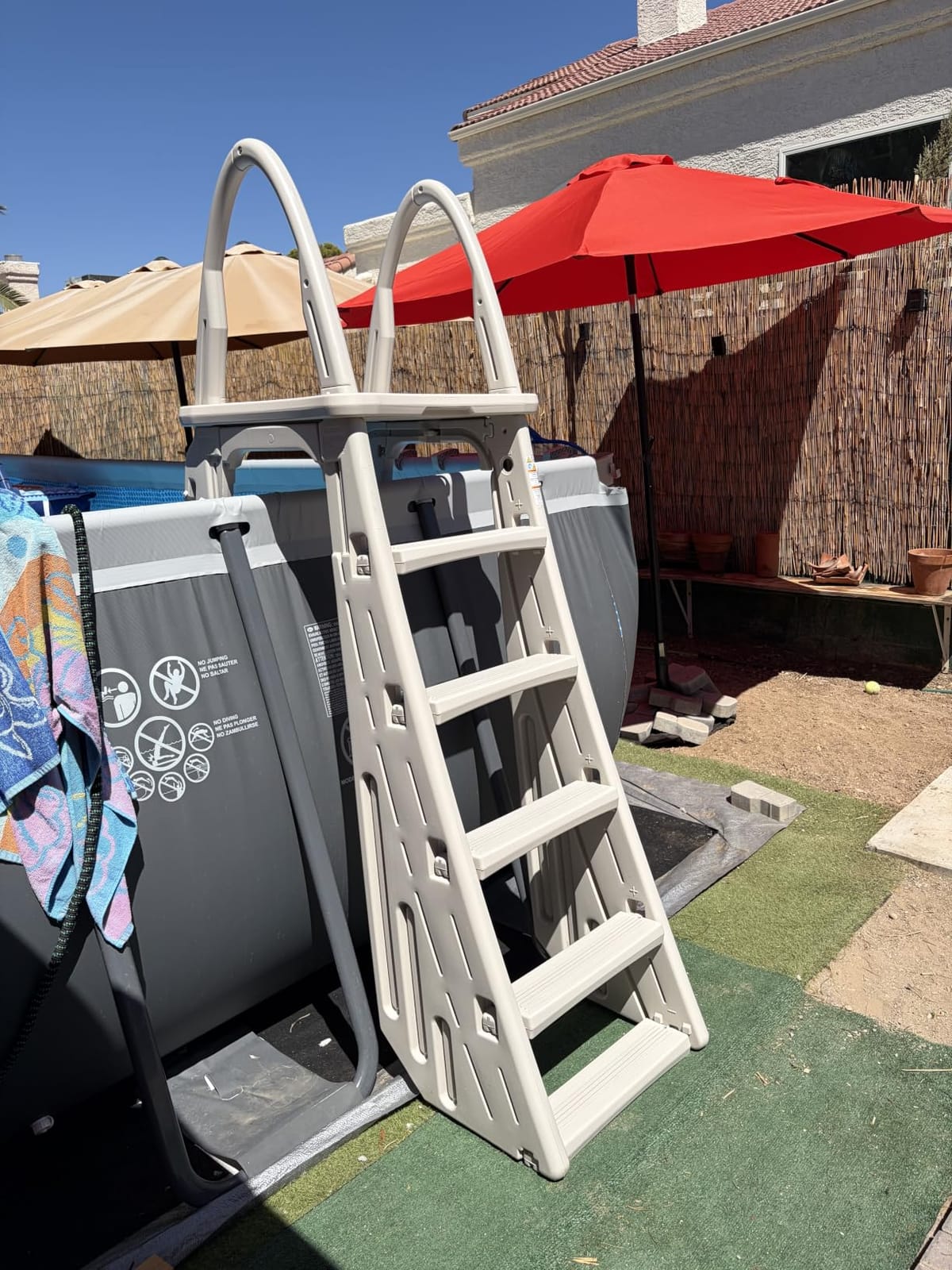
About 5,000 buyers have rated it, and the pattern in those reviews is remarkably consistent. People who upgraded from a factory ladder describe it as much more stable, and the barrier plus the integrated inner side rails are the feature cited most often when a household has young children.
We did notice that at 56 pounds it is a two-person carry, and that the two-step inner section is minimal compared with a stair system if someone in the house has limited mobility. If you want an in-pool position later, the CK7200 conversion kit handles that, sold separately.
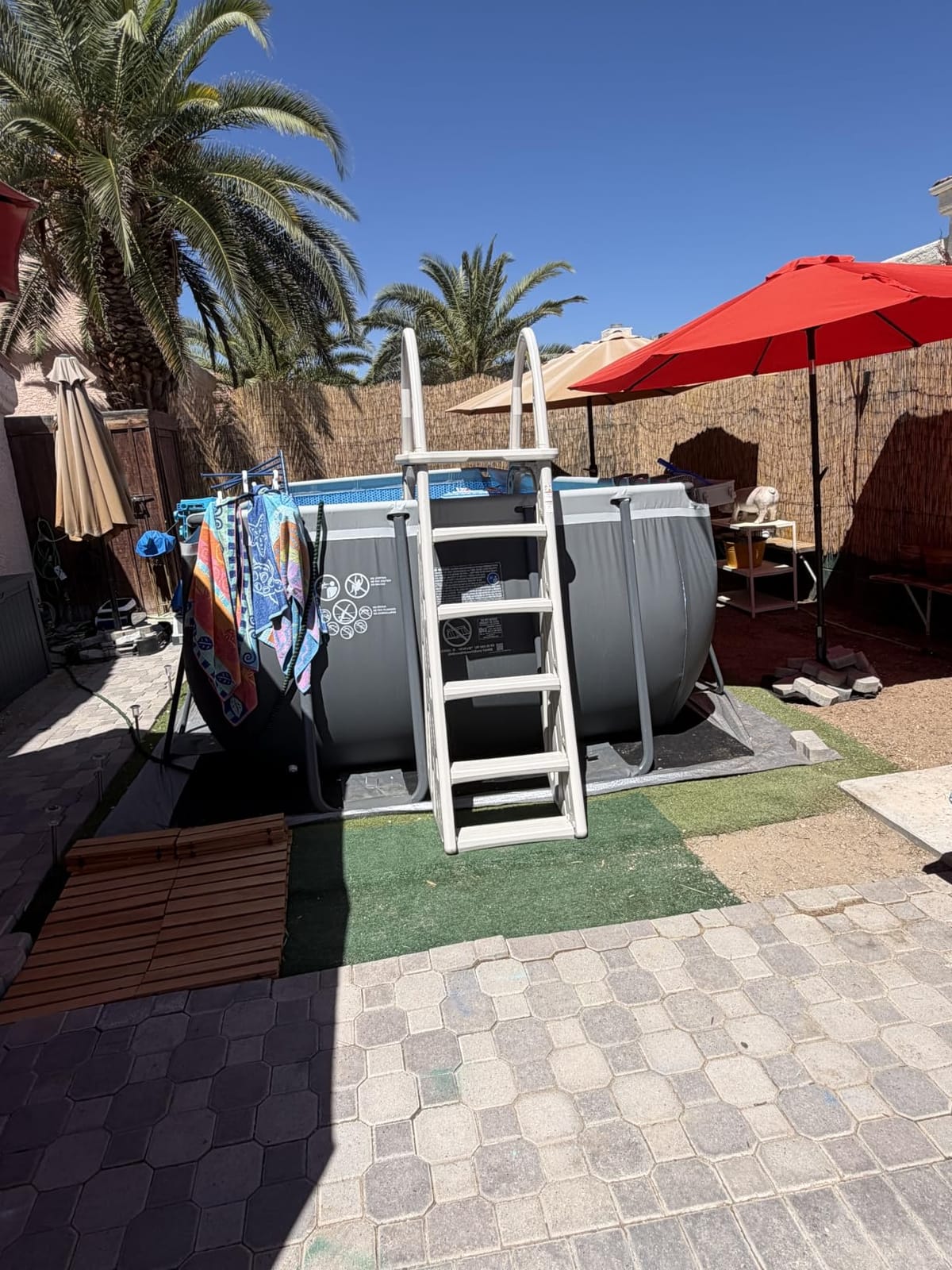
How it handles a deck or no deck
This ladder is built for a pool with no deck. Its A-frame legs straddle the pool wall and stand on the ground, so it needs clearance on both sides of the wall and roughly 22 inches of space along the rail. Owners with a deck that sits tight against the pool wall should look at a deck-mounted unit instead.
What to check before you buy
Two things: your pool top rail width and your pool frame material. The clamps are rated for top rails up to 14 inches wide, and the ladder does not attach to soft-sided or inflatable pools at all. Measure the wall height at the rail rather than trusting the pool’s advertised size, because that is where mismatches come from.
2. Confer Plastics Step-1X Wide Step Unit, 400 lb, 27-Inch Steps
Confer Plastics Step-1X: Sturdy Above Ground Entry System with Dual Handrails and Slip-Resistant Steps, Easy Installation, Supports up to 400 lbs – Proudly Made in USA. Warm Grey with Grey Treads
Wall fit up to 60 in
Load rating 400 lb
Plastic, 26 lb unit
Pros
- 400 lb rating for heavier adults
- 27-inch wide steps
- Dual handrails with slip-resistant nubby treads
- Easy snap-together assembly
- Narrow profile eases vacuuming
Cons
- Floats a couple of inches without ballast
- Sand can leak from fill ports
- Handrails are for balance only
- Hard to lift out when fully filled
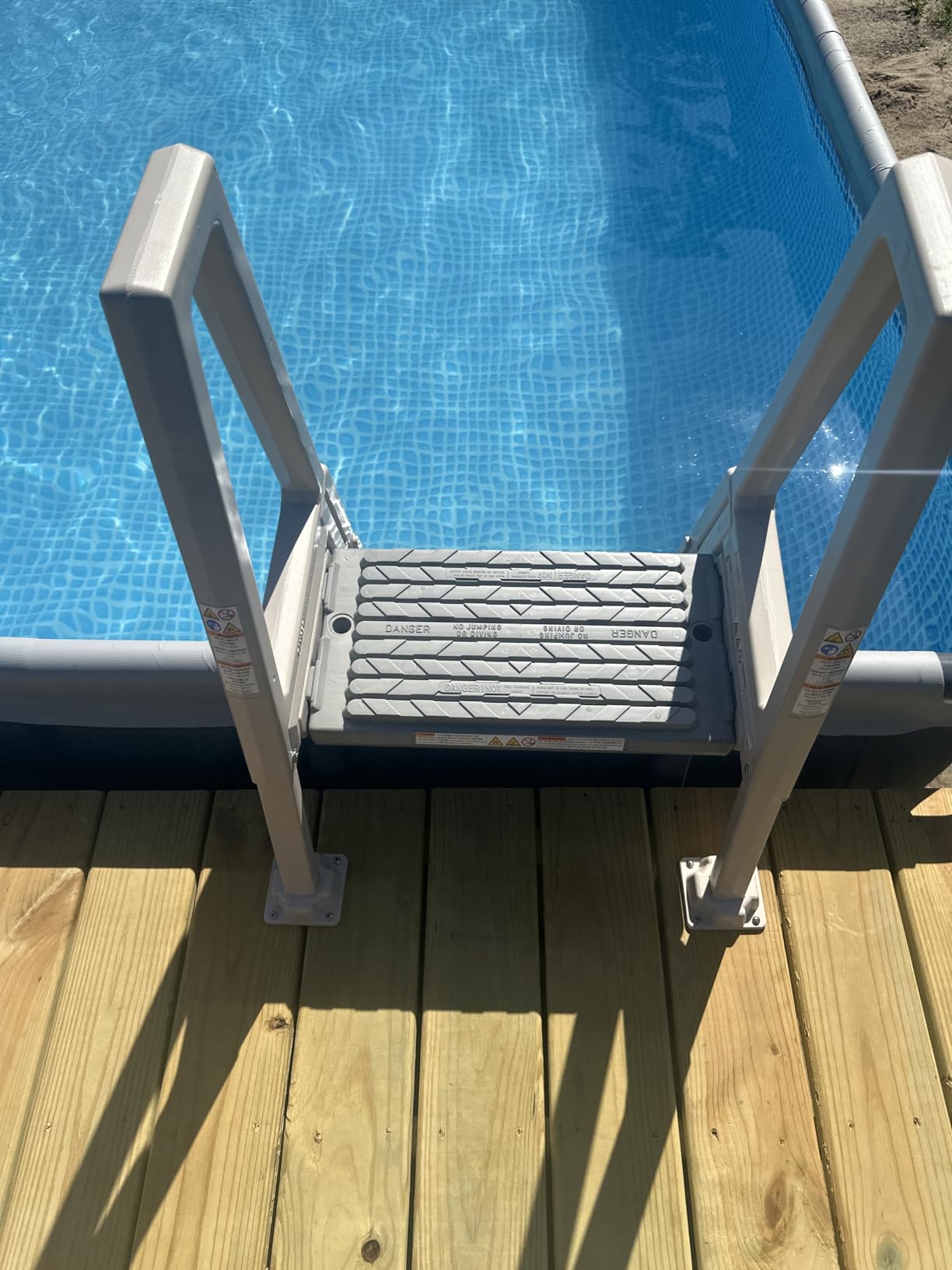
If you want to walk into the pool instead of climbing down a ladder, this is the one to buy. The steps are 27 inches wide, the handrails are on both sides, and the load rating is 400 pounds, which makes it one of the few wide units strong enough for a heavy adult on their own.
Owners repeatedly describe swapping a vertical ladder for this unit as a step change for aging parents, pets, and anyone with knee, hip or back problems. It is sturdy enough to sit on while you wait, and the grey treads stay visible underwater, which matters more than it sounds when someone is looking for the steps from inside the pool.
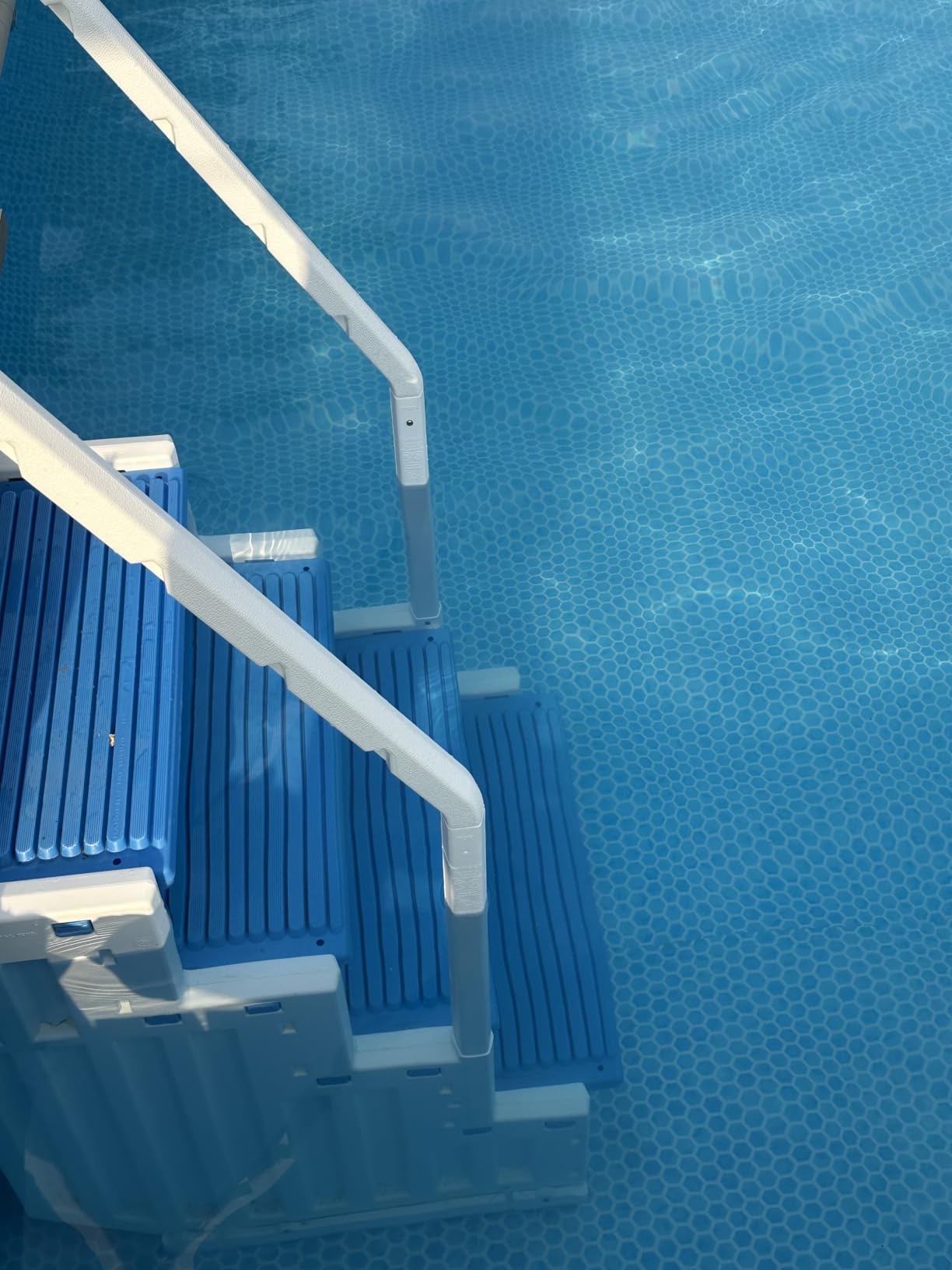
The number one complaint in the reviews is buoyancy. Wide plastic steps displace water, so the unit will lift a couple of inches off the floor unless you add weight. The fix is common and cheap: sand in the fill ports, sandbags, fire glass, or a cement-filled PVC pipe zip-tied to the bottom riser.
Two smaller notes. The unit requires about 40 pounds of sand, which is not included, and a few owners report sand slowly leaking from the fill ports once the steps are sitting in the pool. It also cannot be lifted back out easily once fully filled, so plan your winter removal before you add ballast.
Is it safe for small children
The steps themselves are safe and forgiving, but this unit has no barrier at all. A child can walk up the wide treads with no obstruction, so it is a poor match for a pool where toddlers are unsupervised. If barrier protection matters in your household, choose the roll-guard A-frame or the WDOT ladder instead.
Will it fit your wall height
It is made for flat-bottom above-ground pools and fits decks up to 60 inches high, which covers nearly every common steel-frame wall. Because the outer footprint is only a bracket against the pool wall rather than a full A-frame, it also sits neatly on a narrow deck without taking over the space.
3. Confer Plastics 6000X Heavy Duty In-Pool Ladder, 46-56 Inch Decks, 300 lb
Confer Plastics 6000X Heavy Duty Above Ground in-Pool Swimming Ladder for Decks Adjustable from 42IN to 56IN HIGH
Deck fit 46-56 in
Load rating 300 lb
Plastic, adjustable
Pros
- Wide deck-height adjustment range
- Open risers move water and chemicals
- Flat treads with anti-entrapment barrier
- Extension kit reaches about 68 inches
- Made in the USA with 5-year warranty
Cons
- Light-gauge plastic flexes under load
- Barrier pieces can pop out during handling
- Sand fill is required and can leak
- Assembly is easier with two people
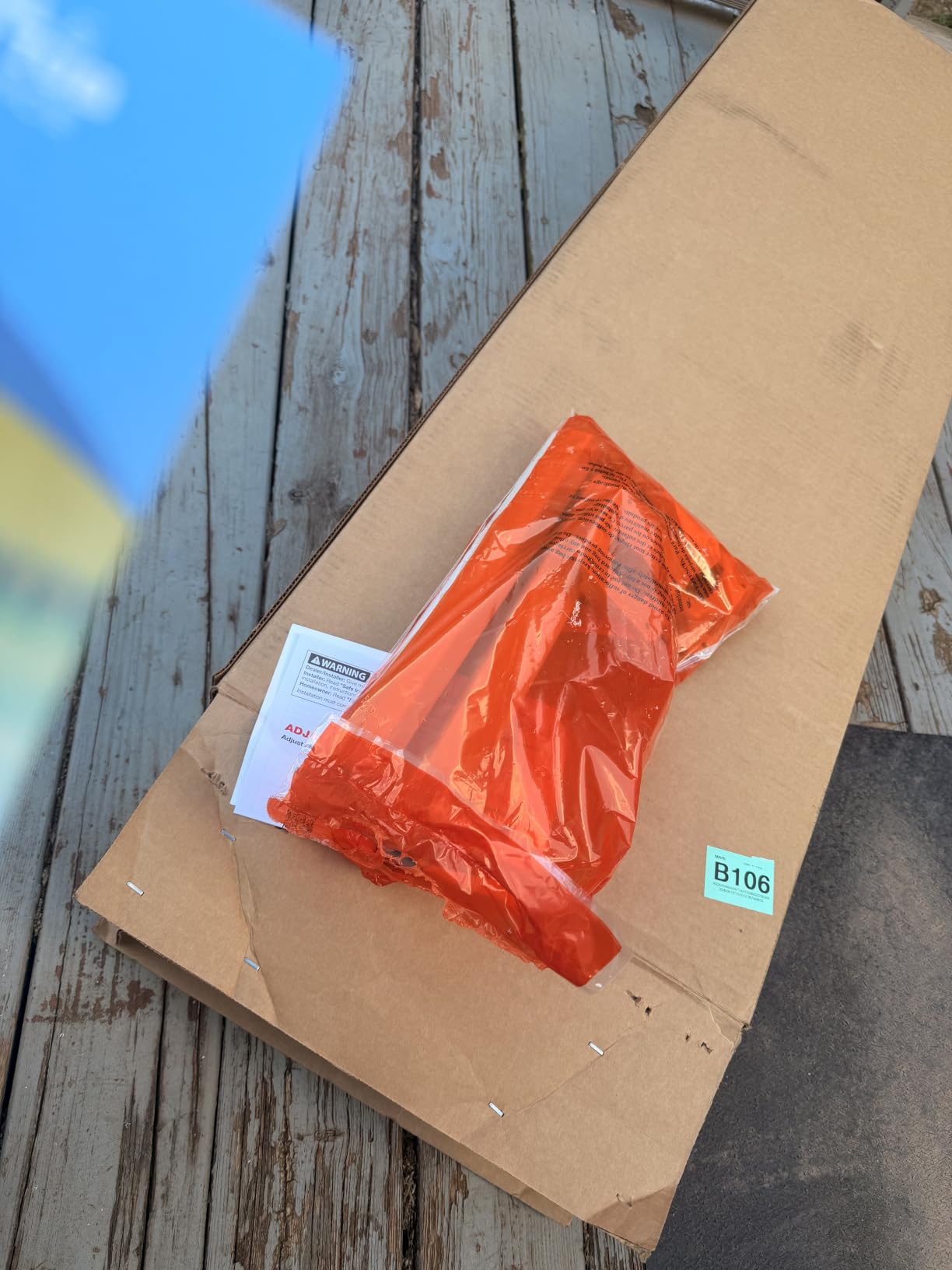
This is the pick for anyone who built a deck around their pool and does not want an A-frame standing on their patio. It mounts through two deck flanges, adjusts for deck heights from 46 to 56 inches, and carries a 300 pound rating. An optional extension kit takes it up to roughly 68 inches for tall builds.
The open riser design is the quiet winner here. Water and pool chemicals flow through the steps instead of collecting behind them, so you are not building a trap for debris and algae in a corner you cannot reach with a vacuum. Reviewers who came from plastic ladders of the past note it feels stiffer and more solid, with no rust after a month of use.
What you give up is a little rigidity. The light-gauge plastic flexes noticeably when you load it, and some owners take a drill to the bottom rung and add their own screws. Reviewers also report that the anti-entrapment barrier pieces do not snap in tightly and can pop out while you are handling the ladder in the water.
Ten pounds of sand are required for pools taller than 48 inches, and sand is not included. Prefilled holes can leak sand into the pool, so fill it inside the pool rather than on the lawn. Assembly takes longer than expected and goes faster with two people.
Why deck owners prefer this shape
A deck-mounted ladder puts nothing on your patio, so there is no sand to sweep, no ladder to reposition when you mow, and no gap in a solar cover along the deck edge. It is also light enough to remove for winter without a second person, which matters in climates that require draining the pool.
What installation actually involves
You drill two holes in the deck, fit the flanges, and shim the ladder until the top step lines up with your coping. The adjustment range is generous, which is the main reason it handles builds where the finished deck height does not match the pool’s advertised wall height. Budget an hour and a helper.
4. Bestway Flowclear 52 Inch Stainless Steel Pool Ladder, 300 lb
Bestway Flowclear 52 in. Pool Ladder
Wall fit 52 in
Load rating 300 lb
Stainless steel, 25 lb unit
Pros
- Stainless steel resists pool chemistry better than painted steel
- Wide treads with dual handrails
- Available in 48 and 52 inch versions
- Simple direct replacement part
Cons
- Some assembly needed and fit can be tight at rails
- Fixed height limits fitment
- No top platform to step onto
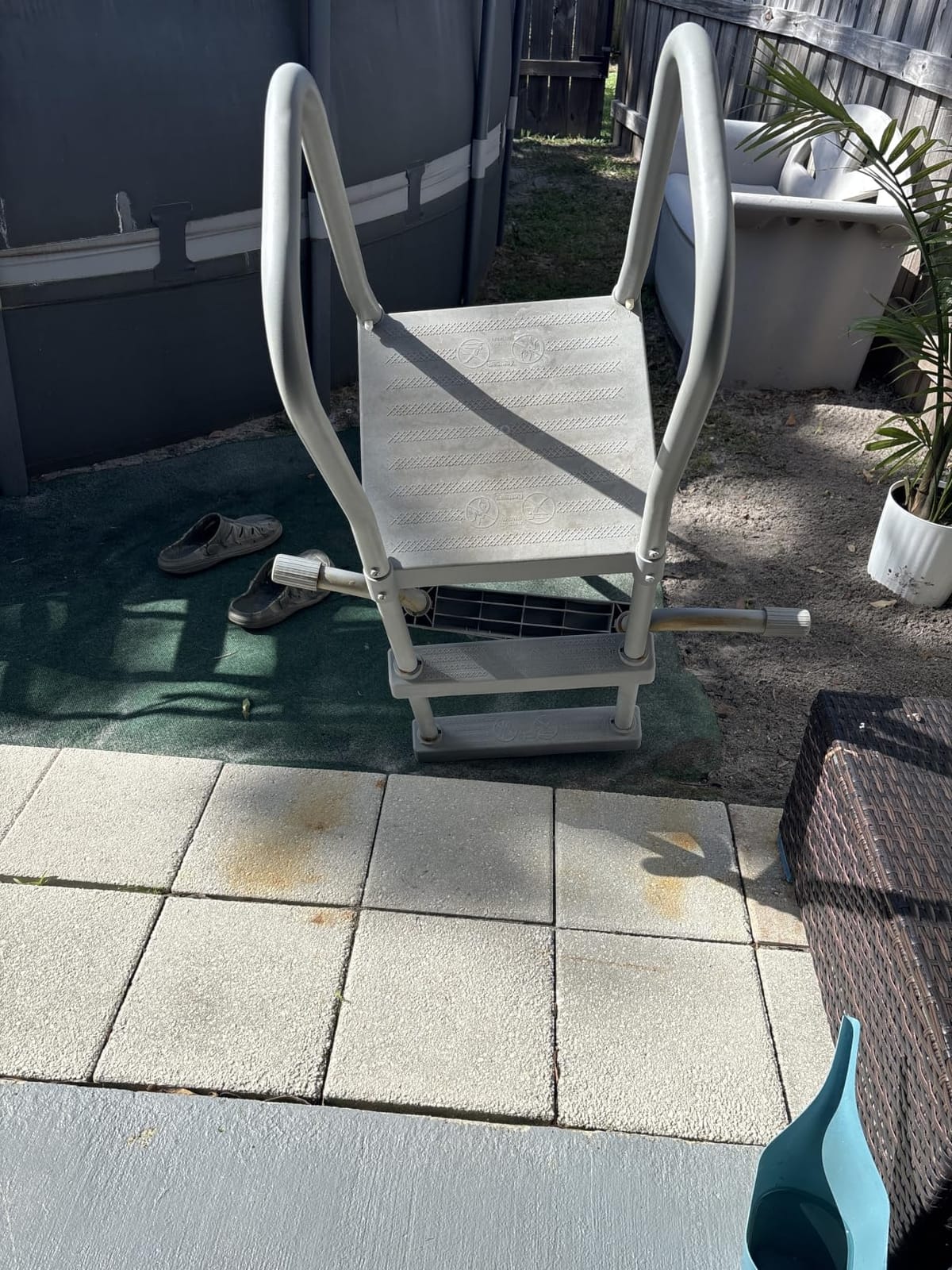
When you just need a working replacement for a worn Bestway ladder and you do not want to change the way you enter the pool, this is the value pick. The frame is stainless steel, the rating is 300 pounds, and it carries 4 steps plus dual handrails for pools up to 52 inches tall.
The material choice is what separates it from cheaper steel ladders. Stainless handles chlorinated water and UV exposure far better than painted or powder-coated steel, and owners moving up from a plastic ladder usually notice the frame stays firm after months of use.
The 4.2-star average across more than 3,400 reviews tells you what to expect. Roughly two thirds of buyers give five stars, and the lower ratings cluster around fit and assembly rather than failure. Some owners find the fit tight against certain pool top rails and the fixed 52-inch height rules out other walls entirely.
There is no top platform, so swimmers step straight onto the pool deck rather than onto a flat standing area. That is fine for most adults and less comfortable for smaller children or anyone who wants a moment of balance before descending.
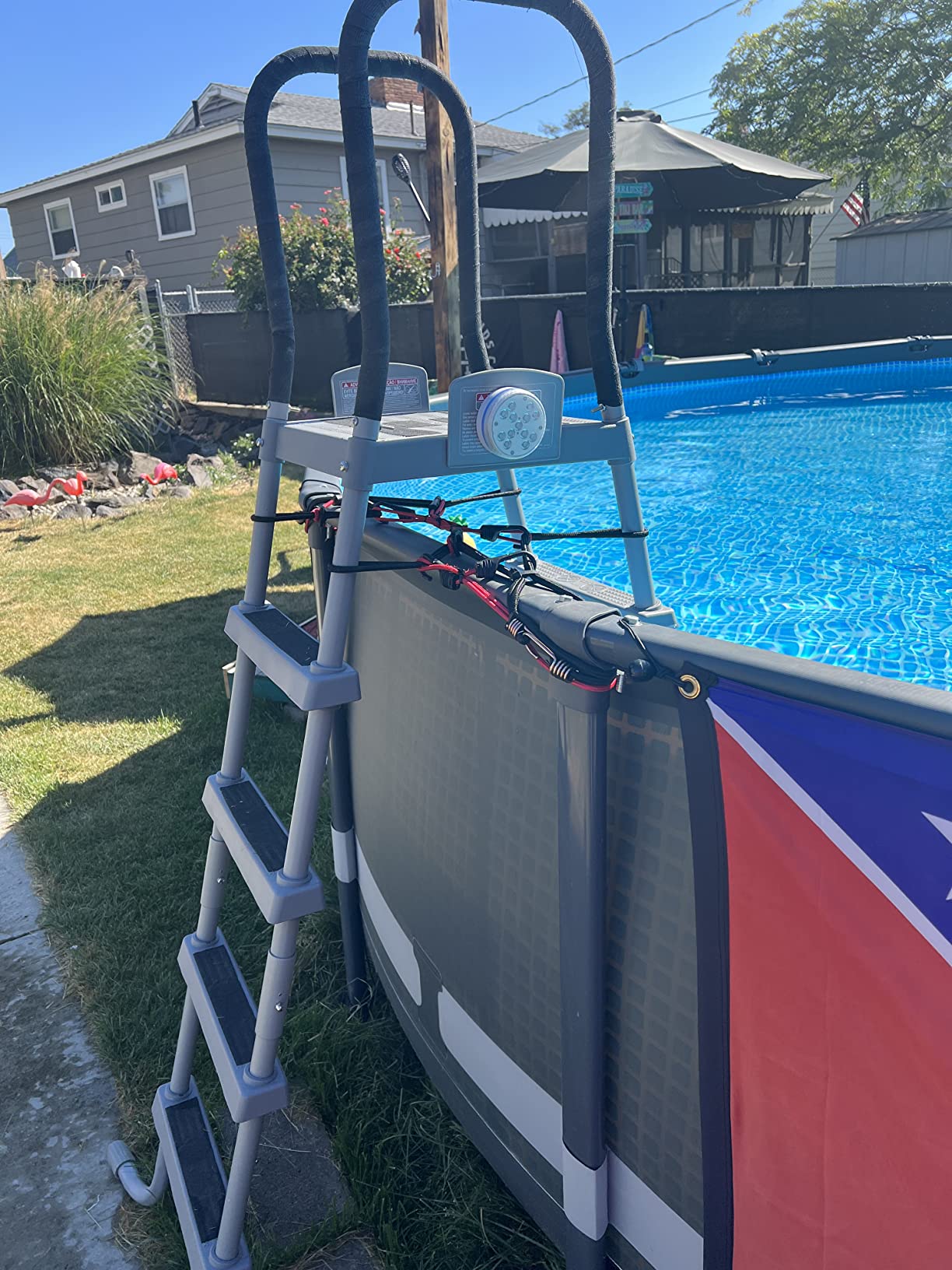
Choosing between the 48 and 52 inch versions
Both sizes run in this line, and picking wrong is the single most common mistake with this product. Measure your pool wall at the top rail with a tape, not from the manufacturer’s listed size, then buy the version that matches. A ladder that is slightly short will leave a gap at the deck edge; one that is too tall will not clamp properly.
Where it fits in a whole setup
This ladder is a working part, not an upgrade. Pair it with one of our top robotic pool cleaners for above ground pools and the difference in day-to-day enjoyment comes mostly from having a ladder that does not rock when you put a full weight on the top step.
5. Intex 28067E Steel Frame 52 Inch Entry Step Ladder, 300 lb
Intex 28067E Steel Frame 52″ Pool Entry Step Ladder with Secure Non-Slip Steps for Above Ground Outdoor Swimming Pools, Silver
Wall fit 52 in
Load rating 300 lb
Alloy steel, 16 oz listed
Pros
- Top platform helps kids reach the deck
- Quick to assemble
- Coated steel holds up through a season
- Affordable platform-style option
Cons
- Considerable wobble and flex when climbing
- Some buyers hesitant to load near 300 lb
- Hardware can rust near salt water
- Steps feel narrow for adult feet
This ladder does something the cheap replacements usually skip: it has a top platform. That single feature changes the way a child exits the pool, because instead of stepping from the top tread straight onto the deck edge, they stand on a flat surface first. It fits 52-inch walls, carries a 300 pound rating, and uses high-impact slip-resistant steps on a coated alloy steel frame.
Assembly is quick, and owners replacing an original Intex ladder report it does the job for a season without complaint. It is also one of the few budget options that reads as more than a temporary fix.
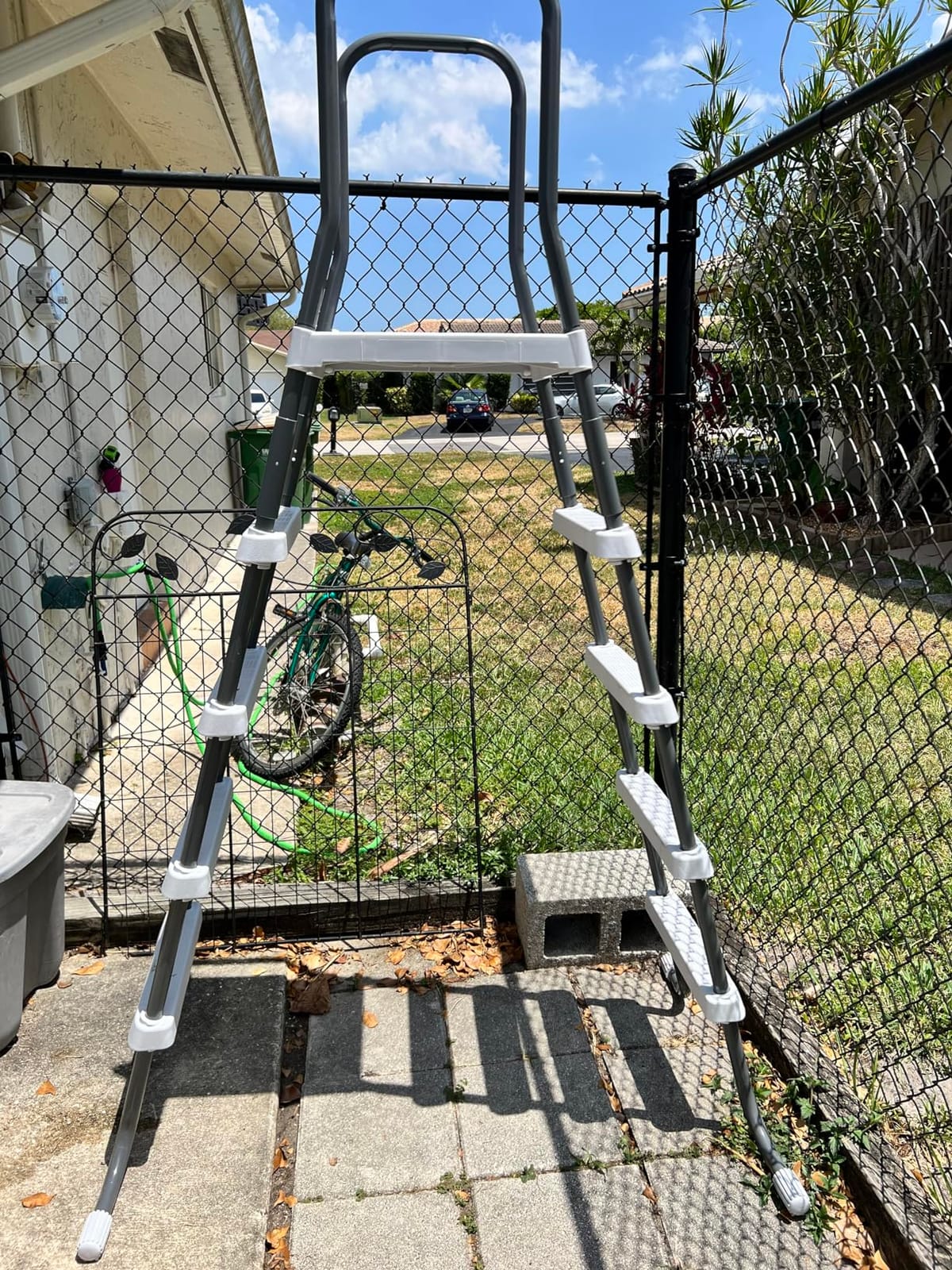
The honest weakness is flex. Three- and four-star reviews keep circling the same point: the frame wobbles laterally when you climb, and several buyers say that shaking feeling stops them trusting the stated 300 pound rating. If you load it fully, climb it one-handed, or use it as a handhold while pulling a heavier person out, it will feel wrong.
There are two other caveats. The hardware can corrode in salt water or saline soil, which rules it out for coastal installs, and the treads feel narrower than buyers expect for adult feet. There is no applicable warranty on this model, so treat it as a seasonal replacement rather than a permanent install.
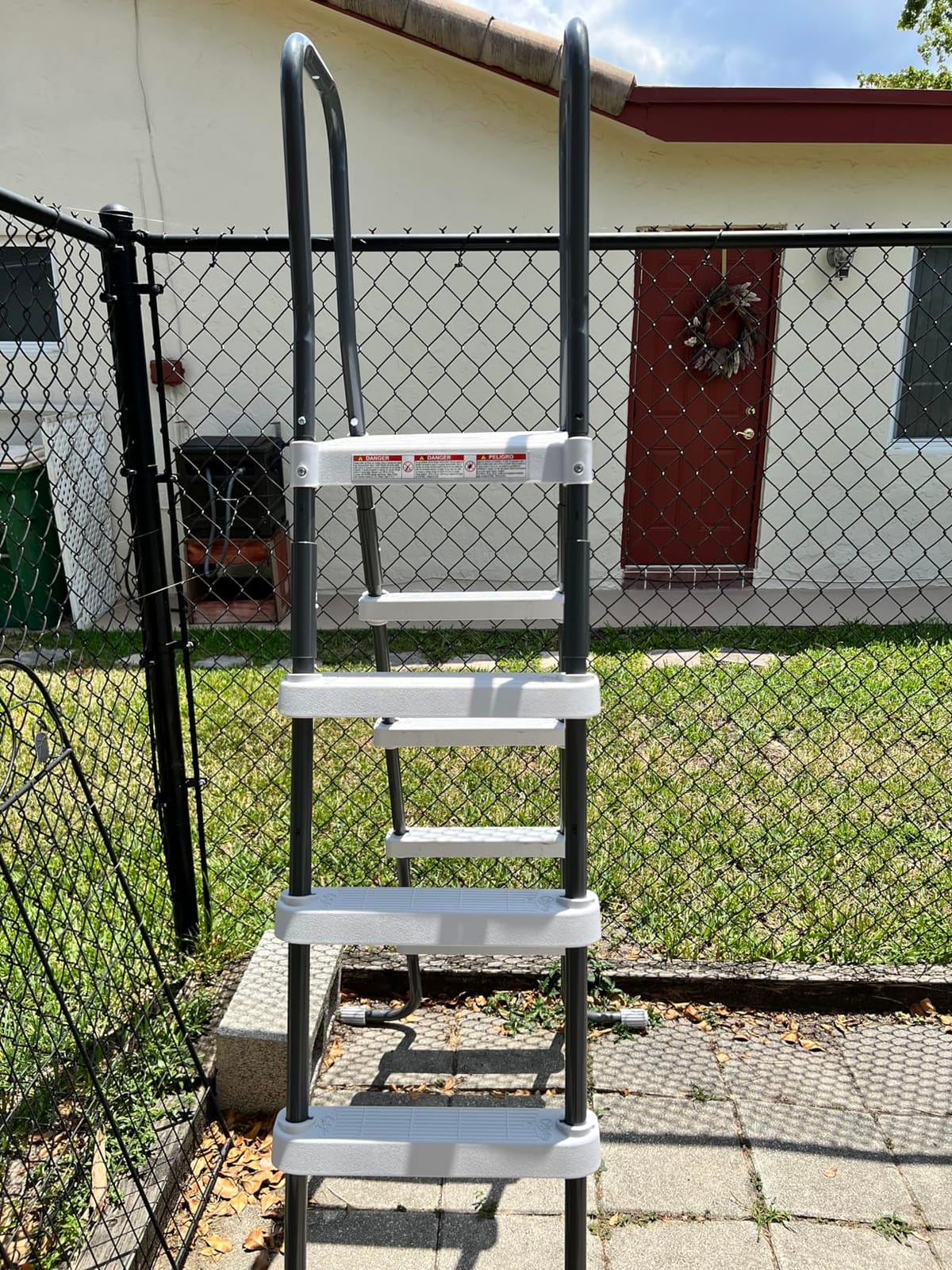
Is it fine for a child to use alone
The platform helps, but there is still no barrier. A determined child can climb the outside and get into the water unsupervised, and the light frame makes a wobbly climb easier to lose footing on. For a family where the pool is gated or supervised at all times, it is fine. Where it is not, pair it with a lock and treat the ladder as the secondary barrier rather than the primary one.
How it holds up over multiple summers
The coated steel frame survives a season well and starts to show its age in year two, particularly at the joints where saltwater gets at the hardware. Owners who want something they can leave mounted for a decade should look at the Blue Wave stainless steel in-pool ladder instead, which uses the same corrosion logic but in a material that does not pit.
6. XtremepowerUS 4-Step Above Ground Entry System, 400 lb
XtremepowerUS Above Ground Swimming Pool Ladder and 4-Step System with Handrails, Heavy-Duty Entry Ladder for Deck to Pool Access, Safety Step Design
Wall fit 42.2 in listed
Load rating 400 lb
HDPE, 50 lb unit
Pros
- Four wide textured steps with curved edges
- 400 lb rating with dual handrails
- Hollow side panels limit floating and move water
- Fillable pipes plus sandbag hooks underneath
- Snap-lock assembly with hardware included
Cons
- Sand required and not included
- Large and heavy for a plastic unit
- Listed height suits shallower walls only
This is the walk-in entry for a shallower setup. Four wide steps with curved edges, dual handrails, and a 400 pound rating make it comfortable for adults and children, and the listed maximum height of 42.2 inches makes it one of the few wide step units that fits a shallow-wall pool rather than a 52-inch wall.
The engineering detail worth knowing is the hollow side panels. They reduce buoyancy and let water move through, which is exactly the problem that makes wide plastic steps ride up on the pool floor. Fillable pipes inside the frame and sandbag hooks beneath the steps give you two ways to add ballast.
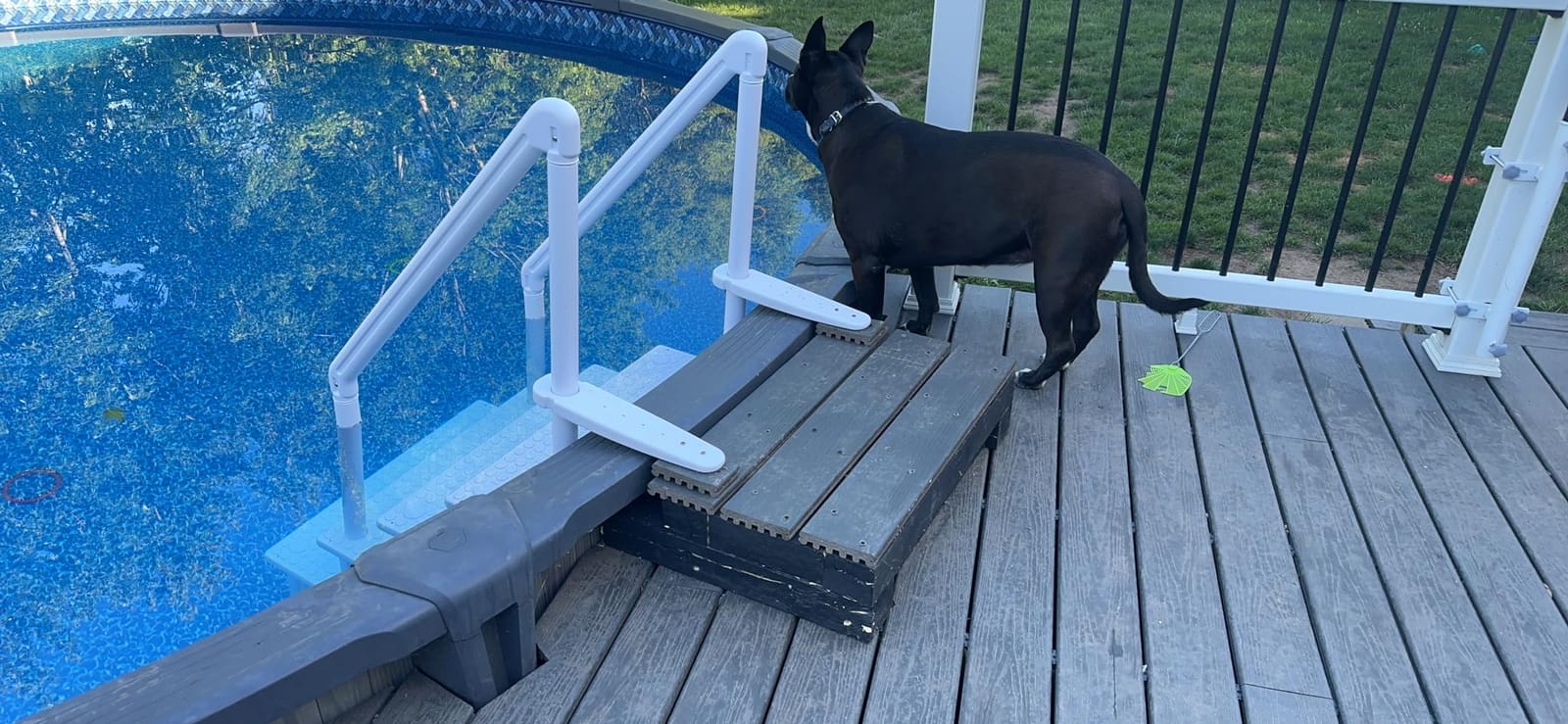
Ratings sit at 4.3 stars across more than 1,100 reviews, with about two thirds at five stars. Buyers point to the wide anti-slip treads, the handrails, and how visible the white steps stay underwater. Mid-range reviews tend to focus on how much sand or water the steps need before they stop moving.
Two limits. The listed height means it suits shallower above-ground setups rather than 52-inch walls, and there is a taller 46.5 to 58.5 inch variant in the same line if your wall is higher. At roughly 50 pounds it is also heavy for a plastic stair unit, and sand for stability is not included.
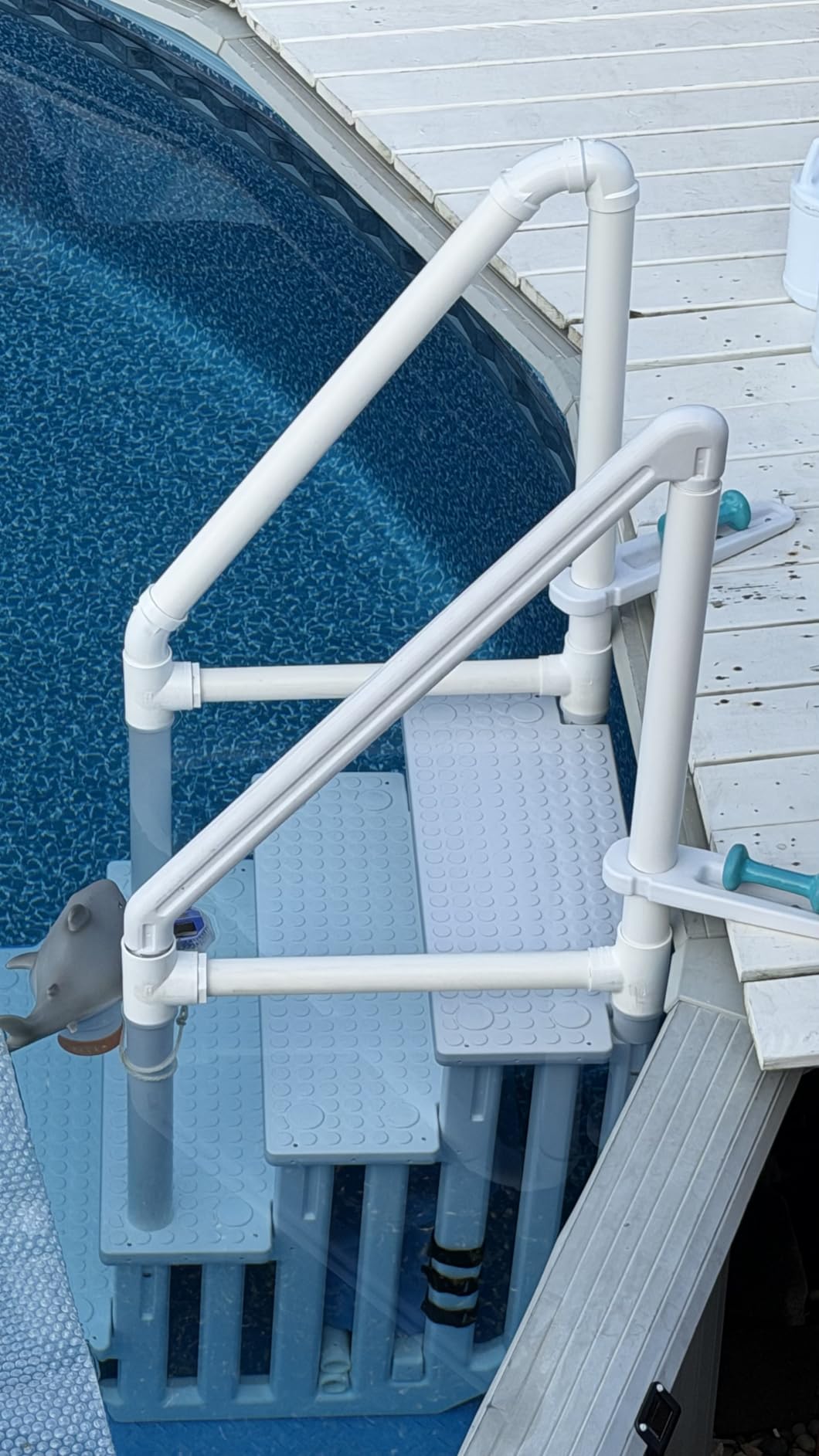
Is this the right ladder for a 42-inch pool
It is the closest thing in this roundup to a purpose-built answer for shallow-wall pools, and that gap is real: most heavy-duty listings are for 48-inch walls and up. Confirm your wall height first, because if your pool is a 52-inch wall you need the taller variant of this system instead of the base model.
How much ballast does it need
Sand goes in the fillable pipes through the ports, and sandbags clip into the hooks under the steps. Owners who dislike sand on the deck often fill the pipes with water and zip-tie a weight to the bottom riser. Either way, ballast before the ladder goes in the pool, not after.
7. Blue Wave Premium Stainless Steel In-Pool Ladder, 225 lb, 54 Inch Pools
Blue Wave Premium Stainless Steel in-Pool Ladder for Above Ground Pools
Pool fit up to 54 in
Load rating 225 lb
Stainless steel, 18 lb unit
Pros
- Real stainless treads and rails resist UV and algae
- Deck flanges included in the box
- Pivoting resin base suits sloped floors
- One owner reports eight seasons of use
Cons
- 225 lb rating is for one person at a time
- Treads can be slick when wet
- May need trimming to match deck height
- Not intended for saltwater pools
This is the durability pick. The treads and handrails are stainless steel rather than resin, and that single material change is why owners who upgrade from plastic report that this is the ladder that finally lasted. It is deck-mounted, fits pools up to 54 inches, and includes the deck flanges so no extra hardware shopping is needed.
The 24-inch wide resin swivel base tread is the feature we did not expect to like as much as we do. It pivots to suit a sloped pool floor, so on a pool with a gradual slope the ladder settles the way it should instead of rocking on one edge and scuffing the liner.
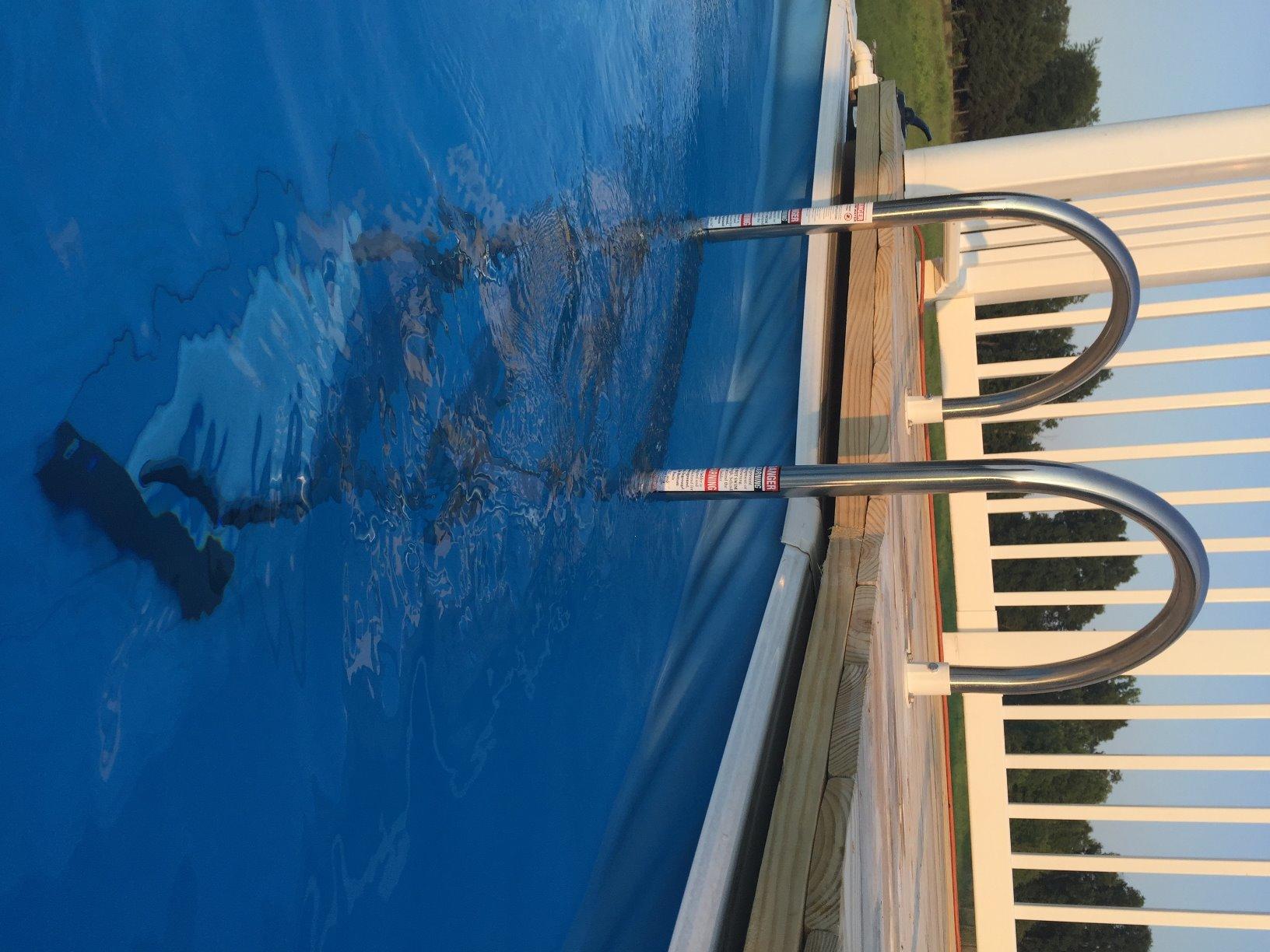
The important number here is 225 pounds, and it is for one person at a time. Several owners report learning that only after buying, so treat the rating as a single-user limit rather than a household limit. Treads also feel smoother when wet than the engraved texture suggests, which is worth testing barefoot before a full season of use.
Two more things to plan for. On taller decks the ladder length may need trimming to match, and the manufacturer states it is not for saltwater pools, where minor rust spotting can appear at the step-to-rail joints. The warranty is one year limited.
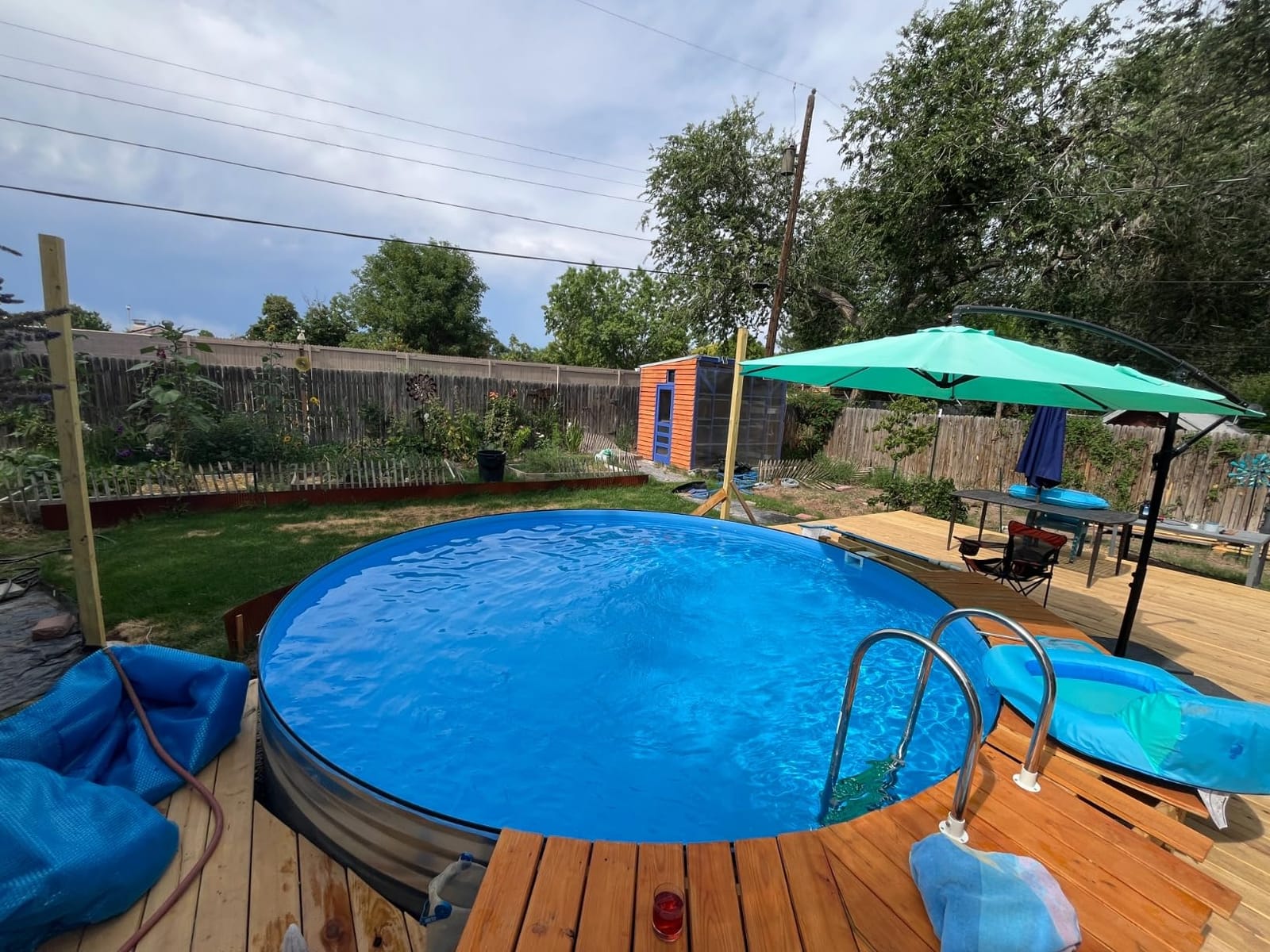
Is stainless worth it over resin
For a pool that stays up year round, yes. Resin treads fade and grow algae film in a way stainless does not, and stainless is the reason owners here describe a decade of service. For a seasonal pool that gets drained and stored, the difference matters less and resin is cheaper to replace if it cracks.
What installation involves
You need a 1.5 inch hole saw to cut the deck, and the flanges are included. The ladder is 18 pounds and 72 inches tall overall, so trimming is a realistic step on a high deck. Set the base swivel before you tighten the top flanges so the pivot can find the slope.
8. Funsicle 36 Inch SureStep Pool Ladder, 250 lb
Funsicle 36″ SureStep Pool Ladder, for Above Ground Swimming Pools, Black
Wall fit up to 36 in
Load rating 250 lb
Alloy steel and plastic
Pros
- Steel frame resists floating
- Steps have grip texture for small children
- Light enough to lift in and out alone
- Four-screw disassembly for storage
- 4.6 star rating from owners
Cons
- Surface rust appears on black steel after a season
- No top platform for young children
- Supplied bolts can loosen with use
- 36 inch height suits low walls only
For a low-walled pool, this is the ladder that makes sense. It suits above-ground pools up to 36 inches tall, carries a 250 pound rating, and the steel frame does not float or wobble the way an all-plastic ladder does. It is also light enough that one person can lift it in and out of the pool repeatedly.
The rating here is the strongest in the roundup at 4.6 stars, with 82 percent of buyers giving five stars. That is not an accident of a small sample; owners consistently call it sturdy, easy to assemble, and good value for what it is.
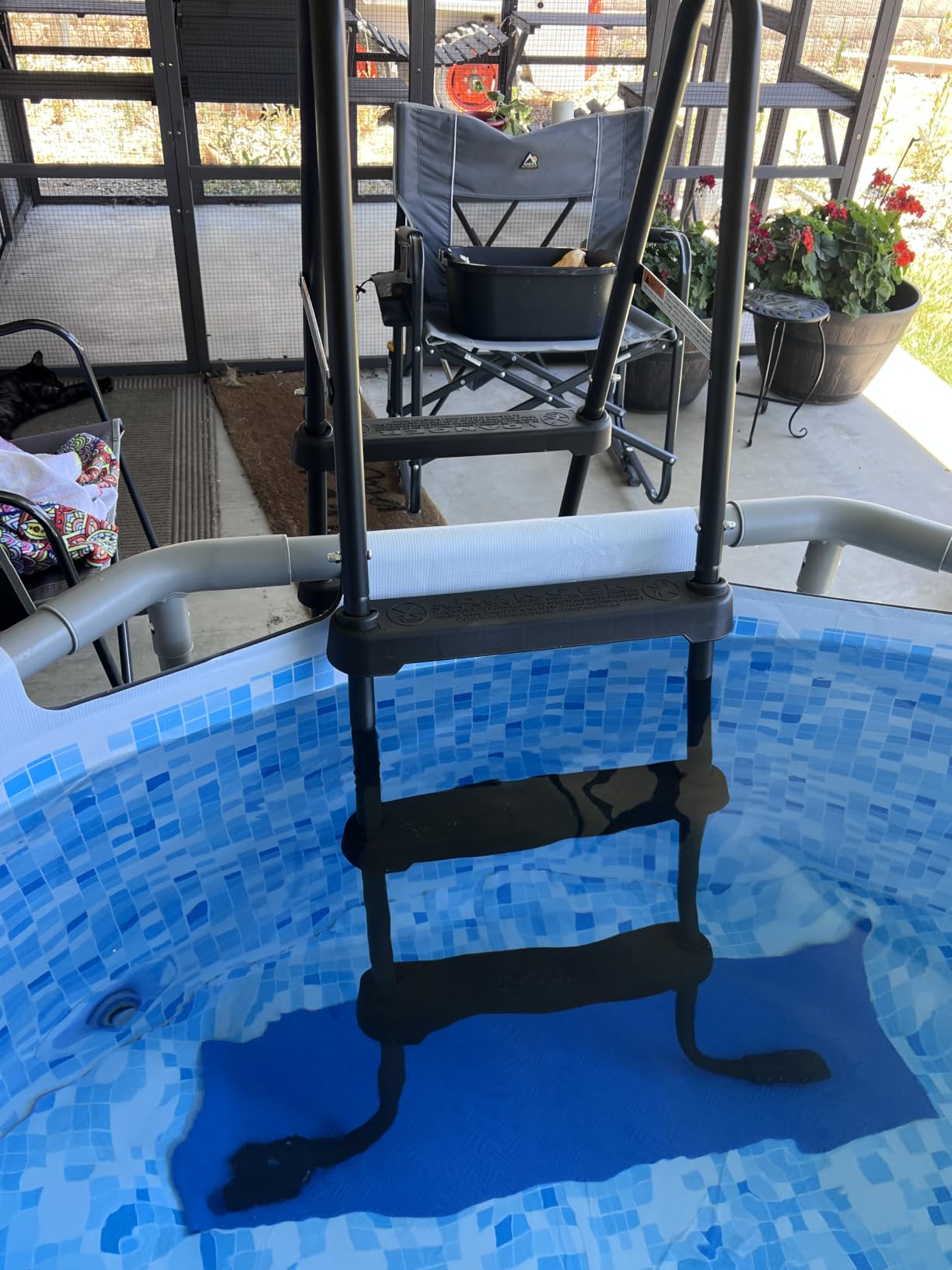
The recurring caveat is rust. Black painted steel develops visible surface rust on hidden sections after a season or two, and the supplied bolts can loosen and back out with use. Neither is a safety failure, but both are the kind of thing you notice every time you get in the pool.
There is no top platform, which matters if you have small children who need a standing area at the top, and the 36-inch size rules it out for any wall above that height. The same line includes 42, 48 and 52 inch versions if you need more height.
Is 250 pounds enough
It is enough for one adult and a child, and it is not enough for a 300 pound adult using the rails to steady themselves. We would treat 250 pounds as a single-person rating and pick a 300 pound model if the heaviest user in your household is above that, since the frame is where a lighter rating shows up first.
Best use case for this ladder
A metal-framed inflatable or semi-inflatable pool that goes up for a few months each year. Steel frame, plastic steps, and four-screw disassembly make it a clean seasonal tool rather than a permanent fixture, and it leaves the pool clear for draining and storage.
9. Intex 28077E Heavy Duty Deluxe Ladder with Removable Steps, 52 Inch, 300 lb
Intex 28077E Deluxe Pool Ladder with Removable Steps for Intex Pools with Wall Height of 52 Inch
Wall fit 52 in
Load rating 300 lb
Alloy steel, 20 lb unit
Pros
- Removable steps lift out when the pool is unused
- Steps snap and lock securely into the base
- Heavy duty alloy frame rated 300 lb
- Improved support base for extended use
Cons
- Fixed 52 inch wall height
- Removable steps can be misplaced
- Composite treads wear over seasons
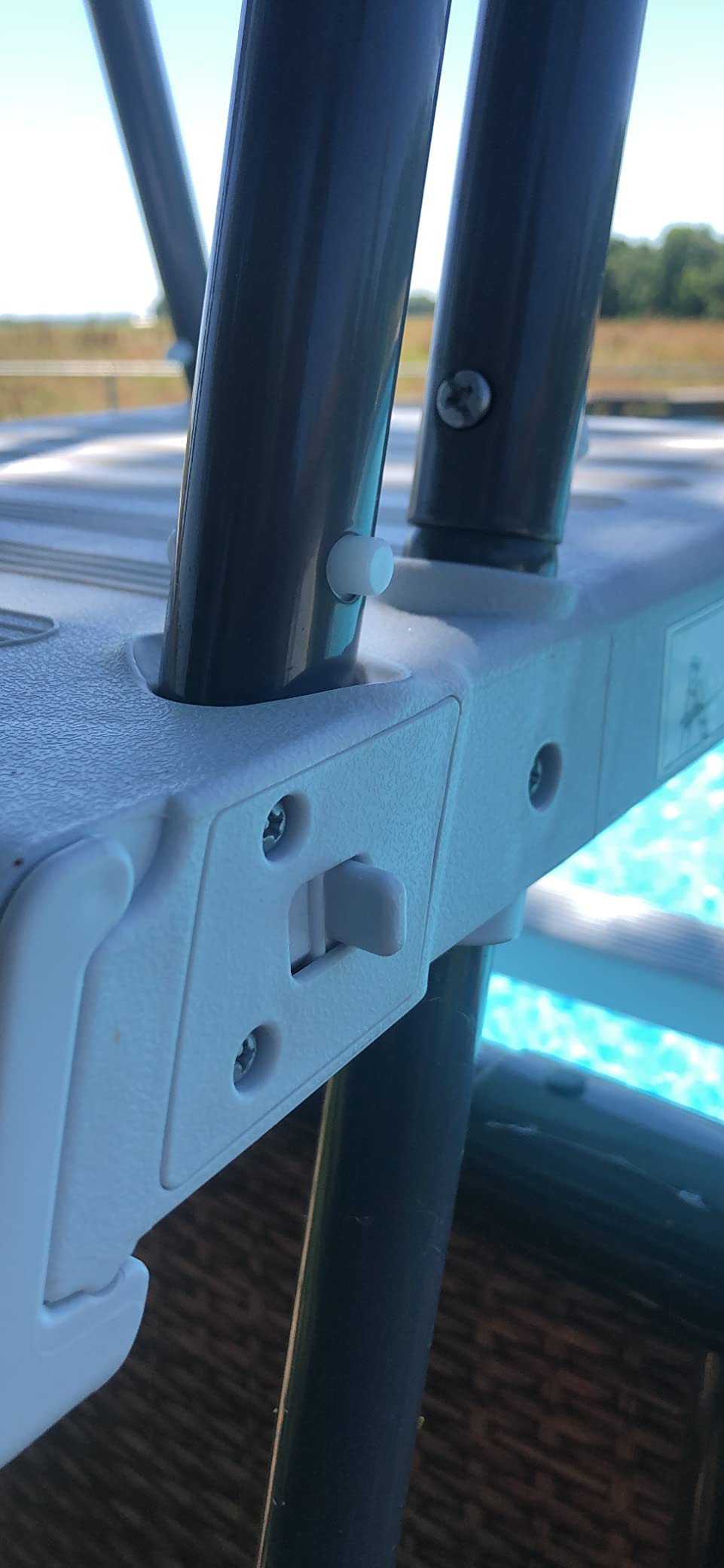
This is the safety-first pick for families who want the pool to be unusable when nobody is swimming. The steps set and snap into the base, so you can lift them out entirely and carry them indoors. That turns a climb-in entry into a barrier without buying a separate gate.
The frame is heavy duty alloy steel rated to 300 pounds, and the improved support base is designed for extended seasonal use rather than a single summer. Width across the ladder is about 19 inches, so it is a step ladder rather than a stair unit.
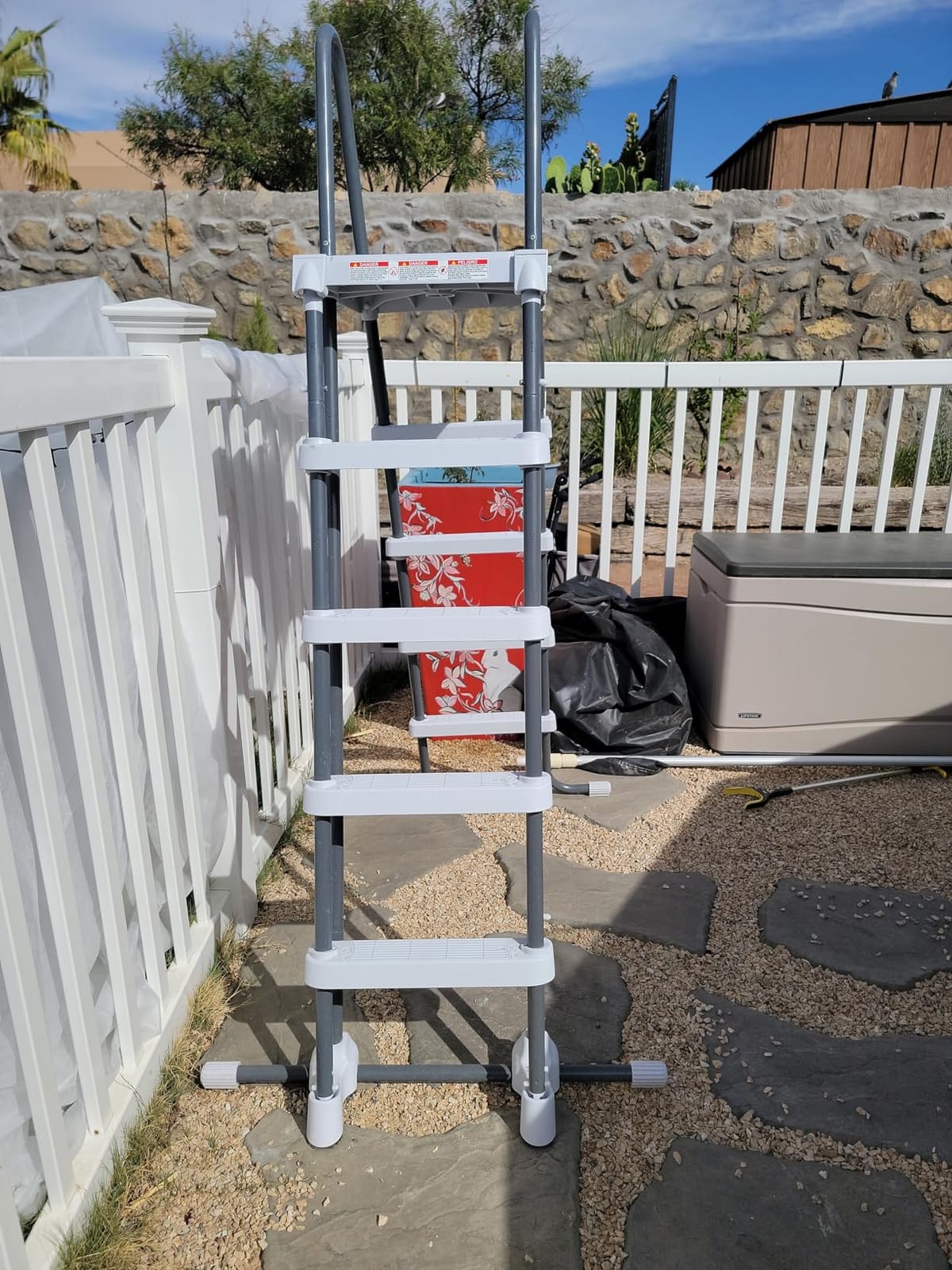
Ratings sit at 4.3 stars from 331 buyers, with about two thirds at five stars. Owners treat it as a straightforward replacement for an original Intex ladder and value the removal step above everything else. The criticism is mild: the fixed 52-inch size limits fitment, and composite treads show wear over multiple seasons.
The obvious trade-off with removable steps is that they can be misplaced. That is a small thing until a child finds them in the yard and puts them back. Keep them indoors with the pool cover rather than leaning them against the wall.
How removable steps compare with a lockable barrier
Removal is stronger protection because the ladder physically cannot be climbed, and it costs nothing extra once the ladder is installed. A lockable roll-guard is more convenient because kids can still use the pool without an adult reassembling the steps. For a pool used several times a week with toddlers around, a lock is more practical.
What to confirm before ordering
That your wall is 52 inches. This is a fixed-height ladder with no adjustment range, so it will not fit a 48-inch or 54-inch wall. If your wall is not exactly 52, skip this one and pick an adjustable model so you are not returning parts.
10. VEVOR 5-Step Inclined Pool Stair with Double Handrails, 300 lb
VEVOR Swimming Pool Ladder, 75°Inclined 5-Step Double Handrails Stair, Non-Slip Heavy Duty Steps, Load Capacity 300 lb, for 48-54 in Inground & Above-Ground Pools of Any Deck Surface Indoor & Outdoor
Deck fit 48-54 in
Load rating 300 lb
Polyethylene, 22 lb unit
Pros
- 75 degree incline eases entry for older swimmers
- Five extra-wide 4.72 inch textured steps
- Double handrails on both sides
- All-PE material resists corrosion and UV
Cons
- Some units report a detaching bottom step
- Short height against a standard wall
- Requires deck drilling and a large hole bit
- Instructions lack part identifiers
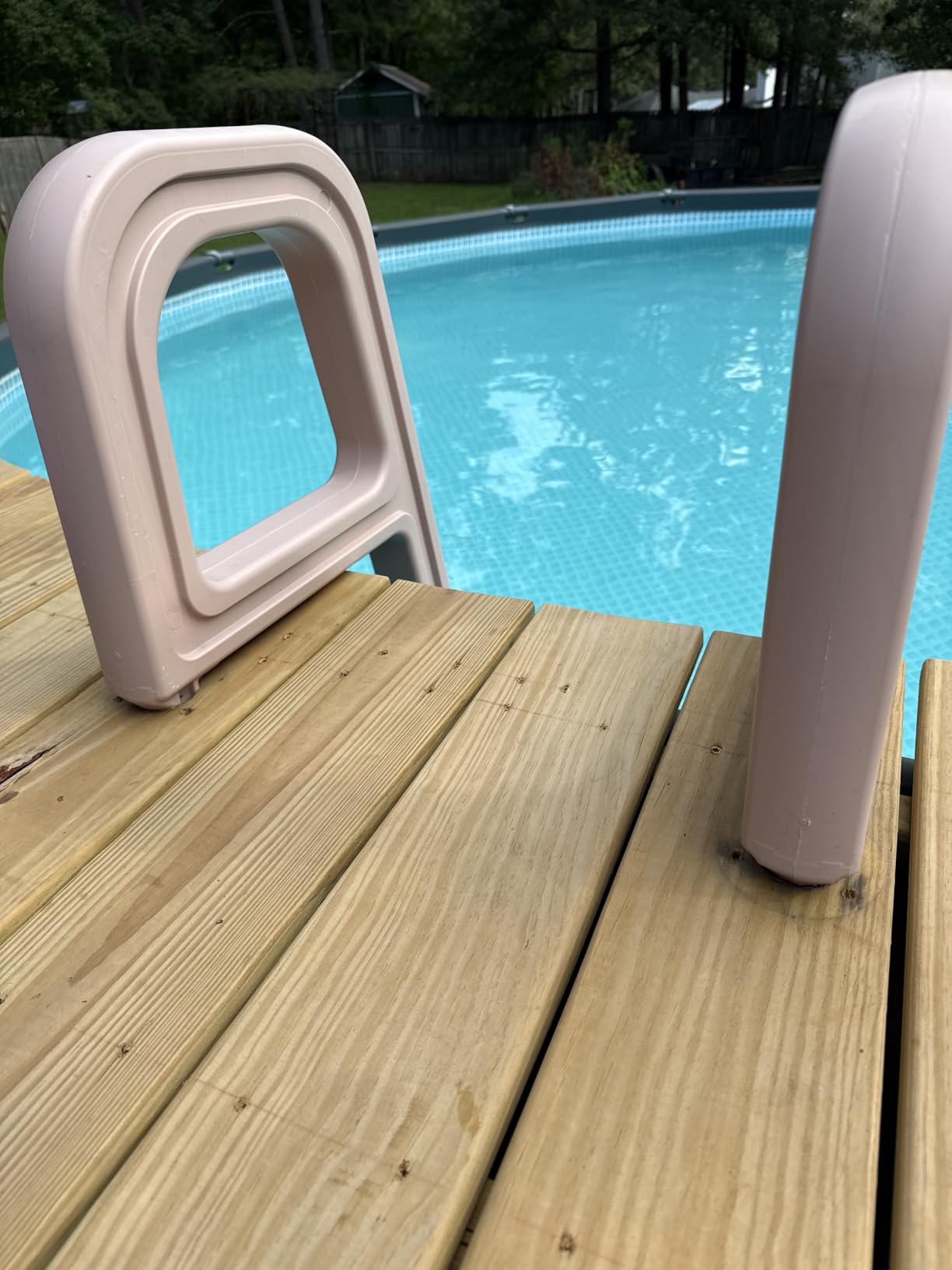
The idea here is simple: a shallower angle means less bending at the knee. At 75 degrees with five extra-wide 4.72 inch steps and handrails on both sides, this stair is the easiest of the group to descend for older swimmers and anyone with arthritis. The textured pattern grips even underwater, and all-PE construction will not rust.
It works on in-ground and above-ground pools and on any deck surface. Retaining plates come pre-drilled, so mounting is a matter of bolting through the plate rather than improvising a bracket.
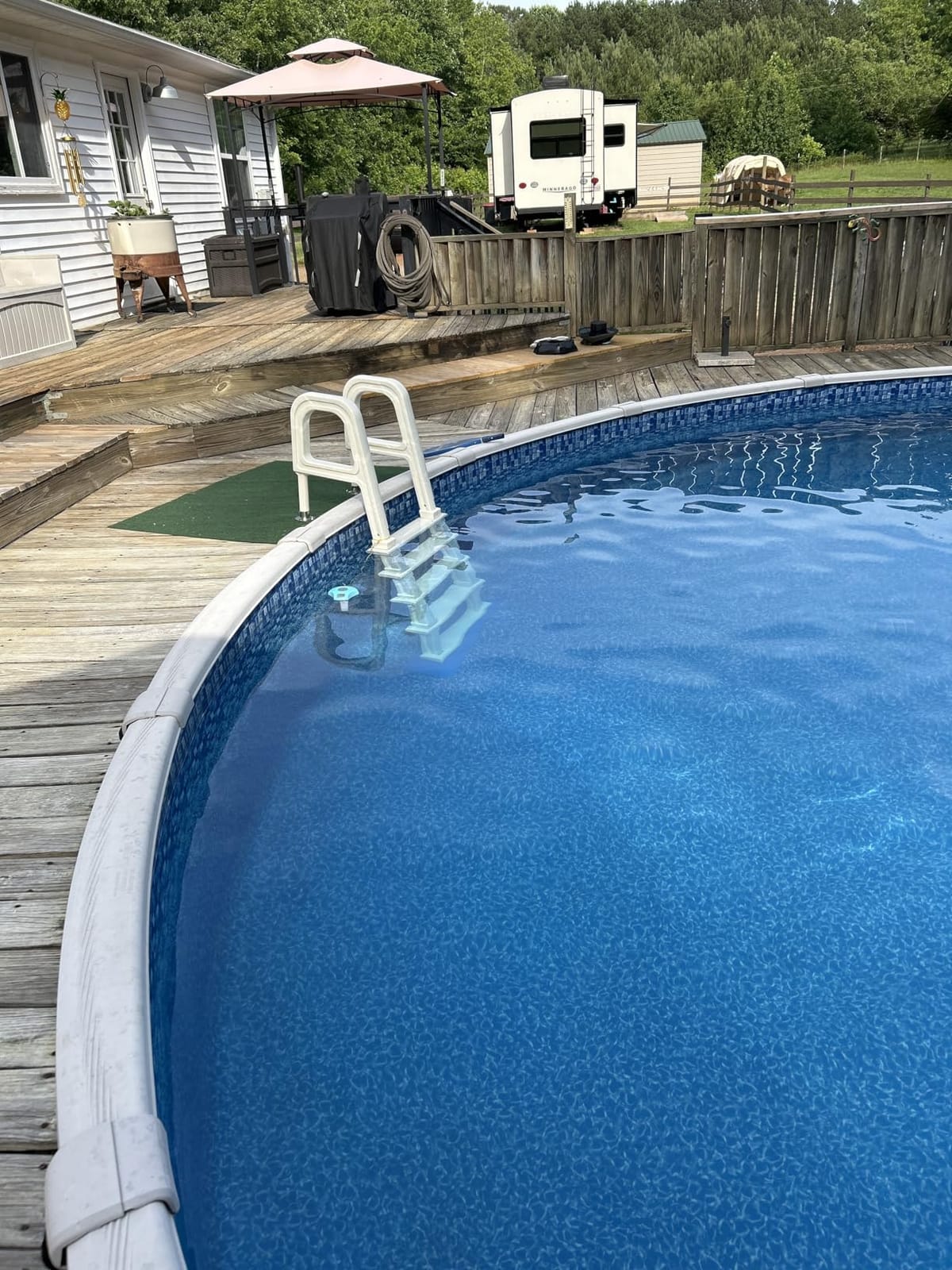
This is the lowest-rated product we included, at 4.1 stars from 121 reviews, and the reason is durability rather than design. Several buyers report the bottom step detaching during first use under a modest load, and the build can feel thin for a 300 pound rating. Instructions without part identifiers mean assembly is trial and error.
Check the height before you commit. At 70.5 inches overall it is short against a standard 24-inch-frame above-ground wall, which owners report is exactly the mismatch. Drilling the deck and cutting a large hole bit are also part of the job, and concrete or tile decks need separate expansion bolts.
Is a 75 degree angle worth the trade-offs
If an adult in your household has arthritis, a bad knee, or limited balance, the shallower angle is a genuine improvement over vertical rungs and it is the whole reason to buy this shape. If everyone in the pool is agile, you give up sturdiness for that comfort and there are better-built alternatives at similar sizes.
How it fits an above-ground pool with a deck
It bolts to the deck the way a deck-mounted in-pool ladder does, with no legs on the patio. The catch is height: measure your deck-to-pool-floor distance and compare it against the 70.5 inch overall height before buying, because a ladder that bottoms out above the floor will not feel right even if it assembles fine.
11. UPHYB 4-Step Pool Stairs with Double Handrails, 400 lb
UPHYB Pool Ladder, 4-Step Pool Stairs with Double Handrails and Non-Slip Steps for 48-54” Above Ground and In-Ground Pools, White
Pool depth 48-54 in
Load rating 400 lb
Polyethylene, 55 lb unit
Pros
- Four wide steps with 4.2 inch dual handrails
- Assembles in under an hour
- Open hollow panels move water and chemicals
- 400 lb rating with textured treads
- Snap-on assembly with accessories included
Cons
- Buoyancy needs added weight
- Handrails feel flimsy when pulled hard
- No top platform or barrier
- Not for users needing a firm handhold
This stair unit gives you a 400 pound rating and handrails on both sides, which puts it in the same class as the premium step units at a lower cost. Four wide steps with textured non-slip treads, a snap-on assembly system, and all-PE construction that will not corrode.
Owners report assembly in under an hour, faster than costlier competing stair units, and customer service that sent a replacement part proactively when one was needed. The hollow side panels are open, so water and chemicals move through rather than pooling behind the steps.
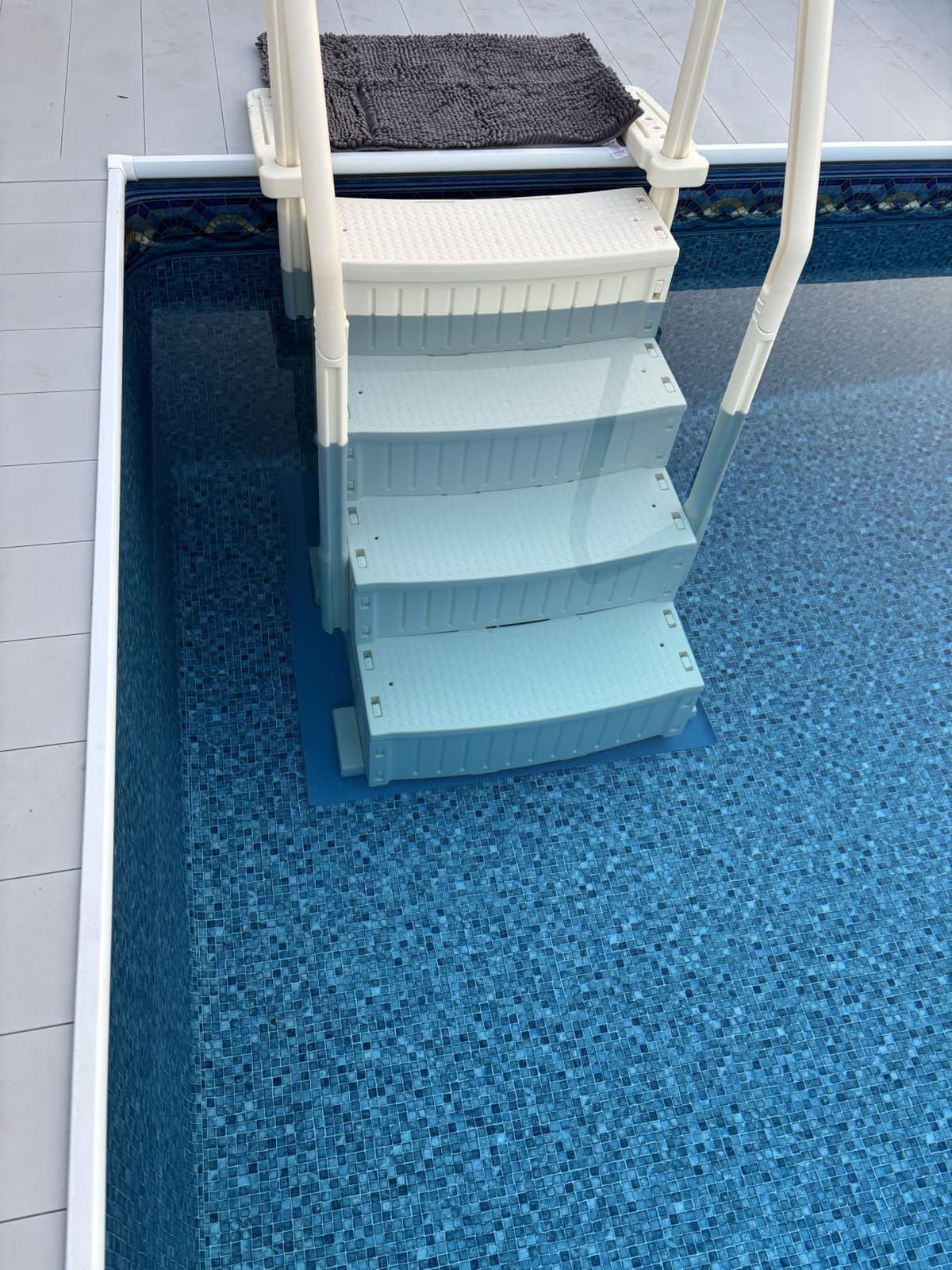
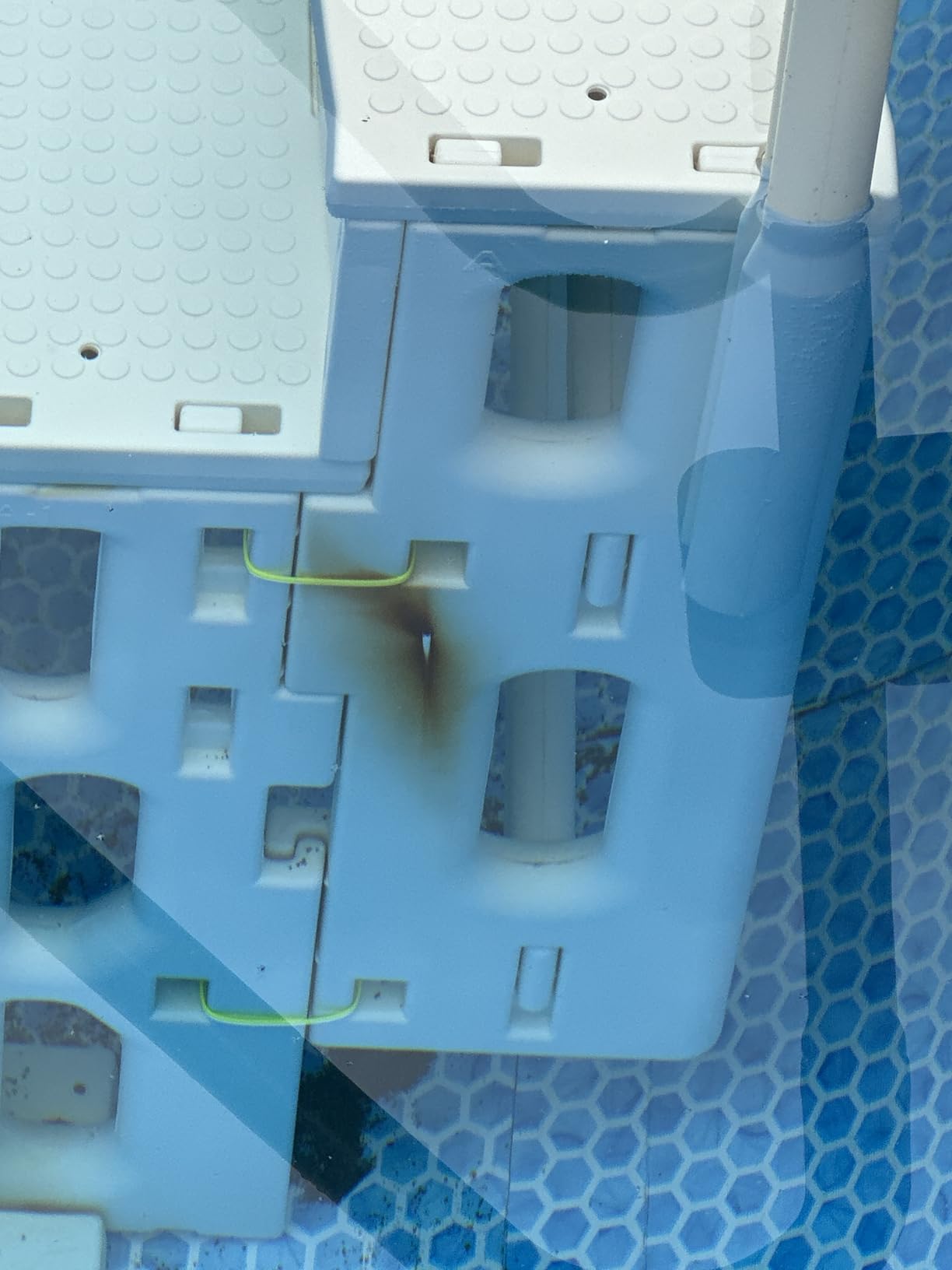
Two problems come up repeatedly. Buoyancy still requires added weight, and the supplied sandbag bar sits too far forward for the steps to stay put on their own. Owners also report the handrails feel flimsy when pulled hard, which is exactly the movement someone makes when assisting another person out of the pool.
There is no top platform and no barrier, so the pool wall edge stays uncovered where the steps meet it. That makes this a poor fit for a household with unsupervised young children, and a poor fit for anyone who relies on a firm handhold to get out.
Who should choose this over a premium step unit
A household where adults are the primary swimmers, everyone is comfortable with wide plastic treads, and the budget matters. The 400 pound rating is honest and matches the premium units, so the saving comes from the all-PE handrails rather than from a lighter load limit.
How to fix the floating problem
Fill the side pipes through the sand ports, and if the supplied sandbag bar sits awkwardly, zip-tie your own weight to the lower riser instead. Test it before anyone climbs. At 55 pounds this is a two-person job to move into position, so get a helper for installation.
12. WDOT A-Frame Safety Ladder with Platform and Barrier, 48-52 Inch Pools, 600 lb
WDOT Pool Ladder Above Ground Swimming Safety A Frame Pool Ladder with Platform and Safety Barrier for 48-52 inches Pool
Wall fit 48-52 in
Load rating 600 lb
HDPE, about 65 lb
Pros
- Highest stated load rating at 600 lb
- Lockable and removable safety barrier
- 1.57 inch thick top platform resists bending
- Adjustable A-frame base with drainage holes
- Pre-drilled assembly needs no drill
Cons
- Heaviest unit here at about 65 pounds
- Barrier must come off for adult entry
- Taller frame can crowd a small deck
The 600 pound rating is the headline here, and it is the only ladder in this roundup rated that high. The frame is high-density polyethylene with five textured non-slip steps, and it fits round, oval and rectangular pools with walls from 48 to 52 inches.
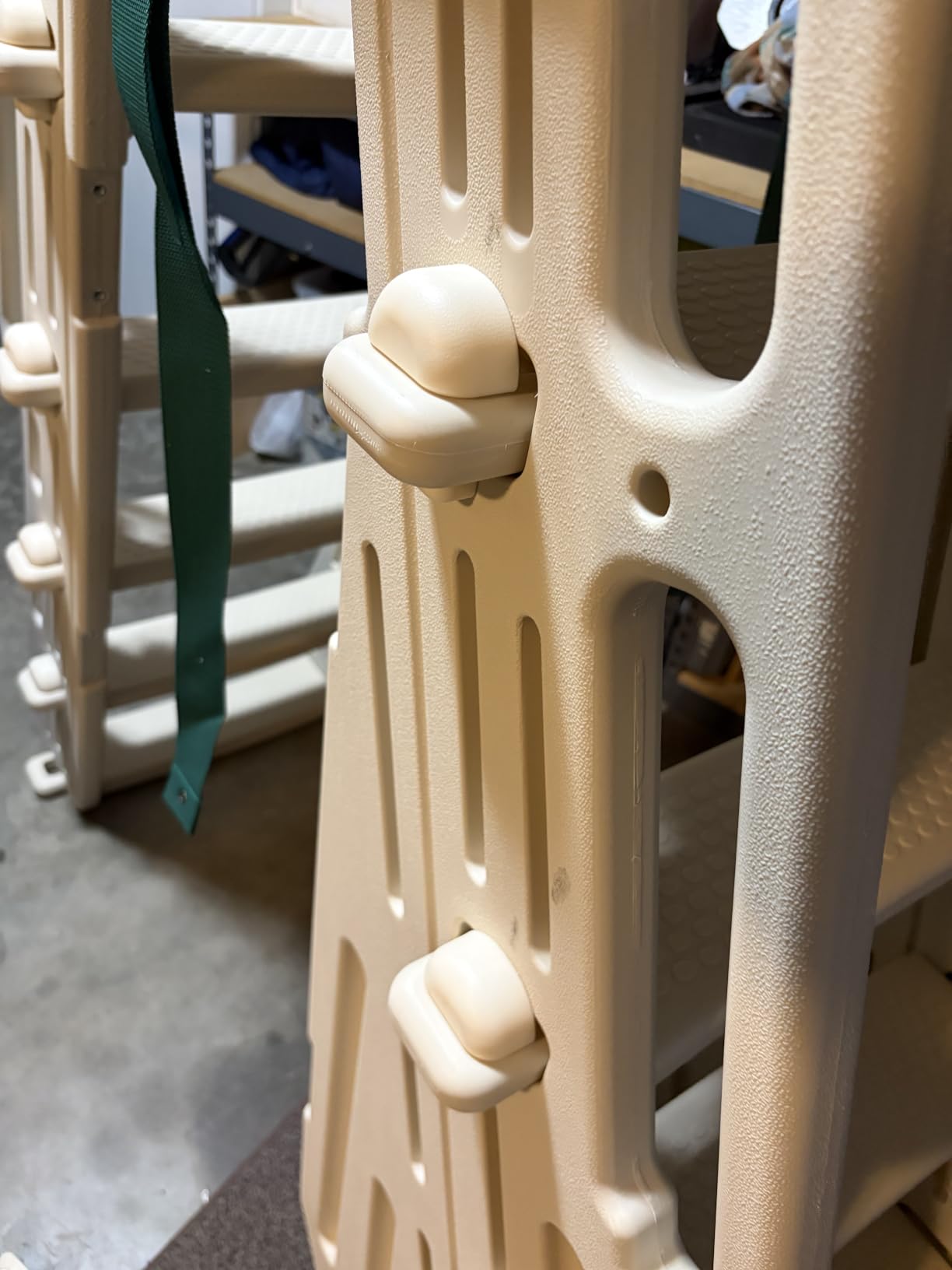
It also carries a lockable and removable safety barrier with a warning label, plus a top platform that is 1.57 inches thick. That platform thickness is not a marketing number: thin platforms flex and warp, and this one is one of the reasons the frame does not feel springy under an adult.
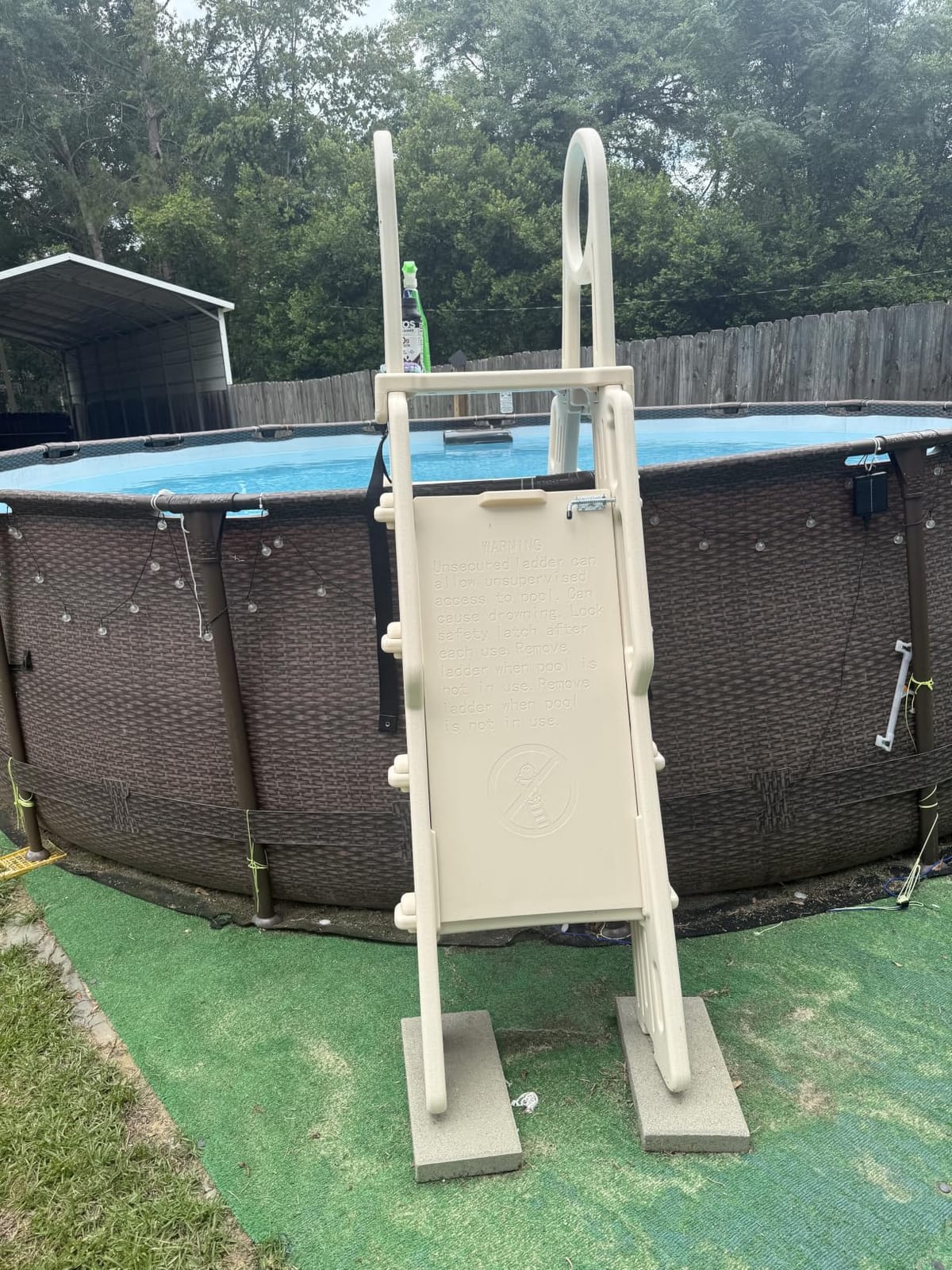
The listing is young, with 94 reviews at 4.4 stars and roughly three quarters at five stars, so the feedback is concentrated rather than spread over years of use. Buyers point to the lockable barrier as the feature that justifies the spend, along with the thick platform and the 600 pound rating.
Two real drawbacks. At about 65 pounds this is the heaviest unit here, which makes storage and repositioning awkward for one person. And the barrier has to be removed for adults to enter comfortably, which is a small daily friction that lighter A-frames do not have.
Is a 600 pound rating real or inflated
Treat it as a marketing ceiling rather than a tested figure. Manufacturers rate ladder frames generously across the industry, and no ladder here is rated for crowds. What matters practically is that 600 pounds comfortably covers the heaviest adult in your household with margin, where a 250 pound model would not.
Which pools it will and will not fit
It suits 48 to 52 inch walls on round, oval or rectangular shapes, with an adjustable A-frame base that stands on concrete, pavers or grass. It is a no-deck ladder, so it needs clearance on both sides of the wall, and at 80 inches tall and 23.7 inches wide it will crowd a small deck area.
How to Choose an Above Ground Pool Ladder
Most of the decision comes down to four things: your wall height, whether you have a deck, who uses the pool, and how you plan to stabilize it. Get these right and the model choice is easy.
Measure the wall height, not the product height
This is the mistake that generates returns. The height printed on a ladder product page is the height of the ladder itself, measured to the top of the handrail, and it is routinely confused with the pool wall height the ladder is designed to fit. A ladder listed at 63 inches tall may be built for a 52-inch wall, because part of that height sits above the coping.
Tape a measuring tape to the outside of the pool wall at the top rail and read the number at deck level. Do it in two or three places around the pool, because oval pools with curved walls can vary. Then read the product’s stated wall-height range rather than its overall height. If a listing gives you one number and no range, treat it cautiously.
Deck or no deck
No deck means an A-frame ladder or a wide step unit, because something has to stand on the ground to hold the ladder in place. A deck means you can bolt a ladder through flanges so nothing sits on your patio, which keeps sand out of the house and leaves the deck clear for furniture.
Owners with a deck sometimes convert an A-frame with a mounting adapter kit and lumber shims when the platform sits slightly above deck height. That path works, but a purpose-built deck-mounted ladder is simpler and usually stiffer, since it is not carrying the deck edge as well as the ground.
Weight capacity and the safety margin
Ratings across this category run from 225 pounds to 600 pounds, and most sit at 300. The number to buy is not the heaviest person, it is the heaviest person plus margin. We would choose at least 100 pounds above your heaviest user, because the load concentrates on the top step and the rails during a climb, not spread across the pool floor.
Also read the rating carefully. A 225 pound stainless steel ladder rated for one person at a time is a different product from a 225 pound ladder rated for two light swimmers. Anything above 400 pounds is genuinely heavy-duty and worth paying extra for if a large adult uses the pool alone.
Safety barrier and anti-entrapment
An anti-entrapment barrier is a moulded gate between the steps that stops a child climbing in behind the ladder, where the space between ladder and wall is a known entrapment risk. Look for the word specifically, and check that the barrier sits submerged rather than sitting above the waterline.
Roll-guard and flip-up outer steps are the alternatives. A roll-guard is a hinged outer section with a lock included, a flip-up section swings out of the way when nobody is climbing, and removable steps come out of the pool entirely. Removeable is the strongest protection and the most daily inconvenience. Barrier design matters more than brand right now because above-ground pools have seen active recall activity in recent seasons, and a ladder that creates an opening next to the wall is the last thing you want.
Resin, steel or stainless
Rotomolded resin and high-density polyethylene will not rust and are light, which makes them easy to remove for winter, but they soften in extreme heat and flex under load. Coated steel is stronger per dollar but the coating fails first and then rusts. Stainless steel is the most durable and the heaviest, and it is the only option here that does not pit in chlorine over years.
For a seasonal pool, resin is the sensible choice. For a pool that stays assembled year round, stainless earns its place. Avoid plain unpainted steel in any pool, and avoid stainless in saltwater, where even stainless shows spotting at the joints.
Why cheap pool ladders fail
Owners report the same failure modes repeatedly, and each one maps to a specification you can check before buying. Flimsy handrails bend on cheap welded models, so check whether the rails are continuous bent tube rather than welded segments. Resin softening in high heat affects steps and treads, so check the wall thickness and whether the material is rotomolded.
Sand plugs and ballast ports leak, which is why the step units here have multiple ballast options: sand in the ports, sandbags under the steps, or a cement-filled pipe zip-tied to the riser. Missing hardware and confusing instructions show up in reviews of budget models, so check that the parts kit and a decent instruction sheet are in the box. And inaccurate height claims remain the top cause of wrong-size purchases.
Installation, Stabilizing and Winter Storage
A ladder that fits but floats is still a bad ladder. Ballast is the difference between a stable entry and a wobble that ends with someone slipping.
How to stabilize a wobbly ladder
First, fill the ballast the manufacturer designed into the unit rather than improvising at the top. Wide step units here take sand or water through side pipes and fill ports, and the sand amount is specified, commonly 10 pounds for a deck ladder and about 40 pounds for a wide entry system. Fill inside the pool, not on the lawn.
Second, add a second layer of weight. Sandbags clipped under the steps, fire glass, or a cement-filled PVC pipe zip-tied to the bottom riser all work, and many owners prefer water fill because it avoids tracking sand onto the deck and into the house. Third, check the base pads sit flat and tighten the hardware.
Fourth, if an A-frame still rocks, the ground under one leg is uneven. Adjustable base pads and shims solve this, and sand piled under the low leg is the cheapest temporary fix. Keep at least a hand’s width of clearance between the ladder and the pool wall on the side that faces the pool interior, so nobody can get trapped behind it.
Protecting the liner
Put a ladder mat under any ladder that sits on the pool floor, and a protective pad under the outer feet where they land on the deck or liner. The Blue Wave swivel base tread in this roundup is designed for exactly this, since a pivoting base settles onto a sloped floor instead of digging into one edge. If your pool floor slopes, treat that as a requirement rather than a preference.
Solar cover interference
A-frame ladders leave a permanent gap where they straddle the wall, and heat escapes through it every night. If you run a solar cover, position the ladder at the shallow end and expect to route the cover around it, or accept the loss. In-pool and deck-mounted ladders leave the cover edge free, which is one more reason deck owners end up switching.
Winter removal is simpler with a light ladder. Steel frame units and plastic step units both come apart, and the light models can be lifted out by one person. Drain ballast before storage, tighten hardware before you put it away, and give coated steel a rust wipe at the start of each season.
Keeping steel and stainless clean
For rust on a coated steel ladder, dry it fully, wipe it with vinegar and water, then use a light oil on the joints and any paint chips. Salt water and saline soil speed this up, which is why the Intex models here draw repeated reports of hardware corrosion. Stainless does not need that treatment, but rinse it and check the step-to-rail joints each season for spotting.
Whichever material you choose, tighten the hardware and check the ballast before the first swim of the season. It takes five minutes and it prevents most of the complaints in this category. If you are also planning pool heating, our guide to solar pool heaters for above ground pools covers how entry gaps affect heat loss.
Frequently Asked Questions
What are the common problems with pool ladders?
The four recurring complaints are wobble from missing ballast, resin treads that soften and crack after two summers, steel hardware that rusts near salt water, and outer steps with no lock or barrier so children can climb in behind the ladder. A fifth common problem is simple mismatch: the ladder does not fit the pool wall height because the advertised product height was mistaken for the wall height it supports.
What is the best above ground pool ladder for heavy people?
Look for a stated rating of at least 400 pounds and buy at least 100 pounds above your heaviest user. In this roundup the Confer Step-1X and XtremepowerUS four-step system are rated to 400 pounds with dual handrails, and the WDOT A-frame is rated to 600 pounds. Wide steps distribute load better than narrow rungs, so a step unit is usually safer for a heavy adult than a vertical ladder.
What ladder brands are most reliable?
Confer Plastics builds its ladders in the USA and backs them with a 5-year manufacturer warranty across the 7200 Roll Guard, the Step-1X and the 6000X. Blue Wave is the pick for long-term durability with a stainless steel in-pool ladder, and it includes deck flanges in the box. Bestway and Intex make dependable replacement parts for their own pools, though warranty coverage on those budget models is limited.
What is the best ladder for an above ground pool?
For a steel-frame pool with no deck, a lockable A-frame such as the Confer 7200 Roll Guard is the safest all-round answer because it fits 48 to 56 inch walls, rates 300 pounds and includes a lock. If anyone in the household has limited mobility, choose a wide step unit instead, such as the Confer Step-1X with 27-inch steps rated to 400 pounds.
What’s the difference between an A-frame ladder and a deck-mounted ladder?
An A-frame straddles the pool wall with steps on both sides and stands on the ground, so it needs clearance on either side of the wall and typically needs ballast. A deck-mounted ladder bolts through flanges into the deck and only has steps inside the pool, so nothing sits on your patio, it removes easily for winter, and it does not leave a gap in a solar cover.
What can you put under a pool ladder to protect the liner?
Put a ladder mat or protective pad under the feet or base that touch the liner. For step units, choose a ladder with a pivoting or swivel base tread so it settles onto a sloped floor instead of digging into one edge. On the deck side, a cut piece of outdoor mat under the outer feet prevents scuffing when the ladder is climbed in and out.
Is there a pool ladder that fits a 42 inch deep above ground pool?
Yes, but the choice is narrower than for a 48-inch wall, and owners report most heavy-duty listings are built for 48 inches and up. The XtremepowerUS four-step system is listed at a 42.2 inch maximum height with a taller 46.5 to 58.5 inch variant available, the Funsicle SureStep line includes a 42 inch version, and adjustable in-pool ladders such as the Confer 6000X cover a range that includes lower walls.
My pool ladder is rusting. How can I clean it and prevent it from rusting?
Remove the ladder, dry it fully, then wipe the affected areas with a vinegar and water solution and apply a light oil to joints and paint chips. For prevention, rinse stainless or coated steel with fresh water after heavy use, keep it out of saline soil where you can, and tighten hardware each season so water does not sit in loose joints. Replace rather than repair any ladder whose rails are pitted rather than just stained.
The Best Pool Ladders for Above Ground Pools: Final Verdict
The Confer 7200 Roll Guard is our pick overall: it fits 48 to 56 inch walls, rates 300 pounds, ships with a lock, and carries the deepest pool of owner feedback in this roundup. If the household includes an adult with limited mobility, move up to the Confer Step-1X with 27-inch steps and a 400 pound rating, and if you have a deck, the 600 pound rated WDOT A-frame or the adjustable Confer 6000X cover the heavy and the space-conscious cases.
Whatever you choose, measure your wall height first, ballast the ladder before anyone climbs it, and check the barrier before the pool opens in 2026. Those three steps prevent nearly every complaint we read about above ground pool ladders in this category.