
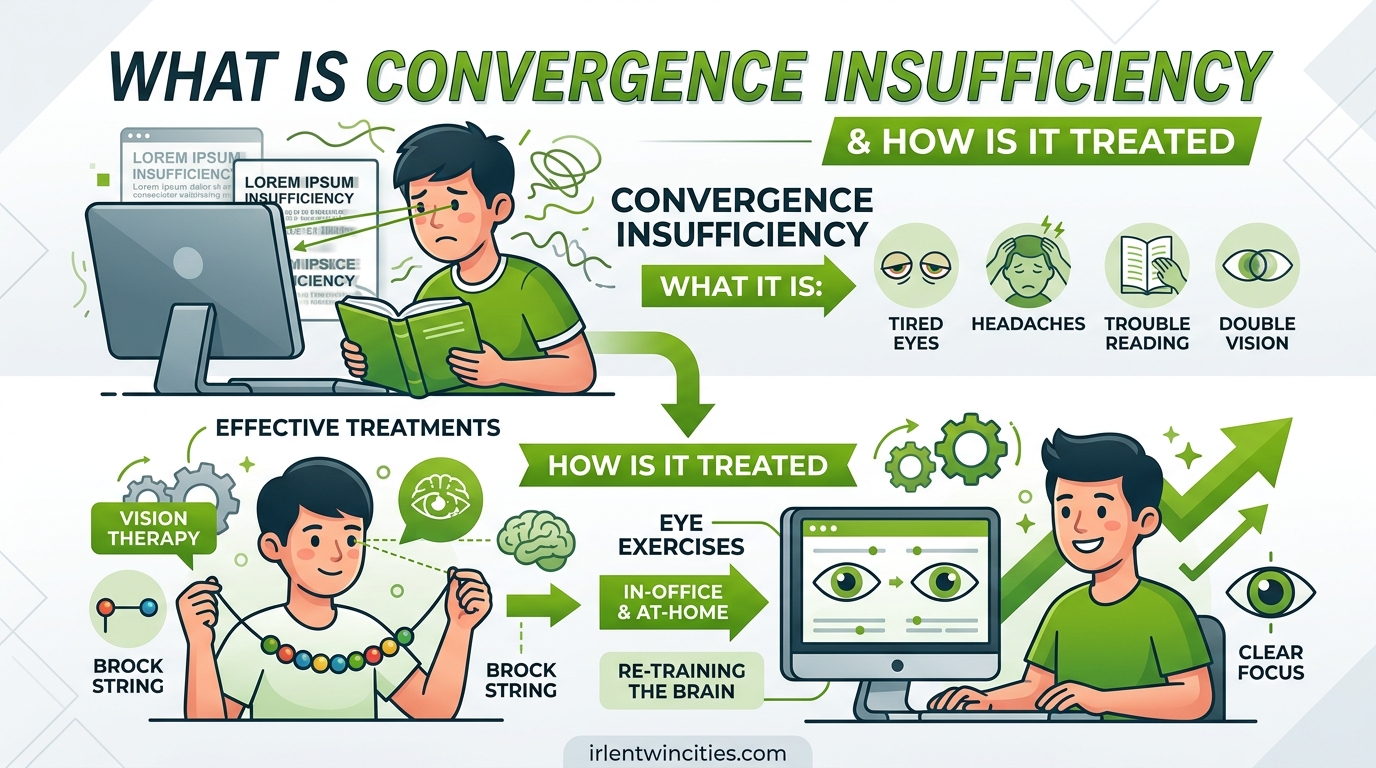
Convergence insufficiency is a vision disorder that affects how your eyes work together when focusing on nearby objects. When you look at something close like a book, phone screen, or computer monitor, your eyes need to turn slightly inward to create a single, clear image. In convergence insufficiency, this coordination fails, causing double vision, blurred sight, headaches, and significant reading difficulties.
I have seen how this condition impacts daily life for both children and adults. Many people struggle for years without realizing their symptoms stem from a treatable eye coordination problem. In this guide, I will explain what convergence insufficiency is, how it is diagnosed, and the treatment options available in 2026.
By the end of this article, you will understand why this condition often goes undetected in routine eye exams, how to recognize the warning signs, and what steps to take if you suspect you or your child might be affected.
Table of Contents
What is Convergence Insufficiency?
Convergence insufficiency is a binocular vision disorder where your eyes cannot point inward together properly when looking at close-up objects. This eye coordination problem affects the ability to maintain single, clear vision during reading, computer work, or any near-vision tasks.
Normal vision requires both eyes to work as a team. When you shift your gaze from a distant object to something nearby, your eyes automatically turn inward through a process called convergence. At the same time, the lenses inside your eyes adjust focus through accommodation. These two functions normally work together seamlessly.
In convergence insufficiency, this teamwork breaks down. One eye may drift outward when attempting to focus up close, causing the brain to receive two different images instead of one unified picture. The result is double vision, blurred sight, or the brain suppressing input from one eye to avoid confusion.
How Normal Convergence Works
Healthy binocular vision depends on precise coordination between your eye muscles and your brain. When you look at something 20 feet away, your eyes point straight ahead. As an object moves closer, your eyes must turn inward at increasingly sharp angles to keep the image aligned on both retinas.
This convergence response happens automatically through a complex neurological process. Your brain calculates the distance, signals the six extraocular muscles surrounding each eye, and adjusts their tension to achieve proper alignment. For near vision within arm’s length, your eyes typically need to converge 12 to 18 degrees inward.
The Near Point of Convergence
Eye care specialists measure convergence ability using a test called the near point of convergence, or NPC. This test determines how close an object can come to your nose while you still maintain single, clear vision with both eyes. A normal NPC ranges from 2 to 4 inches from the bridge of your nose.
People with convergence insufficiency typically show an NPC of 6 inches or greater, often experiencing double vision before the target reaches the normal range. This measurement helps eye doctors diagnose the severity of the condition and track improvement during treatment.
Symptoms of Convergence Insufficiency
The symptoms of convergence insufficiency extend far beyond simple vision problems. This condition creates a cascade of physical discomfort, reading difficulties, and behavioral changes that can significantly impact quality of life.
Visual Symptoms
The most immediate signs involve your actual sight. Double vision, also called diplopia, ranks as the most common complaint. Words may appear to split apart or overlap when reading. Blurred vision comes and goes, especially after periods of close work. You might notice words swimming on the page or losing their sharp edges.
Some people experience intermittent symptoms that worsen with fatigue. The problem may start subtly and grow more pronounced throughout the day. Many report needing to close one eye to read comfortably, though they may not realize they are doing it.
Physical Discomfort
Eye strain and fatigue represent the second major category of symptoms. Your eyes may feel tired, burning, or watery after relatively short periods of reading. Headaches frequently develop, typically starting around the temples or behind the eyes. These headaches often worsen with extended near work and improve with rest.
Some patients describe a pulling sensation around their eyes or tension in their forehead. Others notice their eyes becoming red or irritated. The physical effort required to force the eyes to work together creates genuine muscle fatigue.
Reading and Learning Difficulties
Children with undiagnosed convergence insufficiency often struggle academically in ways that seem unrelated to vision. They may avoid reading, lose their place frequently, or read slowly with poor comprehension. Many skip small words or repeat lines without realizing it.
Concentration problems commonly accompany these reading struggles. Children may appear to have attention deficits when the real issue is visual discomfort. They rub their eyes often, complain about schoolwork, or develop negative associations with reading.
Behavioral Signs in Children
Watch for specific behaviors that suggest convergence problems. Covering one eye while reading represents a common coping mechanism. Holding books unusually close or far away may indicate attempts to find a comfortable viewing distance. Frequent headaches during or after school warrant investigation.
Some children develop strong aversions to reading despite normal intelligence and verbal skills. They may say words move on the page or describe seeing double without realizing this indicates a medical problem.
Adult Presentation Differences
Adults experience convergence insufficiency differently than children. Many adults first notice symptoms after a concussion or brain injury. Computer work often triggers problems since adults spend hours daily on near tasks. Eye fatigue after screen time may signal developing CI.
Adults typically describe their symptoms more precisely than children, reporting exact circumstances where double vision occurs. They may notice reading becomes harder as the day progresses or symptoms worsen during stressful periods.
What Causes Convergence Insufficiency?
Convergence insufficiency stems from problems in the neurological control of eye coordination rather than muscle weakness. Understanding the underlying causes helps explain why this condition develops and who faces the highest risk.
Neurological Basis
The root cause involves disrupted communication between the brain and the eye muscles. The neural pathways controlling convergence fail to function properly, even though the muscles themselves remain healthy. This explains why standard eye exams focusing on eye health may miss the problem entirely.
Research suggests convergence insufficiency often relates to issues in the cerebellum and brainstem areas that coordinate eye movements. These same regions also process balance and spatial awareness, which explains why some patients experience related coordination difficulties.
Brain Injury and Concussion
Adult-onset convergence insufficiency frequently follows head trauma. Concussions, car accidents, or any significant brain injury can disrupt the delicate neural circuits controlling eye coordination. Studies show that up to 50% of concussion patients develop some form of convergence problem.
This connection has grown more recognized in recent years, particularly among athletes and military personnel. Sports-related concussions, falls, and whiplash injuries all represent common triggers for sudden CI development in previously healthy adults.
Developmental Factors
In children, convergence insufficiency often emerges during the school years when reading demands increase significantly. The condition may have existed latently but becomes symptomatic when near-vision tasks require sustained concentration. Some children seem to outgrow adequate convergence ability as academic demands exceed their developmental readiness.
Genetic factors may play a role, as convergence problems sometimes run in families. However, most cases appear without clear hereditary patterns.
Can Convergence Insufficiency Start Suddenly?
Yes, convergence insufficiency can develop suddenly, particularly after head trauma or neurological events. Adults often report waking up after a concussion with new vision problems. The sudden onset typically indicates an acquired form rather than developmental CI.
More commonly, the condition develops gradually over months or years. Slow progression makes symptoms harder to recognize since changes happen incrementally. Many adults cannot pinpoint when their symptoms began, only that they have worsened over time.
How is Convergence Insufficiency Diagnosed?
Proper diagnosis requires specialized testing beyond standard vision screenings. Many patients receive normal results on basic eye exams despite significant convergence problems, leading to delayed treatment and ongoing frustration.
Why Regular Eye Exams May Miss It
Standard eye examinations focus primarily on visual acuity, determining whether you need glasses to see clearly at distance. These tests measure how well each eye sees individually but often fail to evaluate how both eyes work together. A child with 20/20 vision in each eye separately can still have severe convergence insufficiency.
Distance vision tests completely miss near-vision coordination problems. Since convergence only activates for close work, distance-based screenings provide no relevant information. This explains why many children pass school vision tests while struggling tremendously with reading.
Specialized Diagnostic Tests
A developmental optometrist or neuro-optometrist performs specific tests to evaluate convergence ability. The near point of convergence test measures how close you can bring a target before seeing double. This simple but revealing test immediately identifies convergence problems.
Fusional vergence testing assesses your ability to keep images fused while they are moved toward or away from you. This evaluates both convergence and divergence capabilities. Accommodation testing checks how well your focusing system works in coordination with eye alignment.
What to Expect During a Specialized Exam
A comprehensive binocular vision evaluation typically takes 45 to 60 minutes. The optometrist will ask detailed questions about your symptoms, when they occur, and what activities trigger them. They will test each eye individually, then both eyes together.
Expect to track moving targets, view three-dimensional images, and perform reading tests while the doctor observes your eye movements. Some tests use special equipment like prisms or red-green glasses to isolate specific visual functions.
Finding the Right Specialist
Look for an optometrist who specializes in binocular vision, vision therapy, or neuro-optometry. General optometrists and ophthalmologists may not have the specific training or equipment to diagnose convergence insufficiency accurately. Professional organizations like the College of Optometrists in Vision Development maintain directories of qualified specialists.
Ask prospective doctors whether they regularly diagnose and treat convergence problems. Inquire about their experience with vision therapy. A specialist should offer clear explanations and specific testing protocols beyond routine examinations.
Treatment Options for Convergence Insufficiency
Convergence insufficiency responds well to treatment, with vision therapy offering the most effective long-term solution. Multiple approaches exist, ranging from targeted exercises to specialized glasses and, in rare cases, surgical intervention.
Vision Therapy
Vision therapy represents the gold standard treatment for convergence insufficiency. This structured program uses exercises and activities to retrain the brain and eyes to work together properly. Unlike simple eye exercises, vision therapy addresses the neurological foundation of the problem.
Treatment typically combines in-office sessions with home exercises. In-office therapy occurs once or twice weekly under professional supervision, using specialized equipment like prisms, lenses, and computer programs. Home exercises reinforce progress between appointments and build new visual habits.
Specific Vision Therapy Exercises
Several proven exercises target convergence ability directly. The Brock string, a simple white string with colored beads, helps patients learn to control their convergence point consciously. Patients focus on different beads while observing physiological diplopia, training their brain to coordinate both eyes.
Pencil push-ups involve focusing on a pencil tip while slowly moving it toward the nose. This strengthens convergence muscles and extends the near point of convergence. Computer-based therapy programs provide structured exercises with immediate feedback, often making therapy more engaging for children.
Fusional range exercises use prism lenses to gradually increase the demand on the convergence system. Base-out prisms force the eyes to turn inward more than normal, building strength and flexibility in the vergence system.
Prism Glasses
Prism glasses can provide immediate relief by optically correcting the misalignment between eyes. These special lenses bend light before it enters the eye, reducing the amount of convergence needed to achieve single vision. Some patients use prism glasses while undergoing vision therapy or for specific tasks.
Reading glasses with prism are particularly helpful for computer work or extended reading sessions. They reduce symptoms but do not cure the underlying condition. Many patients find prisms useful during the early stages of vision therapy or for situations requiring prolonged near work.
Treatment Timeline and What to Expect
Vision therapy typically requires 12 to 24 weeks for significant improvement, though timelines vary based on severity and consistency. Most patients attend weekly in-office sessions lasting 45 to 60 minutes. Daily home exercises, usually 15 to 20 minutes, accelerate progress.
Children often respond faster than adults due to greater neurological plasticity. However, adults can achieve excellent results with dedicated effort. I have seen adults in their 60s make substantial improvements after decades of untreated symptoms.
Progress is measured through regular testing of the near point of convergence, fusional ranges, and symptom questionnaires. Objective improvements typically appear before subjective symptom relief, so patients should not become discouraged if daily discomfort persists initially.
Surgery and Other Medical Options
Surgery rarely treats convergence insufficiency and only becomes an option in severe, unresponsive cases. Some specialists have explored Botox injections to temporarily weaken specific eye muscles, though this remains experimental.
Medications affecting neurological function are not typically used for isolated CI. However, treating underlying conditions like myasthenia gravis or thyroid eye disease may resolve associated convergence problems.
Home Exercises and Self-Care
While professional vision therapy offers the best outcomes, certain home exercises can help mild cases or support formal treatment. Pencil push-ups performed consistently may improve mild convergence insufficiency. The 20-20-20 rule, taking a 20-second break every 20 minutes to look at something 20 feet away, reduces eye strain during computer work.
Proper lighting, screen positioning at arm’s length, and conscious blinking all support visual comfort. However, these measures manage symptoms rather than cure the underlying condition. Significant convergence problems require professional intervention.
Living with Convergence Insufficiency
Convergence insufficiency affects daily activities from school performance to workplace productivity. Understanding the long-term outlook and practical management strategies helps patients navigate life with this condition.
Daily Life Impact
Reading remains the most obvious challenge, but CI affects many activities. Using smartphones and tablets causes strain due to close viewing distances. Cooking and crafts requiring detailed near work become difficult. Some patients struggle with sports involving fast-moving balls since convergence and tracking work together.
Computer work presents particular problems for adults. Hours of screen time create cumulative eye strain that worsens throughout the workday. Many adults with undiagnosed CI assume they simply cannot tolerate office jobs or need frequent breaks they cannot take.
Work and School Accommodations
Several accommodations can help during treatment. Larger font sizes reduce the convergence demand required for reading. Colored overlays or tinted lenses sometimes improve comfort, though they do not address the underlying problem. Positioning screens slightly farther than normal may provide temporary relief.
Students may benefit from extra time for reading assignments, audio books, or printed materials with increased spacing. Adults might negotiate modified computer setups, additional monitor distance, or task rotation to limit sustained near work.
Can Convergence Insufficiency Be Fully Cured?
Most patients achieve significant symptom relief through vision therapy, with many experiencing complete resolution of their convergence problems. The brain’s ability to develop new neural pathways allows genuine improvement in eye coordination. However, the concept of “cure” requires some nuance.
Some patients maintain their gains indefinitely after completing therapy. Others may need occasional maintenance exercises, especially during periods of stress or illness. A minority experience symptom recurrence years after successful treatment, though this usually responds to a brief therapy refresher.
Does Convergence Insufficiency Get Worse With Age?
Untreated convergence insufficiency may worsen gradually as near-vision demands increase or the visual system ages. The focusing ability of the eyes naturally declines after age 40, a condition called presbyopia. This normal aging change can unmask or aggravate existing convergence problems.
However, age does not doom patients to worsening symptoms. Treatment works at any age, and many adults successfully address long-standing CI. The key is seeking proper diagnosis rather than assuming vision problems are inevitable with aging.
What Happens If Convergence Insufficiency Is Not Treated?
Untreated CI can lead to significant complications beyond simple discomfort. Children may develop strong aversions to reading that impact educational achievement throughout their academic careers. Some children are misdiagnosed with learning disabilities or ADHD when the root cause is actually visual.
Adults with untreated CI often limit their career options or experience declining quality of life as they avoid activities causing discomfort. Chronic headaches and eye strain affect mood and energy levels. Some patients develop suppression, where the brain permanently ignores input from one eye, potentially leading to amblyopia in severe cases.
When to Seek Professional Help
Schedule a comprehensive eye examination with a binocular vision specialist if you experience double vision, frequent headaches with reading, or difficulty concentrating during close work. Children showing reading avoidance, slow reading speed, or complaints about schoolwork warrant evaluation even if they have passed school vision screenings.
Seek immediate care if double vision appears suddenly after head trauma. Post-concussion vision problems should be addressed as part of overall recovery. Early intervention leads to faster results and prevents the development of compensatory habits that complicate treatment.
Frequently Asked Questions
Can you get rid of convergence insufficiency?
Yes, most people can significantly improve or fully resolve convergence insufficiency through vision therapy. Treatment typically involves structured exercises that retrain the brain and eyes to work together properly. While some patients achieve complete resolution, others may need occasional maintenance exercises to keep symptoms at bay. The condition responds well to treatment at any age, though children often see faster results than adults.
Can convergence insufficiency start suddenly?
Yes, convergence insufficiency can develop suddenly, particularly following a concussion, head injury, or other neurological event. This sudden onset is called acquired convergence insufficiency and differs from developmental forms that emerge gradually during childhood. Adult patients often report waking up after an injury with new vision problems. However, many cases develop gradually over months or years, making the onset harder to pinpoint.
What happens if convergence insufficiency is not treated?
Untreated convergence insufficiency can lead to several complications. Children may develop reading avoidance, poor academic performance, or be misdiagnosed with ADHD or learning disabilities. Adults often experience chronic headaches, eye strain, and limitations in career choices or daily activities. Some patients develop suppression, where the brain ignores input from one eye to avoid double vision. The condition rarely causes permanent eye damage, but the impact on quality of life and educational or professional achievement can be significant.
Does convergence insufficiency get worse with age?
Untreated convergence insufficiency may worsen with age as near-vision demands increase and the eyes’ natural focusing ability declines after age 40. This normal aging change, called presbyopia, can aggravate existing convergence problems. However, age itself does not make CI untreatable. Vision therapy works effectively for adults of all ages, and many patients successfully address long-standing symptoms later in life. Proper treatment prevents age-related progression.
Is convergence insufficiency related to ADHD?
Convergence insufficiency is not caused by ADHD, but the symptoms often overlap, leading to misdiagnosis. Children with undiagnosed CI may appear to have attention problems because they avoid reading or lose focus due to visual discomfort rather than actual attention deficits. Studies show children with CI are more likely to be diagnosed with ADHD, though treating the vision problem alone does not resolve true attention disorders. A comprehensive evaluation distinguishing between visual and attentional issues ensures appropriate treatment.
How long does convergence insufficiency treatment take?
Vision therapy for convergence insufficiency typically takes 12 to 24 weeks of regular treatment. Most patients attend weekly in-office sessions lasting 45 to 60 minutes, combined with daily home exercises of 15 to 20 minutes. Children often respond faster than adults due to greater neurological plasticity. Severe cases or those with additional vision problems may require longer treatment. Progress should be measurable within the first month of consistent therapy.
Conclusion
Convergence insufficiency is a treatable vision disorder that affects how your eyes work together during close work. Despite causing significant symptoms including double vision, headaches, and reading difficulties, this condition often goes undetected in routine eye exams. Understanding the signs and seeking proper diagnosis from a binocular vision specialist opens the door to effective treatment.
Vision therapy offers the most successful long-term solution, with most patients experiencing substantial improvement within 12 to 24 weeks. Whether you are a parent concerned about your child’s reading struggles or an adult dealing with post-concussion vision problems, help is available. Convergence insufficiency does not have to limit your educational achievement, career options, or daily comfort.
If you suspect convergence insufficiency might be affecting you or your child, schedule a comprehensive evaluation with a developmental or neuro-optometrist. Early diagnosis and treatment can transform a frustrating, limiting condition into a manageable, temporary challenge. Your eyes are designed to work as a team, and with proper therapy, they can learn to do so again.