
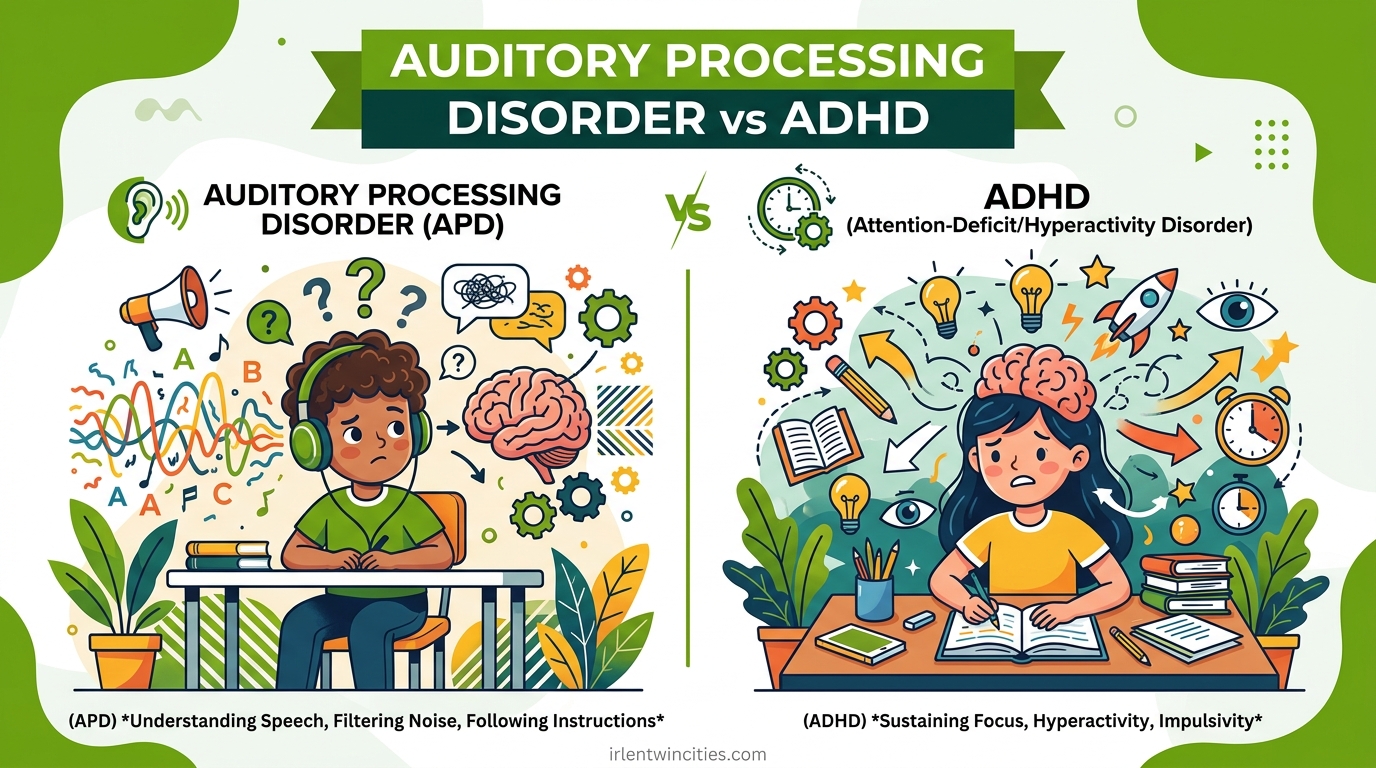
Your child keeps saying “what?” and “huh?” even though their hearing tests come back perfect. Or maybe you’re an adult who feels drained after every meeting, constantly asking colleagues to repeat themselves. These frustrating experiences leave many wondering: is this auditory processing disorder or ADHD? The confusion is completely understandable. Both conditions can make someone seem tuned out, forgetful, or like they’re not listening. Yet they stem from completely different neurological mechanisms and require different approaches.
Understanding auditory processing disorder vs ADHD matters because the treatment paths diverge significantly. Research shows that approximately 50% of people diagnosed with ADHD may also have some form of auditory processing disorder. However, ADHD medications like stimulants will not improve APD symptoms. Getting the right diagnosis means getting the right help. This guide breaks down exactly how to tell these conditions apart, what testing looks like for each, and practical strategies that actually work.
Whether you’re a parent trying to advocate for your child, an adult searching for answers about lifelong listening struggles, or an educator noticing behavioral overlaps in your classroom, this article gives you the clarity you need.
Table of Contents
What Is Auditory Processing Disorder?
Auditory Processing Disorder (APD), also called Central Auditory Processing Disorder (CAPD), is a brain-based condition that affects how the central auditory nervous system processes sound. This is not a hearing problem. The ears work perfectly. The issue happens after sound waves convert to electrical signals and travel to the brain. The auditory cortex struggles to interpret, organize, or make sense of what was heard.
Think of it like a computer with a broken processor. The microphone picks up sound fine, but the CPU cannot decode the information properly. Someone with APD might hear a sentence clearly but process it as gibberish. They might catch every word in a quiet room but hear only fragments when background noise enters the environment.
The 5 Types of APD
APD is not a single uniform condition. Audiologists recognize five distinct types based on which aspect of auditory processing breaks down. Understanding these types helps explain why two people with APD might have very different experiences.
- Auditory discrimination deficit: Difficulty distinguishing between similar sounds, such as “bat” versus “pat.” This affects phonemic awareness and reading development.
- Auditory memory weakness: Trouble recalling what was heard, even immediately after hearing it. This impacts following multi-step directions.
- Auditory sequencing problems: Hearing sounds or words out of order. Someone might process “sixty-five” as “fifty-six.”
- Auditory figure-ground deficit: Inability to focus on important sounds while filtering out background noise. The brain gives equal weight to all auditory input.
- Auditory cohesion deficit: Higher-level difficulty with abstract or complex auditory information, such as understanding sarcasm or following lengthy verbal explanations.
Who Does APD Affect?
APD affects both children and adults, though it often becomes noticeable when children enter school and listening demands increase. Boys are diagnosed more frequently than girls, though this may reflect referral bias rather than true prevalence. Some children are born with APD, while others develop it after recurrent ear infections, head trauma, or neurological events. Adults may acquire APD after strokes, tumors, or age-related changes in the central auditory nervous system.
What Is ADHD?
Attention Deficit Hyperactivity Disorder (ADHD) is a neurodevelopmental condition affecting attention regulation, impulse control, and activity levels. Unlike APD, which specifically impacts auditory processing, ADHD affects multiple domains of executive function. The brain’s attention systems struggle to sustain focus, filter distractions, and manage impulses.
The core challenge in ADHD involves the brain’s reward and attention networks. Neurotransmitters like dopamine and norepinephrine play key roles in signaling what deserves attention. When these systems are dysregulated, the brain either hyperfocuses on interesting stimuli or cannot maintain attention on mundane tasks. Working memory, the ability to hold information in mind while using it, is often impaired. This explains why someone with ADHD might hear instructions perfectly but forget them seconds later.
Three Presentations of ADHD
ADHD presents in three distinct ways, and these presentations can change over time. The inattentive presentation involves difficulty sustaining attention, disorganization, and forgetfulness without significant hyperactivity. The hyperactive-impulsive presentation features restlessness, interrupting, and difficulty waiting turns. The combined presentation includes symptoms from both categories.
Many people, especially girls and women, have the inattentive presentation and go undiagnosed for years. They may appear daydreamy or spacey rather than disruptive. This presentation particularly overlaps with APD symptoms because both involve seeming tuned out during verbal interactions.
Executive Function and Working Memory Connection
Executive functions are the brain’s management system. They include working memory, flexible thinking, and impulse control. ADHD affects these executive functions broadly, not just auditory processing. Someone with ADHD might struggle equally with following written instructions, keeping track of physical objects, and managing time.
Working memory deficits create a specific kind of listening difficulty. As one Reddit user described it: “Our working memories are crap and so by the time we hear the next word, the previous one is gone.” This creates a bottleneck where information enters the ears but cannot be held long enough to process meaning.
ADHD and Auditory Processing Connection
ADHD does affect auditory attention specifically, even when general auditory processing is intact. The ADHD brain struggles with auditory vigilance, the ability to maintain attention to sound over time. Background noise becomes more distracting. Sustained listening during lectures or conversations requires more effort. This creates significant overlap with APD symptoms, making differentiation challenging without professional testing.
Auditory Processing Disorder vs ADHD: Key Differences
The fundamental distinction between APD and ADHD comes down to mechanism versus manifestation. APD is a processing problem. The brain receives sound correctly but interprets it incorrectly. ADHD is an attention regulation problem. The brain can process sound correctly but cannot sustain attention to it.
One Reddit user captured this distinction perfectly: “If we are both absorbed in an activity, he (with ADHD) won’t even notice someone is talking. I (with APD) will hear them but cannot process what they’re saying.” This single sentence encapsulates the core difference. ADHD creates attention gaps where sound is not even registered. APD creates processing gaps where sound is registered but not understood.
Core Distinction: Processing vs Attention
In APD, the auditory system itself is the bottleneck. Sound travels normally through the ear canal, eardrum, and cochlea. The problem occurs when signals reach the brainstem and auditory cortex. Neural pathways fail to encode, organize, or interpret the auditory information accurately.
In ADHD, the attention system creates the bottleneck. The ears and auditory cortex function normally. The issue is that the attention networks cannot sustain focus on auditory input. The brain’s filter allows too many distractions through, or the reward system fails to tag auditory information as important enough to process.
Symptom Comparison Table
| Behavior Observed | APD Interpretation | ADHD Interpretation |
|---|---|---|
| Says “what?” or “huh?” frequently | Heard but didn’t process correctly | Wasn’t attending when spoken to |
| Difficulty following verbal directions | Cannot sequence or remember the steps | Got distracted partway through |
| Appears tuned out in noisy environments | Cannot filter background noise | Attention captured by other stimuli |
| Poor reading and spelling | Phonemic awareness problems | Skipping words, rushing through |
| Social difficulties | Misses subtle social cues in speech | Interrupts, changes topics abruptly |
| Academic struggles | Auditory instruction is primary barrier | Multiple executive function challenges |
Primary Concerns Comparison
Both conditions create challenges, but the primary concerns differ. Understanding these priorities helps guide intervention strategies.
| Primary Concern | APD | ADHD |
|---|---|---|
| Main deficit | Auditory processing accuracy | Attention regulation |
| Listening environment | Quiet is helpful, noise is harmful | Interest level matters more than volume |
| Medication response | No medication available | Stimulants often effective |
| Key accommodation | FM systems, written instructions | Movement breaks, visual reminders |
| Primary professional | Audiologist | Psychiatrist or psychologist |
Symptom Overlap and How to Distinguish Them
Many symptoms appear in both conditions, creating diagnostic confusion. Both APD and ADHD can cause someone to seem forgetful, distracted, or unresponsive. The difference lies in the trigger and the pattern.
APD-Specific Symptoms
Certain symptoms point more strongly toward APD. Listening fatigue is a hallmark sign. After sustained listening, someone with APD feels mentally exhausted in a way that goes beyond simple boredom. They may report that their brain feels full or that they need silence to recover.
Phonemic awareness problems are another APD indicator. Difficulty recognizing that “bat,” “cat,” and “hat” share a rhyming pattern suggests auditory discrimination issues. Struggles with reading, especially phonetic decoding, often accompany APD because reading builds on sound processing.
Background noise sensitivity is particularly telling. Someone with APD may function well in quiet one-on-one conversations but completely shut down at a busy restaurant. The problem is not social anxiety. It is the brain’s inability to filter competing sounds.
ADHD-Specific Symptoms
Hyperactivity and impulsivity strongly suggest ADHD. Fidgeting, interrupting, difficulty waiting turns, and blurting out answers are classic ADHD signs rarely seen in pure APD. These reflect the broader attention and impulse control problems that define ADHD.
Disorganization across multiple domains points to ADHD. Someone who loses belongings, misses deadlines, and cannot keep their workspace tidy is showing executive function deficits beyond auditory processing. APD primarily affects auditory organization. ADHD affects all forms of organization.
Variable attention based on interest is another ADHD marker. Someone with ADHD might listen perfectly during an engaging video game tutorial but tune out during a routine request to take out the trash. With APD, the difficulty persists regardless of how interesting the content is.
The 10-3 Rule for ADHD
The 10-3 rule is a simple guideline that describes typical ADHD attention patterns. A child with ADHD can usually focus for about 10 minutes on a non-preferred task before needing a break. After 3 minutes of movement or preferred activity, they can return to the task with renewed focus.
This rule explains why traditional classroom structures, with their long periods of seated listening, create such difficulty for students with ADHD. It is not defiance or laziness. It is a neurological need for attention cycling that does not match the environment’s demands.
How APD and ADHD Are Diagnosed
Getting the right diagnosis requires the right professional. Because APD and ADHD share symptoms but require different specialists, knowing where to start is crucial.
Testing for Auditory Processing Disorder
APD diagnosis requires evaluation by an audiologist who specializes in central auditory processing. The process begins with a standard hearing test to rule out peripheral hearing loss. Once normal hearing is confirmed, specialized testing begins.
- Dichotic listening tests: Different words are presented to each ear simultaneously. The patient repeats what they heard in each ear. Performance asymmetry indicates processing problems.
- Temporal processing tests: These assess the ability to process sounds over time, including gaps between sounds and patterns in tones.
- Speech-in-noise testing: Words are presented with increasing background noise to determine the signal-to-noise ratio where performance breaks down.
- Auditory figure-ground tests: Competing messages are presented, testing the ability to attend to one while filtering the other.
- Binaural interaction tests: These evaluate how well the two hemispheres work together to process auditory information.
APD cannot be diagnosed before age 7 in most cases because the auditory system is still developing. Testing younger children yields unreliable results. Some audiologists offer screening for younger children, but formal diagnosis waits until the brain’s auditory pathways mature.
Testing for ADHD
ADHD diagnosis involves psychiatrists, psychologists, or other mental health professionals trained in neurodevelopmental disorders. Unlike APD testing, which uses objective auditory measures, ADHD diagnosis relies primarily on behavioral observation and history.
- Clinical interviews: Detailed conversations with the patient and family about developmental history, current symptoms, and functional impairment.
- Behavior rating scales: Standardized questionnaires completed by parents, teachers, and the individual being evaluated. These compare the person’s behavior to age norms.
- Continuous performance tests: Computer-based tests measuring sustained attention, impulsivity, and consistency of response.
- Cognitive testing: Assessments of working memory, processing speed, and other executive functions to identify patterns consistent with ADHD.
- Rule-out assessments: Screening for conditions that mimic ADHD, including anxiety, depression, sleep disorders, and learning disabilities.
ADHD can be diagnosed at any age, though symptoms must have started in childhood. Many adults seek diagnosis after recognizing lifelong patterns or after their children receive ADHD diagnoses.
Why Misdiagnosis Happens
Misdiagnosis between APD and ADHD is common for several reasons. The overlapping symptoms create genuine diagnostic confusion. A child who cannot follow directions might have attention problems, auditory processing problems, or both.
Professionals sometimes evaluate for only one condition. A psychiatrist assessing ADHD might not consider APD. An audiologist testing for APD might not screen for ADHD. This siloed approach misses the comorbidity that exists in roughly half of cases.
ADHD is more widely known and recognized. When parents or teachers observe attention problems, ADHD comes to mind first. APD remains less understood, leading to underdiagnosis.
APD and ADHD Comorbidity: Can You Have Both?
Yes, you can absolutely have both APD and ADHD. Research consistently shows significant overlap between these conditions. Studies suggest that 40% to 75% of individuals diagnosed with ADHD also meet criteria for some form of auditory processing disorder. The commonly cited figure of 50% represents a middle estimate.
This overlap is not coincidental. Both conditions involve brain networks that handle information processing and attention. The central auditory nervous system and the attention regulation systems are anatomically connected and functionally intertwined. When one system is atypical, the other often is too.
Why the 50% Overlap Matters
The high comorbidity rate has practical implications for diagnosis and treatment. If your child receives an ADHD diagnosis, considering APD screening makes sense. If APD is diagnosed, watching for ADHD symptoms is equally important.
As one Reddit user discovered: “Then I found out people with ADHD were more likely to have auditory processing issues. Mind-blowing. And incredibly validating.” Understanding that these conditions commonly coexist removes self-blame and guides appropriate intervention.
Can ADHD Cause APD?
This question gets at the heart of the relationship between these conditions. Strictly speaking, ADHD does not cause APD in the sense of creating the neurological differences seen in APD. They are separate conditions with different underlying mechanisms.
However, ADHD can cause auditory processing difficulties that look like APD. The attention deficits in ADHD create problems with auditory vigilance, working memory for auditory information, and filtering distractions. These functional difficulties can occur even when the auditory cortex processes sound normally.
Distinguishing primary APD from ADHD-related auditory difficulties requires professional testing. The audiologist’s tests measure basic auditory processing independent of attention. If these tests are normal, the listening difficulties are likely attention-based rather than processing-based.
Dual Diagnosis Implications
Having both APD and ADHD creates compounded challenges but also opens more treatment avenues. ADHD medication can improve attention, which indirectly helps with listening. However, medication will not fix the underlying auditory processing deficits. Those require environmental accommodations and auditory training.
A comprehensive treatment plan addresses both conditions. This might include stimulant medication for ADHD, FM systems for APD, combined behavioral strategies, and specific accommodations at school or work. Treating only one condition leaves significant functional impairment.
Management Strategies That Actually Work
Effective management depends on accurate diagnosis. Strategies that help APD may not help ADHD, and vice versa. When both conditions coexist, a combined approach works best.
APD-Specific Strategies
APD management focuses on environmental modifications and compensatory strategies. Because no medication treats APD directly, accommodations become essential.
- FM systems and remote microphone technology: These devices bring the speaker’s voice directly to the listener, overcoming background noise and distance. They are highly effective for APD and also help some people with ADHD.
- Written instructions: Whenever possible, provide directions in writing rather than verbally. This removes the auditory processing barrier entirely.
- Visual supports: Charts, pictures, and graphic organizers supplement verbal information.
- Preferential seating: Sitting close to the speaker reduces distance and competing noise.
- Auditory training: Some audiologists offer computer-based programs designed to strengthen auditory processing skills.
- Noise-canceling headphones: These help during independent work by reducing environmental distractions.
ADHD-Specific Strategies
ADHD management includes both medical and behavioral approaches. Unlike APD, medication plays a central role in ADHD treatment.
- Stimulant medication: Medications like methylphenidate and amphetamines improve attention regulation for approximately 70% of people with ADHD. These do not treat APD but can help with the attention component of listening.
- Movement breaks: Brief periods of physical activity help reset attention. The 10-3 rule suggests a 3-minute break after every 10 minutes of focused work for some individuals.
- Visual reminders: Checklists, timers, and posted schedules externalize working memory.
- Fidget tools: Allowing movement during listening can actually improve focus for some people with ADHD.
- Cognitive behavioral therapy: CBT helps develop organizational skills and coping strategies.
Technology Tools for Both Conditions
Modern technology offers powerful tools for managing both APD and ADHD. These tools address the common challenge of auditory information processing.
- Voice-to-text apps: Real-time transcription allows reading what is being said. Apps like Otter.ai, Google Live Transcribe, and Ava provide accurate transcription.
- Recording devices: Recording lectures or meetings allows review at a slower pace.
- Noise-canceling headphones: Essential for both conditions, these reduce the background noise that distracts ADHD brains and overwhelms APD brains.
- Focus apps: Tools like Freedom, Cold Turkey, and Focus@Will help manage digital distractions that compound listening difficulties.
- Smart speakers with displays: Visual confirmation of voice commands helps verify that auditory processing was accurate.
Classroom and Workplace Accommodations
School accommodations for APD and ADHD are protected under federal law in the United States. Section 504 plans and Individualized Education Programs (IEPs) can include specific supports.
Common accommodations include extended time on tests, written copies of instructions, permission to record lectures, preferential seating, and access to FM systems. For adults, workplace accommodations under the ADA might include written meeting agendas, permission to record important conversations, and access to transcription services.
Self-advocacy becomes crucial. Explaining your needs to teachers, employers, and colleagues helps them understand that requests for repetition or written summaries are not signs of disinterest. They are necessary accommodations for neurological differences.
Frequently Asked Questions
How to tell the difference between ADHD and auditory processing disorder
The key difference lies in attention versus processing. With ADHD, the person often was not attending when spoken to and may not realize someone was talking. With APD, the person hears the speech but cannot process the meaning. ADHD affects attention across all senses and domains. APD specifically affects how the brain interprets sound after it reaches the ears. Professional testing with an audiologist can distinguish these conditions.
What is the 10-3 rule for ADHD
The 10-3 rule describes typical ADHD attention patterns. A person with ADHD can usually focus on a non-preferred task for approximately 10 minutes before needing a break. After about 3 minutes of movement or preferred activity, they can return to the task with renewed focus. This rule helps structure academic and work environments to match neurological needs rather than fighting against them.
How to get tested for auditory processing disorder
Testing for APD requires evaluation by an audiologist who specializes in central auditory processing. The process includes a standard hearing test followed by specialized assessments such as dichotic listening tests, temporal processing tests, speech-in-noise testing, and auditory figure-ground tests. APD typically cannot be diagnosed before age 7 because the auditory system is still developing. Testing is usually not covered by standard hearing screenings at schools.
What are the 5 types of APD
The five types of APD are: 1) Auditory discrimination deficit – difficulty distinguishing between similar sounds, 2) Auditory memory weakness – trouble recalling what was heard, 3) Auditory sequencing problems – hearing sounds or words out of order, 4) Auditory figure-ground deficit – inability to filter out background noise, and 5) Auditory cohesion deficit – difficulty with complex or abstract auditory information like sarcasm or lengthy explanations.
Can you have both APD and ADHD
Yes, approximately 50% of people diagnosed with ADHD also have some form of auditory processing disorder. The conditions share neurological pathways and commonly co-occur. Having both creates compounded listening challenges but also opens more treatment options. ADHD medication may help attention but will not treat APD symptoms. A comprehensive approach addressing both conditions yields the best outcomes.
Why is APD often misdiagnosed as ADHD
APD is frequently misdiagnosed as ADHD because both conditions cause similar observable behaviors: seeming tuned out, difficulty following directions, forgetfulness, and academic struggles. ADHD is more widely known, so professionals and parents often consider it first. Additionally, the conditions overlap in 50% of cases, making pure APD harder to identify when ADHD symptoms are present. Proper diagnosis requires specific audiologist testing for APD.
Does ADHD medication help with APD symptoms
No, ADHD medication does not treat APD symptoms. Stimulant medications improve attention regulation, which may help with listening focus, but they do not fix the underlying auditory processing deficits in the central auditory nervous system. APD requires environmental accommodations like FM systems, written instructions, and noise reduction rather than medication. When both conditions coexist, medication helps the ADHD component while accommodations address the APD component.
Conclusion
Distinguishing auditory processing disorder vs ADHD requires understanding where the breakdown occurs. APD represents a processing problem in the central auditory nervous system. ADHD represents an attention regulation problem affecting executive function. Both can make someone appear tuned out, forgetful, or inattentive. The difference is that with APD, the ears work but the brain misinterprets. With ADHD, the attention system cannot sustain focus on what the ears hear perfectly.
The 50% comorbidity rate means many people live with both conditions simultaneously. This is not a diagnostic failure but a neurological reality. Treatment must address both the processing deficits and the attention challenges. ADHD medication helps attention but will not cure APD. Environmental accommodations help APD but will not fully address ADHD.
If you or your child struggles with listening, following directions, or processing verbal information, seeking professional evaluation is the essential next step. An audiologist can test for APD. A psychiatrist or psychologist can evaluate for ADHD. Getting the right diagnosis opens the door to the right interventions, turning daily struggles into manageable challenges.