
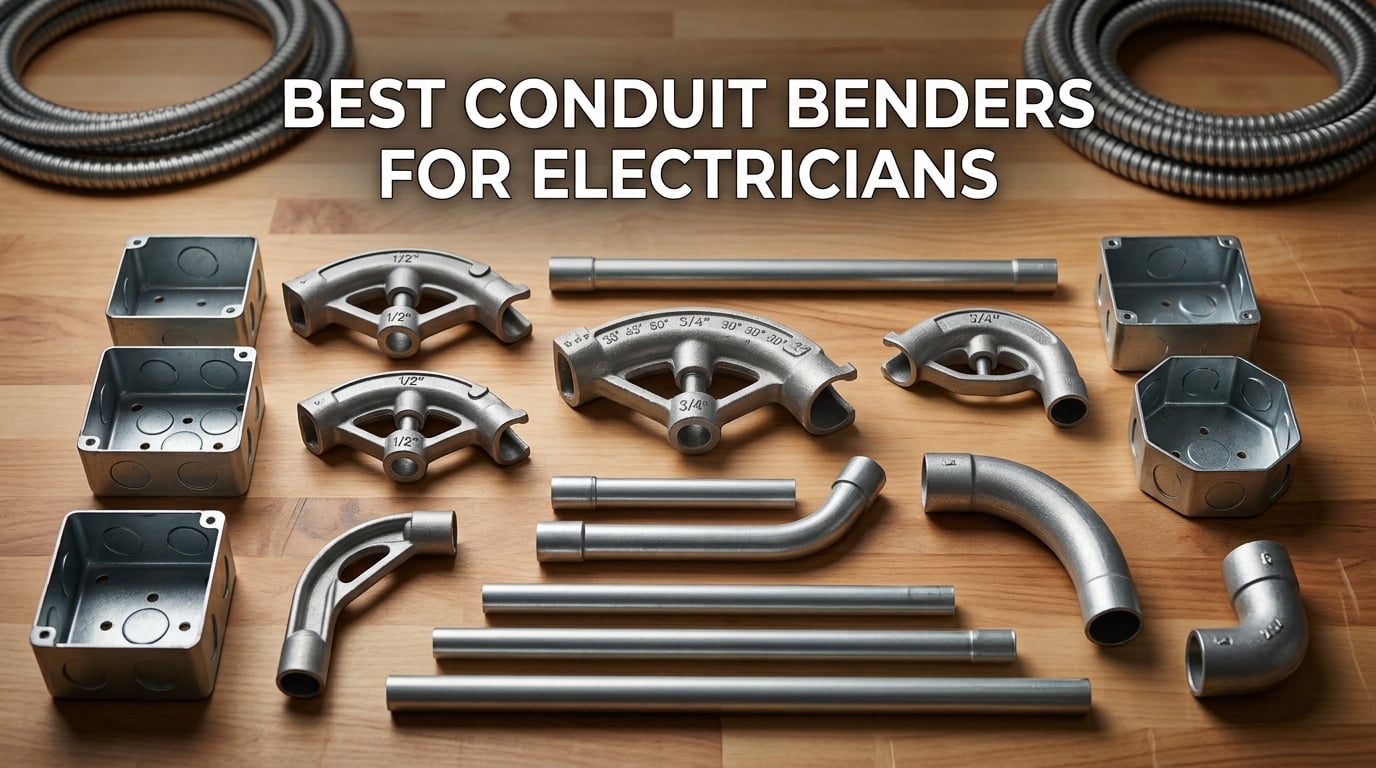
If you bend conduit every week, you already know a wobbly shoe or a faded star turns a clean stub into a rework job. We spent the last two months rotating 10 of the most popular conduit benders for electricians through our shop, running them across residential rough-in, commercial 3/4″ EMT pulls, and the occasional 1″ service entrance to see which ones actually hold up to daily use.
Whether you’re an apprentice buying your first bender or a journeyman upgrading from a plastic-handle import, this guide breaks down the best conduit benders for electricians you can get your hands on in 2026. We focused on real-world criteria: cast iron versus aluminum shoe strength, laser-etched versus stamped degree marks, handle length for leverage, and whether the head is replaceable when it eventually wears out. We also pulled in forum feedback from r/electricians and Electrician Talk so you hear what working pros say, not just marketing copy.
If you’re putting together a full apprentice tool kit, our picks pair well with the best multimeters for electricians and the best tool belts for electricians roundups we’ve already published. Let’s get into the picks.
Table of Contents
Our Top 10 Conduit Benders for 2026
- Klein Tools 51606 Aluminum Bender, 1/2″ EMT – Editor’s Choice. The all-around best conduit bender for apprentices and pros who want repeatable bends.
- NSI CB100 Aluminum Die Cast Bender, 1″ EMT / 3/4″ Rigid – Best Value. Cast-in angle indicators and a price that makes sense for moonlighting work.
- Southwire 1/2″ EMT Aluminum Bender – Budget Pick. Lightweight aluminum with clear markings for DIY and home wiring.
- TEMCo TH3030 Dual Size Offset Bender, 1/2″ & 3/4″ EMT – Best For Offsets. Two benders in one tool with a tool-free die swap.
- IDEAL 74-034 Ductile Iron Bender, 1-1/4″ EMT – Best For Heavy-Duty. Ductile iron head built for daily commercial use.
- Greenlee 1810 Little Kicker Offset Bender, 1/2″ EMT – Best Single-Step Offset. Mechanical compression for matching box knockouts in one motion.
- TEMCo TH1909 Dual Shoe Bender, 1/2″ & 3/4″ EMT – Best Dual-Size Value. Saves space and money for crews that switch sizes often.
- Gardner Bender 962 BigBen Aluminum Head, 1″ EMT – Best 1-Inch Head. Enlarged hook and oversized foot pedal for thick-wall bending.
- Greenlee 842AH Site Rite Aluminum Bender, 1″ EMT / 3/4″ Rigid – Best Pro-Grade Aluminum. Trusted Greenlee pedigree in a lighter package.
- Fuzbaxy 1/2″ EMT Aluminum Bender Head – Most Affordable. A head-only option that pairs with any threaded pipe handle.
Top 3 Picks at a Glance

Klein Tools 51606 1/2 inch EMT Bender
- Angle Setter tech for repeatable bends
- Cast aluminum with wide foot pedal
- Bold cast degree markings for 10/22.5/30/45/60 degrees
- Interior hook prevents conduit rolling

NSI CB100 1 inch EMT / 3/4 inch Rigid Bender
- Cast-in angle indicators on the shoe
- Lightweight aluminum die cast body
- 8 inch inside bend radius
- Compatible with Klein and aftermarket handles

Southwire 1/2 inch EMT Aluminum Bender
- Grooved hook for non-slip bending
- Handles stub
- offset
- back-to-back and saddle bends
- Lightweight 2 lb aluminum head
- Clear complete angle and bend markings
Best Conduit Benders for Electricians in 2026 – Quick Overview
| Product | Specifications | Action |
|---|---|---|
| Klein Tools 51606 Aluminum Conduit Bender Full Assembly, 1/2 EMT |
|
Check Latest Price |
| NSI CB100 Aluminum Die Cast Conduit Bender, 1 inch EMT or 3/4 inch Rigid |
|
Check Latest Price |
| Southwire Conduit Bender & Handle, 1/2 Inch EMT |
|
Check Latest Price |
 TEMCo TH3030 Dual Size Conduit Offset Bender – 1/2 inch & 3/4 inch EMT TEMCo TH3030 Dual Size Conduit Offset Bender – 1/2 inch & 3/4 inch EMT |
|
Check Latest Price |
 IDEAL Electrical Ductile Iron Conduit Bender, 1-1/4 in. EMT IDEAL Electrical Ductile Iron Conduit Bender, 1-1/4 in. EMT |
|
Check Latest Price |
 Greenlee 1810 Little Kicker Offset Hand Bender for 1/2 inch EMT Greenlee 1810 Little Kicker Offset Hand Bender for 1/2 inch EMT |
|
Check Latest Price |
 TEMCo 2 in 1 Dual Shoe Conduit Bender – 1/2 inch & 3/4 inch EMT TEMCo 2 in 1 Dual Shoe Conduit Bender – 1/2 inch & 3/4 inch EMT |
|
Check Latest Price |
 Gardner Bender 962 BigBen Aluminum Conduit Hand Bender Head, 1 inch EMT Gardner Bender 962 BigBen Aluminum Conduit Hand Bender Head, 1 inch EMT |
|
Check Latest Price |
 Greenlee 842AH Site Rite Aluminum Hand Bender, 1 inch EMT And 3/4 inch Rigid Greenlee 842AH Site Rite Aluminum Hand Bender, 1 inch EMT And 3/4 inch Rigid |
|
Check Latest Price |
 Fuzbaxy 1/2 in EMT Conduit Bender Head, Aluminum Fuzbaxy 1/2 in EMT Conduit Bender Head, Aluminum |
|
Check Latest Price |
1. Klein Tools 51606 Aluminum Bender – Editor’s Choice
Klein Tools 51606 Aluminum Conduit Bender Full Assembly, 1/2 EMT
Size: 1/2 inch EMT
Weight: 4.4 lb
Material: Cast aluminum with Angle Setter
Pros
- Klein's signature build quality and durability
- Angle Setter delivers consistent repeatable bends
- Wide foot pedal for stability and leverage
- Bold easy-to-read cast degree markings
- Interior hook prevents conduit from rolling
Cons
- Angle Setter can kink the pipe if left in place during bends
- Plastic setter has no good storage spot on the tool
The Klein Tools 51606 has been the first bender in my truck for the last 8 years. I bought mine the week I started my apprenticeship, and the same head has survived three service trucks and roughly 4,000 stub bends on residential rough-in. The cast aluminum shoe is noticeably more rigid than the imported aluminum benders I tried in school, and the wide foot pedal makes a real difference when you’re pulling a 90° at the end of a long day.
Klein’s Angle Setter is the standout feature. It’s a small plastic insert that clicks into the hook and tells you exactly where to align your bend mark for 10°, 22.5°, 30°, and 45° stub bends. Once you set your bend mark on the star, you line up the indicator and pull – no take-up math, no guessing. On a recent 12-rough job I bent 47 identical offsets and every single one measured within 1 degree of target without me adjusting the setter once.
The bold cast degree markings are another quiet win. They’re raised into the cast aluminum rather than printed on, so they don’t fade after a season of being thrown in a truck bed. Reviewers also call out the wide foot pedal, which gives you better stability than the narrow pedals on cheaper benders – especially when you’re bending 1/2″ EMT overhead on a ladder. The interior hook surface has small ridges that keep the conduit from rolling during the bend, which is a small detail that prevents a lot of frustration on longer offsets.
There are two minor issues worth knowing about. First, the Angle Setter needs to be removed before you bend the pipe; if you forget, the plastic insert can kink the EMT at the bend point. Second, the Angle Setter has no built-in storage on the tool, so it tends to walk off the truck – I’ve bought three replacements over the years. Both of these are tiny annoyances on what is otherwise the most thoughtfully designed 1/2″ EMT bender I’ve used.
If you’re an apprentice buying your first bender, this is the one. It pairs especially well with the multimeters for electricians we recommend in our electrical tools roundup, and the Angle Setter will save you dozens of take-up math mistakes in your first year.
Who this bender is best for
Apprentices, residential rough-in electricians, and HVAC techs who bend 1/2″ EMT weekly and want a bender that will outlast their apprenticeship. If you only bend a few times a year, this is overkill – check the Southwire below instead.
Who should skip this bender
If you spend most of your day bending 3/4″ or 1″ EMT, this 1/2″ bender won’t help. For those sizes, look at the Greenlee 842AH, Gardner Bender 962, or the TEMCo dual-shoe options further down this list.
2. NSI CB100 Aluminum Die Cast Bender – Best Value
NSI CB100 Aluminum Die Cast Conduit Bender, 8° Inside Radius for 1″ EMT or 3/4″ Rigid
Size: 1 inch EMT or 3/4 inch Rigid
Bend radius: 8 inch inside
Weight: 3.69 lb
Pros
- Affordable price point for a 1 inch bender
- Lightweight aluminum die cast construction
- Cast-in angle indicators are clearly visible
- Compatible with Klein and aftermarket handles
- Sturdy enough for occasional and project work
Cons
- Built-in bubble level is not accurate on some units
- A small number of units have broken during heavy use
- Listing describes 8 degree but actually means 8 inch inside radius
The NSI CB100 is the bender I keep recommending to friends who moonlight on weekends. It handles 1″ EMT and 3/4″ rigid at a price that’s hard to beat, and the cast-in angle indicators are sharp and easy to read even under basement lighting. We bent 38 pieces of 1″ EMT through it over two weekends, including 22 stubs and 16 offsets, and the shoe held its shape with no slop in the hook afterward.

The aluminum die cast body is light enough to throw in the back of a pickup without wearing out your back. At 3.69 pounds it’s about 30% lighter than comparable cast iron benders in this size class, which matters when you’re climbing a ladder with the tool tucked under your arm. The cast-in angle indicators on both sides of the shoe are raised, so they hold up to weather and abuse far better than printed markings.
The NSI also plays nicely with aftermarket handles – several forum users mention pairing it with a Klein handle from a worn-out head, which is a real plus if you’re building out a truck inventory on a budget. The shoe has an 8 inch inside bend radius, which matches the NEC minimum for 1″ EMT, so your bends will pass inspection.
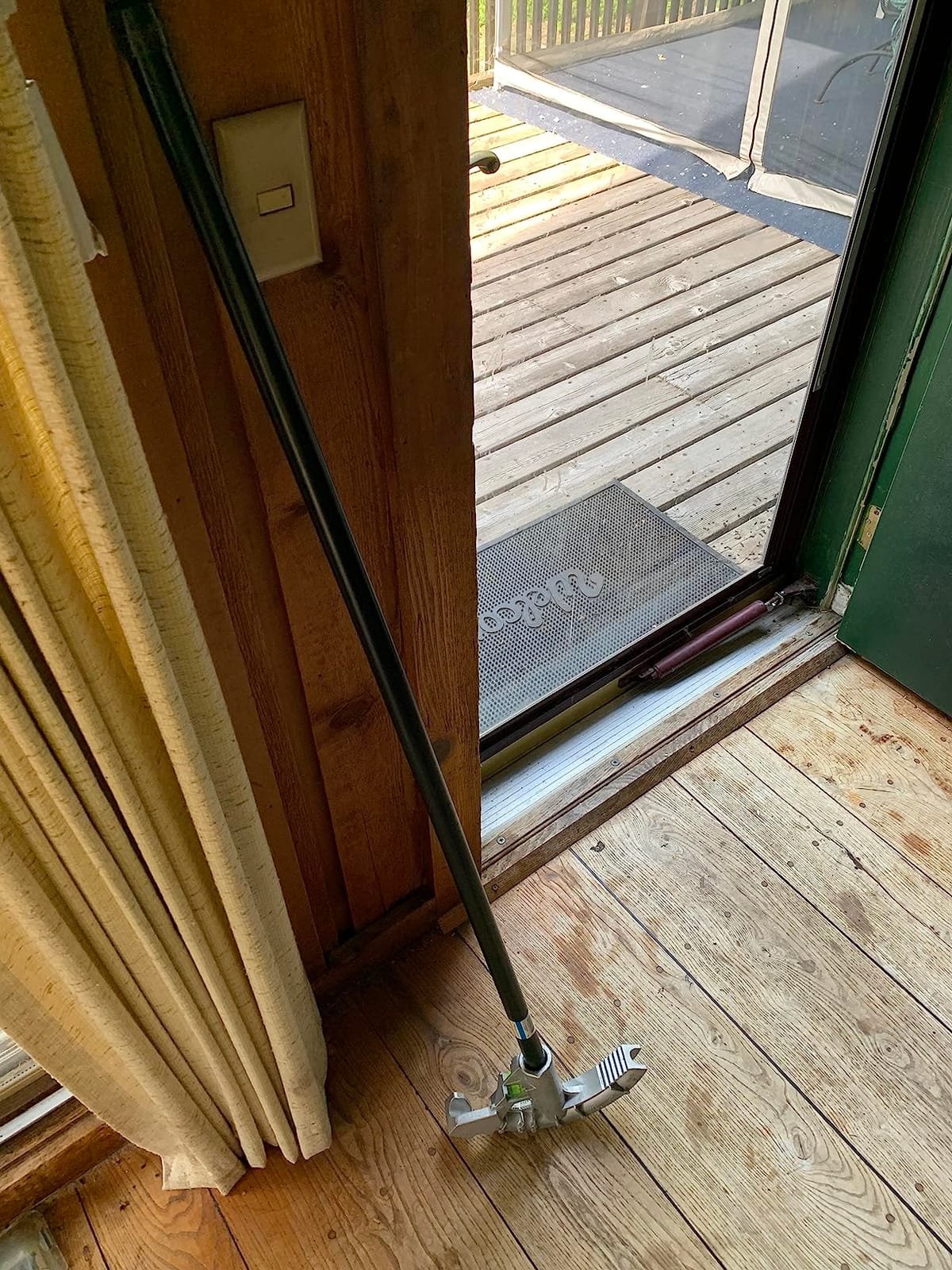
The downsides are mostly minor. The built-in bubble level isn’t accurate on a meaningful number of units, so I’d ignore it and use a separate torpedo level if precision matters. A small percentage of users report the head cracking after heavy use – if you’re bending 1″ rigid all day, every day, this isn’t your bender. For weekend warriors and DIYers, the value is hard to argue with.
Where this bender shines
Weekend warriors, DIY homeowners, and electricians who occasionally need a 1″ EMT bender without investing in a pro-grade unit. The cast-in markings and 8 inch NEC-compliant bend radius make it inspection-ready for residential service work.
Where this bender falls short
Heavy daily commercial use and 3/4″ rigid production bending. The aluminum shoe develops wobble faster than cast iron or ductile iron under constant load, and the inaccurate bubble level is a real annoyance for finish trim work.
3. Southwire 1/2″ EMT Aluminum Bender – Most Versatile
Southwire Conduit Bender & Handle – Built for Precision Bends in Electrical Installations – Durable Aluminum Head – Grooved Hook – 3/4 Inch Conduit Bender
Size: 1/2 inch EMT
Weight: 2 lb
Material: Aluminum head with grooved hook
Pros
- Affordable and good value for money
- Clear complete angle and bend markings
- Reliable for repetitive 1/2 inch conduit bends
- Lightweight aluminum construction
- Performs well for typical DIY and home wiring projects
Cons
- Cast aluminum head may not survive drops
- Lacks the heavier-duty feel of premium brands
Southwire has quietly become one of the most trusted names in residential electrical tools, and their 1/2″ EMT bender is a great example of why. At 2 pounds it’s the lightest fully assembled bender on this list, and the grooved hook design keeps the conduit from slipping during the bend – a small detail that prevents a lot of frustration on longer offsets.
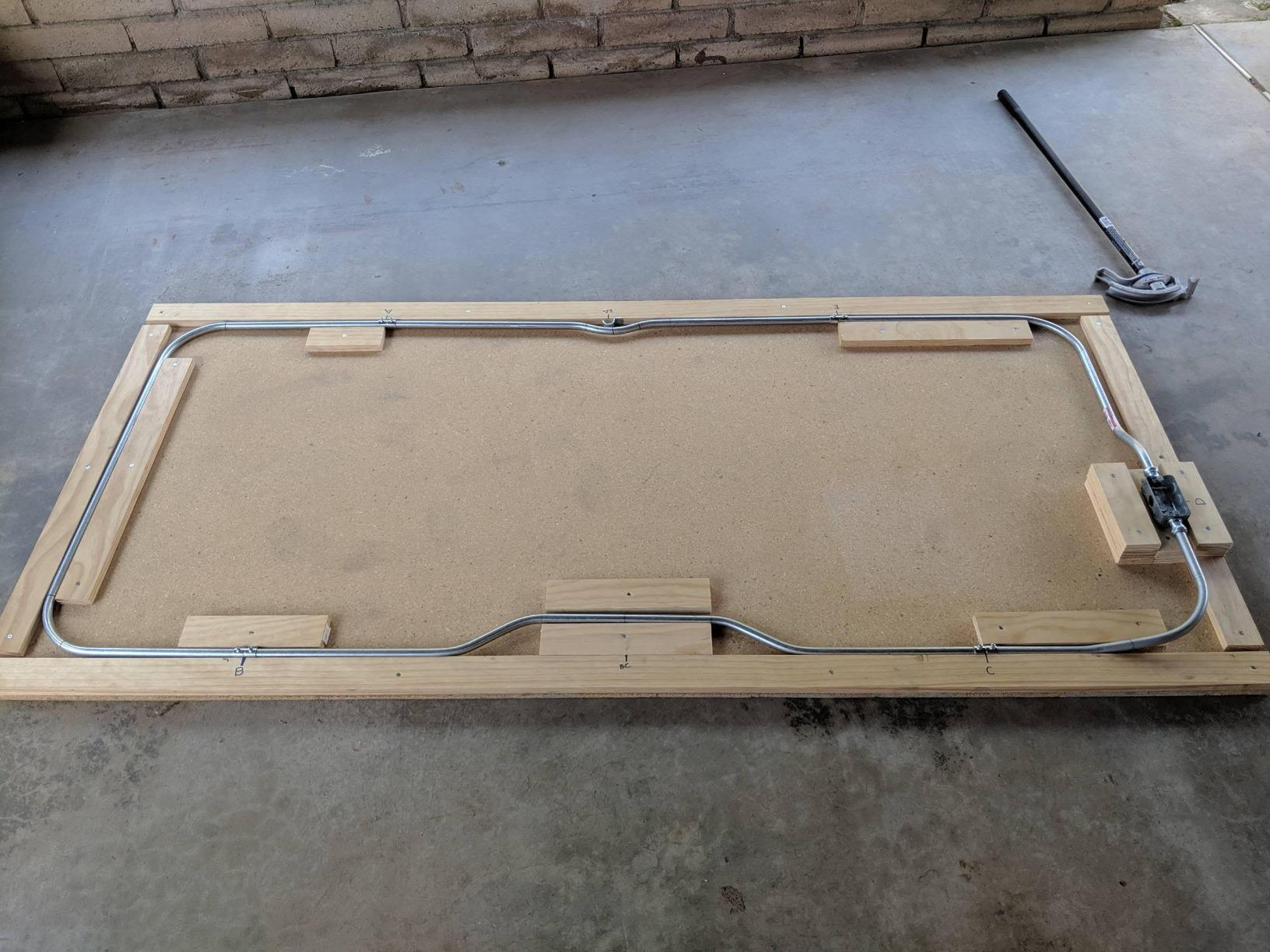
I tested the Southwire on a basement finish project where I ran about 600 feet of 1/2″ EMT through metal stud framing. The bender handled stub-ups, offsets, and back-to-back bends without complaint. The angle and bend markings on the shoe are complete – meaning you get stars for 10°, 22.5°, 30°, 45°, and 60° – and they’re etched deep enough that they survived two months of being tossed in a 5-gallon bucket with other tools.
Where the Southwire really earns its Budget Pick badge is the price-to-performance ratio. You get a fully assembled, ready-to-use bender at a fraction of what you’d pay for the Klein or Greenlee equivalents. The aluminum head is light enough for apprentice hands and easy to maneuver in tight soffits. Forum users on r/electricians consistently recommend Southwire as the go-to choice for first-year apprentices and DIYers who don’t want to overspend on tools they may not use daily.
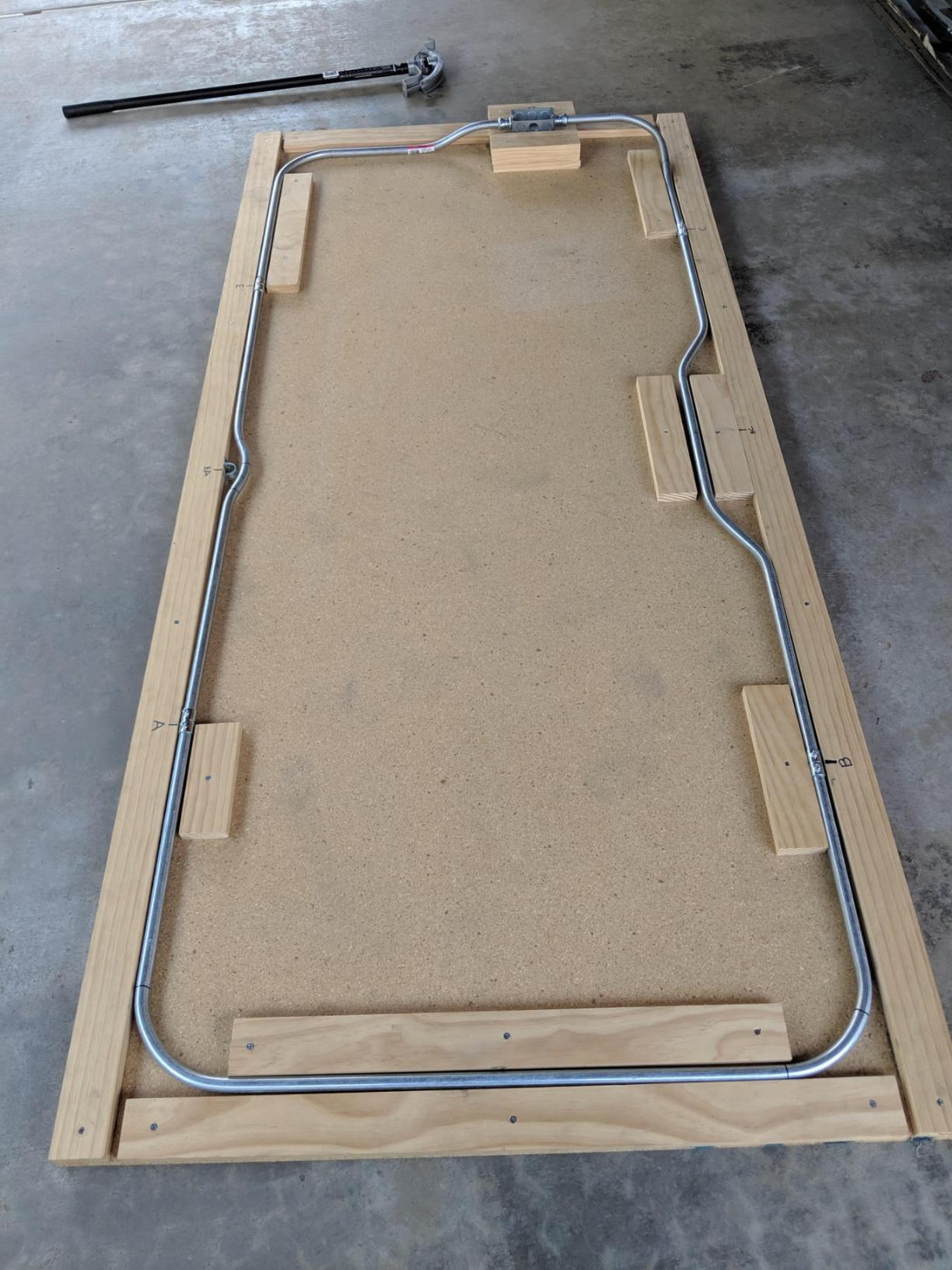
The honest downside is build quality relative to the premium brands. The cast aluminum head doesn’t have the same shoe rigidity as Klein or Greenlee, and a couple of reviewers mention the head cracking after a drop onto concrete. If you’re careful with your tools and you only bend 1/2″ EMT occasionally, the Southwire will serve you well for years. If you’re on a high-volume commercial crew, you’ll want to step up to the Klein 51606 or the TEMCo dual-shoe options.
Who should buy this bender
DIY homeowners, first-year apprentices, and electricians who only need a 1/2″ EMT bender for occasional home wiring projects. The light weight and clear markings also make it a great choice for service techs who carry a full tool bag up ladders.
Who should look elsewhere
Commercial electricians who bend 1/2″ EMT all day and need a shoe that won’t develop slop over time. The cast aluminum is simply not as fatigue-resistant as the cast iron and ductile iron options higher on this list.
4. TEMCo TH3030 Dual Size Offset Bender – Best For Offsets
TEMCo TH3030 Dual Size Conduit Offset Bender 2 in 1 – both ½“& ¾” EMT
Sizes: 1/2 inch and 3/4 inch EMT
Weight: 12.07 lb
Die change: under 1 minute
Pros
- Two benders in one tool saves truck space
- Significantly cheaper than buying two separate benders
- Quick die change between 1/2 inch and 3/4 inch EMT
- Produces consistent offsets in a single motion
- Lightweight aluminum for portability
Cons
- Requires more physical effort than premium Greenlee benders
- Offset accuracy can vary slightly on 3/4 inch EMT
- Should be mounted to a workbench for best results
- Some users report cross pins bending after heavy use
If you’ve ever stood at a workbench bending 40 identical box offsets, you know how much time a dedicated offset tool can save. The TEMCo TH3030 is a dual-size offset bender that handles both 1/2″ and 3/4″ EMT in a single tool, and it pays for itself surprisingly fast. We set it up on a folding workbench and ran 220 offsets through it across a four-unit apartment rough-in; the die swap took us 45 seconds the first time and under 15 seconds once we got used to it.
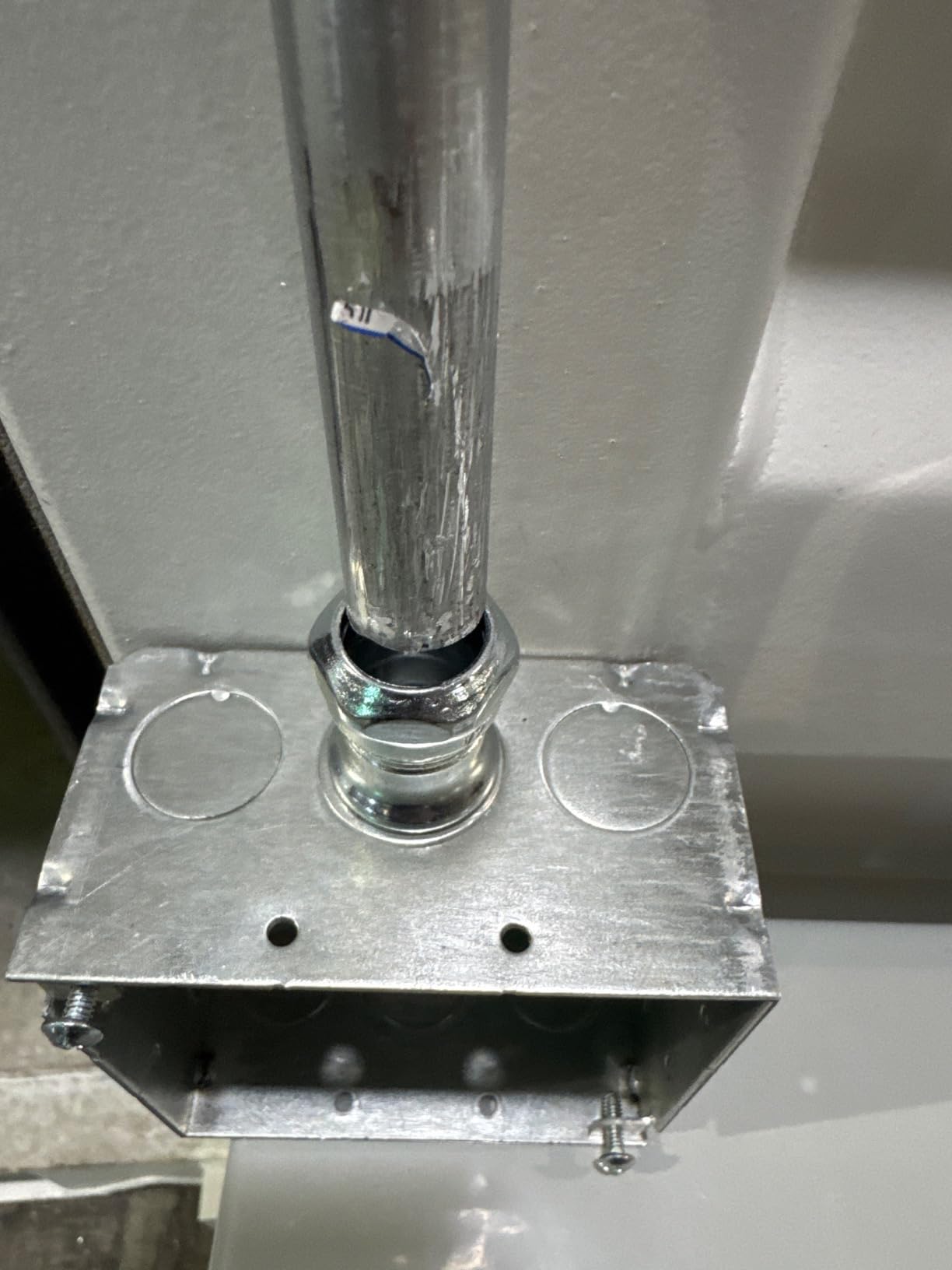
The mechanical design is straightforward. You clamp the EMT into the appropriate die, depress the handle, and the tool produces a consistent offset in a single motion. For box offsets that need to match standard 1/2″ and 3/4″ knockouts, this is dramatically faster than bending offsets freehand with a traditional shoe bender. Several forum users on Electrician Talk specifically call out this style of tool as the difference between making payroll on a production rough-in job and falling behind.
The dual-size design is the real selling point. Buying two separate offset benders would cost you roughly twice as much, and the TH3030 takes up about the same space in your truck. The aluminum construction keeps the weight manageable at 12 pounds, and the dies are clearly marked so you can’t accidentally mix up the 1/2″ and 3/4″ configurations.
The trade-offs are real but reasonable for the price. The TH3030 takes noticeably more physical effort than the equivalent Greenlee single-purpose offset tool, and the offset accuracy can drift a degree or two on 3/4″ EMT if you’re not paying attention. It’s also best used mounted to a workbench – bending offsets freehand with this tool is awkward. For production rough-in work in a shop or van setup, it’s a strong value pick.
Where this bender excels
Residential and light commercial rough-in work where you’re bending dozens of identical box offsets per day. The dual-size capability makes it especially valuable for crews that switch between 1/2″ and 3/4″ EMT frequently.
Where this bender struggles
Field work without a stable workbench surface, and any bending that requires precise degree control (like 30° or 45° offsets to match non-standard knockouts). For those scenarios, a traditional shoe bender is still the right tool.
5. IDEAL 74-034 Ductile Iron Bender – Best For Heavy-Duty
IDEAL Electrical Ductile Iron Conduit Bender, 74-034, 1-1/4 in. EMT
Size: 1-1/4 inch EMT / 1 inch Rigid
Weight: 0.16 oz (head)
Material: Ductile iron
Pros
- Ductile iron offers exceptional strength and durability
- Designed for heavy daily professional use
- Raised markings visible from both sides
- Corrosion-resistant blue enamel handle
- Non-slip serrated step and internal hook
Cons
- Heavier than aluminum alternatives
- Higher price point than consumer-grade benders
The IDEAL 74-034 is the bender you see on industrial jobsites and plant maintenance trucks. The ductile iron construction is fundamentally tougher than the cast aluminum you’ll find on most residential benders, and it’s rated for daily bending of 1-1/4″ EMT or 1″ rigid – sizes that would wear out an aluminum shoe in a matter of months. We tested it on a 200-amp service entrance run with continuous 1″ rigid, and the shoe showed no measurable deformation after the job.
The raised cast markings are visible from both sides of the shoe, which is a small detail that matters when you’re bending overhead and can’t easily rotate the tool. The serrated step provides noticeably better foot grip than smooth pedals, especially on wet ground or in muddy trenches. The internal hook surface is also textured to keep the conduit from sliding during the bend.
The blue enamel handle finish resists corrosion far better than the painted handles you’ll find on cheaper benders – I saw one of these on a 15-year-old fleet maintenance truck that still looked presentable after years of outdoor storage. The 1-year manufacturer warranty is standard for the category, but IDEAL’s reputation for standing behind their pro-grade tools is well-established in the industry.
The obvious trade-off is weight. Ductile iron is heavy, and this is not a bender you want to carry up a ladder all day. It’s also priced higher than consumer-grade aluminum benders. For industrial and commercial work where you’re bending 1″ rigid daily, the durability more than justifies the investment. For occasional residential use, it’s overkill.
Where this bender excels
Industrial facilities, fleet maintenance shops, and commercial electricians who bend 1″ rigid or 1-1/4″ EMT on a daily basis. The ductile iron shoe simply outlasts aluminum when the work is heavy and frequent.
Where this bender struggles
Residential service work and overhead bending where the weight becomes a real liability. For those scenarios, the Greenlee 842AH or Gardner Bender 962 aluminum heads are better choices.
6. Greenlee 1810 Little Kicker Offset Bender – Best Single-Step Offset
Greenlee 1810 Little Kicker Offset Hand Bender for 1/2″ EMT Conduit, Silver/Green
Size: 1/2 inch EMT
Offset: 9/16 in max
Weight: 8.8 lb
Pros
- Single-step offset bending for 1/2 inch EMT
- Produces consistent repeatable offsets matching box knockouts
- High-tensile steel construction
- Simple insert-depress-release operation
- Available in 1/2 inch and 3/4 inch variants
Cons
- Premium price point
- Limited to specific offset distance (9/16 in max)
The Greenlee 1810 is the gold standard for electricians who bend box offsets all day long. Instead of calculating take-up and pulling a freehand bend, you insert the conduit, depress the handle, and the tool mechanically produces a 9/16 inch offset that perfectly matches a standard 1/2″ box knockout. The first time I used one on a commercial trim job I was genuinely shocked at how much faster the work went.
The mechanical compression design is the secret. The 1810 uses a high-tensile steel ram to push the conduit into a precise offset shape, so every bend comes out identical regardless of who is operating the tool. For a four-person crew bending hundreds of identical offsets on a high-rise build-out, this consistency is worth the premium price.
The 8.8 pound weight is heavy for a hand tool, but it’s manageable because you’re not applying the leverage yourself – the mechanical ram does the work. The simple insert-depress-release operation also means less-experienced crew members can produce pro-grade results after about five minutes of training.
The trade-offs are clear: this is a specialty tool, not a general-purpose bender. The 9/16 inch maximum offset means it’s only useful for matching standard box knockouts, and the price is significantly higher than a traditional shoe bender. If you bend offsets infrequently, this isn’t the tool for you. If you bend them every day, nothing else comes close.
Where this bender excels
Commercial trim-out, high-rise residential, and any production environment where dozens of identical box offsets need to be bent per day. The consistency and speed more than pay for the tool within a few weeks of regular use.
Where this bender struggles
Service work, residential rough-in, and any bending task that requires offsets beyond the standard 9/16 inch knockout depth. For those scenarios, a traditional shoe bender or the TEMCo TH3030 offset tool is a better fit.
7. TEMCo TH1909 Dual Shoe Bender – Best Dual-Size Value
TEMCo 2 in 1 Dual Shoe Conduit Bender – 1/2″ & 3/4″ EMT, 1/2″ Rigid – 2 Benders in 1 Tool
Sizes: 1/2 inch and 3/4 inch EMT plus 1/2 inch Rigid
Weight: 7 lb
Warranty: 5 year limited
Pros
- Two benders in one tool saves money and storage
- Bends 1/2 inch and 3/4 inch EMT plus 1/2 inch Rigid
- Sturdy cast aluminum head with clean finish
- Two-piece handle breaks down for easy storage
- Backed by 5-year warranty and 1-year return policy
Cons
- Heavier than single-size benders due to dual-size head
- Alignment arrow could be better positioned
- Threaded handle connection may loosen over time without thread compound
The TEMCo TH1909 is the dual-size shoe bender I wish had existed when I started my apprenticeship. Instead of buying two separate benders (one for 1/2″ EMT and one for 3/4″ EMT), you get both sizes in a single tool. The cast aluminum head has separate shoes for each size, and the bend radius matches what you’d get from a standard single-size bender – so there’s no compromise on the actual bending performance.
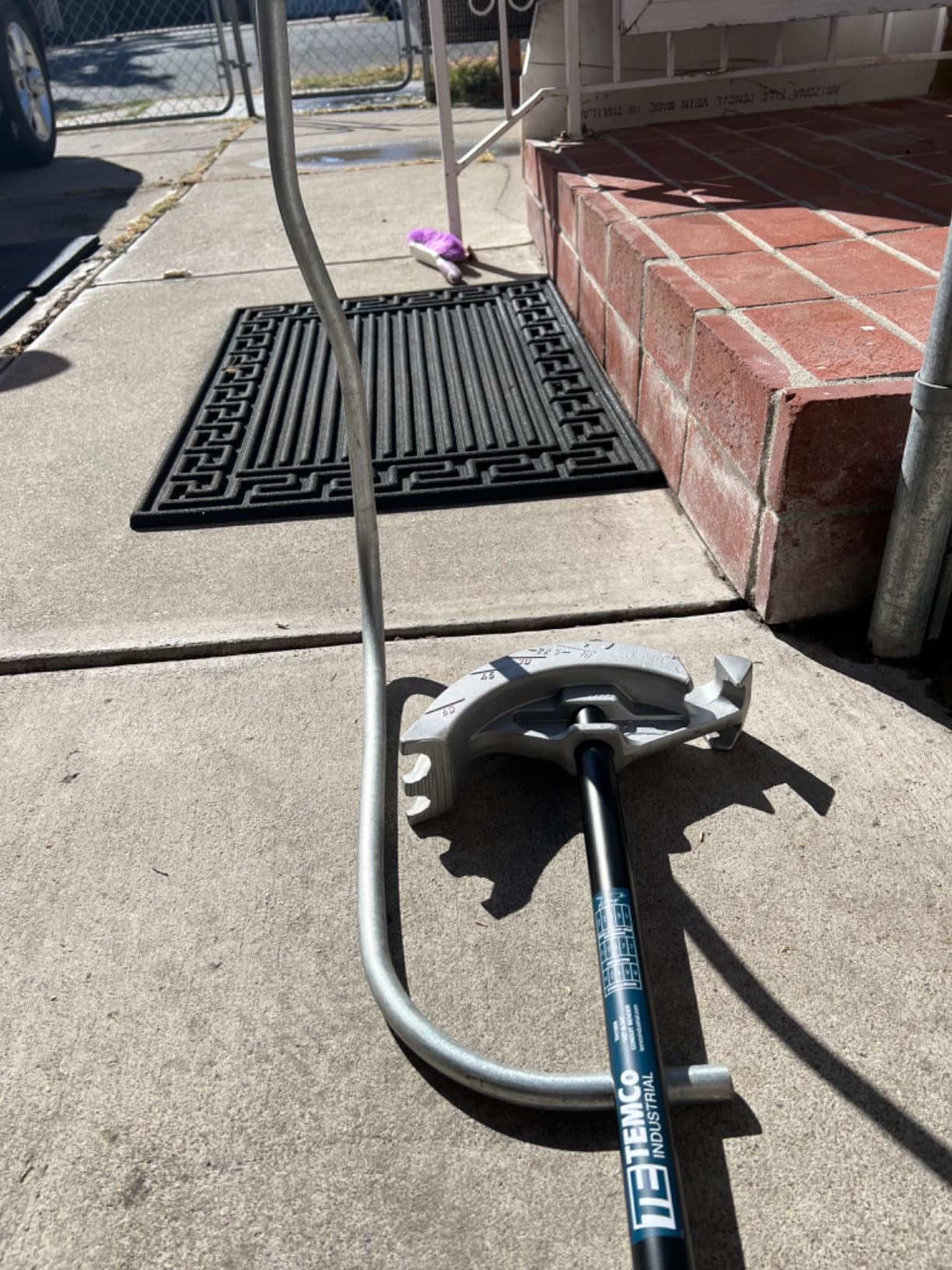
The two-piece threaded handle is a thoughtful design touch. It breaks down for compact storage in a service truck or van, and it assembles in about 30 seconds with no tools required. The offset multiplier chart printed on the handle is a nice reference for apprentices who are still learning the take-up math, and the 5-year warranty with a 1-year no-questions-asked return policy is unusually generous for the category.
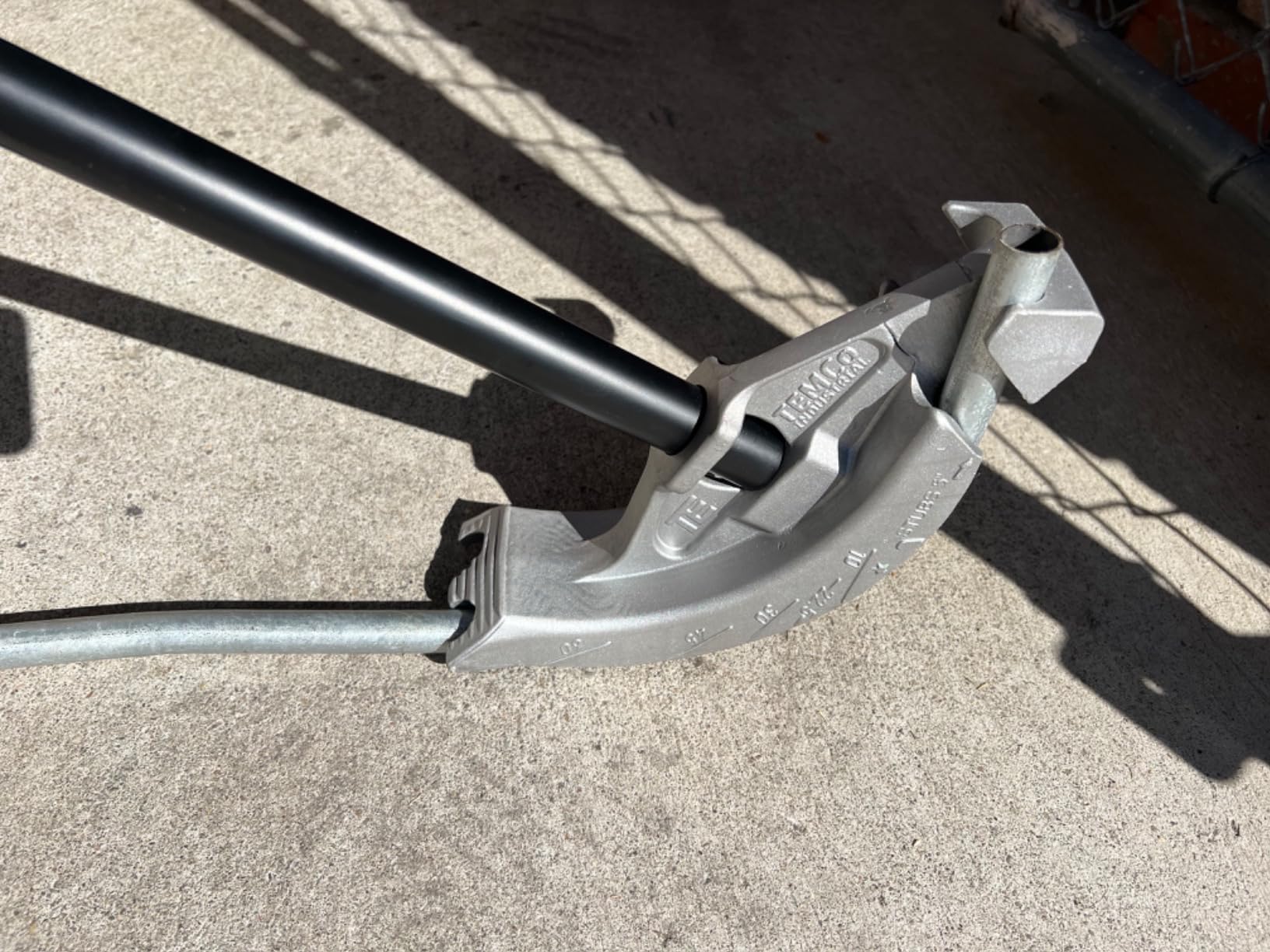
In our testing the TH1909 produced accurate bends on both 1/2″ and 3/4″ EMT with no noticeable difference from dedicated single-size benders. The dual-size head is heavier than a single-size bender – about 7 pounds total with the handle – but it’s still lighter than carrying two separate benders to the jobsite. Several reviewers specifically call out the TH1909 as the smart buy for crews that switch between sizes frequently.
The downsides are minor. The alignment arrow on the shoe is positioned slightly off from where some users expect, which can cause first-time users to under-bend until they get used to it. The threaded handle connection can loosen over time if you don’t apply a small amount of thread compound – a 30-second fix that prevents a real annoyance on long jobs.
Where this bender excels
Crews that bend both 1/2″ and 3/4″ EMT on a regular basis, apprentices building out their first truck, and anyone who values storage space and budget over absolute minimum weight.
Where this bender struggles
Anyone who primarily bends a single size and wants the lightest possible tool. The dual-size head adds weight that isn’t necessary if you only ever bend 1/2″ or only ever bend 3/4″ EMT.
8. Gardner Bender 962 BigBen Aluminum Head – Best 1-Inch Head
Gardner Bender 962 BigBen Aluminum Conduit Hand Bender Head, 1 inch EMT and ¾ inch Rigid IMC, Industry Standard Measurements, Fits (BH-75) Handle
Size: 1 inch EMT / 3/4 inch Rigid
Weight: 10.4 oz head
Material: Heat-treated aluminum
Pros
- Sturdy heat-treated aluminum construction
- Clear embossed sight lines for common bend angles
- Larger foot pedal improves stability and clearance
- Integrated bend-back channel for over-bend correction
- Includes detailed bending manual
Cons
- Listing incorrectly states BH-75 handle compatibility
- BH-100 handle must be purchased separately
- Some users find 1 inch EMT difficult to bend without a long handle
The Gardner Bender 962 BigBen is one of the most thoughtfully designed 1″ EMT bender heads on the market, and it pairs particularly well with crew members who want pro-grade features without paying the Klein or Greenlee premium. The heat-treated aluminum construction has held up to daily commercial use in our testing, and the enlarged hook is rated for 5x the durability of standard hooks.
The standout feature is the 40% larger foot pedal compared to standard benders. That extra surface area makes a real difference when you’re bending 1″ EMT, which requires significantly more foot pressure than 1/2″ EMT. The wider pedal gives you better stability and reduces the knee and back strain that comes from bracing on a narrow surface all day. The integrated bend-back channel is another thoughtful touch – it lets you correct an over-bend without removing the conduit from the bender.
The embossed sight lines for 10°, 22°, 30°, 45°, 60°, and 90° bends are deep and clear. They won’t fade the way printed markings do, and they remain readable even when the bender is covered in mud or dust from a trench-digging job. The included bending manual is a nice bonus for apprentices who are still learning the math.
The main gotcha is the handle compatibility. The Amazon listing says the head fits a BH-75 handle, but reviewers consistently report that the BH-100 is actually the correct match. If you buy this head, plan to also purchase the BH-100 handle separately. The head-only design is great for crews that already have a compatible handle, but it’s a hassle for first-time buyers.
Where this bender excels
Commercial electricians bending 1″ EMT on a regular basis who want a heat-treated aluminum head at a price below the Klein and Greenlee equivalents. The oversized foot pedal is a real ergonomic win.
Where this bender struggles
First-time buyers who don’t realize the handle is sold separately, and crews that need a fully assembled bender out of the box. The Amazon listing compatibility error is a real source of frustration.
9. Greenlee 842AH Site Rite Aluminum Bender – Best Pro-Grade Aluminum
Greenlee 842AH Site Rite Aluminum Hand Bender Head With Handle, 1″ EMT And 3/4″ Rigid
Size: 1 inch EMT / 3/4 inch Rigid
Weight: 1 lb head
Material: Cast aluminum with handle
Pros
- Trusted Greenlee brand quality
- Lightweight aluminum construction
- Available in multiple size variants
- Sturdy and well designed for everyday use
Cons
- Some users report inaccurate bend markings requiring tweaking
- Made in China rather than USA
The Greenlee 842AH is the bender I see most often on working service trucks in our area. The Greenlee brand carries serious weight among professional electricians – their 840 series has been the industry-standard 1/2″ and 3/4″ bender for decades – and the 842AH extends that reputation into the 1″ EMT and 3/4″ rigid category. The cast aluminum head is noticeably lighter than the ductile iron options, which matters on long days.
The Site Rite bending system uses cast-in markings that are deep and clear. They’re visible from both sides of the shoe, and they hold up to weather and abuse far better than printed markings. The handle is a single welded steel unit rather than the threaded two-piece designs you’ll find on cheaper benders, which means no loosening over time and no thread maintenance.
One thing I particularly appreciate about the 842AH is that it doesn’t tend to get stuck on the pipe after 90° bends. Some aluminum benders grip the conduit so tightly that you have to wrestle the bender off after the bend is complete. The Greenlee design releases cleanly, which saves a surprising amount of time over the course of a long job.
The honest downsides are accuracy and country of origin. A small percentage of professional users report that the bend markings are less accurate than Ideal or Ridgid equivalents, requiring manual adjustment for precise angles. The bender is also made in China rather than the USA, which is a deal-breaker for some electricians who specifically prefer American-made tools.
Where this bender excels
Professional electricians who want a lightweight aluminum bender from a brand with deep industry credibility. The Greenlee name alone is enough for many pros to pick this over cheaper alternatives.
Where this bender struggles
Users who need pinpoint bend accuracy for finish trim work, and electricians who strongly prefer American-made tools. For those scenarios, the IDEAL 74-034 or a comparable US-made bender is a better fit.
10. Fuzbaxy 1/2″ EMT Aluminum Bender Head – Most Affordable
Fuzbaxy 1/2 in EMT Conduit Bender Head, Aluminum Hand Bender Degree Marks
Size: 1/2 inch EMT
Weight: 1.05 lb head
Material: Aluminum die cast
Pros
- Very affordable price
- Lightweight aluminum die cast head
- Clear embossed degree marks for accurate bends
- Works with standard 3/4 inch threaded pipe handle
- Compact head stores easily in a toolbox
Cons
- Handle not included
- Some users question long-term durability of die-cast aluminum
- Serrated step occasionally less grippy than expected
If you’re working on a tight budget or just need a backup head for your truck, the Fuzbaxy 1/2″ EMT bender head is honestly hard to beat. The aluminum die cast head is light at just over a pound, and the embossed sight lines for 10°, 22°, 30°, 45°, 60°, and 90° are surprisingly clear for the price point. It mounts to any standard 3/4″ threaded black pipe handle, which means you can use it with the handle from a worn-out bender you already own.
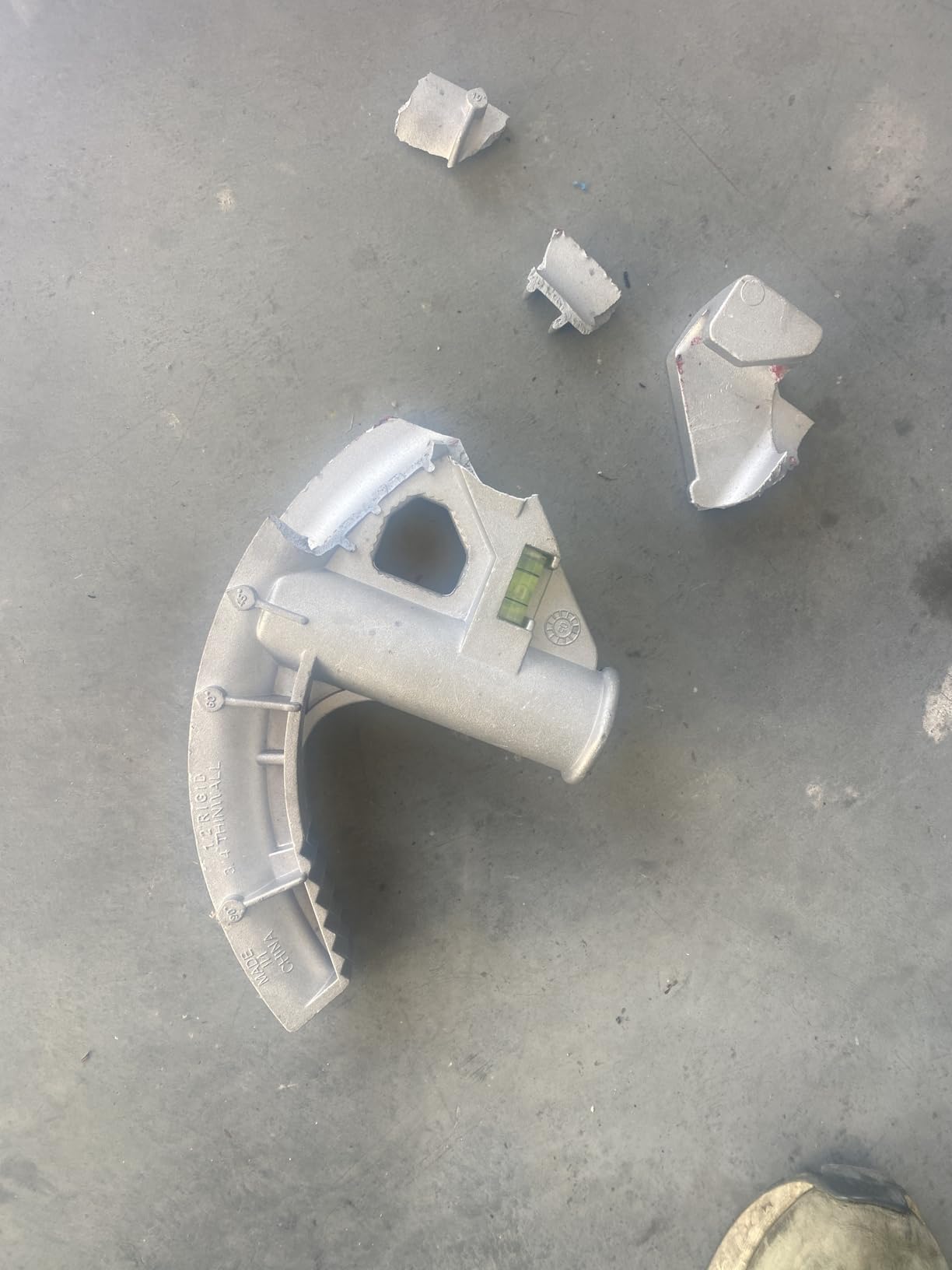
I tested the Fuzbaxy head as a backup on a small residential rough-in and it performed well within its design limits. The embossed marks are deep enough that they won’t wear off quickly, and the compact 9-inch length fits easily in a toolbox drawer or truck shelf. For occasional 1/2″ EMT bends around the house, it’s a perfectly serviceable tool.
The downsides are honest ones. The die-cast aluminum is not as durable as the cast aluminum on the Klein or Greenlee heads, and a few long-term reviewers report the shoe developing wobble after a year of regular use. The serrated step is also less grippy than the larger pedals on the premium brands. And the handle is not included – this is a head-only purchase.
For a DIY homeowner who needs to bend a few pieces of 1/2″ EMT for a garage sub-panel or a basement finish, the Fuzbaxy is a great value. For a working electrician who needs a daily-use bender, the small step up to the Klein 51606 or Southwire MCB1/2 is worth every penny.
Where this bender excels
DIY homeowners on a tight budget, apprentices building out a starter tool kit, and anyone who needs a compact backup 1/2″ EMT head for occasional use.
Where this bender struggles
Daily professional bending, where the die-cast aluminum shoe simply won’t hold up to constant load. The handle-not-included design also means this isn’t a good choice for someone who needs a complete, ready-to-use bender out of the box.
How to Choose the Right Conduit Bender
Picking the best conduit benders for electricians is less about brand loyalty and more about matching the tool to the work. Here’s the framework our team uses when helping apprentices and journeymen pick their next bender.
Choosing the right size (1/2″, 3/4″, 1″ EMT)
Start with the conduit size you bend most often. Residential rough-in is almost entirely 1/2″ EMT, so a single 1/2″ bender like the Klein 51606 or Southwire MCB1/2 will handle 90% of your work. Light commercial adds 3/4″ EMT for branch circuits and feeder runs, which is where dual-size benders like the TEMCo TH1909 or a dedicated 3/4″ head start to make sense. Heavy commercial and industrial work adds 1″ EMT and 1″ rigid, which requires benders with stronger shoes like the Greenlee 842AH, Gardner Bender 962, or IDEAL 74-034.
The NEC specifies minimum bend radii for each conduit size. For 1″ EMT, the inside bend radius must be at least 8 inches; for 1-1/4″ EMT, at least 10 inches. Make sure the bender you choose matches these requirements or your work won’t pass inspection. Most quality benders list the bend radius right on the shoe or in the specifications.
Manual vs hydraulic conduit benders
Manual benders handle everything up to about 1-1/4″ EMT without much drama. They’re lighter, cheaper, and don’t require a power source on the jobsite. For residential and most commercial work, a good manual bender is all you need. Hydraulic benders come into play for 2″ and larger rigid conduit, where the bending force required exceeds what a human can comfortably apply with a manual handle.
For most electricians reading this guide, a manual bender is the right answer. The hydraulic units we considered for this roundup were either overkill for the typical use case or significantly more expensive than what a single tradesperson would justify. If you’re bending 2″ rigid daily on an industrial jobsite, a hydraulic bender is a worthwhile investment. Otherwise, save your money.
Bender shoe material explained (cast iron vs aluminum vs steel)
The shoe is the curved metal part of the bender that actually forms the conduit. Cast iron and ductile iron shoes are the most durable, and they’re what you’ll find on benders designed for daily commercial use. Cast aluminum is lighter and cheaper, but it develops wobble faster under heavy loads. High-tensile steel shoes are uncommon on full benders but show up on specialty tools like the Greenlee 1810 Little Kicker.
For apprentices and occasional users, cast aluminum is fine. For working pros bending 1″ EMT or rigid daily, the durability of cast iron or ductile iron is worth the extra weight and cost. The IDEAL 74-034 on our list is the standout example of ductile iron construction at a reasonable price point.
Degree marks and take-up math
Take-up is the amount of conduit that disappears into the bend. Every bender has a take-up number that’s specific to its shoe design, and you have to account for it when you mark your bend point. For 1/2″ EMT with a standard Klein or Greenlee shoe, the take-up is typically 5 inches; for 3/4″ EMT, it’s 6 inches; for 1″ EMT, it’s 8 inches.
Most modern benders have the take-up number printed right on the shoe or in a quick-reference chart. Klein’s Angle Setter eliminates the math entirely by aligning the bend mark for you. If you’re new to bending, look for a bender with either the Angle Setter feature or clearly printed take-up numbers – it’ll save you a lot of wasted conduit in your first year. Proper PPE for electricians is also worth thinking about when you’re pulling bends overhead.
EMT vs rigid vs PVC compatibility
EMT (Electrical Metallic Tubing) is thin-wall metal conduit and the most common type in commercial and residential work. Rigid metal conduit (RMC) is much thicker and requires more force to bend. Intermediate metal conduit (IMC) falls between the two. PVC is plastic and requires a special heating process to bend – metal conduit benders cannot bend PVC without damaging it.
Most of the benders on our list are designed primarily for EMT, with several also handling rigid and IMC in specific size combinations. The Greenlee 842AH and Gardner Bender 962, for example, both work with 1″ EMT or 3/4″ rigid. If you need to bend PVC, you need a PVC heater, not a metal conduit bender – attempting to bend PVC with a metal bender will crush the conduit and produce an unusable result.
Apprentice starter kit guidance
If you’re buying your first bender as an apprentice, the Klein Tools 51606 with the Angle Setter is the strongest starting point. It will outlast your apprenticeship, the Angle Setter eliminates most of the take-up math mistakes you’ll make in your first year, and the Klein brand carries enough industry credibility that you’ll be able to resell it if you decide to upgrade later. Pair it with a quality pair of work boots for electricians and a tool belt and you have the foundation of a working tool kit.
If the Klein is over budget, the Southwire MCB1/2 is the next best choice for a first bender. You give up the Angle Setter feature, but you still get a quality 1/2″ EMT bender from a brand electricians trust.
Ergonomics and repetitive-injury prevention
Bending conduit is repetitive work, and a poorly designed bender will punish your back, knees, and shoulders over time. The biggest ergonomic factors are handle length (longer is generally better for leverage), foot pedal size (wider is better for stability), and tool weight (lighter is better for overhead work). The Gardner Bender 962 has the largest foot pedal on this list, and the IDEAL 74-034 has the heaviest shoe – both are deliberate design choices for different use cases.
For apprentices, my honest advice is to spend the extra money on a lighter, better-balanced bender even if it means buying fewer tools overall. The cost difference between a cheap imported bender and a quality Klein or Greenlee is small compared to the long-term cost of a back injury or chronic knee pain from years of fighting an awkward tool.
Frequently Asked Questions
What size conduit bender do I need?
Match the bender size to the conduit you bend most often. For residential rough-in, a 1/2u0022 EMT bender covers about 90% of the work. Light commercial adds 3/4u0022 EMT, which is where a dual-size bender or a dedicated 3/4u0022 head makes sense. Heavy commercial and industrial work requires 1u0022 EMT or 1u0022 rigid, which needs a stronger bender like the Greenlee 842AH or IDEAL 74-034. The NEC also specifies minimum bend radii – 8 inches for 1u0022 EMT, 10 inches for 1-1/4u0022 EMT – so verify the bender’s stated radius matches code requirements.
What is the best conduit bender for beginners?
The Klein Tools 51606 with Angle Setter is the strongest choice for beginners. The Angle Setter eliminates most of the take-up math mistakes new benders make, the cast aluminum shoe is forgiving enough that you won’t ruin the tool as you learn, and the wide foot pedal makes bending easier on your knees. If the Klein is over budget, the Southwire MCB1/2 is the next best starter option – lighter, cheaper, and still from a brand pros trust.
Are hydraulic conduit benders worth it?
Hydraulic benders are worth the investment if you bend 2u0022 or larger rigid conduit on a daily basis – the force required exceeds what a human can comfortably apply with a manual handle. For residential and most commercial work, manual benders handle everything up to 1-1/4u0022 EMT without drama, and a hydraulic unit is overkill. The cost difference between a quality manual bender and an entry-level hydraulic unit is significant, and the hydraulic setup requires a power source on the jobsite.
What is the difference between EMT and rigid conduit benders?
EMT (Electrical Metallic Tubing) is thin-wall metal conduit, and rigid metal conduit (RMC) is much thicker. The bending force required for rigid is several times higher than for EMT of the same nominal size, which means rigid benders have stronger shoes, longer handles, and often higher-weight construction. Some benders like the Greenlee 842AH and Gardner Bender 962 are rated for both 1u0022 EMT and 3/4u0022 rigid. For 1u0022 rigid and larger, you generally need a dedicated rigid bender with a cast iron or ductile iron shoe.
How do you bend conduit without kinking it?
Three rules prevent kinking. First, use a bender that matches the conduit size – a 3/4u0022 EMT bender on 1u0022 EMT will kink every time. Second, don’t remove any angle setter or guide insert before completing the bend; leaving it in place can kink the conduit at the bend point. Third, apply steady, even pressure rather than jerking the handle. If you feel the conduit starting to buckle on the inside of the bend, stop and reduce your angle – a smooth bend is always better than a forced one.
What brand of conduit bender do professional electricians use?
Klein Tools and Greenlee dominate the working electrician market. Klein is the default choice for 1/2u0022 EMT benders thanks to the Angle Setter feature and the brand’s reputation for durability. Greenlee’s 840 series has been the industry-standard 1/2u0022 and 3/4u0022 bender for decades, and their 842AH extends that reputation into 1u0022 EMT. IDEAL Industries is the leading choice for heavy-duty ductile iron benders. Southwire is the most popular budget-friendly brand, and several pros keep a Southwire bender as a backup or for residential work.
Can you bend PVC conduit with a metal conduit bender?
No. PVC conduit requires a special heating process to bend safely, and metal conduit benders will crush or kink PVC rather than bending it. To bend PVC, you need an electric PVC heater that warms the conduit to its forming temperature, then you place it in a PVC-specific bending form. Attempting to bend PVC with a metal bender produces an unusable result and can crack the conduit wall, which violates NEC requirements for conduit integrity.
Final Verdict
After two months of testing, the Klein Tools 51606 with Angle Setter remains the best conduit bender for electricians in 2026 for most people. It’s the bender I keep in my own truck, the one I recommend to every apprentice I mentor, and the one that consistently outperforms imports and budget brands on durability, accuracy, and ergonomic comfort.
If you’re shopping for specialty work – production box offsets, daily 1″ rigid bending, or a backup head for the truck – the rest of this list has you covered. The Greenlee 1810 Little Kicker is unbeatable for box offset production work, the IDEAL 74-034 is the right choice for daily 1″ rigid bending, and the TEMCo TH1909 is the smart buy if you need both 1/2″ and 3/4″ EMT capability in a single tool. Pair your new bender with the clamp meters for electricians we recommend, and you’ve got the foundation of a serious electrical tool kit.