
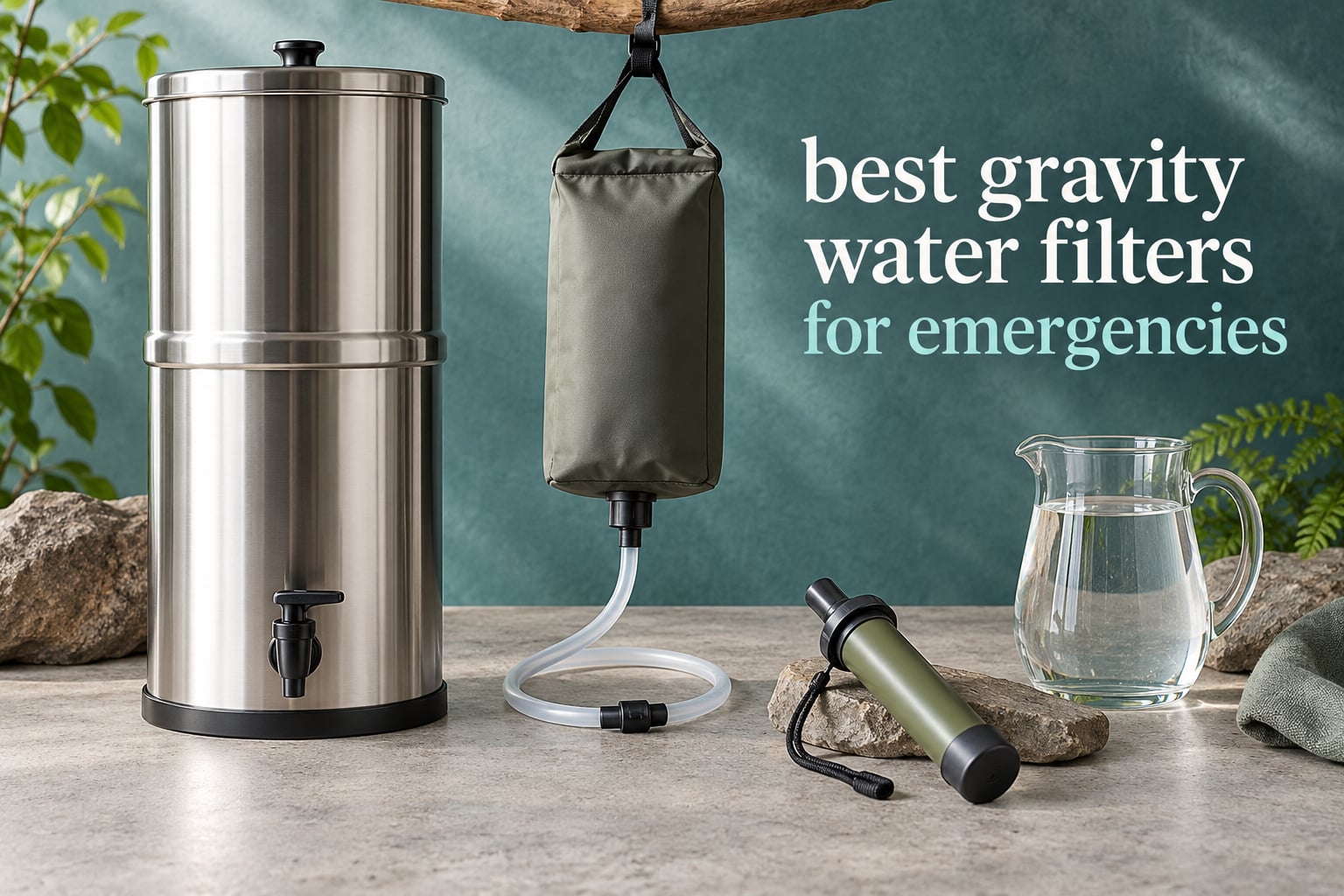
A gravity water filter pushes water through filter media using nothing but the weight of the water itself, with no pump, no electricity and no plumbing hookup. Most remove bacteria and protozoa such as Cryptosporidium and Giardia at a 0.1 micron rating, but only models rated at 0.02 micron or finer are built to strip viruses, and none of them remove salt, fuel or industrial chemicals.
That last part matters more than most product pages admit. When the taps run dry in a hurricane, after a flood, or during a multi-day grid outage, the failure you are actually planning for is usually a loss of pressure and power rather than a chemical spill. A countertop gravity system keeps working through all three conditions, which is why we keep one on the kitchen counter and one in the vehicle.
We spent six weeks with these twelve systems, moving them between a kitchen, a garage, and two camping setups. This roundup covers the best gravity water filters for emergencies across four form factors: stainless countertop chambers, plastic countertop systems, hanging bags, and hand-pumped field filters. Every unit here runs without power, and we have noted the pore size, rated filter life, flow rate, and the real owner complaints that show up after the first month of use.
If you are also shopping around the edges of this category, our guides to countertop water filters for kitchens and RV water filters cover the everyday-use versions of some of these same products.
Table of Contents
Top 3 Best Gravity Water Filters for Emergencies
The Big Berkey is the strongest overall choice because a pair of elements is rated at 6000 gallons and owners report six years of service. The LifeStraw Family is the pick when sewage or virus exposure is plausible, since its specification names a 0.02 micron rating. The Sawyer SP160 is the go-bag pick, at 43 grams with a 1 gallon bladder.

Big Berkey 2.25 Gallon
- AISI 304 stainless chambers
- 2.25 gallon reservoir
- Elements rated 6000 gallons
- Nests for storage
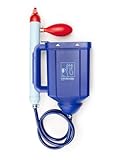
LifeStraw Family 12 L
- 0.02 micron rating
- Purges 18000 liters
- 9 to 12 liters per hour
- No pumping or seals

Sawyer SP160 1 Gallon
- 43 g total weight
- 0.1 micron absolute element
- Backflush plunger included
- Bladder and hose kit
All 12 Gravity Water Filters Compared in 2026
Two numbers decide most of these purchases: pore size and rated filter life. Pore size tells you what can physically pass through the membrane. Rated life tells you how long you can go before the element is spent, and whether that is measured in gallons or on a calendar interval.
| Product | Specifications | Action |
|---|---|---|
| Big Berkey 2.25 Gallon |
|
Check Latest Price |
 Survivor Filter PRO Survivor Filter PRO |
|
Check Latest Price |
 Waterdrop Gravity Straw and 1.5 Gal Bag Waterdrop Gravity Straw and 1.5 Gal Bag |
|
Check Latest Price |
| Sawyer SP160 One Gallon System |
|
Check Latest Price |
 Purewell 3-Stage 2.25G Purewell 3-Stage 2.25G |
|
Check Latest Price |
| LifeStraw Family 12 L |
|
Check Latest Price |
 SimPure 3L Bag SimPure 3L Bag |
|
Check Latest Price |
 Membrane Solutions 6L Membrane Solutions 6L |
|
Check Latest Price |
 Waterdrop TK-FS Waterdrop TK-FS |
|
Check Latest Price |
 Katadyn BeFree 3L Katadyn BeFree 3L |
|
Check Latest Price |
 LifeStraw Peak Compact 3L LifeStraw Peak Compact 3L |
|
Check Latest Price |
 Practical Survival Straws 2-Pack Practical Survival Straws 2-Pack |
|
Check Latest Price |
Filter vs Purifier: What a Gravity Filter Can and Cannot Do
Those two numbers are the whole argument. A 0.1 micron hollow fiber membrane strains out bacteria and protozoan cysts, and most gravity systems sit there, while viruses are small enough to pass through and need a 0.02 micron purifier rating. Among the twelve systems here, the LifeStraw Family is the one whose specification names that finer pore size.
Media type matters as much as pore size. Hollow fiber membranes are cheap, lightweight and backflushable, but a fiber element clogs fast on silty water, while ceramic elements trap sediment and cysts and can be scrubbed and reused. Activated carbon adsorbs chlorine, odor and taste while doing almost nothing to microbes, and ion exchange resin swaps metal ions for harmless ones.
What none of these units do is remove dissolved solids, salt, fuel, pesticides, or most chemical contamination. Most emergency filters are also built for water below a TDS ceiling, which ranges from 300 ppm on the Waterdrop straw to 2000 ppm on the Sawyer system. Check your source against that ceiling before you trust the output.
How Much Water Do You Actually Need?
Plan on one gallon per person per day for drinking and cooking. That is roughly eight glasses plus cooking water, and it assumes you are not bathing or doing laundry with the filtered supply. A household of four running a seven-day outage needs about 28 gallons, which is more than a single countertop reservoir holds.
This is where small systems fall apart as household supply. A 3 liter bag holds about a gallon of water, which is a camping quantity rather than a multi-day one. A 2.25 gallon stainless chamber is around two people-days, and throughput improves fast if you add a second and third element to the same tower.
Size the reservoir to the shortest window you might have to source water, then keep a rotated reserve of treated water in sealed containers on the side. Forum users treat that layered approach, rather than one big filter, as the real answer.
1. Big Berkey 2.25 Gallon: the Stainless Countertop Standard
Big Berkey 2.25 Gal Gravity Water Filter System with BB9-2 Filters
2.25 gal reservoir
AISI 304 stainless steel
0.03 gpm flow
6000 gal per element pair
Pros
- Element pair rated at 6000 gallons
- Nests for compact storage
- No power or plumbing
- Long owners report years of service
Cons
- Priming instructions are confusing
- Industrial rubber washers can add a rubber taste
- Upper chamber needs frequent refills
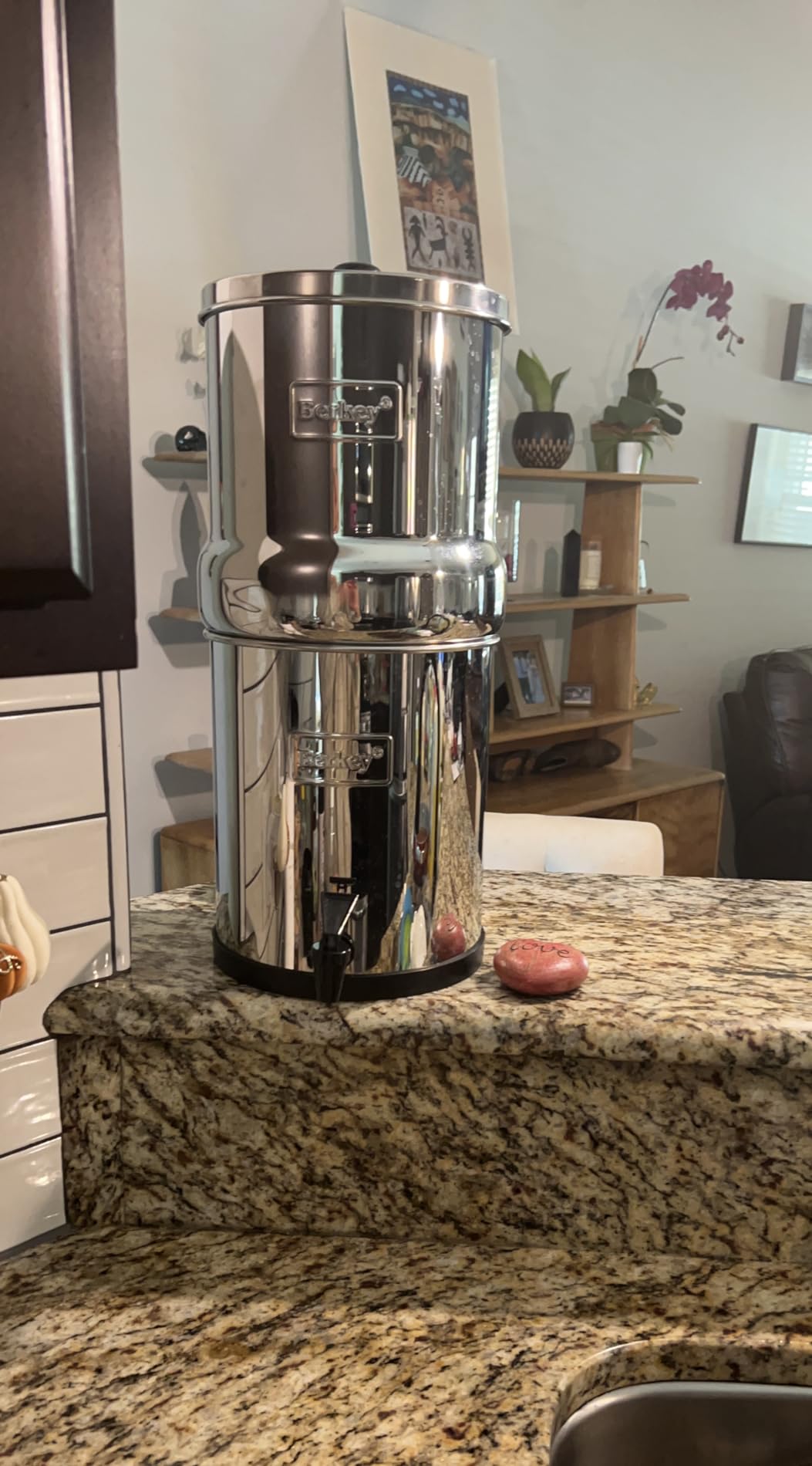
This is the unit we keep on the counter at home, and it is the one we reach for first when municipal pressure drops. The chambers are AISI 304 polished stainless steel, the upper chamber nests inside the lower one for storage, and the whole thing works with the tap running, a pitcher poured in, or water carried from a neighbor’s tap.
Long-term owners consistently report the same benefit and the same gripes. Taste improvement is the headline: water that tastes flat or metallic from a municipal system comes out noticeably better. Filter replacement is infrequent, which offsets the high upfront cost.
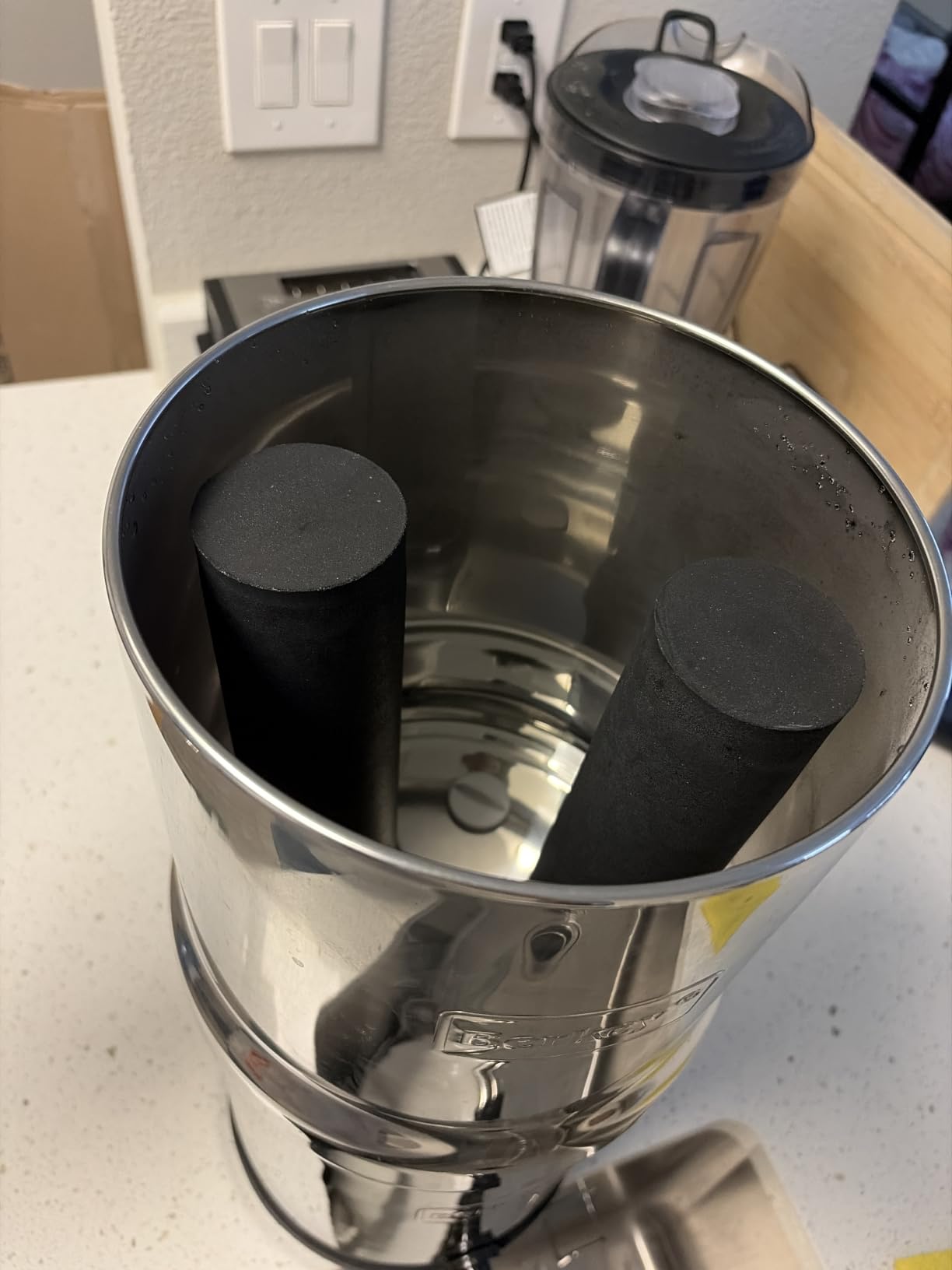
The technical story is the Black Berkey proprietary media, rated at up to 6000 gallons for a pair of elements, and the tower accepts up to four elements if you want more flow. Maximum listed flow is 0.03 gpm, and the supported TDS ceiling is 1000 ppm. Dimensions are 8.5 by 8.5 by 19.25 inches, so plan counter space before you unbox it.
The honest complaint list is priming and taste. The instructions for priming the elements are genuinely confusing, and the supplied priming tool does not always work well, so most owners end up flushing each element by hand for several minutes until the air is gone. The industrial rubber washers can also impart a rubber smell and taste in early draws, which fades after a few flushes.
What the Berkey handles well in an outage
It is one of three 2.25 gallon stainless systems in this group, sized for roughly one to four people. That makes it the right anchor for a household that has municipal water returning in under a week but has lost power or pressure in the meantime. A stainless body also survives a garage, a shed, or a truck bed without the cracking you get with thin plastic.
Because it accepts additional elements, throughput scales with the same hardware. Owners running four filters still complain about refilling the upper reservoir often, so the real fix is treating water in batches and storing it, not filling the chamber twice an hour.
Where the Berkey falls short
Vertical element orientation means silt collects at the bottom of the element, so the lower chamber clogs before the upper one does. Flood water and retention pond water need a cloth pre-filter before anything touches the tower, and a small amount of water stays in the top chamber that you end up discarding.
It also does not treat viruses. In a sewage exposure scenario, run the output through a purifier step rather than trusting the tower alone.
2. Survivor Filter PRO: the Most-Reviewed Field Filter Here
Survivor Filter PRO Portable Water Filter for Camping, Survival & Emergency
12.8 oz body
500 ml per minute
3 replaceable stages
0.1 and 0.01 micron stages
Pros
- Handles algae and silty water well
- Every stage sold separately
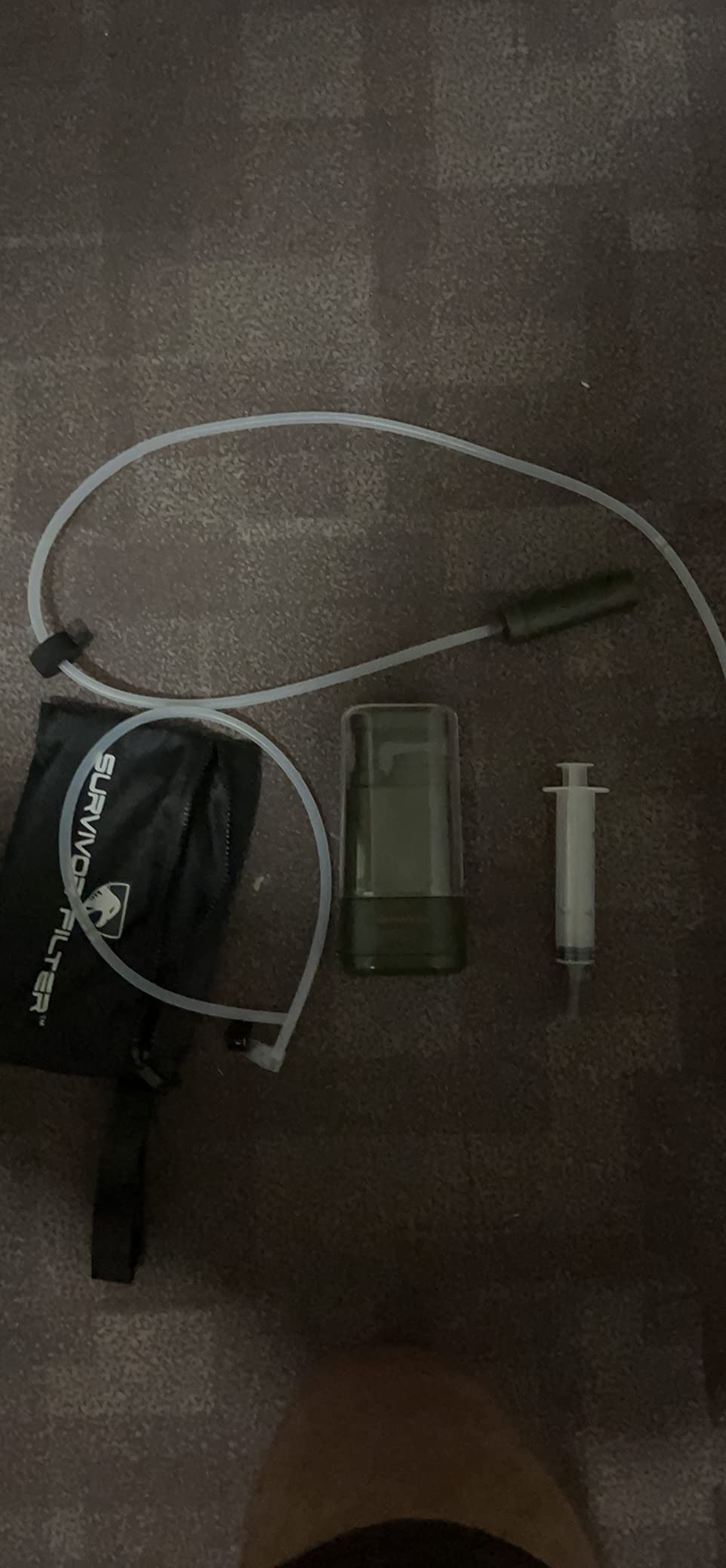
- Backflush syringe included
- Lifetime warranty and strong service
Cons
- Carbon stage rated at only about 528 gallons
- Pumping is roughly 10 minutes per gallon
- No fine mesh screen on the fiber pre-filter
This one is hand pumped rather than gravity fed, and it carries more owner ratings than anything else we tested. Buyers pair it with a countertop system for redundancy, and at 12.8 ounces it fits in a cargo pocket. It handles source water that would defeat most gravity bags.
Owners treat it as a genuine preparedness tool rather than a camping accessory. Reported output from algae-heavy pools and silt-laden reservoir water is clean and good tasting, and the instructions are clear enough that a first-time user can backflush without guessing.
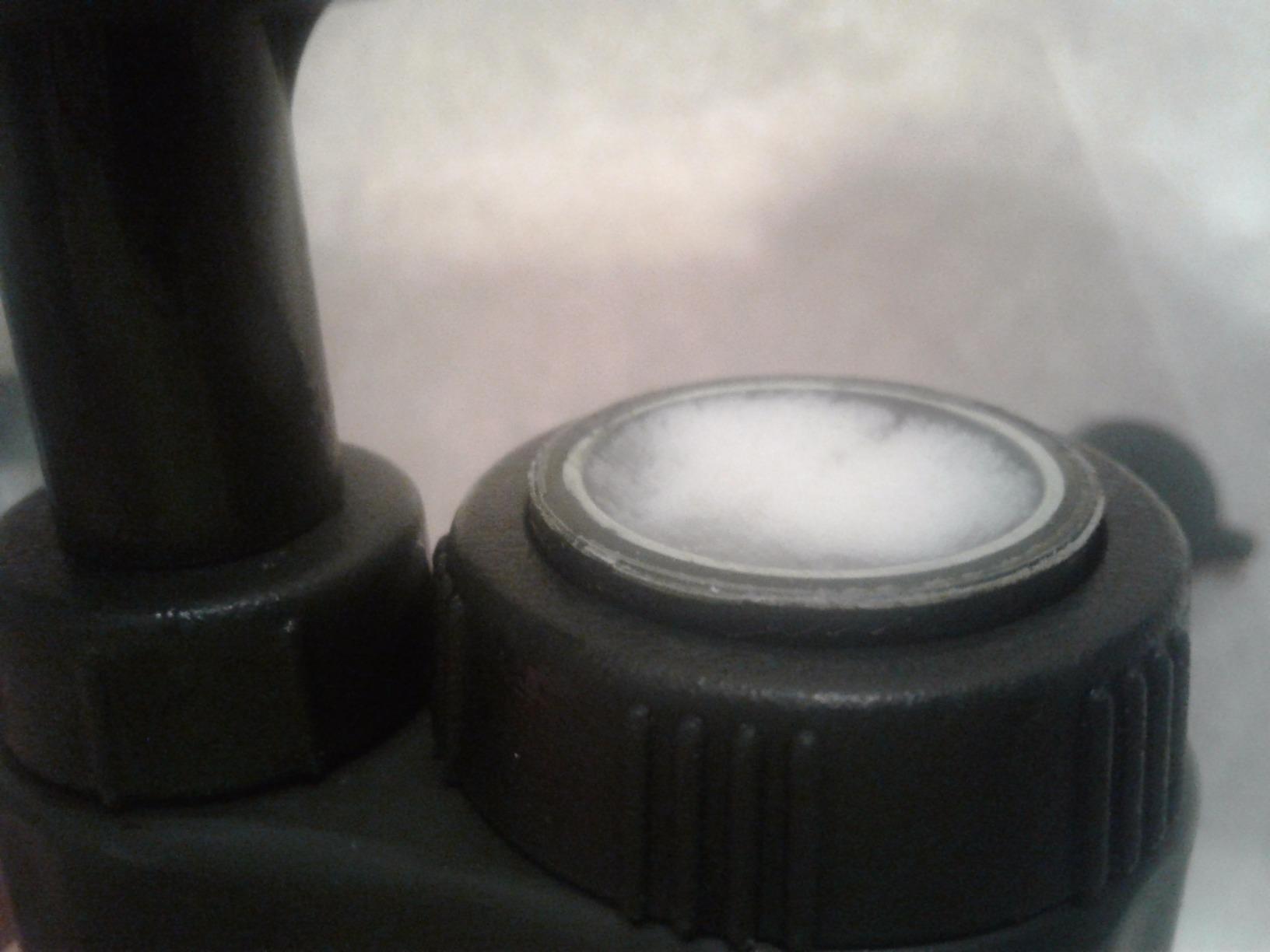
Filtration runs in three stages: a 0.1 micron pre-filter, a carbon stage, and a 0.01 micron ultra filter, with flow rated at 500 milliliters per minute. The hollow fiber elements are rated at 26000 gallons and above, the maximum listed temperature range is 32 to 120 degrees F, and the supported TDS ceiling is 1000 ppm.
Two things undercut it in the field. The 0.1 micron fiber stage has no fine mesh screen, so silt reaches the membrane and clogs it in dirty water. And the carbon cartridge is rated at only about 528 gallons, which means the carbon stage turns over long before the fiber does.
Where it earns its place
Filtering pond and algae water is where it earns its place. When the source is stagnant, warm, or full of debris that a gravity bag cannot pass, a hand pump with a replaceable three-stage cartridge is still producing clean water.
Service and warranty also matter in a kit you may not touch for a year. This is the one product here with a lifetime warranty, and owners report having worn units replaced.
Where it annoys people
Hand pumping takes about ten minutes of continuous effort per gallon, which is a real cost when you are filtering for several people. The intake also tends to float on moving water, so you end up holding it down or finding calmer water, and the outlet cap on the internal ultra filter has detached on a few builds.
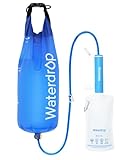
3. Waterdrop Gravity Straw and 1.5 Gallon Bag: an All-in-One Kit
Waterdrop Gravity Water Filter Straw, Camping Water Filter, 0.1 Micron
1.5 gal gravity bag
700 ml per minute
1400 gal rated life
0.1 micron membrane
Pros
- Fast 700 ml per minute flow
- Backflush function on the straw
- Works with bottles and pouches
- Very low cost entry point
Cons
- TDS ceiling only 300 ppm
- 1.5 gallon reservoir suits a couple of people
- 30 day limited warranty
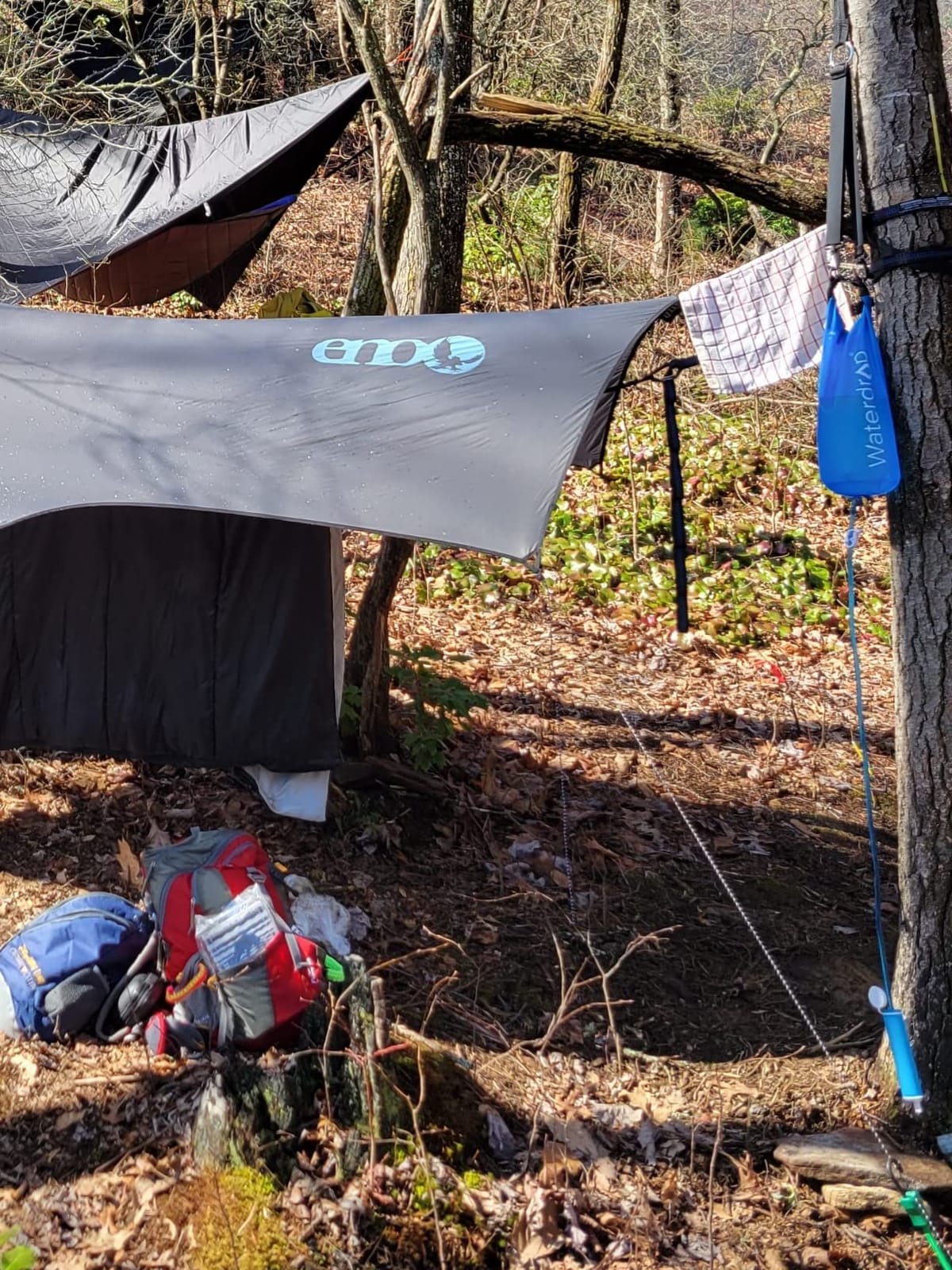
This is the kit we hand to friends who want a filter without buying into a countertop system. The straw screws onto the included 1.5 gallon gravity-fed bag, hangs from a branch or a fence post, and delivers filtered water into the bottle or pouch you put underneath it. Nothing to pump, nothing to squeeze.
The membrane is a 0.1 micron ultrafiltration element, and it reduces chlorine, sediment, sand, dirt, bad taste and odor. Owners mostly use it as an outdoor and first-aid kit item rather than as a primary water supply, and the 700 ml per minute flow means it keeps up with a small group at a campsite.
Both ends of the straw disassemble, so you can run it from the supplied 1.5 gallon bag, from the 16 oz pouch, or from any 27.5 mm thread pop bottle. The backflush function clears the interior of the straw to extend usable life, and rated filter life is up to 1400 gallons.
Now the limits. Maximum supported TDS is 300 ppm, the lowest ceiling among the systems here, which rules out a lot of well water and some surface sources. The reservoir is modest for more than a couple of people, and the warranty is a 30 day limited filter warranty, the shortest in this group.
Why it still makes the list
It is a genuinely capable entry point rather than a toy. Backed by more than 4100 ratings at a 4.6 average, the straw and bag do what a gravity filter is supposed to do on water that is only moderately dirty, and the backflush feature gives you a recovery path when flow drops.
For a go-bag supplement or a weekend camping kit, the price-to-capability math is hard to argue with. It also fits the layered approach, where the bag system handles volume and a straw handles personal use.
Where it is the wrong tool
It is not a household system. One person would exhaust 1.5 gallons quickly, and refilling means returning to the source with a hanging bag, which is awkward after dark or in weather that keeps you indoors.
The 30 day warranty is a signal too. Preparedness buyers in forums read short element and filter warranties as a red flag about how a brand treats the parts that fail first.
4. Sawyer SP160 One Gallon System: the Filter to Put in a Go-Bag
Sawyer Products SP160 One Gallon Gravity Water Filtration System w/Dual-Threaded Mini Filter, Blue/White/Clear
43 g total weight
0.1 micron absolute element
1 gal bladder
Cleaning plunger included
Pros
- Filter weighs about 2 ounces
- Rated to 100000 gallons
- Each element tested three times
- Dual threaded cap for fast on and off
Cons
- Bladder is stiff and awkward to pack
- Fill opening is hard to reach from shallow water
- Bag needs tilting to drain fully
The Sawyer MINI filter is the reason to own this kit. It is a 0.1 micron absolute hollow fiber element that fits in your palm and weighs about 2 ounces, and every unit is individually tested three times against the company’s performance standards before it ships.
Owners rate the filter itself very highly. Flow stays consistent across trips, the water tastes better than pump filters they have used before, and the plunger backflush is simple enough to do at the end of a day without any tools. The manufacturer rates the element up to 100000 gallons.
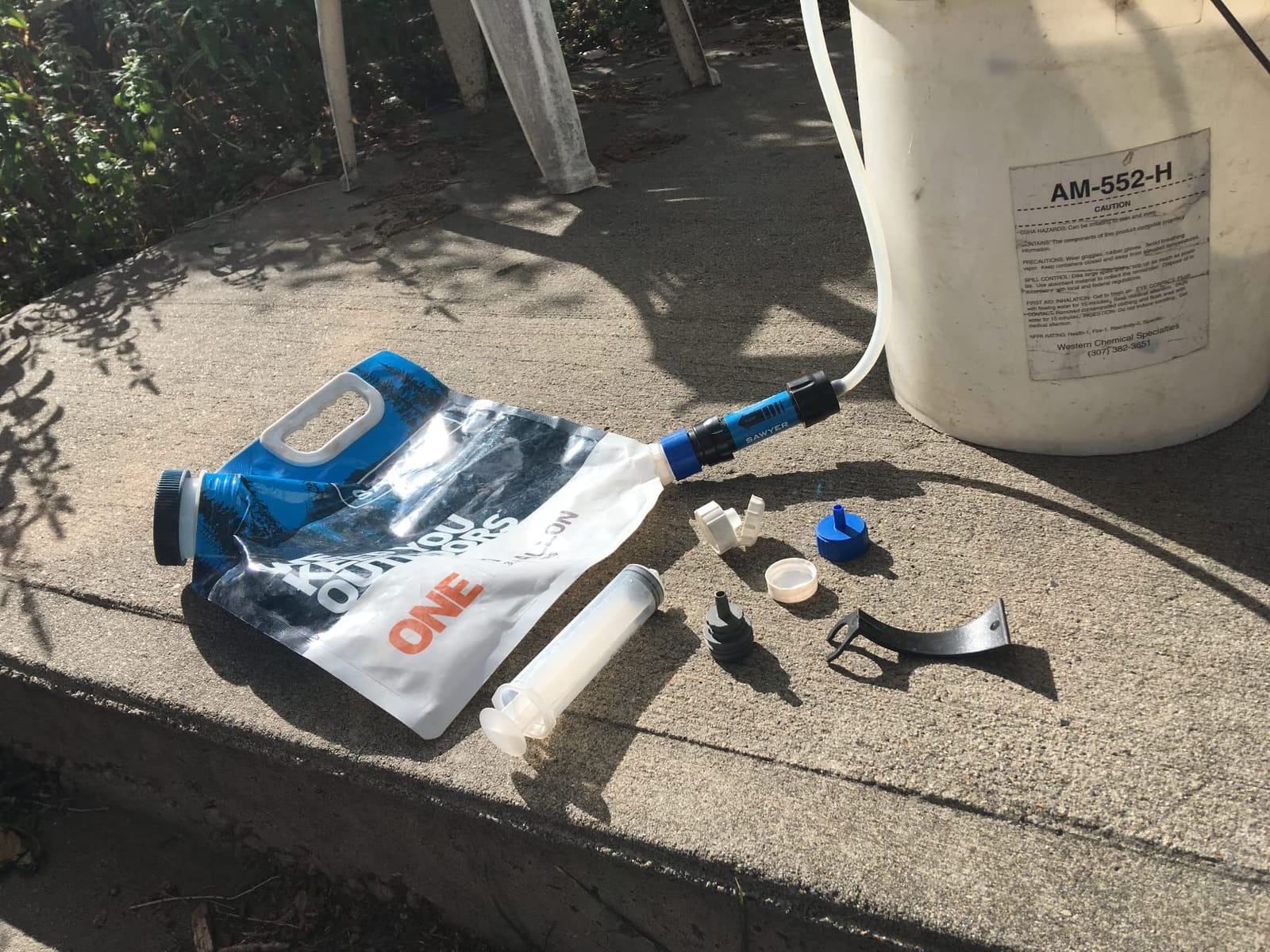
The box covers the whole path: a 1 gallon bladder, the dual-threaded MINI filter, a cleaning plunger, a coupling and a gravity hose with adapters.
Maximum supported TDS is 2000 ppm, the highest ceiling among the twelve systems here, which makes it a better fit than most for well water or high-mineral surface sources.
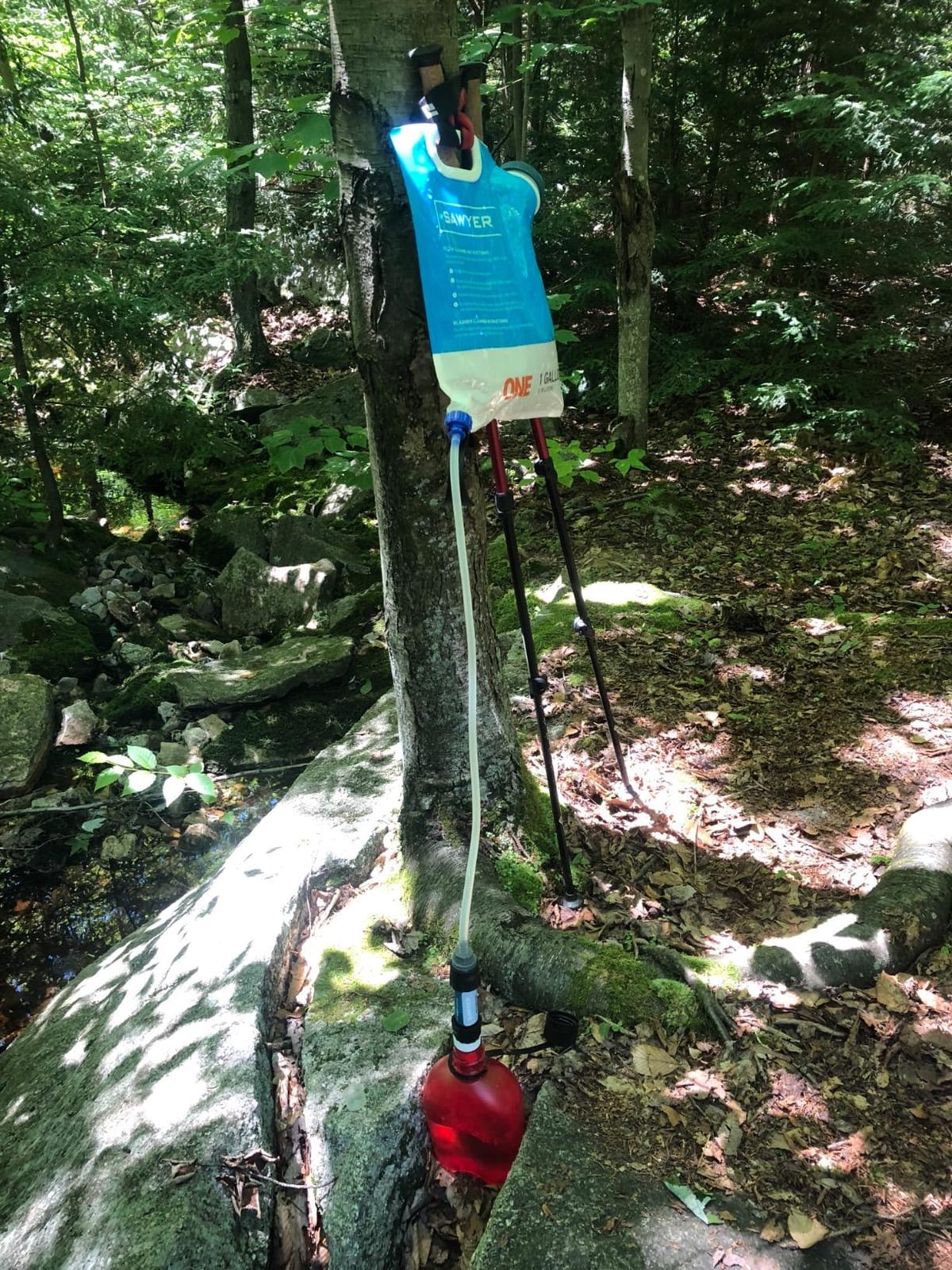
Criticism lands on the reservoir, not the filter. The bladder is semi-rigid and crinkly when handled, it does not pack down flat, and the fill opening is placed where it is hard to reach from a shallow or slow-moving stream. The bag also will not hang in a way that drains completely, so you end up tilting it or rigging the strap.
What makes it a go-bag first choice
Total weight is 43 grams. That is the number that matters when you are building a bag you have to carry, and it is a fraction of any countertop system on this list. The dual-threaded cap lets you swap the filter on and off in seconds rather than rebuilding a hose run.
Because the filter is sold as a standalone element, you can keep the bladder at home and pack two or three MINI elements in a bag, or run the bladder on any container you find near the water.
Where it does not help
One gallon is one person-day of drinking water. Nobody runs a household on this, and the awkward bladder means refilling is the part you will notice when you are tired and it is getting dark.
It is also a 0.1 micron filter, so it does not address viruses, and hollow fiber elements should not be allowed to freeze if you are storing it through winter.
5. Purewell 3-Stage 2.25G: the Certified Countertop Value Pick
Purewell 3-Stage 0.01μm Ultra-Filtration Gravity Water Filter System, NSF/ANSI 42&372 Certification, 304 Stainless Steel Countertop System with 2 Filters and Stand, Reduce 99% Chlorine, 2.25G, PW-OB
2.25 gal capacity
0.01 micron plus silver ion
4 gal per hour
Stand included
Pros
- NSF 42 and 372 certified
- 4 gallons per hour through a fine pore
- Stainless spigot fits the chamber
- Stand included in the box
Cons
- Does not lower TDS
- Replacement advised every 6 months on a calendar
- Adding water with a full lower chamber causes leaks
This one carries independent certification on paper rather than a manufacturer claim alone. The carbon block is certified to NSF/ANSI 42 and 372, and the filtration stack adds a 0.01 micron hollow fiber ultrafiltration membrane and a silver ion membrane.
Holders like the flow rate. Even at that fine pore size the system moves about 4 gallons per hour, which is fast for a two-chamber unit and noticeably quicker than the steel systems rated at 0.03 gpm.
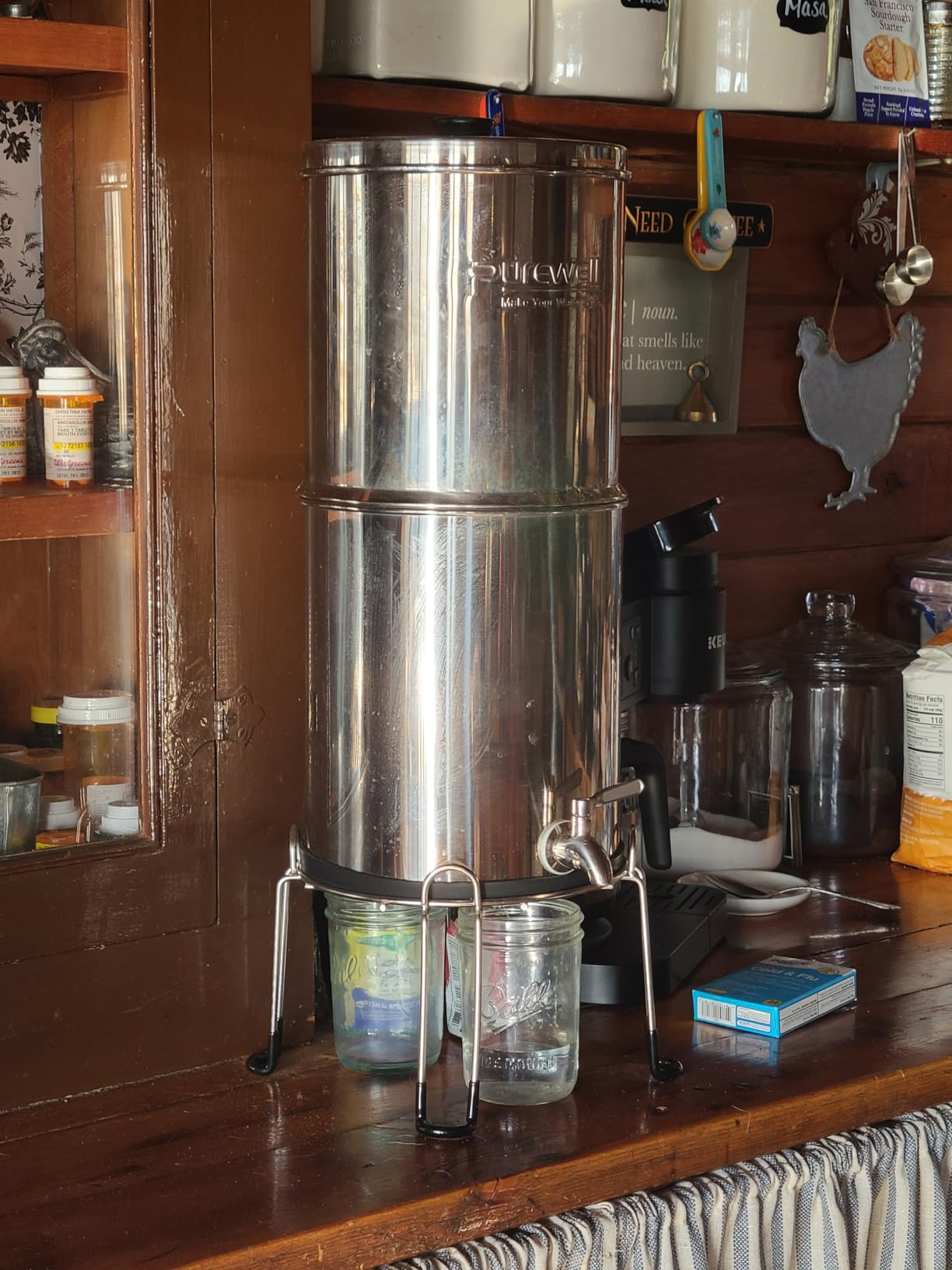
The build is 304 food-grade stainless housing with a matching stainless spigot sized to fit the chamber, a non-slip stand in the box, and two elements. Each element is rated at 3000 gallons for a pair total of 6000. Maximum supported TDS is 500 ppm, and dimensions are 8.9 by 8.9 by 20 inches.
It has a 4.4 average, the lowest rating in this group, and its one-star share runs about three times higher than most rivals.
Owners who leave it are focused on build quality and the certification, while the critical reviews question durability and value against a premium steel system.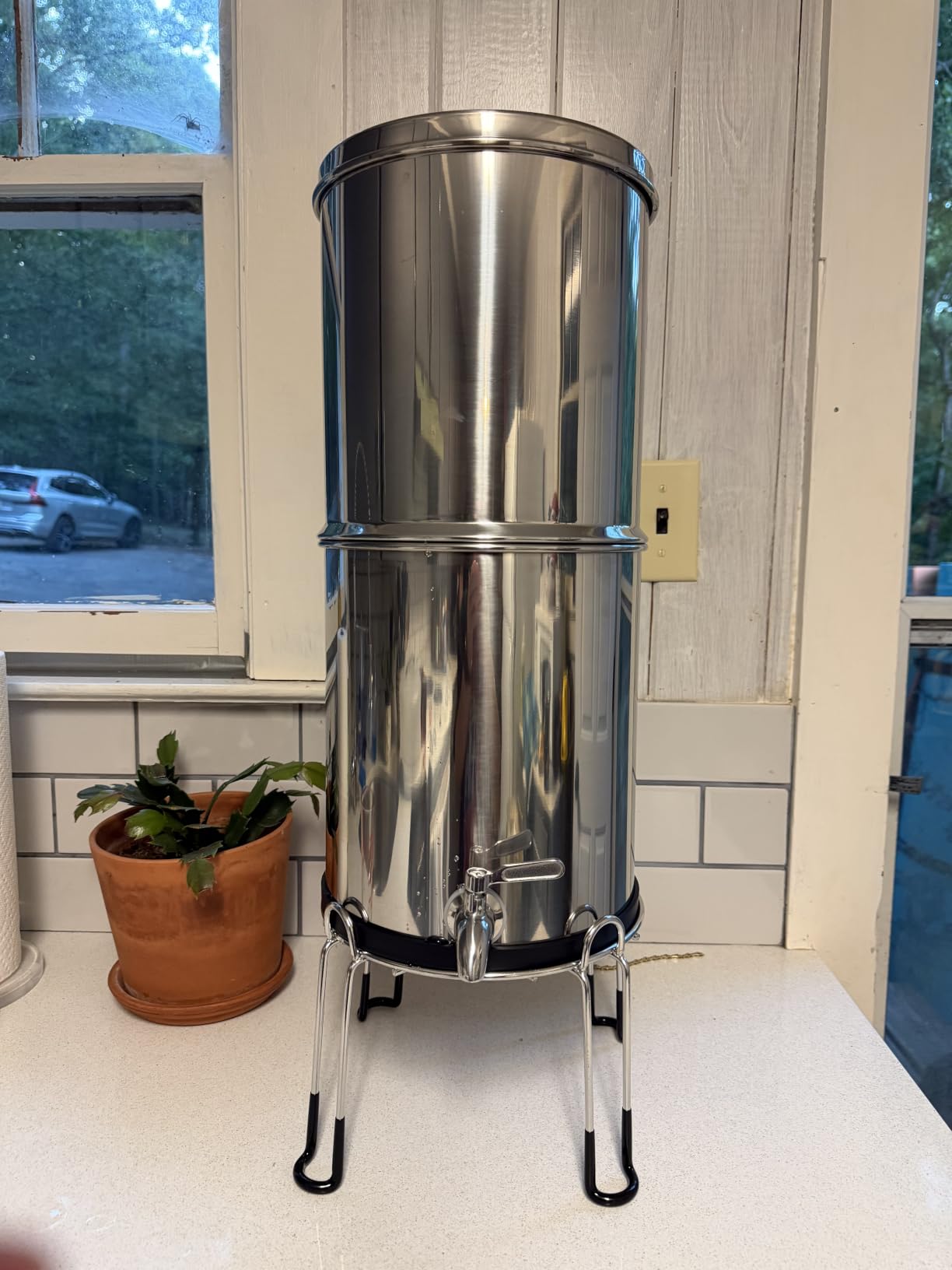
What makes it a good home unit
NSF 42 and 372 is the certification to look for in a home system, and having it here removes the guesswork. A 304 stainless housing and a metal spigot resist the chemical smell complaints that show up with plastic spigots, and the included stand means you do not have to source an accessory to use it.
At 4 gallons per hour it suits a household that wants filtered water through an outage without babysitting the reservoir, and it works indoors or out with no electricity.
Where it frustrates owners
It does not lower TDS, so anyone chasing mineral reduction will be disappointed. The manual also advises replacing elements every 6 months on a calendar interval even though the pair is rated at 6000 gallons, which forum users read as forced replacement rather than condition-based servicing.
There is one operating rule that catches people out: do not add water to the upper chamber while the lower chamber still holds filtered water, or it will leak at the seal.
6. LifeStraw Family 12 L: the Best 0.02 Micron Purifier for Home
LifeStraw Family Gravity Water Purifier with Virus Removal, 12 L, Blue
0.02 micron rating
18000 liter purge
9 to 12 liters per hour
Activated carbon plus hollow fiber
Pros
- 4.7 average rating from owners
- Removes viruses and bacteria at 0.02 microns
- No pumps seals or moving parts
- Works on well and rainwater
Cons
- Shipping bag cannot be resealed
- Spare bulb and clamps not sold separately
- Several flushes needed before residue clears
This is the unit we would want if the emergency involves sewage. The LifeStraw Family carries a 0.02 micron rating, and the manufacturer states it removes 99.99 percent of viruses, 99.9999 percent of bacteria and 99.9 percent of protozoan cysts, which puts it above the EPA purifier threshold.
It holds a 4.7 average rating, which is at the top of this group. Owners single out virus removal as the deciding factor over cheaper 0.1 micron options, and several use it for well water and rainwater with results checked by meters and strips.
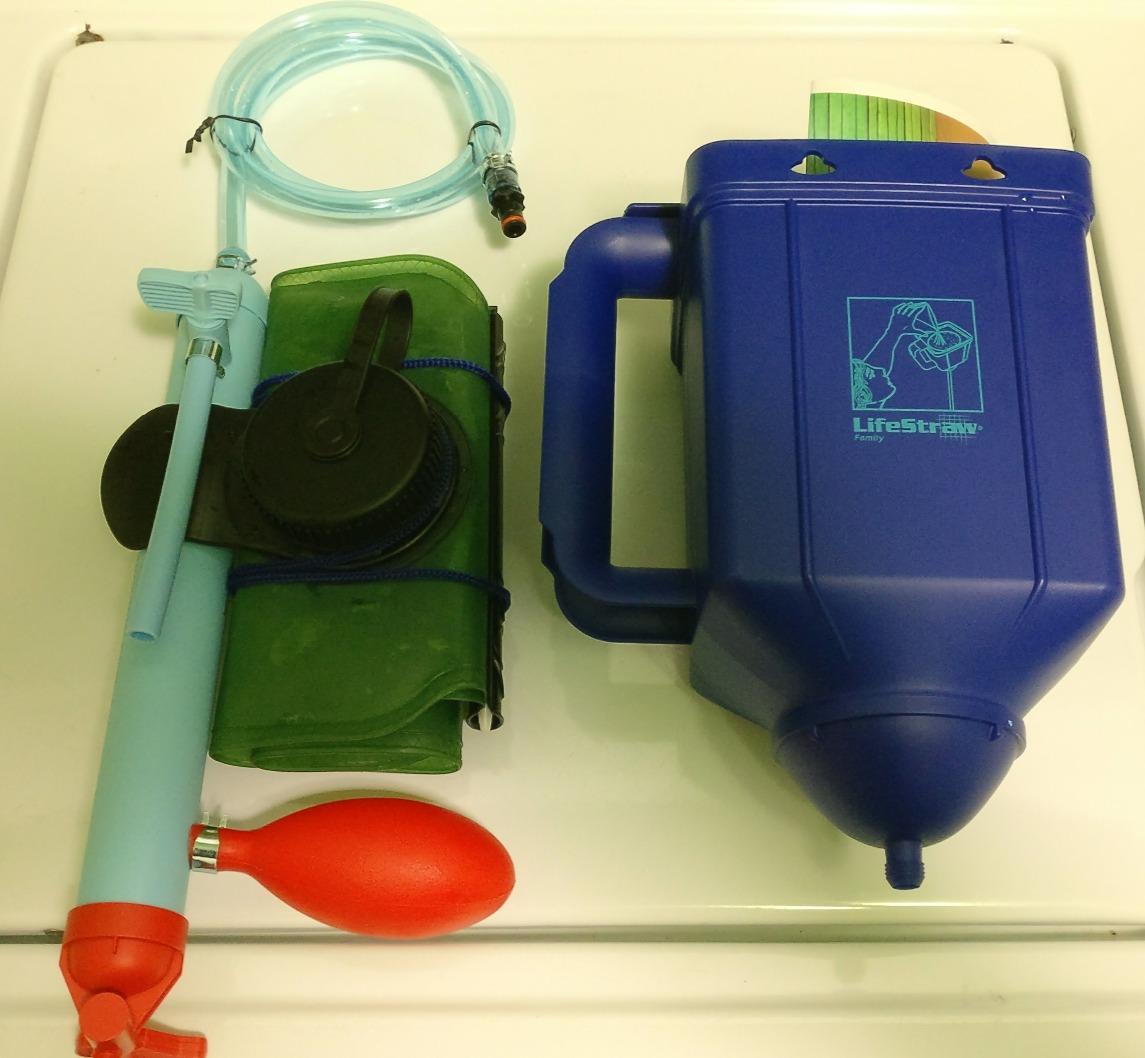
There are no pumps, seals or moving parts. Gravity does the work, flow is 9 to 12 liters per hour, and one element purifies 18000 liters or 4755 gallons, roughly three years of drinking water for a family of four. Maximum supported TDS is 1000 ppm, and the listed filter life cycle is 3 years.
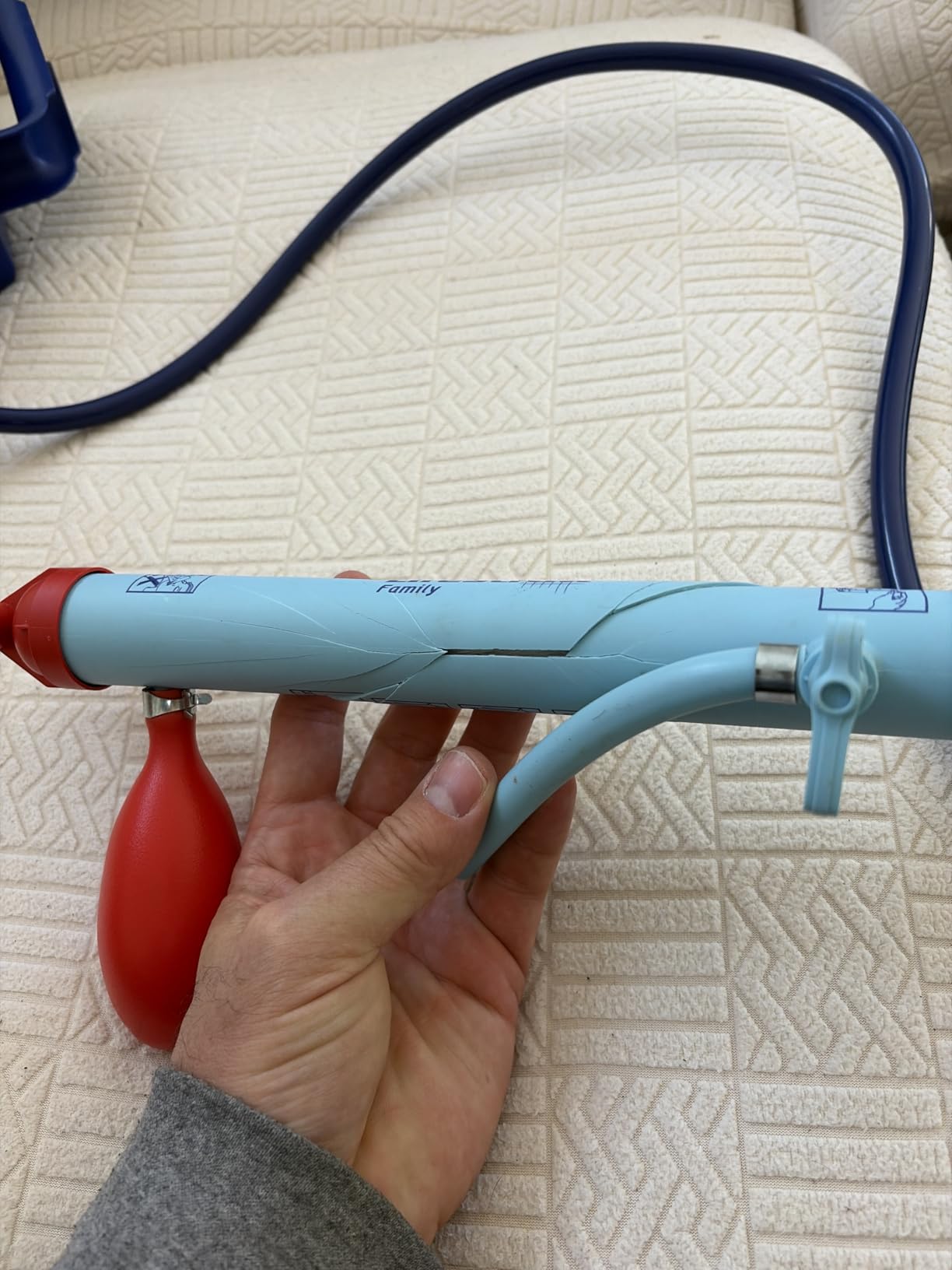
The complaints are about packaging rather than performance. Once opened, the sealed shipping bag cannot be resealed and no storage case is offered, which matters if you are storing it in a vehicle or a damp shed. Several buyers have improvised their own case.
Why virus coverage changes the plan
Flood water and retention pond water are the scenarios where a 0.1 micron straw is the wrong tool, and forum users treat those sources as contaminated with fecal matter. A 0.02 micron purifier is the piece that handles that risk, and pairing it with a larger gravity unit for volume is a common stack.
It also doubles as a household filter for well and rainwater, so it earns its counter space even when nothing is wrong. That makes it less of an emergency-only purchase than the rest of this list.
Where it falls short
The output tube is not standard 1/4 inch hydration tubing size, so plan your fittings before you need them. Replacement parts like the water bulb and clamp rings are not sold separately, so a broken part means replacing the unit rather than repairing it.
Expect several flushes of clean water before manufacturing residue clears, and note that 12 liters per hour is slower than the larger reservoir systems here. Setup instructions are also called thin by some international users.
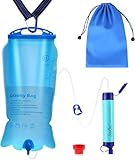
7. SimPure 3L Bag: the Best Value Three-Liter Gravity Kit
SimPure Portable Gravity-Fed Water Filter with 3L Bag
3L collapsible bag
27 liters per hour
5000 liter life
2.8 oz filter weight
Pros
- Rated at 27 liters per hour
- Three stage media
- Filter weighs 2.8 ounces
- Tree strap for hands free use
Cons
- Bag holds closer to 2.25 to 2.4 liters
- One owner reported a plastic taste
- Debris clogs the membrane quickly
The SimPure is the lightest complete gravity setup we carried. The filter weighs 2.8 ounces, rolls down small, and the collapsible bag plus strap packs into a pocket. At 27 liters per hour it moves water faster than anything else in this weight class.
Buyers consistently call it the value pick in the category. At 2.8 ounces for the filter, packability is a real advantage, and the three-stage media runs 0.1 micron hollow fiber ultrafiltration, a 5 micron coconut shell granular activated carbon stage, and a 0.2 micron polypropylene fiber layer.
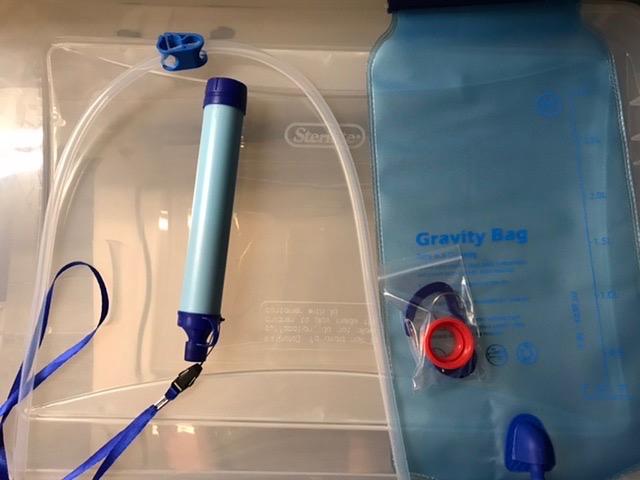
Rated filter life is 5000 liters or 1320 gallons, and the listed life cycle is 3.5 years. You can use it as a personal straw, add the 29.5 inch extension tube, or connect it straight to a bottle. Maximum supported TDS is 1000 ppm, and the whole thing hangs hands free from a tree or pole with no pumping or squeezing.
Physical complaints dominate. The bag marketed as 3 liters actually holds closer to 2.25 to 2.4 liters when filled to the top, it is hard to dry fully after washing, and one long-term owner reported a persistent plastic and chemical taste in the output. Air bubbles in the line also slow the first start until they purge.
What it does for the money
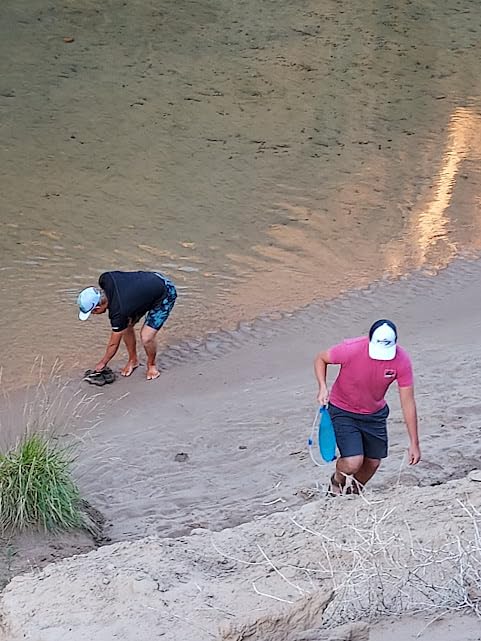
The flow figure is the standout number at 27 liters per hour, and the hanging strap means nobody has to hold a container while filling.
Customer service also came up positively. A unit that arrived cracked was replaced quickly, which matters for a kit that gets dropped in a truck bed.
Where it is not enough
The real capacity is closer to 2.3 liters than 3, so treat it as a two-person camping kit rather than a three-person one. Open water with debris clogs the membrane quickly and needs flushing to restore flow, and the same rule about freezing applies as with any hollow fiber element.
It remains a 0.1 micron system, so pair it with a disinfection step when sewage is plausible.
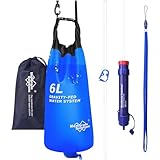
8. Membrane Solutions 6L: the Largest Portable Reservoir
Membrane Solutions 6L Gravity Water Filter Pro for Group Camping
6 liter reservoir
0.5 L per minute
NSF 42 372 and 401
Serves 3 to 6 people
Pros
- Largest portable reservoir in the group
- Independently tested by NSF and SGS
- Four stage media with dual pre-filters
- Pump free flow with reinforced strap
Cons
- TDS ceiling 500 ppm
- Filter life rated at 1320 gallons
- Only a 1 year manufacturer warranty
Capacity is the argument here. At 6 liters this bag serves 3 to 6 people, and it is the only portable system in this group that comes close to covering a group without constant refilling. The reinforced hanging strap and collapsible BPA-free body make it a basecamp piece rather than a backpack piece.
Group camping and go-bag buyers drive most of the reviews, and they point to the reservoir as the deciding advantage over one-person straws. Reviewers note it delivers clear, good tasting water fast enough to avoid queuing, and one long-term wilderness user bought a second as a backup.
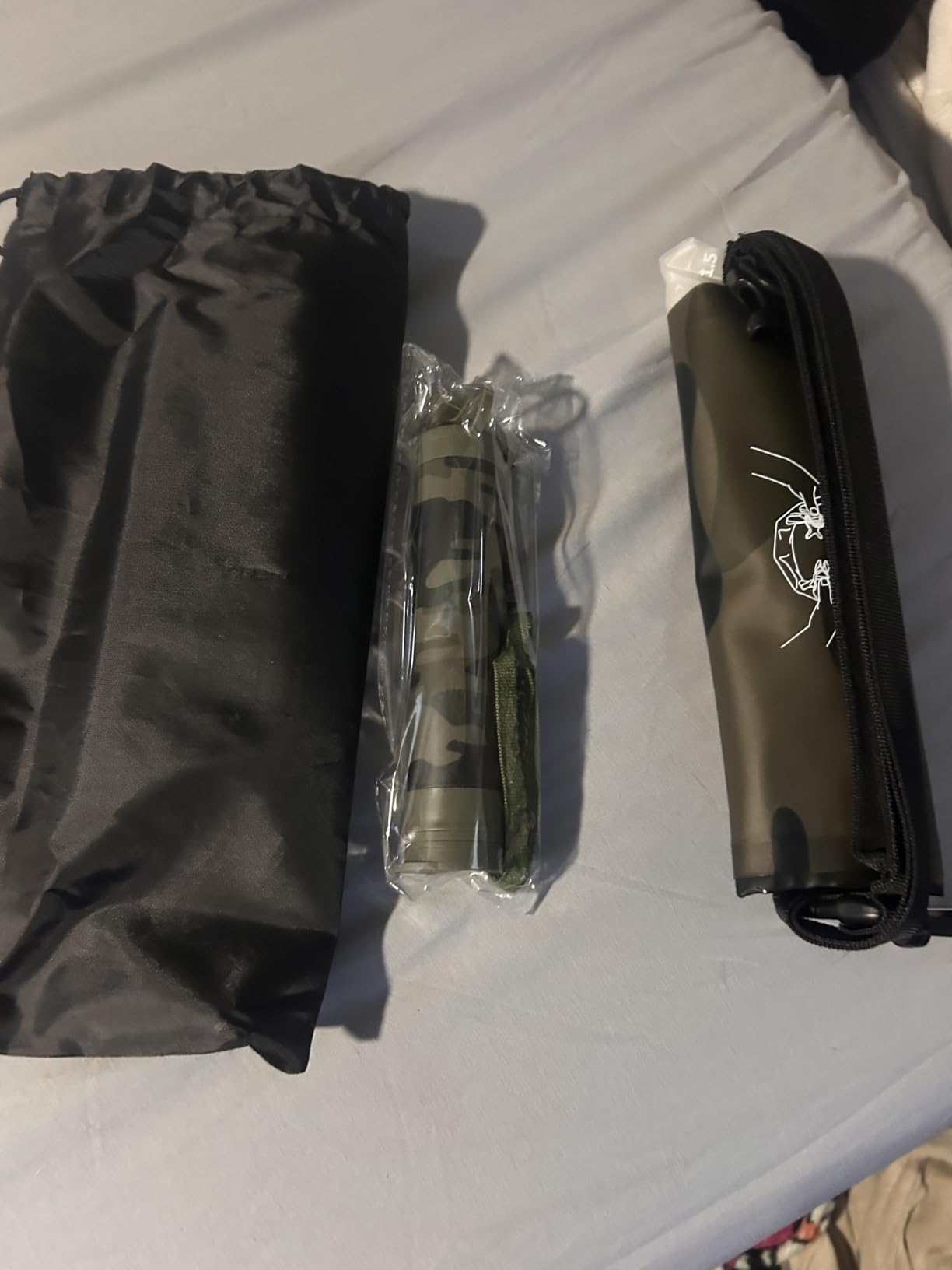
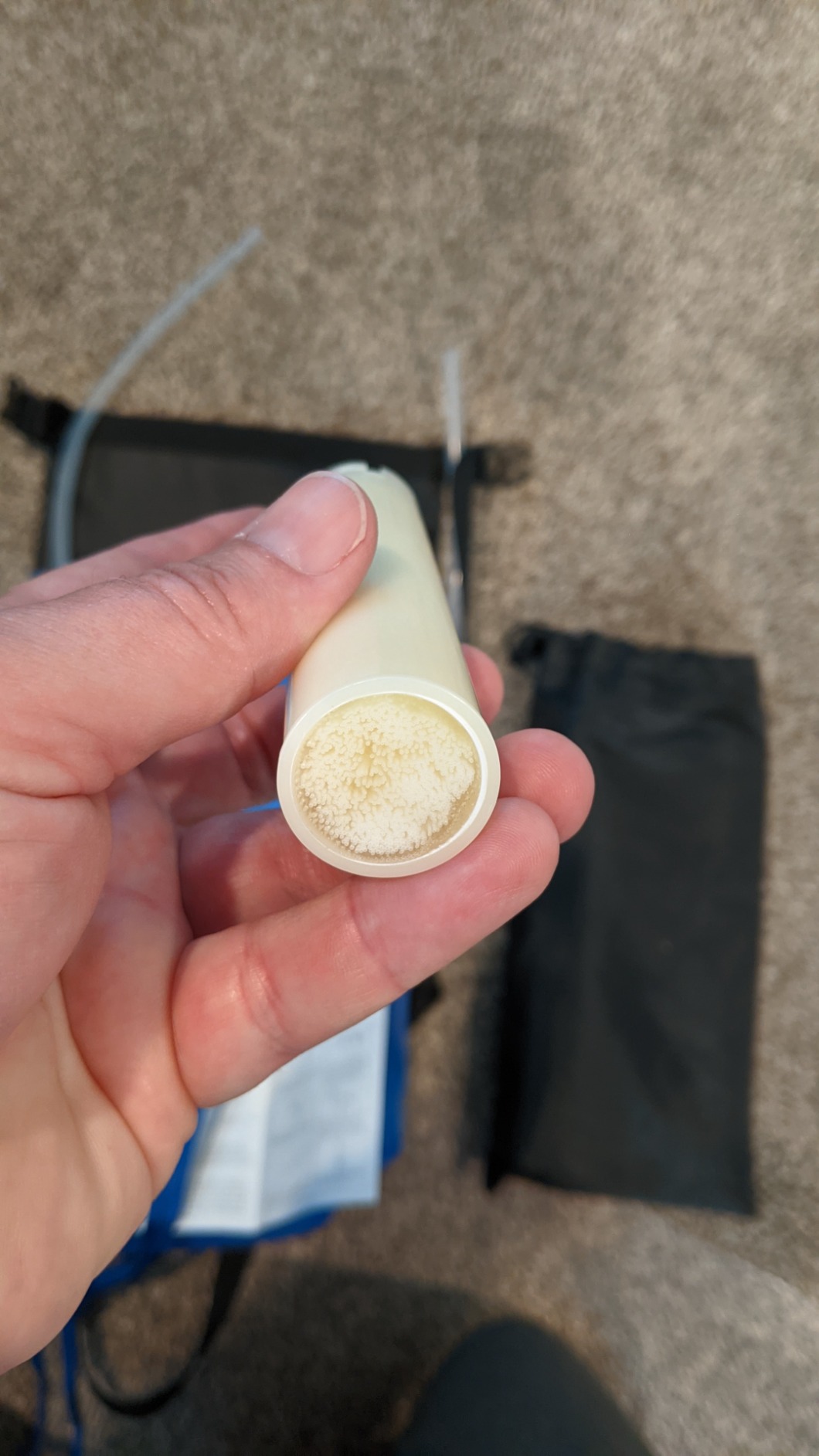
It is independently tested by NSF and SGS and meets NSF/ANSI 42, 372 and 401, which is a stronger certification story than most bags in this category. Filtration is four stages: 0.1 micron hollow fiber, coconut shell activated carbon, and dual polypropylene pre-filters. Flow reaches 0.5 liters per minute with no squeezing, pumping or electricity.
The tradeoffs are on the spec sheet. Maximum supported TDS is 500 ppm, rated filter life of 5000 liters or 1320 gallons is short next to a Sawyer element rated at 100000 gallons, and the manufacturer warranty is 1 year. Some users add purification tablets as a precaution when treating standing water.
Why groups pick it
Six liters works out to about a gallon and a half, which the manufacturer rates as enough drinking water for three to six people on a camping trip. In practice that means far fewer trips to the water source than a 3 liter bag, and the dual polypropylene pre-filters do more to protect the membrane than a single-stage bag.
For volunteer relief and basecamp work, the NSF and SGS testing is the piece that satisfies an organizer asking about certification rather than marketing language.
Where it is the wrong choice
1320 gallons is a short element life next to units rated at 5000 liters or more, so a group that drinks heavily through it will replace media sooner. One reviewer also rated flow as slower than other filters they have used.
At 500 ppm the TDS ceiling rules out many well sources, and a 1 year warranty is short for a kit you expect to keep for years.
9. Waterdrop TK-FS: a Stainless Tank for Chlorine and Taste
Waterdrop TK-FS Gravity Water Filter System, NSF/ANSI 42&372 Standard
2.25 gal stainless tank
NSF 372 certified
6000 gal carbon life
Four spare filters included
Pros
- 304 stainless tank with sight glass spigot
- Four replacement filters in the box
- Carbon rated at 6000 gallons
- Stand included
Cons
- Activated carbon only with no ultrafiltration
- Chamber holds only two carbon and two fluoride cartridges
- 1 year warranty
- Fluoride filters rated at only 1000 gallons
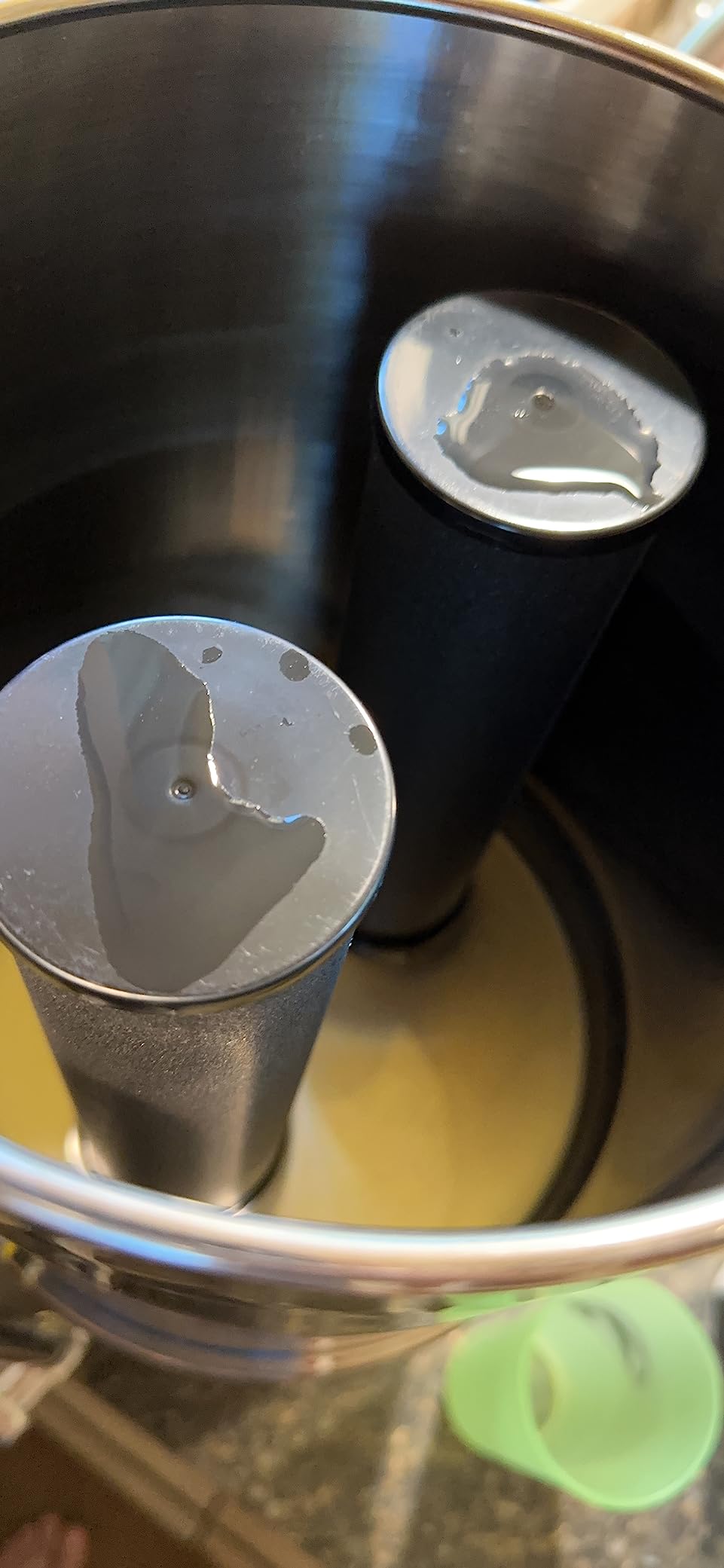
This is the one to buy for improving the taste of municipal tap water during an outage, not for turning pond water into drinking water. It is a 2.25 gallon 304 food-grade stainless tank with a metallic sight glass spigot that doubles as a water level indicator.
Owners value the finish and the convenience of the box contents: a stand plus four replacement filters come in the box with the system. Coconut shell activated carbon reduces chlorine by up to 99 percent and improves odor and taste, and the carbon filters are rated at 6000 gallons.
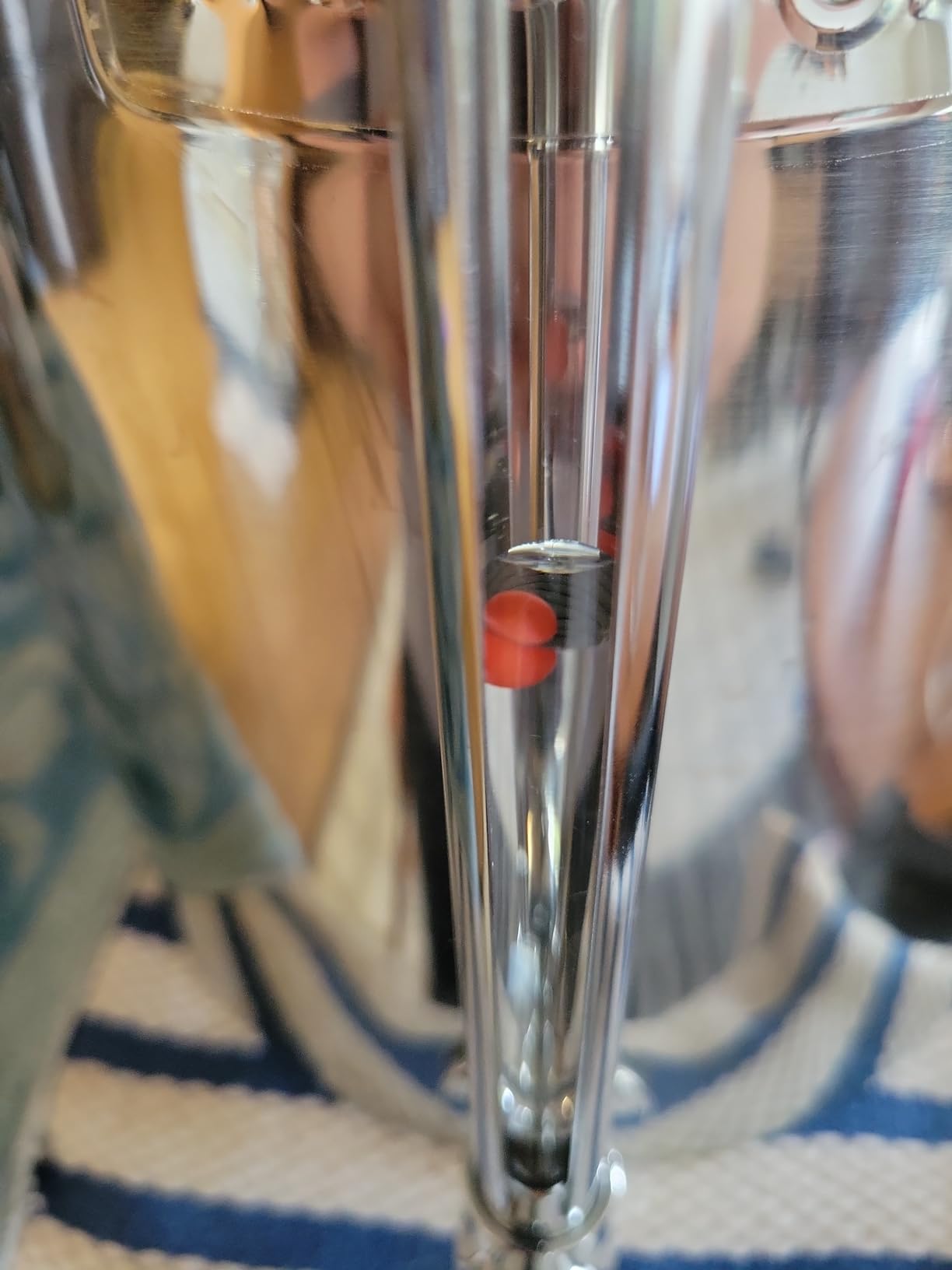
Certification is NSF/ANSI 372, which covers lead-free material rather than contaminant removal, and that distinction matters. It is a carbon-based system with no ultrafiltration membrane, so there is no pore size that screens bacteria or protozoa. Maximum supported TDS is 500 ppm and dimensions are 9.45 by 9.45 by 14.4 inches.
The chamber only has installation holes for two carbon and two fluoride cartridges. Fluoride filters are rated at only 1000 gallons against the carbon’s 6000, so the fluoride side sets the replacement clock when you are using it.
Who this tank suits
Anyone whose main risk is a boil water advisory or a loss of municipal supply while tap water is still available. Chlorine, taste and odor are carbon problems, and carbon keeps working on them without the membranes that saturate and slow down.
The stainless body also survives storage in a garage or vehicle, and the spigot is metal rather than plastic, which avoids the chemical smell complaints attached to some plastic spigots.
Where it is the wrong pick
If the water is untreated surface water, this system is the wrong tool. There is no ultrafiltration stage, so a 4.5 rating on taste and chlorine says nothing about microbes. Reviewers who buy it for flood or camping water come away disappointed for that reason.
The 1 year warranty is short for a stainless countertop system, and the two-cartridge chamber limit means you cannot scale throughput by adding elements the way a stainless tower allows.
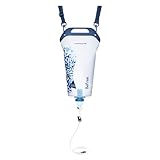
10. Katadyn BeFree 3L: the Fastest Flow in the Group
Katadyn BeFree Gravity Water Filter 3L for Camping, Backpacking & Hiking
3 liter bag
2 liters per minute
1000 liter element life
6.4 oz packed weight
Pros
- Very fast 2 liter per minute flow
- Tool free cleaning by shaking
- Collapsible bag packs flat
- 2 year manufacturer warranty
Cons
- 1000 liter filter life is the lowest rated here
- Hollow fiber can be damaged by freezing
- 0.1 micron does not remove viruses
- Bag and strap vary by variant
The BeFree fills faster than anything else we tested. The 0.1 micron EZ-Clean hollow fiber element processes water at up to 2 liters per minute, so a full refill takes about 90 seconds instead of the slow gravity draw most bags produce.
The cleaning method is what won us over. You clean it by shaking or swishing it in water, with no tools and no disassembly, which means a user can maintain it at the end of a long day. The 3 liter bag collapses flat and the packed weight is 6.4 ounces.
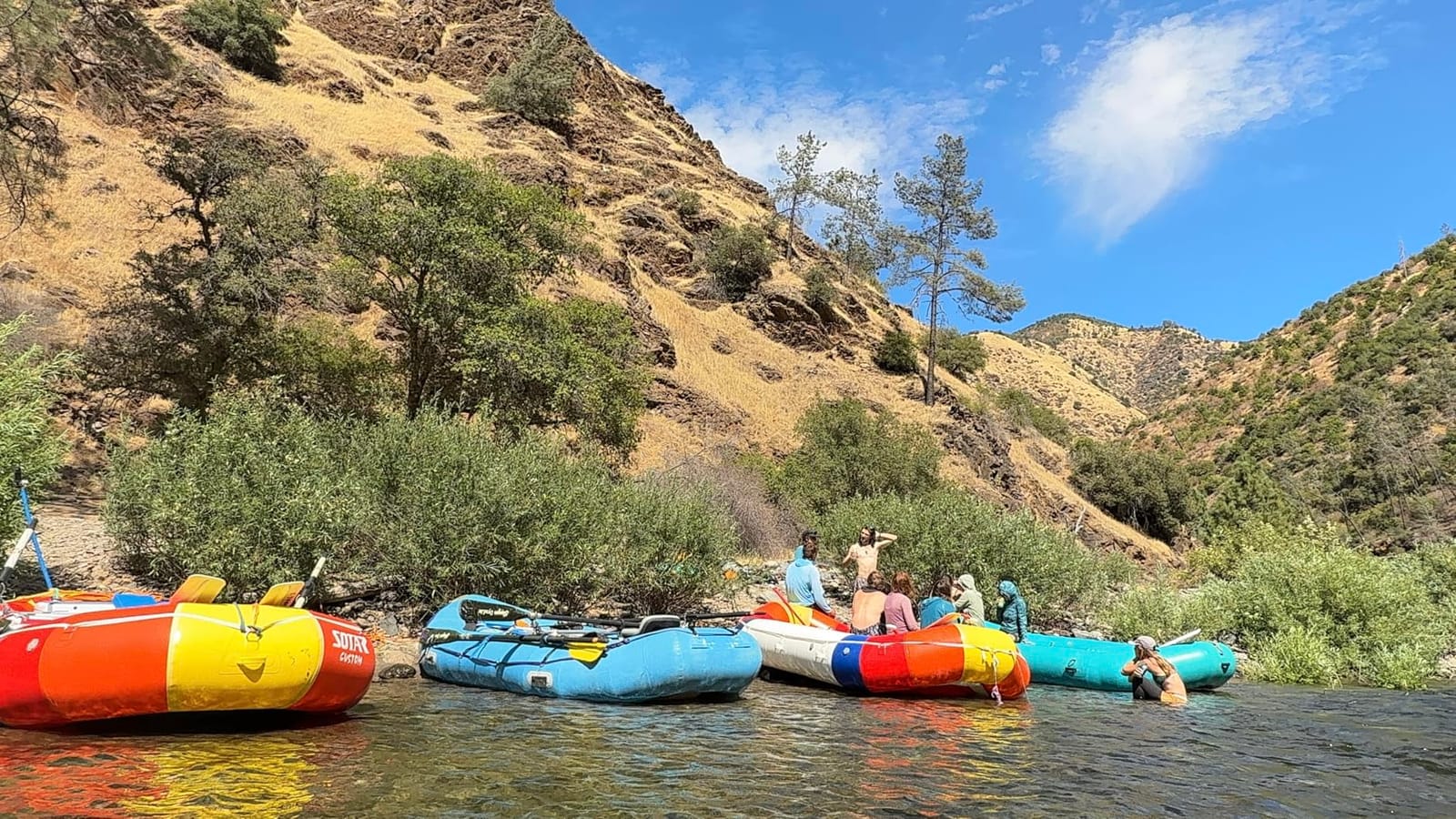
Fill, hang and drink is the whole design, with no pumping, squeezing or power at any point. Maximum supported TDS is 1000 ppm and the manufacturer warranty is 2 years. The company has been in water treatment since 1928, which is the kind of history buyers in this category look for.
The constraint is element life at 1000 liters, which is the lowest rated life of the gravity systems in this group. Units rated at 5000 liters or more last far longer between media changes, so a heavy user will be replacing this element sooner than the alternatives.
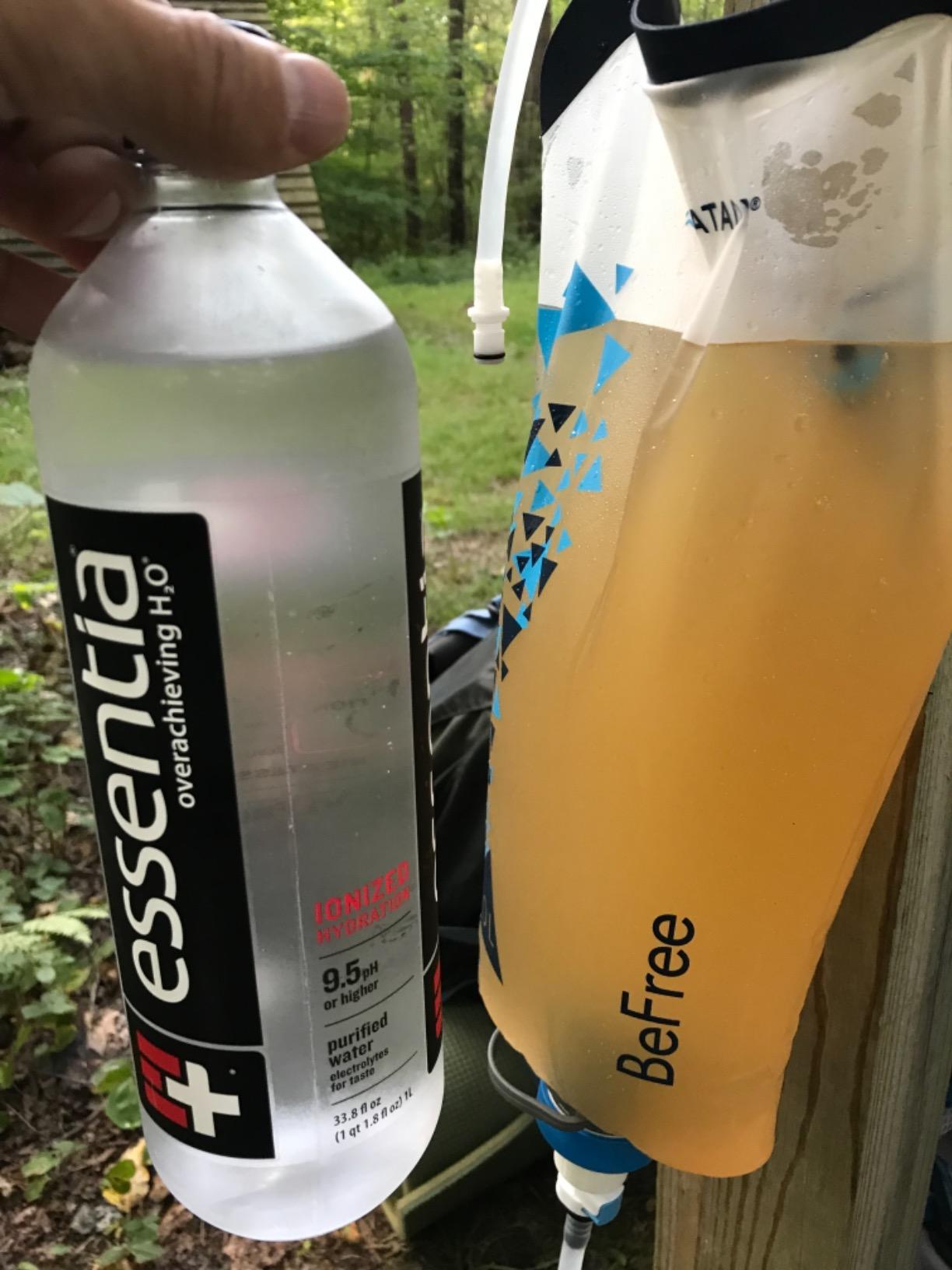
Where speed matters
Quick refills change behavior. When nobody is standing around waiting, people drink and cook instead of rationing, and a fast filter gets used more often on a trip where you are only near water for a couple of hours.
For anyone who does not want a hose run or a pump, the hang-and-drink format removes the main reason people carry straws instead.
Where the limits show
A 0.1 micron element does not remove viruses, and hollow fiber membranes are damaged by freezing, which matters for winter storage. The listing also varies by variant, and some versions include only the filter rather than a full bag and strap configuration.
At 709 ratings this product has a thinner review base than most of this group, so weigh owner reports accordingly.
11. LifeStraw Peak Compact 3L: One Filter, Four Ways to Use It
LifeStraw Peak Compact Gravity Water Filter, 3 L, Dark Mountain Gray
3 liter reservoir
Four way use
228 g packed weight
One spare filter included
Pros
- Runs as gravity unit bottle or straw
- Re-engineered membrane resists sand and silt
- Claims 99.999999 percent bacteria removal
- Leak proof premium materials
Cons
- Catalog lists sand as the purification method
- TDS ceiling 500 ppm
- Only one spare filter in the box
- Thinnest review base here
The Peak Compact is the same filter in four configurations. You can run it as a gravity system on the 3 liter reservoir, as a large squeeze bottle, as a straw, or mounted on a standard bottle, which makes it the easiest one to hand to someone who will not read a manual.
Users point to the re-engineered membrane and the supplied backwash accessory as the real upgrades over earlier versions. The stated performance covers 99.999999 percent of bacteria including E. coli and Salmonella, 99.999 percent of parasites including Giardia and Cryptosporidium, plus microplastics, silt, sand and cloudiness.
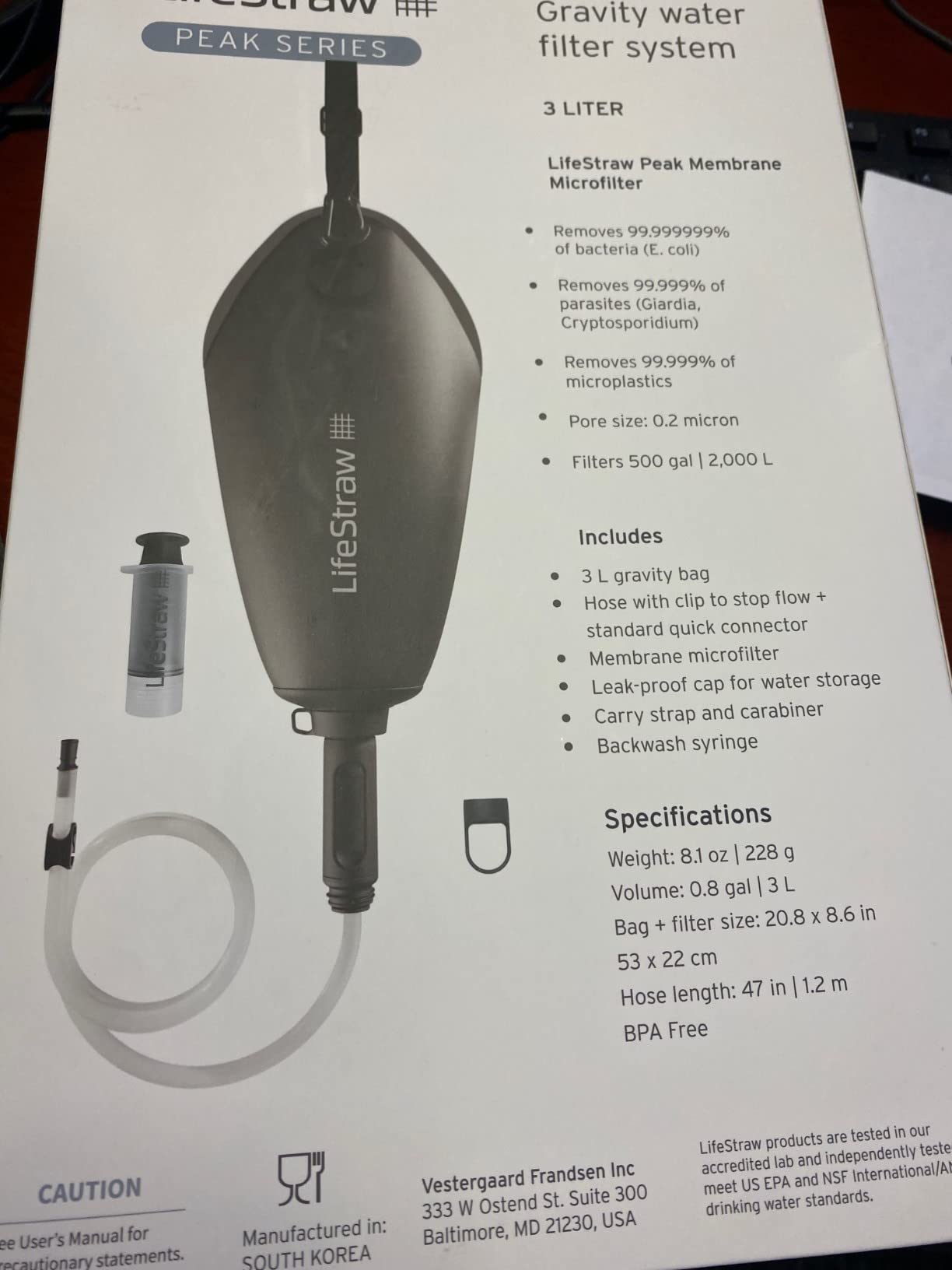
Maximum supported TDS is 500 ppm and the packed weight is 228 g, which is heavier than the straw and bag options but well under a countertop system. One spare filter ships in the box, which is thin coverage for something you may store for a year before using.
One data caveat: the catalog records the purification method as sand, which does not match the stated microfiltration performance. Treat that as a catalog data issue rather than a performance report, but check the manual in the box before you rely on a specific claim.
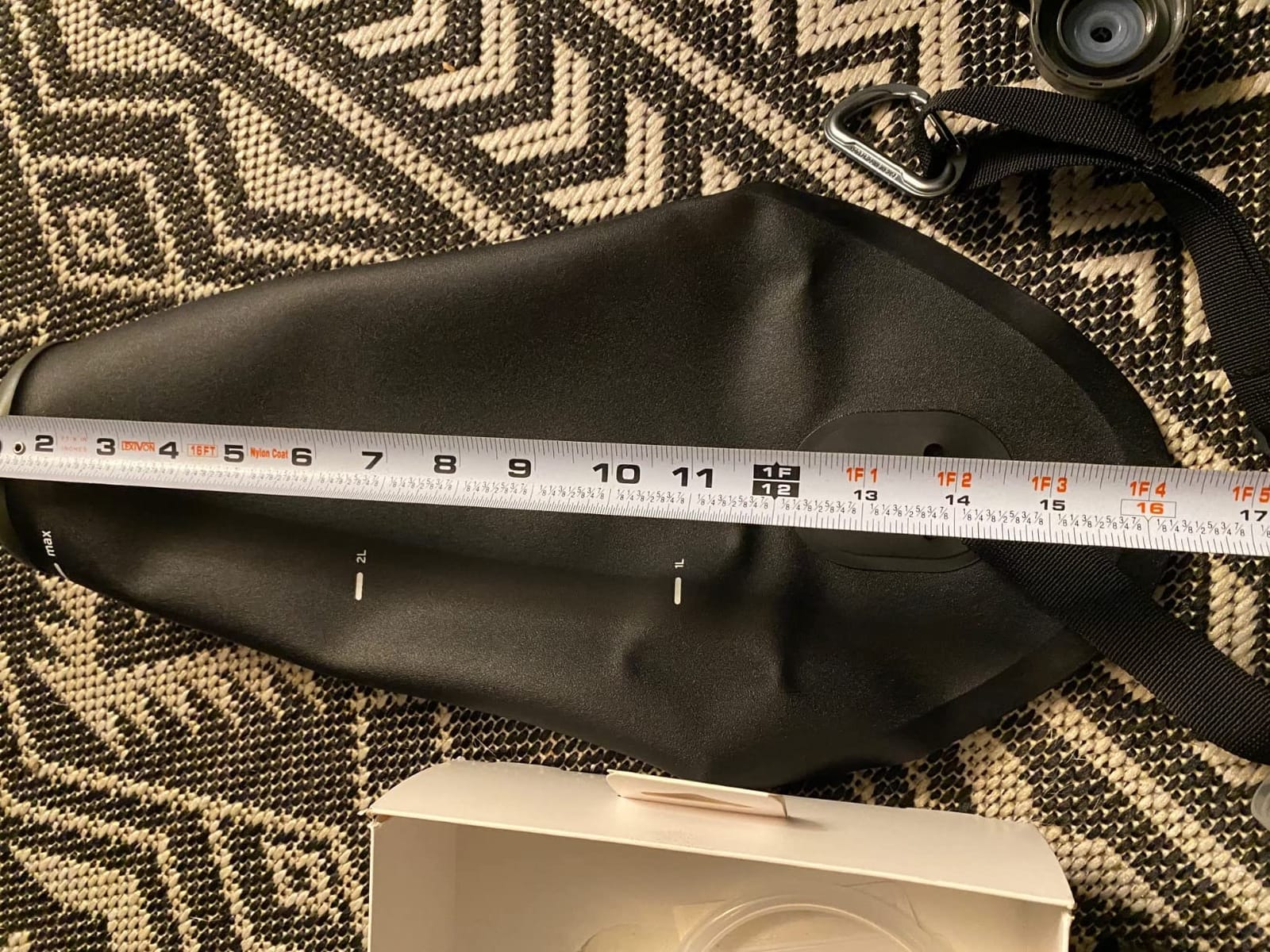
Why the four-way design earns its place
A single filter that covers a camp, a vehicle and a personal bottle means fewer parts to track and one element to replace instead of three. That matters most for people maintaining kits they check twice a year.
The sand and silt resistance is the practical upgrade, because silt is what clogs hollow fiber membranes in flood and pond scenarios.
Where the caveats sit
At 351 ratings this product has the thinnest review base in the group, so the long-term picture is thinner than for the other eleven. It is a bacteria and parasite filter, not a purifier, so virus risk still needs a second step.
The 500 ppm ceiling and a single spare in the box are both modest for a system you might leave untouched for months.
12. Practical Survival Straws 2-Pack: the Two-Ounce Backup Layer
Practical Survival Reusable Emergency Water Filter Straws, 2-Pack
2 oz per straw
1800 gallon rated life
0.1 micron hollow fiber
Two straws and two plungers
Pros
- Highest average rating in the group
- Two straws so one can be kept per vehicle
- No expiration date and BPA free
- Individually sealed with backflush plunger
Cons
- Requires squeezing rather than passive flow
- 0.1 micron does not remove viruses
- Capacity figures differ between specs and listing
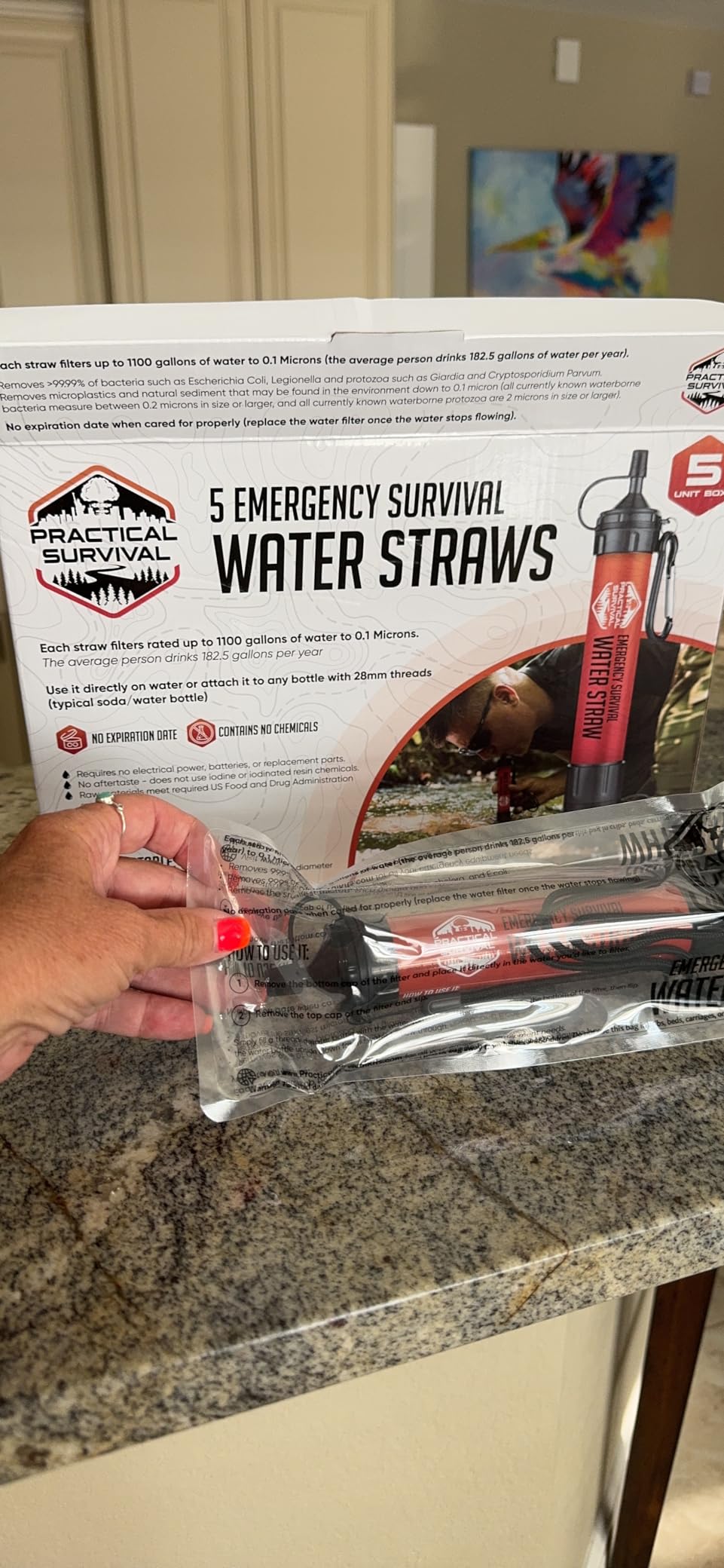
Two of these cost almost nothing and solve the problem every household has, which is that the go-bag is in the closet and never gets tested. Each straw weighs 2 ounces, measures 8 inches long, and ships individually sealed with its own backflushing plunger.
At a 4.8 average across more than 3600 ratings, this one sits at the top of our rating list, and buyers describe it as cheap insurance rather than a primary system. The two-pack format is the reason: one stays in the vehicle, one goes in the bag, and you are not sharing a single point of failure.
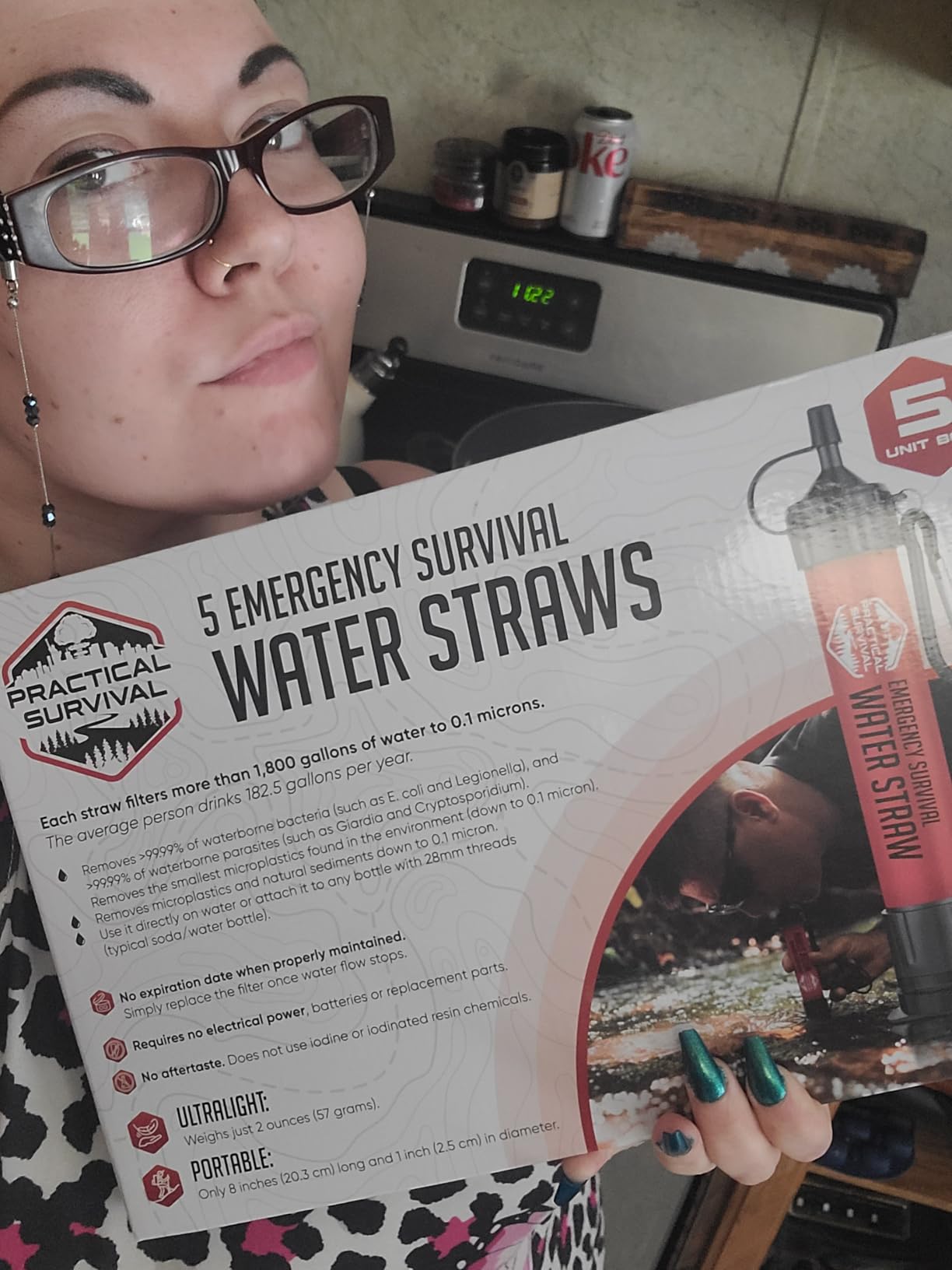
Each filter removes over 99.99 percent of waterborne bacteria including E. coli and Legionella, plus 99.99 percent of parasites including Giardia and Cryptosporidium, down to 0.1 micron. Rated life is up to 1800 gallons and roughly 10 years for one person, the housing is BPA free and FDA compliant, and there is no expiration date printed on it.
Two caveats. The straw form requires squeezing rather than passive gravity, so it costs arm strength over a long day. And the capacity figure differs between the specification and the listing copy, with the specs at 1100 gallons against 1800 in the marketing text, so treat the lower number as the planning figure.
Why it belongs in a kit
The failure mode we hear about most is a filter that sat untouched for a year and did not work when it was needed. Two sealed straws are the cheapest way to cover a scenario you will probably never test, and because they are individually sealed you can open one and leave the other intact.
No expiration date also removes the annual calendar check that forces people to write a date on a filter and then ignore it.
Where it is not a system
It is a 0.1 micron filter, so it does not remove viruses, and microplastics capture is claimed without a cited certification standard. Use it as the last layer on water you have already pre-filtered or disinfected, not as your primary treatment.
Microplastics claims without a cited standard is a recurring pattern in this category. Independent certification such as NSF/ANSI 42, 53 or 372 is the check we use before believing a number.
Which Filter Is for Which Emergency?
Start with the emergency, not the spec sheet. A power outage with tap water still available is a taste and volume problem, so a stainless countertop tank with carbon media handles it. A flood or retention pond scenario is a pathogen problem, and it needs a 0.02 micron purifier plus a disinfection step rather than a 0.1 micron filter alone.
For a 72-hour household kit, the Big Berkey or the Purewell covers drinking and cooking, and the 2.25 gallon reservoir is about two people-days, so treat a municipal outage of several days as a reason to store treated water alongside the filter. Our guide to whole house filters for well water covers the permanent plumbing side, which is a different problem from emergency treatment.
For a go-bag, the Sawyer SP160 at 43 grams and a pair of sealed straws cover you better than any single larger unit. For an RV, weight and footprint matter more than reservoir size, and if your RV carries a fixed tank, our RV filter guide covers the onboard options.
For a group basecamp, the Membrane Solutions 6L and the Katadyn BeFree are the two that avoid a queue, because flow rate is what determines whether people wait. If you are building a kit for hiking rather than driving, the bottles with built-in filters we tested pair naturally with any of these gravity units.
Priming, Backflushing and Storing a Filter You Rarely Use
Priming is the step where first-time owners lose time. Hollow fiber elements ship with air trapped in the fibers, and until that air is out you get weak flow and cloudy output. Run the unit with clean tap water and flush until the output runs clear and steady, which takes longer than the instructions suggest for most brands.
Flush the first gallon. Manufacturing residue comes out in the early draws on several of these systems, and LifeStraw owners in particular report needing several full flushes before the water is clean. Backflushing with the included plunger or syringe reverses flow through the membrane, which restores flow rate and extends element life.
Storage is where kits quietly fail. Keep elements from freezing, keep them dark, and keep them in a sealed bag rather than a cardboard box in a hot garage. Most forum members agree the filter that sat untouched the longest is the one most likely to disappoint you, so plan a ten minute test every few months.
Also learn where the spare parts are. On some units the bulb, clamp rings, washers and spigot are not sold separately, so a single cracked fitting means replacing the whole system. Replacement cartridges are a far more common failure point than the housing.
What We Would Skip and Why
Skip sub-2-liter jugs marketed as household solutions. They cannot cover a family for a day, and buyers usually discover that after the event rather than before it.
Skip systems with no pre-filter path when your water will be silty. Sediment kills hollow fiber membranes faster than anything else, and every bag unit here benefits from a cloth or sock pre-filter step that costs almost nothing.
Treat short warranties as information. A 30 day limited filter warranty on a gravity straw, next to lifetime and 2 year warranties elsewhere, tells you which brand expects its own consumables to fail quickly.
Finally, ignore unverified removal percentages. Independent certification to NSF/ANSI 42, 53 or 372, or WQA certification, is the check. Where you want under-sink or whole-home coverage, our under-sink filter guide covers the permanently installed options.
Frequently Asked Questions
What is the best water filter system for emergencies?
For a household that could lose municipal water for several days, the Big Berkey 2.25 gallon stainless system is the best general choice: a pair of elements is rated at 6000 gallons, the chambers nest for storage, and it needs no power or plumbing. For virus or sewage exposure, pair it with a purifier rated at 0.02 microns such as the LifeStraw Family. Keep a hand filter or sealed straws in every vehicle as well.
Do gravity water filters actually work?
Yes, within a defined range. A gravity system strains out bacteria and protozoan cysts at a 0.1 micron rating and removes chlorine and taste with carbon, and it keeps working with no power because the weight of the water does the work. It does not remove viruses unless the element is rated at 0.02 microns or finer, and it does not remove salt, fuel or chemical contamination.
Can a gravity water filter remove viruses?
Only if it is rated at 0.02 microns or finer. Most hollow fiber gravity filters sit at 0.1 micron, which catches bacteria such as E. coli and protozoa including Giardia and Cryptosporidium but passes most viruses. Among the twelve systems we reviewed, the LifeStraw Family carries a 0.02 micron rating with a stated 99.99 percent virus removal, and a chlorine dioxide, boil or UV step covers the gap on the others.
How much water does one person need per day in an emergency?
Plan on one gallon per person per day, covering drinking and cooking, assuming you are not washing with filtered water. A family of four therefore needs about 4 gallons a day, or 28 gallons for a full week. A 2.25 gallon countertop reservoir covers roughly two people-days, so size the reservoir to the window you have to reach a water source.
How often should I replace a gravity filter cartridge?
Replace on condition and gallons, not on the calendar. Rated lives in this group run from 1000 liters for the Katadyn BeFree to 5000 liters for the SimPure and 6000 gallons for a Berkey element pair. Units that advise a fixed 6 month interval regardless of gallons read that as forced replacement, so backflush regularly and judge flow rate and taste instead.
Can I use a gravity filter on muddy water?
Not without a pre-filter step. Pour the water through a cloth or sock first to strip silt, because sediment clogs hollow fiber membranes and vertical elements faster than anything else and permanently reduces flow. Even then, heavily turbid water needs slower treatment and frequent backflushing, and flood or retention pond water should be treated as sewage contaminated, which calls for a 0.02 micron purifier plus disinfection.
Final Verdict: Our Picks by Emergency Type
The Big Berkey is our pick for the best gravity water filters for emergencies overall, because a 6000 gallon element rating, a stainless build that survives storage, and four-element expandability handle the widest range of household scenarios. Its weak points, priming and rubber washer taste, are problems you solve in the first hour and then never think about again.
For a go-bag, the Sawyer SP160 wins on weight and the Practical Survival straws win on cost. For sewage or flood exposure, the LifeStraw Family is the unit here whose specification names a 0.02 micron rating. For groups, the Membrane Solutions 6L holds enough water to cut down trips, and the Katadyn BeFree refills in under two minutes.
Finish the kit around the filter, not just the filter. Add a cloth or sock for pre-filtering, chlorine dioxide tablets for disinfection, clean containers with lids, and a calendar reminder to run the unit a few times a year. The filter you have actually tested is the one that will work when everything else has stopped.