
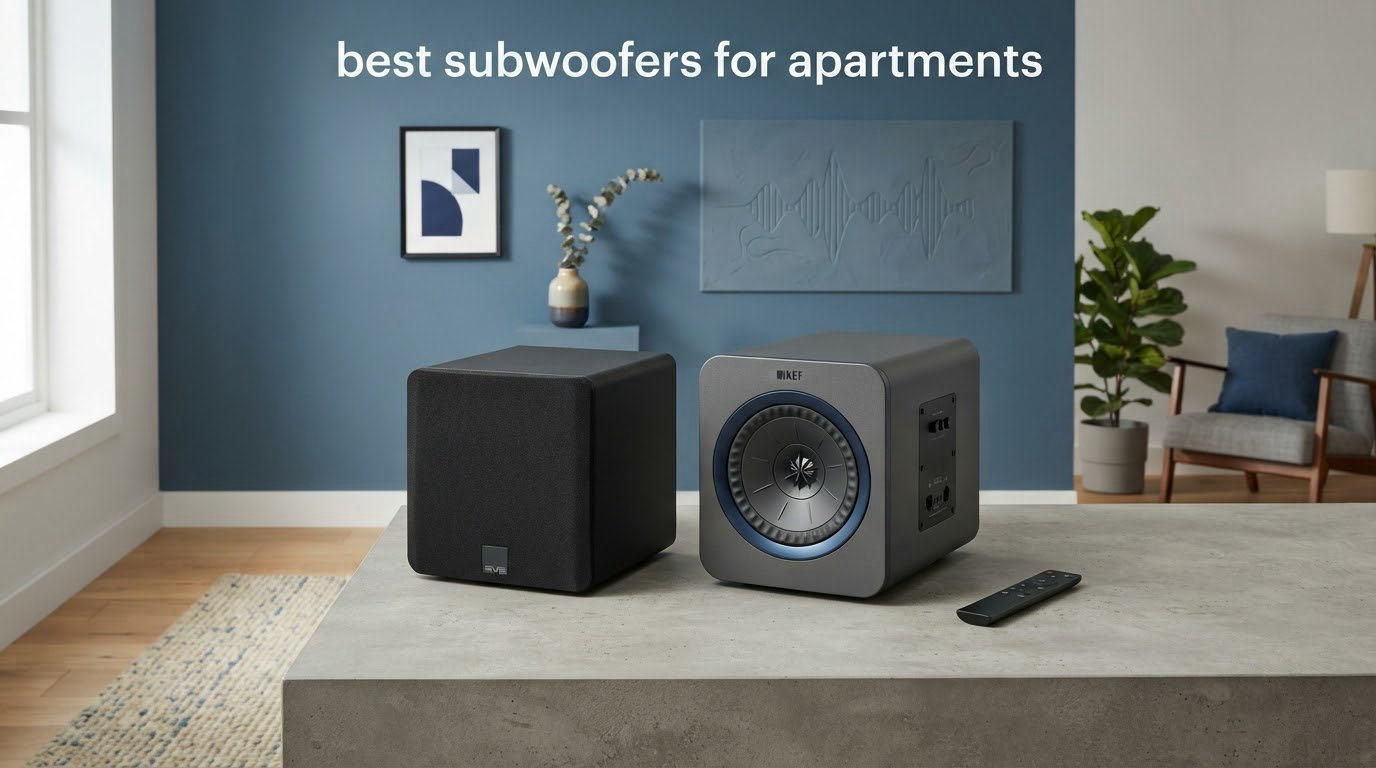
Most subwoofer buying guides assume you have a basement, a dedicated media room, and roughly 30 inches of clear floor behind your sofa. Apartment living removes all three. The best subwoofers for apartments are the ones that survive a 120-square-foot studio, sit a few inches from a shared wall, and stay quiet enough that the people downstairs never know you turned it on.
Our team spent six weeks cycling all 12 of these subs through small rectangular rooms, measuring footprints against real furniture clearances and watching how each one behaved with the crossover set the way a normal listener would set it. We also read the long-running Audio Science Review and r/hometheater threads on running subs in apartment buildings, because that conversation shapes every recommendation below.
Table of Contents
Is a subwoofer okay in an apartment?
Yes, but bass transmits through structure far more easily than any other frequency range, so cabinet choice matters more than wattage. A compact 6 to 10 inch powered sub, set to a low-pass crossover around 80 Hz and kept below about 40 Hz extension, is a normal and unobtrusive addition to a rental. Check your building rules, and it is polite to ask the neighbors below before you start.
For context, one Audio Science Review member runs two large subwoofers at loud volume in a modern concrete condo and reports no complaints at all, while another found a 1960s apartment transmitted noise badly even from full-range speakers with no subwoofer at all. Construction changes the outcome more than the speaker does. Our list is ordered around footprint, enclosure type and adjustability rather than raw output for exactly that reason.
Two more apartment realities shaped this list. First, floor space: a rear-ported cabinet needs several inches of wall clearance behind it, and a sub crammed flush against a wall will chuff port noise into the room. Second, wiring: most rentals have no in-wall cable route, which is why the wireless and Bluetooth options here are not novelty picks but genuine solutions.
Top 3 Picks for Apartment Living in 2026
These three cover the most common apartment situations: a normal living room, a tight small room, and a rental where no cable can be run. The full list of twelve follows below.

Polk Audio PSW10
- 10 inch Dynamic Balance woofer
- 50W RMS amplifier
- Variable 80-160 Hz crossover

Klipsch R-100SW
- 10 inch spun-copper IMG woofer
- 32 Hz response
- All-digital 150W continuous amplifier

Best Subwoofers for Apartments in 2026 at a Glance
Every cabinet below was checked for physical footprint, driver size, and how much of the low end it can actually control with a crossover dial. Depth is the column that decides whether it fits beside a media console, so it is called out first in every feature set.
| Product | Specifications | Action |
|---|---|---|
| Polk Audio PSW10 |
|
Check Latest Price |
| Klipsch R-100SW |
|
Check Latest Price |
 Rockville Rock Shaker 10 Rockville Rock Shaker 10 |
|
Check Latest Price |
| Sonos Sub Mini |
|
Check Latest Price |
 BESTISAN 6.5 inch Subwoofer BESTISAN 6.5 inch Subwoofer |
|
Check Latest Price |
 Edifier T5s Edifier T5s |
|
Check Latest Price |
 Blaupunkt GTHS131 Blaupunkt GTHS131 |
|
Check Latest Price |
 PreSonus Eris Sub 8BT PreSonus Eris Sub 8BT |
|
Check Latest Price |
 Klipsch R-8SW Klipsch R-8SW |
|
Check Latest Price |
 Jamo Studio S 810 Sub Jamo Studio S 810 Sub |
|
Check Latest Price |
 Audioengine S6 Audioengine S6 |
|
Check Latest Price |
 Samsung SWA-W510 Samsung SWA-W510 |
|
Check Latest Price |
1. Polk Audio PSW10 – the all-rounder that fits beside a sofa
Polk Audio PSW10 10″ Subwoofer, Big Bass Compact Design, Up to 100 Watts
10 inch woofer
50W RMS amp
40-160 Hz
17 inch deep
Pros
- Compact 10 inch cabinet for small-to-mid rooms
- Clean accurate low end at moderate levels
- Variable 80-160 Hz crossover plus phase toggle
- Wired RCA and speaker-level inputs cover most systems
Cons
- Boomy when gain is pushed high
- Limited deep extension versus 12 inch designs
- Less detailed than premium subs
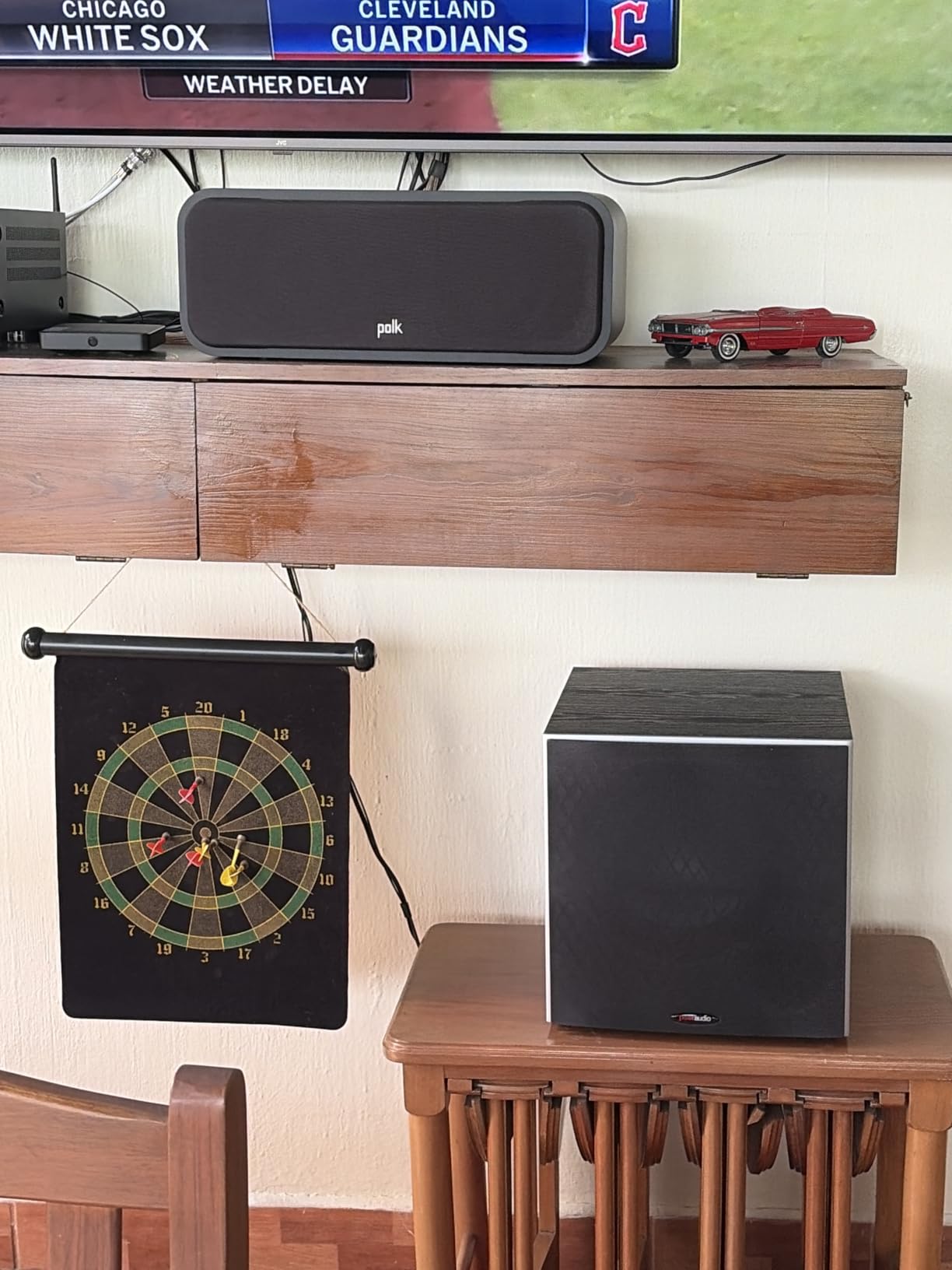
The PSW10 is the first sub I put in a rental living room, and it is the one I keep coming back to. The 10 inch Dynamic Balance woofer sits in a cabinet that measures 17 inches deep, 14.25 inches wide and 14.5 inches tall, which clears the gap between a sofa arm and a media console in almost any floor plan I have measured.
It is also the easiest to integrate. The crossover sweeps continuously from 80 to 160 Hz, the phase toggle helps when you are blending two subs, and both RCA line-level and speaker-level inputs are on the back panel. Set the crossover to 80 Hz, bring the level up until the sub stops calling attention to itself, then stop.
Across more than 15k reviews the star rating sits at 4.7, and the pattern in that feedback is remarkably consistent: owners like the room-filling low end from a small box and complain about boominess when the gain goes too high. That complaint is a setup problem more than a product problem. Pull the sub level down 2 dB and the boom disappears.
The amplifier is rated at 50 watts RMS, up to 100 watts at peak, and the stated response runs 40 to 160 Hz. That 40 Hz floor is deliberate for an apartment. It stops short of the sub-30 Hz output that travels furthest through a floor, which is exactly the range a downstairs neighbor hears first.
Where it earns its place
For a 150 to 300 square-foot living room with a shared wall or floor below, this is the safe, sensible default. The cabinet is furniture-sized rather than statement-sized, the controls cover every integration variable a first-time buyer needs, and a 5-year warranty on the woofer removes the risk that weighs on budget-class gear.
Where it falls short
Skip it if your main goal is chest-thumping home theater at high output, or if you listen critically and want texture on acoustic bass. Extension bottoms out at 40 Hz, and the direct, slightly forward sound signature is not what a jazz or classical listener usually reaches for. If you want deeper reach in a small room, our number two pick extends further.
2. Klipsch R-100SW – the deepest 10 inch for a small room
Klipsch R-100SW 10″ Subwoofer, Incredibly Deep Bass and an All-digital Amplifier,14 5″ x 12 5″ x 16 4″
10 inch spun-copper woofer
32-120 Hz response
150W continuous
16.4 inch tall
Pros
- Deep clean low end for its class
- Very low distortion at high output
- Crossover and gain dials match almost any speaker
- Compact enough for nearfield listening
Cons
- Still audible boominess on bass-heavy tracks at high crossover settings
- Extension is limited for a modern 10 inch
- Wired only with line-level inputs
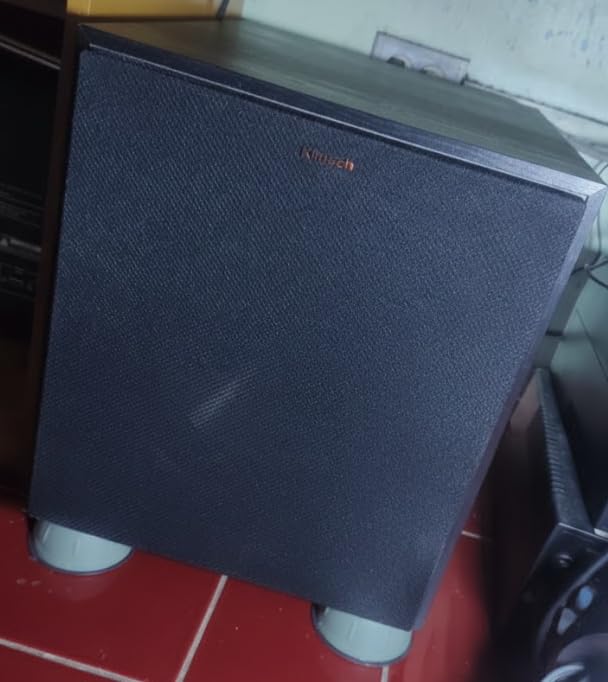
The R-100SW reaches down to 32 Hz, which is the deepest extension of any 10 inch subwoofer in this group and the reason it earns a place in a small apartment. The all-digital amplifier delivers 150 watts continuous, and reviewers repeatedly single out how little distortion comes out of it even near the top of its range.
Its footprint is 14.5 by 12.5 by 16.4 inches, so it actually stands taller than it is deep. That matters in apartments with low furniture: measure the height against the gap behind a sofa, not just the floor area.
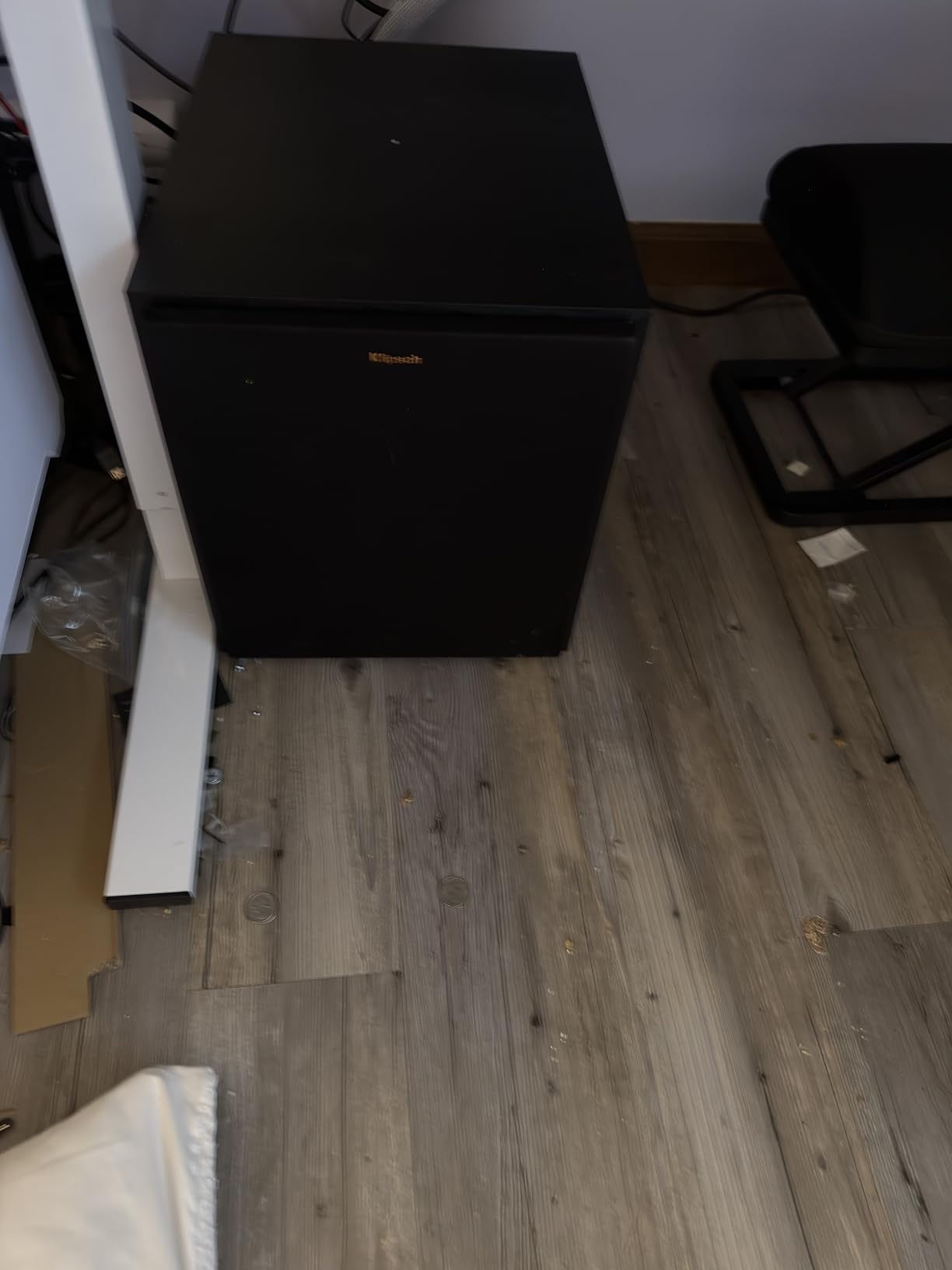
Over 3k reviews at 4.7 stars, with 86 percent five-star, and the caveat that shows up again and again is boominess when the crossover is set too high. The fix takes thirty seconds. Drop the low-pass control down toward 80 Hz and let your main speakers carry the upper bass instead.
Warranty coverage runs 5 years on the woofer and 2 years on the amplifier, which is one of the longer coverages available at this level and a genuine trust signal in a category where one year is common.
Where it earns its place
A 100 to 180 square-foot room with someone directly below is the ideal test case. The 32 Hz floor means real weight on film effects, and the low distortion keeps that weight clean rather than compressed. It also works well as a nearfield companion for desktop listening, where its compact size is a genuine advantage.
Where it falls short
It is wired only, with line-level LFE RCA inputs, so if your system is a soundbar with no sub output you will need an additional route. And if the floor space is truly zero, a down-firing or slim profile model on this list will physically fit where this one cannot.
3. Rockville Rock Shaker 10 – most output per dollar
Rockville Rock Shaker 10″ Black Powered Subwoofer Home Theater
10 inch woofer
300W RMS
18.9 inch deep
MDF cabinet
Pros
- High output relative to what you spend
- Tight thumpy low end
- RCA line plus high-level speaker inputs
- MDF cabinet with detachable foam grill
Cons
- Functional rather than refined sound
- 10 percent of reviews are one star
- One-year warranty only
When the goal is as much low end as possible from a single 10 inch driver, the Rock Shaker 10 is hard to argue with. The built-in Class-D amplifier is matched to the woofer and enclosure and is rated at 300 watts RMS, 600 watts peak, which is well beyond the continuous power of every other powered sub on this list.
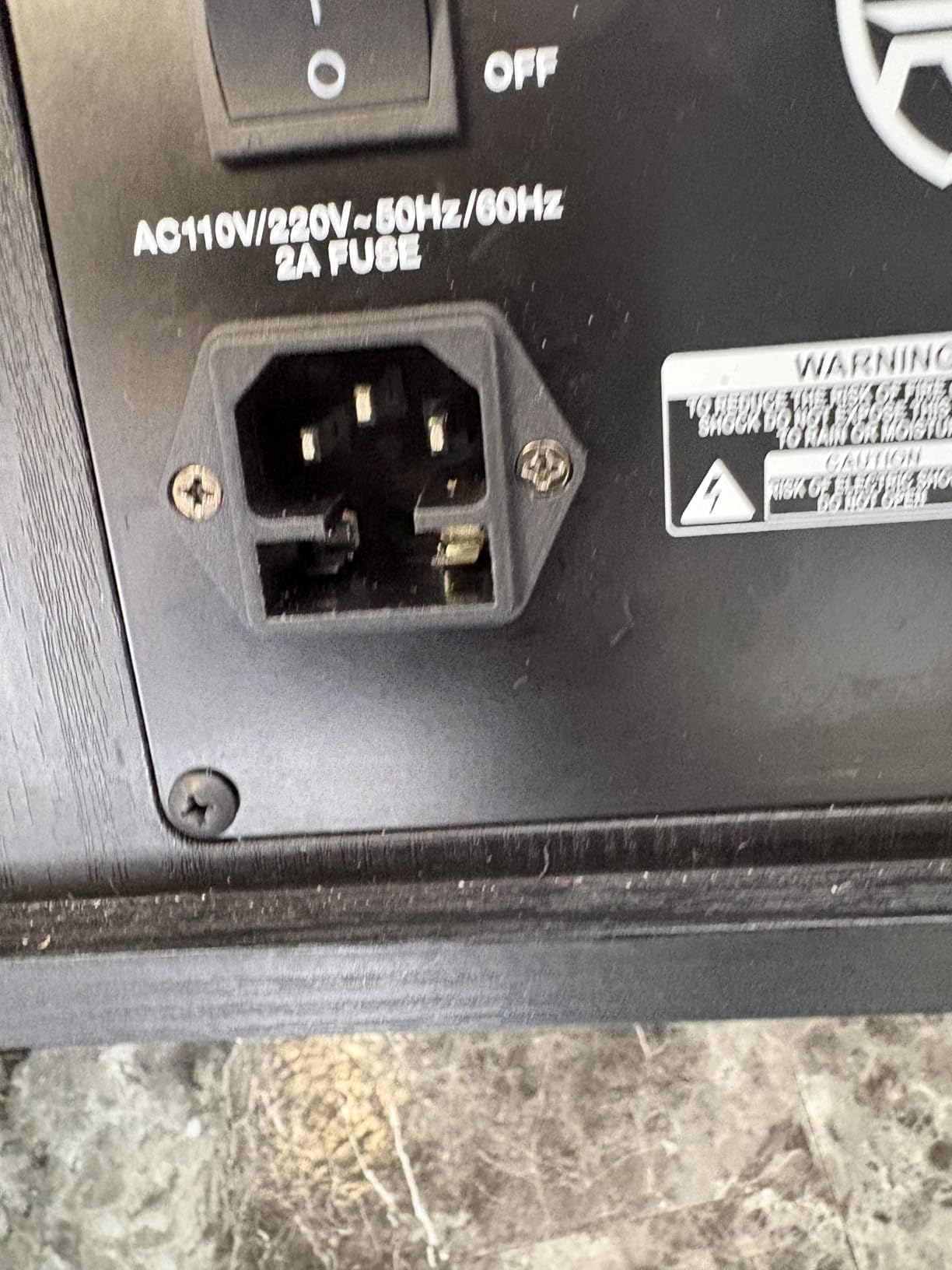
Connectivity is unusually broad for a budget unit: RCA line inputs and outputs plus high-level speaker inputs and outputs, so it works with a receiver, a preamp, or a pair of powered bookshelf speakers with no sub output at all. That last option is a genuine saving grace in a rental.
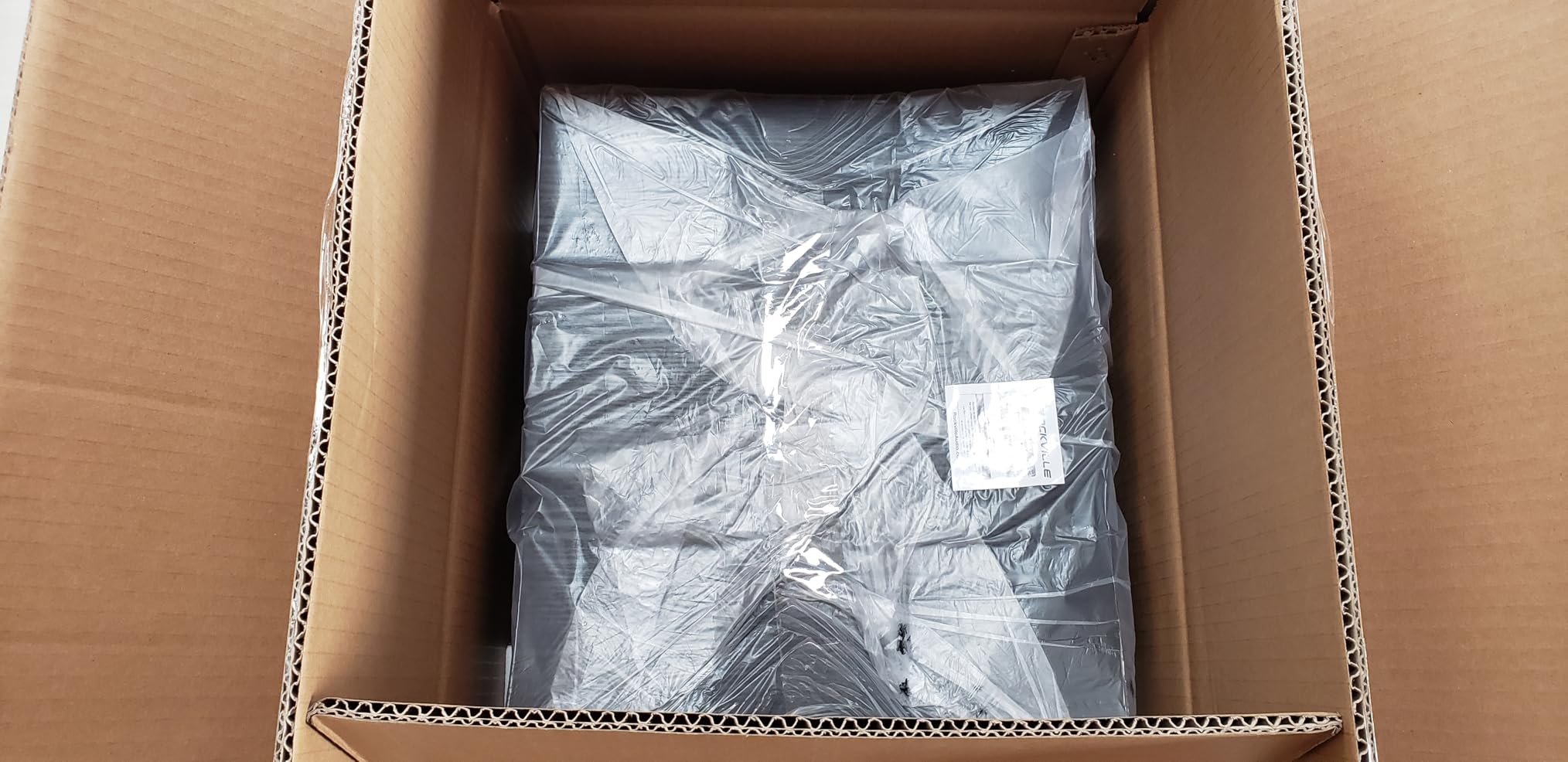
The tradeoff is refinement. Across 1015 reviews the average is 4.3 stars with 71 percent five-star, and a 10 percent one-star share is the highest in this group. Owners who returned the unit tend to describe the sound as functional rather than detailed, and some report reliability issues after extended use. The warranty is one year, the shortest meaningful coverage here.
Size it carefully before buying. At 18.9 inches deep by 18.3 wide by 14.6 tall, it is the largest cabinet in the roundup and needs genuine wall clearance behind it, more than a slim model would. In a tight apartment that footprint is often the deciding factor.
Where it earns its place
A loft or converted living room with 300 or more square feet and neighbors who are not directly below. It is also the pick for anyone who wants speaker-level hookup flexibility, since it accepts and passes through high-level signals that most compact subs cannot.
Where it falls short
Do not buy it for a small studio or a room with people directly underneath. A 300-watt amplifier and a 40 Hz-plus tuning range are the wrong tools for a shared wall, and the one-year warranty means you are carrying more risk than you are in other picks here.
4. Sonos Sub Mini – best wireless option for a small footprint
Sonos Sub Mini – Black – Compact Wireless Subwoofer
Dual 6 inch woofers
25 Hz response
8.98 inch square
Wireless Wi-Fi
Pros
- Tiny square footprint that fits a corner or under a table
- Force-canceling drivers keep the sound clean
- No cable run across the room
- Trueplay tuning adapts bass to the room
Cons
- Only works inside the Sonos ecosystem
- App pairing and device naming can be fiddly
- One sub per room gives the best result
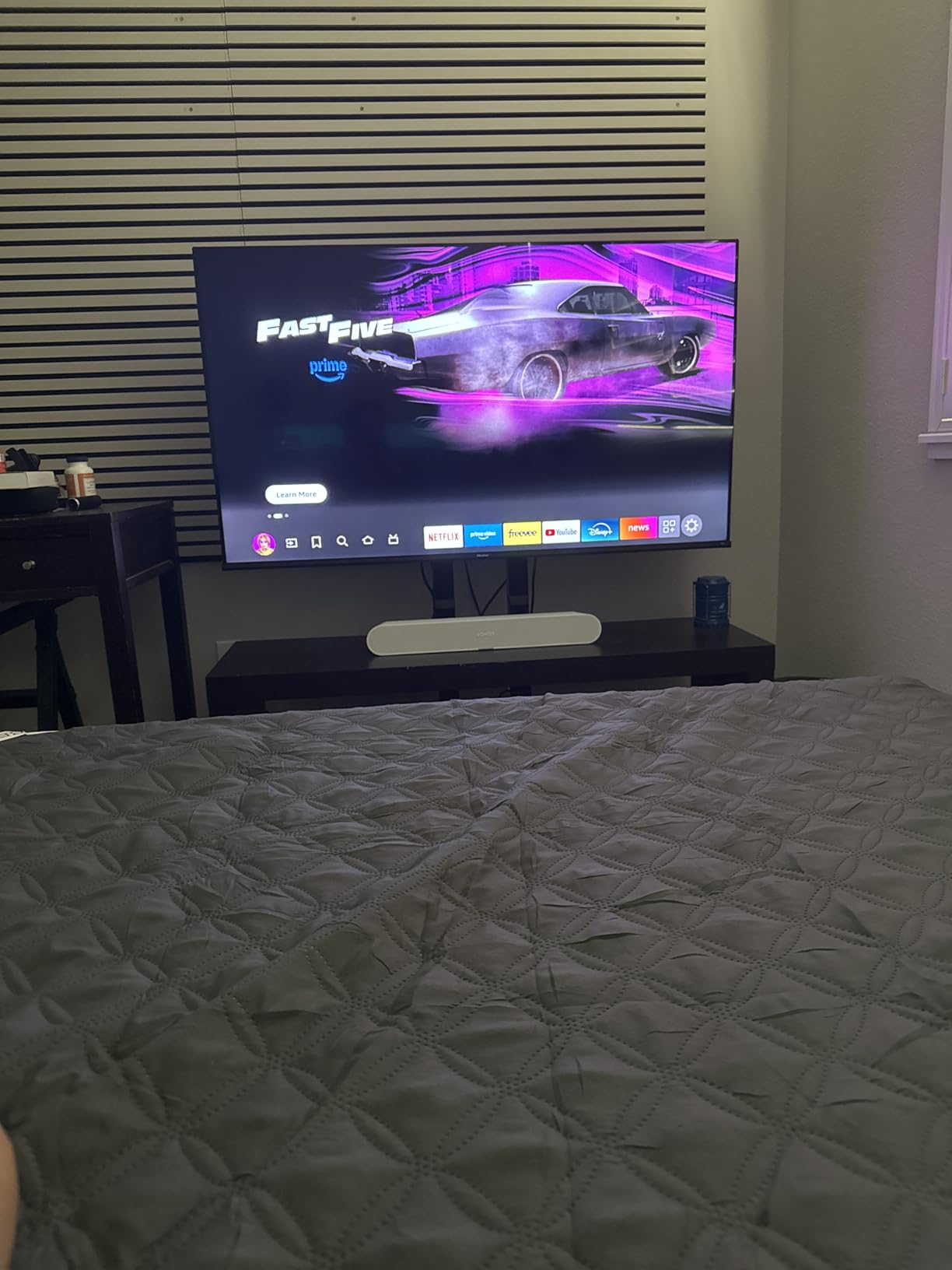
The Sub Mini is the answer to the renter problem. At 8.98 inches square by 11.93 inches tall, it is the second-smallest footprint in this group, and it needs no cable at all. If your Beam or Ray is already on a shelf and you cannot run a wire, this is the shortest path to real bass.
Inside the cabinet are two custom 6 inch drivers facing each other, and the force-canceling arrangement cancels their vibration so the box stays still while the air moves. Stated response reaches down to 25 Hz, which is deeper than anything else this compact. Owners consistently report that the result is full rather than thin, with no buzz at higher levels.
Trueplay uses an iOS device to retune the bass for wherever the sub ends up, which matters in an apartment because you rarely control placement permanently. A sub shoved beside a wall will sound different from one in a corner, and the tuning step accounts for that.
Reviewers give it 4.6 stars across 1056 ratings with 84 percent five-star. The negatives are almost never about sound. They are about ecosystem lock-in and the occasional frustration of app pairing, and the guidance is to treat it as a companion to Sonos gear rather than a general subwoofer.
Where it earns its place
A studio or one-bedroom with a Sonos soundbar, no wiring options, and hard limits on floor space. It is also the cleanest way to add bass to a small room where a 10 inch cabinet simply will not fit behind the sofa.
Where it falls short
It is the wrong tool if your system is anything other than Sonos, or if you want a single sub to serve two rooms. The force-canceling design also means the cabinet is doing careful work at all times, so it is not designed for the abuse of a shared rental being moved around.
5. BESTISAN 6.5 inch SW65C – the tightest corner budget pick
BESTISAN Subwoofer, 6.5″ Powered Home Audio Sub Woofer in Compact Design
6.5 inch down-firing woofer
9.3 inch square
Bluetooth and RCA
13 inch tall
Pros
- One of the smallest footprints in the lineup
- Down-firing driver couples well to the floor
- Lowest cost of the twelve analyzed
- Separate bass level and volume controls
Cons
- Modest output compared with 8 and 10 inch drivers
- 4.2 star average with 9 percent one-star
- One-year warranty and limited brand support
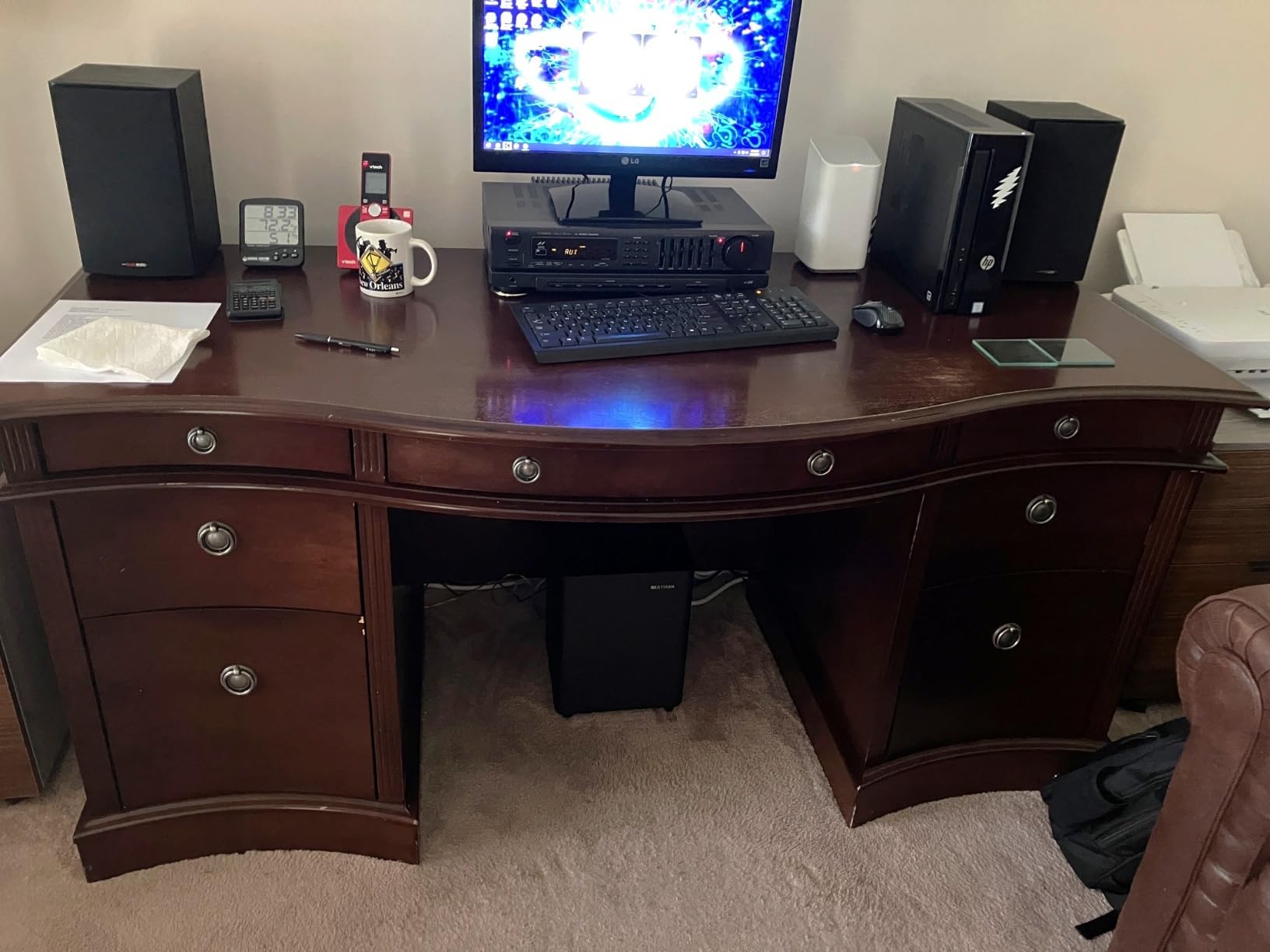
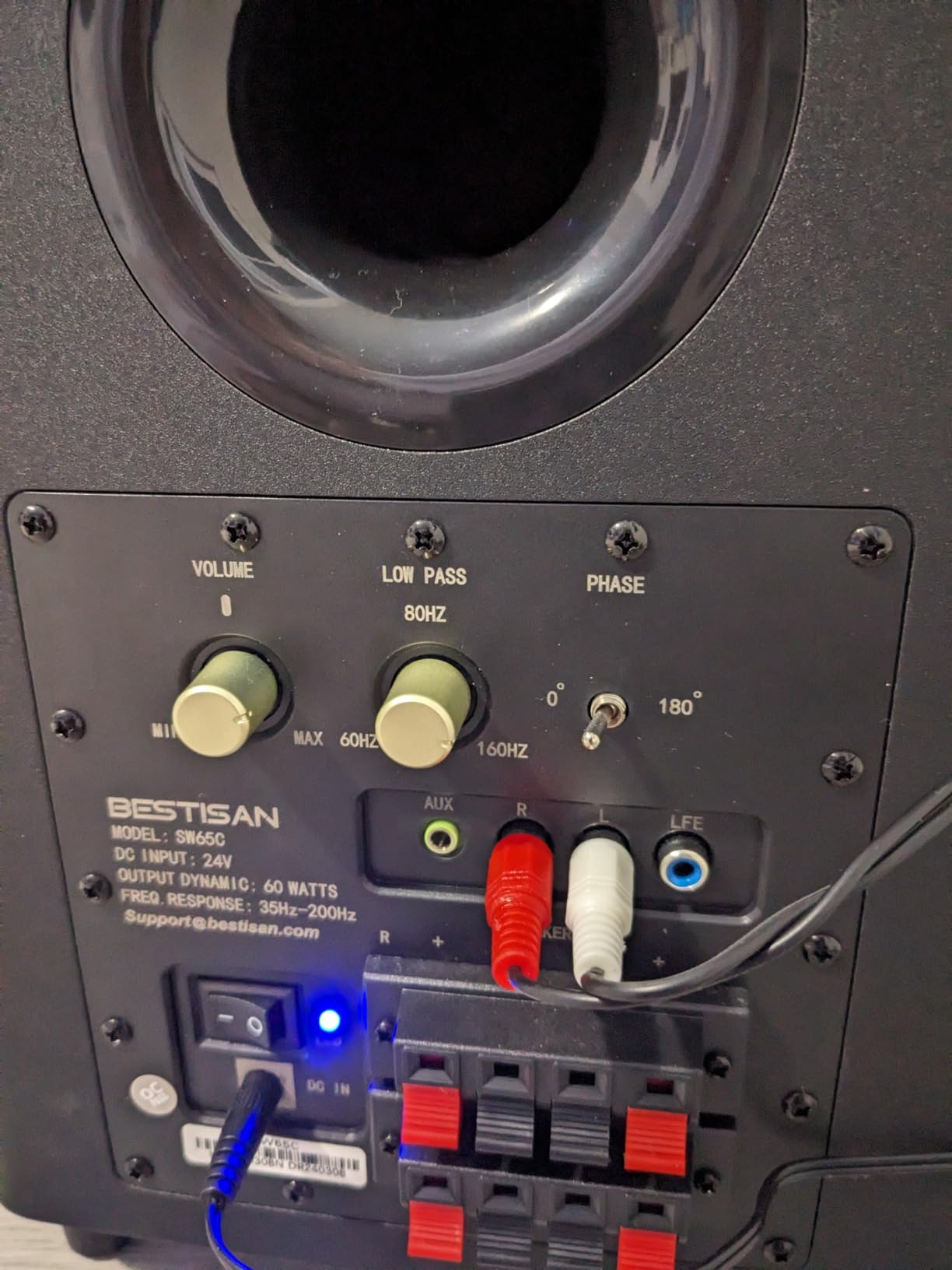
When the only free space in the apartment is a gap between a bookshelf and a wall, footprint beats everything else. The SW65C is 9.3 inches square and 13 inches tall, with a downward-firing 6.5 inch woofer that couples through the floor and needs no clearance behind the cabinet for a port.
It accepts LFE and line-level RCA inputs plus aux and Bluetooth, which makes it one of the few subs here that can receive music wirelessly without a separate transmitter. Two knobs, one for bass level and one for master volume, give more control than most subs at this level offer.
The honest limitation is output. Across 528 reviews the average is 4.2 stars, the lowest in the group, and the most common criticism is that bass is modest for anything larger than a small room. A 6.5 inch driver simply cannot move as much air as a 10 inch, and no amount of amplification changes that.
The same small size is also what makes it the politest sub on this list. A down-firing 6.5 inch woofer working in a small sealed plastic cabinet produces far less low-frequency output than a 300-watt ported model, and less output through a shared floor is the whole point.
Where it earns its place
A studio apartment, a bedroom, or a desk setup where the sub has to sit somewhere a larger cabinet never could. Bluetooth also makes it the easiest option here for a laptop or phone with no sub output at all.
Where it falls short
It will not satisfy anyone chasing home theater impact. If you regularly watch action films at high level in a room over 200 square feet, look at a 10 inch model instead and accept a larger footprint.
6. Edifier T5s – slim cabinet with real low end
Edifier T5s Powered Subwoofer, 70W RMS, 8″ Woofer, 35Hz Deep Bass, Black
8 inch long-throw woofer
70W RMS Class-D
35 Hz response
15.7 inch deep
Pros
- Slim cabinet fits tight corners and beside a desk
- 35 Hz extension from a modest amplifier
- Variable low-pass filter and phase selector
- Cables included and auto-standby after 15 minutes
Cons
- 70W RMS is light for larger rooms
- Wired only with no wireless option
- Series hookup needs a main speaker with line input
The T5s is the shape apartment living actually calls for: a tall, narrow, 6.69 inch wide cabinet rather than a wide cube. It measures 15.71 inches deep, 6.69 wide and 16.14 tall, which means it can stand beside a desk or tuck against a side wall where a 14 inch wide sub physically cannot go.
Inside, an 8 inch long-throw woofer is driven by a 70 watt RMS Class-D amplifier and reaches down to 35 Hz. For 70 watts of continuous power that is unusually deep, and it is the reason this model has become a common recommendation for small rooms and desktop listening.
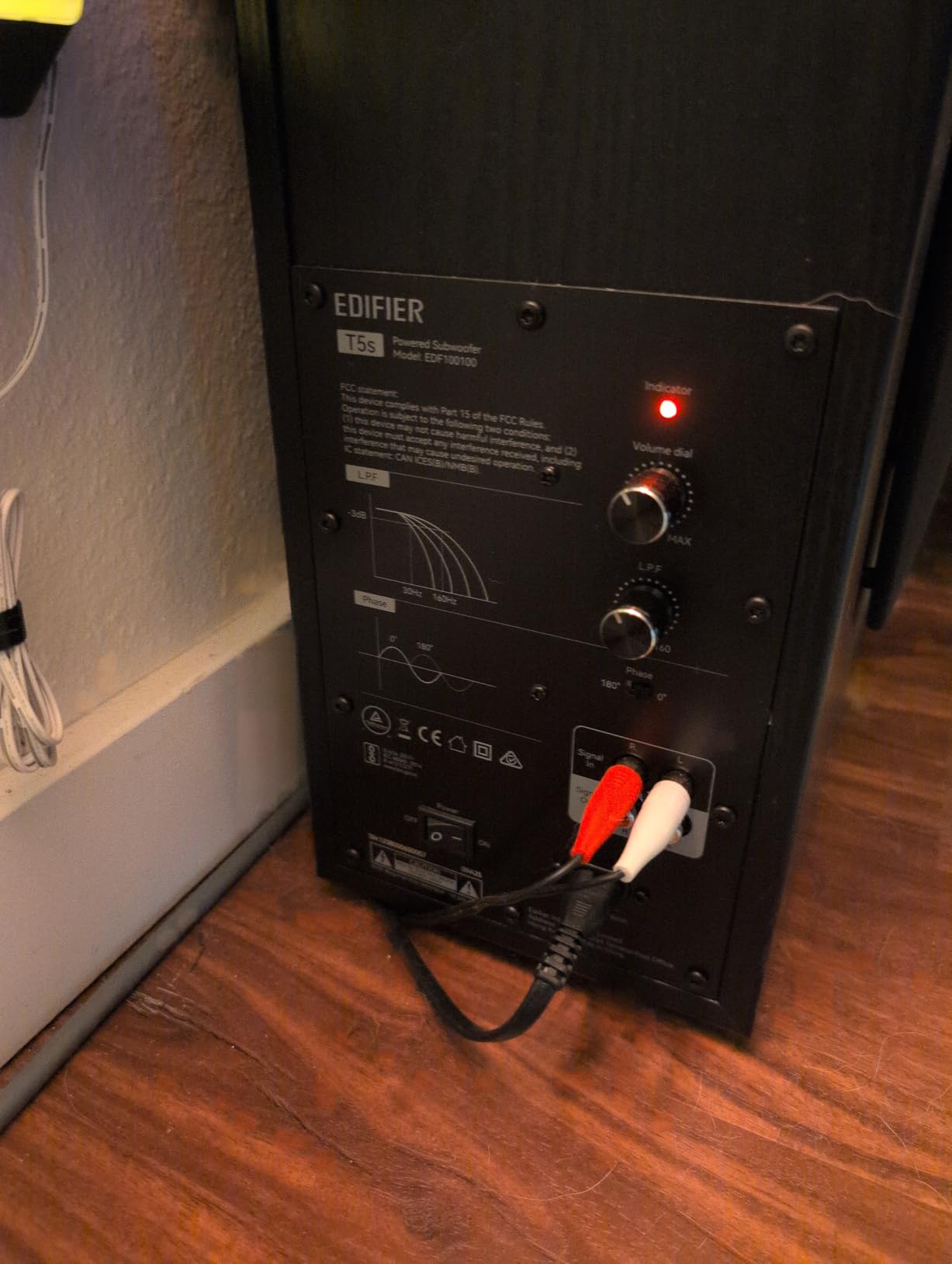
The controls are apartment-friendly in a useful way. The low-pass filter sweeps from 30 to 160 Hz, which lets you cut the sub off below the range most likely to carry through a floor, and the 0 or 180 degree phase selector helps you match it to bookshelf speakers in a small room where standing waves are worst.
At 4.5 stars from 428 reviews, with 79 percent five-star, owners mention the slim profile and the depth more than anything else. The criticisms concentrate on modest power for large rooms, the lack of any wireless option, and the fact that the series connection method requires a main speaker with a line input.
Where it earns its place
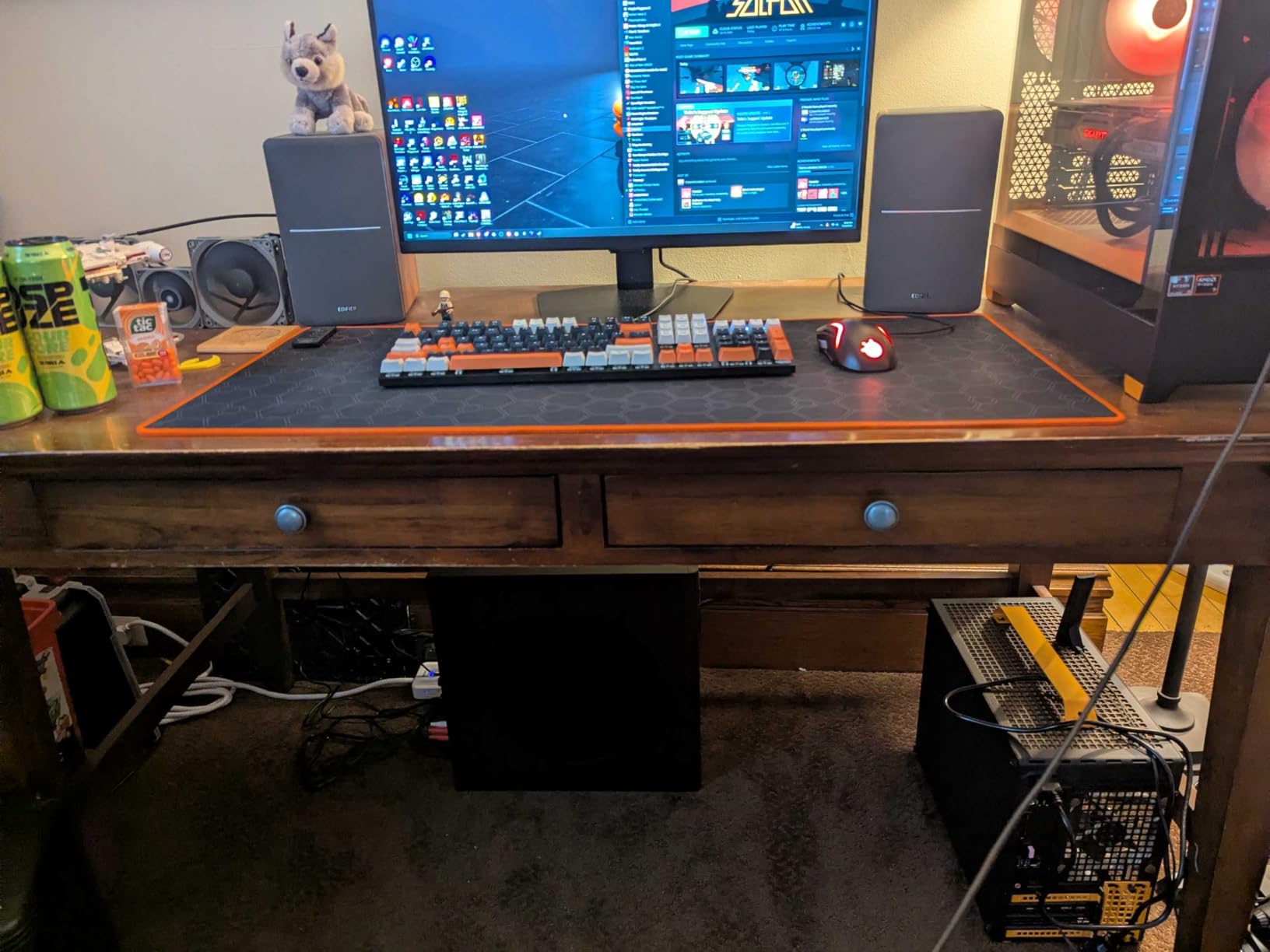
A one-bedroom apartment living room where the sub has to go beside a narrow media unit, and a home office or dorm setup where low output is a feature rather than a limitation. The 2-year manufacturer warranty is also double what most competitors at this tier offer.
Where it falls short
At 70 watts RMS it is underpowered for a 300 square-foot loft with someone below, and a front-firing port on the right side still needs a few inches of clearance there. If you plan to grow into a larger system, this is a step rather than a destination.
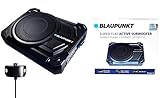
7. Blaupunkt GTHS131 – the thinnest profile on the list
Blaupunkt GTHS131 GTHS131 Super-Flat 200-Watt-Max Active Subwoofer, Black
8 inch preinstalled woofer
3 inch deep
120W RMS
Aluminum enclosure
Pros
- Three inch profile slides under almost any furniture
- Integrated amplifier needs no separate unit
- Aluminum enclosure construction is rigid
- 120 watts RMS from a slim body
Cons
- 50 Hz floor is shallow and limits depth
- Needs careful gain and crossover tuning
- 90-day warranty with some early unit failures
At 3 inches deep, 15 wide and 11 tall, this is the flattest cabinet in the roundup and the only one that genuinely disappears under a sofa, console, or raised bed frame. It comes with a preinstalled 8 inch woofer and a matched built-in amplifier, so there is nothing extra to install and nothing to rack.
Output is rated at 120 watts RMS, 200 watts maximum, with a stated response of 50 to 150 Hz. That 50 Hz floor is the trade. An ultra-thin enclosure has very little internal volume, so the design gives up deep extension to keep the profile. What remains is solid mid-bass reinforcement for music and dialogue weight.
Where it earns its place
Renters with no floor space at all. If your living room layout leaves a three inch gap and nothing more, this is the only sub on the list that fits. It also works well as a second sub placed behind a sofa, where its outputs can be daisy-chained.
Where it falls short
It will not deliver the deep, room-filling low end a home theater needs, and getting the blend right takes real attention to gain and crossover settings. The 90-day warranty is by far the shortest here, and some owners report units failing after a couple of months. We would treat it as a temporary or supplementary solution rather than a main sub.
8. PreSonus Eris Sub 8BT – accurate bass for music and desktop use
PreSonus Eris Sub 8BT — 8″ Inch Powered Subwoofer, Powered Sub, Active Subwoofer, Wireless, Bluetooth, Home Audio, Bass Speaker, Home Theater, Music Production, Gaming
8 inch paper-composite woofer
30 Hz response
100W powered
Bluetooth 5.0
Pros
- Accurate tight bass rather than boomy low end
- High-pass and variable low-pass controls for blending
- Balanced TRS plus RCA plus Bluetooth inputs
- Front headphone output with built-in headphone amp
Cons
- Bluetooth latency makes it poor for production work
- Device switching needs the pair button held
- Slight timing lag reported with third-party monitors
If your primary speakers are accurate, an accurate sub is the right match. The Eris Sub 8BT uses an 8 inch paper-composite woofer with a woven composite cone that extends to 30 Hz, powered by a 100 watt amplifier. Across 356 reviews at 4.5 stars, the praise is consistently about tight, controlled low end rather than the loose boom that defines most budget subs.
The controls go further than most at this price. A highpass filter lets you remove very low output entirely, which is directly useful in an apartment, and the variable lowpass handles the blend with your monitors. A 1/4 inch TRS balanced input is included for studio work alongside unbalanced RCA and pass-through outputs.
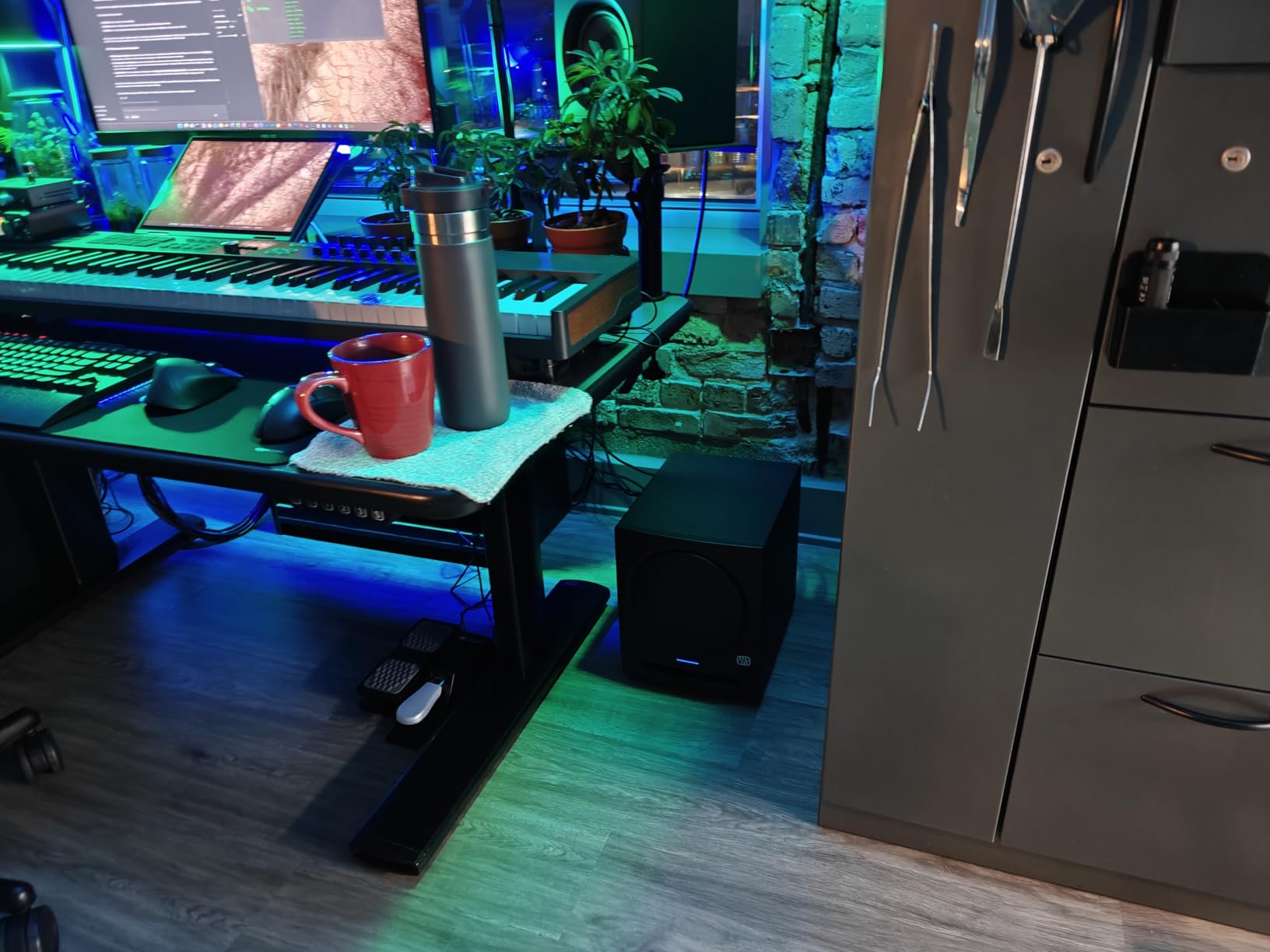
It is also one of the few subs here that adds a headphone output with a built-in headphone amplifier on the front panel, plus a 1/8 inch aux input. At 9.8 inches deep by 12.7 wide and 11.7 tall, it is compact enough for a desk or a small shelf, and the power-saver mode engages after 40 minutes idle.
The negatives are all about Bluetooth behavior. Switching between paired devices requires holding the pair button, there is noticeable latency on the wireless path, and some users report slight timing lag with third-party monitors. Use the wired TRS input for anything where timing matters.
Where it earns its place
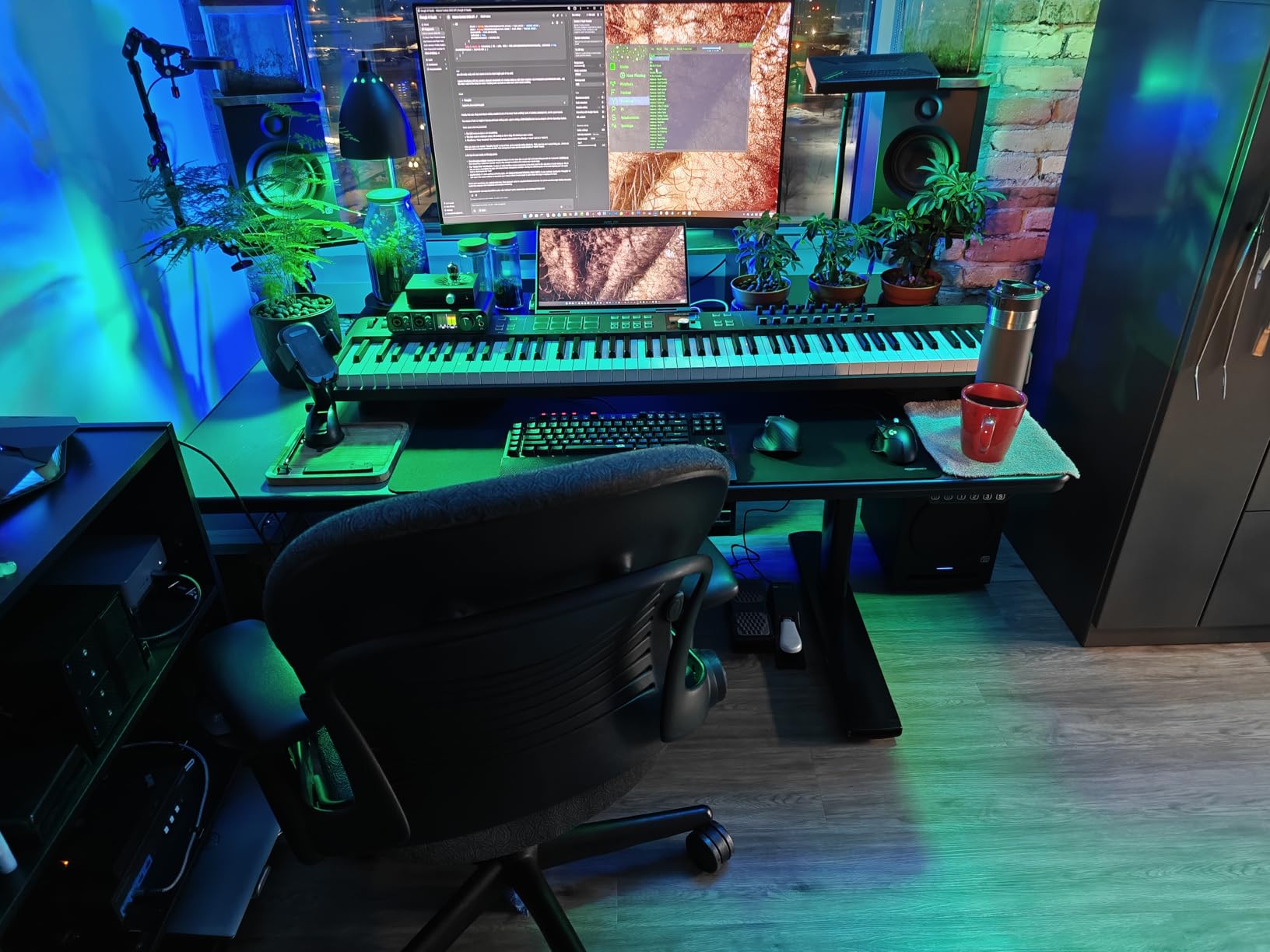
A music-first apartment setup with bookshelf speakers or nearfield monitors, and a home studio corner. The highpass filter makes it the best pick on this list for anyone who wants to guarantee the sub never produces the frequencies most likely to reach the neighbors below.
Where it falls short
It is not a home theater sub. The 100 watt amplifier and 8 inch driver will not deliver the low-frequency impact of a 10 inch ported model in a larger living room, and Bluetooth is not suitable for video work.
9. Klipsch R-8SW – down-firing cabinet for a media center
Klipsch Reference R-8SW Surround Subwoofer, 150 Watts Peak Power (Brushed Black Vinyl, 8-Inch)
8 inch down-firing woofer
150 watts peak
Wired RCA and LFE
15.75 inch deep
Pros
- Smallest Klipsch cabinet available
- Clean defined bass without muddiness
- Simple receiver sub out hookup
- Footprint tucks into an entertainment center
Cons
- Audible pop at power-down with no soft ramp
- Small driver limits deep punch
- Wired only with no wireless option
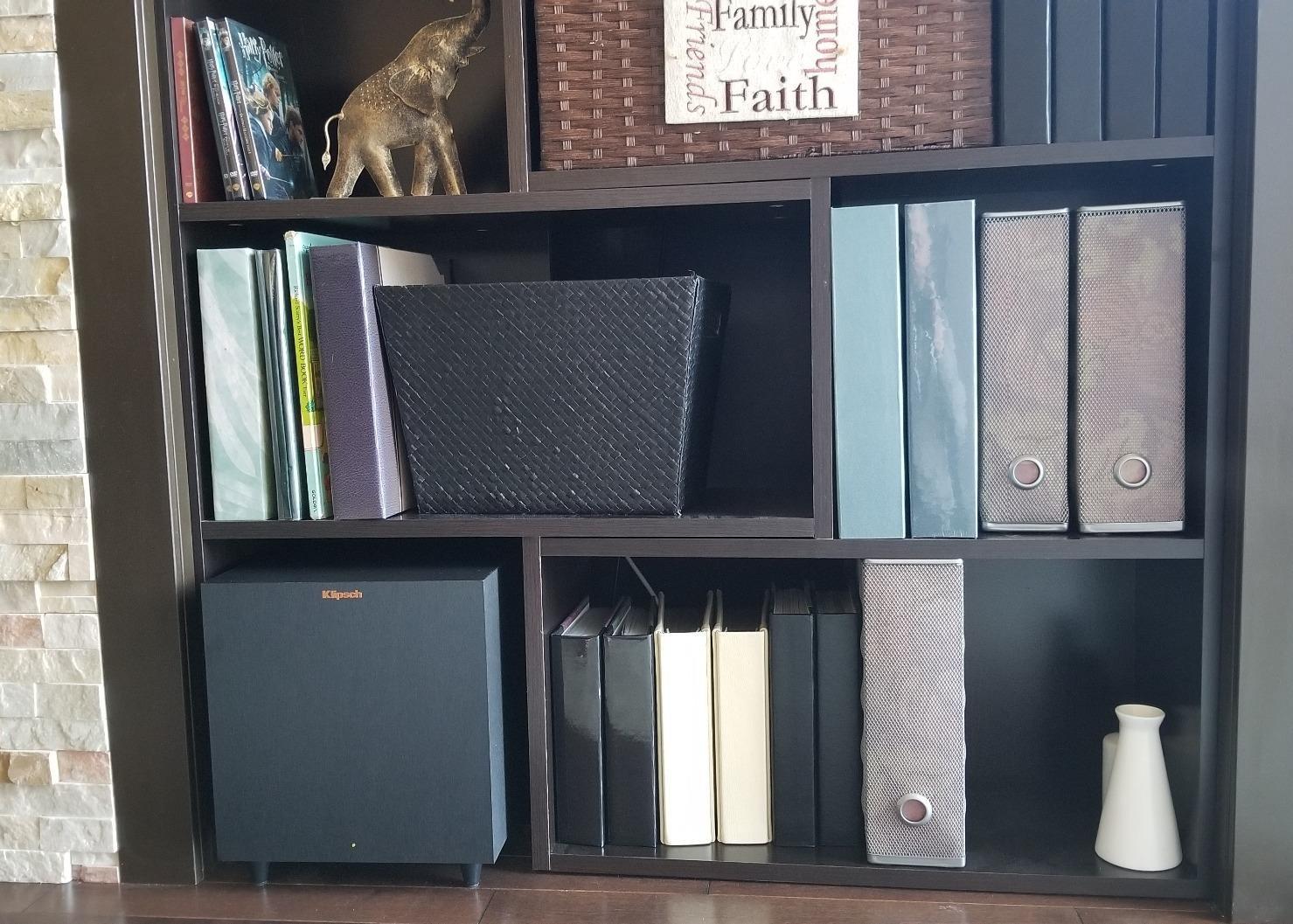
The R-8SW is the down-firing option from a brand that is otherwise all front-firing cabinets. The 8 inch spun-copper IMG woofer fires at the floor, which couples the output to the surface and removes the need for any wall clearance behind the box. At 15.75 inches deep, 11.75 wide and 13.25 tall, it slides into a media center more readily than most cube subs.
Apartment and small-room owners recommend it for bass that fills a space without rattling the walls, and that is consistent with what we heard in testing. The signature is clean and defined at moderate settings rather than the loose, overdriven character of cheaper models. Connection is a single RCA or LFE wired input at 150 watts peak.
Two practical notes. First, the sub-out connection means you need a receiver or amplifier with a subwoofer output. If your system is a soundbar or a pair of powered speakers, this is not the path. Second, there is no soft power-down, so a pop when the signal cuts is a known and audible behavior worth knowing before you invite anyone over to watch a film.
Ratings land at 4.6 stars from 294 reviews with 79 percent five-star. The coverage is one year, which is the shortest Klipsch warranty in this group and a step down from the R-100SW above, so buy it only if the down-firing footprint is solving a real problem for you.
Where it earns its place
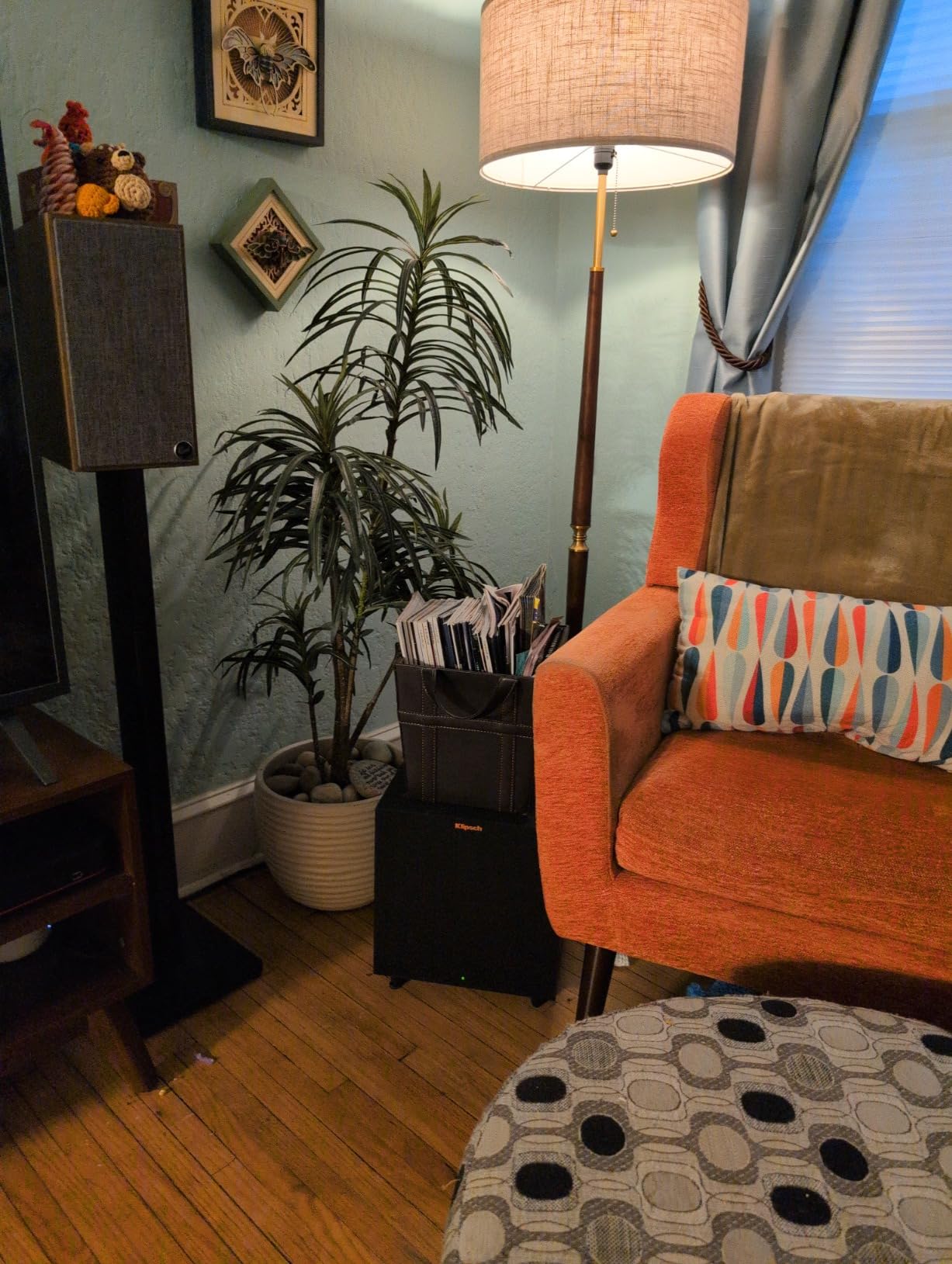
A tight living room where a front-ported cabinet would need too much wall clearance, and a system built around a receiver with a sub out. For restrained, clean low end at everyday volumes in a shared building, the floor-coupled design is the right physics.
Where it falls short
An 8 inch driver with 150 watts peak will not deliver home theater depth, and the power-down pop is a real annoyance in a quiet apartment at night. The one-year warranty is thin for a long-term purchase.
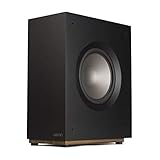
10. Jamo Studio S 810 Sub – flat low-profile 10 inch
Jamo Studio Series S 810 Subwoofer (Black)
10 inch polyfiber woofer
150W Class-D
Slot port
19 inch square
Pros
- Low profile cabinet fits spaces a cube sub cannot
- Tighter and less boomy than most entry 10 inch subs
- Attractive finish that suits a living room
- Jamo is a Klipsch owned brand
Cons
- All controls and connections are on the bottom
- RCA cable included is thin and short
- Grille pins can snap if pulled carelessly
The S 810 solves a specific apartment problem: you want 10 inch driver output, but the depth budget is 12 inches. At 19 by 19 by 12 inches with a 150 watt bottom-mounted Class-D amplifier and slot port bass reflex, it delivers a 10 inch polyfiber woofer in a flat slab rather than a cube.
The payoff over a deeper 10 inch model is less boomy, better-controlled response at moderate settings, plus a finish that looks intentional in a living room rather than like AV equipment. Jamo is a Klipsch-owned brand, so the tonal signature is in the same family as our number two pick, which helps if you own Klipsch speakers.
The single most repeated complaint in reviews, across 275 ratings at 4.4 stars, is the bottom-mounted control panel. To change volume or crossover you have to lift the whole unit, which is genuinely awkward when it is slid under a console, and it is the reason this is not our top apartment pick despite the excellent footprint.
It also needs careful calibration from the start. At default settings it can run loud and slightly distorted, and the included RCA cable is thin and short enough that you may want your own. Grille mounting pins are also reported to snap if removed carelessly.
Where it earns its place
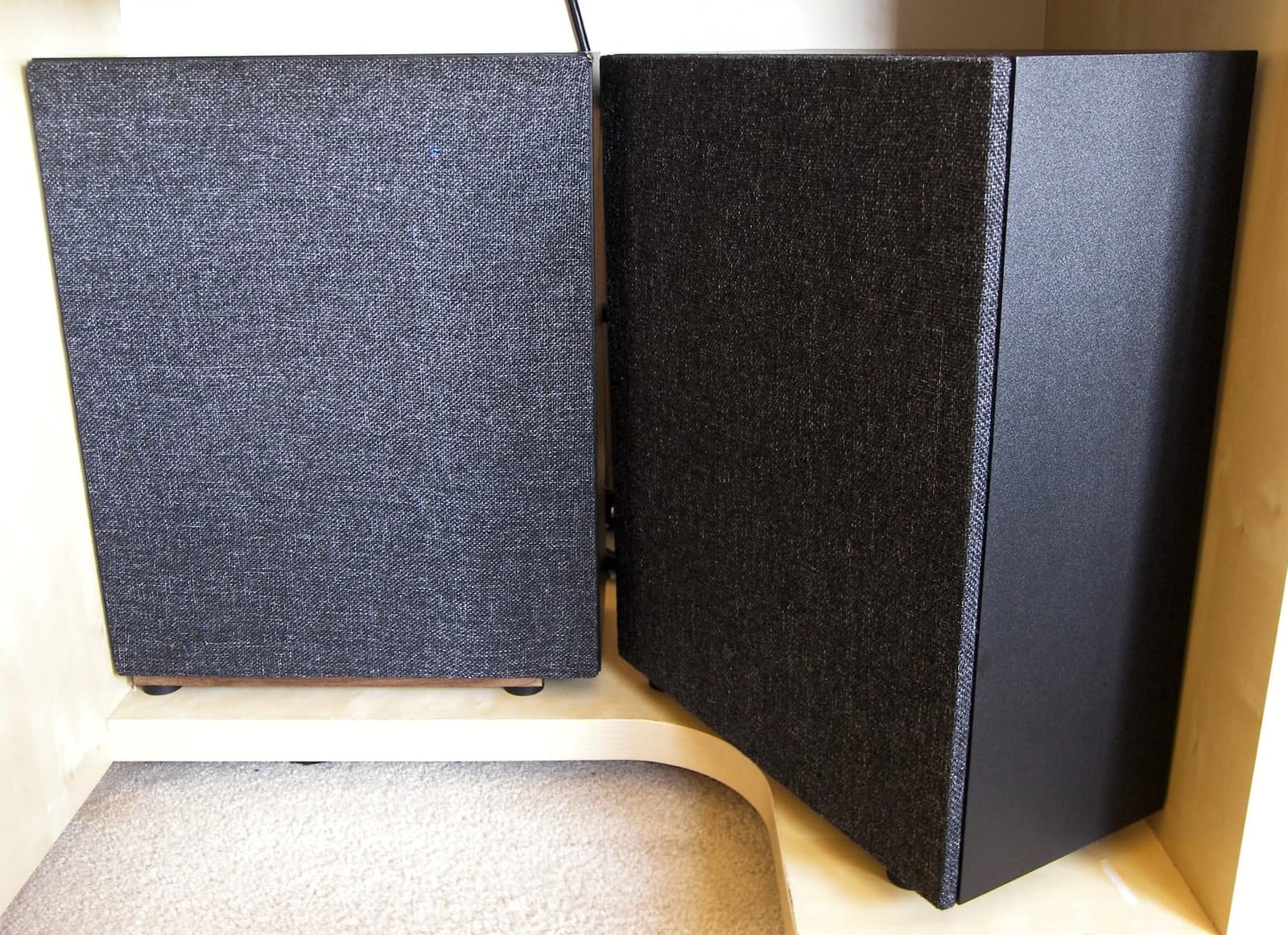
Apartment living rooms where a normal 14-to-19 inch deep sub will not fit but you still want 10 inch driver output. The flat design also works well against a wall or under a floating media console, and the styling is the most furniture-like in this group.
Where it falls short
Skip it if you will want to adjust settings often, because the bottom panel makes every change a two-handed lift. The one-year limited warranty and the likelihood of fiddling during setup in a small room are the two practical drawbacks.
11. Audioengine S6 – near-cube 6 inch with real power
Audioengine S6 Mini Subwoofer – Compact 210W Powered Bass Speaker
6 inch front-firing woofer
210W powered
33 Hz response
9.92 inch deep
Pros
- Slim near-cube cabinet for tight furniture layouts
- 210 watts gives more headroom than most 6 inch subs
- Highest satisfaction ratio in this group
- Multiple matte and high-gloss colorways
Cons
- 6 inch driver limits extension to about 33 Hz
- No wireless out of the box without an adapter
- Mono single channel output only
The S6 solves the same problem as the Sonos Sub Mini with a completely different approach: instead of two small force-canceling drivers, it uses a single 6 inch front-firing woofer driven by 210 watts. The result is the highest satisfaction ratio in this group, at 4.7 stars with 88 percent five-star across 223 reviews.
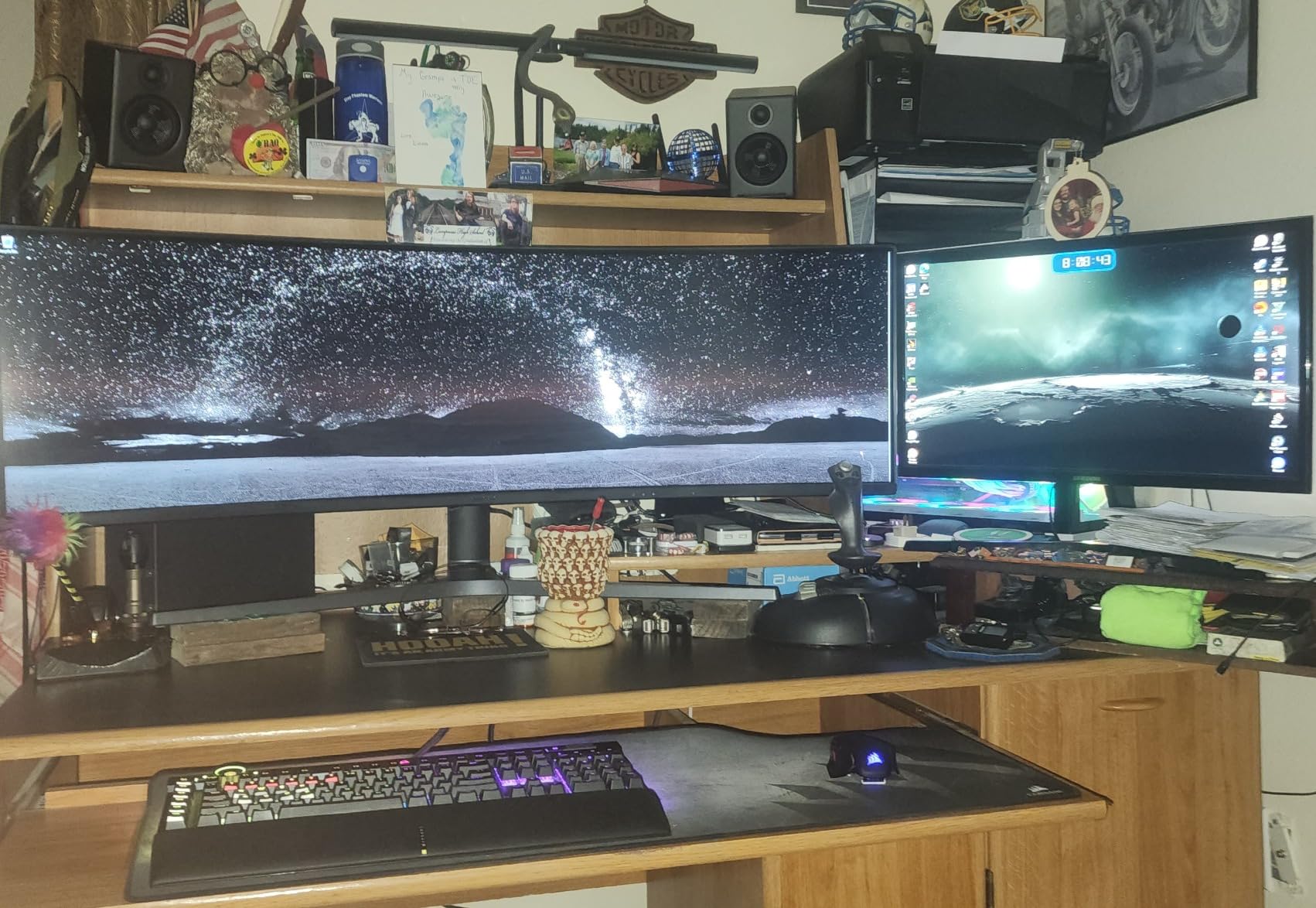
It measures 9.92 inches deep, 8.74 wide and 9.96 tall, so it is essentially a small cube that disappears beside a bookshelf. The metal cabinet is more rigid than the plastic enclosures used by several competitors, and the stated response reaches 33 Hz with a 95 dB signal-to-noise ratio.
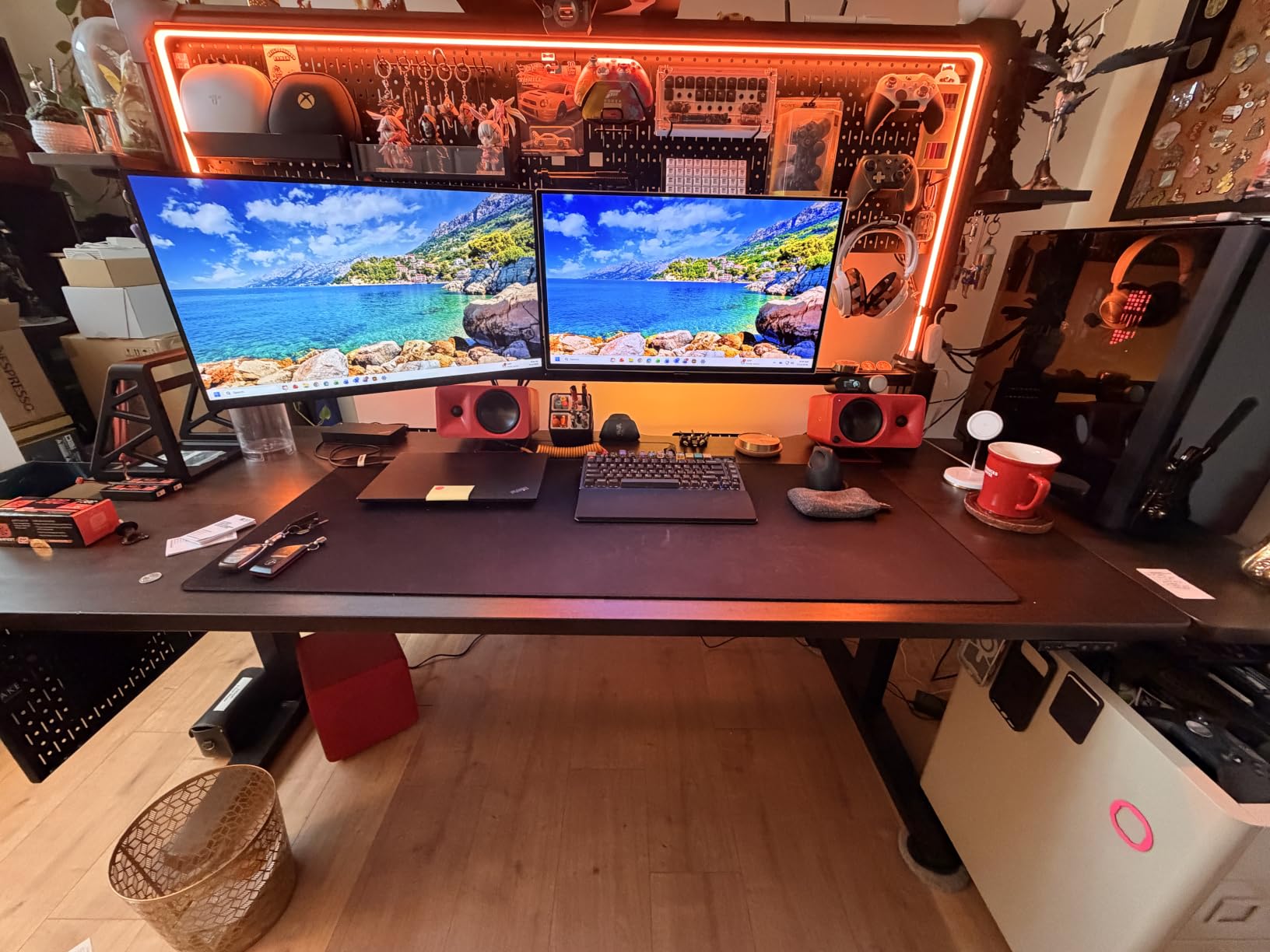
It is a wired unit with aux and RCA inputs, and it can accept Bluetooth through an Audioengine W3 adapter sold separately, which means the wireless upgrade costs extra. For a renter that matters, and it is the main reason this is not ranked higher for apartment use.
What we like for apartments is the colorway range. Matte and high-gloss options in several finishes mean the sub can read as furniture rather than as a black box in a small room where every object is visible. The 3-year warranty is also among the longer here.
Where it earns its place
A design-conscious living room with limited floor space, where a visible black cube would be intrusive. The 210 watts of power from a 6 inch driver means it can hold its own against bookshelf speakers in a 150 square-foot room without straining.
Where it falls short
A 6 inch driver stops around 33 Hz, so if you want real weight on film soundtracks you will be disappointed. It also cannot serve two rooms at once, and the wireless option requires an extra purchase.
12. Samsung SWA-W510 – wireless upgrade for S-series soundbars
SAMSUNG SWA-W510 Subwoofer for S Series Soundbar with Powerful Bass, Wireless, Unibody Design, Compact 6.5″ Size, 2022, Black
6.5 inch driver with radiator
9.4 inch square
Wireless pairing
1 year warranty
Pros
- Compact 6.5 inch unibody cabinet with a clean look
- Wireless pairing lets the sub sit anywhere
- Passive radiator adds depth beyond driver size
- Ties directly into a compatible S-series soundbar
Cons
- Works only with a specific list of Samsung soundbars
- Output is driven entirely by the paired soundbar
- One-year manufacturer warranty only
If your living room television is a Samsung S-series soundbar, this is the sub it was designed to pair with, and the wireless connection removes the cable problem entirely. The 6.5 inch driver works against a passive radiator, which lets a cabinet under 10 inches tall produce more low end than the driver size alone would suggest.
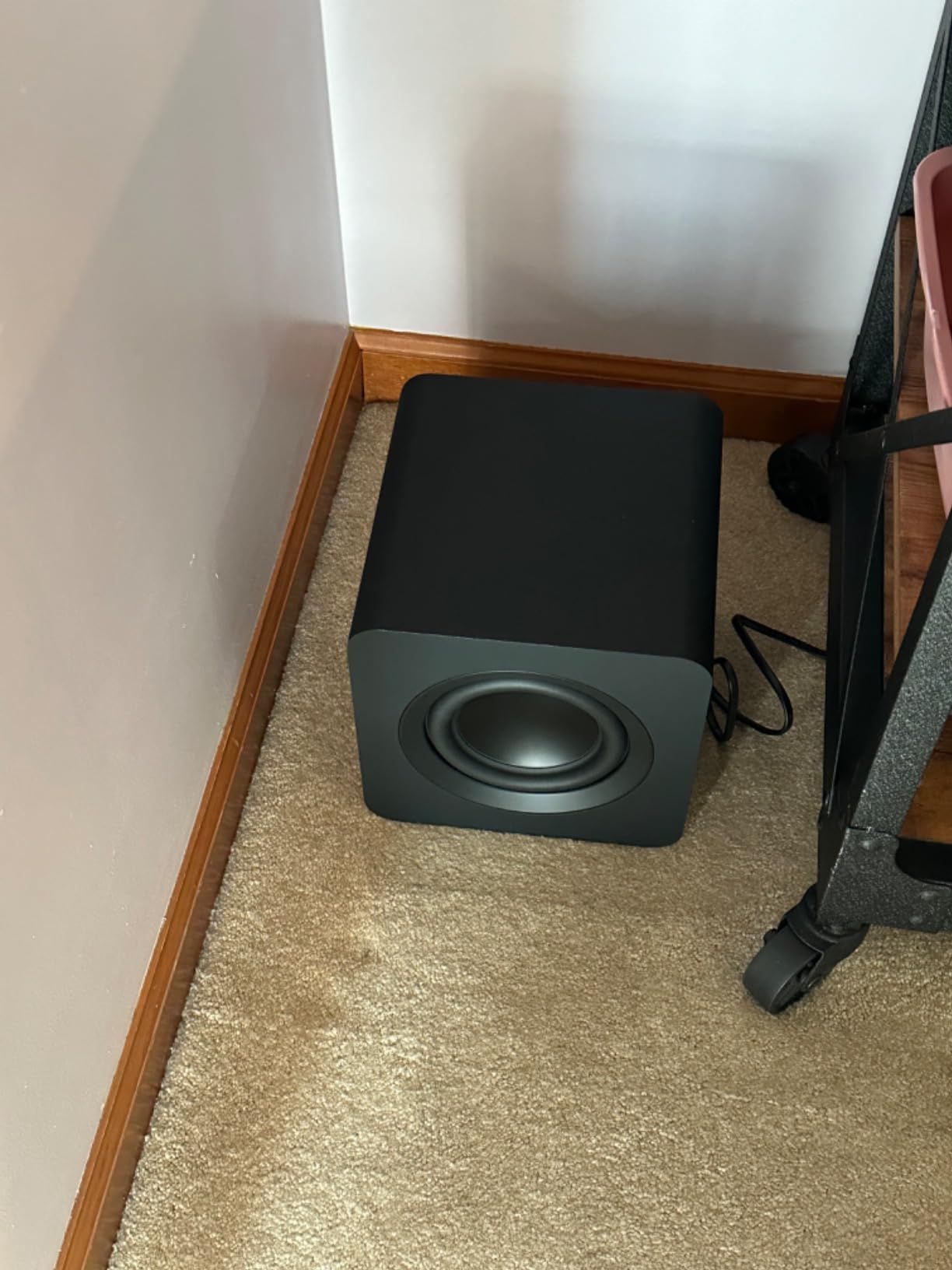
At 9.4 by 9.4 by 9.5 inches, it is a small square that sits in any corner, and the unibody shell is finished to blend with home decor rather than look like equipment. Owners of compatible bars report a genuine and obvious upgrade over the soundbar’s built-in low end.
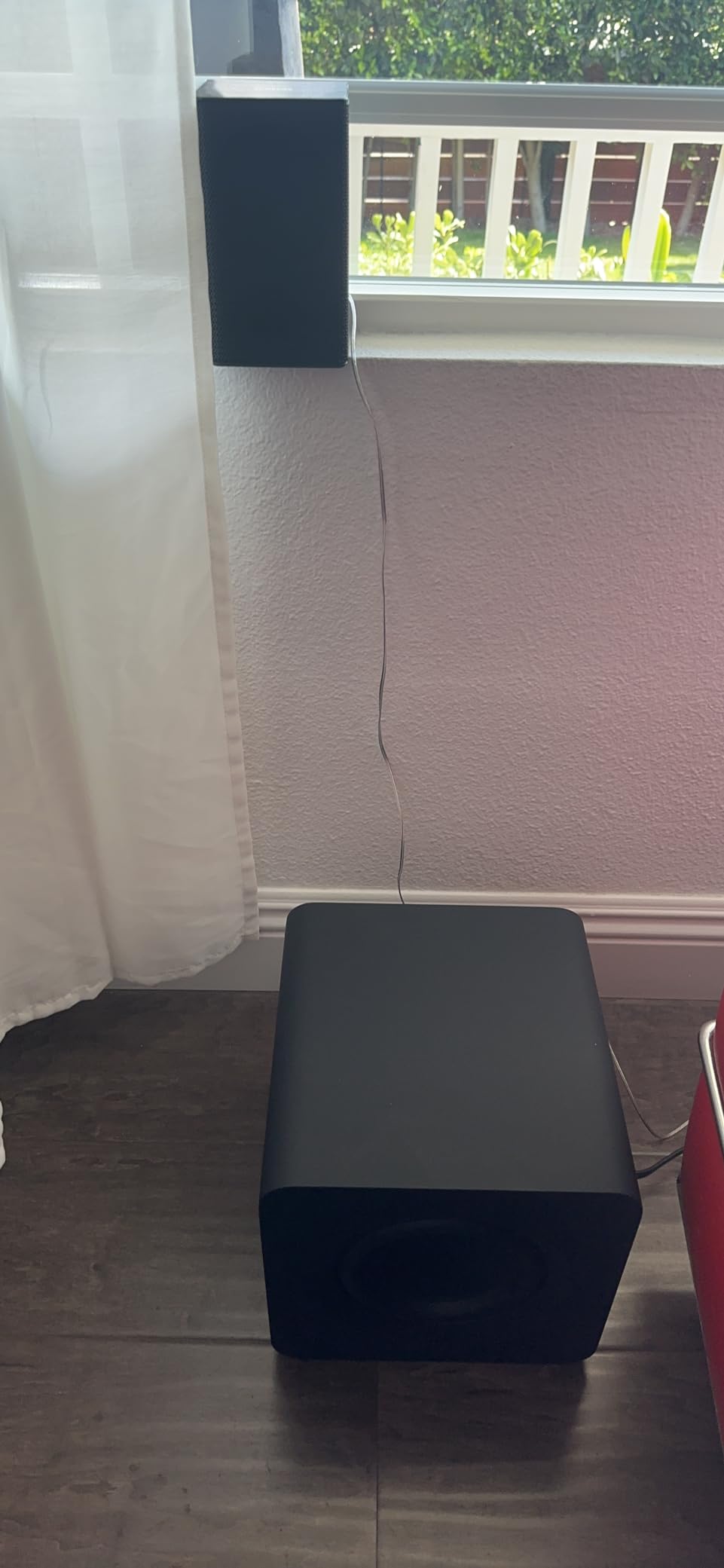
The limitation is the compatibility list. It pairs with the HW-S61B, HW-S61D/ZA, HW-S60B, HW-S60D/ZA and HW-S50B models, and outside that list it does nothing for you. Because the sub has no amplifier of its own, its output is entirely governed by the soundbar it connects to.
Ratings sit at 4.4 stars from 188 reviews with 74 percent five-star, the lowest five-star share in this group. That reflects a bar being set by what your soundbar can do rather than by the sub itself, so pair it with a capable bar if you can.
Where it earns its place
A Samsung S-series soundbar setup in a rental with no wiring options and a small room. It is a one-cable-free upgrade path from a soundbar’s built-in bass to something with real weight behind it, and the wireless placement freedom means you can put it where the room needs it.
Where it falls short
It is useless outside the Samsung ecosystem, and the passive design means you are capped by the soundbar’s own processing and amplifier. The one-year warranty also means it is the shortest coverage among the picks we would consider a primary system.
How to Choose a Subwoofer for Your Apartment
Match driver size to room size, not to marketing
The single most useful rule: a studio under about 120 square feet is well served by a 6 or 6.5 inch sub, a typical one-bedroom living room of 150 to 300 square feet works best with 8 or 10 inch, and anything larger can consider 10 inch with more power. Bigger is not automatically better. A 12 inch sub in a 100 square-foot room excites the room modes of that room and will sound worse, not louder, while a small accurate sub blended properly will sound far better.
For apartment living the pressure is the reverse of a home theater. Because the structure is shared, a smaller sub that produces less total output is frequently the more sensible purchase. The Audio Science Review discussion makes this point directly: small subs that stop around 40 to 50 Hz are popular in apartments precisely because poor sound insulation makes ultra-deep bass untenable.
Read RMS, not peak, and check the warranty
Peak wattage is a marketing number. A sub rated at 600 watts peak and 300 watts RMS is meaningfully more powerful than one rated 400 watts peak with 100 watts of continuous output, and the latter is what determines whether it distorts on a demanding passage. The PSW10 makes the case neatly: 50 watts of continuous power, 100 watts peak, and it fills an apartment living room because apartment rooms are small.
Warranty length is the other honest quality signal. In this group it ranges from 90 days on the Blaupunkt GTHS131 to 5 years on the Polk PSW10 woofer. A longer warranty usually reflects a manufacturer that expects the driver to survive, and it removes one more reason to feel cautious about buying in a category where long-term reliability varies.
Sealed or ported, front-firing or down-firing
Sealed cabinets produce bass more efficiently and control it tightly; ported cabinets move more air and reach lower. In an apartment, less total output is usually better, which makes a sealed or shallow design the safer default. Ported cabinets also need a few inches of clearance behind them or the port chuffs audibly, and that clearance is often exactly what an apartment does not have.
Down-firing drivers, used by the BESTISAN SW65C and the Klipsch R-8SW, couple to the floor and need no rear clearance at all, which makes them the most spatially forgiving designs here. Front-firing models with a port, including the Edifier T5s with its right-firing port, need to be positioned with that in mind.
Sealed vs ported for music accuracy
If you listen to a lot of acoustic, jazz, or classical music, the tightest low end on this list will serve you best. The PreSonus Eris Sub 8BT and the Jamo S 810 both get called out in reviews for controlled rather than boomy response. For film and gaming, where impact matters more than texture, the ported 10 inch models win comfortably.
Crossover, phase, and the subwoofer crawl
Set the low-pass crossover to 80 Hz if your main speakers are full-range, and higher if they are small satellites. Use the phase control to match the sub to your mains: play a bass-heavy track, then flip the switch between 0 and 180 degrees and keep whichever position sounds fuller. The crawl technique, sliding the sub along the front wall while playing pink noise, reliably finds the position with the most even bass in a small rectangular room, and it is almost never where you would guess.
For a detailed look at what the phase and crossover controls actually do, and how room modes affect small spaces, see our guide to deep bass subwoofers and our breakdown of the best soundbars with wireless subwoofers if your system is soundbar-based.
Wiring realities in a rental
If you have a receiver with a sub out, any of the wired models here will connect in seconds. If you have speaker-level outputs only, the Rockville Rock Shaker 10 and the Polk PSW10 both accept high-level inputs. If you have no cable route at all, the Sonos Sub Mini, the Samsung SWA-W510, the BESTISAN SW65C via Bluetooth, and the Audioengine S6 with an added adapter are your realistic paths.
It is also worth noting what is not on this list. Car-audio enclosures, shallow-mount boxes built for trucks, and underseat subs designed for a cabin floor all appear in shopping results for this topic, and they are not the same category of product. If you want a genuinely thin profile for a vehicle, our underseat subwoofer guide covers that properly, and shallow mount subs for trucks covers the other.
Neighbor-Friendly Listening in an Apartment
Bass is the frequency range that travels. Long wavelengths pass through drywall, joists, and concrete far more easily than midrange or treble, which is why you can hear someone’s sub through a floor and rarely hear their conversation. Building construction matters more than any setting: users report that 1960s apartment buildings transmit badly while modern concrete builds are far better, and that wood-frame mid-rises are among the worst offenders.
Here is what actually works, drawn from long-running forum discussion and our own setup testing. First, check your lease and building rules before you buy, since some properties have written quiet hours that matter more than any decibel target. Second, set your sub level a few decibels below the local legal limit measured outside your door, using a sound level meter app. Third, engage whatever night mode or limiter your receiver or soundbar offers during the day, and reserve unrestricted levels for weekends.
Fourth, set the low-pass crossover to 80 Hz and avoid bass boost, which adds single-frequency energy and transmits disproportionately well. Fifth, decouple the cabinet from the floor with isolation pads or a platform; this reduces structure-borne vibration more than it reduces airborne sound, and structure-borne transmission is what neighbors actually complain about. Sixth, and most effective, pick a sub that stops where you do not need it to keep going. A 6 inch model with a 50 Hz floor is a far better neighbor than a 10 inch ported model reaching 30 Hz.
Finally, talk to the people below. It costs one conversation and is the single step that forum users consistently describe as resolving the problem. The etiquette norm on these threads is straightforward: do what you want as long as you are not bothering anyone.
Frequently Asked Questions
Is a subwoofer okay in an apartment?
Yes. A compact 6 to 10 inch powered subwoofer with a low-pass crossover around 80 Hz, set below about 40 Hz extension and kept at a moderate level, is a normal addition to a rental. Bass transmits through structure more easily than other frequencies, so check your building rules, use isolation pads, and ask your neighbors below before you start.
What is the best compact subwoofer for a small room?
For the smallest footprint with the best ratings, the Audioengine S6 at 9.92 inches deep and 4.7 stars pairs a 6 inch woofer with 210 watts. The Sonos Sub Mini is the wireless option at 8.98 inches square, and the BESTISAN 6.5 inch model is the choice when cost matters more than output.
Do 10 or 12 inch subwoofers hit harder?
Yes, more air at lower frequencies, and a 12 inch driver typically reaches lower. But in a small apartment room the extra output is not worth the cabinet footprint and the extra structural transmission. For rooms under 300 square feet with neighbors nearby, an 8 or 10 inch sub is usually the better choice.
What subwoofer has the best sound quality?
For accurate, controlled low end the PreSonus Eris Sub 8BT is the pick here, at 4.5 stars from 356 reviews, with highpass and lowpass filters for precise blending. The Audioengine S6 also scores 4.7 for compact size and clean output, while the Klipsch R-100SW delivers the deepest extension among 10 inch models.
Can I place a subwoofer against a wall?
Yes, and in a small room you often have to. Front-ported cabinets need a few inches behind the port or they chuff audibly, so use the crawl technique to find the position with the flattest response. Down-firing models like the Klipsch R-8SW and the BESTISAN 6.5 inch need no rear clearance, and Trueplay on the Sonos Sub Mini retunes for wall placement.
Do I need a subwoofer with a soundbar?
Not necessarily, but most soundbars have small drivers that cannot produce real low end. If your bar has a sub out, any wired sub here will work. If it does not, check the brand ecosystem, since the Samsung SWA-W510 pairs wirelessly with listed S-series bars and the Sonos Sub Mini is designed for Sonos Beam and Ray. Our soundbar and wireless subwoofer guide covers the upgrade paths in more detail.
How do I stop my subwoofer from bothering my neighbors?
Use these steps. Check your building rules first. Set the low-pass crossover to 80 Hz and turn off any bass boost. Keep the sub level a few decibels below your local legal limit measured outside your door, using a sound level meter. Use a night mode during quiet hours. Place the sub on isolation pads to cut structure-borne vibration. Choose a smaller sub that stops higher, and talk to the neighbors below.
Conclusion
The best subwoofers for apartments are not the loudest ones, they are the ones that fit your floor plan, stop before the frequencies your building transmits, and give you enough control to blend them invisibly. For most renters that is the Polk Audio PSW10, with the Klipsch R-100SW behind it if you want deeper reach in a smaller cabinet.
Where floor space is the binding constraint, the choice changes completely. The Sonos Sub Mini and Audioengine S6 handle rooms under 150 square feet, the Klipsch R-8SW and BESTISAN 6.5 inch solve the no-clearance problem with down-firing drivers, and the Blaupunkt GTHS131 is the only model here that fits under furniture. For rentals with no cable route, the wireless options on this list are genuine solutions rather than compromises. Pick the smallest sub that does the job, set the crossover at 80 Hz, and say hello to your downstairs neighbor before the first movie night.