
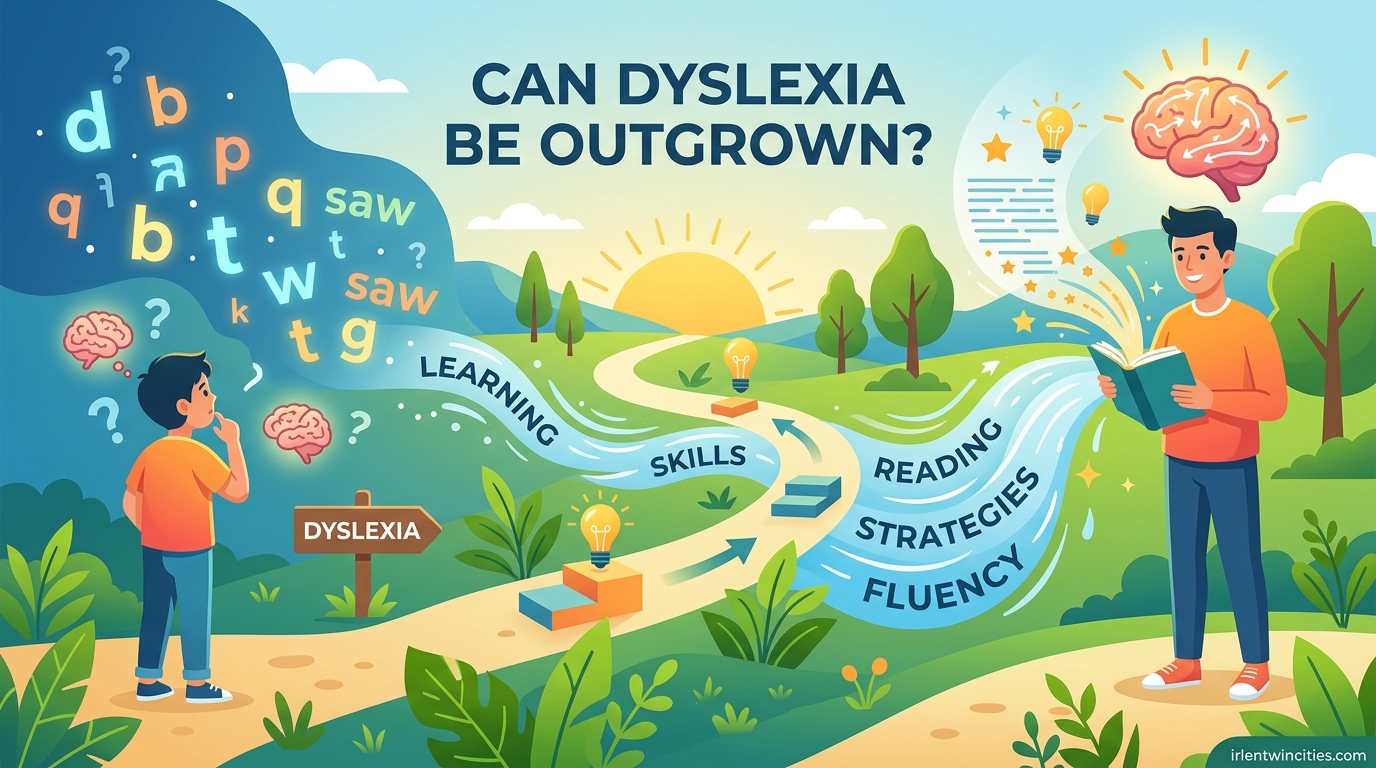
When your child receives a dyslexia diagnosis, one of the first questions that comes to mind is whether they will eventually outgrow it. I have worked with families facing this concern for over a decade, and the answer is not what most parents hope to hear. Dyslexia cannot be outgrown. It is a lifelong neurological condition that affects how the brain processes language, and no amount of therapy or intervention will make it disappear completely.
However, this does not mean your child is doomed to struggle with reading forever. In this article, we will explore why dyslexia is permanent, why many people mistakenly believe it can be cured, and what strategies actually help individuals thrive with dyslexia throughout their lives. You will learn about the brain science behind dyslexia, early intervention approaches that work, and how adults successfully navigate life with this learning difference.
Table of Contents
Can Dyslexia Be Outgrown or Does It Last Forever? The Direct Answer
No, dyslexia cannot be outgrown. It is a lifelong brain-based learning difference that remains with a person from childhood through adulthood. According to leading dyslexia organizations and neurological research, the structural differences in brain regions responsible for language processing do not change over time.
Children do not outgrow dyslexia as they get older. What changes is their ability to compensate for their reading difficulties through specialized instruction, assistive technology, and developed strategies. While a dyslexic individual may become a proficient reader with proper support, their underlying neurological differences persist throughout life.
Why Many People Think Dyslexia Can Be Outgrown
The misconception that dyslexia can be outgrown stems from several understandable but misleading observations. Parents often watch their child improve dramatically after receiving specialized reading instruction and assume the dyslexia itself has disappeared.
What actually happens is skill acquisition, not brain change. When a child with dyslexia receives effective intervention, they learn decoding strategies, build compensatory mechanisms, and develop workarounds for their neurological differences. They are not outgrowing dyslexia. They are learning to work with it.
Compensatory Strategies Can Mask Symptoms
Many adults with dyslexia become so skilled at hiding their difficulties that others assume they have been cured. They memorize words instead of decoding them, use context clues heavily, and avoid reading whenever possible. This masking behavior creates the illusion that dyslexia has disappeared.
I have spoken with dozens of adults who say the same thing. They learned to compensate so well that their coworkers and even family members never knew they struggled with reading. The dyslexia never left. Their strategies just got better.
Reading Fluency Improvements Create False Hope
When a child moves from struggling to read simple words to reading full sentences, the progress feels like a cure. Parents naturally want to believe the problem has been solved. In reality, the child has worked significantly harder than their peers to reach that point, and they will continue to need extra processing time and mental effort for reading tasks throughout their life.
The Neurological Reality: Why Dyslexia Is Lifelong
To understand why dyslexia cannot be outgrown, you need to understand what causes it in the first place. Dyslexia is not a behavioral problem or a sign of low intelligence. It is a neurological condition rooted in how the brain processes language.
Brain-Based Differences Persist Over Time
Research using brain imaging has consistently shown that people with dyslexia have structural and functional differences in specific brain regions. These areas, primarily in the left hemisphere, are responsible for phonological processing. They help us connect sounds to letters and decode written language.
These brain differences are present from birth and remain stable throughout life. They are not abnormalities that need fixing. They are simply variations in how the brain is wired. Just as someone cannot rewire their brain to change their natural handedness, a person cannot rewire their brain to eliminate dyslexia.
Phonological Processing Differences Are Permanent
The core difficulty in dyslexia involves phonological processing. This is the brain’s ability to recognize and manipulate the sounds within words. People with dyslexia struggle to break words into individual sounds and blend sounds together to form words.
While intensive instruction can strengthen these pathways to some degree, the fundamental difference in processing remains. This is why even highly successful adults with dyslexia often report that reading still requires more mental effort than it does for others.
Perceptual Processing and Dyslexia: The Irlen Connection
While most discussions of dyslexia focus on phonological processing, there is another aspect that deserves attention. Visual perceptual difficulties can compound reading challenges for many individuals with dyslexia. This is where Irlen syndrome and related perceptual processing issues enter the picture.
When Visual Processing Complicates Reading
Some people with dyslexia experience additional challenges beyond phonological processing. They may see text that appears to move, shimmer, or blur on the page. Words might seem to run together, or white spaces between lines may feel overwhelming. These perceptual difficulties are separate from dyslexia but frequently co-occur with it.
Research has shown that addressing these visual perceptual issues can significantly improve reading comfort for affected individuals. Colored overlays or specialized lenses can help stabilize the visual perception of text, making reading less exhausting and more efficient.
Understanding the Distinction
It is important to understand that phonological dyslexia and visual perceptual difficulties are different conditions that can exist independently or together. Phonological dyslexia is language-based. Visual perceptual issues are sensory-based. Both affect reading, but they require different interventions.
At our practice, we have seen individuals who made limited progress with traditional dyslexia interventions suddenly improve dramatically when their visual perceptual difficulties were addressed. This does not mean their dyslexia was outgrown. It means one barrier to reading was removed, allowing their other strategies to work better.
How Dyslexia Can Improve Without Being Outgrown
While dyslexia cannot be cured, the reading and writing abilities of people with dyslexia can improve substantially. The key is understanding the difference between eliminating a learning difference and learning to work effectively with it.
Skill Acquisition Versus Brain Change
When a child with dyslexia receives effective instruction, they are acquiring skills, not changing their brain structure. They learn explicit strategies for decoding words. They build their vocabulary to support context-based reading. They develop memory techniques to compensate for processing differences.
These skills are real and valuable. A child who once could not read simple sentences can grow into an adult who reads complex professional documents. But the underlying neurological differences remain. Reading likely still takes more energy, requires more concentration, and happens more slowly than it does for non-dyslexic peers.
Effective Intervention Approaches
The most effective interventions for dyslexia follow structured, multisensory approaches. The Orton-Gillingham methodology is the gold standard, breaking reading and spelling into small, manageable skills taught through visual, auditory, and kinesthetic channels.
These approaches work with the dyslexic brain rather than against it. They provide explicit, systematic instruction that makes up for the brain’s difficulty with implicit language learning. With consistent, intensive intervention, most children with dyslexia can reach grade-level reading ability.
Compensatory Strategies That Help
Beyond reading instruction, individuals with dyslexia benefit from developing compensatory strategies. These include using text-to-speech software, audiobooks, speech-to-text for writing, and organizational tools that reduce the cognitive load of written tasks.
Adults with dyslexia often become experts at choosing careers and roles that play to their strengths. Many excel in fields requiring spatial reasoning, creative problem-solving, or interpersonal skills. Their dyslexia does not disappear. They simply build a life where their strengths matter more than their reading speed.
Early Intervention: Critical Despite Lifelong Nature
Understanding that dyslexia is lifelong might feel discouraging, but it actually makes early intervention even more important. Since we cannot wait for dyslexia to disappear, we must act quickly to provide the support children need.
Closing the Skill Gap
Early intervention can close the gap between a dyslexic child’s reading ability and that of their peers. Research consistently shows that the earlier specialized instruction begins, the better the outcomes. Children who receive intervention in early elementary school typically show stronger reading skills than those who start later.
This is not because early intervention cures dyslexia. It is because young brains are more plastic and responsive to instruction. The neural pathways for reading are still developing, and intensive support during this window can build stronger compensatory networks.
Best Age for Intervention
The ideal time to begin intervention is between ages 5 and 7, when children are first learning to read. At this stage, reading difficulties have not yet led to significant frustration or negative associations with school. The skill gap between dyslexic and non-dyslexic children is still small.
That said, intervention at any age helps. Older children, teenagers, and adults can all improve their reading skills with appropriate instruction. It may take more time and effort than it would have at age 6, but meaningful improvement is always possible.
Living With Dyslexia as an Adult
One of the most powerful ways to understand dyslexia is to hear from adults who have lived with it. Forum discussions reveal common experiences that textbooks often miss.
Real Experiences From Adults With Dyslexia
Adults diagnosed with dyslexia in childhood consistently report that they still identify as dyslexic decades later. Many say they have learned to read well but still process text differently than others. They describe reading as tiring, requiring concentration that others do not seem to need.
The most frequent story is one of childhood struggle. Many adults remember being written off as lazy or not trying hard enough. They felt shame around their reading difficulties and developed elaborate strategies to avoid reading aloud or being asked to write in front of others.
Yet these same adults often describe professional success. They found careers that valued their visual-spatial abilities, creativity, or problem-solving skills. They used assistive technology to handle reading-heavy tasks. They built support systems that accommodated their needs.
Workplace Accommodations
Modern workplaces offer more accommodations than ever before for adults with dyslexia. Text-to-speech software, speech-to-text dictation, extended time for written tasks, and alternative formats for documentation all help level the playing field.
Self-advocacy skills become crucial in adulthood. Adults who understand their dyslexia and can explain their needs to employers and colleagues fare better than those who try to hide their difficulties. Being open about dyslexia allows others to provide support rather than making incorrect assumptions about capability.
Frequently Asked Questions About Dyslexia
Does dyslexia stay with you forever?
Yes, dyslexia stays with you forever. It is a lifelong neurological condition that does not go away with age or treatment. While individuals can learn effective reading strategies and compensatory skills, the underlying brain differences remain throughout life.
What are 5 signs of dyslexia?
The five common signs of dyslexia include: 1) Difficulty learning letter sounds and names, 2) Trouble rhyming words, 3) Slow or inaccurate reading and spelling, 4) Difficulty sounding out unfamiliar words, and 5) Problems with memorizing sequences like days of the week or multiplication tables.
What are the four stages of dyslexia?
The four stages of dyslexia progression are: 1) Pre-reading stage where children struggle with phonological awareness, 2) Initial reading stage where letter-sound correspondence is difficult, 3) Fluent reading stage where automaticity remains challenging, and 4) Compensated stage where individuals read adequately but with extra effort.
Is dyslexia passed on by mother or father?
Dyslexia can be passed on by either parent. It has a strong genetic component and tends to run in families. If one parent has dyslexia, there is approximately a 50% chance their child will also have it. If both parents have dyslexia, the likelihood increases significantly.
Can dyslexia get better with age?
Dyslexia symptoms can improve with age through compensatory strategies and learned skills, but the condition itself does not get better. Adults with dyslexia often become more skilled at managing their reading challenges, but the underlying neurological differences persist. Early intervention provides the best outcomes.
Is dyslexia a lifelong condition?
Yes, dyslexia is absolutely a lifelong condition. It is not something children outgrow or that adults overcome completely. Dyslexia is a neurological difference present from birth that affects how the brain processes written language. With proper support and intervention, individuals can become successful readers, but they remain dyslexic throughout their lives.
Conclusion: Can Dyslexia Be Outgrown?
So, can dyslexia be outgrown? The answer is clear and definitive. No, dyslexia cannot be outgrown and it does last forever. This is not a message of hopelessness, but of reality. Understanding that dyslexia is a lifelong brain-based learning difference allows families to focus on what actually works rather than waiting for a cure that will never come.
The good news is that with early intervention, appropriate accommodations, and the development of compensatory strategies, individuals with dyslexia can become successful readers and achieve their goals. They may read differently than others, using more mental energy and specialized techniques, but they can read well.
If you suspect your child has dyslexia, do not wait to seek assessment. The earlier you understand their learning profile, the sooner you can connect them with the instruction and support they need. Dyslexia is permanent, but struggle is not. With the right help, every child with dyslexia can build the skills they need to thrive in school and beyond.