
You have asked your child to put on their shoes three times. The backpack sits open on the floor, homework half-finished. It is 7:45 AM, the bus comes in ten minutes, and you are acting as your child’s “external frontal lobe” once again. If this scene feels painfully familiar, you are not alone – and you are not failing as a parent.
Executive function skills are the mental processes that help children plan, focus attention, remember instructions, and juggle multiple tasks. These skills do not develop automatically, and some kids need more support than others. The good news? You can teach these skills systematically, and 2026 brings more research-backed strategies than ever before.
In this guide, I will share what our team learned after reviewing dozens of studies and talking with occupational therapists, educators, and parents who have been in the trenches. You will get clear explanations, age-specific guidance, and practical strategies you can start using today.
Table of Contents
What Are Executive Function Skills?
Executive function skills serve as the brain’s control panel. They live in the prefrontal cortex, the part of the brain right behind your forehead that continues developing into the mid-20s.
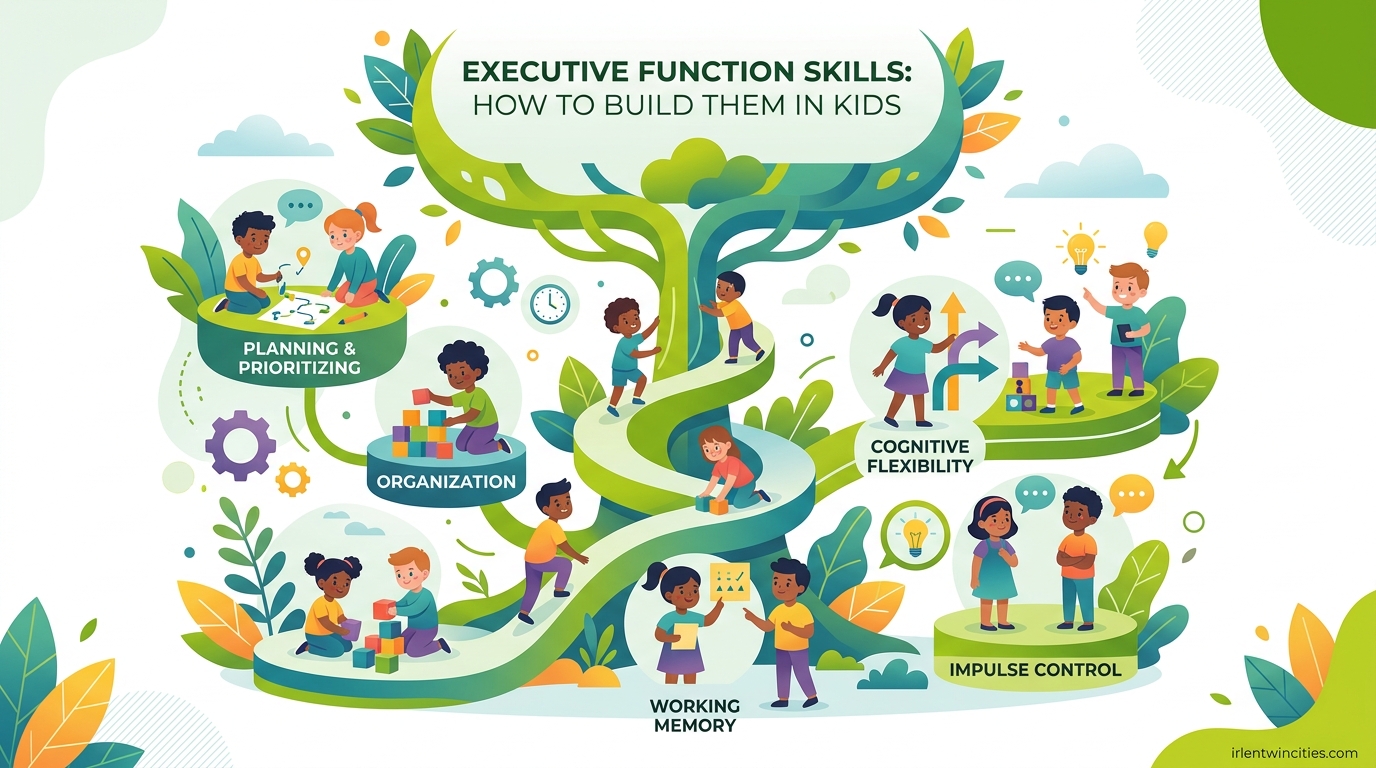
These skills break down into eight core abilities that work together to help children manage daily life. Understanding each one helps you spot where your child needs support.
The 8 Core Executive Function Skills Every Child Needs
Impulse Control: The ability to stop and think before acting. This shows up when your child pauses before grabbing a toy from a sibling or blurting out an answer in class.
Working Memory: Holding information in mind while using it. Your child uses this when following multi-step directions like “put your plate in the sink, then grab your backpack.”
Emotional Regulation: Managing feelings in appropriate ways. This skill helps kids handle disappointment when plans change or frustration during difficult homework.
Task Initiation: Getting started on tasks without excessive procrastination. This is the child who begins their homework after one reminder instead of ten.
Planning and Organization: Creating a roadmap to complete tasks. Kids with this skill gather materials before starting projects and keep their backpack reasonably organized.
Self-Monitoring: Checking work and tracking progress. A child using this skill notices they made an error on math homework and fixes it before turning it in.
Cognitive Flexibility: Adapting when things change. This helps kids cope when recess gets canceled or when they need to switch from playtime to homework mode.
Goal-Directed Persistence: Sticking with tasks despite challenges. This drives a child to keep trying a difficult puzzle or finish a long reading assignment.
These eight skills interconnect constantly. A child struggling with homework might have weak working memory (forgetting the directions), poor task initiation (cannot get started), and emotional regulation issues (frustration leading to giving up).
Signs Your Child Is Struggling With Executive Function
Every child loses their jacket or forgets homework occasionally. How do you know when these behaviors signal real executive function challenges rather than typical kid behavior?
The key difference is frequency and impact. Normal forgetfulness happens sometimes and does not derail the child’s day. Executive dysfunction creates daily friction that affects school performance, home life, or self-esteem.
Warning Signs by Age Group
Preschool (Ages 3-5): Extreme difficulty with transitions, frequent emotional meltdowns when routines change, inability to follow two-step directions consistently, trouble taking turns or waiting, and difficulty organizing simple play activities.
Elementary (Ages 6-12): Losing belongings daily despite reminders, starting homework but never finishing, chronic procrastination on simple tasks, inability to estimate how long tasks take, messy backpack and desk despite organizational tools, emotional outbursts over minor frustrations, and difficulty shifting between activities.
Teens (Ages 13-18): Missing deadlines despite having a planner, staying up until 2 AM starting projects due the next day, inability to break long-term projects into steps, messy room that affects functioning, difficulty prioritizing tasks, and emotional reactions that seem disproportionate to the situation.
Executive Function and Neurodivergence
Children with ADHD, autism spectrum disorder, learning disabilities, or trauma histories often have executive function differences. The prefrontal cortex develops differently in neurodivergent brains, creating genuine neurological challenges rather than behavioral choices.
If your child has ADHD, their executive age may lag 2-3 years behind their chronological age. A 10-year-old with ADHD might have the executive skills of a 7-year-old. This is not bad parenting – it is brain wiring.
However, executive dysfunction also affects neurotypical children, especially during periods of stress, illness, or rapid growth. Skill-building strategies help every child, regardless of their neurological starting point.
When to Seek Professional Help
Consider an evaluation if your child’s struggles significantly impact daily functioning. Warning signs include academic performance dropping despite effort, chronic family conflict around routines, declining self-esteem, anxiety about school or daily tasks, and difficulty maintaining friendships.
Occupational therapists, child psychologists, and educational specialists can provide targeted interventions. Many parents report feeling relieved after evaluation – finally understanding why their child struggles and getting a roadmap for support.
How to Build Executive Function Skills in Kids: 8 Proven Strategies
Here is the framework that works. These eight strategies come from evidence-based practices, input from occupational therapists, and real parent experiences shared in support communities.
Strategy 1: Externalize Everything With Visual Tools
Children with weak executive function cannot hold information in their heads reliably. Your job is to make the invisible visible.
Create checklists for daily routines. A morning routine checklist might include: eat breakfast, brush teeth, get dressed, pack backpack, put on shoes. Laminate it and attach a dry-erase marker so your child checks items off each day.
Use visual schedules showing the flow of the day. Pictures work better than words for younger children. For homework, create a visual chart breaking assignments into steps: gather materials, read directions, complete first section, check work, move to next section.
Parent Script: “I notice homework feels overwhelming. Let us make a checklist together so your brain does not have to remember all the steps. You will just follow your list.”
Strategy 2: Break Big Tasks Into Tiny Steps
A science project feels impossible to a child with poor planning skills. “Clean your room” is similarly overwhelming. Break these down until the first step takes less than five minutes.
Instead of “do your homework,” try: take out your math book, open to page 47, read problem one, write your name on the paper. After each micro-step, your child gets a small sense of completion that fuels motivation.
Parent Script: “That essay looks huge. Let us split it into baby steps. We will write the steps on index cards and flip each one over as we finish. You only need to think about step one right now.”
Strategy 3: Teach Time Management Explicitly
Children with executive dysfunction have distorted time perception. Five minutes and thirty minutes feel the same to them. You must teach time concretely.
Use visual timers like Time Timers that show time disappearing as a colored wedge. This makes time visible in a way digital clocks cannot. Set timers for task transitions: “When the red is gone, we switch from play to homework.”
Help children estimate task duration, then compare estimates to reality. Ask: “How long do you think this worksheet takes?” When they finish, discuss the actual time. This builds metacognition – the ability to think about thinking.
Strategy 4: Create Structured Routines
Routines reduce the cognitive load of decision-making. When mornings follow the same pattern daily, your child’s brain creates automatic pathways. They expend less mental energy on basic tasks, preserving capacity for harder work.
Establish consistent wake-up times, homework times, and bedtime routines. The exact schedule matters less than consistency. Weekend routines can differ from school days, but each day type should stay predictable.
Build in transition warnings. Give a five-minute heads-up before routine changes: “In five minutes, we start homework.” Then a one-minute warning. This helps children prepare mentally and reduces resistance.
Strategy 5: Model Metacognition Out Loud
Metacognition means thinking about your thinking. Children develop this skill by hearing adults narrate their mental processes. Talk through your planning, problem-solving, and self-regulation in real time.
Try these verbalizations: “I need to make dinner, but I am tired. Let me break this down. First I will check the recipe, then gather ingredients.” Or: “I am feeling frustrated with this traffic. I will take three deep breaths to calm my body before I keep driving.”
After your child completes a task, ask reflective questions: “What strategy worked best there?” “What was the hardest part?” “What would you do differently next time?” This builds self-awareness gradually.
Strategy 6: Use Rewards Strategically
Children with executive dysfunction work harder than peers for basic tasks. Using a planner requires significant effort when your brain resists organization. Strategic rewards acknowledge this extra labor and motivate skill-building.
Create specific, achievable reward criteria. “If you use your morning checklist without reminders this week, we get ice cream Friday.” Immediate, concrete rewards work better than delayed, vague ones.
Focus on effort and strategy use, not just outcomes. Reward using the checklist, not just having a good morning. This reinforces the skill you want to build.
Strategy 7: Build Emotional Regulation Skills
Emotional dysregulation derails executive function. When a child melts down over homework, no organizational strategy works until they calm down. Teach regulation skills proactively.
Practice breathing techniques together. Belly breathing, “smell the flower, blow out the candle,” or square breathing (trace a square while breathing in, hold, out, hold) give children concrete tools.
Create a calm-down plan for meltdowns. Identify a safe space, calming activities, and when to use them. Write this plan when your child is calm, then refer to it during upset moments.
Parent Script: “I see you are feeling overwhelmed. Your brain needs a break before we can solve this problem. Let us do five belly breaths together, then look at the checklist.”
Strategy 8: Gradually Transfer Responsibility
Many parents of children with executive dysfunction become their child’s external brain. You remember the homework, pack the backpack, and prompt every step. This is necessary support, but the goal is gradual independence.
Start by co-creating systems together. You make the checklist with your child, then gradually hand over pieces. First they check items off independently, then they help create the list, eventually they manage it alone with check-ins.
Expect setbacks. Skill-building is not linear. A child who manages their morning routine independently for two weeks might need heavy support again after a stressful event. This is normal neurological development, not failure.
Executive Function Skills by Age: What to Expect
Understanding age-appropriate expectations helps you support your child without demanding skills their brain cannot yet perform. Here is what typical executive function development looks like.
Preschool Years (Ages 3-5)
The prefrontal cortex is just beginning development. Expect children to follow simple two-step directions with support, take turns with reminders, and use pictures or words to express feelings. They can follow basic routines with visual cues but need significant adult scaffolding.
Focus on building foundation skills: identifying emotions, simple turn-taking games, and consistent routines. Do not expect independent organization or impulse control.
Early Elementary (Ages 6-8)
Children can now follow three-step directions, begin using simple planners or checklists with help, and organize small spaces like a desk drawer. They start understanding time concepts like “before dinner” versus “after school.”
Emotional regulation improves but still needs support during transitions or disappointments. Children this age can identify strategies that help them calm down, though they cannot always implement them independently.
Upper Elementary (Ages 9-11)
Children should manage basic organizational systems with check-ins, follow multi-step projects broken into steps, and use tools like planners or digital reminders. They can increasingly monitor their own work and catch errors.
Time management becomes more realistic. Children this age can estimate how long simple tasks take and begin planning for longer assignments. Emotional regulation should be mostly independent, though stress still triggers dysregulation.
Teen Years (Ages 12-18)
Teens should independently use organizational systems, plan for long-term projects, and manage most daily routines without parental oversight. They can think abstractly about their thinking and adjust strategies based on what works.
However, the prefrontal cortex is still developing through the mid-20s. Risk-taking, emotion-driven decisions, and inconsistent organization are normal teen brain behavior, not character flaws.
Support teens by helping them identify their own systems rather than imposing yours. Ask: “What organizational tools work for you?” rather than “Use this planner I bought.”
Games and Activities That Build Executive Function Skills
Skill-building does not have to feel like therapy. Many games naturally exercise executive function while children simply have fun.
Games for Ages 3-7
Simon Says: Builds impulse control and working memory. Children must hold the rule “only follow when Simon says” while processing the command.
Red Light, Green Light: Classic impulse control practice. Children learn to stop immediately when hearing “red light.”
Memory Matching Games: Strengthen working memory by requiring children to hold card locations in mind.
Freeze Dance: Children practice stopping action on cue, building inhibitory control in a fun context.
Games for Ages 8-12
Chess and Strategy Board Games: Require planning several moves ahead, adjusting strategy based on opponent moves, and managing frustration when losing.
Chess, Checkers, Blokus, and Ticket to Ride: All build planning and cognitive flexibility.
Card Games (Uno, Spades, Hearts): Working memory holds card counts and strategies. Children must track multiple variables simultaneously.
Jenga: Builds impulse control and self-monitoring. Children must assess tower stability and control hand movements precisely.
Puzzle Games (Rush Hour, Gravity Maze): Require systematic problem-solving, planning sequences, and persisting through difficulty.
Activities for Teens
Strategy Video Games: Games like Minecraft, Civilization, or Portal require planning, resource management, and adjusting strategies. The key is choosing games with genuine strategic depth rather than pure action.
Complex Card Games (Magic: The Gathering, Bridge): Build working memory, planning, and cognitive flexibility through intricate rule systems.
Sports and Martial Arts: Team sports require following complex plays, adjusting strategies mid-game, and managing emotions after wins or losses. Martial arts specifically build self-regulation and goal-directed persistence.
Music Lessons: Learning an instrument requires breaking complex tasks into steps, persisting through difficulty, and self-monitoring performance quality.
Frequently Asked Questions
What are executive function skills in children?
Executive function skills are cognitive processes that help children plan, focus attention, remember instructions, and manage multiple tasks. They include eight core abilities: impulse control, working memory, emotional regulation, task initiation, planning and organization, self-monitoring, cognitive flexibility, and goal-directed persistence. These skills serve as the brain’s control panel and develop gradually throughout childhood and adolescence.
How do I know if my child has executive function issues?
Signs of executive dysfunction include losing belongings daily despite reminders, chronic procrastination on starting tasks, emotional meltdowns over minor frustrations, inability to follow multi-step directions, difficulty with transitions between activities, and messy organization that impacts functioning. The key difference from normal behavior is frequency and impact. If these issues create daily friction affecting school performance, home life, or self-esteem, consider an evaluation with an occupational therapist or child psychologist.
Can executive function skills be improved?
Yes, executive function skills can absolutely be improved through targeted strategies and practice. Research shows that teaching explicit organizational strategies, using visual tools, building routines, and playing specific games strengthens these skills. Like physical muscles, executive function improves with consistent exercise. While the prefrontal cortex develops on its own timeline, skill-building interventions help children function better at their current developmental level and build habits that serve them throughout life.
At what age do executive function skills fully develop?
Executive function skills begin developing in early childhood and continue maturing through the mid-20s. The prefrontal cortex, where these skills live, is one of the last brain regions to fully develop. Preschoolers show basic impulse control. Elementary children develop organization and planning abilities. Teens improve abstract thinking and long-term planning. However, skill-building strategies work at any age, and even adults can strengthen these abilities.
How are executive function and ADHD connected?
ADHD is essentially an executive function disorder. Children with ADHD typically show differences in prefrontal cortex development and neurotransmitter function affecting executive skills. A child with ADHD may have an executive age 2-3 years younger than their chronological age. While all children need executive function support, those with ADHD require more intensive strategies and accommodations. The good news is that the same evidence-based strategies help both neurotypical and neurodivergent children.
What is the best way to help my child with executive functioning?
The most effective approach combines several strategies: externalize information with visual schedules and checklists, break big tasks into tiny steps, teach time management with visual timers, create consistent routines, model your thinking out loud, use strategic rewards, build emotional regulation skills, and gradually transfer responsibility from parent to child. Start with one or two strategies rather than overwhelming your child with changes. Pick the area causing the most daily friction and build skills there first.
Building Skills for Life
Executive function skills are not innate personality traits. They are learnable, teachable abilities that develop through practice, support, and the right strategies.
Your child is not lazy, defiant, or unmotivated. Their brain is developing at its own pace, and they need scaffolding to succeed. The strategies in this guide give you tools to support that development without burning yourself out as a parent.
Start small. Pick one strategy from this guide that addresses your biggest daily pain point. Implement it consistently for two weeks before adding another. Celebrate progress, not perfection. And remember: the goal is not a child who never needs reminders. It is a child who gradually internalizes skills and becomes capable of managing their own life.
You have got this. And so do they.