
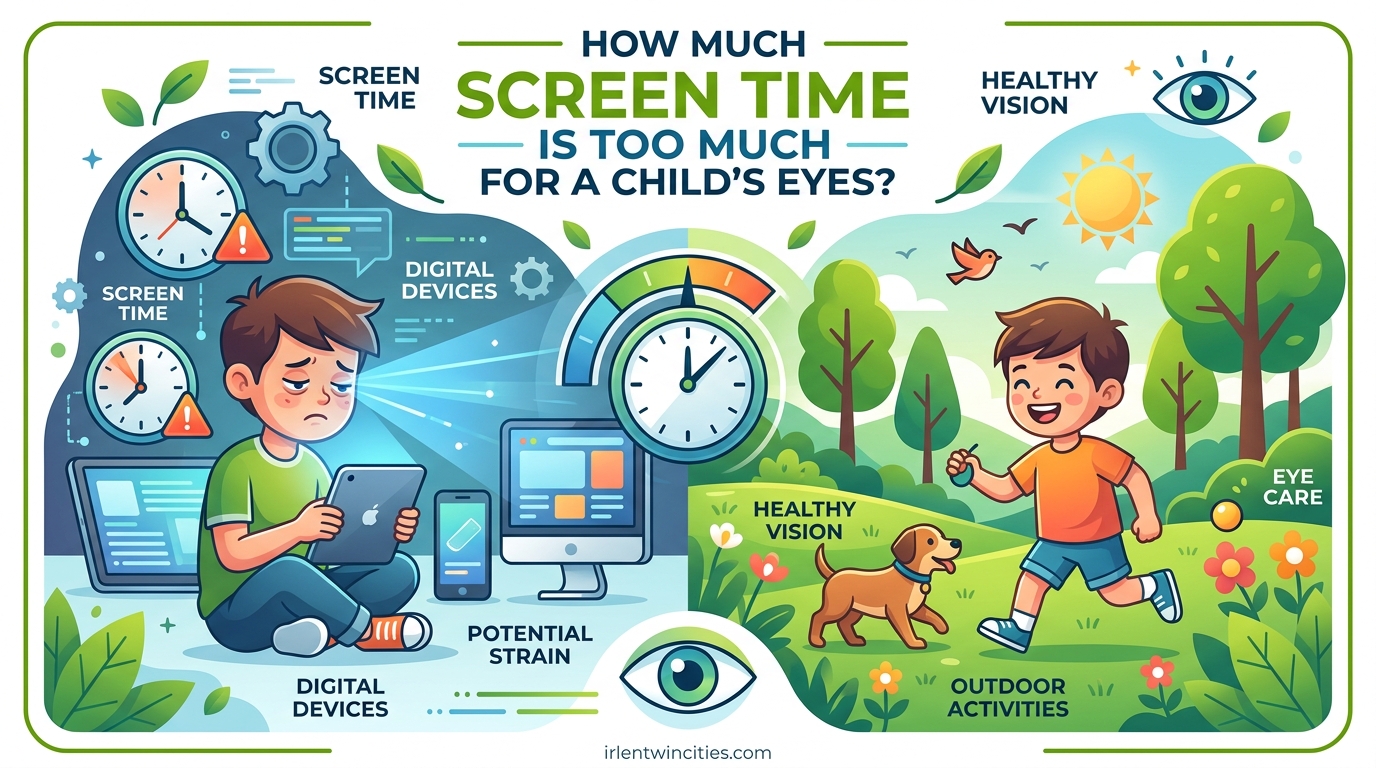
You’re not alone if you’ve worried about your child’s eyes after watching them stare at a tablet for hours. As parents, we juggle online homework, educational apps, and the inevitable plea for “just one more video” daily. The question isn’t whether screens are part of your child’s life—they are—but rather how much screen time is too much for a child’s eyes before real damage starts.
There is no single “magic number” of hours that instantly harms every child’s eyes. Eye health depends on age, individual sensitivity, screen habits, and whether your child gets enough breaks and outdoor time. In this guide, I’ll share what leading medical authorities actually recommend, the warning signs to watch for, and practical strategies you can implement today without buying expensive gadgets.
Table of Contents
How Screen Time Affects Children’s Eyes
Understanding what happens to your child’s eyes during screen use helps you make informed decisions. The effects aren’t mysterious—they’re well-documented physiological responses to prolonged near-focus and reduced blinking.
Eye Fatigue and Asthenopia
When your child concentrates on a screen, their eye muscles work harder than you might realize. The ciliary muscles contract continuously to maintain focus on near objects, leading to a condition called asthenopia—the medical term for eye fatigue. This isn’t just tiredness; it’s muscular strain similar to what you’d feel after holding a weight for too long.
Symptoms include aching around the temples, difficulty concentrating, and that telltale complaint: “My eyes hurt.” The American Academy of Ophthalmology notes that children often don’t recognize these symptoms early, making parental observation crucial.
Dry Eyes and Reduced Blinking
Here’s a startling fact: we blink about 15-20 times per minute normally, but only 3-4 times per minute when staring at screens. This dramatic reduction means your child’s tear film—the protective liquid layer covering the eyes—evaporates faster than it can be replenished.
The result is dry, irritated eyes that may appear red or feel gritty. Your child might start rubbing their eyes frequently or complain of a burning sensation. Without intervention, chronic dry eye can damage the ocular surface over time.
Blurry Vision and Accommodation Spasm
Have you noticed your child struggling to focus when they look up from a screen? This temporary blurry vision often signals accommodation spasm—when the eye’s focusing system essentially “locks up” from sustained close work.
The ciliary muscles become so accustomed to near-focus that they resist relaxing when your child looks at distant objects. While usually temporary, repeated episodes can indicate developing focusing problems that warrant professional evaluation.
Myopia (Nearsightedness) Risk
The connection between screen time and myopia has become one of the most researched topics in pediatric eye health. Nearsightedness has nearly doubled in the United States since 1971, with rates reaching up to 90% among teenagers in some Asian countries.
Research suggests that prolonged “near work”—activities requiring close focus like reading or screen use—triggers signals that promote eyeball elongation. The elongated shape causes light to focus in front of the retina rather than on it, creating nearsightedness. Children who spend more time indoors and less time outdoors show significantly higher myopia rates.
Recommended Screen Time Limits by Age
Medical authorities have established age-based guidelines that serve as practical benchmarks. Remember that these represent maximums for entertainment screen time—educational use may require different considerations.
Under 18-24 Months (Video Chat Only)
The American Academy of Pediatrics recommends avoiding digital media use entirely for children under 18 months, with one exception: video chatting. FaceTime with grandparents supports social development and doesn’t count as passive screen consumption.
The World Health Organization screen time recommendations similarly advise no sedentary screen time for children under 2 years. This age represents critical brain and vision development periods where physical interaction matters most.
Ages 2-5 Years (1 Hour Max)
For preschoolers, both AAP and WHO recommend limiting screen time to one hour per day of high-quality programming. Quality matters significantly here—educational content with interactive elements beats passive watching.
Co-viewing dramatically changes how toddlers process screen content. When you watch together and discuss what you’re seeing, screens become interactive learning tools rather than passive entertainment. Research shows preschoolers with more than 2 hours of daily screen time had nearly 8-fold increased odds of inattention problems.
Ages 6 and Older (Consistent Limits)
For school-age children, the AAP emphasizes “consistent limits” rather than specific hour counts. This flexibility acknowledges that homework increasingly requires screens, and a one-size-fits-all number doesn’t work for every family.
That said, most experts recommend keeping recreational screen time under 2 hours daily when possible. The key is ensuring this doesn’t replace sleep, physical activity, and other essential health behaviors. Consider creating a family media use plan through the AAP’s online tool to establish your household’s specific boundaries.
Understanding the AAO Position
The American Academy of Ophthalmology takes a different stance than the AAP. They explicitly state they do not have specific screen time recommendations for children, emphasizing that screen use hasn’t been proven to cause permanent eye damage. Their focus centers on managing symptoms and preventing myopia through outdoor time rather than arbitrary limits.
The 20-20-20 Rule and Other Prevention Strategies
Practical prevention doesn’t require expensive equipment or dramatic lifestyle overhauls. These evidence-based strategies protect your child’s eyes during necessary screen use.
The 20-20-20 Rule Explained
This simple rule serves as the foundation of digital eye strain prevention: every 20 minutes, look at something 20 feet away for at least 20 seconds. This break allows the ciliary muscles to relax and resets the focusing system.
Twenty seconds matters because that’s approximately how long your eyes need to fully relax their accommodation. Twenty feet represents optical infinity for eye focusing purposes—meaning your eyes essentially rest when viewing objects at that distance or beyond. Setting a timer or using break reminder apps helps establish this habit until it becomes automatic.
The 20-20-20-2 Rule (Adding Outdoor Time)
Children’s Hospital of Philadelphia recommends an enhanced version: the 20-20-20-2 rule. The additional “2” represents 2 hours of outdoor play daily. This modification addresses the myopia prevention research showing that outdoor light exposure helps maintain healthy eye development.
Natural light appears to trigger dopamine release in the retina, which inhibits eyeball elongation. Studies consistently show that children spending more time outdoors develop myopia at significantly lower rates, regardless of their near-work activities.
Screen Positioning: The 1-2-10 Rule
Proper positioning reduces strain significantly. Follow the 1-2-10 rule: hold phones at least 1 foot away, tablets and computer screens at least 2 feet away, and TVs at least 10 feet away. The larger the screen, the farther your child should sit.
Additionally, position screens slightly below eye level. Looking upward at screens exposes more of the eye’s surface to air, increasing dry eye risk. The ideal viewing angle is 15-20 degrees below horizontal.
Proper Lighting and Glare Reduction
Room lighting should match screen brightness—neither significantly brighter nor darker. Excessive contrast forces your child’s eyes to constantly adapt, causing fatigue. Position screens to avoid window glare, which creates additional strain.
Consider using blackout curtains or repositioning the desk if glare remains problematic. Matte screen protectors can reduce reflections on tablets and phones used in varying lighting conditions.
Blink Reminders and Eye Exercises
Since reduced blinking causes significant dry eye problems, conscious blinking helps. Teach your child “complete blinks”—fully closing and opening eyes rather than the partial blinks common during screen concentration. The AAO’s BLINK strategy summarizes this: Blink, Lubricate with artificial tears if needed, keep screens Inches away, take Near device breaks, and Know your sources.
The Importance of Outdoor Play
Outdoor time serves dual purposes: it gives eyes a complete break from near-focus while providing the light exposure that supports healthy eye development. Even cloudy days offer significantly more light intensity than indoor environments.
Make outdoor time non-negotiable, just like meals and sleep. Two hours daily represents the research-backed threshold for myopia prevention, though any outdoor time benefits eye health. Sports, playground time, or simple backyard play all count toward this goal.
Blue Light: What Parents Should Know
Blue light marketing has created confusion among parents. Let’s clarify what the evidence actually shows.
The AAO Position on Blue Light
The American Academy of Ophthalmology states clearly that digital screens do not emit enough blue light to cause eye damage. The sun emits far more blue light than any consumer device, and our eyes handle natural exposure daily.
The concern about blue light damaging retinal cells stems from laboratory studies using exposure levels impossible to achieve with normal device use. Current research does not support claims that screen blue light harms children’s eyes.
Sleep Disruption vs Eye Damage
Where blue light does matter: sleep. Blue light suppresses melatonin production more effectively than other wavelengths. This disruption of the circadian rhythm explains why screen use before bed makes falling asleep harder.
The impact on sleep quality represents the primary blue light concern for children. Poor sleep affects everything from academic performance to emotional regulation, making the bedtime screen rule important for overall health.
Are Blue Light Glasses Worth It?
Given the AAO’s position on blue light eye safety, expensive blue light glasses aren’t necessary for eye health protection. The Academy explicitly does not recommend them for preventing digital eye strain.
If you choose to use them anyway, consider inexpensive options rather than premium brands. The filtering effect may help sleep when used in the evening, but this benefit comes from better sleep hygiene rather than eye protection.
Screen Time and Sleep
Sleep and screen use intertwine in ways that affect both eye health and overall wellbeing.
The One Hour Before Bed Rule
The AAP recommends removing screens at least one hour before bedtime. This buffer allows melatonin levels to rise naturally, supporting healthy sleep onset. For children who struggle with sleep, extending this to two hours may help.
This rule applies to all screens—phones, tablets, computers, and television. Even passive TV watching before bed affects sleep quality more than reading or other non-screen activities.
Keeping Devices Out of Bedrooms
Charging devices outside bedrooms removes temptation for late-night scrolling and eliminates the subtle stress of notification checking. The blue light exposure from nighttime phone checks—even brief ones—resets the sleep disruption cycle.
Consider creating a central charging station in a common area. This simple boundary supports better sleep for the whole family, not just children.
When Screen Time Symptoms May Indicate Irlen Syndrome
At Irlen Twin Cities, we regularly see children whose screen time complaints extend beyond typical digital eye strain. Understanding when symptoms suggest visual processing disorders helps parents seek appropriate care.
Beyond Typical Eye Strain
Standard digital eye strain improves with the 20-20-20 rule, proper breaks, and reduced screen time. When complaints persist despite these interventions, underlying visual processing issues may exist.
Irlen Syndrome—a light sensitivity condition affecting visual processing—often masquerades as simple eye fatigue. Children with this condition experience discomfort from specific light wavelengths that don’t bother typical eyes. Screens emit precisely the light types that trigger Irlen symptoms.
Warning Signs of Visual Processing Issues
Watch for these indicators that suggest more than standard screen fatigue: headaches that worsen with fluorescent lighting (common in schools), text that appears to move or shimmer on screens, difficulty tracking lines when reading, and complaints that white screens “hurt” or “glow.”
Children with Irlen Syndrome often rub their eyes excessively, avoid reading on screens despite enjoying books, and show improved comfort with dark mode or blue-light-heavy filters. These children may squint at screens while having no trouble with other near activities.
When to Seek Specialized Assessment
If your child’s screen-related symptoms don’t improve with standard interventions, consider a comprehensive evaluation. Standard eye exams may show 20/20 vision while missing visual processing disorders that affect learning and comfort.
Proper assessment identifies whether simple habit changes suffice or whether conditions like Irlen Syndrome require specialized intervention. The goal is ensuring screen time doesn’t become painful when it could be manageable with appropriate support.
When to See a Pediatric Eye Doctor
Certain symptoms warrant professional evaluation beyond routine vision screenings.
Headaches and Eye Pain
Regular headaches centered around the temples or behind the eyes after screen use signal focusing problems. While occasional strain is normal, frequent pain indicates your child’s visual system struggles with the demands placed on it.
Persistent Blurry Vision
Blurry vision that lasts more than a few minutes after screen use suggests accommodation problems or developing refractive errors. This differs from the temporary blur that resolves quickly when looking away from screens.
Squinting and Eye Rubbing
Consistent squinting at screens, even when positioned correctly, indicates possible vision problems. Excessive eye rubbing—beyond normal fatigue—suggests significant discomfort requiring investigation.
Regular Vision Screening Schedule
The American Optometric Association recommends comprehensive eye exams at 6 months, 3 years, before first grade, and annually thereafter through age 18. School vision screenings catch some problems but miss many conditions affecting learning and comfort.
If your child uses screens extensively for school, discuss this with your eye care provider. They can assess focusing ability, eye teaming, and other functions that basic vision tests overlook.
FAQ
How much screen time is bad for kids’ eyes?
There is no specific threshold where screen time becomes ‘bad’ for all children. The American Academy of Ophthalmology states they have no specific screen time recommendations because permanent eye damage from screens hasn’t been proven. However, the American Academy of Pediatrics recommends no screens under 18 months (except video chat), 1 hour maximum for ages 2-5, and consistent limits for ages 6+. Focus on breaks, outdoor time, and watching for symptoms rather than obsessing over exact minutes.
What is the 10-10-10 rule for screens?
The 10-10-10 rule is a variation of the standard 20-20-20 rule, particularly helpful for younger children with shorter attention spans. It suggests: every 10 minutes, look at something 10 feet away for 10 seconds. While less comprehensive than the 20-20-20 rule, it’s easier for young children to remember and implement.
Is it okay to let my 3 year old watch TV?
Yes, but with limits. The AAP recommends no more than 1 hour per day of high-quality programming for children ages 2-5. Co-viewing with you dramatically improves the experience—talk about what you’re watching and connect it to real-world experiences. Avoid solo, passive viewing when possible, and prioritize interactive, educational content over entertainment.
What is the 30-30-30 eye rule?
The 30-30-30 rule is another break variation: every 30 minutes, look at something 30 feet away for 30 seconds. This works well for children doing homework sessions or online learning. The principle remains the same—regular breaks that let eye muscles relax prevent fatigue and strain.
Can screen time cause permanent eye damage?
Current research from the American Academy of Ophthalmology indicates that screen time does not cause permanent eye damage. However, excessive screen time is associated with increased myopia (nearsightedness) rates and temporary discomfort from digital eye strain. The myopia connection matters because high myopia increases risks for serious eye conditions later in life, making prevention important.
Does screen time cause myopia in children?
Screen time itself doesn’t directly cause myopia, but the ‘near work’ pattern associated with screens contributes to its development. Research shows that prolonged close-focus activities combined with insufficient outdoor time raises myopia risk significantly. The good news: increasing outdoor play to 2 hours daily substantially reduces myopia development, even for children with screen-heavy schedules.
Conclusion
The question of how much screen time is too much for a child’s eyes doesn’t have a simple numerical answer. What matters most: regular breaks using the 20-20-20 rule, adequate outdoor play, proper screen positioning, and watching for warning signs that indicate professional evaluation is needed.
You don’t need expensive blue light glasses or complex interventions to protect your child’s eyes. The strategies outlined here cost nothing yet provide substantial protection against digital eye strain and myopia risk. Start with one change—perhaps the 20-20-20 rule timers—and build from there. Small, consistent improvements to screen habits will serve your child’s vision well throughout 2026 and beyond.