
I remember the first time I saw a struggling reader’s face transform while listening to an audiobook. It was in my third year of working with students who had spent years feeling defeated by printed text. That moment changed everything I thought I knew about reading instruction.
How to use audiobooks effectively for struggling readers is a question more parents and educators are asking in 2026. With audiobook consumption up 15% year over year, we are seeing a shift in how we approach literacy support. The research is clear: when implemented correctly, audiobooks are not a shortcut or a crutch. They are a powerful bridge to reading success.
Many adults worry that audiobooks do not count as real reading. I hear this concern from teachers and parents almost weekly. The truth is more nuanced and far more encouraging than most people realize.
Table of Contents
What Is Audio-Assisted Reading
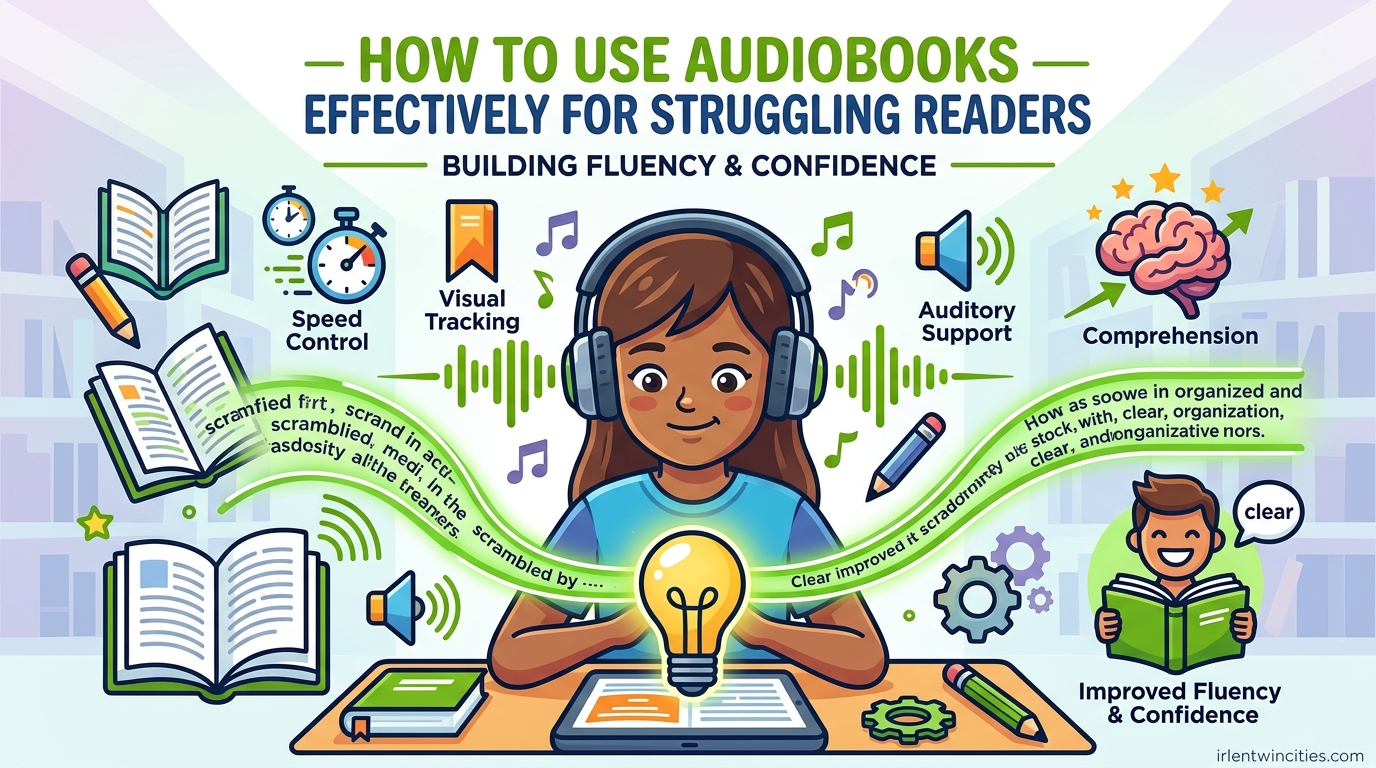
Audio-assisted reading is a strategy where students listen to a professionally narrated version of a text while simultaneously following along with the printed words. This is different from simply listening to an audiobook while doing other activities. The key is the simultaneous engagement with both auditory and visual text.
The approach combines three essential elements: a fluent reading model, visual word exposure, and active comprehension work. When a student hears expressive reading while seeing the words on the page, their brain makes connections that pure phonics instruction alone cannot achieve.
Think of it like training wheels on a bicycle. The audio provides support that allows the student to experience the joy and momentum of reading while still building the skills they need to eventually ride independently.
10 Benefits of Audiobooks for Struggling Readers
How do audiobooks help struggling readers? The benefits extend far beyond simple entertainment. Research and classroom experience have identified ten key advantages that make audio-assisted reading one of the most effective interventions available.
1. Increases word exposure and vocabulary development. Students hear thousands more words than they would struggle through on their own. This exposure builds the rich vocabulary that is essential for comprehension and academic success.
2. Builds background knowledge. Struggling readers often miss out on grade-level content because they cannot decode the text. Audiobooks give them access to the same stories and information as their peers, leveling the playing field.
3. Reduces working memory deficits. When students must focus all their mental energy on sounding out words, they have nothing left for understanding meaning. Audiobooks free up working memory for comprehension.
4. Removes printed word decoding anxiety. Years of struggle create genuine anxiety around text. Audiobooks remove that barrier, allowing students to experience reading as something enjoyable rather than stressful.
5. Provides a fluent reading model. Students hear proper phrasing, expression, and pacing. This models what good reading sounds like, helping them internalize the rhythm of language.
6. Develops listening comprehension skills. The ability to understand complex spoken language is a critical literacy skill. Audiobooks strengthen this ability while building the bridge to print comprehension.
7. Maintains engagement with grade-level content. Students stay connected to classroom discussions and peer recommendations. They do not fall further behind while working on foundational skills.
8. Improves sight word recognition. Seeing and hearing words simultaneously reinforces recognition. Students begin to recognize words they have repeatedly encountered in audio format.
9. Supports educational independence. Students can access books without constant adult support. This builds confidence and creates positive associations with reading.
10. Develops a love of books and stories. Perhaps most importantly, audiobooks allow students to fall in love with literature. They experience the magic of story, which motivates continued engagement with reading.
How to Use Audiobooks Effectively for Struggling Readers
Implementation makes all the difference between audiobooks being a helpful tool or just background noise. After working with dozens of families and consulting with reading specialists, I have refined this process into clear steps anyone can follow.
Step 1: Start with the 20-minute rule. Research consistently shows that 20 minutes of daily reading exposure is the sweet spot for building vocabulary and comprehension. Begin with one 20-minute audiobook session per day.
Step 2: Use follow-along format initially. Have the student hold the physical book or ebook while listening. This creates the audio-visual connection that strengthens word recognition. Some platforms offer word highlighting which can be especially helpful.
Step 3: Choose books slightly above independent reading level. The goal is to provide access to engaging, grade-appropriate content. A book the student could not read independently but can comprehend with audio support is ideal.
Step 4: Discuss what you hear. Pause periodically to ask comprehension questions. Who is the main character? What just happened? Why do you think they did that? This keeps the brain actively engaged rather than passively listening.
Step 5: Adjust playback speed as needed. Most apps allow speed adjustment. Start at normal speed. If the student struggles to keep up, slow it down. As they become more comfortable, some students prefer slightly faster speeds.
Step 6: Create a consistent routine. Same time, same place, same expectations. Many families find that audiobooks work well during car rides, before bed, or as part of homework time. Consistency builds habits.
Step 7: Track engagement and progress. Keep a simple log of what books were completed and the student’s reactions. Note any new vocabulary used in conversation or increased interest in independent reading.
Choosing the Right Audiobooks
Not all audiobooks are created equal when it comes to supporting struggling readers. The selection process matters almost as much as the listening itself.
Use the five-finger rule adapted for audiobooks. Open the physical book to a random page. For every word the student cannot read, raise a finger. Zero to one fingers means the book is appropriate for follow-along listening. Two to three fingers can work with support. Five fingers means the book is too difficult even with audio assistance.
Narrator quality can make or break the experience. Professional voice actors who use distinct voices for characters and expressive reading are best. Avoid robotic text-to-speech for struggling readers unless absolutely necessary. Human narration provides the intonation and emotion that keep listeners engaged.
Consider the student’s interests above all else. A struggling reader who loves dinosaurs will persist through challenging content about paleontology. A student who finds the topic boring will tune out regardless of difficulty level.
Platform features matter too. Look for apps that offer word highlighting, adjustable speed, and easy navigation. The ability to jump back 30 seconds is surprisingly useful when attention wanders.
Audiobooks for Different Learning Needs
Every struggling reader is unique, and audio-assisted reading can be adapted for specific learning differences. Understanding these nuances helps maximize the benefit.
Students with Dyslexia
Do people with dyslexia prefer audiobooks? The answer is overwhelmingly yes, and for good reason. Dyslexia creates a neurological barrier to decoding printed text that is separate from intelligence or comprehension ability. Audiobooks bypass this barrier entirely.
For dyslexic learners, human-read audiobooks are strongly preferred over text-to-speech. The natural rhythm and expression help with processing. Learning Ally specializes in human-narrated books for this population and is worth the subscription cost for many families.
Simultaneous reading with text is especially beneficial for dyslexic students. Seeing the words while hearing them can strengthen neural pathways for word recognition over time.
Students with ADHD
Do people with ADHD do better with audiobooks? The answer depends on implementation. Many ADHD learners struggle with the sustained attention required for traditional reading. Audiobooks can help, but they require active engagement strategies.
Short listening sessions work better than marathon sessions. Ten to fifteen minutes with discussion breaks is often more effective than 30 minutes of passive listening. Fidget tools can help some students focus better while listening.
Follow-along format is crucial for ADHD learners. Having the physical book to track with provides a visual anchor that can reduce mind-wandering. Some students benefit from using a finger or reading guide strip under the words as they listen.
English Language Learners
Audiobooks provide pronunciation models and natural language rhythm that support second language acquisition. ESL students benefit from hearing fluent English while seeing the text. This dual coding accelerates both vocabulary and grammar internalization.
Start with books the student knows in their first language, if available. Familiar content allows focus on language rather than trying to follow an unknown story while processing new vocabulary.
Transitioning from Audiobooks to Print Reading
This is the question I hear most from concerned parents: Will my child become dependent on audiobooks and never learn to read print? The evidence suggests the opposite happens when implementation is done correctly.
The goal of audio-assisted reading is to create a bridge, not a permanent replacement. As students experience success and build vocabulary through listening, many naturally become more interested in print books. The confidence gained from understanding complex stories often transfers to increased willingness to attempt printed text.
Use a gradual release approach. Start with full audio support for all reading. After several weeks of success, introduce short periods of independent reading at a lower difficulty level while maintaining audiobooks for grade-level content. Over time, increase the ratio of independent to supported reading based on the student’s comfort and success.
Continue phonics and decoding instruction alongside audiobook use. Audio-assisted reading complements rather than replaces foundational skills work. Students still need explicit instruction in letter-sound relationships and decoding strategies.
Watch for natural curiosity about print. Many parents report their child asking how to spell words they encountered in audiobooks or wanting to read favorite passages from print books. These are signs the bridge is working.
Free vs Paid Audiobook Services
Cost should never be a barrier to accessing audiobooks for struggling readers. There are excellent free options alongside subscription services that may be worth the investment for some families.
Library-Based Free Options
Libby and OverDrive connect to your local library card and offer thousands of audiobooks at no cost. The selection varies by library system but often includes popular children’s and young adult titles. This is where I recommend all families start.
Hoopla is another library-connected service that offers audiobooks, often with different titles than OverDrive. Many libraries provide access to both.
Specialized Services for Learning Differences
Learning Ally provides human-narrated audiobooks specifically for students with dyslexia and print disabilities. There is a subscription fee, but many schools and districts have institutional accounts. Individual memberships are available for families.
Bookshare offers free access to students with qualifying disabilities, including dyslexia and visual impairments. A medical or educational professional must certify eligibility. The collection includes textbooks and pleasure reading.
Commercial Options
Audible offers the largest selection but can be expensive for heavy users. Their subscription model includes one book per month plus discounts. The Whispersync feature allows switching between audio and ebook formats, which is useful for audio-assisted reading.
Epic provides a vast digital library including read-to-me books for younger readers. The subscription is reasonable and includes many titles popular with elementary students.
Measuring Progress and Success
How do you know if audiobooks are actually helping? Progress with audio-assisted reading can be measured in several ways beyond traditional reading assessments.
Comprehension Indicators
Can the student retell the story with reasonable accuracy? Do they make connections between the book and real life? Can they answer questions about character motivation and plot? These comprehension skills often improve before decoding skills do.
Vocabulary Growth
Listen for new words showing up in the student’s speech and writing. Many parents report their child using sophisticated vocabulary they could not possibly have encountered in books at their independent reading level.
Engagement and Attitude
Does the student now talk about books with enthusiasm? Do they recommend titles to friends or family? Have they developed preferences for genres or authors? A positive attitude toward reading is a significant victory.
Print Reading Transfer
Monitor whether the student attempts more challenging print books. Look for recognition of words they have encountered repeatedly in audio format. Some students show improved fluency in print after extensive audio exposure.
Keep a simple journal noting books completed, vocabulary noticed, and observations about engagement. Review this periodically to see patterns of growth.
Frequently Asked Questions
How do audiobooks help struggling readers?
Audiobooks help struggling readers by providing access to grade-level content, building vocabulary through increased word exposure, reducing working memory load, modeling fluent reading, and removing the anxiety of decoding difficulty. They allow students to comprehend complex text while continuing to develop foundational skills.
What is the 5 finger rule for books?
The 5 finger rule helps determine if a book is at the right difficulty level. Open to a random page and read. Raise a finger for each word you cannot read. Zero to one fingers means the book is appropriate. Two to three fingers means it might be challenging. Five fingers means the book is too difficult.
Do people with ADHD do better with audiobooks?
People with ADHD can benefit from audiobooks when implemented with active engagement strategies. Follow-along format with physical text, shorter listening sessions with breaks, and fidget tools can help maintain focus. Audiobooks reduce the sustained attention demands of traditional reading while still building comprehension and vocabulary.
Do people with dyslexia prefer audiobooks?
Yes, people with dyslexia often strongly prefer audiobooks because they bypass the neurological decoding difficulties associated with dyslexia. Human-read audiobooks with follow-along text are particularly beneficial. Organizations like Learning Ally specialize in providing audiobook accommodations for dyslexic readers.
Do audiobooks improve reading comprehension?
Yes, audiobooks improve reading comprehension by allowing students to understand complex text that would be inaccessible at their decoding level. When paired with follow-along text, they can also improve print comprehension over time by building vocabulary, background knowledge, and familiarity with complex sentence structures.
Is dyslexia linked to high IQ?
Dyslexia occurs across the full range of intelligence levels and is not directly linked to IQ. Many people with dyslexia have average or above-average intelligence. Dyslexia is a specific learning difference affecting reading decoding, not a reflection of overall cognitive ability.
How long should struggling readers listen to audiobooks daily?
The research-backed recommendation is 20 minutes of daily audiobook listening for struggling readers. This duration provides sufficient word exposure and vocabulary building while remaining manageable for attention spans. Sessions can be split into two 10-minute periods if needed.
Do audiobooks count as reading?
Yes, audiobooks count as reading when implemented with engagement strategies. They provide the same comprehension, vocabulary, and content benefits as silent reading. For struggling readers, audio-assisted reading with follow-along text offers additional benefits by modeling fluent reading while building print word recognition.
Conclusion
How to use audiobooks effectively for struggling readers comes down to understanding that audio-assisted reading is a bridge, not a destination. When implemented with intention, follow-along text, and consistent engagement, audiobooks transform the reading experience for students who have spent years struggling.
The ten benefits we explored show that audiobooks do far more than simply entertain. They build vocabulary, model fluency, reduce anxiety, and provide access to grade-level content. For students with dyslexia, ADHD, or other learning differences, they can be the difference between giving up on reading and developing a lifelong love of books.
Start with your local library and the free Libby app. Choose books your student is genuinely interested in, slightly above their independent reading level. Use the follow-along format and discuss what you hear. Track progress not just in decoding skills but in engagement, vocabulary use, and attitude toward books.
Most importantly, remember that every student who struggles with reading can succeed with the right support. Audiobooks are one of the most powerful tools we have to make that success possible in 2026 and beyond.