
Finding clear answers about ADHD vs autism differences can feel overwhelming. Both conditions are neurodevelopmental disorders that affect how people think, process information, and interact with the world around them. Yet despite their similarities, ADHD and autism have distinct characteristics that make each experience unique.
I have spent considerable time researching these conditions, speaking with clinicians, and listening to countless personal stories from adults navigating diagnosis and self-discovery. What I have learned is this: understanding the differences between ADHD and autism is not just an academic exercise. It directly impacts whether someone receives the right support, the appropriate accommodations, and most importantly, a sense of self-understanding that can transform their life.
This guide breaks down everything you need to know about how ADHD and autism differ. We will explore the core distinctions in social interaction, routine preferences, attention patterns, and sensory processing. We will also examine where these conditions overlap, what happens when someone has both, and practical strategies for managing daily life.
Whether you are questioning your own neurodevelopmental profile, supporting a loved one, or simply seeking to understand these conditions better, this comprehensive guide will give you the clarity you need.
Table of Contents
What Are the Main Differences Between ADHD and Autism?
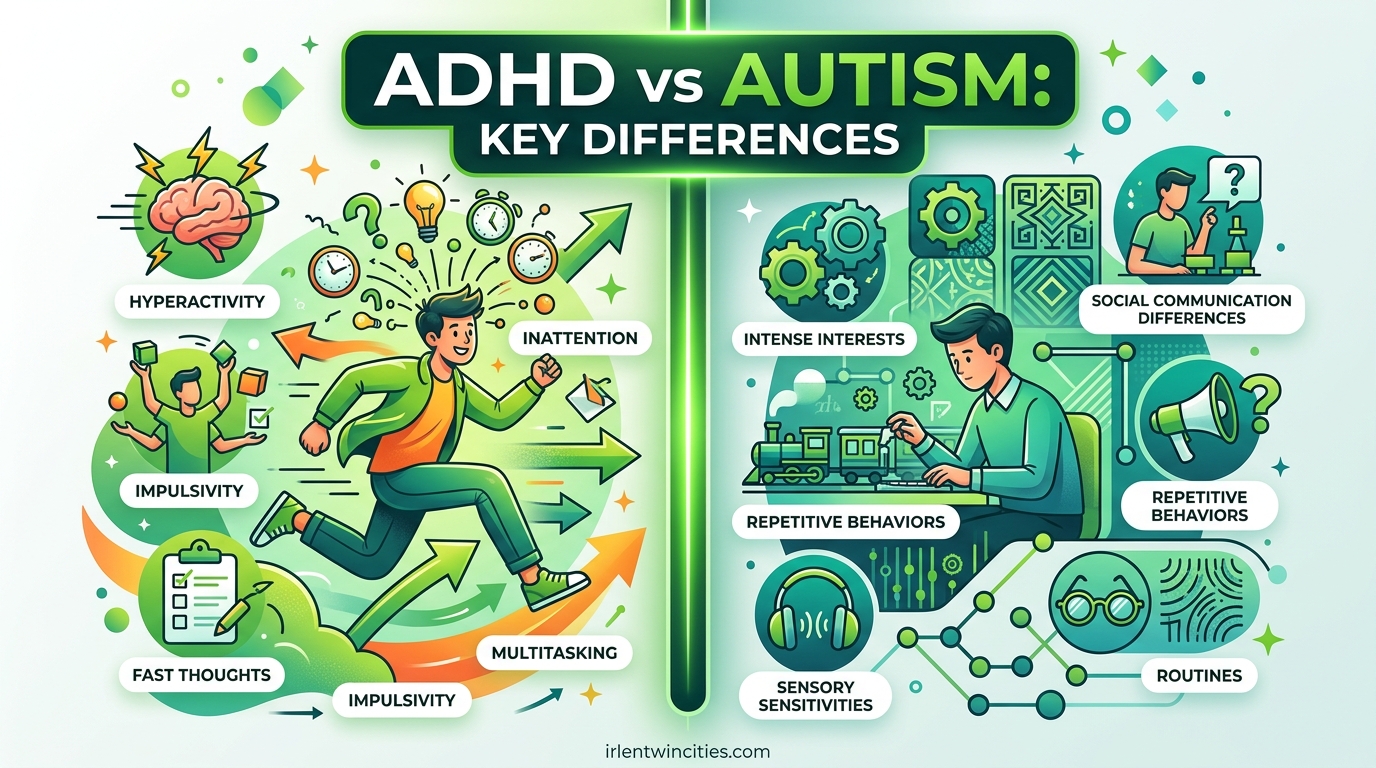
Before diving into the details, here is a quick overview of the five key areas where ADHD and autism diverge. This summary is designed to answer the most common questions quickly while providing a framework for deeper exploration.
- Social Interaction: ADHD often involves social enthusiasm but impulsive communication; autism involves challenges with social intuition and literal interpretation of language
- Routine and Structure: People with ADHD typically crave novelty and struggle with sameness; autistic individuals usually prefer predictability and can find change distressing
- Attention and Focus: ADHD features difficulty sustaining attention on mundane tasks; autism features intense, sustained focus on specific interests (often called monotropism)
- Behavioral Patterns: ADHD is marked by impulsivity and hyperactivity; autism is characterized by repetitive behaviors, stimming, and restricted interests
- Sensory Processing: While both conditions involve sensory differences, the patterns and triggers vary significantly between ADHD and autism
These differences reflect the distinct underlying mechanisms of each condition. ADHD primarily affects dopamine regulation and executive function, while autism involves differences in neural connectivity and information processing. Understanding these distinctions helps explain why someone might feel constantly restless and novelty-seeking versus feeling overwhelmed by change and seeking comfort in repetition.
One person I spoke with described it beautifully: “ADHD is like having a butterfly brain that flits from flower to flower, while autism is like being deeply rooted in one spot, completely absorbed by what is right in front of you.”
Social Interaction: ADHD vs Autism
Social communication is one of the most telling areas where ADHD and autism differ. While both conditions can create social challenges, the underlying reasons and outward expressions are distinct.
People with ADHD often describe themselves as social butterflies. They may talk excessively, interrupt others, or switch topics rapidly during conversations. This is not a lack of interest in others but rather a manifestation of impulsivity and working memory challenges. The person with ADHD understands social rules intuitively but struggles to apply them consistently.
From our research into community forums and lived experiences, one consistent theme emerged: ADHD social difficulties stem from poor impulse control rather than social understanding deficits. As one forum participant shared, “I know I should not interrupt. I can feel myself doing it. But the words just come out before my brain can stop them.”
Autism presents a different picture. Autistic individuals may struggle to pick up on unspoken social cues, understand sarcasm or figurative language, or navigate the unwritten rules of conversation. This is not about intelligence or desire to connect. Many autistic people deeply want relationships but find the neurotypical social world confusing or exhausting.
The metaphor we heard repeatedly in forums describes this well: “ADHD is the social butterfly, flitting about from one topic to the next, while autism is the wallflower, content to stay away or be quiet.” Both may appear socially awkward at times, but the reasons and internal experiences differ dramatically.
Another crucial distinction involves social motivation. People with ADHD often seek stimulation through social interaction and may become bored or restless in solitary activities. Autistic individuals frequently prefer smaller social circles or alone time and may find extensive socializing draining regardless of how much they enjoy the people involved.
Understanding these differences matters for relationships. A partner or friend with ADHD might need reminders about listening and turn-taking, while someone with autism might benefit from explicit communication about feelings and expectations. Neither is broken. Both simply operate with different social processing systems.
Routine and Structure: Novelty vs Predictability
One of the most striking differences between ADHD and autism involves how each condition relates to routine, structure, and change. This distinction often surprises people who assume all neurodivergent individuals prefer sameness.
People with ADHD typically struggle with routine. They crave novelty, get bored easily, and may feel restless or trapped when required to follow repetitive patterns. This is why someone with ADHD might start a dozen new hobbies, abandon old interests quickly, or reorganize their furniture every few months. The brain seeks stimulation, and routine often fails to provide it.
Our team has noted this pattern repeatedly in our research: the ADHD brain is novelty-seeking by design. Without new input, interest wanes. This explains why traditional organizational systems often fail for people with ADHD. What worked last month feels impossibly boring this month, leading to the classic cycle of abandoned planners, half-finished projects, and constant pursuit of the next interesting thing.
Autism presents the opposite pattern. Autistic individuals often find comfort in predictability, routine, and familiar environments. Change can feel threatening or overwhelming because it requires processing new information without the benefit of established patterns. A sudden schedule change, an unexpected visitor, or a moved household item can create significant distress.
This need for sameness is not stubbornness or inflexibility. It is a coping mechanism for managing a brain that processes information differently. Routine reduces the cognitive load required for daily functioning. When the world follows expected patterns, mental resources are preserved for other tasks.
Here is where things get fascinating. When someone has both ADHD and autism, a condition increasingly called AuDHD, these competing needs create what many describe as an internal war. One part of the brain craves novelty and change while another part desperately needs routine and predictability.
We heard this described eloquently in community discussions: “Having both feels like being a walking contradiction. I need structure to function, but I also cannot stand doing the same thing repeatedly. I get bored of my routines before they become habits, then collapse when everything is chaotic.”
Understanding this tension is crucial for anyone supporting someone with AuDHD or navigating it themselves. The solution often involves creating structured novelty, predictable patterns that still offer variation, or flexibility within boundaries.
Focus and Attention: Hyperfocus vs Special Interests
Attention patterns represent another major area where ADHD and autism diverge. Both conditions involve differences in how attention is directed and sustained, but the patterns are nearly opposite in many ways.
ADHD is stereotypically associated with distractibility and difficulty focusing. While this is often true, especially for mundane tasks, it is only half the story. People with ADHD also experience hyperfocus, a state of intense, sustained concentration where time seems to disappear and distractions fade away. During hyperfocus, someone with ADHD might spend eight hours on a video game, a creative project, or a new interest without eating, drinking, or noticing the passage of time.
The key distinction in ADHD is that attention is task-dependent rather than interest-dependent. Boring tasks feel nearly impossible to focus on regardless of importance, while engaging tasks capture attention completely regardless of priority. This is why someone with ADHD might fail to complete a critical work assignment but spend hours researching an obscure hobby.
Autism involves a different attention pattern often described as monotropism. This theory suggests that autistic brains tend to focus deeply on fewer channels of information at once. Rather than being distractible in the ADHD sense, autistic individuals may struggle to divide attention between multiple inputs.
Special interests in autism reflect this pattern. An autistic person might develop intense, encyclopedic knowledge about a specific topic, often maintaining that interest for years or decades. The interest is not just a hobby but a significant source of joy, comfort, and self-regulation.
While both ADHD hyperfocus and autism special interests involve intense concentration, the underlying mechanisms differ. ADHD hyperfocus is often situational and responsive to stimulation levels. Autism special interests are typically enduring, deep, and provide consistent satisfaction regardless of external circumstances.
From the forums we analyzed, many people with AuDHD described how these attention patterns interact. One participant explained: “My autism gives me special interests I maintain for years, but my ADHD means I can only hyperfocus on them when my dopamine is right. Some days I am all in, other days I cannot access that focus at all.”
Behavioral Patterns: Impulsivity vs Repetitive Behaviors
The behavioral expressions of ADHD and autism also reveal important distinctions. Understanding these patterns helps clinicians differentiate between the conditions and helps individuals understand their own experiences.
ADHD is characterized by impulsivity and hyperactivity. This might manifest as interrupting conversations, making decisions without considering consequences, physical restlessness, or difficulty waiting turns. These behaviors stem from challenges with inhibition and delayed gratification rather than from preference or choice.
The DSM-5 criteria for ADHD specifically include symptoms like blurting out answers, difficulty waiting in line, acting without thinking, and feeling driven by a motor. These are observable, measurable behaviors that indicate a pattern of difficulty with self-regulation.
Autism involves different behavioral patterns grouped under restricted repetitive behaviors. These include repetitive movements (stimming), insistence on sameness, highly restricted interests, and sensory seeking or avoiding behaviors. Stimming might involve hand-flapping, rocking, spinning, or other rhythmic movements that help regulate sensory input and emotional states.
Unlike ADHD impulsivity, autistic repetitive behaviors are typically intentional and serve a regulatory function. Stimming helps manage overwhelming sensory input or emotional intensity. Routines reduce anxiety. Special interests provide comfort and predictability in a chaotic world.
One key insight from our research: both sets of behaviors represent attempts to regulate the nervous system, but they work differently. ADHD behaviors often reflect an under-stimulated brain seeking input. Autism behaviors often reflect an overstimulated brain seeking to manage input.
People with both conditions may display both patterns, sometimes simultaneously. They might impulsively start new projects (ADHD) while also engaging in repetitive soothing behaviors (autism) when overwhelmed by those projects.
Sensory Processing Differences
Sensory processing differences occur in both ADHD and autism, though the patterns and intensity vary between conditions. Understanding these differences helps explain many daily challenges that neurodivergent individuals face.
In ADHD, sensory processing differences often manifest as seeking or avoiding behaviors. Some people with ADHD crave intense sensory input, leading them to enjoy loud music, spicy foods, or physical activity. Others may be easily overwhelmed by sensory input, finding background noise or bright lights distracting. The key pattern is that sensory experiences affect attention and arousal levels.
Autism typically involves more pronounced sensory processing differences. Many autistic individuals experience sensory input more intensely than neurotypical people. Tags in clothing, fluorescent lights, certain food textures, or background conversations might feel unbearable. Others may be under-sensitive to input, requiring more intense experiences to register sensation.
A concept that emerged frequently in our forum research is interoperception, the awareness of internal body states. Differences in interoperception appear in both conditions but manifest differently. People with ADHD may struggle to notice hunger, thirst, or fatigue until they are extreme. Autistic individuals may notice internal sensations intensely, sometimes leading to heightened anxiety about physical symptoms.
Both conditions can involve sensory overwhelm, but the triggers and responses differ. ADHD overwhelm often builds gradually as attention fragments across too many inputs. Autism overwhelm may hit suddenly when a specific sensory threshold is crossed. Both can lead to shutdown or meltdown states, but the pathways there are distinct.
Accommodations for sensory differences vary accordingly. Someone with ADHD might benefit from noise-canceling headphones to reduce distractions. An autistic person might use the same headphones to prevent sensory overload from specific frequencies or volumes. The tool is similar, but the need behind it differs.
Overlapping Traits: Where ADHD and Autism Meet
While this guide focuses on ADHD vs autism differences, understanding where these conditions overlap is equally important. Many people have traits from both conditions, and some shared experiences create confusion during diagnosis.
Executive Function Challenges in Both Conditions
Executive function refers to the cognitive processes that help us plan, organize, initiate tasks, manage time, and regulate behavior. Both ADHD and autism involve executive function differences, though the patterns vary.
In ADHD, executive dysfunction is central to the diagnosis. Working memory deficits make it hard to hold information in mind while using it. Difficulty with task initiation means important tasks feel impossible to start. Time blindness means five minutes and five hours feel subjectively similar. These challenges affect every area of life from work to relationships to self-care.
Autism also involves executive function differences, though they often present differently. An autistic person might struggle with planning flexible routines, switching between tasks, or organizing information in neurotypical ways. The challenge is less about impulsivity and more about needing clear structures to support executive functioning.
Both conditions can benefit from similar accommodations: visual schedules, external reminders, breaking tasks into smaller steps, and creating environmental supports that reduce the load on executive functioning. The underlying reasons differ, but the practical solutions often overlap.
Emotional Regulation and Rejection Sensitivity
Emotional dysregulation occurs in both ADHD and autism, though the patterns and triggers differ. Understanding these patterns helps individuals develop appropriate coping strategies.
ADHD often involves emotional intensity that rises and falls quickly. People with ADHD may experience emotions more intensely than others and have difficulty moderating their expression. Rejection sensitive dysphoria, while not an official diagnostic criterion, is frequently reported by adults with ADHD. This involves extreme emotional pain in response to perceived criticism, rejection, or failure.
Autism can involve different emotional regulation patterns. Some autistic individuals experience alexithymia, difficulty identifying and describing emotions. Others feel emotions intensely but struggle to express them in expected ways. Emotional overwhelm may build gradually from sensory and social stressors until a meltdown or shutdown occurs.
Both conditions benefit from learning emotional regulation strategies, though the specific approaches may differ. Mindfulness, sensory regulation techniques, and therapy can all help. The key is understanding which patterns apply to your experience.
Gender Differences in Presentation
Gender significantly affects how both ADHD and autism present, which historically led to underdiagnosis in girls and women. Understanding these differences is crucial for accurate identification.
Girls with ADHD often present with inattentive symptoms rather than hyperactive ones. They may be daydreamers, struggling internally while appearing quiet and compliant externally. This internalized presentation means their difficulties are less visible to teachers and parents, leading to missed diagnoses.
Autistic girls and women frequently develop sophisticated masking and camouflaging abilities. They may observe and mimic social behaviors, hiding their autistic traits to fit in. This masking is exhausting and contributes to high rates of anxiety, depression, and burnout in autistic women.
Both conditions in females may present as perfectionism, people-pleasing, anxiety, or exhaustion rather than the stereotypical symptoms seen in diagnostic criteria developed primarily with male presentations in mind. This gender gap in understanding has left countless women undiagnosed until adulthood.
Recognition of these patterns is improving. More clinicians are receiving training in how ADHD and autism present across genders. Self-advocacy and community education are also helping more people recognize themselves in descriptions that match their lived experience.
What Is AuDHD? Understanding Co-Occurrence
One of the most significant developments in neurodivergent understanding is the recognition that ADHD and autism frequently co-occur. When someone has both conditions, the experience is often called AuDHD, a term that captures the unique intersection of these neurotypes.
Research consistently shows high co-occurrence rates. Studies estimate that 21% to 50% of autistic individuals also meet criteria for ADHD. Conversely, about 28% of people with ADHD also show autistic traits significant enough for an autism diagnosis. Twin studies reveal genetic overlap between the conditions, suggesting shared hereditary factors.
Despite these high rates, the DSM-5 historically prevented diagnosing both conditions simultaneously. This changed with DSM-5 revisions, allowing clinicians to recognize when someone has both ADHD and autism. This diagnostic shift matters because it validates the lived experiences of millions who knew they did not fit neatly into either category alone.
The genetic and neurological overlap between ADHD and autism helps explain why they co-occur so frequently. Both conditions involve differences in dopamine regulation, neural connectivity, and information processing. While the specific patterns differ, the underlying neurobiological factors share common ground.
Understanding co-occurrence matters for support and treatment. Someone with AuDHD needs strategies that address both the impulsivity and novelty-seeking of ADHD and the routine needs and sensory sensitivities of autism. Treatments that work for one condition alone may be ineffective or even harmful when both are present.
What Does AuDHD Feel Like?
While clinical descriptions explain what AuDHD is, lived experience descriptions explain what it feels like. These personal accounts provide crucial context for understanding the daily reality of having both conditions.
One theme that emerges consistently in community discussions is the feeling of being a contradiction. The ADHD brain craves change, novelty, and stimulation. The autistic brain craves routine, predictability, and familiarity. Having both means constantly navigating between these competing needs.
We found this description in our forum research that captures the experience beautifully: “AuDHD feels like its own unique flavor, not just a mix of both but a distinct neurotype. Some days my ADHD is in charge, and I am spontaneous, impulsive, and craving new experiences. Other days my autism is dominant, and I need everything exactly the same or I will fall apart. Most days they are fighting for control, and I am exhausted just trying to balance them.”
Another common experience involves the social realm. The ADHD desire for connection and conversation conflicts with the autistic need for limited social exposure and explicit communication. Someone with AuDHD might enthusiastically initiate social contact, then feel overwhelmed and need to withdraw abruptly.
The internal experience of AuDHD often involves high self-awareness paired with difficulty controlling behavior. Someone might know they should not interrupt, know exactly how they come across socially, yet be unable to stop themselves. This hyperawareness without corresponding control can be deeply frustrating.
Many people with AuDHD describe masking both sets of traits, leading to extreme exhaustion and eventual burnout. They might develop elaborate systems to appear neurotypical, hiding both their impulsivity and their need for routine. This constant performance takes a toll.
Validation matters deeply for people with AuDHD. Having both conditions dismissed or treated as impossible under older diagnostic frameworks left many feeling confused and broken. Modern recognition that these conditions can and do co-occur provides relief and opens doors to appropriate support.
Getting a Diagnosis as an Adult
Adult diagnosis of ADHD, autism, or both has increased dramatically in 2026. Many people reach adulthood without recognizing their neurodivergent traits, often because diagnostic criteria focused on childhood presentations or male presentations that did not match their experience.
The diagnostic process typically begins with self-recognition. Many adults seek diagnosis after learning about ADHD or autism through social media, hearing others describe experiences that mirror their own, or reaching a point where coping strategies are no longer sufficient. This self-discovery phase is often emotional, bringing both relief and grief.
Formal diagnosis usually involves comprehensive assessment by a qualified clinician. For ADHD, this might include clinical interviews, rating scales, and sometimes cognitive testing. For autism, assessment often involves detailed developmental history, observation, and structured interviews like the ADOS-2.
Several screening tools can provide initial guidance. The ASRS (Adult ADHD Self-Report Scale) screens for ADHD traits. The AQ (Autism Quotient) and RAADS-R (Ritvo Autism Asperger Diagnostic Scale-Revised) screen for autistic traits. These tools are not diagnostic but can help determine whether pursuing formal assessment makes sense.
Challenges in adult diagnosis are significant. Wait times for assessment can stretch months or years depending on location. Private assessments offer faster timelines but at significant cost. Many adults face skepticism from clinicians who still believe these conditions only affect children or who are unfamiliar with how these conditions present in adults.
Self-diagnosis is a valid and accepted practice in neurodivergent communities. Given the barriers to formal diagnosis, many people find that extensive self-research, community connection, and applying neurodivergent frameworks to their lives provides sufficient clarity and support.
Practical Management Strategies
Whether you have ADHD, autism, or both, practical strategies can help manage daily life. The key is finding approaches that honor your neurotype rather than forcing yourself into neurotypical frameworks.
For attention and focus challenges, environmental modifications often help more than willpower. Reducing visual clutter, using noise-canceling headphones, implementing body doubling (working alongside others), and breaking tasks into tiny steps can make previously impossible tasks manageable.
Time management strategies differ from traditional advice. Externalizing time through visual timers, multiple clocks, and calendar systems compensates for time blindness. Building transition time between activities acknowledges that switching tasks requires significant mental energy. Expecting yourself to jump immediately from one focus to another is often unrealistic.
Sensory management is crucial for both conditions. Creating sensory-friendly spaces at home, having sensory tools available (fidget toys, weighted blankets, noise-canceling headphones), and learning to recognize pre-overwhelm signals prevents crisis situations. Pushing through sensory discomfort leads to shutdown, not success.
For those with AuDHD, the strategy becomes creating structured novelty. This might mean having a consistent morning routine but varying the specific activities within it, or maintaining a predictable weekly schedule with room for spontaneous adventures. The balance is personal and may shift depending on which traits are more dominant at any given time.
Social strategies include being explicit about communication needs, scheduling recovery time after social events, and finding community with other neurodivergent people who understand different communication styles. Masking less and accommodating more leads to sustainable social connection.
Professional support can be valuable. Therapists who understand neurodivergence, occupational therapists who specialize in sensory processing, and coaches familiar with ADHD and autism can provide targeted strategies. Medication can help with ADHD symptoms for those who choose that route.
FAQ
What are some differences between ADHD and autism?
The main differences include: 1) Social interaction – ADHD involves impulsivity while autism involves challenges with social intuition; 2) Routine preferences – ADHD craves novelty while autism prefers predictability; 3) Attention patterns – ADHD involves distractibility while autism involves intense special interests; 4) Behavior – ADHD features impulsivity while autism features repetitive behaviors; 5) Sensory processing – both differ but with distinct patterns.
How does ADHD social issues differ from autism?
ADHD social difficulties stem from impulsivity and poor working memory – the person knows social rules but struggles to apply them consistently. Autism social difficulties involve challenges reading social cues and understanding unwritten rules. As one person described it: ADHD is the social butterfly while autism is the wallflower.
Can you have both ADHD and autism?
Yes, having both ADHD and autism is common and is often called AuDHD. Studies show 21-50% of autistic individuals also have ADHD, and about 28% of people with ADHD have autistic traits. The conditions share genetic overlap and can co-occur, creating a unique experience that is not simply the sum of both conditions.
What is AuDHD?
AuDHD refers to having both ADHD and autism. It is not just having traits from both conditions but often represents a distinct neurotype with its own characteristics. People with AuDHD often describe feeling like a walking contradiction, with competing needs for novelty and routine, social connection and solitude.
Is ADHD or autism more common?
ADHD is more commonly diagnosed than autism. ADHD affects approximately 5-7% of children and 2.5-4% of adults globally. Autism affects about 1-2% of the population. However, both conditions are likely underdiagnosed, particularly in females and adults who may present differently than diagnostic criteria assume.
How often is ADHD misdiagnosed as autism?
Misdiagnosis between ADHD and autism can occur due to overlapping traits, particularly in areas like executive function and social difficulties. The conditions share genetic factors and frequently co-occur. Accurate diagnosis requires comprehensive assessment by clinicians familiar with how both conditions present, particularly in adults and females where presentations differ from stereotypes.
Which is worse: ADHD or autism?
Neither condition is worse than the other. Both ADHD and autism are neurodevelopmental differences that present unique challenges and strengths. Impact varies greatly depending on individual circumstances, support systems, co-occurring conditions, and environment. Many neurodivergent advocates reject framing either condition as bad, instead recognizing them as different ways of processing the world.
Can ADHD mask autism?
Yes, ADHD traits can mask or camouflage autism, particularly in social situations. The social enthusiasm and talkativeness associated with ADHD might hide underlying autistic social difficulties. Conversely, autistic masking abilities might hide ADHD impulsivity. This masking is one reason why co-occurrence is often missed, particularly in individuals who have developed strong compensatory strategies.
Understanding ADHD vs Autism: Finding Your Path Forward
Understanding ADHD vs autism differences is not about placing people into neat boxes. It is about recognizing patterns that help individuals understand themselves, access appropriate support, and build lives that work with their neurotype rather than against it.
The distinctions we have explored, social interaction patterns, routine preferences, attention styles, behavioral expressions, and sensory processing differences, provide a framework for understanding these conditions. The overlapping traits in executive function, emotional regulation, and gender presentation remind us that neurodivergence is complex and individual.
For those navigating AuDHD, the experience of having both ADHD and autism, we hope this guide validates the reality of living with seemingly contradictory needs. You are not broken for craving both novelty and routine, both connection and solitude. You are navigating a unique neurotype that requires its own strategies and understanding.
If you see yourself in these descriptions, consider the next steps that feel right for you. This might involve formal assessment, community connection, self-advocacy, or simply applying neurodivergent frameworks to your self-understanding. There is no single right path, only the path that serves your needs.
The landscape of neurodivergent understanding continues to evolve in 2026. More clinicians are recognizing adult presentations. More research is exploring the overlap between conditions. More communities are providing spaces for authentic connection and support. Whether you have ADHD, autism, both, or are still figuring it out, you are part of this evolving understanding.
Your brain is not wrong. It is different. And understanding that difference is the first step toward building a life that truly fits.