
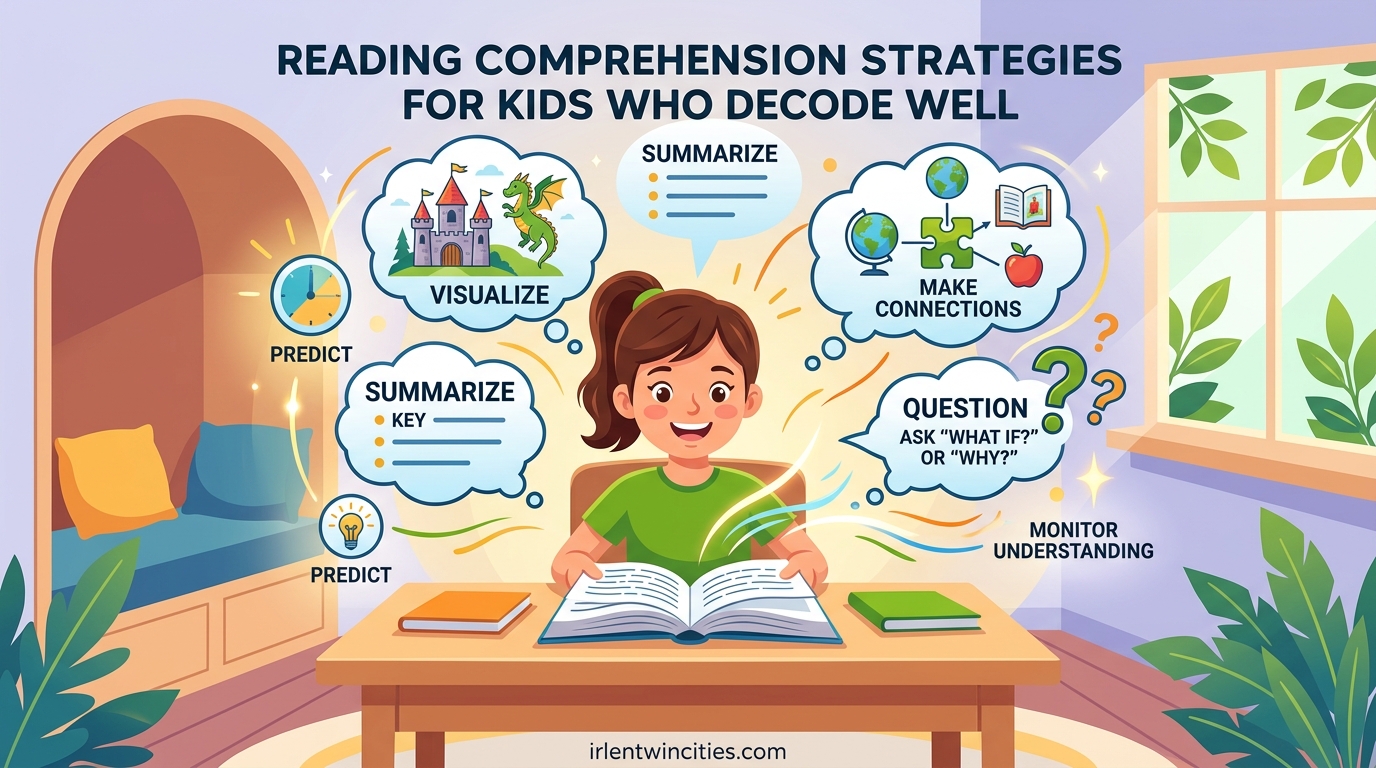
You sit beside your child as they breeze through a chapter book, words flowing smoothly with perfect expression and pacing. Then you ask, “So, what just happened in the story?” Silence. A blank stare. Maybe a shrug. If this scenario sounds familiar, you are dealing with one of reading instruction’s most frustrating phenomena: the fluent decoder who struggles with comprehension. Reading comprehension strategies for kids who decode well address this specific gap that leaves parents and teachers equally puzzled.
I have worked with dozens of families facing this exact challenge over the past eight years. These children can read aloud beautifully, often scoring well on fluency assessments. They pronounce multisyllabic words correctly, read with appropriate phrasing, and never stumble over difficult vocabulary. Yet when asked to retell what they read, answer questions, or connect ideas across paragraphs, they falter.
The good news? This is fixable. The strategies in this guide target the specific needs of fluent decoders who need to build better comprehension. You will learn evidence-based techniques that bridge the gap between word recognition and understanding. Whether you are a parent helping with homework or a teacher differentiating instruction, these approaches work.
Table of Contents
Understanding the Decode-Comprehension Gap
Before diving into solutions, we need to understand the problem. Reading involves two distinct but interconnected processes: decoding (recognizing words) and comprehension (making meaning). For many children, decoding instruction happens first and intensely. They learn phonics, sight words, and word attack strategies. By third or fourth grade, many can decode grade-level text accurately and fluently.
Comprehension instruction, however, often receives less focused attention. Teachers assume that if a child reads fluently, understanding follows naturally. Research from the National Reading Panel consistently shows this is not true. Fluent decoding does not guarantee comprehension. Some children become skilled word callers without developing the mental habits that create meaning from text.
Why Fluent Decoders Fall Through the Cracks
Children who decode well often avoid detection in classroom settings. They volunteer to read aloud, impressing teachers with their smooth delivery. They complete reading assignments quickly because they do not struggle with word recognition. On standardized tests, their fluency scores may be strong even when comprehension scores lag behind.
These students may be labeled as careless, inattentive, or unmotivated when they fail to answer comprehension questions correctly. The real issue? They never developed the active reading strategies that transform text into understanding. They are reading without thinking, a habit that becomes harder to break the longer it continues.
Signs Your Child Is a Fluent Decoder with Comprehension Struggles
How do you know if this describes your child or student? Look for these patterns. They read aloud with appropriate expression and pacing but cannot summarize what they read. They answer comprehension questions with vague responses or direct quotes from the text without understanding. They struggle to make predictions or connections to prior knowledge.
Other indicators include avoiding discussions about books, preferring to reread familiar simple texts over challenging new material, and having difficulty identifying main ideas versus supporting details. They may also struggle with inference questions that require reading between the lines.
The Science Behind the Gap
Reading scientists explain this phenomenon through the Simple View of Reading, which states that reading comprehension equals decoding multiplied by language comprehension. If either factor is weak, overall comprehension suffers. Fluent decoders have the first component locked in. Their weakness lies in language comprehension, specifically the metacognitive strategies needed to construct meaning from text.
The brain has limited cognitive resources. When children first learn to read, decoding demands significant attention. As decoding becomes automatic, cognitive resources should free up for comprehension. For fluent decoders who still struggle, this transfer never fully happened. They continue focusing on word-level processing rather than meaning-making.
Reading Comprehension Strategies for Kids Who Decode Well
Now we move to the core strategies. These approaches specifically target the needs of fluent decoders who must shift from word-focused reading to meaning-focused reading. Each strategy builds the mental habits that create deep comprehension.
Monitoring Comprehension: The Foundation Strategy
The first and most critical strategy is teaching children to monitor their own comprehension. This means recognizing when understanding breaks down and knowing what to do about it. Fluent decoders often keep reading even when they have lost the thread of meaning. They have learned to prioritize accuracy and speed over understanding.
Start by explicitly teaching the concept that good readers stop when they are confused. Model this with think-alouds. Read a passage aloud, then pause and say, “Wait, I am not sure what just happened. Let me reread that paragraph.” Demonstrate specific fix-up strategies: rereading confusing sections, reading ahead to see if context clarifies, or looking up unknown vocabulary.
Create a simple checklist card that children can keep in their books. When they feel lost, they check the card and choose a strategy: reread, read on, look for clues, or ask for help. This makes the invisible process of monitoring visible and actionable. Practice this during shared reading time until it becomes automatic.
One teacher I worked with implemented a “comprehension check” routine. Every few pages, students place a sticky note where understanding wavered. They write a quick note about what confused them and which fix-up strategy they used. This simple practice increased comprehension scores by 23% in her classroom over one semester.
Metacognition: Getting Kids to Think About Thinking
Metacognition sounds complicated, but for reading it simply means thinking about your own thinking. Fluent decoders who struggle with comprehension often read passively, letting words wash over them without active mental engagement. Metacognitive strategies wake up the brain during reading.
Begin with basic awareness questions. Before reading, ask: “What do I already know about this topic? What do I want to learn?” During reading, prompt: “What am I picturing in my mind? Does this make sense with what I read before?” After reading, reflect: “What was the most important thing I learned? What questions do I still have?”
Encourage children to verbalize their thought processes. When you read together, pause periodically and ask, “What are you thinking right now?” Do not accept “nothing” as an answer. If they truly have no thoughts, model your own. “I am wondering why the character made that choice. I am predicting that something bad will happen next. I am connecting this to that time we went camping.”
Over time, these questions become internalized. The child who once read passively now has a running mental dialogue with the text. They question, predict, visualize, and connect automatically. This is the hallmark of a skilled comprehender.
Questioning Strategies Using the QAR Framework
The Question-Answer Relationship framework teaches children to recognize different types of questions and where to find answers. This is powerful for fluent decoders who tend to treat all questions the same way, often resulting in incorrect responses or frustrated guessing.
QAR identifies four question types. Right There questions have answers explicitly stated in the text, usually in one sentence. The words in the question often match words in the text exactly. Teach children to locate the key words from the question and find the matching sentence.
Think and Search questions require readers to gather information from multiple places in the text. The answer is in the text but not in one spot. Readers must synthesize information across paragraphs or pages. Model this by highlighting different sections that together answer the question.
Author and Me questions require readers to use both text information and their own background knowledge. The answer is not explicitly stated. Readers must infer based on text clues plus what they already know. These questions often start with “Why do you think…” or “What caused…”
On My Own questions can be answered without reading the text at all, using only the reader’s prior knowledge and experiences. These build connections but do not assess text comprehension. Distinguishing these from Author and Me questions is crucial. One requires text evidence; the other does not.
Practice QAR by having children categorize questions before answering them. Create cards with different question types and have them sort the questions first, then locate or generate answers. This metacognitive step improves accuracy significantly.
Summarizing: The Ultimate Comprehension Check
If a child can accurately summarize what they read, they comprehend it. Summarizing forces readers to identify main ideas, distinguish important from unimportant details, and synthesize information concisely. For fluent decoders who have been getting by on surface reading, summarizing reveals the gaps in their understanding.
Start with simple frameworks. The “Somebody Wanted But So Then” structure works well for fiction. Somebody (character) Wanted (goal) But (problem) So (solution) Then (resolution). This five-part summary captures the essential story elements without overwhelming young readers.
For nonfiction, teach the main idea and supporting details format. The main idea answers “What is this mostly about?” Supporting details answer “What proves or explains the main idea?” Use graphic organizers with a central box for the main idea and surrounding boxes for details.
Avoid common summarizing mistakes. Some children simply retell every detail in order, creating long, unfocused summaries. Others provide only their opinion or reaction without including text content. The goal is a brief, accurate representation of the most important information from the passage.
Practice summarizing after every reading session, even for short passages. Start with paragraphs before moving to full chapters. Oral summarizing works as well as written for building comprehension skills. The act of putting the reading into one’s own words strengthens memory and understanding.
Graphic Organizers: Visualizing Understanding
Graphic organizers transform abstract text into visual representations, making relationships and structures concrete. For fluent decoders who process words sequentially without seeing the bigger picture, organizers provide a framework for understanding how pieces fit together.
Story maps help with fiction comprehension. A basic story map includes setting, characters, problem, events, and resolution. As children read, they fill in each section. This prevents the common problem of finishing a book without being able to identify the main conflict or explain how it was resolved.
For nonfiction, use text structure organizers. Cause and effect organizers have boxes for causes leading to effects. Compare and contrast organizers use Venn diagrams or T-charts. Problem and solution organizers separate the issue from attempted solutions. Sequence organizers show steps in order.
Introduce organizers gradually. Start by completing them together after reading. As familiarity grows, transition to filling in sections during reading. Eventually, children can select the appropriate organizer for the text structure and complete it independently.
One parent reported that her fourth-grade son, who could read Harry Potter fluently but could not answer basic questions about the plot, transformed his comprehension within weeks using story maps. The visual structure helped him attend to story elements he had been ignoring while focused on word-level reading.
Text Structure Recognition
Understanding text structure gives readers a roadmap for comprehension. Fiction and nonfiction follow predictable patterns. When children recognize these patterns, they know what to expect and what to look for while reading. This is especially helpful for fluent decoders who have been reading words without grasping overall organization.
Fiction typically follows story grammar structure: setting, characters, initiating event, internal response, attempt, consequence, and reaction. Teach these elements explicitly. When children know to expect these components, they read with purpose, actively seeking character motivations and plot developments.
Nonfiction uses several common structures. Cause and effect explains why something happened. Signal words include “because,” “since,” “as a result,” and “therefore.” Compare and contrast shows similarities and differences using “similarly,” “however,” “in contrast,” and “unlike.” Problem and solution presents an issue and resolution with “problem,” “issue,” “solution,” and “solved.”
Teach children to hunt for signal words that reveal structure. Create anchor charts listing common signal words for each structure. When children spot these words, they know what organizational pattern the author is using. This predicts what information will come next and how ideas relate to each other.
Practice by having children identify the structure before reading. Provide short passages and ask them to name the structure and highlight signal words. This pre-reading analysis prepares the brain to receive information in the appropriate framework.
Before, During, and After Reading Framework
Effective comprehension instruction happens at three stages: before reading, during reading, and after reading. Each stage has specific purposes and strategies. Fluent decoders who struggle often skip the before and after stages entirely, diving into text without preparation and moving to the next text without reflection.
Before Reading: Setting the Stage
Pre-reading activities activate prior knowledge and establish purpose. Before opening the book, discuss the title and cover. What do you think this will be about? What do you already know about this topic? Preview headings, pictures, and text features to build a framework for incoming information.
Set a purpose for reading. Are we reading to learn specific facts? To enjoy a story? To answer particular questions? Purpose guides attention, helping readers know what to focus on and what to remember. Fluent decoders who have been reading without purpose benefit enormously from this simple step.
Make predictions based on previewing. What might happen in this story? What questions do you have about this topic? Predictions create curiosity and investment in finding answers. They also provide a check for comprehension as predictions are confirmed or revised during reading.
During Reading: Active Engagement
During reading, the goal is maintaining active mental engagement. This is where monitoring comprehension, using graphic organizers, and applying fix-up strategies come into play. Encourage children to pause periodically and check understanding. They should be asking themselves questions, making connections, and adjusting predictions.
For younger children or those new to active reading, use sticky notes as comprehension checkpoints. Place a sticky note every few pages. When they reach each marker, they pause and tell one important thing that happened or one question they have. This breaks reading into manageable chunks with built-in reflection.
Model think-alouds regularly. Share what is happening in your mind as you read. “I am picturing this scene like a movie. I am wondering if the main character will make the right choice. This reminds me of another book I read.” Verbalizing these processes teaches children what internal dialogue during reading sounds like.
After Reading: Consolidation and Reflection
After reading, comprehension solidifies through discussion and summarization. Ask for a retelling or summary using the frameworks described earlier. Discuss answers to questions posed before reading. Were predictions correct? What new information was learned?
Extend comprehension through response activities. Drawing a scene from the story, writing a letter to a character, or connecting the text to personal experience deepens understanding. These activities require children to process and transform the reading, moving beyond simple recall to true comprehension.
Reflect on the reading process itself. What was easy? What was confusing? What strategies helped? This metacognitive reflection builds awareness of effective reading habits and prepares children to apply successful strategies to future reading.
Parent Tips: Helping at Home
Parents often feel helpless when their child reads beautifully but understands little. The good news is that home support makes a significant difference. You do not need teaching credentials to implement these strategies effectively.
Start by choosing the right books. Select material at the upper edge of your child’s comprehension ability, not their decoding ability. If they can decode fifth-grade text but comprehend at a third-grade level, choose third-grade books for comprehension practice. Gradually increase complexity as comprehension improves.
Read together daily. Take turns reading aloud or read the same book independently then discuss. The key is conversation about the text. Ask questions that require thinking, not just memory. “Why did the character do that?” beats “What color was the car?” every time.
Use your child’s interests as leverage. One parent shared that her son, obsessed with space, finally engaged with comprehension when she used space-themed nonfiction. The motivation to learn about a favorite topic drove him to attend to meaning in ways he never had with school-assigned books.
Make comprehension visible. Use graphic organizers at the kitchen table. Create simple story maps on paper. Draw pictures of what you are both imagining as you read. These concrete activities make abstract comprehension processes tangible and teachable.
Be patient and persistent. Changing reading habits takes time. A child who has spent years focusing only on word accuracy will not become a deep comprehender overnight. Celebrate small improvements. Notice and comment when your child uses a strategy successfully. Positive reinforcement builds confidence and motivation.
Teacher Tips: Classroom Application
Classroom teachers face the challenge of differentiating instruction for fluent decoders who need comprehension support while also serving struggling decoders. Several approaches work well in mixed-ability settings.
Small group comprehension instruction allows targeted strategy teaching. Group fluent decoders together for focused comprehension work while other groups receive decoding support. All groups benefit from appropriate challenge levels.
Explicit strategy instruction, where teachers name the strategy, model it, provide guided practice, and then independent practice, works better than implicit exposure. Do not assume that good readers will pick up strategies naturally. Teach them directly, step by step.
Think-alouds are powerful modeling tools. Regularly verbalize your thinking process while reading aloud to the class. Explain what you are doing and why. Over time, students internalize these thought patterns and apply them during independent reading.
Peer discussions build comprehension through social interaction. Literature circles, book clubs, and partner reading provide opportunities for children to articulate their understanding and hear others’ perspectives. Explaining thinking to peers often clarifies understanding for the speaker.
Assessment should match the focus of instruction. For fluent decoders, assess comprehension separately from fluency. Use retelling rubrics, comprehension questioning, and written responses to gauge understanding accurately. Do not assume strong fluency indicates strong comprehension.
Age-Specific Adaptations
Comprehension strategies apply across age groups but require age-appropriate implementation. Younger children need more concrete, scaffolded approaches. Older children can handle abstract concepts and independent application.
For ages 6-8, focus on basic monitoring and simple graphic organizers. Use picture-based story maps. Practice oral summarizing with sentence starters. “This story was about… The problem was… The characters solved it by…” Keep sessions short and highly interactive.
For ages 9-11, introduce QAR questioning, complex graphic organizers, and independent summarizing. Teach text structure recognition explicitly. Encourage written responses and deeper discussions about author purpose, theme, and inference.
For ages 12 and up, focus on metacognitive reflection and strategy selection. Help students identify which strategies work best for different text types and purposes. Teach study skills that build on comprehension foundations. Address increasingly complex text structures and vocabulary.
Frequently Asked Questions
What are the 7 most frequently used strategies for reading text comprehension?
The seven most commonly taught comprehension strategies are: 1) Monitoring comprehension, 2) Using metacognition, 3) Using graphic and semantic organizers, 4) Answering questions, 5) Generating questions, 6) Recognizing story structure, and 7) Summarizing. These evidence-based strategies form the foundation of most effective comprehension instruction programs.
Why can my child read fluently but not understand?
This is called the decode-comprehension gap. Your child has developed automatic word recognition skills but has not yet built the mental habits that create meaning from text. The brain can only focus on so much at once. When children first learn to read, decoding demands most of their attention. As decoding becomes automatic, cognitive resources should shift to comprehension. For some children, this shift does not happen naturally and requires explicit teaching of comprehension strategies.
What is the 3 2 1 comprehension strategy?
The 3-2-1 strategy is a simple after-reading activity where students record: 3 things they learned, 2 things they found interesting, and 1 question they still have. This strategy works well for nonfiction texts and helps students consolidate learning while identifying gaps in understanding. It also provides teachers and parents with insight into what the child actually comprehended from the reading.
How do I teach reading comprehension at home?
Start by reading together daily and asking thinking questions rather than memory questions. Use graphic organizers like story maps to make comprehension visible. Practice summarizing after each reading session. Model your own thinking with think-alouds. Choose books at your child’s comprehension level, not their decoding level. Be patient and celebrate small improvements as your child builds new mental habits.
What are the super 6 comprehension strategies?
The Super 6 comprehension strategies are: predicting, questioning, monitoring, visualizing, inferring, and summarizing. These six strategies represent the core active reading processes that skilled readers use automatically. Teaching these strategies explicitly helps struggling comprehenders develop the mental habits that create meaning from text.
How long does it take to see improvement in comprehension?
With consistent practice using evidence-based strategies, most children show noticeable improvement within 6-12 weeks. However, building deep comprehension habits is a gradual process that continues over years. Early improvements may appear in specific contexts or with particular strategy use. Generalization across all reading situations typically takes several months of sustained practice. The key is consistency and patience.
Conclusion: Reading Comprehension Strategies for Kids Who Decode Well
The fluent decoder who struggles with comprehension represents one of reading education’s hidden challenges. These children often escape early detection because their word-reading skills mask underlying comprehension weaknesses. Left unaddressed, the gap between decoding and understanding widens over time, creating frustrated readers who abandon books as academic demands increase.
The strategies in this guide offer a path forward. Monitoring comprehension, building metacognition, using the QAR framework, summarizing, graphic organizers, and text structure instruction provide the mental tools these children need. When taught explicitly and practiced consistently, these approaches transform word callers into thoughtful readers who engage deeply with text.
Parents and teachers play equally important roles in this transformation. Home support reinforces classroom instruction. Patient, persistent application of these strategies creates new reading habits that last a lifetime. The child who once read beautifully without understanding can become the reader who not only decodes fluently but also thinks deeply, questions actively, and comprehends fully.
Start with one strategy. Monitor comprehension is the foundation. Add others as your child or student becomes comfortable. Celebrate small victories along the way. The journey from decoding to deep comprehension is worth every step.