
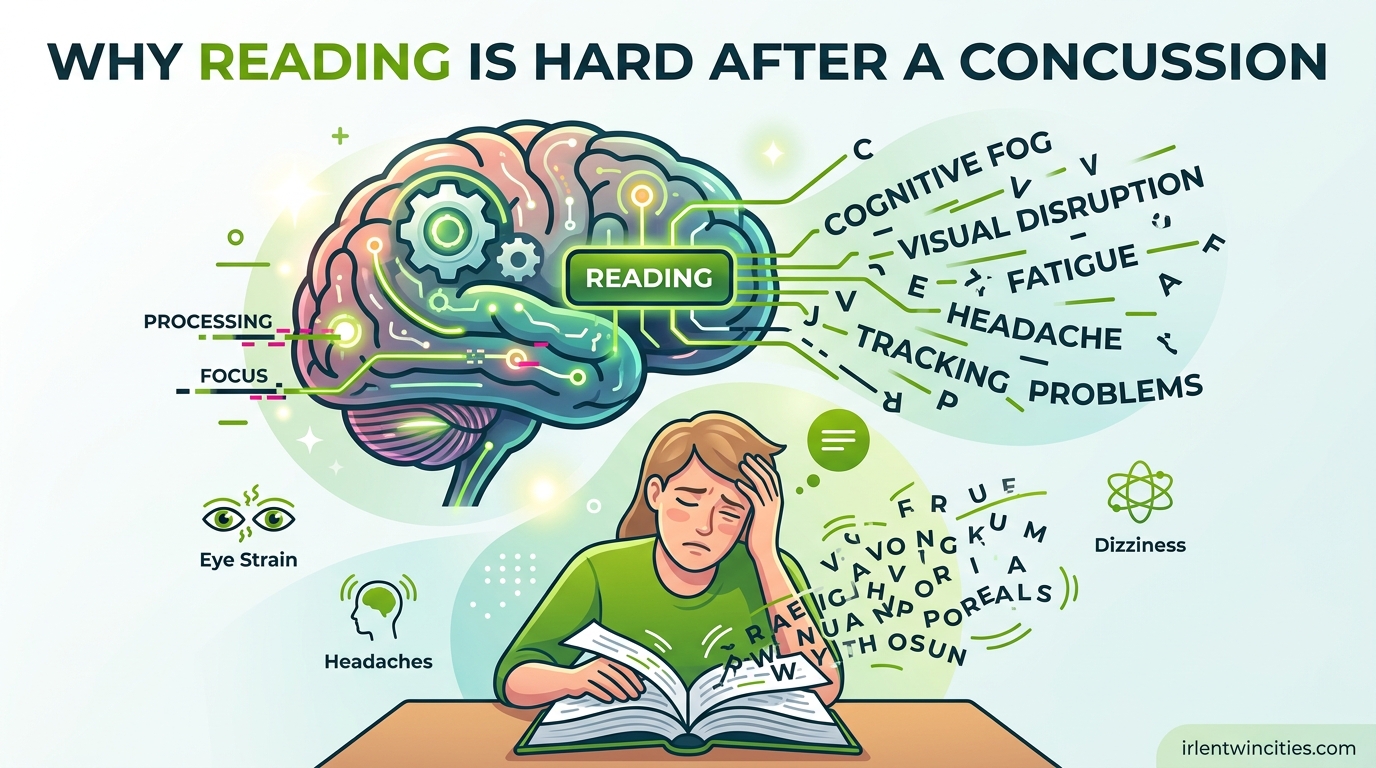
Reading becomes hard after a concussion because the brain injury disrupts the neural pathways that control your eye movements, visual processing, and cognitive stamina. Your eyes might look fine to a standard optometrist, yet the connection between what your eyes see and how your brain interprets it has been damaged. Understanding why this happens is the first step toward finding strategies that actually work for your recovery.
In this guide, I will explain the four main reasons reading becomes difficult after a head injury. You will learn about oculomotor dysfunction, focusing problems, visual processing changes, and cognitive fatigue. More importantly, you will discover practical strategies that have helped countless concussion survivors return to reading comfortably.
Table of Contents
How Concussion Disrupts Your Eye Movements
Your brain controls six tiny muscles around each eye that work together to track text across a page. These coordinated movements are called saccades when you jump from word to word, and pursuits when you smoothly follow a moving line. A concussion can damage the neural pathways that coordinate these precise movements.
When these pathways are disrupted, your eyes may not land exactly where your brain intends. You might find yourself skipping lines, re-reading the same sentence multiple times, or losing your place after just two lines of text. This is not a problem with your eye muscles themselves, but with the brain signals telling them where to move.
Many concussion survivors describe the sensation of words swimming or jumping on the page. Others report that their eyes feel disconnected from their brain, as if they are watching their own eyes move but cannot control them smoothly. These are classic signs of oculomotor dysfunction, one of the most common yet underdiagnosed post-concussion symptoms.
The frustration is compounded when standard eye exams come back normal. Your eye doctor might say your vision is perfect because the test only measures eye health, not the brain-eye coordination that reading requires. This disconnect between test results and real-world symptoms leaves many patients feeling dismissed or questioning whether their difficulties are real.
Focusing Problems: Convergence and Accommodation
Reading requires your eyes to work together as a team, converging inward to focus on text held at arm’s length or closer. This ability, called convergence, often becomes impaired after concussion. When your eyes cannot converge properly, you may experience double vision, eye strain, or the sensation of your eyes pulling apart when you try to read.
Another critical focusing skill is accommodation, which allows your eyes to shift focus between near and far objects smoothly. After a concussion, this reflex can become sluggish or inaccurate. You might notice that text goes blurry after reading for a few minutes, or that it takes several seconds for your eyes to clear when you look up from your book.
These focusing problems create a cascade of symptoms. Headaches often develop within minutes of starting to read. Your eyes may burn, water, or feel excessively tired. Some people describe feeling cross-eyed or report that their eyes physically hurt when they try to concentrate on text. These are not signs of weakness or lack of effort, they are physiological responses to damaged neural control systems.
The technical term for these combined issues is convergence insufficiency and accommodative dysfunction. Studies show these conditions affect up to 50% of concussion patients, yet many never receive proper diagnosis because standard eye exams do not test for these functional problems. Your eyes can be perfectly healthy while still being unable to perform the complex teamwork that reading demands.
Visual Processing Changes in the Brain
Even when your eyes successfully capture visual information, your brain must process that data to create meaning. After a concussion, the areas of your brain responsible for visual processing may work slower or less efficiently. This creates a bottleneck where information from your eyes arrives faster than your brain can interpret it.
Visual processing after concussion often involves heightened sensitivity to light, motion, and contrast. Screens feel overwhelming within minutes because the flickering backlight, bright colors, and rapid scrolling demand more processing power than your injured brain can supply. Many survivors report that paper books feel easier than screens because the visual load is lower, though both can trigger symptoms.
Another common issue is visual overstimulation. Busy pages with small fonts, tight line spacing, or cluttered layouts require more cognitive resources to parse. Your brain may struggle to filter out background visual noise and focus on the text itself. This explains why many concussion survivors prefer simple layouts with plenty of white space and larger text sizes.
The connection between your visual system and your vestibular system (balance and spatial orientation) also plays a role. When these systems are not communicating properly, reading can trigger dizziness, nausea, or a sense of motion sickness. You might feel like the room is moving while you try to keep your eyes on the page, making sustained reading nearly impossible.
Cognitive Effects: Attention, Memory, and Fatigue
Reading is not just a visual task, it is a complex cognitive activity that requires sustained attention, working memory, and mental stamina. After a concussion, your brain operates with reduced cognitive reserve. The mental effort required to track text, process meaning, and retain information can exhaust your limited resources within minutes.
Attention difficulties are particularly frustrating for former avid readers. You might find yourself reading the same paragraph three times without absorbing any meaning. Your mind wanders more easily, or you might feel unable to filter out background noise and distractions that never bothered you before. This is not a lack of interest in your book, it is a symptom of impaired attentional control.
Working memory challenges also impact reading comprehension. You may struggle to hold the beginning of a sentence in mind while reading to the end, making complex sentences feel impossible to parse. Following a plot line across multiple chapters or remembering character names from page to page can feel like mental gymnastics. These difficulties often improve as your brain heals, but they can persist for months.
Cognitive fatigue is perhaps the most universal post-concussion reading symptom. Your brain simply tires faster than it did before injury. What once felt effortless now requires conscious effort and drains your energy reserves. This fatigue is real and physiological, not a sign of laziness or lack of willpower. Pushing through it often backfires, triggering headaches, symptom flares, and longer recovery times.
Eye Problems vs Brain Processing Problems
One of the most confusing aspects of post-concussion reading difficulties is understanding why standard eye exams often come back normal. Your eyes themselves, the physical organs, are likely perfectly healthy. The problem lies in the brain’s control of those eyes and the processing of visual information.
A standard eye exam tests visual acuity (how clearly you see), eye pressure, and basic eye health. It does not typically assess how well your eyes work together, how smoothly they track moving objects, or how quickly they shift focus between distances. These functional vision skills are what reading requires, and they are controlled by neural pathways that can be damaged by concussion.
If your regular eye doctor says everything looks fine but you still cannot read comfortably, consider seeing a neuro-optometrist or a doctor specializing in neuro-optometric rehabilitation. These specialists perform comprehensive evaluations that test eye teaming, tracking, focusing, and visual processing. They understand that vision is a neurological function, not just an optical one.
Distinguishing between eye problems and brain processing problems matters because the treatments differ. Glasses or contact lenses will not fix oculomotor dysfunction or visual processing delays. Vision therapy, specialized lenses, and targeted rehabilitation exercises address the neurological aspects of post-concussion vision problems. Getting the right diagnosis leads to the right treatment.
Practical Strategies for Reading After Concussion
While your brain heals, you can implement practical strategies that make reading more manageable. These accommodations reduce the visual and cognitive load, allowing you to engage with text without triggering symptoms.
The 20-20-20 Rule
The 20-20-20 rule is a simple but powerful technique for managing visual fatigue. Every 20 minutes of reading, look at something 20 feet away for 20 seconds. This gives your eye muscles a chance to relax and reset, reducing the strain that builds up during sustained near work.
To implement this rule effectively, set a timer on your phone or use a visual cue like finishing a page. The key is consistency, even if you feel fine at the 20-minute mark. Preventing fatigue is easier than recovering from it. Some survivors find they need shorter intervals initially, such as 10-10-10, gradually working up to the full 20-20-20 as they recover.
Environmental Modifications
Lighting plays a crucial role in reading comfort after concussion. Natural, indirect light is usually best. Avoid harsh overhead fluorescents or reading in dim conditions. Position light sources to minimize glare on pages or screens. Some survivors benefit from colored overlays or tinted glasses that reduce light sensitivity and visual stress.
For screen reading, adjust your display settings aggressively. Reduce brightness to the minimum comfortable level. Increase text size significantly, many concussion survivors find 150% to 200% zoom necessary in the early stages. Use dark mode or high contrast settings. Position your screen at arm’s length and slightly below eye level to reduce neck strain.
Reading Techniques and Pacing
Change how you read to match your current capacity. Start with shorter materials, articles instead of novels, or children’s books if necessary. There is no shame in adjusting your reading level to your recovery stage. Use a bookmark or ruler to keep your place and reduce the visual scanning required to find the next line.
Take breaks before you feel symptoms starting. Once headaches, eye strain, or dizziness begin, you have already pushed too far. Rest is part of the recovery process, not a delay from it. Some survivors use audio books as a bridge, getting the content without the visual demand, though some find audio processing similarly challenging early in recovery.
Assistive Tools and Technologies
Consider tools designed to reduce visual strain. Blue light filtering glasses or software can help with screen tolerance. Text-to-speech software allows you to listen while following along visually, sharing the cognitive load between auditory and visual processing. Physical page markers, line guides, or tinted overlays can make paper reading more manageable.
Experiment with different formats. Some survivors find e-readers with e-ink displays easier than backlit tablets or phones. Others prefer paper books with specific font types and sizes. Large print books, widely available at libraries, can be a game-changer during recovery. The right format can mean the difference between reading five minutes and reading thirty.
When to Seek Professional Help
Certain warning signs indicate that your reading difficulties require professional evaluation. If symptoms persist beyond two to four weeks after your concussion, or if they are severely impacting your work, school, or daily life, it is time to seek specialized care. Do not wait for symptoms to resolve on their own if they are significantly limiting your activities.
Seek immediate evaluation if you experience double vision that does not resolve with rest, severe headaches triggered by minimal visual tasks, or episodes where your vision goes completely blurry or dark. These symptoms may indicate more serious issues requiring prompt attention. Trust your instincts, if something feels wrong beyond normal post-concussion symptoms, get it checked.
The right specialists make a difference. Look for a neuro-optometrist, a developmental optometrist, or a vision therapy practice. Some occupational therapists also specialize in visual rehabilitation. Ask potential providers specifically about their experience with post-concussion vision problems. General practitioners and standard eye doctors may not have the training to diagnose or treat these functional vision issues.
Treatment options vary based on your specific deficits. Vision therapy involves exercises to retrain eye movements and coordination. Specialized prism lenses or tints can reduce symptoms during daily activities. Computer-based visual training programs provide structured rehabilitation. In some cases, medication for associated symptoms like migraines may help indirectly. A comprehensive evaluation determines which approaches will benefit you most.
How Long Do Reading Problems Last After Concussion
Recovery timelines vary widely among concussion survivors. For many people, reading difficulties improve significantly within the first two to six weeks as acute symptoms resolve. During this acute phase, rest and gradual return to visual activities usually lead to steady improvement.
For others, reading problems persist for months or even years. Post-concussion syndrome, defined as symptoms lasting beyond three months, affects a significant minority of patients. If you are months or years past your concussion and still struggling with reading, you are not alone, and your symptoms are real. Many forum discussions reveal survivors four years post-injury who still cannot read for more than two minutes without symptoms.
Several factors influence how long reading problems last. The severity of the initial injury matters, though even mild concussions can cause persistent symptoms. History of previous concussions increases risk for longer recovery. Age, overall health, sleep quality, and stress levels all play roles. Early intervention with appropriate rehabilitation can sometimes shorten recovery time.
The good news is that even long-standing reading difficulties often respond to proper treatment. Vision therapy and neuro-optometric rehabilitation have helped patients years after their initial injury. Your brain maintains neuroplasticity, the ability to form new neural connections, throughout life. Targeted exercises can retrain damaged pathways and restore functional reading ability, even when months of rest have not helped.
Frequently Asked Questions
Can concussion make it harder to read?
Yes, concussion commonly makes reading significantly harder. The brain injury disrupts oculomotor function, the neural control of eye movements, and can cause convergence insufficiency where eyes do not team properly. Many survivors lose their place after just a few lines, experience double vision, or develop severe headaches within minutes of reading. These symptoms affect up to 50% of concussion patients.
How long does it take your brain to fully heal from a concussion?
Most concussion symptoms resolve within two to four weeks for mild injuries. However, reading problems and other symptoms can persist for months or years in cases of post-concussion syndrome. Recovery timelines vary based on injury severity, history of previous concussions, age, sleep quality, and access to rehabilitation. There is no single timeline that applies to everyone.
Is reading good for concussion recovery?
Reading can support recovery when done in moderation and with proper pacing. Gradual return to cognitive activities helps the brain heal, but pushing too hard too fast can trigger symptoms and delay recovery. The key is finding the right balance, short reading sessions with frequent breaks, stopping before symptoms worsen, and gradually increasing duration as tolerance improves.
Is it okay to read while recovering from a concussion?
Yes, reading is generally okay during concussion recovery if you follow the 20-20-20 rule and respect your symptom limits. Start with very short sessions, five to ten minutes, and increase gradually. Stop immediately if you develop headaches, dizziness, or significant fatigue. Some doctors recommend complete cognitive rest for the first 24 to 48 hours, then gradual reintroduction of light reading.
What is the 20 20 20 rule for concussions?
The 20-20-20 rule helps manage visual fatigue after concussion. Every 20 minutes of reading or screen time, look at something 20 feet away for 20 seconds. This relaxes eye muscles and reduces strain. Set a timer to stay consistent, and consider starting with shorter intervals like 10-10-10 if 20 minutes feels too long initially.
Is it normal to not be able to read after a concussion?
Yes, being unable to read after concussion is a common and normal symptom. Many survivors cannot read for more than a few minutes without headaches, eye strain, or losing their place. While distressing, especially for avid readers, this symptom usually improves with time and appropriate treatment. If reading remains impossible after several weeks, consult a neuro-optometrist for evaluation.
Understanding Why Reading Is Hard After a Concussion
Reading difficulties after concussion stem from a combination of oculomotor dysfunction, focusing problems, visual processing delays, and cognitive fatigue. Your eyes and brain are trying to perform a complex coordination task with damaged neural pathways. The frustration you feel is valid, and the symptoms are real, even when standard tests come back normal.
If you are struggling to read after a head injury, know that you are not alone. Many survivors lose their place after two lines, find screens overwhelming within minutes, and face skepticism when eye exams show normal results. These experiences are shared by thousands of concussion patients navigating the same challenges.
The path forward involves understanding your specific deficits, implementing practical strategies like the 20-20-20 rule, and seeking specialized help when needed. Recovery may take weeks, months, or longer, but improvement is possible. Your brain can heal, and with the right support, reading can become enjoyable again. Start with small steps, be patient with your progress, and remember that rest is part of healing, not a delay from it.