
Watching your child struggle with reading and writing can be heartbreaking. You might wonder if the difficulties they are experiencing are just part of normal development or something more serious. If your second or third grader seems to be falling behind their peers, it is worth understanding the specific signs of dyslexia at these critical grade levels.
Dyslexia affects between 5 and 10 percent of children, making it one of the most common learning differences. The good news is that when we catch it early and provide the right support, children with dyslexia can thrive academically and develop strong self-esteem. This guide walks you through exactly what to look for in second and third grade, what steps to take, and how to advocate for your child.
Table of Contents
What Is Dyslexia?
Dyslexia is a language-based learning disability that affects how the brain processes written and spoken language. It is not a matter of intelligence. Children with dyslexia often have average or above-average intelligence, but their brains process language differently, which creates challenges with reading, spelling, and writing.
At its core, dyslexia involves difficulties with phonological processing. This means breaking words into sounds and connecting those sounds to letters. When this skill does not develop automatically, reading becomes slow and labored. Instead of recognizing words instantly, children with dyslexia must sound out each word letter by letter, which slows comprehension dramatically.
Many people mistakenly believe dyslexia means reading letters backward or writing them in reverse order. While letter reversals can occur, they are not the defining characteristic. Dyslexia is really about the underlying language processing system, not visual perception of letters.
Signs of Dyslexia in Second Grade
Second grade is often when dyslexia becomes more apparent. The curriculum shifts from learning to read toward reading to learn. Children who struggled with basic decoding now face the challenge of understanding what they read while still fighting with the mechanics of reading itself.
Reading Difficulties
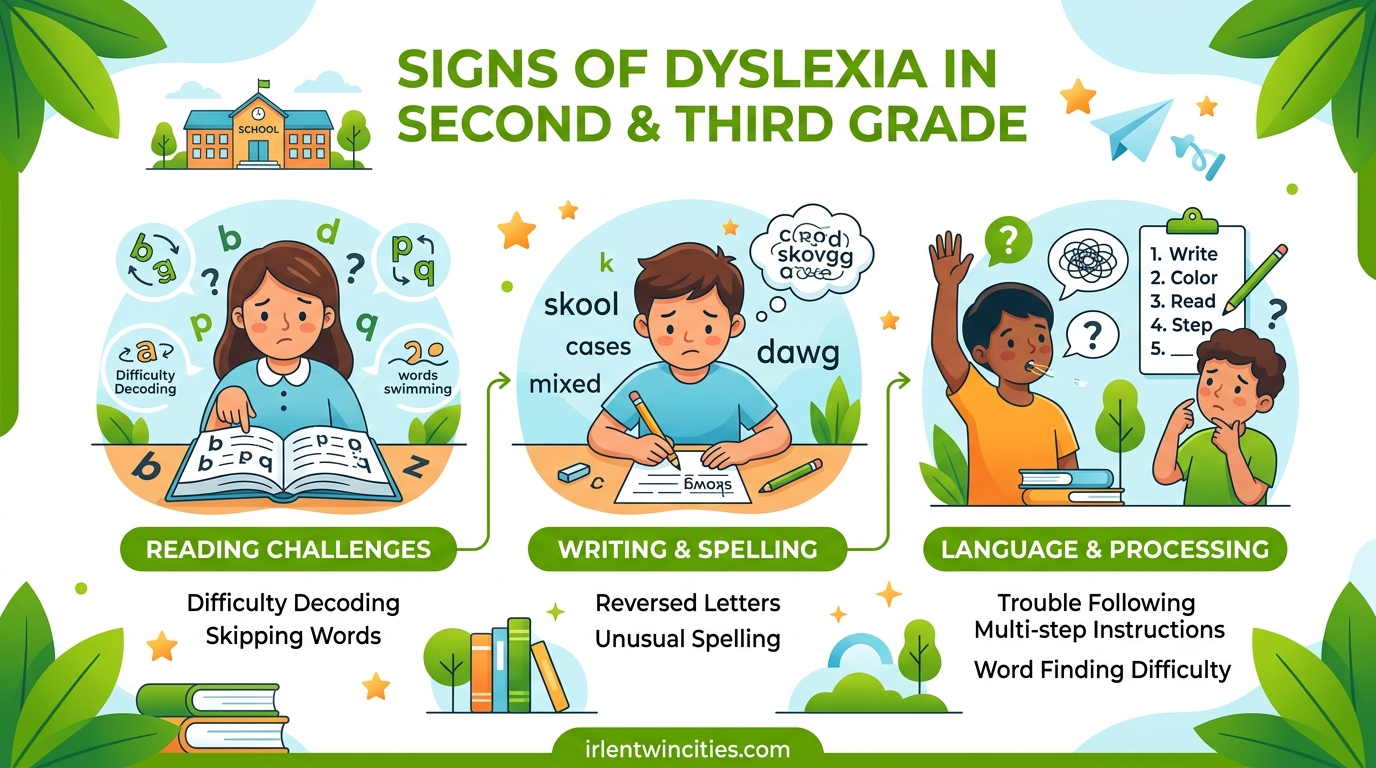
Second graders with dyslexia often show significant struggles with decoding unfamiliar words. They may rely heavily on guessing rather than sounding out words systematically. You might notice your child reads the same word correctly on one page only to struggle with the same word a few pages later.
Slow, labored reading is another hallmark. Your child might read much more slowly than classmates, struggling to blend sounds together. They often skip small words like “the,” “of,” or “and” when reading aloud. Sight word recognition is typically weak, meaning common words that should be recognized instantly still require effort.
Many second graders with dyslexia have difficulty with phonemic awareness tasks. They struggle to identify sounds in words, to blend sounds into words, or to segment words into individual sounds. This weakness makes phonics instruction feel overwhelming rather than helpful.
Writing Challenges
Spelling problems become more pronounced in second grade. Children may consistently miss common short-vowel words and struggle to remember spelling patterns. Letter reversals may persist longer than typical, including confusing letters like b and d, p and q, or m and w.
Handwriting often looks unusual. Children with dyslexia may hold their pencil in an awkward grip and have trouble forming letters consistently. Writing sentences feels extremely difficult because they must simultaneously think about spelling, grammar, and content while their working memory is already strained by the language processing demands.
Speaking and Oral Language Issues
Oral language difficulties often surprise parents. Your child might have a rich vocabulary for speaking but struggle to find the right word when needed. This word-finding difficulty shows up as pausing mid-sentence or substituting similar-sounding words.
Confusing similar-sounding words is common. Your child might say “spaghetti” when they mean “spaghetti” but struggle to keep similar words straight. Following multi-step verbal directions remains challenging, and your child might ask for repetition or only follow part of a set of instructions.
Signs of Dyslexia in Third Grade
Third grade is widely recognized as a critical turning point. Academic demands increase significantly, with less time for reading instruction and more expectation that children can read independently to learn other subjects. This is when gaps become harder to ignore.
Reading Difficulties
Third graders with dyslexia often read the same sentence multiple times and still cannot explain what it said. This re-reading behavior is a coping strategy, but it signals that the reading process is not building comprehension. Word guessing becomes more entrenched, with children frequently guessing wrong words that make sentences incoherent.
Reading fluency remains significantly below grade level. Your child might still sound out words that classmates read automatically. Text reading lacks expression and sounds choppy rather than smooth. Many third graders with dyslexia avoid reading whenever possible because it has become so effortful and unpleasant.
Decoding multi-syllable words is particularly difficult. Children may successfully sound out simple words but fall apart when encountering longer words in science or social studies texts. This puts them at a disadvantage across all subjects, not just language arts.
Writing Challenges
Spelling remains inconsistent and below grade level. Your third grader may still struggle with basic words that peers spell correctly. Writing assignments feel overwhelming because generating text while simultaneously monitoring spelling, grammar, and handwriting exceeds their processing capacity.
Written compositions are typically much shorter than classmates. Getting ideas down feels like an uphill battle when basic transcription skills are still automatic. Your child might have strong ideas but cannot get them onto paper, leading to frustration and avoidance.
Letter formation issues may persist, and handwriting often looks cramped or unusual. The physical act of writing competes with the cognitive demands of generating content, leaving little mental bandwidth for higher-level thinking.
Speaking and Oral Language Issues
Semantic errors become more noticeable. Your child might say a word that is related to but not exactly the intended word, such as calling a “lion” a “tiger” or a “sofa” a “chair.” These are not random mistakes but indicate underlying difficulty with word retrieval and language organization.
Word-finding difficulties persist and may worsen under pressure. When asked questions in class or expected to answer quickly, third graders with dyslexia may freeze or give answers that are close but not quite right. They often know the material but cannot access it verbally in the moment.
Confusing similar-sounding words continues, and your child might struggle to understand jokes, idioms, or sarcasm that rely on language nuance. This can create social difficulties as peers use language in ways that are hard for your child to follow.
Distinguishing Dyslexia from Other Issues
Not every reading difficulty indicates dyslexia. Some children simply develop reading skills more slowly but will catch up with time and continued instruction. The key difference is that dyslexia involves a neurological difference in how the brain processes language, not just a developmental delay.
Children who are slow readers but can understand what they read when it is read to them may not have dyslexia. The distinguishing factor is whether decoding is the bottleneck. If your child comprehends material well when listened to but struggles to decode independently, dyslexia is likely involved.
Irlen Syndrome: Commonly Mistaken for Dyslexia
Irlen Syndrome, also called Scotopic Sensitivity Syndrome, is a visual processing issue that can be mistaken for dyslexia. Children with Irlen Syndrome experience difficulty with reading due to how their brain interprets visual information, particularly with certain colors and contrasts.
Signs that might indicate Irlen Syndrome rather than pure dyslexia include complaints about light sensitivity, eyestrain when reading, difficulty tracking across a line of text, and words appearing to move or blur. Some children with dyslexia also have Irlen Syndrome, making professional evaluation important to identify all contributing factors.
ADHD and Other Considerations
ADHD can co-occur with dyslexia, and separating the two can be challenging. Both conditions can cause difficulty with focus and academic performance. However, ADHD primarily affects attention and executive function, while dyslexia specifically impacts language processing skills.
If your child shows attention difficulties primarily but reads reasonably well when they focus, ADHD might be the primary issue. When reading difficulties persist even during high-interest activities and include the specific language processing signs described above, dyslexia is more likely the cause.
Social and Emotional Impacts
Academic struggles take an emotional toll on second and third graders with dyslexia. By this age, children compare themselves to peers and notice when they are falling behind. Your child might express frustration, anxiety, or helplessness about schoolwork that seems to come easily to others.
Avoidance behaviors often develop as children learn that reading and writing lead to frustration. Your child might pretend to be sick on reading days, claim to have finished homework when it is incomplete, or resist sitting down to read. These behaviors are survival strategies, not laziness or defiance.
Self-esteem suffers when children believe they are simply not smart enough. Even intelligent children with dyslexia internalize failure and may stop trying in affected areas. Parents often report that their child says things like “I am stupid” or “I can’t do schoolwork” despite showing strength in other areas like art, music, or spatial reasoning.
Building on strengths is essential for emotional health. Children with dyslexia often excel in areas requiring visual-spatial thinking, creativity, or hands-on learning. Focusing on these strengths helps maintain confidence and motivation while they work through academic challenges.
What to Expect During Dyslexia Evaluation
If you suspect dyslexia, a comprehensive evaluation is the next logical step. This typically involves a child psychologist, school psychologist, or reading specialist who has training in diagnosing learning differences.
Evaluation components usually include tests of phonological awareness, rapid naming (quickly naming letters or numbers), decoding skills, word recognition, spelling ability, and reading fluency. The evaluator will also assess comprehension to determine whether your child understands language despite reading difficulties.
Expect the evaluation process to take several hours spread across multiple sessions. The assessor will gather information from parents and teachers to understand how your child functions in different settings. This comprehensive approach helps identify not just whether dyslexia is present but also how it affects your child’s learning and what supports would be most helpful.
Results are typically shared in a detailed report that explains your child’s strengths and challenges, provides specific diagnoses if appropriate, and includes recommendations for classroom accommodations, intervention services, and strategies to support learning at home.
Next Steps for Parents
If you notice signs of dyslexia in your second or third grader, starting the conversation with your child’s teacher is often the first step. Prepare specific examples of what you observe at home, and ask for the teacher’s perspective on classroom performance. Many schools have reading specialists who can conduct preliminary screenings.
Requesting a formal school evaluation is your right under federal law. If the school agrees that evaluation is warranted, they must evaluate within a reasonable timeframe (typically 60 days in many states). You can also seek private evaluation if you want additional assessment or if the school evaluation process seems too slow.
At home, creating a supportive environment matters enormously. Reading aloud to your child keeps them exposed to rich language and content without the frustration of decoding. Playing language games that build phonemic awareness helps without making reading feel like punishment. Most importantly, affirming your child’s worth independent of academic performance helps them maintain a healthy self-image.
Join a parent network or support group if possible. Connecting with other parents facing similar challenges provides practical advice and emotional support. Many communities have dyslexia associations that offer resources, events, and advocacy training.
Frequently Asked Questions
What does dyslexia look like in a 3rd grader?
Third graders with dyslexia typically read slowly and laboriously, often guessing at words rather than sounding them out. They may read the same sentence multiple times without understanding it. Written work is often short and misspelled, with difficulty getting ideas on paper. They might confuse similar-sounding words and struggle with word-finding under pressure.
How do I know if my 2nd grader is dyslexic?
Look for slow, labored reading, heavy reliance on guessing words, and difficulty with sight words. Second graders with dyslexia often struggle to blend sounds together when sounding out words, skip small words when reading aloud, and have spelling that falls below grade level. Letter reversals persisting beyond typical ages, difficulty following verbal directions, and struggles with phonemic awareness tasks are also common warning signs.
What age does dyslexia start to show?
Dyslexia typically becomes noticeable when children begin formal reading instruction, usually around kindergarten or first grade. However, signs can appear as early as preschool through difficulties with rhyming, letter learning, or oral language development. In second and third grade, the demands of reading to learn often make dyslexia more apparent as gaps widen between struggling readers and typically developing peers.
What is commonly mistaken for dyslexia?
Irlen Syndrome, also called Scotopic Sensitivity Syndrome, is frequently mistaken for dyslexia because it also causes reading difficulties. Unlike dyslexia, Irlen Syndrome involves visual processing issues where certain colors or contrasts cause words to appear to move or blur. Some children have both conditions. ADHD is also commonly confused with or co-occurs alongside dyslexia. Slow reading development without underlying language processing issues can sometimes be mistaken for dyslexia, though the causes differ.
How is dyslexia diagnosed in elementary school?
Dyslexia is diagnosed through comprehensive evaluation by a qualified professional such as a child psychologist, school psychologist, or educational diagnostician. The evaluation includes tests of phonological awareness, rapid naming, decoding ability, word recognition, spelling, fluency, and reading comprehension. The evaluator also gathers information from parents and teachers about classroom performance and behavior. A formal diagnosis typically results in a detailed report with recommendations for support and accommodations.
What school supports exist for dyslexic students?
Schools must provide appropriate interventions and accommodations under federal law ( IDEA and Section 504). Common supports include specialized reading instruction (such as Orton-Gillingham or Wilson programs), extended time on reading tasks, audiobook access instead of solely printed text, reduced reading assignments, assistive technology like text-to-speech software, preferential seating, and written directions provided verbally. The specific supports should be based on your child evaluation results and outlined in an Individualized Education Program (IEP) or 504 Plan.
Final Thoughts
Recognizing signs of dyslexia in second and third grade is a gift you give your child. The earlier we identify these challenges, the sooner we can provide targeted support that prevents years of frustration and lost confidence. If something feels wrong to you, trust your instincts and seek answers.
Your child is not lazy, unintelligent, or unwilling to try. They have a brain that processes language differently, which creates real obstacles but also real strengths. With the right identification, appropriate instruction, and supportive environment, children with dyslexia can become confident readers, successful students, and capable adults.
The path forward begins with awareness and action. You have already taken the first step by reading this guide. The next step is reaching out to your child’s teacher, requesting an evaluation, or seeking professional guidance. Your child deserves the support that comes from understanding their learning profile, and you have the power to make that happen.