
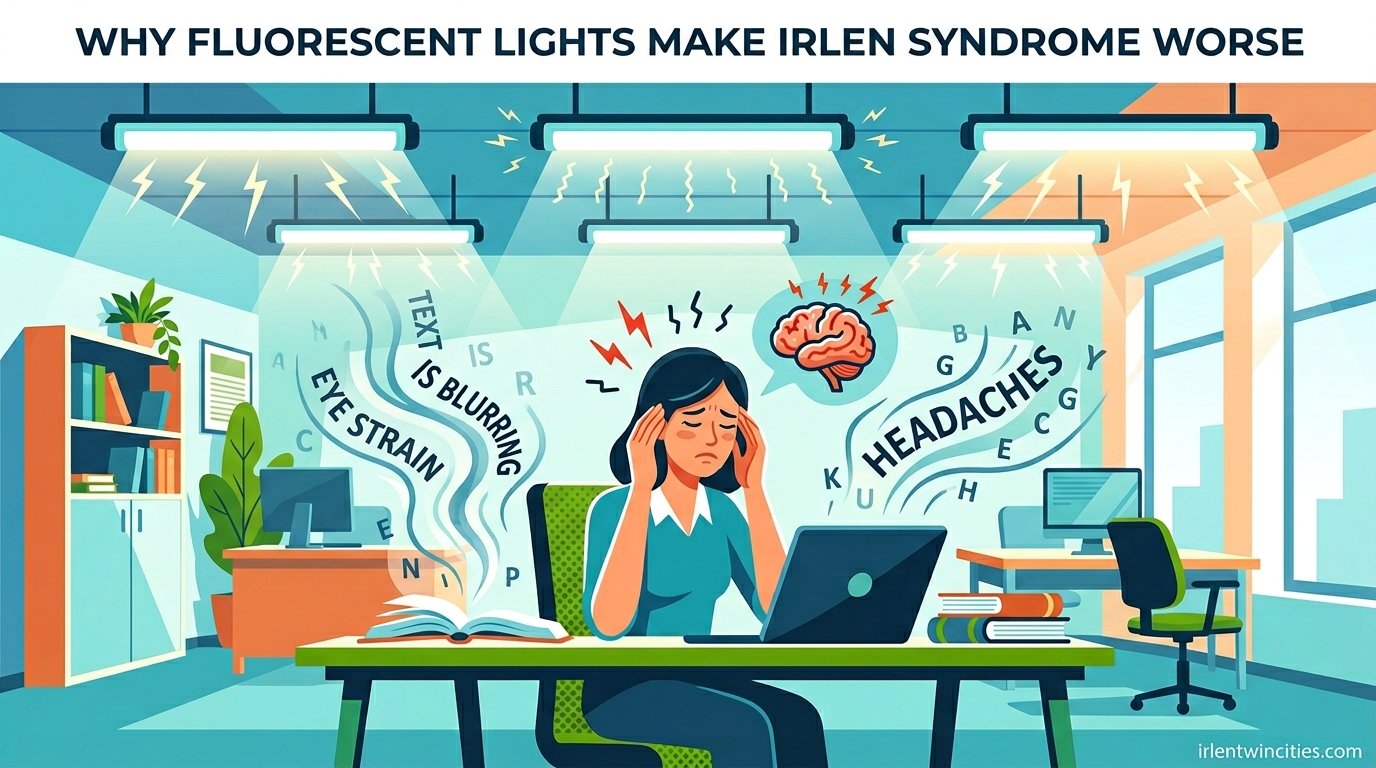
Fluorescent lights make Irlen Syndrome worse because they emit an uneven light spectrum with intense peaks of blue and green light, combined with an invisible flicker that overwhelms the brain’s visual processing system. For people with Irlen Syndrome, also known as Scotopic Sensitivity Syndrome, this creates a perfect storm of visual stress that triggers headaches, eye strain, brain fog, and reading difficulties. Understanding why this happens is the first step toward finding relief.
Our team has worked with hundreds of individuals struggling with fluorescent light sensitivity, and the stories are remarkably consistent. People describe walking into grocery stores and feeling instantly drained, sitting in fluorescent-lit classrooms and watching letters swim on the page, or leaving offices with pounding headaches they cannot explain. These are not random symptoms. They are the predictable response of a perceptual processing disorder meeting a particularly hostile light source.
Approximately 12 to 14 percent of the general population lives with some degree of Irlen Syndrome, though many have never heard the name for what they are experiencing. Among people with ADHD, autism, or dyslexia, that number jumps to nearly 30 percent. If you have ever wondered why fluorescent lights make you feel terrible while others seem unaffected, this guide will explain the science behind your symptoms and what you can do about it.
Table of Contents
What Is Irlen Syndrome?
Irlen Syndrome is a perceptual processing disorder that affects how your brain interprets visual information. Unlike vision problems that affect the eye itself, Irlen Syndrome originates in the brain and how it processes the wavelengths of light entering your eyes.
When someone has Irlen Syndrome, certain wavelengths of light particularly in the blue and green spectrum trigger overactivity in the brain’s visual cortex. This overactivity creates distortions in how visual information is processed, leading to the physical and cognitive symptoms that make daily activities challenging.
Scotopic Sensitivity: The Technical Name
You may also hear Irlen Syndrome referred to as Scotopic Sensitivity Syndrome. The term scotopic refers to the visual system’s operation under low light conditions, though the condition affects perception across all lighting environments. Research at Cornell University using fMRI imaging has shown that people with Irlen Syndrome experience measurable overactivity in specific brain regions when exposed to certain light wavelengths.
Who Is Affected?
The prevalence statistics might surprise you. Research suggests 12 to 14 percent of the general population has some degree of Irlen Syndrome. That number rises significantly for people with related conditions. Up to 30 percent of individuals with ADHD, autism, or dyslexia also experience Irlen Syndrome symptoms.
Some people develop Irlen Syndrome after head trauma or brain injury. Others have had it their entire lives without realizing that their visual experience differs from what others see. Many assume that everyone sees the world the same way they do, not realizing that the glare, visual distortions, and fatigue they experience are not universal.
Common Co-occurring Conditions
Irlen Syndrome frequently exists alongside other neurodevelopmental and neurological conditions. In our practice, we regularly see clients who also have ADHD, autism spectrum disorder, dyslexia, or chronic migraines. The connection is not coincidental. These conditions often share underlying neurological differences in sensory processing.
People with ADHD and autism frequently report heightened sensitivity to sensory input across all modalities. Adding fluorescent light sensitivity to that existing sensory load can create significant daily challenges. Similarly, the visual stress from Irlen Syndrome can trigger or worsen migraine episodes in susceptible individuals.
Why Fluorescent Lights Make Irlen Syndrome Worse
Fluorescent lighting creates three distinct problems for people with Irlen Syndrome, each compounding the others to produce the symptoms that make fluorescent environments so challenging to navigate.
The Uneven Light Spectrum
Natural sunlight provides a relatively smooth distribution of light across the visible spectrum. Fluorescent lights, by contrast, emit light in spikes. Rather than a gradual curve of wavelengths, fluorescent bulbs produce intense peaks at specific points, particularly in the blue and green portions of the spectrum.
These spectral peaks hit exactly the wavelengths that trigger overactivity in the brains of people with Irlen Syndrome. Where natural light allows the visual system to operate normally, the uneven distribution from fluorescent tubes bombards the brain with problematic wavelengths at higher intensities than the visual processing system can comfortably handle.
One of our clients described it perfectly: sunlight feels like a gentle wave, but fluorescent light feels like being pelted with tiny stones. The uneven spectrum creates visual noise that the brain must constantly work to filter out, leading to the fatigue and brain fog that so many people report.
The Invisible Flicker
Perhaps the most insidious aspect of fluorescent lighting is its flicker rate. Fluorescent bulbs operate by exciting mercury vapor with electricity, which produces ultraviolet light that then causes a phosphor coating inside the tube to glow. This process inherently flickers, typically at 60 to 120 times per second depending on the ballast type.
While this flicker is too fast for most people to consciously perceive, the brain registers it. Research has shown that even at these high frequencies, the visual system responds to the rapid fluctuations in light output. For people with Irlen Syndrome, whose visual processing is already compromised, this constant flicker forces the brain to work overtime trying to maintain a stable visual image.
The result is the cognitive exhaustion that forum users frequently describe. One Reddit user shared that fluorescent lights in grocery stores caused them to feel tired and have difficulty thinking. Another noted that they experience brain fog and fatigue on hazy but bright days, with fluorescent lighting producing similar effects. These are textbook descriptions of the flicker effect in action.
Concentrated Blue Light
Fluorescent lights emit a disproportionate amount of blue light compared to natural light sources. Blue light has higher energy per photon than other visible wavelengths, and it penetrates deeper into the eye. For people with Irlen Syndrome, this blue light concentration is particularly problematic.
Blue light scatters more easily in the eye, creating additional glare and visual noise. It also plays a significant role in regulating circadian rhythms and alertness. The high blue content in fluorescent lighting can disrupt normal visual processing while simultaneously affecting mood and energy levels in ways that compound the perceptual symptoms.
Modern LED lighting shares this blue light problem, which explains why many people with Irlen Syndrome find both fluorescent and LED lights challenging. Some clients report that poorly designed cheap LED lights are actually worse than fluorescents, creating an additional challenge as the world transitions away from fluorescent technology.
What Happens in the Brain
When someone with Irlen Syndrome encounters fluorescent light, the brain’s visual processing pathways become overactive. fMRI studies have documented this overactivity in the visual cortex, parietal lobe, and temporal lobe during visual tasks under problematic lighting conditions.
This overactivity represents the brain struggling to interpret visual input correctly. The uneven spectrum, flicker, and blue light create conflicting signals that the brain cannot resolve efficiently. Instead of processing visual information automatically, the brain enters a state of continuous compensatory activity, trying to filter distortions and maintain stable perception.
The energy cost of this constant compensation is substantial. It explains why people with Irlen Syndrome experience such profound fatigue after relatively short periods in fluorescent environments. The brain is essentially running a marathon while trying to accomplish normal visual tasks, leaving few cognitive resources for other activities.
Symptoms You May Experience Under Fluorescent Lights
The symptoms of fluorescent light sensitivity vary from person to person, but certain patterns appear consistently. Based on our clinical experience and the forum discussions we reviewed, here are the most commonly reported symptoms.
Headaches and migraines rank among the most frequent complaints. Many people describe a specific type of headache that begins shortly after entering a fluorescent-lit space and often resolves soon after leaving. For those prone to migraines, fluorescent lighting can be a significant trigger.
Eye strain is nearly universal among people with Irlen Syndrome exposed to fluorescent lights. Eyes may feel tired, dry, or irritated. Some people experience burning sensations or the sensation that their eyes are working unusually hard to focus.
Brain fog and cognitive difficulties are frequently described. People report difficulty thinking, concentrating, or processing information. Reading becomes challenging, and even simple tasks feel mentally exhausting. The forum user who described fluorescent lights making them feel weird and cognitively impaired captured this experience accurately.
Visual distortions are a hallmark symptom of Irlen Syndrome. Text may appear to move, swim, or shimmer on the page. Letters might blur together or develop halos. Some people see rivers of white running through printed text or experience depth perception issues where flat surfaces appear to move or tilt.
Physical fatigue often accompanies cognitive symptoms. Many people describe feeling drained or exhausted after time in fluorescent environments, even if they have not engaged in physical activity. This fatigue can persist for hours after leaving the problematic lighting.
Anxiety and irritability are emotional symptoms that frequently accompany the physical ones. The constant visual stress creates a background state of tension that can manifest as anxiety in fluorescent-lit spaces. Some children with Irlen Syndrome become hyperactive or disruptive under fluorescent lights as a response to the sensory discomfort.
Comparing Different Types of Artificial Light
Not all artificial lighting affects Irlen Syndrome equally. Understanding the differences can help you make better choices about your environment and advocate for appropriate accommodations.
Fluorescent Lighting
Traditional fluorescent tubes and compact fluorescent bulbs present the combination of problems described above: uneven spectrum, invisible flicker, and high blue light content. Full-spectrum fluorescent bulbs marketed as more natural may reduce some symptoms but typically do not eliminate the flicker issue entirely.
LED Lighting
LED technology has largely replaced fluorescent lighting in new installations, but the transition is not universally positive for people with Irlen Syndrome. LEDs can flicker at various frequencies depending on their driver circuitry, and cheap or poorly designed LED fixtures may produce more problematic flicker than quality fluorescents.
However, quality LED lighting with proper drivers and warmer color temperatures can be significantly better than fluorescent. The key factors are the absence of flicker and a more balanced spectrum with reduced blue light output.
Incandescent Lighting
Traditional incandescent bulbs produce light by heating a filament until it glows, creating a continuous spectrum similar to natural light. They do not flicker at problematic frequencies and produce relatively little blue light compared to fluorescent or LED sources.
For many people with Irlen Syndrome, incandescent lighting is the most comfortable artificial light source. The gradual phase-out of incandescent bulbs in favor of more energy-efficient alternatives has created genuine challenges for people with light sensitivity.
Solutions and Treatments
While fluorescent lighting will not disappear overnight, effective treatments can dramatically reduce or eliminate symptoms. Our practice focuses on solutions that address the underlying perceptual processing problem rather than just managing symptoms.
Colored Overlays
Colored transparent overlays placed over reading material can reduce visual stress immediately. By filtering out specific wavelengths of light before they reach the eye, overlays calm the overactivity in the brain’s visual processing centers. One forum user reported that a pink overlay improved their reading speed by 25 percent and dramatically improved reading fluidity.
Overlays are an excellent starting point because they are inexpensive and non-invasive. They allow you to test whether color filtering helps your symptoms before investing in more permanent solutions.
Irlen Spectral Filters
Irlen Spectral Filters are precision-tinted lenses worn as glasses or contact lenses. Unlike generic tinted glasses, these filters are customized to each individual’s specific wavelength sensitivity through a detailed diagnostic process. The precise tint blocks the exact wavelengths that trigger your visual processing difficulties.
Most people require a unique combination of colors to achieve optimal results. The diagnostic process involves testing multiple color combinations under controlled conditions to identify the precise tint that eliminates distortions and reduces symptoms.
Environmental Modifications
Practical environmental changes can reduce exposure to problematic lighting. Where possible, request seating away from direct fluorescent fixtures. Use desk lamps with incandescent or warm-toned LED bulbs for task lighting. Consider using a hat or visor indoors to block overhead light from entering your visual field directly.
Some workplaces and schools allow the installation of fluorescent light filters or covers that modify the spectrum and reduce flicker. These covers can transform fluorescent-lit spaces into more comfortable environments for people with Irlen Syndrome.
Getting Tested
Proper diagnosis is essential for effective treatment. Irlen Syndrome cannot be detected through standard eye exams because it is not a vision problem. Specialized testing by a certified Irlen diagnostician identifies the specific wavelengths causing your symptoms and determines the optimal treatment approach.
Testing typically takes one to two hours and involves examining your visual responses under various lighting conditions and with different colored filters. The results provide a clear understanding of your condition and a customized treatment plan.
Practical Tips for Managing Fluorescent Light Exposure
Until you can implement permanent solutions, these practical strategies can help you navigate fluorescent-lit environments more comfortably.
Take regular breaks from fluorescent lighting when possible. Even brief periods in natural light or dimmer environments can give your visual system a chance to recover. If you work in a fluorescent-lit office, try to step outside or into a different lighting environment during lunch breaks.
Use peripheral vision rather than direct gaze when moving through fluorescent spaces. Looking slightly to the side of your path reduces the intensity of light hitting the most sensitive part of your retina. This technique takes practice but can significantly reduce symptoms.
Wear a brimmed hat or visor indoors to block overhead fluorescent light from entering your eyes directly. This simple modification can make a surprising difference in comfort levels, particularly in environments like grocery stores where multiple fixtures create intense overhead lighting.
Prioritize natural light exposure when possible. Morning sunlight helps regulate your visual system and can improve tolerance to artificial lighting throughout the day. Position yourself near windows when available.
Consider using apps that adjust screen color temperature on computers and devices. While not a complete solution, reducing blue light from screens can help compensate for the blue light exposure from overhead fluorescent lighting.
Frequently Asked Questions
What are three symptoms of fluorescent light sensitivity?
The three most common symptoms of fluorescent light sensitivity are headaches or migraines, eye strain and fatigue, and cognitive difficulties including brain fog and trouble concentrating. Many people also experience visual distortions where text appears to move or blur, and emotional symptoms like irritability or anxiety in fluorescent-lit environments.
Is Irlen linked to ADHD?
Yes, research shows a significant connection between Irlen Syndrome and ADHD. Approximately 30 percent of people with ADHD also have Irlen Syndrome, compared to 12 to 14 percent in the general population. The two conditions share underlying neurological differences in sensory processing, and many people with both conditions find that treating Irlen Syndrome improves their overall functioning.
Can fluorescent lights affect mental health?
Fluorescent lights can affect mental health by triggering anxiety, irritability, and stress in sensitive individuals. The constant visual processing load created by fluorescent lighting puts the brain in a state of overactivity that can manifest as emotional tension. Some people experience significant anxiety specifically in fluorescent environments, and the fatigue caused by visual stress can contribute to feelings of depression or overwhelm.
Can fluorescent lights cause overstimulation?
Yes, fluorescent lights cause overstimulation in people with Irlen Syndrome and other sensory processing differences. The invisible flicker, uneven light spectrum, and high blue light content bombard the visual system with more input than it can comfortably process. This sensory overload forces the brain to work continuously to filter and interpret visual information, leading to the characteristic symptoms of fatigue, brain fog, and visual stress.
Conclusion
Understanding why fluorescent lights make Irlen Syndrome worse empowers you to take control of your visual environment. The combination of uneven light spectrum, invisible flicker, and concentrated blue light creates a perfect storm of visual stress that overwhelms the brain’s processing capabilities. You are not imagining these symptoms, and you are not alone in experiencing them.
Effective treatments exist. From simple colored overlays to precision-tinted Irlen Spectral Filters, solutions can eliminate the symptoms that make fluorescent environments so challenging. If you recognize yourself in the experiences described here, consider scheduling an assessment with a certified Irlen diagnostician. The right treatment can transform fluorescent-lit spaces from sources of pain and fatigue into comfortable environments where you can function at your best.