
If you’ve ever wondered why your child (or you) struggles with attention despite ADHD medication, or why reading feels physically painful even with glasses, you’re not alone. The confusion between Irlen Syndrome and ADHD affects thousands of families, leading to frustration, ineffective treatments, and unnecessary struggles in school and work. Understanding how these conditions overlap—and where they differ—can be the key to getting the right help.
Irlen Syndrome and ADHD how the symptoms overlap is a question that deserves serious attention because research suggests up to 30% of people diagnosed with ADHD may actually have Irlen Syndrome instead, or in addition to it. Let me walk you through exactly what you need to know to distinguish between these two conditions and get the right diagnosis.
Table of Contents
Understanding Irlen Syndrome
Irlen Syndrome, also known as Scotopic Sensitivity Syndrome or Meares-Irlen Syndrome, is a perceptual processing disorder affecting how the brain processes visual information. It’s not a problem with your eyes themselves—your vision can be perfectly 20/20—but rather how your brain interprets what those eyes see, especially under certain lighting conditions and with specific visual patterns.
Think of it like this: your brain’s visual processing center becomes overstimulated by particular wavelengths of light and high-contrast patterns. This overstimulation creates physical discomfort, visual distortions, and cognitive difficulties that can mimic attention problems. The key difference? These symptoms are directly triggered by environmental factors like fluorescent lighting, bright sunlight, black text on white paper, or striped patterns.
People with Irlen Syndrome might see words moving on the page, experience headaches after just 15 minutes of reading, or feel completely exhausted in classrooms with fluorescent lights. These aren’t attention problems—they’re visual processing problems that manifest as what looks like inattention or hyperactivity.
Understanding ADHD
Attention Deficit Hyperactivity Disorder (ADHD) is a neurodevelopmental condition affecting the brain’s executive functions, particularly attention regulation and impulse control. Unlike Irlen Syndrome, ADHD isn’t triggered by specific environmental conditions—it’s a constant difference in brain chemistry and structure that affects how a person focuses, organizes tasks, and regulates behavior across all situations.
ADHD symptoms typically fall into three categories: inattention (difficulty sustaining focus, easily distracted, forgetful), hyperactivity (fidgeting, excessive talking, restlessness), and impulsivity (interrupting, difficulty waiting, making hasty decisions). These symptoms exist regardless of lighting conditions, visual stimuli, or reading tasks—they’re part of how the person’s brain operates throughout the day.
Importantly, ADHD is typically diagnosed through comprehensive behavioral evaluations, symptom checklists, and sometimes standardized testing. It’s considered a difference in brain wiring that often responds well to medication, behavioral therapy, and environmental accommodations—but the key is that it’s not visually triggered.
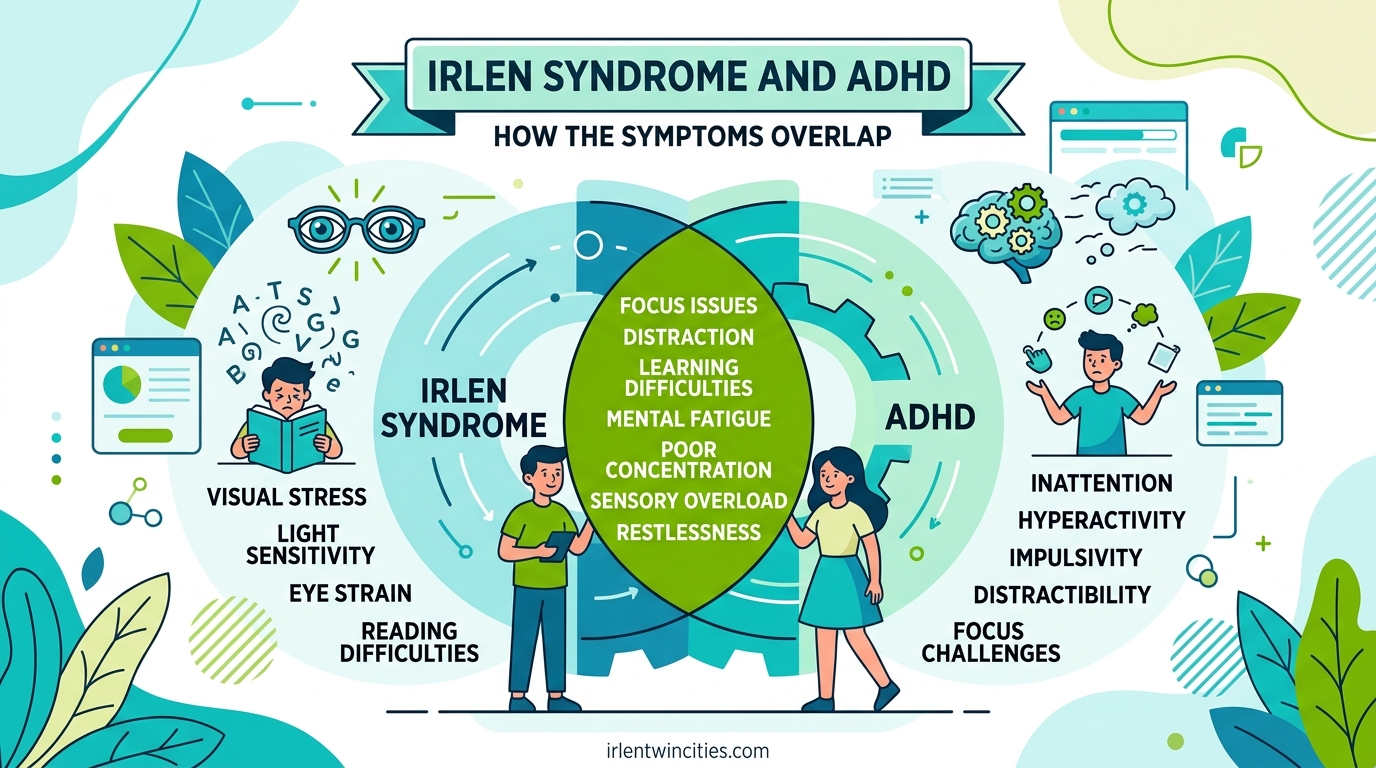
Irlen Syndrome and ADHD: How the Symptoms Overlap
Here’s where things get confusing: both conditions can look remarkably similar from the outside. A child who can’t sit still, avoids reading, loses focus constantly, and struggles academically could have either condition—or both. This overlap explains why misdiagnosis is so common and why getting the right evaluation matters so much.
Let me break down the seven key symptoms that these conditions share:
- Difficulty sustaining attention on tasks – Both conditions can make it hard to stay focused, especially during reading or schoolwork
- Avoidance of reading and close work – Children with either condition often resist homework, reading aloud, or sustained visual tasks
- Restlessness and fidgeting – The discomfort from Irlen or the hyperactivity from ADHD can both manifest as constant movement
- Easily distracted by environment – Both conditions make it hard to filter out irrelevant stimuli and stay on task
- Academic underachievement – Despite normal intelligence, both can lead to poor grades and frustration in school
- Forgetfulness and disorganization – Both conditions affect working memory and task completion
- Emotional regulation difficulties – Frustration from either condition can lead to irritability, low self-esteem, and behavioral issues
The crucial difference lies in WHY these symptoms occur. With Irlen Syndrome, the attention problems stem from physical discomfort and visual processing challenges—the brain is literally overloaded by visual stimuli. With ADHD, the attention problems stem from executive function differences in how the brain regulates focus and impulse control. Same symptoms, completely different root causes.
Research from Australia found that 7 overlapping symptoms appear on standard ADHD diagnostic criteria, making it nearly impossible to distinguish between the conditions based on behavior alone. This is why environmental observation and specialized testing are so critical.
The Critical Differences: What Sets Them Apart
While the behavioral symptoms overlap significantly, several key differences can help you distinguish between Irlen Syndrome and ADHD. Recognizing these differences can guide you toward the right diagnosis and treatment approach.
Environmental Triggers: Irlen Syndrome symptoms are directly triggered by specific visual environments—fluorescent lighting, bright sunlight, high-contrast patterns, and sustained reading. A person with Irlen might function perfectly outdoors or in dim lighting but struggle immensely in a standard classroom. ADHD symptoms remain relatively consistent across environments regardless of lighting or visual patterns.
Physical Symptoms: Irlen Syndrome often causes physical discomfort that ADHD doesn’t—headaches, eye strain, nausea, dizziness, and actual visual distortions (words moving, blurring, or disappearing). People with ADHD don’t typically experience these physical symptoms from reading or visual processing; their struggles are cognitive rather than physically painful.
Medication Response: Perhaps the most telling difference is medication response. Research indicates that up to 50% of people diagnosed with ADHD don’t respond to medication, and many of these non-responders actually have Irlen Syndrome. When ADHD’s a striking pattern: if ADHD medications aren’t helping, it’s worth investigating whether Irlen Syndrome is the real culprit.
Situational Variability: Irlen symptoms fluctuate based on lighting, time of day, and visual demands. A child might focus fine during one-on-one reading in natural light but completely fall apart in a fluorescent-lit classroom. ADHD shows more consistency across situations—the attention struggles persist regardless of environment.
Can You Have Both? Understanding Co-occurrence
Yes, you can absolutely have both Irlen Syndrome and ADHD simultaneously. In fact, research suggests that approximately 70% of people with Irlen Syndrome have co-existing conditions, and ADHD is one of the most common. When both conditions are present, they often compound each other’s effects, making symptoms more severe and treatment more complex.
When both conditions coexist, it’s essential to address both. Irlen treatment alone won’t resolve true ADHD symptoms, and ADHD medication alone won’t fix visual processing problems. People with both conditions typically need a combined approach: colored filters or overlays for Irlen, plus appropriate ADHD treatment strategies.
Interestingly, Israeli research found that specialized diagnostic tools can differentiate between pure ADHD, pure Irlen, and combined cases. These tools measure how attention and visual processing change under different lighting conditions and with various colored filters, helping clinicians understand exactly what they’re treating.
Misdiagnosis: When It Looks Like ADHD But Isn’t
The misdiagnosis rates are concerning. Studies suggest that as many as 30% of people diagnosed with ADHD may actually have only Irlen Syndrome, while another significant portion has both conditions but only the ADHD is recognized. This misdiagnosis has real consequences: unnecessary medication, continued struggles in school, and years of frustration without proper treatment.
Why does this happen? Standard ADHD diagnostic tools don’t screen for visual processing problems. If a child meets the behavioral criteria for ADHD—difficulty focusing, academic struggles, restlessness—they’re often diagnosed without investigating whether visual triggers are causing or contributing to these symptoms. The 50% medication non-response rate should be a major red flag that something else is going on.
Warning signs that ADHD might actually be Irlen Syndrome include: symptoms that worsen dramatically under fluorescent lights, complaints that reading physically hurts, avoidance of bright environments, and no family history of ADHD. If medication isn’t helping, or if symptoms fluctuate based on lighting conditions, it’s time to investigate further.
Getting the Right Diagnosis: Next Steps
If you suspect Irlen Syndrome might be masquerading as ADHD, or if both conditions are present, here’s what to do. First, document symptom patterns across different environments—note when symptoms worsen (fluorescent lights? reading? bright sunlight?) and when they improve. This pattern documentation is incredibly valuable for diagnosis.
Second, seek out an Irlen diagnostician for a comprehensive screening. Irlen testing typically involves assessing visual comfort and processing with various colored overlays and filters, measuring how attention and reading performance change with different visual conditions. Many people find immediate relief during their first diagnostic session.
Third, don’t abandon existing ADHD treatment without medical supervision. If both conditions are present, you’ll likely need both treatments working together. Work with healthcare providers who understand both conditions and can coordinate care appropriately.
Finally, advocate for appropriate accommodations. Whether it’s Irlen, ADHD, or both, schools and workplaces can provide environmental modifications—natural lighting, reduced visual clutter, colored overlays, and extended time for visual tasks. These accommodations make a tremendous difference in daily functioning.
FAQ
Can you have ADHD and Irlen Syndrome?
Yes, you can have both ADHD and Irlen Syndrome simultaneously. Research indicates that approximately 70% of people with Irlen Syndrome have co-existing conditions, and ADHD is among the most common. When both conditions are present, they often compound each other’s effects, making symptoms more severe. Treatment typically requires addressing both conditions: colored filters or overlays for Irlen Syndrome plus appropriate ADHD interventions such as medication, behavioral therapy, or environmental accommodations.
What is the difference between Irlen Syndrome and ADHD?
Irlen Syndrome is a visual processing disorder where the brain overreacts to specific wavelengths of light and visual patterns, causing physical discomfort and attention problems triggered by environmental factors like fluorescent lighting or high-contrast print. ADHD is a neurodevelopmental condition affecting attention regulation and impulse control that remains consistent across all environments. The key difference is that Irlen symptoms are environmentally triggered and often cause physical symptoms (headaches, eye strain, visual distortions), while ADHD symptoms are constant and primarily cognitive rather than physically painful.
Can Irlen Syndrome be misdiagnosed as ADHD?
Yes, research suggests that up to 30% of people diagnosed with ADHD may actually have only Irlen Syndrome. This happens because both conditions share overlapping symptoms like difficulty sustaining attention, avoidance of reading, restlessness, and academic struggles. Standard ADHD diagnostic tools don’t screen for visual processing problems, so the underlying visual triggers are often missed. The key red flag is medication non-response—approximately 50% of people diagnosed with ADHD don’t respond to medication, and many of these non-responders actually have Irlen Syndrome instead of or in addition to ADHD.
Do ADHD medications work for Irlen Syndrome?
No, ADHD medications typically do not work for Irlen Syndrome because the conditions have different underlying causes. ADHD medications target neurotransmitter imbalances in the brain’s attention regulation systems, while Irlen Syndrome involves visual processing problems triggered by specific wavelengths of light. The approximately 50% medication non-response rate in ADHD diagnoses is a major indicator that many people actually have Irlen Syndrome rather than or in addition to ADHD. Irlen Syndrome is treated with colored overlays or spectral filters that alter the light entering the visual system, not with stimulant or non-stimulant medications.
What are the environmental triggers for Irlen Syndrome?
Environmental triggers for Irlen Syndrome include fluorescent lighting (especially in classrooms and offices), bright sunlight, high-contrast patterns (like black text on white paper), striped patterns, glossy paper, and sustained reading or close visual work. These triggers cause the brain’s visual processing center to become overstimulated, leading to physical symptoms like headaches, eye strain, nausea, and dizziness, as well as cognitive symptoms like difficulty concentrating and reading problems. Unlike ADHD, where symptoms remain consistent across environments, Irlen symptoms fluctuate based on lighting conditions and visual demands.
How is Irlen Syndrome diagnosed compared to ADHD?
Irlen Syndrome is diagnosed through specialized screening with colored overlays and filters that assess how visual processing and attention change under different lighting conditions. Testing measures reading speed, comprehension, comfort, and focus with various colors to identify the specific wavelengths that reduce symptoms. ADHD is diagnosed through comprehensive behavioral evaluations, symptom checklists, observations across multiple settings, and sometimes standardized computer tests like T.O.V.A. or CPT-d. Israeli research has developed diagnostic tools that can differentiate between pure ADHD, pure Irlen, and combined cases by measuring attention changes under different lighting and filter conditions.
Can colored filters help with ADHD symptoms?
Colored filters do not treat true ADHD symptoms directly, as ADHD is a neurodevelopmental condition affecting attention regulation rather than a visual processing disorder. However, colored filters can dramatically improve symptoms in people whose attention problems are actually caused by undiagnosed Irlen Syndrome. This creates the appearance that filters help ADHD, when in reality they’re addressing a different condition entirely. For people who have both ADHD and Irlen Syndrome, colored filters can reduce visual stress and improve attention capacity, making other ADHD treatments more effective, but the filters specifically target the Irlen component, not the ADHD itself.
What percentage of people with ADHD also have Irlen Syndrome?
Research indicates that approximately 30% of people diagnosed with ADHD may actually have only Irlen Syndrome instead of ADHD, while another significant percentage (estimated around 15-25%) have both conditions simultaneously. This means that nearly half of all ADHD diagnoses may involve Irlen Syndrome to some degree. Studies show that 70% of people with Irlen Syndrome have co-existing conditions, with ADHD being among the most common. These high co-occurrence rates explain why ADHD medications don’t work for many people and why comprehensive screening for both conditions is essential for accurate diagnosis and effective treatment.
At what age can Irlen Syndrome be diagnosed?
Irlen Syndrome can be diagnosed at any age, from young children through adults. Symptoms often emerge in early elementary school when reading demands increase, but many people aren’t diagnosed until adolescence or adulthood after years of unnecessary struggle. Children as young as 6-7 can undergo Irlen screening, though diagnostic methods are adapted for younger ages. Adults who were never properly diagnosed often experience tremendous relief when they finally discover Irlen Syndrome, as it provides an explanation for lifelong difficulties with reading, attention, and academic performance that never responded to traditional interventions or ADHD treatment.
Do Irlen symptoms change as children get older?
Irlen Syndrome symptoms typically persist throughout life without treatment, though the impact may change as academic and visual demands evolve. Children may initially avoid reading or show behavioral problems in school, while adults often develop coping mechanisms or choose careers that minimize visual stress. Without proper intervention, symptoms don’t spontaneously improve—they may actually worsen with age as visual processing becomes less efficient. However, with appropriate treatment using colored overlays or spectral filters, people of any age can experience significant symptom reduction and improved functioning. The key is accurate diagnosis and consistent use of the prescribed filters.
Conclusion: Understanding the Overlap for Better Outcomes
The confusion between Irlen Syndrome and ADHD how the symptoms overlap has real consequences for millions of people. When visual processing problems are mistaken for attention deficits, people spend years struggling with treatments that don’t address the root cause. But understanding the key differences—environmental triggers, physical symptoms, medication response, and situational variability—can guide you toward the right diagnosis and effective help.
If you recognize yourself or your child in this article, especially if ADHD medications haven’t helped or symptoms fluctuate dramatically based on lighting conditions, consider scheduling an Irlen screening. The difference proper treatment makes can be life-changing. Many people report improvements in reading speed, academic performance, and overall quality of life once their visual processing needs are properly addressed.
Remember, having one condition doesn’t exclude the other—but treating the right condition with the right approach is essential. Whether it’s Irlen, ADHD, or both, understanding what’s really happening is the first step toward getting the help you need.