
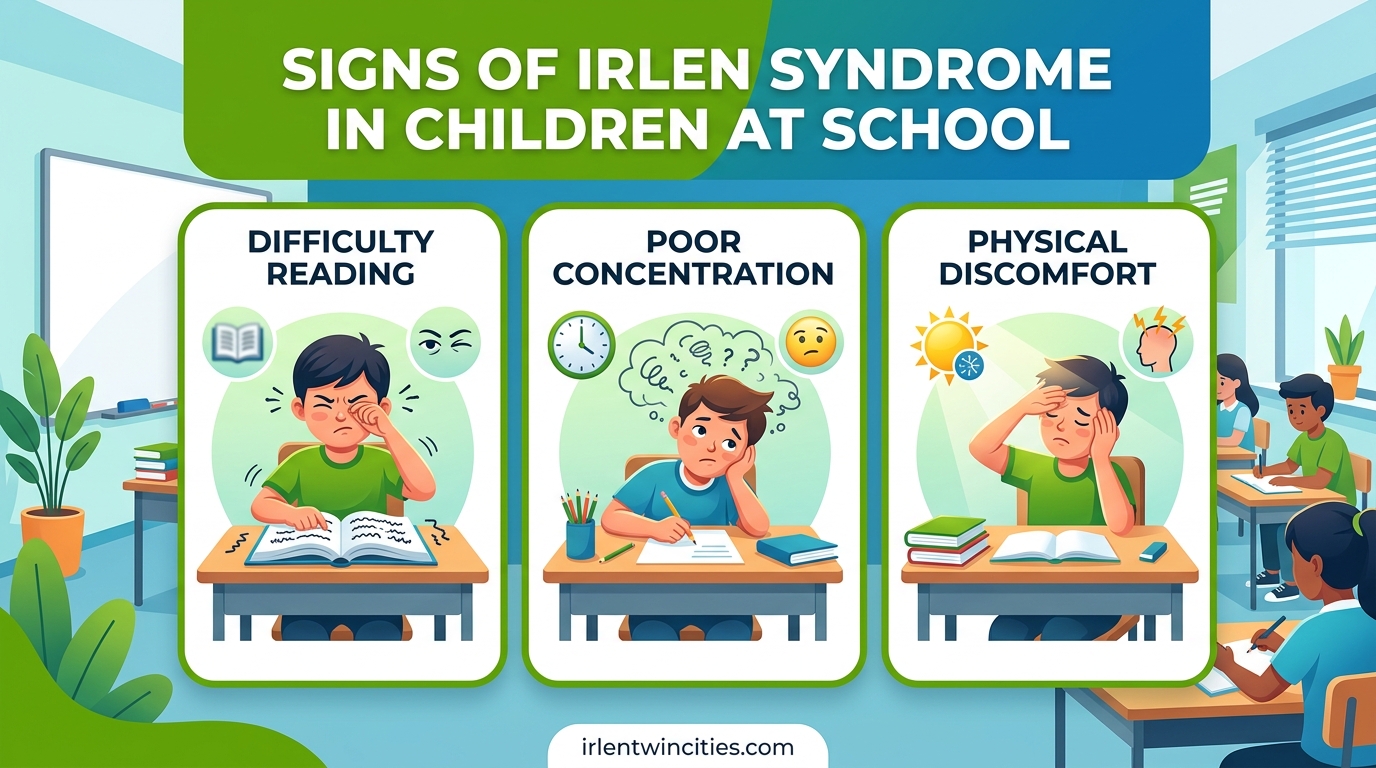
Watching your child struggle with reading and schoolwork can be heartbreaking. You might notice they avoid books, complain about headaches after homework time, or seem exhausted after a full day of classes. These struggles often get labeled as laziness or lack of motivation. But for many children, the real issue is something entirely different: Irlen Syndrome.
Our team has spent years working with families navigating learning difficulties. We have seen firsthand how Irlen Syndrome affects children’s academic performance and self-esteem. This condition is frequently misdiagnosed or overlooked entirely, leaving children without the support they need to succeed.
In this guide, you will learn exactly what signs of Irlen Syndrome look like in the classroom. We will walk through the specific symptoms to watch for at different grade levels. You will also discover how this condition differs from dyslexia and ADHD, and what steps you can take if you suspect your child may be affected.
Table of Contents
What Is Irlen Syndrome?
Irlen Syndrome is a perceptual processing disorder that affects how the brain interprets visual information. When children with this condition look at text, their brain struggles to accurately process what they are seeing. The result is that print can appear distorted, blurry, or like it is moving on the page.
The condition goes by several names. You might hear it called Scotopic Sensitivity Syndrome, Visual Stress, or Meares-Irlen Syndrome. Whatever the label, the underlying issue remains the same: the visual cortex processes information differently, creating distortions that make reading and classroom work physically uncomfortable.
Unlike vision problems that an eye exam can detect, Irlen Syndrome originates in the brain rather than the eyes themselves. This is why many children pass standard vision screenings yet still struggle intensely with reading and written assignments. The brain’s interpretation of visual input is fundamentally different.
We often hear from parents who describe bright, curious children who excel in math, science, and creative thinking but fall apart when faced with reading tasks. This pattern is a hallmark of Irlen Syndrome. Children may be gifted in many areas yet find reading comprehension exhausting and frustrating.
Reading Difficulties at School
Reading problems are often the first sign that alerts parents and teachers to potential Irlen Syndrome. However, these difficulties look different from what you might expect with traditional dyslexia. Understanding the specific patterns can help you identify whether your child is experiencing visual processing issues.
Children with Irlen Syndrome frequently skip words or entire lines while reading. They lose their place on the page constantly, even when reading aloud with guidance. This is called a tracking difficulty, and it happens because the text seems unstable or difficult to follow.
Misreading words is another common symptom. A child might read “was” as “saw” or “could” as “cloud.” These errors go beyond typical developmental mistakes. The letters themselves appear distorted or jumbled, making accurate word recognition nearly impossible.
Reading speed is typically very slow. While peers zip through assignments, children with Irlen Syndrome plod along, often re-reading sentences multiple times because comprehension fails the first pass. This slow reading translates into homework taking much longer than it should.
Many parents in our community describe watching their children grow increasingly frustrated with homework. Sessions that should take thirty minutes stretch to two hours. Children end the day exhausted from the mental effort of simply processing what they see.
Comprehension suffers dramatically when text appears unstable. Even children who understand concepts verbally may fail to grasp what they read because so much cognitive energy goes toward deciphering the words themselves. This creates a painful disconnect between intelligence and academic performance.
Physical Symptoms and Behaviors
Beyond the academic struggles, Irlen Syndrome manifests in very real physical symptoms. These bodily responses often provide the clearest signal that something is wrong beyond simple learning differences.
Headaches are extremely common. Children may complain of head pain during or after reading assignments, after time in bright classrooms, or after looking at screens. These are not attention-seeking behaviors. The physical discomfort is genuine and can be severe.
Eye strain is another hallmark symptom. Watch for children rubbing their eyes frequently, squinting at text, or reporting that their eyes feel tired or sore. They might blink excessively or complain that their eyes burn.
General fatigue is pervasive. Parents frequently describe children who come home from school looking completely drained. One parent told us: “My bright seventh-grader drags herself through the door and collapses on the couch, too exhausted to even talk about her day.” This level of tiredness goes beyond normal school fatigue.
Some children experience nausea, especially during prolonged reading or when in environments with fluorescent lighting. Others report feeling restless or fidgety, unable to sit still because the visual effort is so uncomfortable.
Drowsiness while reading is another signal. Despite getting adequate sleep, children may fall asleep over their books because reading requires so much effort. Their brains are working overtime to process visual information, leaving them genuinely exhausted.
Behavioral changes often accompany these physical symptoms. Children may become withdrawn, avoid homework, or act out in frustration. They know they are struggling but cannot articulate why. This leads to low motivation and declining self-esteem over time.
Light Sensitivity and Classroom Impact
Light sensitivity is a core feature of Irlen Syndrome that significantly impacts school performance. Understanding how different lighting conditions affect your child can help explain why they struggle more at certain times of day or in specific classrooms.
Fluorescent lights are particularly problematic. Most schools rely heavily on fluorescent lighting, and this creates a chronic uncomfortable environment for children with Irlen Syndrome. The flickering and brightness of these lights can cause headaches, eye strain, and difficulty concentrating as the day progresses.
White paper glare presents another challenge. Standard white paper reflects light in ways that create visual discomfort for children with this condition. Reading from worksheets, textbooks, and whiteboards can become increasingly difficult as the light changes throughout the day.
Bright classrooms without natural lighting alternatives can trigger symptoms. Some children do better with natural light from windows, while others struggle with any direct light source. The variability makes it hard to predict what environments will feel comfortable.
Many parents notice symptoms worsening as the school day goes on. Morning classes might go fine, but afternoon sessions become unbearable as fatigue and light sensitivity accumulate. Children may seem fine on Monday but completely depleted by Friday.
We have heard from many families that their children perform dramatically better during shorter school days, summer programs, or when studying with colored overlays. These improvements point directly to the role of visual processing and light sensitivity in academic struggles.
Warning Signs Teachers and Parents Should Watch For
Recognizing Irlen Syndrome requires knowing what to look for at different developmental stages. The signs evolve as children move through school and reading demands increase. Here is what to watch for at each stage.
Early Elementary (Kindergarten Through Second Grade)
At this stage, children are learning to read. Warning signs include difficulty learning letter names and sounds despite normal intelligence. Children may confuse similar letters, struggle to track from one word to the next, and avoid reading activities whenever possible.
You might notice your child preferring picture books over any text-heavy content. They may become frustrated or tearful during reading time. Physical complaints like headaches or stomachaches before school or homework are common.
Upper Elementary (Third Through Fifth Grade)
This is when reading demands increase dramatically and symptoms often become impossible to ignore. Children who previously managed may suddenly fall behind as textbooks get longer and assignments get more complex.
Watch for declining reading comprehension despite regular practice. Children may read fluently but understand almost nothing. Homework takes excessively long. Children frequently lose their place when reading, skip lines, or re-read sections repeatedly.
Reports from teachers often include comments about fatigue, inattention, or frustration. Your child might start refusing to read aloud or avoiding written assignments altogether.
Middle School (Sixth Grade and Beyond)
By this point, the accumulated effects of years struggling with visual processing take a significant toll. Students face dense textbooks, lengthy reading assignments, and standardized testing requirements.
Signs at this stage include extremely slow reading speeds that make keeping up with assignments impossible. Students may have developed elaborate avoidance strategies. Test scores often do not reflect the student’s actual intelligence or knowledge.
Many children begin to define themselves as “not smart” or “bad at school” despite excelling in other areas. Anxiety about school and specifically about reading becomes prevalent. Social isolation may increase as peers gravitates toward activities that do not require struggling through text.
How Irlen Syndrome Differs from Dyslexia and ADHD
One of the most common questions we receive is whether Irlen Syndrome is the same as dyslexia or ADHD. This confusion is understandable, but the conditions are distinct despite some overlapping symptoms.
Irlen Syndrome is fundamentally a visual processing disorder. The eyes themselves work fine, but the brain misinterprets what it sees. Dyslexia, on the other hand, is a language-based learning disability that affects the ability to decode words and spell, regardless of visual presentation.
A child with dyslexia might see perfectly stable text that does not blur or move. The problem lies in connecting sounds to letters and understanding how words are constructed. A child with Irlen Syndrome may have no difficulty with language processing but literally cannot see the text clearly.
The key distinction is that dyslexia does not typically involve light sensitivity or physical symptoms like headaches and eye strain. If your child complains about text moving, hurting their eyes, or becoming worse under fluorescent lights, Irlen Syndrome is more likely the culprit.
ADHD and Irlen Syndrome can produce similar-looking attention difficulties. A child struggling to read because the text is distorted and exhausting may appear hyperactive or unable to focus. They may fidget, look around the room, or seem distracted when in fact they are fighting visual discomfort.
One important reality is that these conditions can coexist. A child may have both Irlen Syndrome and dyslexia, or Irlen Syndrome and ADHD. Having one condition does not rule out the others. Proper assessment is essential to understand the full picture of your child’s challenges.
Research suggests that about a third of individuals with dyslexia also have Irlen Syndrome. Similarly, many children with ADHD symptoms actually have underlying visual processing issues that standard ADHD evaluations do not detect.
What Parents Can Do
If you recognize these signs in your child, you are probably wondering what steps to take next. The good news is that Irlen Syndrome is treatable, and children can experience significant improvement with proper intervention.
Start by speaking with your child’s teacher. Share your observations about reading difficulties, fatigue, and physical symptoms. Ask if they have noticed similar patterns in the classroom. Teachers can provide valuable documentation of behaviors you might not see at home.
Request a comprehensive evaluation. Standard school screenings often miss Irlen Syndrome because they test vision rather than visual processing. Look for a certified Irlen diagnostician who can conduct a proper assessment using colored overlay testing and detailed symptom questionnaires.
During an Irlen assessment, a specialist will evaluate how different colored overlays affect your child’s reading ability, comfort level, and visual perception. If Irlen Syndrome is confirmed, the diagnostician will prescribe specific colored lenses or overlays tailored to your child’s needs.
While pursuing formal assessment, you can implement classroom accommodations immediately. Request that your child sit away from fluorescent lights, closer to the front of the room. Allow breaks during extended reading tasks. Consider providing colored paper or overlays for reading assignments.
Many children experience dramatic improvements within days of getting their correct overlay or colored lenses. One parent described watching her formerly struggling reader suddenly read an entire chapter without complaints for the first time in years.
Frequently Asked Questions
How to help students with Irlen Syndrome?
Classroom accommodations make a significant difference. Students benefit from sitting away from fluorescent lights, using colored overlays while reading, taking frequent breaks, and having access to audio versions of textbooks. A proper Irlen assessment can provide colored lenses or overlays specifically calibrated to reduce visual distortions. Teachers should also reduce homework length requirements and provide alternative assessment options when reading speed is affected.
Is Irlen linked to ADHD?
Irlen Syndrome and ADHD can produce similar symptoms, including difficulty concentrating, fidgeting, and restlessness. However, they are separate conditions. Some children with Irlen Syndrome are initially diagnosed with ADHD because the visual discomfort causes attention-like behaviors. If a child struggles specifically during reading and visually demanding tasks but not during other activities, Irlen Syndrome should be considered.
Is Irlen Syndrome a form of dyslexia?
No, Irlen Syndrome is not a form of dyslexia. While both conditions can cause reading difficulties, they have different underlying causes. Dyslexia is a language-based learning disability affecting how the brain processes sounds and letter patterns. Irlen Syndrome is a perceptual processing disorder affecting how the brain interprets visual information. A child can have both conditions simultaneously.
Can you have Irlen Syndrome without dyslexia?
Yes, absolutely. Many children and adults have Irlen Syndrome without any dyslexia symptoms. They may read fluently with good comprehension when text is presented in a way their brain can process correctly. Irlen Syndrome exists on its own and does not require comorbid dyslexia or other learning disabilities to be a legitimate condition causing real difficulties.
Conclusion
Recognizing the signs of Irlen Syndrome in children at school can be life-changing. When we identify this condition, children finally receive an explanation for struggles that have plagued them for years. They stop being labeled lazy or unintelligent and can access appropriate support.
If you suspect your child may have Irlen Syndrome, trust your instincts as a parent. You know your child better than anyone. Seek out a certified Irlen diagnostician for a comprehensive assessment. In the meantime, implement classroom accommodations to reduce visual stress.
With proper identification and intervention, children with Irlen Syndrome can thrive academically and rediscover their love of learning. The journey from struggle to understanding is not always quick, but it is absolutely worth taking.
Every child deserves to experience the joy of reading without pain, fatigue, and frustration. By learning to recognize the signs of Irlen Syndrome, you are taking the first step toward giving your child the support they need to succeed.