
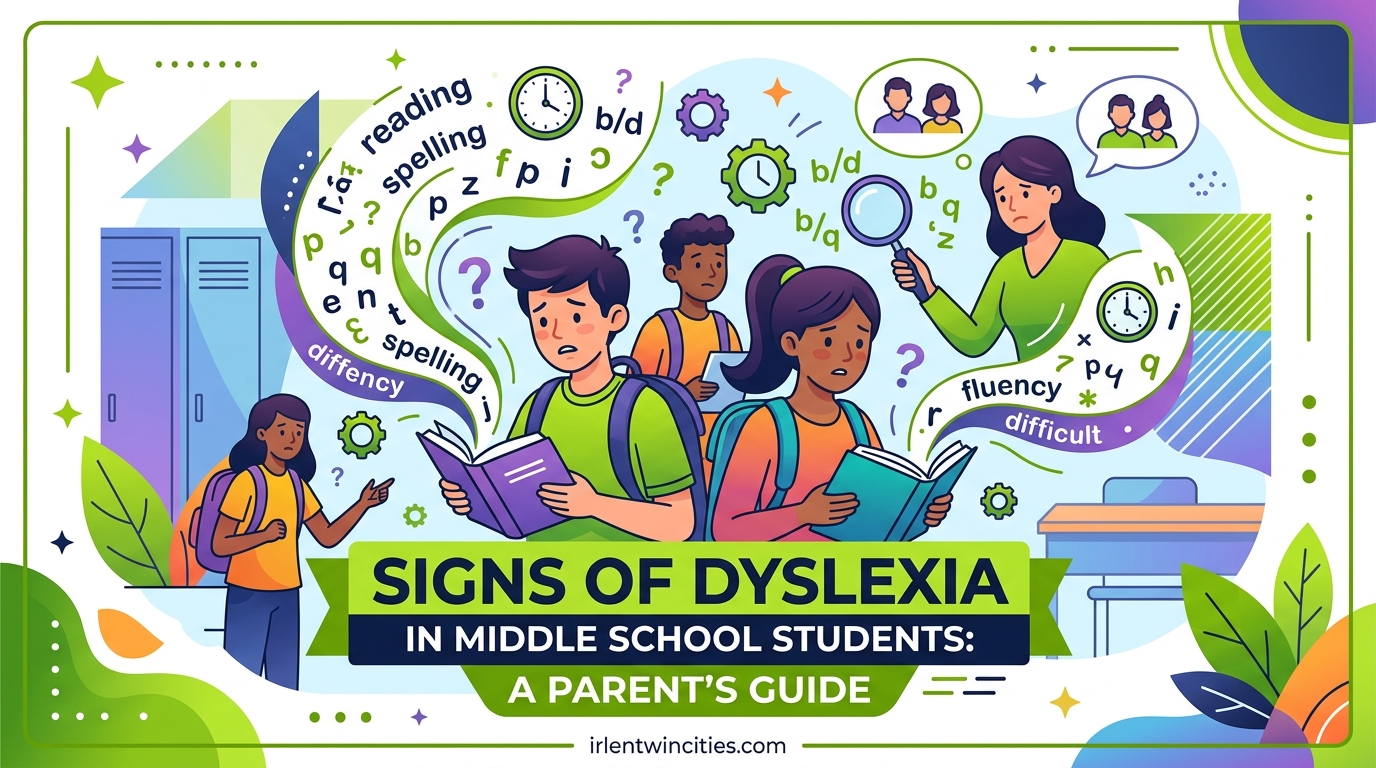
Recognizing the signs of dyslexia in middle school students can feel overwhelming for parents. You’re watching your child struggle with reading, writing, or spelling at an age when academic demands suddenly intensify. I’ve worked with hundreds of families navigating this exact situation, and I want to help you understand what to look for and when to seek support.
Dyslexia is a language-based learning disability that affects how the brain processes written words. It impacts reading, spelling, writing, and sometimes speaking, despite a student having average or above-average intelligence. In middle school, these challenges often become more visible because the academic workload shifts from learning to read to reading to learn.
Table of Contents
Understanding Dyslexia in Middle School
Middle school marks a dramatic transition in academic expectations. Students move from one classroom and one teacher to multiple classes with multiple teachers. Textbooks become denser, vocabulary grows more complex, and written assignments increase significantly.
For students with dyslexia, this transition can feel like hitting a wall. The compensation strategies that worked in elementary school often stop working when faced with longer texts, abstract concepts, and tighter deadlines. Many students who appeared to read adequately in earlier grades suddenly struggle with the volume and complexity of middle school reading.
Our team has observed that parents frequently tell us their child seemed fine in elementary school. Their child might have even been in advanced reading groups. But middle school exposed gaps that weren’t visible before. This pattern is incredibly common and explains why so many dyslexia diagnoses happen during the middle school years.
Reading Difficulties and Decoding Challenges
Reading challenges are often the most obvious signs parents notice first. Students with dyslexia read slowly and laboriously, even if they eventually decode the words correctly. They might spend three times longer on a reading assignment than their classmates.
Phonological processing difficulties make it hard to sound out unfamiliar words. A middle schooler might struggle with multisyllabic words they haven’t memorized. They might guess at words based on first letters rather than decoding them fully.
Reading comprehension issues frequently appear even when decoding seems adequate. Students might read a paragraph aloud but retain almost nothing. They work so hard on the mechanics of reading that understanding becomes secondary. This creates a frustrating pattern where they appear to read but cannot answer questions about the text.
Many students develop avoidance behaviors around reading. They might suddenly hate reading for pleasure, avoid reading aloud in class, or claim they forgot their book at school. Some students become skilled at hiding their struggles by copying homework or relying on classmates.
From the forum discussions I’ve reviewed, parents consistently report that their children became anxious about being called on to read in front of peers. One parent described their 12-year-old developing stomachaches before English class. Another noted their child started “forgetting” glasses to avoid reading on the board.
Writing and Spelling Challenges
Spelling inconsistencies are frequently the clearest indicator of dyslexia in middle school. Students might spell the same word three different ways within one paragraph. Their written work contains bizarre spellings that don’t follow phonetic patterns at all.
I’ve seen countless examples where a student spells “confusion” as “confooshun” and “enough” as “enuf” in the same essay. These inconsistencies persist despite years of spelling instruction and practice. This is different from typical spelling mistakes because it shows a fundamental difficulty with orthographic processing.
Handwriting struggles often accompany dyslexia, a condition sometimes called dysgraphia. Letters might be poorly formed, sizing inconsistent, or spacing irregular. Students grip pencils awkwardly and complain that writing hurts their hands. Their written output rarely matches their verbal abilities.
Written expression presents significant hurdles. Getting ideas onto paper feels exhausting. Essays come back covered in red marks for grammar and punctuation errors that seem careless but actually reflect underlying processing difficulties. Students might write short, simple sentences when they’re capable of complex verbal expression.
A parent on Reddit shared that their niece was an excellent student who devoured books but had “terrible spelling and writing.” This combination of strong reading comprehension with poor spelling is actually a classic dyslexia presentation that many people miss. The child’s brain compensated for reading but couldn’t overcome the spelling challenges.
Oral Language and Word Retrieval Difficulties
Word retrieval problems affect how students express themselves verbally. They might pause midsentence, searching for a specific word they know but cannot access. Conversations include frequent filler words like “um,” “like,” or “you know.”
These students often say “thing” or “stuff” instead of specific vocabulary. They might describe a word rather than naming it. You hear phrases like “that round thing you write with” instead of “pen.” This happens despite having the word in their vocabulary.
Expressing complex ideas verbally becomes challenging. A student might explain something brilliantly in conversation but struggle to write it down. Or they might lose their train of thought while speaking. These difficulties stem from the same processing differences that affect reading and writing.
Foreign language learning presents particular difficulties. Middle school often introduces foreign language requirements. Students with dyslexia frequently struggle enormously with these classes. The additional language processing demands overwhelm an already taxed system.
Forum discussions revealed that many adults with dyslexia remember foreign language classes as their most challenging academic experience. The combination of new phonological systems, spelling patterns, and grammar rules can feel impossible.
Social and Emotional Impact
The emotional toll of undiagnosed dyslexia in middle school can be devastating. Self-esteem drops as students compare themselves to peers. They start believing they’re stupid or lazy despite being intelligent and capable in other areas.
Anxiety about school becomes common. Students might develop physical symptoms like stomachaches or headaches before school. Some begin refusing to attend school altogether. The constant fear of being asked to read aloud or reveal their struggles creates overwhelming stress.
Avoidance behaviors emerge as coping mechanisms. Students procrastinate on reading assignments, “forget” books, or spend hours avoiding homework they could complete in 30 minutes with proper support. Parents often misinterpret this as laziness when it’s actually shame and fear.
Social withdrawal can occur when students feel different from their peers. They might avoid activities that involve reading or writing. Some become class clowns to deflect attention from academic struggles. Others grow quiet and disconnected.
Multiple forum participants described being called lazy or unmotivated before their diagnosis. One person wrote about how “exhausting” it was pretending to understand when everyone else seemed to read effortlessly. Another mentioned developing anxiety that persisted into adulthood.
Organizational and Memory Challenges
Working memory issues affect daily school functioning. Students forget multistep directions immediately after hearing them. They might complete the first step of an assignment but have no recall of the remaining steps.
Time management becomes problematic. Estimating how long tasks take feels impossible. Students spend hours on simple assignments or rush through complex ones. They frequently miss deadlines despite having adequate time to complete work.
Following sequences creates difficulties. Remembering the order of operations in math, steps in science labs, or sequences in history timelines becomes challenging. These students need written checklists and visual reminders that peers don’t require.
Processing speed differences mean students need more time for academic tasks. They understand concepts but cannot demonstrate knowledge as quickly as expected. Timed tests become particularly problematic regardless of subject matter.
When to Be Concerned: Red Flags for Parents
Certain patterns warrant immediate attention. If your child’s reading ability seems significantly below their verbal intelligence, that’s concerning. When a student speaks like a high schooler but reads like a third grader, dyslexia is likely.
Persistent spelling problems despite practice indicate underlying issues. If your middle schooler still spells phonetically after years of instruction, that’s a red flag. Normal spelling development should show increasing standardization by this age.
Emotional distress about school demands investigation. Anxiety, avoidance, tears over homework, or declining self-worth related to academics are not normal. These emotional responses often signal that a student is working much harder than peers with less to show for it.
A sudden drop in academic performance during middle school transition deserves evaluation. Students who previously earned As and Bs now earning Cs or lower might be hitting the wall of compensation limits. Their strategies aren’t working anymore.
What to Do If You Suspect Dyslexia
Start by talking with your child in a supportive way. Explain that everyone’s brain works differently. Some brains are fantastic at reading but struggle with math. Others excel at creative thinking but need different approaches for reading. Your child’s brain has strengths and areas that need support.
Document the specific signs you’ve observed. Keep a list of examples showing the gap between your child’s abilities and their academic performance. This documentation helps when speaking with teachers and evaluators.
Request a comprehensive evaluation through your school. Contact the special education department or school psychologist. Ask for a full assessment including reading, writing, spelling, phonological processing, and cognitive abilities. Don’t settle for a brief screening.
Understand the difference between an IEP and a 504 plan. An Individualized Education Program provides specialized instruction and services. A 504 plan offers accommodations without specialized instruction. Students with dyslexia might qualify for either depending on severity and state laws.
Common accommodations include extended time on tests, reduced spelling penalties, access to audiobooks, speech-to-text software, and copies of notes. These supports level the playing field without lowering academic expectations.
Consider outside evaluation if school assessment is delayed or insufficient. Private psychologists specializing in learning disabilities can provide comprehensive testing. While expensive, this investment often yields valuable information for advocacy.
Frequently Asked Questions
What does dyslexia look like in middle school?
Dyslexia in middle school typically presents as slow, laborious reading, poor spelling that doesn’t improve with practice, trouble with written expression, and word retrieval difficulties during conversations. Students may avoid reading, show anxiety about schoolwork, and experience declining self-esteem. Academic performance often drops as the workload increases because elementary compensation strategies stop working.
How to tell if a 12 year old is dyslexic?
Look for a significant gap between verbal abilities and reading or writing performance. A 12-year-old with dyslexia might speak articulately and understand complex concepts but read slowly, spell inconsistently, and struggle to get ideas onto paper. Watch for avoidance of reading, anxiety about school, and exhaustion after academic tasks. Persistent phonetic spelling and trouble with unfamiliar words are strong indicators.
What are three warning signs of dyslexia?
Three key warning signs include: 1) Reading that is slow and laborious despite adequate intelligence, requiring significantly more time than peers; 2) Spelling that remains inconsistent and phonetic even after years of instruction, with the same word spelled differently within one piece of writing; 3) A noticeable gap between verbal expression and written output, where a student speaks eloquently but cannot write correspondingly well.
What is commonly mistaken for dyslexia?
Vision problems, lack of motivation, laziness, and ADHD are frequently mistaken for or occur alongside dyslexia. Some children have vision issues that make reading difficult, though true dyslexia is a brain-based language processing difference. ADHD can co-occur with dyslexia and shares symptoms like difficulty completing work. Language processing disorders and auditory processing issues can also mimic dyslexia. Proper assessment distinguishes between these conditions.
Conclusion
Recognizing the signs of dyslexia in middle school students empowers you to seek appropriate support for your child. The key indicators include slow and labored reading, persistent spelling inconsistencies, challenges with written expression, word retrieval difficulties, and emotional distress about schoolwork.
If you recognize multiple signs in your middle schooler, trust your instincts and pursue evaluation. Early identification opens doors to accommodations and teaching approaches that can transform a struggling student into a successful learner. Dyslexia comes with challenges, but it also brings unique strengths in creative thinking, problem-solving, and big-picture understanding.
Your advocacy can make the difference between years of frustration and a path to academic confidence. The middle school years are challenging enough without undiagnosed learning differences creating unnecessary barriers. With proper support, students with dyslexia thrive academically and develop the self-advocacy skills they’ll need throughout life.