
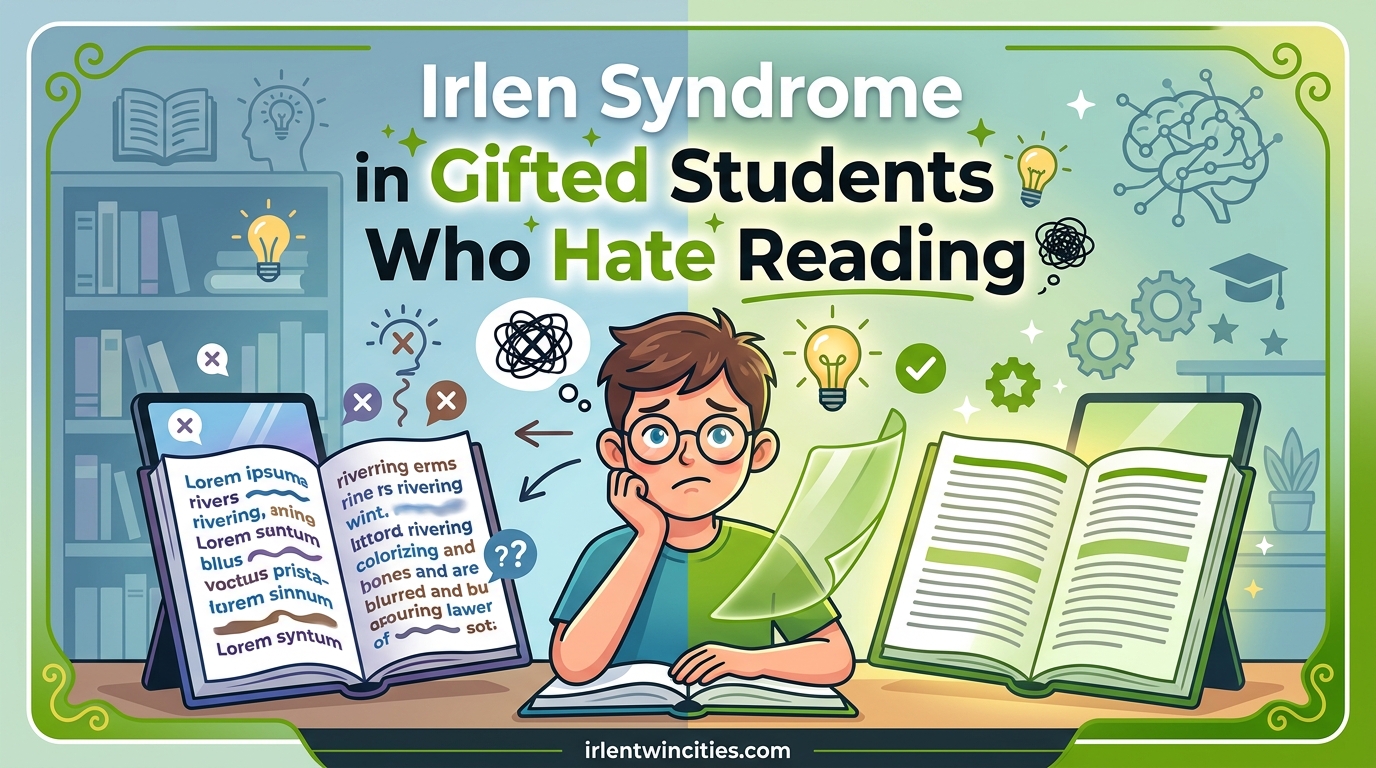
It is one of the most frustrating paradoxes in education: a brilliantly intelligent child who consistently avoids reading, struggles with homework that involves text, or complains that reading makes their head hurt. Parents and teachers often assume the child is lazy, unmotivated, or simply doesn’t want to put in the effort. But what if the real issue is something entirely different—a neurological condition that makes reading physically painful?
Irlen Syndrome, also known as Scotopic Sensitivity Syndrome or Meares-Irlen Syndrome, is a visual processing disorder that affects how the brain interprets visual information. For students with Irlen Syndrome, text may appear blurry, distorted, or unstable on the page. White backgrounds can cause glare and visual stress, making reading exhausting and uncomfortable. This condition frequently goes unrecognized in gifted students because their high intelligence allows them to develop sophisticated coping mechanisms that mask their struggles.
This article explores the connection between Irlen Syndrome and gifted students, explaining why bright children may hate reading, how to recognize the signs, and what parents and educators can do to help. We will also explore the important connection to Twice Exceptional (2E) students—children who are both gifted and have learning differences like Irlen Syndrome.
Table of Contents
What Is Irlen Syndrome?
Irlen Syndrome is a perceptual processing disorder that affects the brain’s ability to process visual stimuli correctly. Unlike refractive vision problems that can be corrected with glasses, Irlen Syndrome originates in the brain’s processing centers, not in the eyes themselves. The condition was first identified by Helen Irlen in the 1980s and is sometimes referred to as Scotopic Sensitivity Syndrome or Meares-Irlen Syndrome.
For individuals with Irlen Syndrome, reading becomes a constant battle against visual distortions. Text may appear to move, blur, or bunch together. White pages—particularly glossy paper—can create a glare that feels overwhelming. Some people describe watching words “jump” on the page or seeing rivers of white between lines of text. This visual stress can cause headaches, eye strain, fatigue, and concentration difficulties that make sustained reading nearly impossible.
The condition exists on a spectrum, meaning different individuals experience varying degrees of severity. Some may have mild symptoms that only become noticeable during extended reading sessions, while others experience severe distortion that makes reading laborious from the very first page. Research suggests that approximately 14% of the general population may have some degree of Irlen Syndrome, with that number rising to 46% among individuals with reading difficulties.
Irlen Syndrome frequently co-occurs with other conditions. Many individuals who have dyslexia or ADHD also experience Irlen Syndrome symptoms, though the conditions are distinct. Dyslexia involves difficulty with language processing and decoding words, while Irlen Syndrome specifically involves visual processing challenges. Someone can have both conditions simultaneously, which often compounds reading difficulties.
Photophobia, or light sensitivity, is commonly associated with Irlen Syndrome. Many affected individuals find that fluorescent lighting causes significant discomfort, and some report sensitivity to contrast between text and background. This is why colored overlays and precision-tinted lenses have shown effectiveness in helping manage the condition—these tools can reduce the visual stress that makes reading so challenging.
Signs of Irlen Syndrome in Gifted Students
Identifying Irlen Syndrome in gifted students presents unique challenges. Because these children often have high cognitive abilities, they develop creative strategies to work around their reading difficulties. They may ace verbal tests while failing written ones, contribute brilliantly to discussions while avoiding homework assignments that involve reading, or seem to understand concepts when explained verbally but struggle when expected to read independently.
Recognizing the following signs can help parents and teachers identify potential Irlen Syndrome in intellectually advanced students:
Reading Behavior Signs
- Strongly prefers learning from lectures, videos, or discussions rather than reading
- Avoids reading for pleasure despite being highly curious about topics
- Uses fingers or a ruler to track lines while reading
- Frequently loses place while reading or skips lines accidentally
- Rubbing eyes or squinting when reading assignments
- Reading tire-out: starts strong but abilities decline significantly after 10-15 minutes
- Reports that reading causes headaches, eye strain, or nausea
- Will do almost anything to get out of reading assignments
Light and Visual Comfort Signs
- Complains about glare from white paper or glossy surfaces
- Prefers reading in dim lighting rather than bright spaces
- Finds LCD screens easier to read than printed text
- Wears sunglasses indoors or in bright environments
- Experiences headaches after extended screen time
- Notices improvement when text is placed on colored background
Academic Performance Patterns
- Dramatic discrepancy between verbal intelligence and reading achievement
- Excellent comprehension when material is read aloud versus independently
- High test scores on multiple-choice exams but struggles with reading-based tests
- Inconsistent performance: some days significantly better than others
- Struggles with timed tests despite knowing the material thoroughly
- Homework takes much longer than expected given the apparent intelligence
Emotional and Behavioral Signs
- Expresses frustration or anxiety about reading assignments
- Has high academic motivation but cannot complete reading-based tasks efficiently
- Reports feeling exhausted after school from visual processing demands
- Demonstrates learned helplessness around reading tasks
- Uses avoidance strategies consistently when reading is required
If you recognize multiple signs from these lists, consider exploring Irlen Syndrome testing. A proper diagnosis can be life-changing, transforming reading from a painful chore into an accessible skill.
Why Gifted Students Hide Reading Difficulties
One of the most poignant aspects of Irlen Syndrome in gifted students is how effectively these children learn to hide their struggles. Because they are intelligent and perceptive, they quickly recognize that their reading difficulties do not match their perceived intelligence. They develop elaborate coping mechanisms to avoid revealing their challenges, and this concealment often delays diagnosis by years or even decades.
Gifted students often develop reading avoidance strategies that become invisible to parents and teachers. Some children with Irlen Syndrome learn to memorize content presented in class rather than reading it later. Others become so skilled at using context clues that they can guess at words without actually seeing them clearly. Many develop intense listening skills as a primary learning channel, allowing them to excel academically while their reading difficulties remain hidden.
One reddit user shared their experience: “I assumed all my life that reading was physically painful for everyone—something one suffers through as a price for achievement. I thought everyone experienced text that moved on the page, words that blurred together, and headaches that built up during extended study sessions. I just assumed that successful people were better at enduring the discomfort.”
This mindset is remarkably common among individuals with undiagnosed Irlen Syndrome. Gifted students, in particular, tend to internalize the narrative that success requires overcoming challenges through determination and hard work. When reading is difficult, they interpret their struggle as a personal failing rather than a neurological condition. The resulting shame and frustration can lead to anxiety, depression, and plummeting self-esteem—despite exceptional intellectual capabilities.
The paradox of high intelligence masking Irlen Syndrome cannot be overstated. Teachers often assume that a bright child who struggles with reading simply needs to try harder, pay more attention, or care more about academics. Parents may wonder why their clearly talented child refuses to read for pleasure or frequently complains about homework. Without understanding Irlen Syndrome, adults may inadvertently dismiss or punish behavior that is actually a symptom of a legitimate neurological condition.
Many gifted students with Irlen Syndrome report that they developed a reputation for being “lazy” or “unmotivated” despite their intellectual capabilities. They learn to hide their reading difficulties not because they are deceptive, but because asking for help feels impossible when their challenges are invisible and poorly understood. These students may perform adequately in early grades when reading volumes are smaller but become increasingly overwhelmed as academic demands increase.
The 2E Connection: Twice Exceptional Students
Twice Exceptional (2E) students are children who are both gifted and have learning differences or disabilities. The 2E framework is essential for understanding why Irlen Syndrome so often goes unrecognized in intellectually advanced children. A child can be in the top percentile of cognitive abilities while simultaneously struggling with conditions like ADHD, dyslexia, dysgraphia, or Irlen Syndrome. These children do not simply cancel out—being gifted does not erase learning challenges, and having a learning difference does not diminish giftedness.
Irlen Syndrome qualifies as a 2E condition when it occurs in students who also demonstrate high intellectual abilities. The combination creates a unique profile: a child who can grasp complex concepts quickly but struggles to read fluently, who has sophisticated thinking abilities but becomes frustrated and exhausted by reading-based assignments, who shows remarkable verbal reasoning but has difficulties with written expression.
The 2E framework helps explain why traditional identification methods often fail to recognize Irlen Syndrome in gifted students. Schools typically identify students with learning disabilities through achievement testing that compares performance against typical peers. Gifted students, however, may score at average or above-average levels on these tests despite significant challenges, leading evaluators to conclude that no disability exists. Their high cognitive abilities allow them to compensate for their difficulties in testing situations.
Similarly, gifted programs typically identify students through intelligence testing that measures cognitive abilities without considering processing challenges. A gifted student with undiagnosed Irlen Syndrome may score in the highly gifted range on IQ tests while simultaneously struggling to read grade-level material. Neither identification system captures the full profile of the 2E student, leaving these children without appropriate support.
The good news about 2E identification is that recognizing both giftedness and learning differences allows for appropriate accommodations that address both. Rather than forcing a student to choose between acceleration (because they’re gifted) and remediation (because they have a disability), 2E approaches recognize that these children need both—and that the combination creates unique needs that neither traditional gifted nor special education programs adequately address.
For students with Irlen Syndrome, appropriate 2E accommodations might include: providing access to colored overlays or tinted lenses during reading activities, allowing audio versions of texts, reducing reading load while maintaining content rigor, providing extended time for reading-based tests, and training students in self-advocacy strategies that help them communicate their needs effectively.
How to Recognize and Diagnose Irlen Syndrome
Diagnosing Irlen Syndrome requires specialized assessment that goes beyond standard vision screenings. A typical eye exam checks for refractive errors and ocular health but does not evaluate the brain’s visual processing capabilities. Identifying Irlen Syndrome requires assessment from a trained Irlen diagnostician who can evaluate how an individual’s brain processes visual information under different conditions.
The Irlen screening process typically involves several components. Initial screenings may be conducted by trained school personnel or Irlen Certified Screener practitioners and can identify candidates who would benefit from full diagnostic assessment. Full diagnostic evaluations are conducted by Irlen Certified Psychologists or other qualified diagnosticians who have completed extensive training in the Irlen Method.
During assessment, the diagnostician evaluates how the individual responds to various colored overlays and filters. By systematically testing different colors and tint levels, the practitioner can identify the precise combination that reduces or eliminates visual distortions. This personalized color prescription is then used for Irlen lenses (precision-tinted glasses) or colored overlays that the individual can use during reading activities.
Several warning signs suggest that a child should be evaluated for Irlen Syndrome, particularly if the child is academically gifted. Persistent reading difficulties despite high intelligence and appropriate instruction may indicate Irlen Syndrome or another processing disorder. A significant gap between listening comprehension and reading comprehension often signals a processing challenge rather than a motivation or effort issue. Additionally, reports from the child that reading causes physical discomfort—including headaches, eye strain, or nausea—should be taken seriously as potential symptoms.
Some parents have discovered that e-readers like Kindle devices significantly reduce their child’s reading difficulties. This may occur because e-readers allow users to adjust background colors, reduce glare, and sometimes use different font rendering than printed text. While e-reader improvement does not confirm Irlen Syndrome, it can be a helpful indicator that colored filters might provide benefit.
Early diagnosis is crucial. The longer Irlen Syndrome goes undiagnosed, the more likely the child is to develop emotional difficulties, learned helplessness, and negative self-perceptions around academics. Students who receive diagnosis and appropriate intervention can often overcome reading challenges and develop positive relationships with text-based learning.
Support Strategies for Parents and Teachers
Supporting a gifted student with Irlen Syndrome requires balancing high expectations with appropriate accommodations. These children need recognition of their intellectual strengths alongside understanding of their processing challenges. With the right support, students with Irlen Syndrome can achieve academically while developing healthy strategies for managing their condition.
For parents, creating a supportive home environment begins with believing your child. When a highly capable student reports that reading is difficult or painful, take those reports seriously. Seek evaluation from qualified professionals who understand Irlen Syndrome and 2E profiles. Advocate for your child within the school system to ensure appropriate accommodations are in place, and connect with other parents of 2E children to share strategies and resources.
Teachers can support students with Irlen Syndrome by providing materials in multiple formats. Offering audio versions of readings allows students to access content without the visual stress of reading. Allowing colored overlays or tinted glasses during reading activities can significantly reduce distortion and fatigue. Reducing reading load while maintaining content rigor can prevent the exhaustion that often accompanies extended reading sessions for these students.
Self-advocacy training is particularly valuable for older students with Irlen Syndrome. As students approach high school and college, they will need to communicate their needs effectively to professors and employers. Teaching students to explain their condition, describe their needs, and request appropriate accommodations prepares them for lifelong success. Students who understand their own processing profile can make informed decisions about when to use accommodations and when to push through challenges independently.
Perhaps most importantly, adults must avoid the trap of assuming that because a child is intelligent, their challenges are not real or significant. High intelligence does not make a person immune to visual processing difficulties, and it does not mean that success should come easily without accommodations. Gifted students with Irlen Syndrome need adults who recognize both their abilities and their needs, providing support that honors their potential while addressing their challenges.
Conclusion
Irlen Syndrome represents a significant challenge for many gifted students who struggle with reading despite their high intellectual capabilities. This visual processing disorder causes text to appear distorted, blurry, or unstable, making reading physically uncomfortable and academically challenging. When Irlen Syndrome goes unrecognized in gifted students, the consequences can include years of unnecessary struggle, damaged self-esteem, and unrealized potential.
Understanding the connection between Irlen Syndrome and giftedness is crucial for parents, educators, and the students themselves. The Twice Exceptional framework helps explain why high intelligence can mask processing difficulties and why traditional identification methods often fail to recognize these children’s needs. By recognizing the signs of Irlen Syndrome in gifted students and pursuing proper diagnosis, families can access interventions that transform reading from a painful chore into an accessible skill.
If you suspect that a gifted child in your life may have Irlen Syndrome, seek evaluation from a qualified Irlen diagnostician. With proper diagnosis and appropriate accommodations, students with Irlen Syndrome can thrive academically while developing effective strategies for managing their visual processing challenges. Early identification and intervention make a profound difference, allowing these remarkable young people to reach their full potential without the unnecessary burden of undiagnosed struggle.
Frequently Asked Questions
Is Irlen Syndrome a real condition?
Yes, Irlen Syndrome is a recognized visual processing disorder that has been extensively studied since the 1980s. While the condition remains somewhat controversial in certain medical circles, numerous individuals report significant improvements with colored overlays or precision-tinted lenses. The Irlen Method has helped thousands of people worldwide, and research continues to explore the neurological basis of the condition.
Is Irlen Syndrome linked to ADHD?
Irlen Syndrome and ADHD frequently co-occur, though they are distinct conditions. ADHD involves attention and executive function challenges, while Irlen Syndrome involves visual processing difficulties. Many individuals with ADHD also experience Irlen Syndrome symptoms, and vice versa. The overlap is significant enough that evaluation for one condition should include consideration of the other.
Can you have Irlen Syndrome and dyslexia?
Yes, Irlen Syndrome and dyslexia can occur together. They are separate conditions—dyslexia involves language processing difficulties while Irlen Syndrome involves visual processing challenges—but they frequently co-occur in individuals with reading difficulties. Having both conditions can compound reading challenges, and addressing both through appropriate interventions provides the best outcomes.
What is Meares-Irlen Syndrome?
Meares-Irlen Syndrome is another name for Irlen Syndrome, combining the names of the researchers who first identified aspects of the condition. It is also called Scotopic Sensitivity Syndrome. The various names refer to the same visual processing disorder characterized by difficulties processing visual information, particularly from white backgrounds and certain light wavelengths.
Do people grow out of Irlen Syndrome?
Irlen Syndrome is a neurological condition that typically persists throughout life, though symptoms may become more manageable with appropriate interventions like colored overlays or tinted lenses. While some individuals may experience changes in symptom severity over time, the underlying processing differences generally remain. Early intervention and appropriate accommodations help individuals develop effective strategies for managing their condition throughout life.