
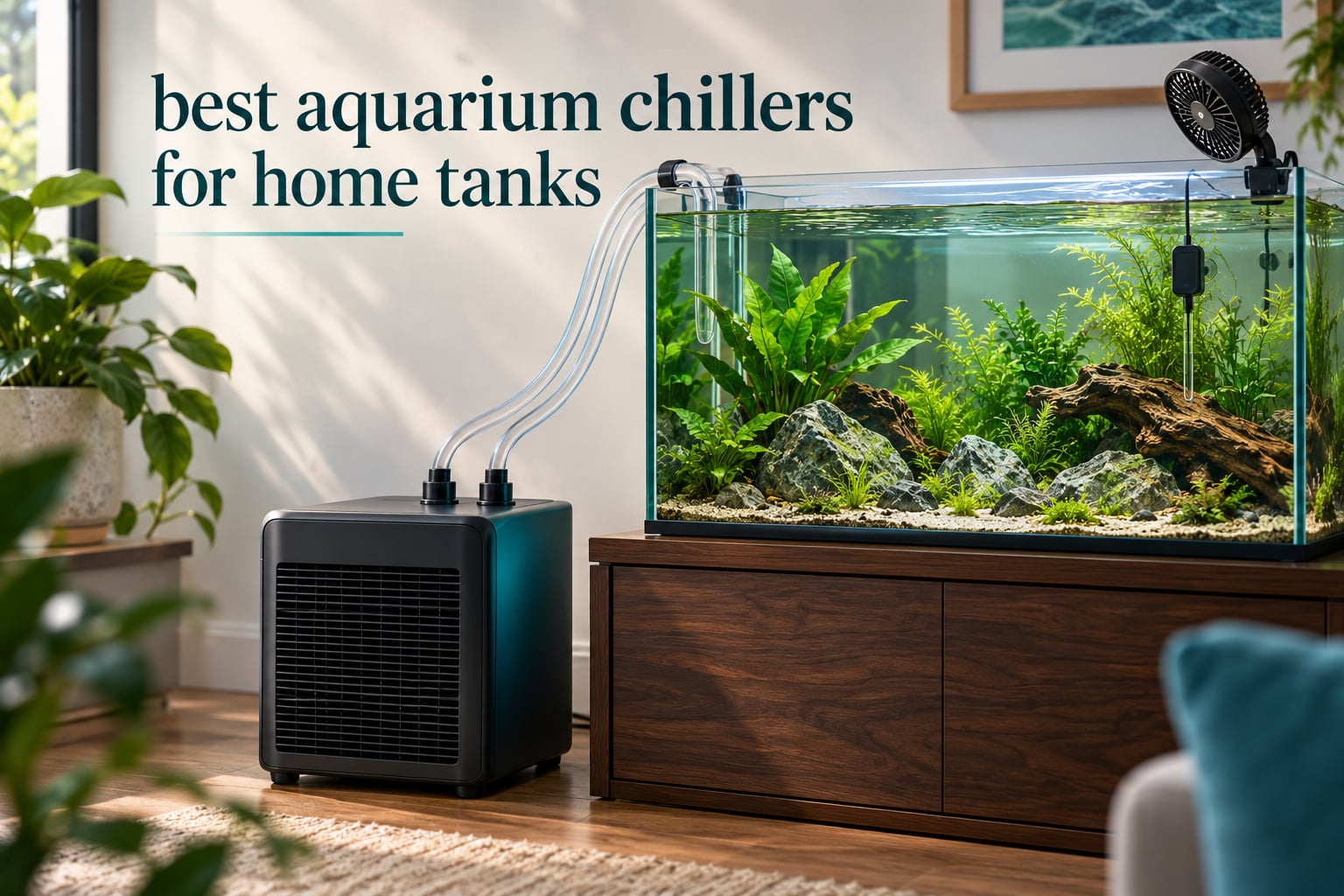
Choosing the best aquarium chillers for home tanks comes down to one number: how many degrees below your room temperature you need the water to sit. A chiller is a powered cooling unit that pulls heat out of tank water and dumps it into your room air, and it is the only device that can drop a tank well below ambient. That is why axolotl keepers, goldfish keepers and summer reefers keep asking the same question on every forum: will this thing actually reach the temperature I need, and how loud is it while it does it?
We spent weeks reading spec sheets, owner reviews and forum threads to put this list together, and we compared all 12 units below on cooling type, rated capacity, heat exchanger material, flow rate and noise. Five of these are real compressor chillers and one is a compact inline titanium unit. The other six are evaporative clip-on fans, which cost a fraction of the price and drop water by a few degrees, but can never go below room temperature. We have labelled which is which so you do not buy a fan expecting a chiller.
If you are still choosing the tank itself, start with our 12 best fish tanks roundup, and if your cooling problem starts with a hot lamp over a planted tank, read our guide to aquarium lights for planted tanks first. Switching to LEDs removes a surprising amount of heat before you spend anything on cooling hardware.
Table of Contents
Top 3 Aquarium Chiller Picks at a Glance
Our best overall pick, our best value pick and our premium titanium pick all use real refrigeration compressors, which is the only technology that reaches temperatures below ambient.

BAOSHISHAN 1/10 HP 42 Gal
- 1/10 HP compressor
- Up to 10F below ambient
- 45-50dB
- Pump and tubing included

Active Aqua 0.10 HP Titanium
- 10-40 gallon rating
- 1
- 020 BTU
- Pure titanium evaporator
- Boost rapid cooling

Active Aqua 0.25 HP Titanium
- 40-92 gallon rating
- 396-925 GPH
- Pure titanium evaporator
- Digital control
The Best Aquarium Chillers for Home Tanks in 2026 at a Glance
Every unit below appears in this table with the two or three specs that actually decide the purchase: what kind of cooling it does, how big a volume it is rated for, and whether the wetted heat exchanger is titanium. All 12 are written up in full below in ranked order.
| Product | Specifications | Action |
|---|---|---|
| BAOSHISHAN 1/10 HP Aquarium Chiller 42 Gal |
|
Check Latest Price |
| Active Aqua Water Chiller 0.25 HP Titanium 40-92 Gal |
|
Check Latest Price |
| Active Aqua Water Chiller with Boost 0.10 HP 10-40 Gal |
|
Check Latest Price |
 Poafamx 1/3 HP Aquarium Chiller 40-80 Gal Poafamx 1/3 HP Aquarium Chiller 40-80 Gal |
|
Check Latest Price |
 DaToo Aquarium Cooling Fan Clip-On DaToo Aquarium Cooling Fan Clip-On |
|
Check Latest Price |
 AQUASMITH Aquarium Chiller Fan with Temperature Control AQUASMITH Aquarium Chiller Fan with Temperature Control |
|
Check Latest Price |
 hygger Aquarium Chiller Fan with Timer Controller hygger Aquarium Chiller Fan with Timer Controller |
|
Check Latest Price |
 PAIZOO Aquarium Chiller Fan 3 Speed Ultra-Quiet PAIZOO Aquarium Chiller Fan 3 Speed Ultra-Quiet |
|
Check Latest Price |
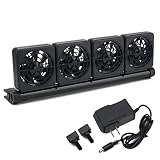 Liveek Aquarium Fan 4 Head Cooling Unit Liveek Aquarium Fan 4 Head Cooling Unit |
|
Check Latest Price |
 AQUASMITH Aquarium Fan AFan-PV Ultra-Quiet AQUASMITH Aquarium Fan AFan-PV Ultra-Quiet |
|
Check Latest Price |
 PAIZOO Aquarium Chiller Fan with Temp Probe PAIZOO Aquarium Chiller Fan with Temp Probe |
|
Check Latest Price |
 JBJ Arctica Aquarium Chiller 1/15 HP JBJ Arctica Aquarium Chiller 1/15 HP |
|
Check Latest Price |
1. BAOSHISHAN 1/10 HP Aquarium Chiller 42 Gal – Best Overall
BAOSHISHAN 1/10 HP Aquarium Chiller 42 Gal Fish Tank Water Chiller 110V
1/10 HP compressor
42 gallon rating
Up to 10F pull-down
45-50dB
Pump and hoses included
Pros
- Cheapest true chiller in this roundup
- Complete kit with pump
- tubing and hose clamps
- Up to 10F below ambient for a 42 gallon tank
- Quiet for a compressor unit at 45-50dB
- Works in freshwater and saltwater
Cons
- Heat exchanger is stainless steel rather than titanium
- Needs 6 inches of clearance around the case for airflow
- Included pump is a starting point for larger volumes
This is the unit we keep coming back to for home tanks because it removes the two things that usually make a chiller purchase annoying. The first is the shopping list. The box contains the chiller, a water pump, water pipe, a charger and instructions, so you are not hunting for a separate pump on the same afternoon you unbox it. The second is the noise floor. Owners describe it as a low hum rather than a rattling machine, and the manufacturer rates it at 45-50dB at one meter.
Cooling performance is honest compressor performance. The 1/10 HP refrigeration compressor lowers water temperature by up to 10F and is rated for tanks up to 42 gallons, with the manufacturer suggesting 33 gallons as a peak-summer figure. Rated flow is 800 liters per hour, which is plenty to push through a chiller of this size on a modest inline pump.
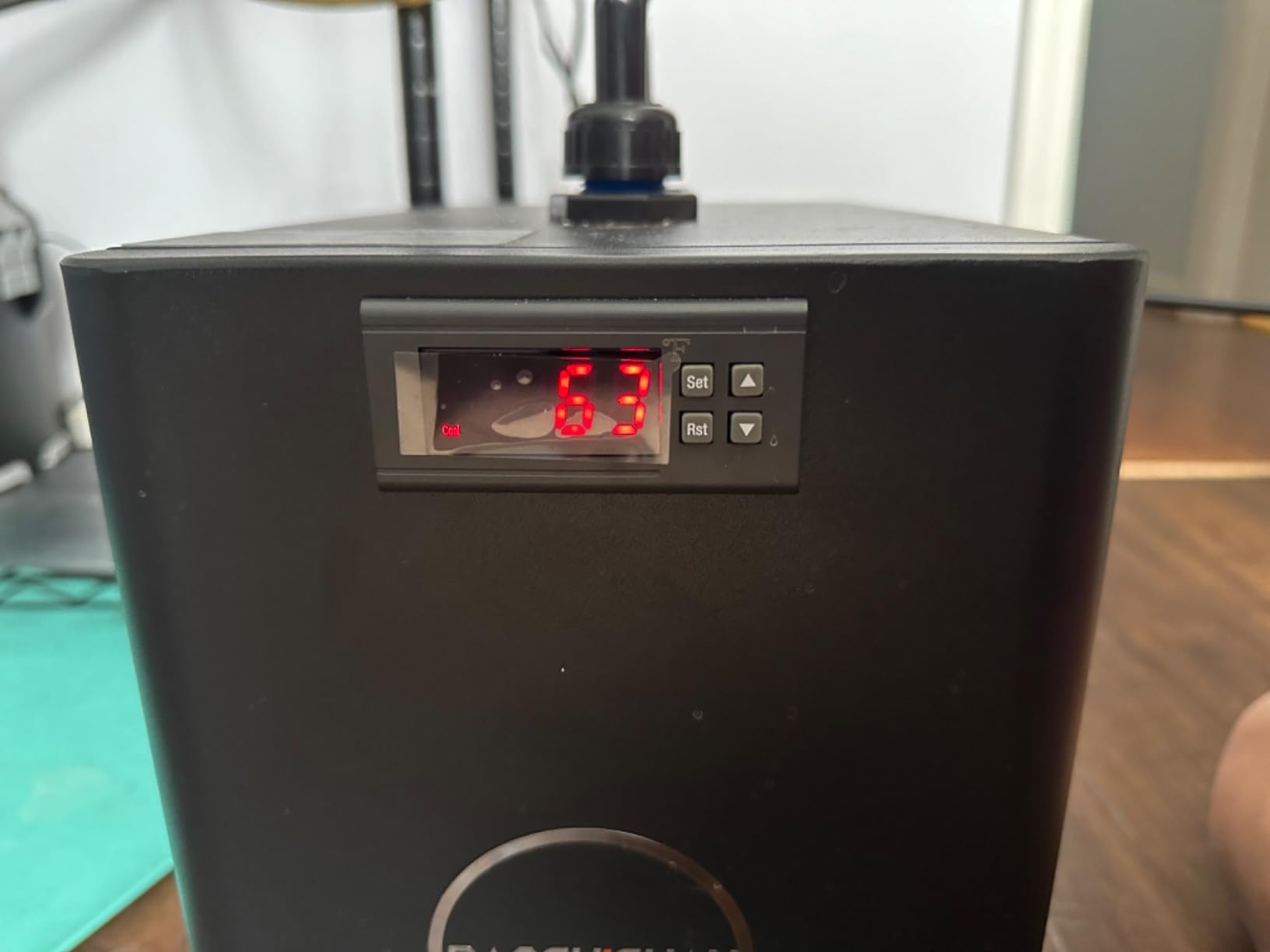
The physical design is worth understanding before you buy. The case is 13.39 inches long by 7.87 inches wide by 11.81 inches tall and the unit weighs 13 kg, so it fits on a stand without a reinforced shelf. Two high-speed fans move air through enlarged side vents, and those vents need about 6 inches of clearance on both sides. Cramming it into a cabinet is a common cause of a chiller that runs constantly and never reaches its set point.
The honest limitation is the wetted material. The specification sheet lists stainless steel as the material type, and reviewers consistently report it working in both freshwater and saltwater tanks. For a lightly salted community tank that is fine. For a reef running true seawater at specific gravity above 1.020, an all-titanium evaporator removes a question you would otherwise be researching. The protein skimmer roundup covers the other half of that salt-water question.
Will it fit a 20 gallon planted tank and stay quiet in a bedroom
A 20 gallon tank is comfortably inside this unit’s 42 gallon rating, and since the compressor only has to move the temperature gap rather than the whole volume, it tends to cycle on and off through a normal summer day rather than run flat out. On a planted tank the air movement is mild enough not to blow gas out of the water column, which a multi-fan unit in high gear can do.
For noise, treat 45-50dB at one meter as quiet-room acceptable rather than silent. If your tank sits in a bedroom, stand the chiller on foam or a vibration pad and keep the case off the hardwood. A compressor chiller heard through a hollow cabinet wall is what makes people think all chillers are loud.
When to skip this one
Skip it if you run a reef at full seawater strength and want a titanium heat exchanger as a matter of course, or if you are planning a tank over 40 gallons. It is also the wrong choice for anyone who does not have 6 inches of open air on each side of the unit, because restricted airflow is the number one cause of a chiller that never reaches its set point.
2. Active Aqua Water Chiller 0.25 HP Titanium 40-92 Gal – Premium Pick
Active Aqua Hydroponic Water Chiller, 0.25 HP, Pure Titanium, 40-92 Gallon
0.25 HP compressor
40-92 gallon rating
Pure titanium evaporator
396-925 GPH
Digital control
Pros
- Covers a wide 40-92 gallon range from one unit
- Pure titanium evaporator suits salt and fresh water
- Boost mode for rapid pull-down after adding warm water
- 396-925 GPH circulation capacity
Cons
- Pump and hoses are not included
- Heaviest unit here at 44.9 pounds
- Needs steady ventilation to dump heat
This is the one we recommend for anyone running a mid-size display who plans to keep the equipment for years. The evaporator is pure titanium, which is the material that matters when the water on the other side of the coil is salted, and the 0.25 HP compressor is rated across a 40-92 gallon window rather than a single tank size. That range matters because your real summer load depends on your room, not your tank.
Owners of larger tanks and hydroponic reservoirs consistently rate the cooling headroom highly, and the boost function earns its own praise. When you do a 30 percent water change with warm tap water, boost gives you a faster pull-down than waiting for the thermostat to do it in stages. Digital temperature control on the front panel is straightforward to set once you understand its hysteresis behaviour.
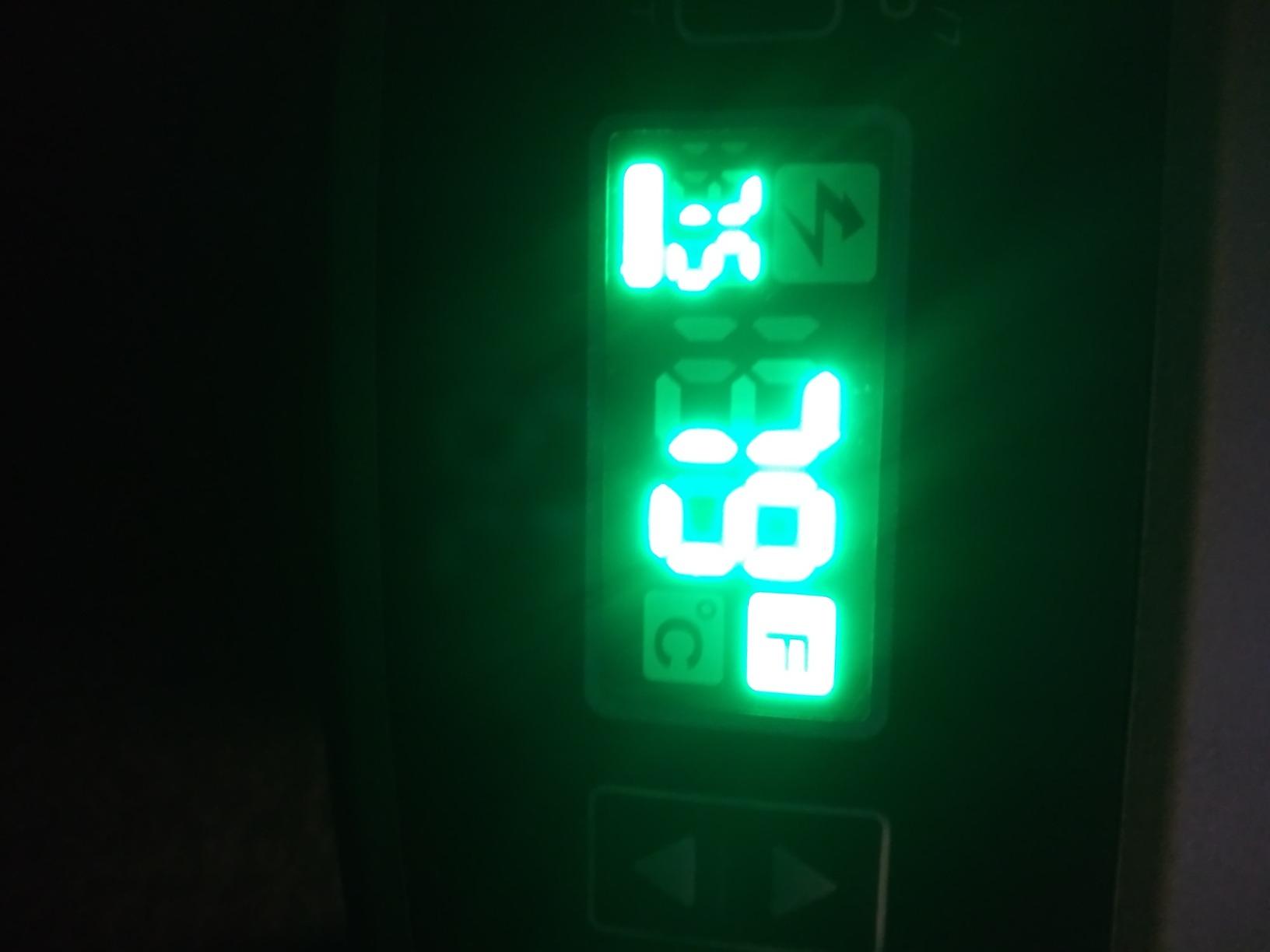
Plan your installation carefully because the hardware is not in the box. The pump and hoses are sold separately, and this unit is designed to pair with the AAPW400, AAPW550 or AAPW800 circulation pumps. At 44.9 pounds and 19 by 14 by 19 inches, it is a substantial box to move and needs a stand that will take the weight without a wobble.
Flow is a genuine strength here. The rated circulation capacity of 396-925 GPH means you can push water through the heat exchanger fast enough to keep the whole column mixed, which is what you want on a deep tank where the top is cool and the bottom is warm. A chiller starved of flow cools a narrow ribbon of water and leaves the rest of the tank untouched.
Is this the right chiller for a 55 gallon reef
Yes, comfortably. 55 gallons sits in the middle of the rated 40-92 gallon window, and a tank that size in a warm room benefits from the extra flow capacity. Because the evaporator is titanium, you are not making a materials compromise to get there, and the digital control gives you a set point you can hand over to an external controller later.
The one thing to watch is heat rejection into the room. A unit this size expels a meaningful amount of heat through the case vents, so give it air on all sides and do not enclose it in a cabinet. In a small room that heat comes straight back into the water you are trying to cool.
When to skip this one
Skip it for tanks under 30 gallons, where the capacity is wasted, and skip it if budget rules out a separate circulation pump. If you have a sump, a controller-driven inline pump and an open stand, this is a very hard unit to argue with.
3. Active Aqua Water Chiller with Boost 0.10 HP 10-40 Gal – Best Value
Active Aqua Water Chiller with Boost, 0.10 HP, 10-40 Gal, Cold Plunge
0.10 HP compressor
10-40 gallon rating
1,020 BTU
Pure titanium evaporator
Holds within about 1 degree
Pros
- Digital control holds temperature within about 1 degree
- Pure titanium evaporator rated for salt or fresh water
- Boost function for rapid pull-down
- Owners measure well below the listed wattage in use
Cons
- Compressor noise is audible
- like a small window unit
- Fittings can weep at the barb connections
- Pump and hoses sold separately
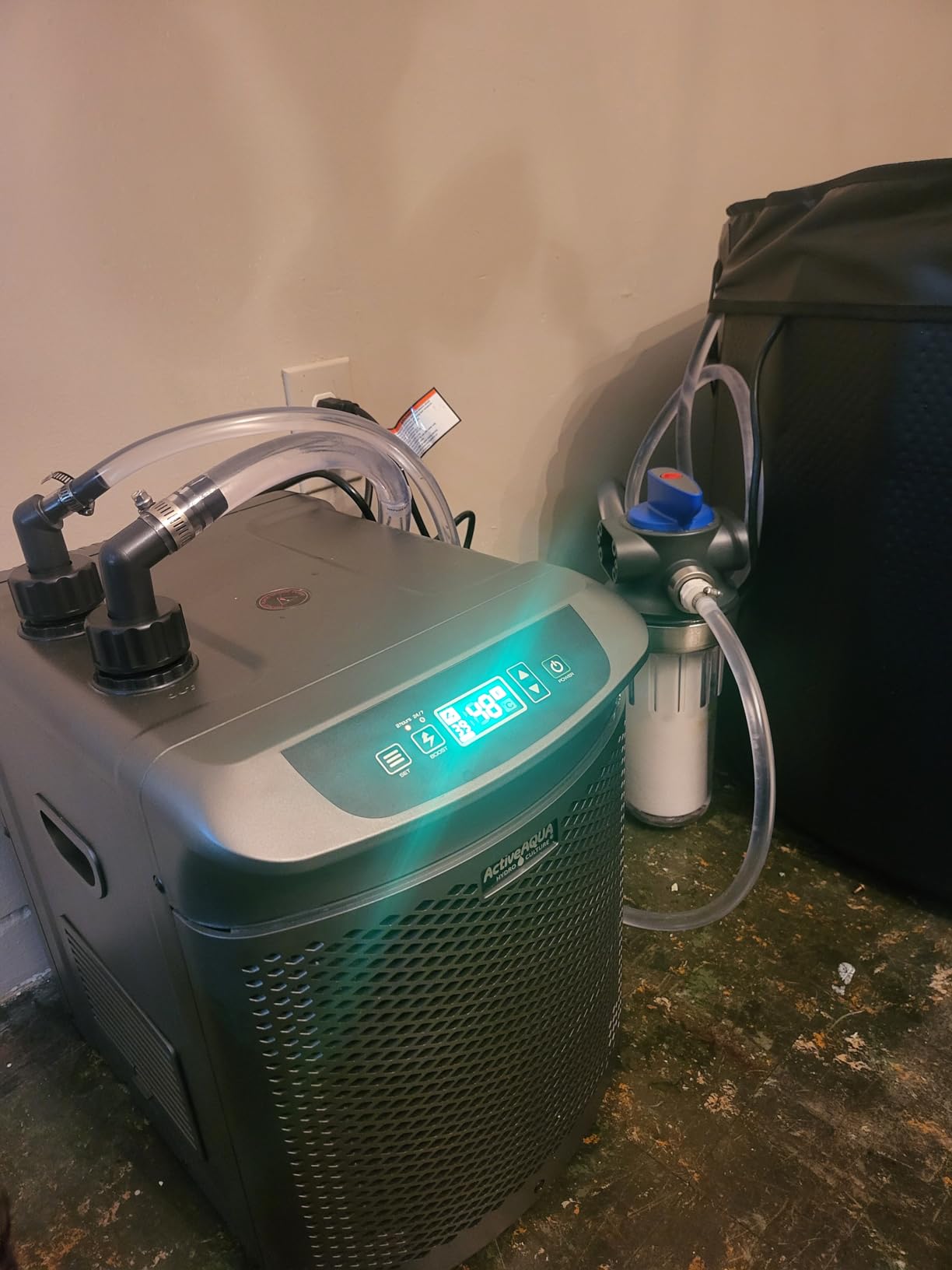
This is our pick for axolotl and amphibian tanks, where the target sits in the low 60s and the room does not. It is a 0.10 HP compressor unit rated for 10-40 gallon volumes with a stated capacity of 1,020 BTU, which is the number to match against your room heat load rather than your tank size. Axolotl keepers on the forums treat chillers as close to non-negotiable once water passes 68-70F, and this is a unit built to hold below that line in a warm room.
Control accuracy is the standout. The digital control system holds temperature within about 1 degree according to the manufacturer, and owners report typical 1-2 degree accuracy in real use. The boost function is genuinely useful for axolotl tanks because a large water change with room-temperature water spikes the temperature fast, and boost walks it back down without you hovering over the dial.
Owners also note that real power draw sits well under the listed 510 watt rating, with measurements around 180W while actively cooling. That is good news for anyone running a chiller on a circuit shared with other aquarium equipment, and it also limits how much heat the unit adds to the room when it is working hard.
The negatives are consistent across reviews and worth taking seriously. Compressor noise is audible and comparable to a small room air conditioner, so this is not a bedroom tank. A minority of owners report units that stop chilling after several months, and a few report weeping at the barb fittings. Fittings are included with the unit, but the pump and hoses are not.
Can this reach 60-64F for axolotls in a hot room
With 1,020 BTU of rated capacity on a tank inside its 10-40 gallon window, a real pull-down of several degrees below ambient is realistic, and that is usually enough to keep an axolotl tank in the low 60s through a hot afternoon. The key is flow, which we cover in the sizing section below. A chiller with a starved flow rate will read a cold thermometer and leave the tank warm.
Expect the compressor to be audible during a pull-down and quieter once the set point is reached, since it cycles. Put it on a cabinet stand, not on the same surface as the tank, and you will remove most of the transmitted vibration.
When to skip this one
Skip it if noise in a bedroom is a dealbreaker, if you are not prepared to buy a pump and hoses, or if your tank is over 40 gallons. A minority of buyers also hit compressor failures within months, so buy it from a seller with a workable return policy.
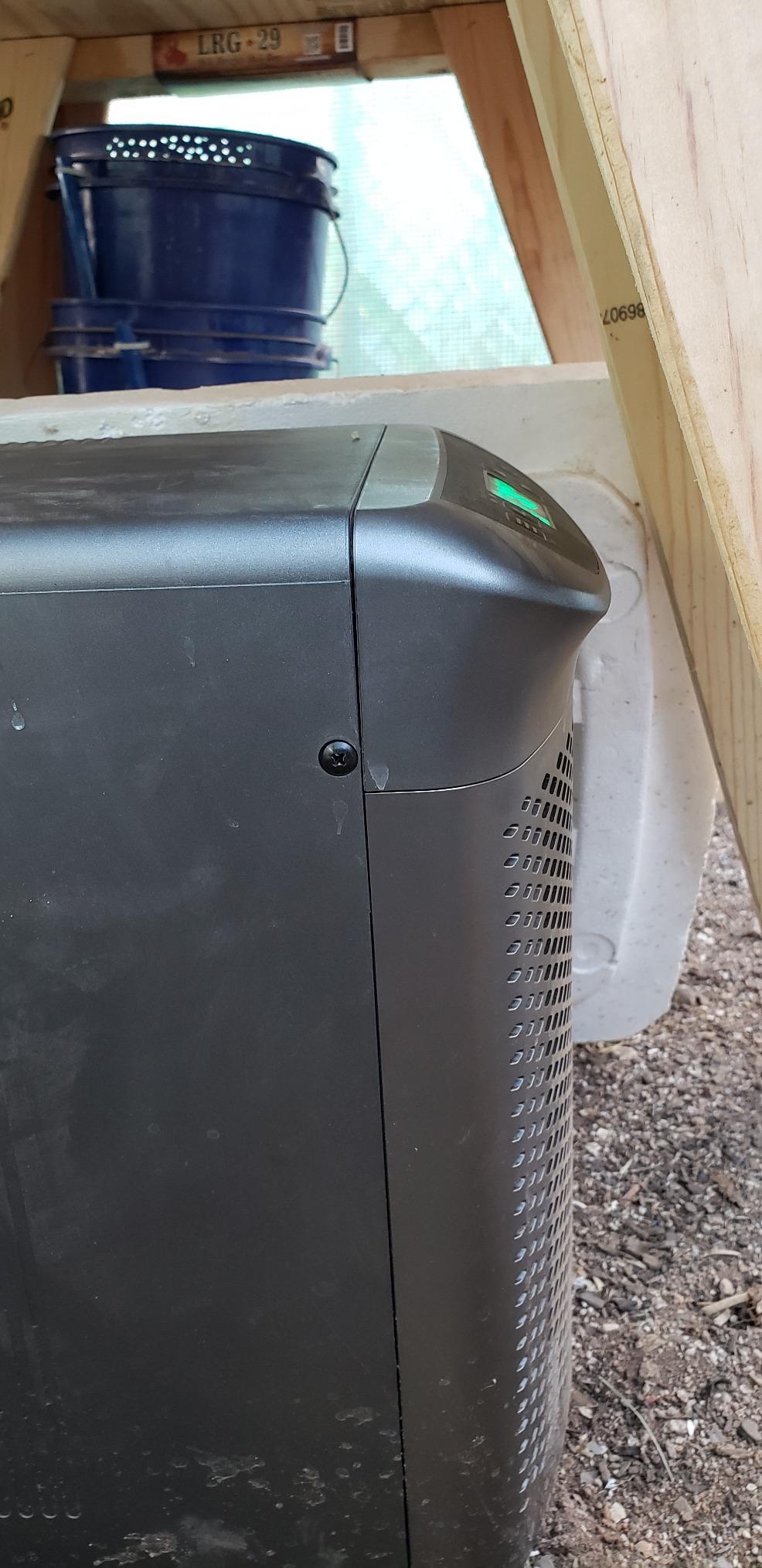
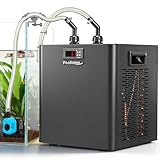
4. Poafamx 1/3 HP Aquarium Chiller 40-80 Gal – Best for 40 to 80 Gallon Tanks
Poafamx 1/3 HP Aquarium Chiller, Quiet Fish Tank Water Chiller 40-80 Gal
1/3 HP compressor
40-80 gallon rating
Cools up to 10C below room temp
Under 45dB
R290 refrigerant
Pros
- Highest rated horsepower in this roundup at 1/3 HP
- Complete kit with pump
- hose connectors and clamp
- Titanium evaporator rated for fresh and salt water
- Under 45dB operation
Cons
- Several owners report units stopping within 6-12 months
- Bundled pump is weak at roughly 158 GPH
- Some buyers report thermostat calibration drift
This is the pick when one tank has to cover a wide range of summer load. The 1/3 HP compressor is rated for 40-80 gallon tanks and is specified to cool water up to 10C below room temperature, which is a wider pull-down window than the 10F figure quoted by the 1/10 HP units in this list. If your summer room regularly sits in the high 70s and you need a 55 gallon tank at 72F, this is the unit sized for that gap.
It is also one of the more complete packages here. The box includes the chiller, a water pump, a water hose, hose connectors and a clamp, so the plumbing list is short. The evaporator is a corrosion-resistant titanium type for fresh and salt water, and the refrigerant is R290, described as low GWP with zero ozone depletion potential.
Two practical notes from the specs. First, the unit must stand upright for up to 24 hours after shipping before the first power-on, which is a refrigerant-settling requirement rather than a formality. Second, the case measures 12.6 by 12.6 by 7.28 inches and weighs 37 pounds, and dual cooling fans with a ventilated case need clearance to sustain heat dissipation.
Reliability is the real concern. Several owners report units ceasing to work within 6-12 months, and the bundled pump at roughly 158 GPH is a commonly reported upgrade point. If your tank sits in the upper part of the rating, plan on a stronger pump from the start, and pair the unit with a controller so a stalled compressor is obvious rather than silent.
Is 1/3 HP overkill for a 40 gallon axolotl tank
It is not overkill, it is insurance. A 1/3 HP compressor on a 40 gallon tank has headroom to run in short cycles rather than flat out, which means lower energy use and a quieter tank. The risk of running a small unit flat out is that it never catches up on a hot afternoon and the tank drifts upward exactly when your animals are most stressed.
The noise rating under 45dB, combined with the kit, makes this a strong choice for a 40-60 gallon axolotl or reef tank. Owners specifically call out its effectiveness in hot climates for those use cases.
When to skip this one
Skip it if your tank is under 30 gallons, or if you are buying on a tight budget and the eventual pump replacement is not in your plan. The reported failure rate within a year is the reason we rank it fourth rather than higher despite its capability.
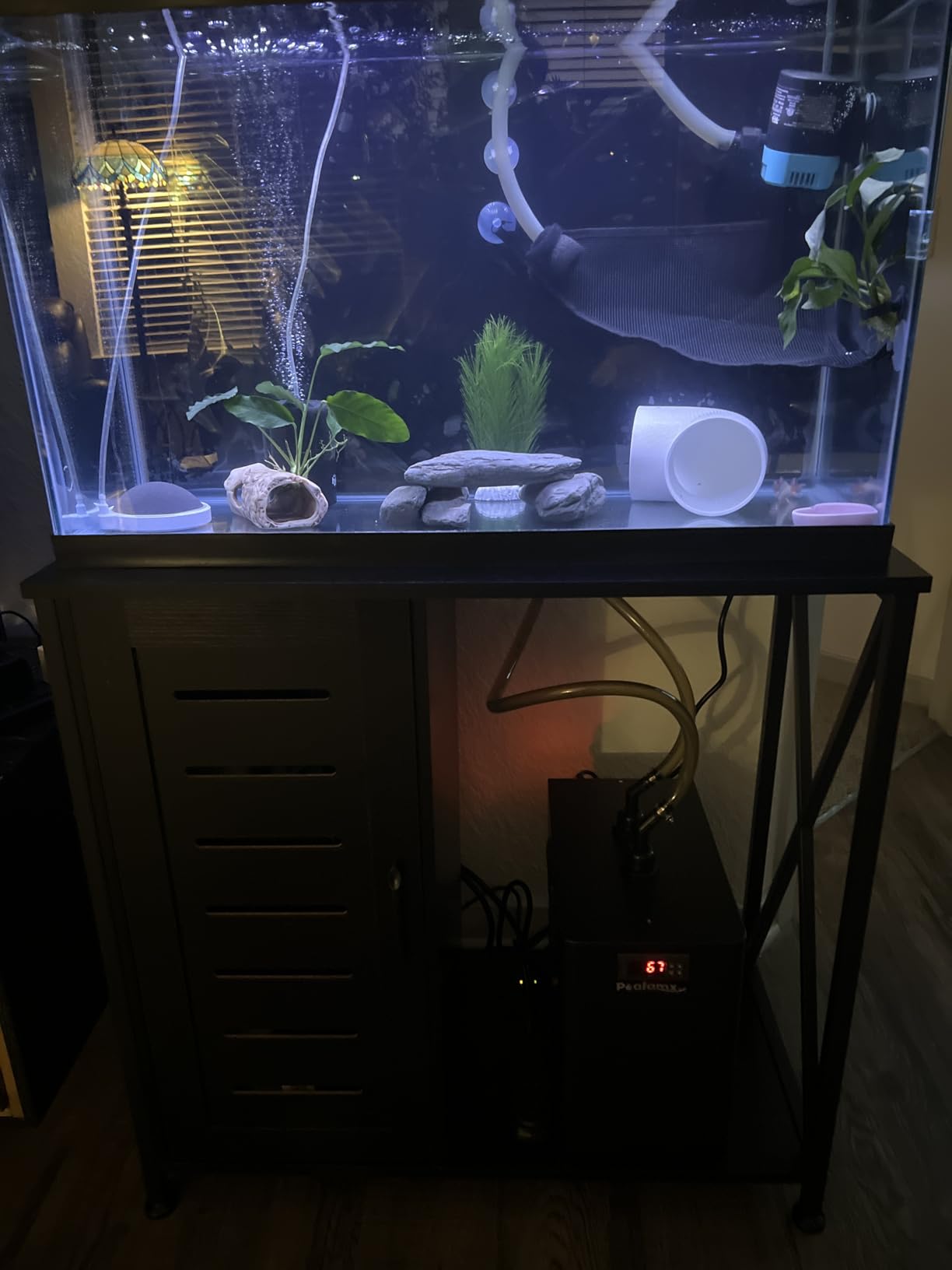
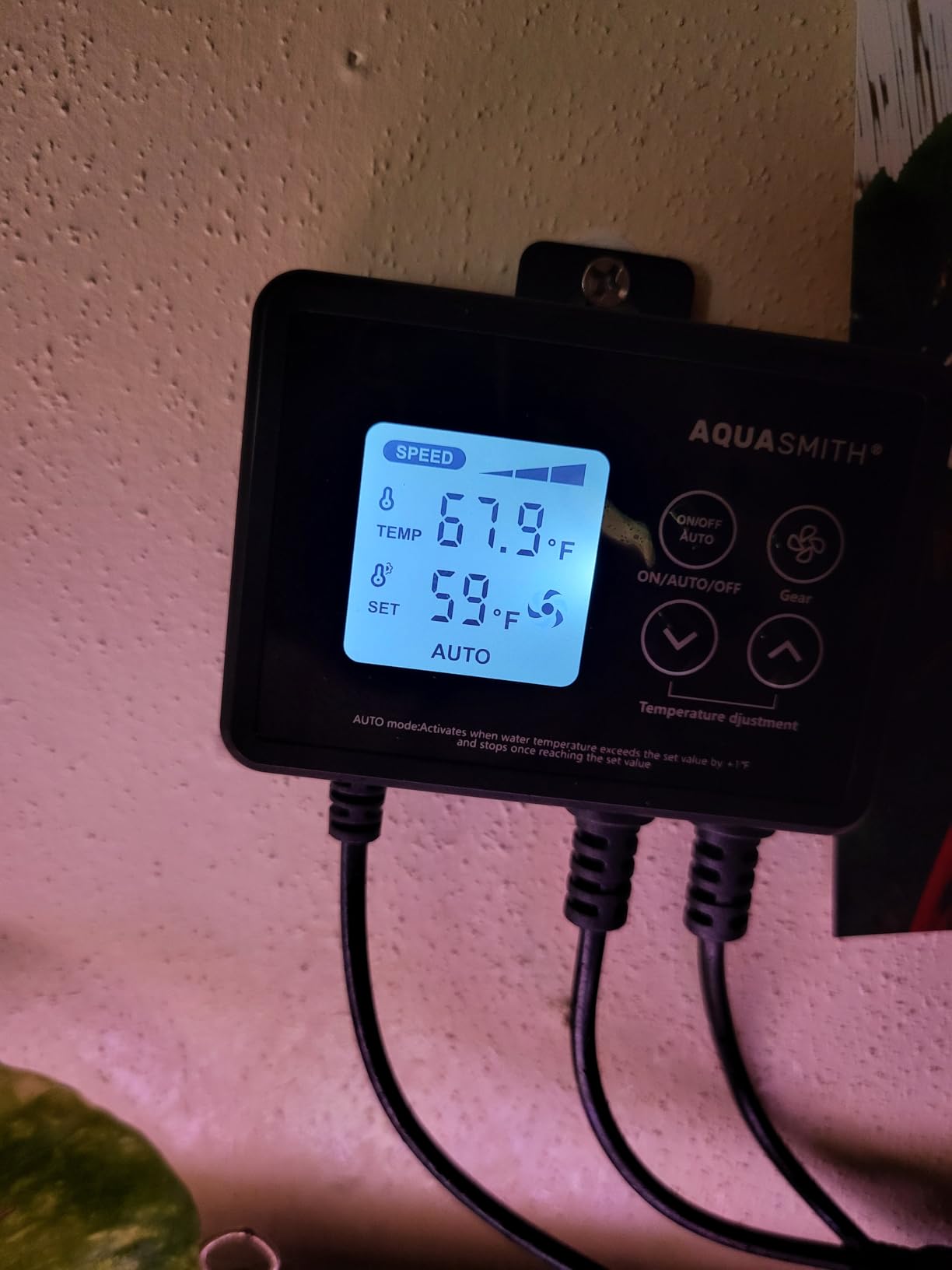
5. AQUASMITH Aquarium Chiller Fan with Temperature Control – Best for Axolotl Tanks on a Budget
AQUASMITH Aquarium Chiller Fan,Fish Tank Cooler with Temperature Control,Minimum Setting 59℉,Auto Start/Stop,Refrigeration Effect 3-7℉,3-Speed Modes,for Axolotl Seawater Freshwater Coral Grass Tank
Evaporative cooling fan
Setpoint 59-93F
3-7F cooling effect
Built-in temperature probe
Under 40dB
Pros
- Tanks up to 20 gallons for a fraction of the cost of a chiller
- Built-in probe and LED controller automate the on and off cycling
- Wide 59-93F setpoint range suits cold-water species
- Dual brushless fans run under 40dB
- Adjustable clip fits a wide range of rims
Cons
- Evaporative only
- so cooling is capped by room temperature and humidity
- Increases water loss and needs more frequent top-offs
- Some owners measure closer to a 3F drop than the advertised 7F
This is the fan I recommend when the question is whether you need a chiller at all. It carries an independent LED display controller with a high-precision temperature probe, shows set and real-time temperature at the same time, and starts and stops automatically once the set point is reached. That automation is what separates it from a plain clip-on fan, and axolotl keepers on the forums treat a multi-fan clip-on unit as the first line of defence above roughly 68-70F.
Cooling comes from evaporation, which is the whole story and the whole limitation. Rated effect is 3-7F with three speed modes, dual brushless fans at 3000 rpm and 3 m/s airflow, and operation under 40dB. The adjustable clip spans 0.2 to 0.95 inches, and the fan head rotates 360 degrees with 30 degrees of airflow angle adjustment.
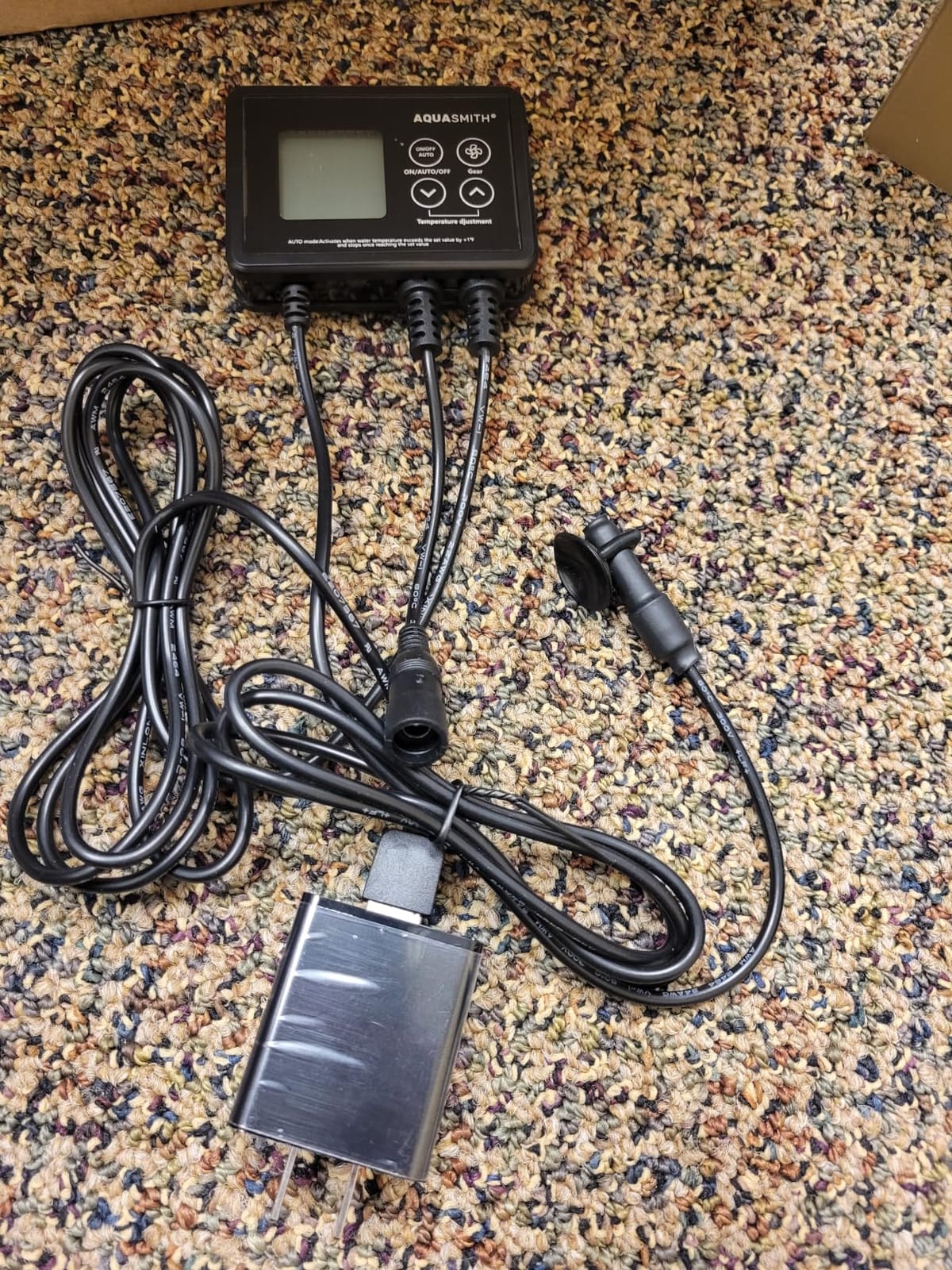
The probe is a ceramic type rated for both salt and fresh water, which matters more than it sounds because a bare steel probe in a reef tank is a corrosion problem you inherit. The setpoint range from 59F to 93F is unusually wide for a fan and lets you dial in a low target for amphibians without hunting through presets.
Understand the ceiling before you buy. An evaporative unit can only approach ambient temperature, and it works faster in dry air than in a humid room. Owners report results closer to 3F than the advertised 7F, and the extra airflow increases evaporation, so you will be topping off more often. If your room holds 78F in July, no fan will hold 68F.
Is a temperature-controlled fan enough for a 20 gallon axolotl tank
For a 20 gallon tank, often yes, if the room is not already at your target. A fan rated 3-7F with a probe-based controller can take the edge off a mild day and keep the tank a few degrees cooler than it would sit otherwise. It is also the cheapest way to find out whether your room is the real problem.
The failure mode is humidity. In a muggy summer room the evaporative ceiling drops and the fan chases a number it cannot reach, which is exactly when the aquarium controller and a real compressor become worth the money.
When to skip this one
Skip it if you need water reliably below room temperature, if you live in a humid climate and no dehumidification, or if you hate top-off routines. It is also the wrong tool for a 40 gallon plus tank on its own.
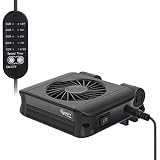
6. hygger Aquarium Chiller Fan with Timer Controller – Budget Pick
hygger Aquarium Chillers Fan, Quiet Fish Tank Cooling Fan Equipment with Adjustable Timer Speed Controller, Suitable for Freshwater Saltwater Tanks(1-Fan Head)
Evaporative cooling fan
Five speed levels
Timer from 0.5 to 12 hours
One controller drives 1-3 heads
Pros
- Five speed levels cover summer through to shoulder seasons
- External timer controller removes daily on and off handling
- Quiet copper core motor on FDB bearings
- One controller can run 1-3 fan heads
Cons
- Cooling is evaporative only
- so room temperature sets the limit
- Clip only fits tank walls under 0.45 inches thick
- Single fan head gives limited airflow for larger tanks
This is the pick if you want scheduled cooling across more than one tank. The external controller offers timer settings from 0.5 to 12 hours, and a single controller plus cord can drive one to three fan heads across multiple tanks. For a household running an axolotl tank and a shrimp tank in summer, that is a useful feature rather than a gimmick.
The motor is an all-copper core with FDB bearings inside an ABS shell, and there are five wind speed levels for seasonal adjustment plus independent fan head angle adjustment. Owners highlight quiet operation as the standout alongside the controller, which is why it rates well across nearly five hundred reviews.
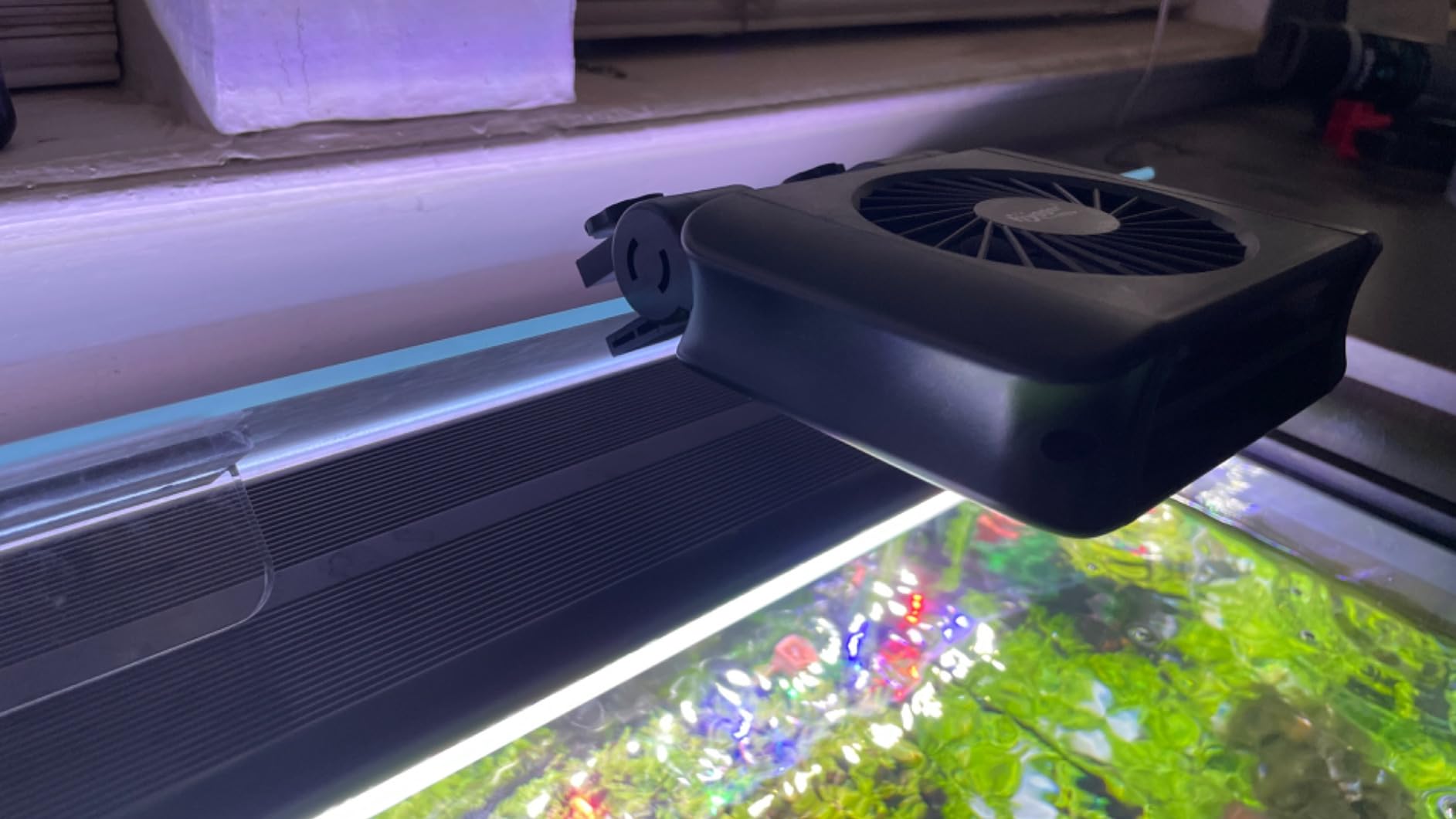
Physical limits are worth checking before you order. The clip fits tank walls under 0.45 inches thick, which covers most rimmed glass but excludes thicker low-iron panes and many rimless designs. The unit weighs 14.46 ounces and measures 7.76 by 5.39 by 2.17 inches, so mounting weight is never the issue. Fit is.
Like every fan in this group, it cools by evaporation only. If the room is already at 76F, the tank will drift toward that number no matter which speed you select. Budget fans earn their place as a first move and as a supplement to a chiller that already handles the heavy lifting on a large tank.
Can one controller run fans on two different tanks
Yes. The controller and cord are rated to drive one to three fan heads, so a single timed schedule can run a fan in the living room and another in the bedroom on the same programme. Just keep each fan within the tank size where the airflow actually makes a difference, which for a single head is a small tank.
For a small axolotl tank where the goal is a few degrees of relief, five speed levels and a timer are enough to build a decent summer routine without a chiller.
When to skip this one
Skip it if your glass is thicker than 0.45 inches, if the tank is rimless with no clamp surface, or if you need temperatures below ambient. One fan head also gives you limited airflow, so a single head is not the answer for anything above a small planted tank.
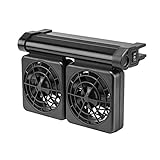
7. DaToo Aquarium Cooling Fan – Most Reviewed Unit in the Set
DaToo Aquarium Chiller Fish Tank Fan Aquarium Cooling Fan, 1 Yr Warranty
Clip-on evaporative fan
4-6F cooling effect
Two speed settings
12V low voltage
Adjustable 90-190 degrees
Pros
- A cheap way to drop tank temperature by several degrees
- Clip-on install with no tank modification on most setups
- Two speed settings and adjustable direction
- 12V low-voltage design is safer around water
Cons
- Clip does not fit every rim style and may need a hood trimmed
- Audible on the higher setting despite quiet marketing
- Cooling effect is limited on larger tanks
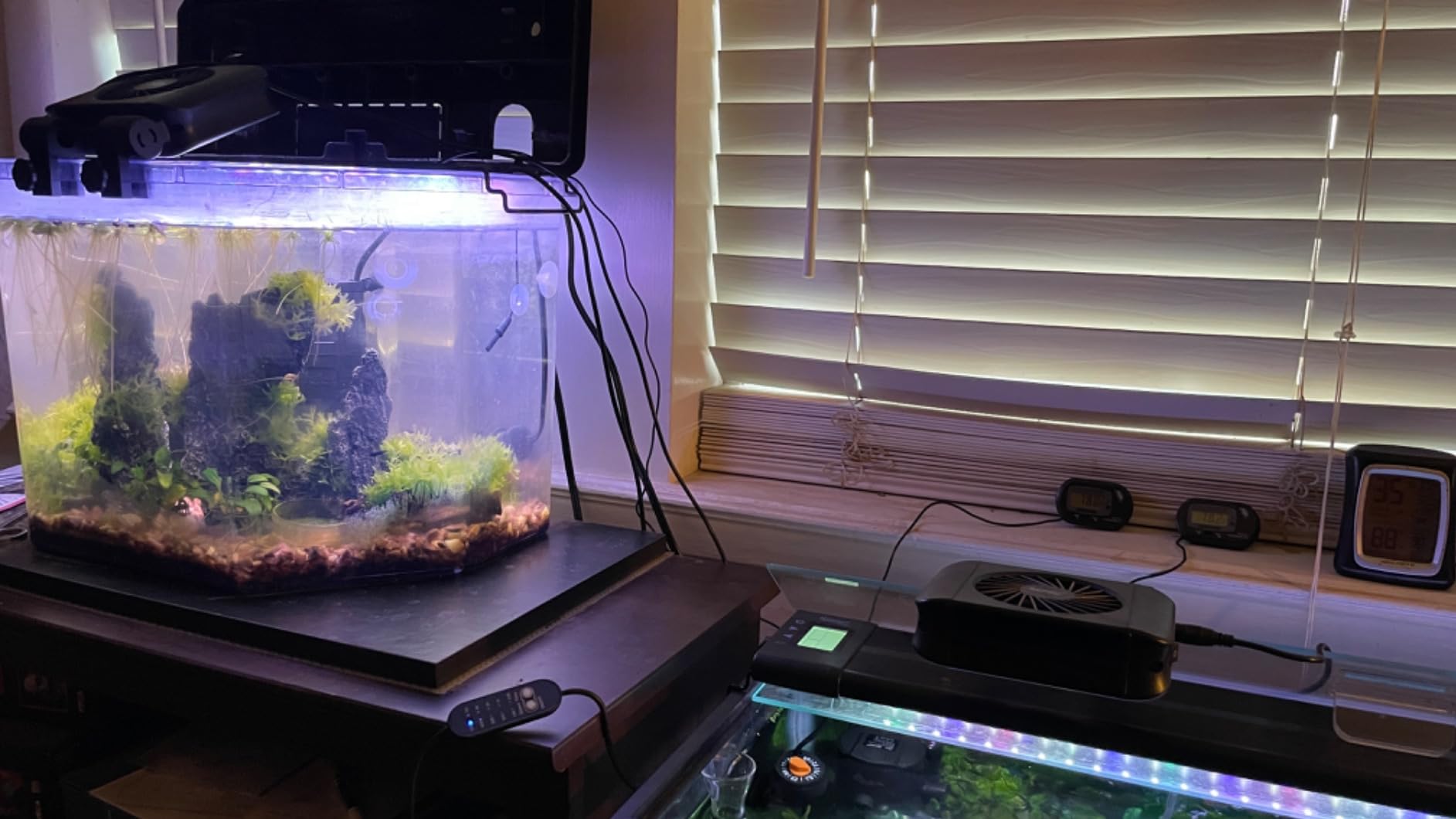
With 908 reviews this is the most heavily reviewed product in the roundup, and owners overwhelmingly use it the same way: on 5-30 gallon tanks as a cheap supplement or a stopgap before committing to a compressor. The cooling effect is rated 4-6F with two speed settings, and the fan head adjusts through a 90 to 190 degree range so you can aim airflow across the surface rather than straight down.
Safe installation is the design’s strongest argument. It runs on 12V low voltage, which matters when a device clipped to a wet glass edge is the thing keeping an axolotl alive. The body is engineering grade ABS with an aluminum alloy clip, weighs 1.25 pounds and measures 8.5 by 5.3 by 3.1 inches.
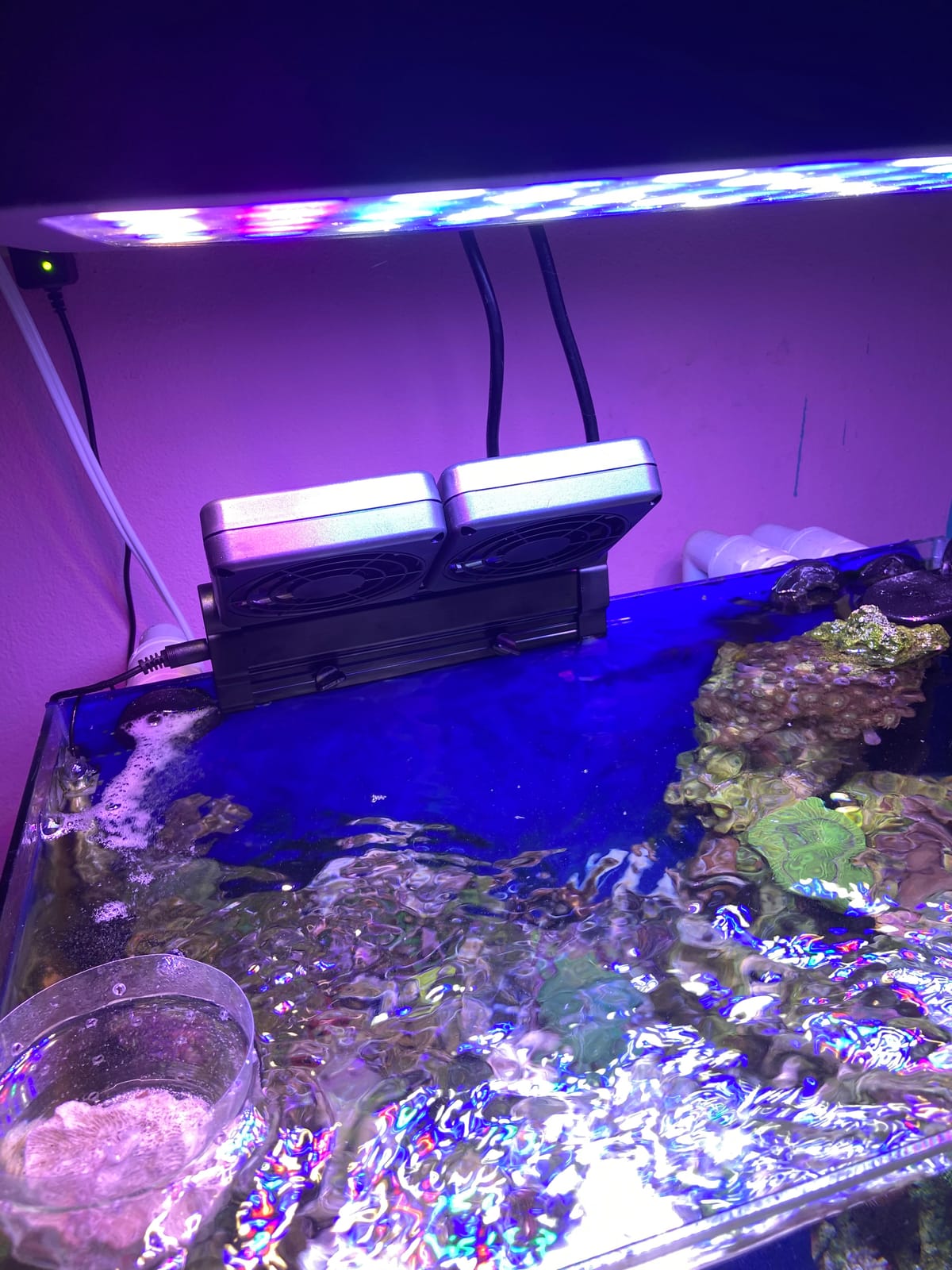
The marketing says the fan is rated 10-12dB quieter than comparable products, and in our experience that claim holds on low. On the higher setting it is plainly audible, so treat the speed control as a daytime and nighttime setting rather than a preference. The one-year warranty and 24-hour customer support are also stated on the listing.
The recurring complaint is fit. The clip does not suit every rim style, and some owners trim a hood to make it work, which is a modification most people would rather avoid. The second complaint is scope: cooling effect is limited on larger tanks, because a single small fan cannot move enough air across a wide surface to drop the whole volume.
Is this good enough on its own for a 10 gallon tank
For a 10 gallon tank, usually yes in most rooms. A small water column loses heat quickly, and a single fan delivering a rated 4-6F of evaporative cooling is usually enough to hold a shrimp or juvenile axolotl tank steady without a chiller. It is also the cheapest way to test whether your summer problem is a real heat load or just a warm lamp.
Pair it with a cheap thermometer and give it a week. If the tank holds the range you want, you have saved a lot of money. If it drifts with the room, you have learned what you need to know for a chiller decision.
When to skip this one
Skip it for tanks over 30 gallons, for rooms you need to keep quiet at night, and for rim styles the clip cannot grip. It is also the wrong choice if you cannot commit to regular top-offs, because the cooling mechanism is evaporation.
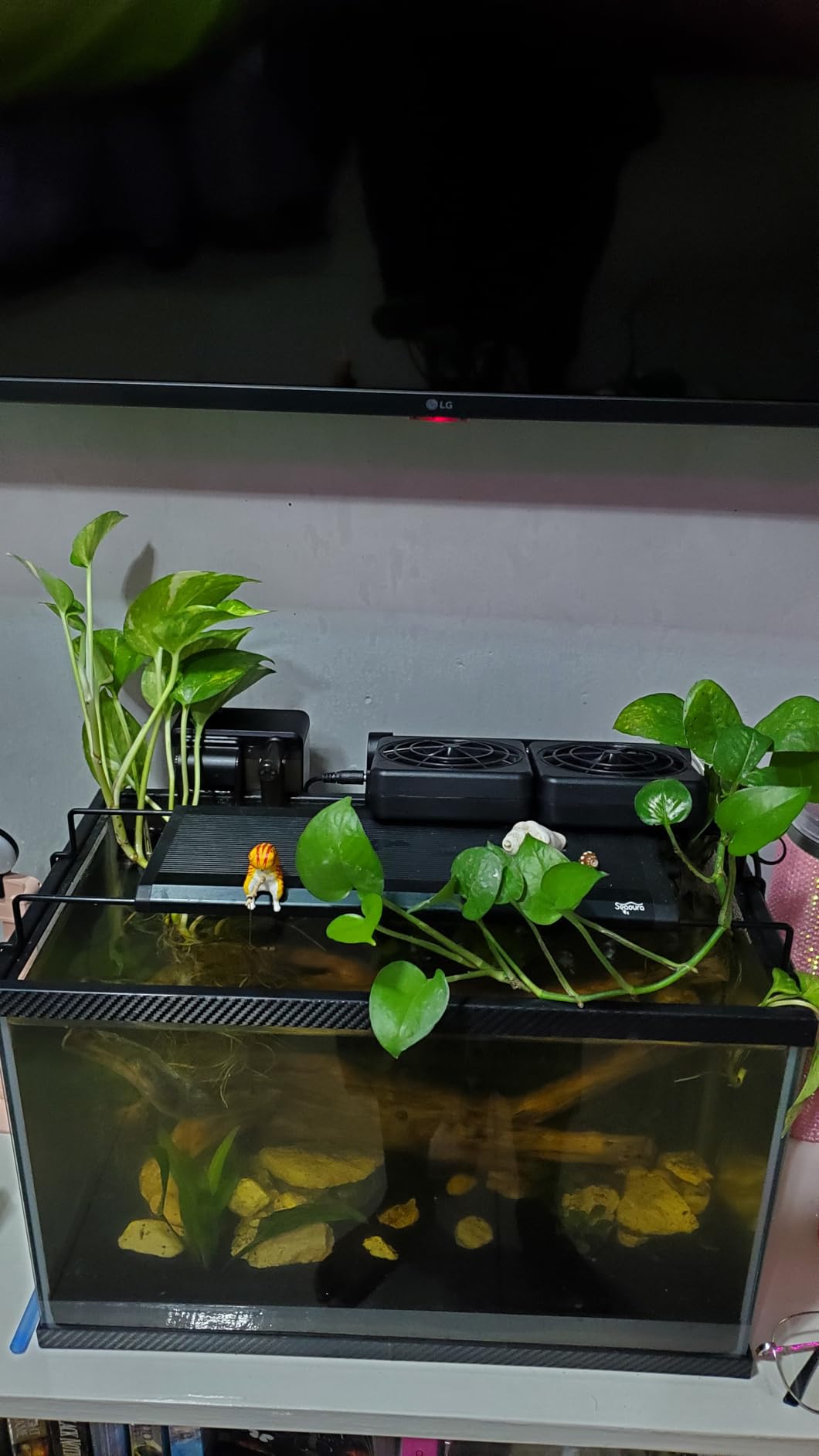
8. PAIZOO Aquarium Chiller Fan PZBS-2 – Best for Nano Tanks
PAIZOO Aquarium Chiller Fan, Ultra-Quiet Fish Tank Cooler with 3 Speed Mode
Dual turbo evaporative fan
Three speed modes
USB powered with 5V adapter
Recommended up to 20 gallons
Pros
- Among the most reviewed units we covered
- Quiet dual-fan design with copper motors and mute bearings
- Three modes cover night
- all-day and rapid cooling
- Wide clips fit most standard rimmed tanks
- USB powered with adapter included
- no wall wiring
Cons
- Manufacturer rates effectiveness for tanks up to 20 gallons
- Cooling is evaporative and limited by ambient conditions
- Increases evaporation and requires more frequent top-offs
This is a straightforward nano and small-tank fan. The manufacturer rates it for tanks up to 20 gallons and advises multiple fans for anything larger, which is honest guidance you rarely see in this category. Axolotl keepers use it as a budget alternative to a compressor chiller, and the three speed modes let you run a quiet setting at night and a stronger one in the afternoon.
Build quality is above what the price suggests. The motors are pure copper, the bearings are double-capped mute types, and the fan angle adjusts 45 degrees. Power comes from USB with a 5V 2A adapter included and a 150 cm cable, so there is no mains adapter sitting behind the tank and one fewer thing to trip over.
Draw is modest at 6.4 watts, which is roughly nothing on a power meter and one of the strongest arguments for fans in general. A six-watt load running continuously all summer is effectively invisible on a bill, which is not true of a compressor chiller working against a hot room.
Clips fit aquarium walls under 26mm thick, which covers most rimmed tanks but not thick low-iron glass. Reviewers are clear that the evaporative ceiling is the binding constraint, and that increased evaporation means more frequent top-offs. On a nano tank that is a two-minute job once a week.
Does a 6 watt fan really make a difference in summer
On a nano tank, yes. Water surface area relative to volume is high in a small tank, so a focused airflow across the surface strips a surprising amount of heat. The catch is that the room sets the floor, so in an 80F room the tank will settle above 70F no matter which of the three modes you pick, and the fan will simply be chasing a target it cannot reach.
For a shrimp tank, a juvenile axolotl, or a hospital or quarantine tank, the three modes make this an easy daily tool. Run it on low overnight, standard during the day, and high in the late afternoon when the room peaks.
When to skip this one
Skip it for tanks over 20 gallons, for glass thicker than 26mm, and for anyone who needs a set temperature below ambient. If your room runs hot and humid, spend the difference on a small compressor chiller instead.
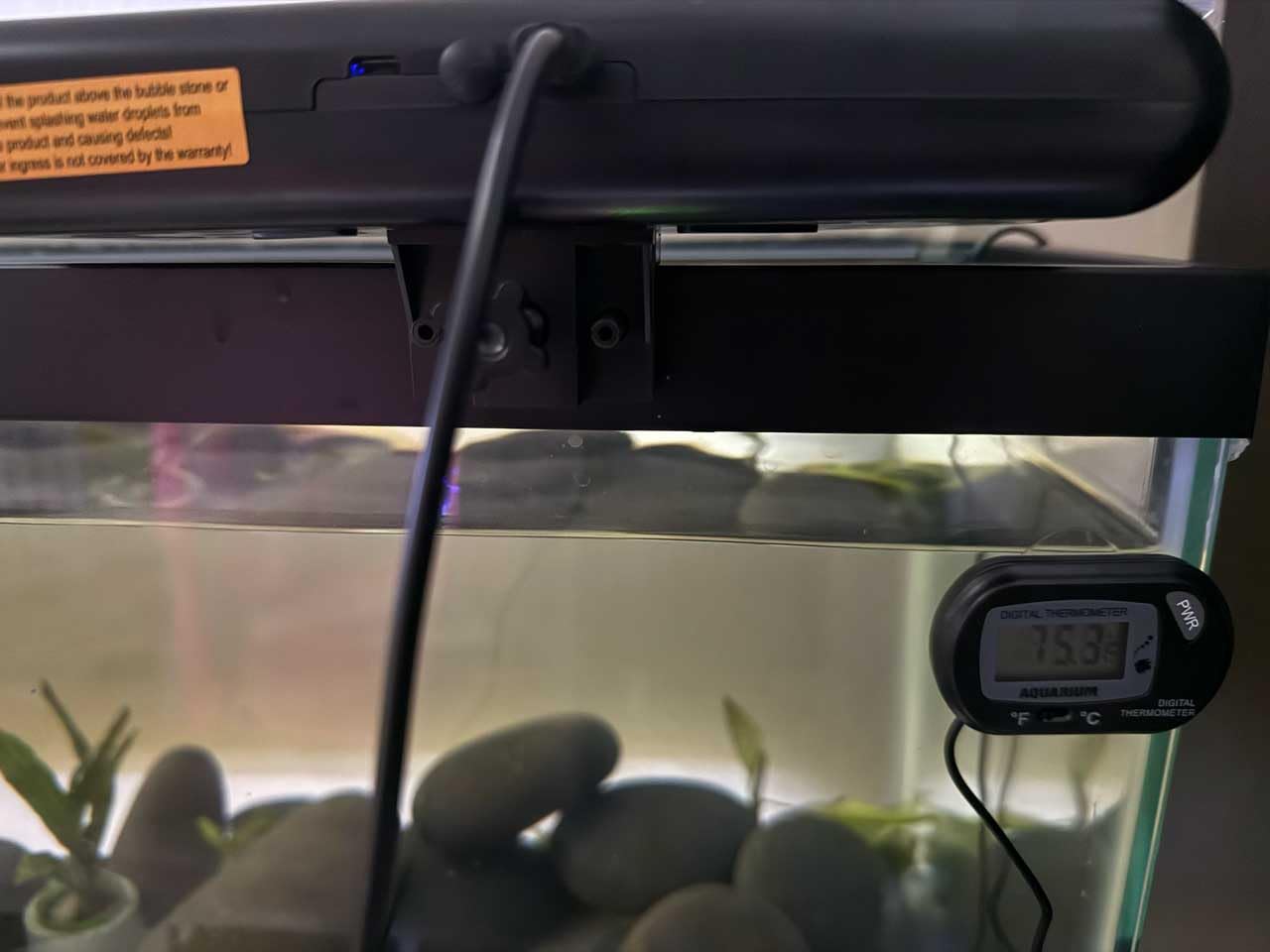
9. Liveek Aquarium Fan 4 Head – Best Multi-Fan Coverage
Liveek Aquarium Fan 2 3 4 Heads, Aquarium Chillers Cooling Fan Adjustable Fish Tank Cooling Fan with 2 Wind Speed Fan for Water Tank, Aquarium Tank Chiller (4 Head)
Four fan heads
2-4C cooling effect
Two speed settings
About 30dB low, 50dB high
Pros
- Four fan heads cool 20-40 gallon tanks more evenly than a single fan
- Low setting is quiet at roughly 30dB
- Each head adjusts through 100 degrees
- Hand-screw bracket needs no tools
Cons
- Bracket does not clamp to every rim and may not fit rimless tanks
- High speed is noticeably loud at around 50dB
- Several owners report fan failures within weeks or months
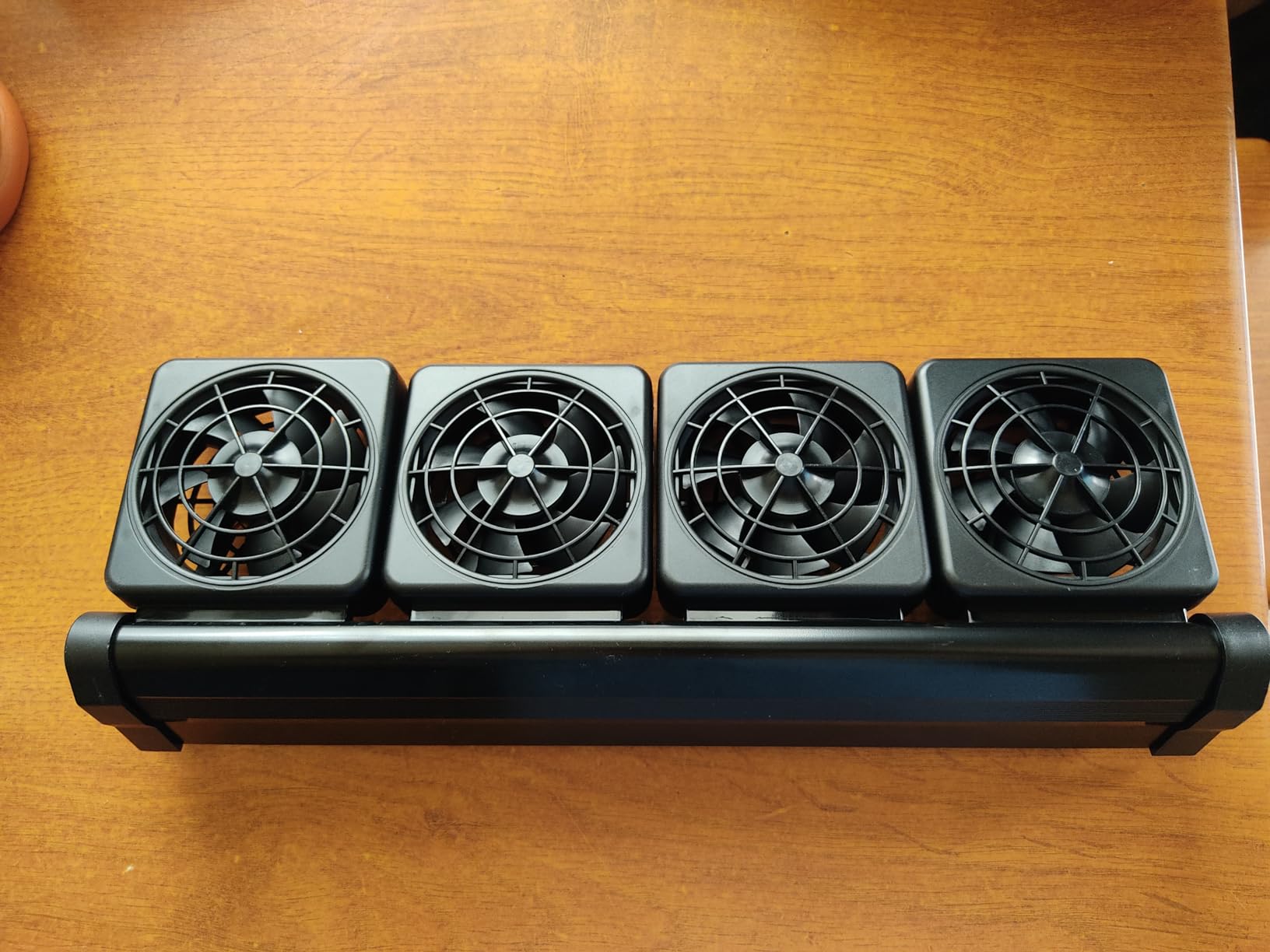
When one fan head is not enough airflow, four is the sensible jump. Owners of small-to-mid axolotl and reef tanks report meaningful temperature drops on 20-40 gallon setups, with a rated 2-4C cooling effect and two speed settings. Because each head has 100 degrees of angle adjustment, you can spread the airflow along the back of the tank instead of hammering one corner.
The bracket is the part that decides whether this works for you. It is a hand-screw aluminum alloy bracket that clamps glass up to 0.47 inches or 1.2cm thick, and it needs no tools. Variants with two and three heads exist as well, which is worth knowing if four fans is more cooling than your tank needs.
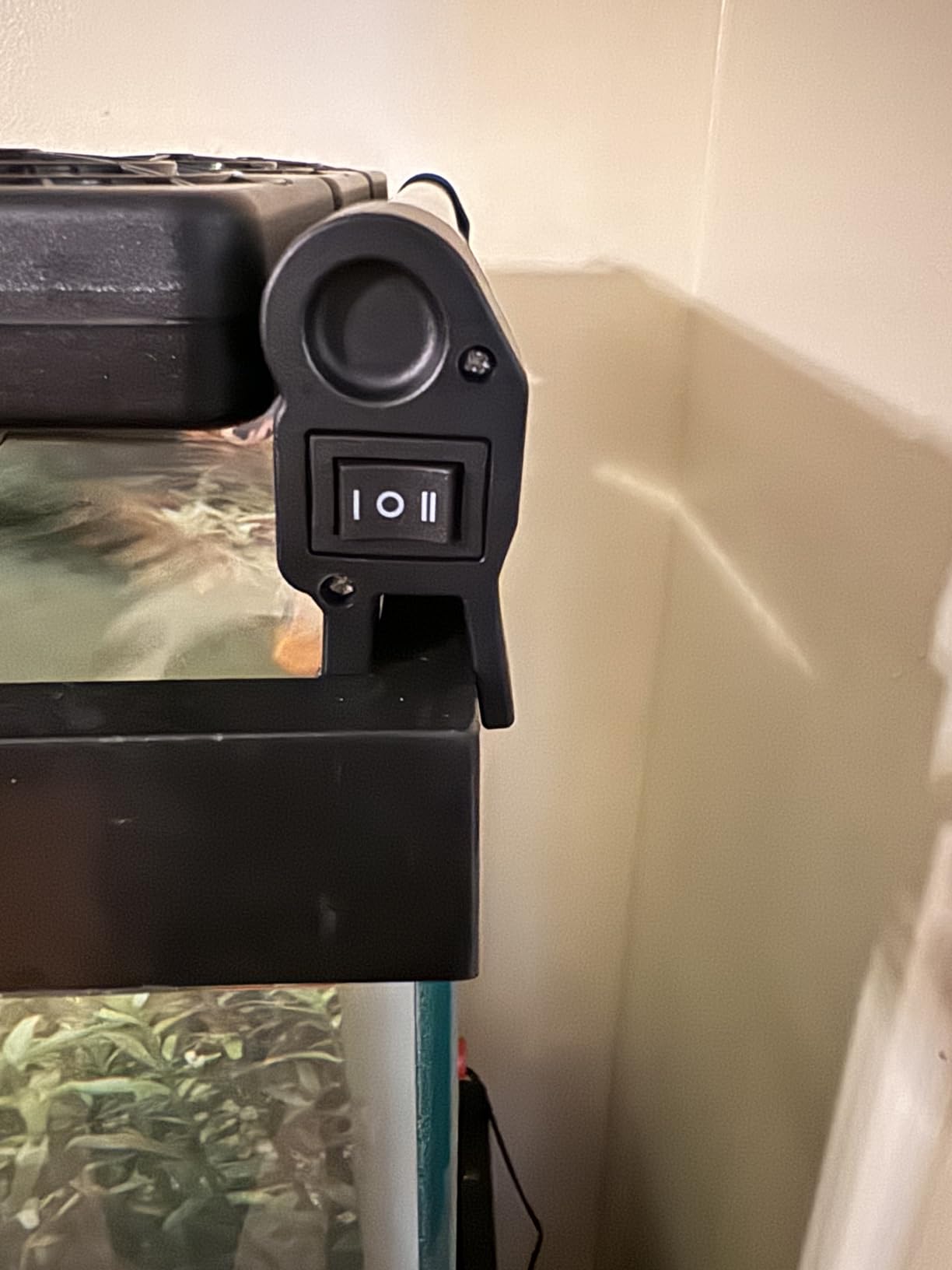
Noise is the trade-off. The listing puts operation at about 30dB on the first gear and 50dB on the second, and reviewers confirm that split. On low it is genuinely quiet for a multi-fan unit and fine in a bedroom. On high it is noticeably loud, and on a 4-head unit the four motors compound, so a bedroom at that setting is a stretch.
Reliability is the other flag. Several owners report fan failures within weeks or months, and multi-head units give you more failure points than a single head. Evaporation also increases sharply with four heads running, so expect to top off more often, particularly in low-humidity weather.
Is four heads better than one head of the same size
For air distribution, yes. Multiple heads spread evaporation across the whole surface rather than creating one cold patch, which produces a more even tank temperature and fewer warm corners for algae to exploit. The trade is cost, noise at high speed and more points of failure.
For a 20-40 gallon tank where you cannot cool the room, four heads is a reasonable bridge while you decide on a compressor. For a 10 gallon nano, one or two heads is plenty.
When to skip this one
Skip it for rimless tanks where the bracket has nothing to grip, for anyone sensitive to 50dB, and for setups where frequent water top-offs are a problem. The mixed reliability record on the multi-head units is the main reason it sits this far down the list.
10. AQUASMITH Aquarium Fan AFan-PV – Best for Rimless Tanks
Aquarium Fan,Ultra-Quiet Fish Tank Cooler,More Powerful,Cooling Effect 3-7℉ with 3 Speed Modes Adjustable Applicable Aquariums with or Without Edges, for Axolotl Seawater Freshwater Coral Grass Tank
Evaporative fan for 20-50 gallon tanks
3-7F effect
Three speed modes
About 35dB
Adjustable 0.2-0.95 inch clamp
Pros
- Very quiet at roughly 35dB for bedroom and nighttime use
- Clamp fits both rimmed and rimless aquariums
- Brushless motor with 58 blades at up to 3600 RPM
- 360 degree rotation with 30 degree airflow adjustment
Cons
- Evaporative cooling only
- so it cannot cool below room temperature
- Increased evaporation means frequent top-offs
- Some owners measure a 2-3F drop rather than 3-7F
- Mounting suits open-top tanks more than covered ones
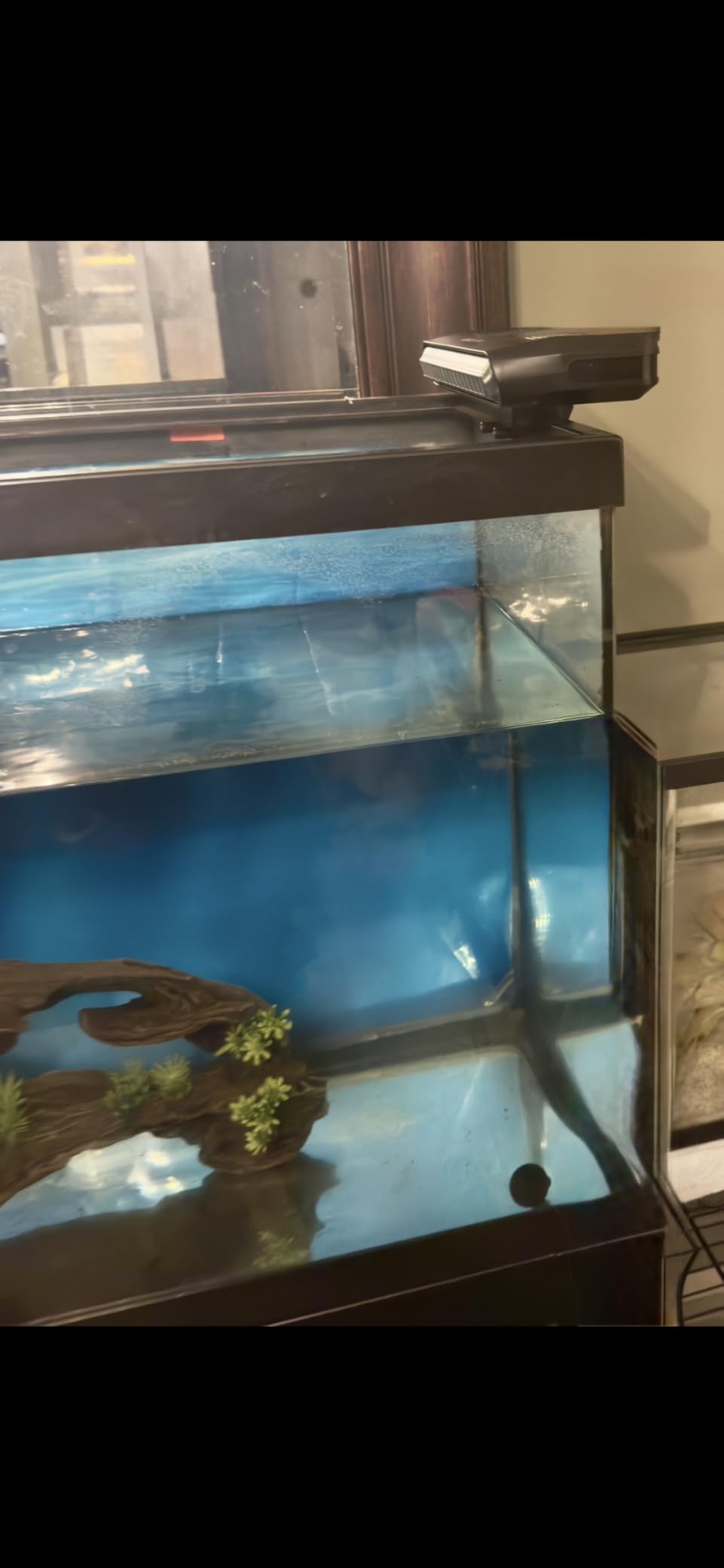
This is the fan we suggest for a rimless aquarium, where a bracket-style clip has no rim to grip. The adjustable clamp spans 0.2 to 0.95 inches, the fan head rotates 360 degrees and the airflow angle adjusts 30 degrees, which is enough freedom to place it on any pane of a low-iron tank without drilling or modifying anything.
The motor is a brushless dual-turbine design with 58 high-density blades turning at up to 3600 rpm, pushing air through a pressurised duct focused on the water surface. Rated range is 20-50 gallons with a 3-7F cooling effect across three speed modes, and operation is about 35dB, which is the number that puts it between a quiet single clip-on and a multi-head unit.
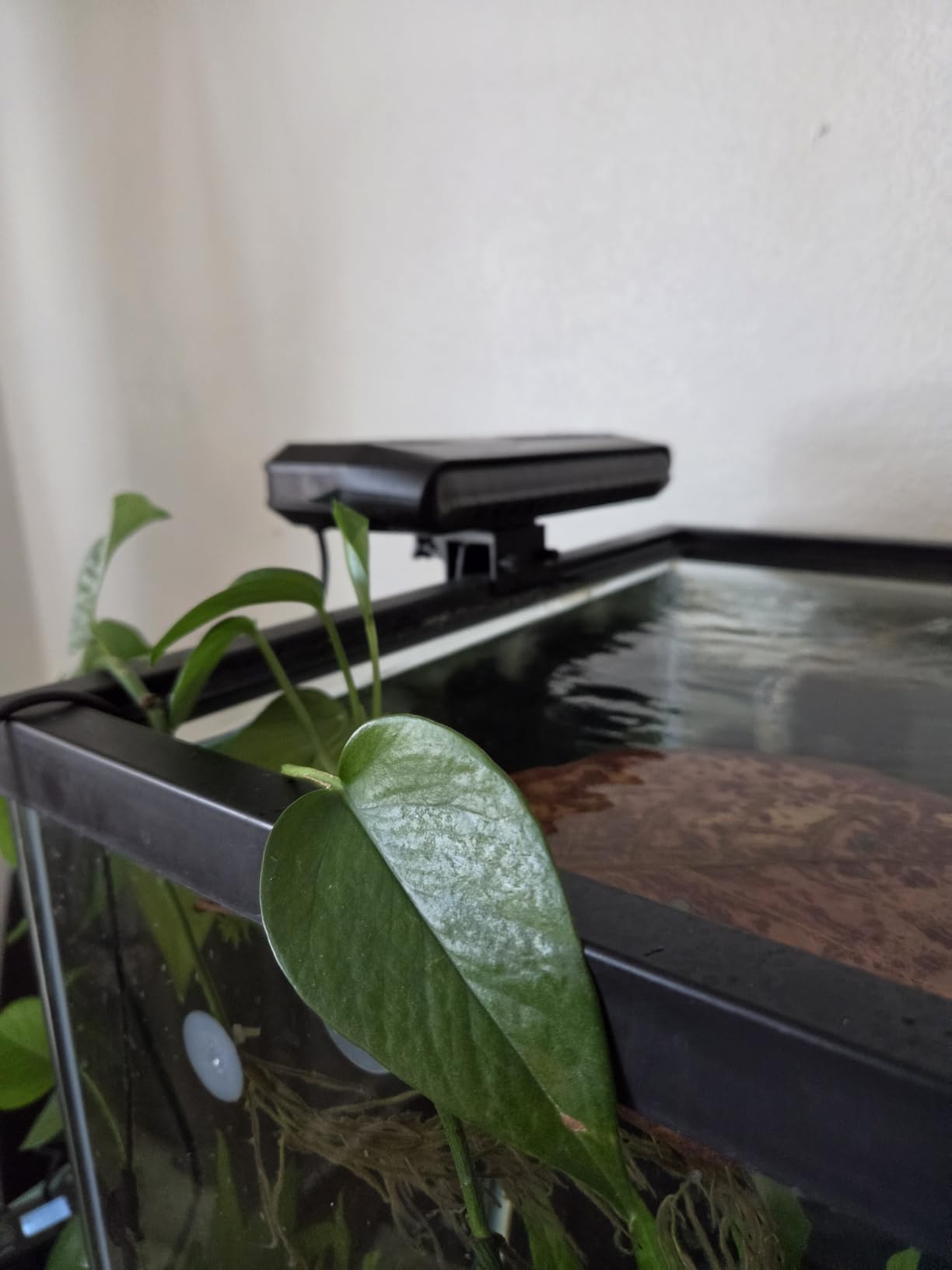
That 35dB figure is why it earns its place in this list. It holds a moderate airflow without the noise that makes fans unpopular in bedrooms. Reviewers with newer tanks consistently praise the stable clamp fit and the removable rotating mount.
Be realistic about the numbers, though. Reviewers repeatedly measure closer to a 2-3F drop than the advertised 3-7F, and that gap between the claim and the result is the single most important thing to understand about evaporative cooling. The unit weighs 1.12 pounds, measures 8.66 by 3.86 by 1.63 inches and includes a power plug, so it is a self-contained addition to a setup with no plumbing.
Is this quiet enough to run overnight in a bedroom
At about 35dB and in its gentle mode, yes. That is roughly the level of a quiet home office, and it is far below the compressor hum of any of the chiller sections in this roundup. Because it has a low setting specifically, you can run it all night without it registering as noise.
Over a covered tank, the effect drops because airflow is not reaching open surface. On an open-top or lightly covered display it performs as rated.
When to skip this one
Skip it if you need water below room temperature, if your tank is over 50 gallons, or if top-off frequency is a problem for you. It is also a weaker choice than a four-head unit for very large surface areas, because a single head simply moves less air.
11. PAIZOO Aquarium Chiller Fan PZBS-3 – Best with a Temperature Probe
PAIZOO Aquarium Chiller Fan, Auto Temp Control Water Cooler with Temp Probe
Evaporative fan with immersed probe
LCD readout
50-99F setpoint
Auto start and stop
Three speed modes
Pros
- Immersed temperature probe with LCD display gives real readings
- Automatic on and off cycling once the setpoint is reached
- Very wide 50-99F setpoint range
- Three modes include a quiet night setting
Cons
- Manufacturer rates it for tanks up to 20 gallons
- Cooling is evaporative and limited by room conditions
- Set temperature must sit at least 1F below the probe reading to trigger the fan
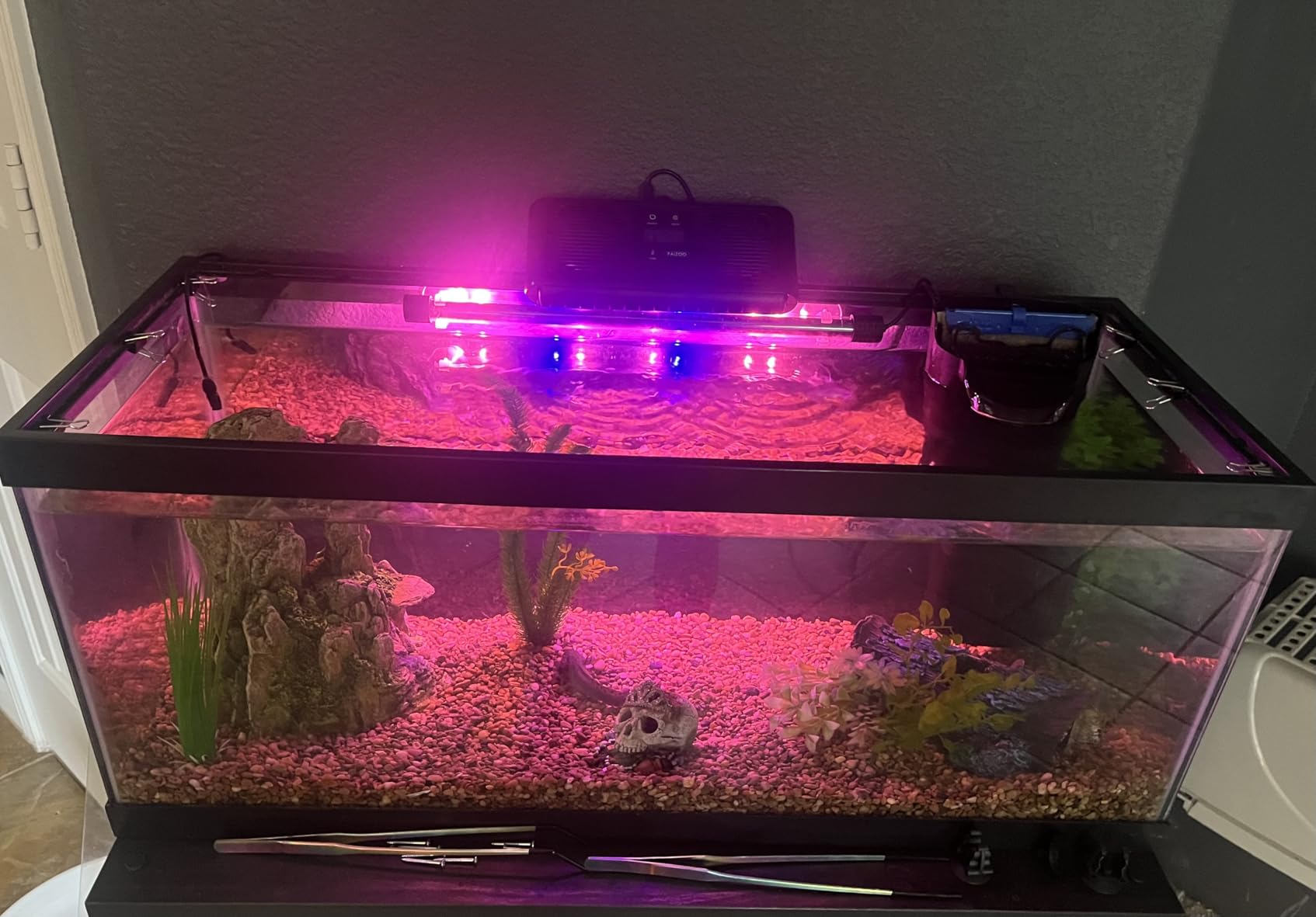
This is a probe-controlled fan, and that changes how you use it. Rather than guessing whether the tank is cool enough, the immersed high-precision probe and LCD readout show you the actual water temperature, and the fan cycles automatically once you reach the set point. For a small tank where you cannot afford a chiller, that is a real step up from a manual fan.
The setpoint range runs from 50 to 99F, which is wide enough to set an amphibian target well below anything a tropical tank needs. There are three speed modes including a quiet night mode, dual pure-copper fan motors with a 45 degree adjustable outlet, and USB power with a 140cm cable.
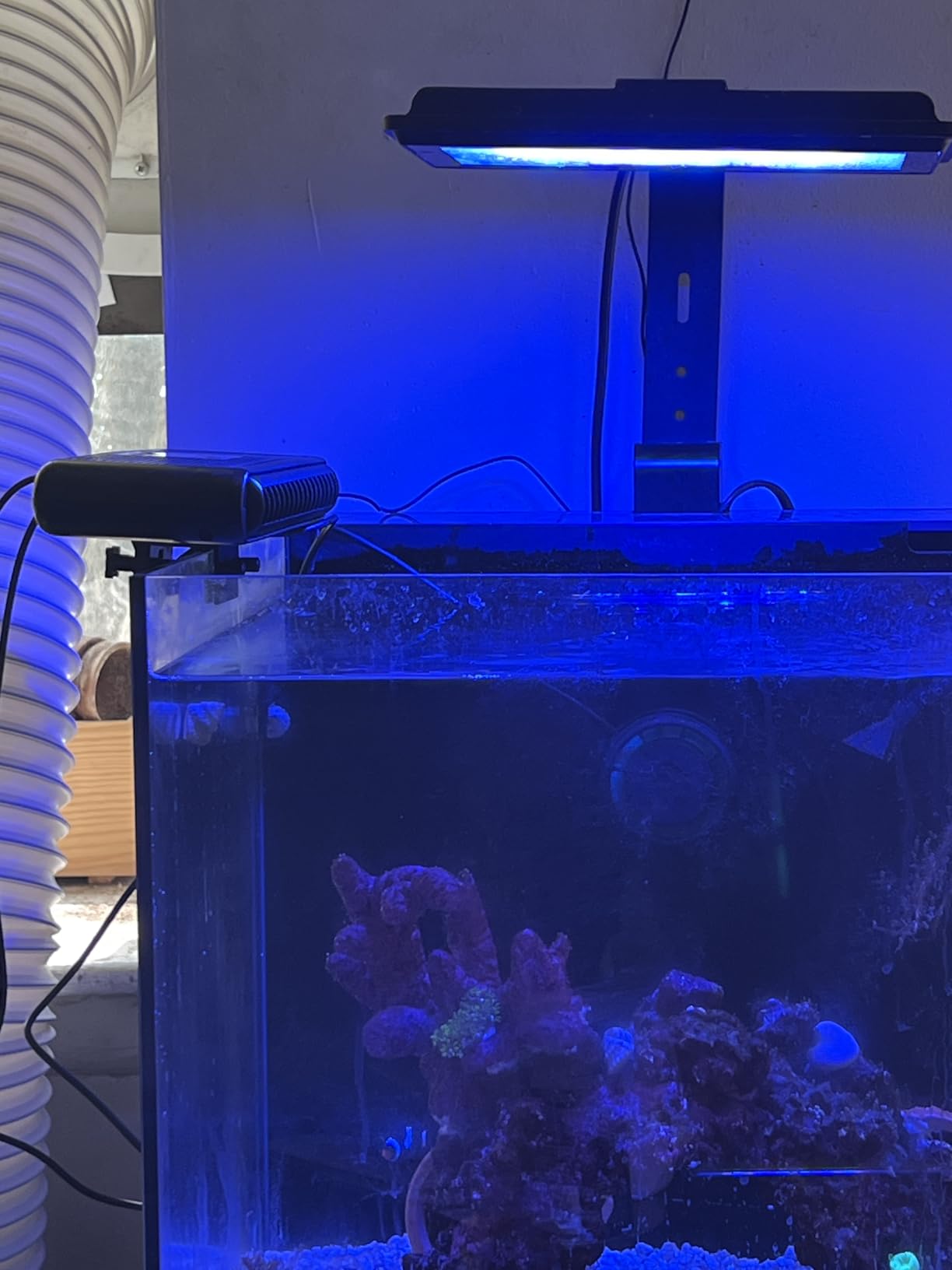
Two details matter for installation. The probe cable is 80cm, which is short, so the controller has to sit near the tank rather than across the room. And the fan only starts when the set temperature is at least 1F below the current probe reading, which trips up first-time users who set the target equal to the reading and then wonder why nothing happens.
Draw is 6.4 watts and the unit weighs 15.52 ounces, so it is a background appliance in every sense. Reviewers value the real-time temperature display and the auto start and stop, with the recurring caveats being the 20-gallon sizing guidance and the fact that cooling stops at ambient.
Is the probe accurate enough to run a shrimp tank on its own
For a small shrimp or fry tank, a probe-controlled fan is a sensible way to hold a ceiling without a chiller. You get a real reading, automatic cycling and a night mode, and the 6-watt draw is irrelevant on a power meter.
What it cannot do is fight the room. If your living room holds 79F in July, the probe will keep reporting a temperature that climbs all afternoon, and the fan will simply run at high speed trying to close a gap that evaporation cannot close.
When to skip this one
Skip it for tanks over 20 gallons, for set points below room temperature, and if you need the controller mounted away from the tank. It is a small-tank tool by the manufacturer’s own guidance.
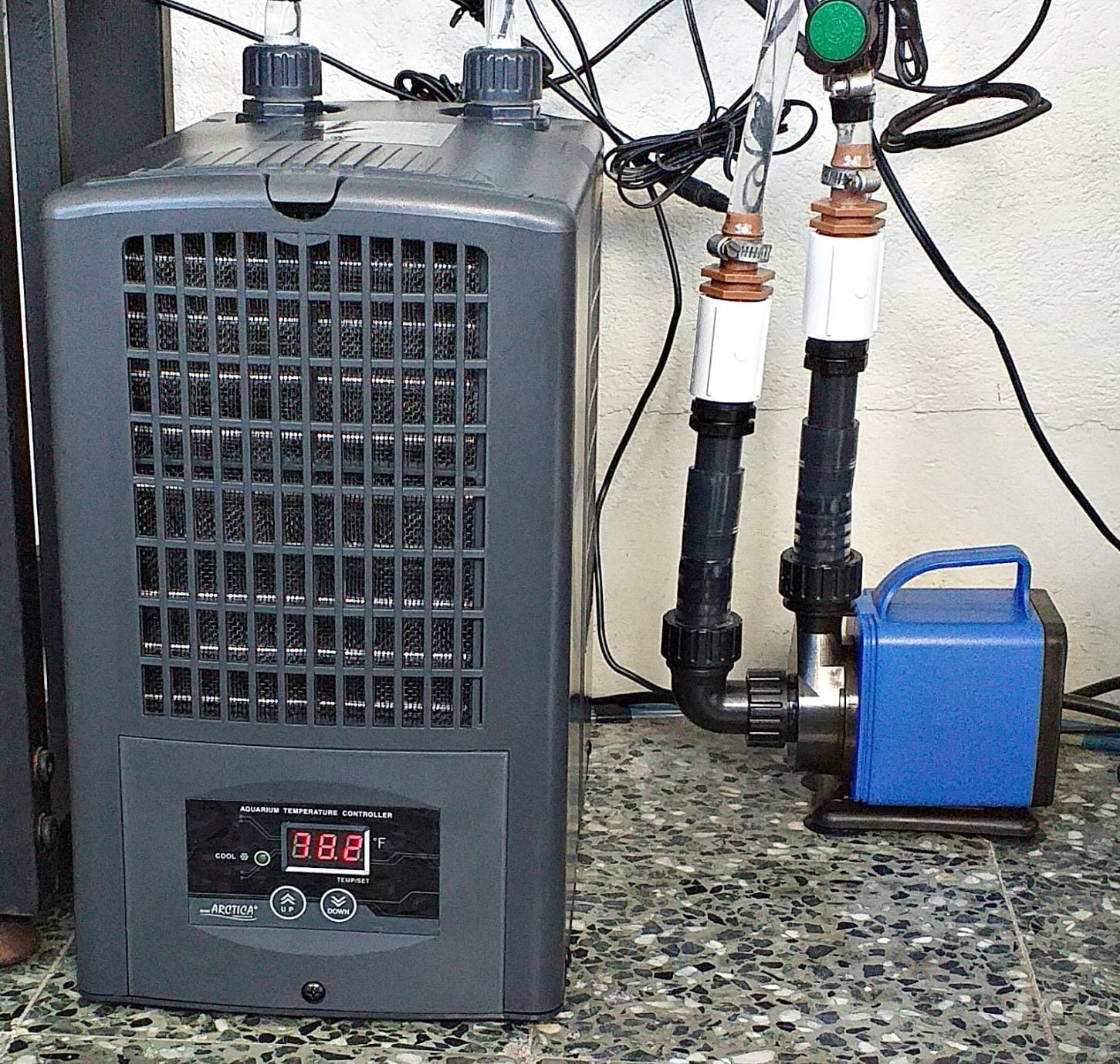
12. JBJ Arctica Aquarium Chiller 1/15 HP – Quietest Inline Compressor Chiller
JBJ Arctica Aquarium Chiller, 1/15 HP
1/15 HP inline chiller
Titanium coil heat exchanger
Compact housing
Runs quietly
Low energy draw
Pros
- Titanium coils resist corrosion and exchange heat efficiently
- Among the quietest compressor chillers available
- Compact contemporary footprint for small tank setups
- In-line series installation suits simple plumbing
Cons
- 1/15 HP capacity suits only modest tank sizes
- Older listing with a small review base
- Requires a compatible pump and plumbing to run
The JBJ Arctica is the name that comes up most often in aquarium forum threads when people ask which chiller is quietest, and owners there compare its hum to a mini fridge. That is the standard worth holding any compressor chiller to. Multiple independent communities name it as the quiet, reliable recommendation, and for a bedroom or living-room tank that consistency matters more than any single spec.
The build is where the money goes. The coil material is titanium, which gives efficient heat exchange and real corrosion resistance, and the condenser is designed for low energy use. At 25 pounds and 12 by 16 by 15 inches, it is compact enough for a small stand, and installation is in-line series with quick installation in mind.
Capacity is the constraint. At 1/15 HP this is a small chiller, built for modest tank sizes, and the flow through it depends on a pump you supply. The technical data describes efficient inline series installation, so plan the plumbing as a loop: pump, chiller, back to the tank.
One thing to weigh honestly is the review base. This listing carries a much smaller pool of customer reviews than the budget units higher up in this list, so you are buying on brand reputation and build specification rather than on volume of owner feedback. If you are comfortable with that trade, the titanium coil and quiet compressor are the two things you are really paying for.
Is the JBJ Arctica worth it over a cheaper compressor chiller
If noise is the deciding factor, yes. A titanium evaporator and a compressor designed for quiet running cost more, and that money shows up most in a room where a 45-50dB hum would be annoying. In a utility room or a basement, a cheaper compressor unit is the more sensible purchase.
Titanium also removes a long-term worry on any tank that is not purely freshwater, and it is the reason reefers accept a chiller sitting in the return line rather than isolating it.
When to skip this one
Skip it for anything over about 30 gallons, because the 1/15 HP capacity will run constantly trying to keep up. Also skip it if you want a large body of owner reviews behind the purchase, or if you need a plug-and-play kit and do not want to source a pump.
Do You Need a Chiller? Fans vs Chiller vs Room Air Conditioning
A chiller is worth buying when your room temperature regularly exceeds your target water temperature. If the room sits below the number you need, a heater or a fan is enough and a chiller is wasted money. That single test eliminates most bad purchases, and it is the first question to ask before reading any product list.
Aquarium cooling fans are cheap, quiet and effective at removing a few degrees. They work by driving air across the water surface to raise evaporation, which removes heat from the water and dumps it into the room as humidity. Their ceiling is ambient temperature, and their performance drops in humid air. They also raise your water loss, so plan for more frequent top-offs.
Compressor chillers move heat from water to room air using refrigerant, an evaporator coil and a condenser. They cost more, take more space, add audible hum, and they are the only option that reaches temperatures below ambient. The trade is that a chiller heats the room slightly while a fan heats the room through humidity instead. A chiller owner on a forum reported a used unit that worked well but warmed neighbouring tanks by several degrees, which is the failure mode nobody mentions until it happens to them in a small room.
Room air conditioning is the third option and the one most people try first. If you already run a window or split unit for the house, cooling the room cools the tank passively, and it costs nothing extra to buy. It is noisy, it dries the room, and it only works while it is running. For axolotl keepers the consensus is that chillers are close to non-negotiable once water passes roughly 68-70F, with a multi-fan clip-on unit as the first line of defence for small tanks.
How to Size an Aquarium Chiller Without Guessing
Size on the temperature gap, not on gallons. A 40 gallon tank in a 70F room and a 40 gallon tank in an 85F room are completely different problems, and the second one needs far more cooling capacity than the first. Start by writing down your peak summer room temperature and your target water temperature, then subtract one from the other.
A useful way to think about it is that small home tanks need very little cooling capacity while large ones need a lot, and that heat load scales with surface area and glass exposed to sunlight. For a 20 gallon axolotl tank you typically need to close a gap of 10-15F. For a 40 gallon reef in a hot room, the same gap applies but there is more water mass to hold the temperature, which is where a 0.25 HP class unit such as the Active Aqua 40-92 gallon model earns its place.
Check the stated cooling rating against your gap. The Active Aqua 0.10 HP unit is specified at 1,020 BTU and the Poafamx 1/3 HP is specified to cool up to 10C below room temperature, while the BAOSHISHAN 1/10 HP is rated for up to a 10F drop on a 42 gallon tank. If the stated differential is smaller than your gap, the unit will run continuously and still not arrive.
Flow rate is the spec nobody publishes and everybody needs. Water has to move through the heat exchanger fast enough to transfer heat into it, and a chiller starved of flow cools a narrow ribbon of water while the rest of the tank stays warm. Use the rated circulation figures where they exist, such as the 396-925 GPH range on the Active Aqua 0.25 HP, and if the unit has no built-in pump, size yours to the high end of that range.
For sumpless display tanks, the neat trick that comes out of aquarium advice forums is to run the chiller on an inline canister filter. A high-flow canister filter acts as the circulation pump, so you push water through the chiller without putting a pump inside the glass and without drilling the tank. If you are still choosing filtration, our aquarium filter roundup covers the high-flow inline options.
Finally, decide whether an external controller will drive the chiller. Budget units often have a thermostat that only handles round numbers and needs roughly a 2F swing before the compressor kicks in, which shows up as visible temperature swings in the tank. Pairing the chiller with an aquarium controller and a tighter 0.5F hysteresis fixes that, and it also lets you log what the water is doing overnight.
Titanium vs Stainless Heat Exchangers for Saltwater Tanks
A titanium heat exchanger is a coil or plate made from titanium, and its advantage over stainless steel is corrosion resistance in salted water. A titanium heat exchanger is the safer choice for any tank running seawater, because salt water attacks stainless and copper over time, while titanium shrugs it off. This is the single most-repeated technical recommendation across the reef forums.
For freshwater-only setups, stainless steel is adequate and cheaper to build, which is why budget compressor units use it. The BAOSHISHAN 1/10 HP in this roundup lists stainless steel and its owners do run it in both fresh and salt water successfully, but the tradeoff is that you are accepting a shorter expected life on the wetted side in exchange for a lower purchase cost.
Veteran reefers put it more bluntly: pay attention to the heat exchanger on any chiller, and pay most attention on units sold for hydroponics, because most metals do not corrode as quickly in plain freshwater. The practical rule we use is simple. Below about 15 gallons of freshwater, material barely matters. Above that, or on any reef, choose titanium and stop thinking about it. If your chiller is feeding a reef, the other half of the salt-water kit is covered in our protein skimmer guide.
How to Install an Aquarium Chiller Without Drilling Your Tank
Every chiller needs a loop: water leaves the tank, passes through the heat exchanger, and returns. The question is only what moves the water. The simplest install uses the chiller’s built-in pump, if it has one, and hoses with clamps straight to the tank. That is how the BAOSHISHAN and Poafamx kits are designed to be used, and it is why those two are the easiest first chiller purchases.
For units without a pump, like both Active Aqua models, you need a circulation pump sized to the chiller’s rated flow. Run the pump and chiller in series: pump outlet to chiller inlet, chiller outlet back to the tank, with unions at both ends so you can split the loop for maintenance without draining the tank.
Sumpless tanks are solved with an inline canister filter as the pump. This is the approach that came out of the aquarium advice forum, and it is the single most useful trick for home aquariums. A high-flow canister filter rated in the many hundreds of GPH is more than enough to push water through a small chiller, and using it inline means you are not adding a second dedicated pump to the stand, which saves money, reduces noise and adds less heat to the room than running a separate circulation pump.
If you have a sump, the install is easier still. Feed the chiller from the sump and return it to the display or the sump, and your existing return pump becomes the circulation. Two cautions apply to every install. Run a drip loop, meaning a slack section of hose at the chiller end, so a leak at the fitting runs down the hose and onto the floor instead of straight into the electronics. And leave the case vents open on all sides so the condenser can actually dump heat.
Our advice on plumbing is the same as on any aquarium plumbing: dry-run everything with a bucket before you connect it to a tank you care about. If you have just set the tank up, our aquarium kit roundup covers the starting equipment that pairs with a chiller install.
What Else You Need to Buy With an Aquarium Chiller
A chiller is never the whole bill. If the unit does not include a pump, you need a circulation pump rated to the chiller’s flow range, and for titanium models like both Active Aqua units that pump is sold separately. Budget for vinyl tubing and hose clamps sized to the chiller inlets, because the fittings on the unit are the weak point several owners report weeping at.
You also need a thermometer you trust and, ideally, a controller. A cheap probe reading the water continuously is worth more than the built-in thermostat, and an aquarium controller that switches the chiller on a tighter hysteresis solves the swing problem that budget thermostats cause. Mount the probe in the water column where it reads the mixed temperature, not in a corner near the return.
Add surge protection. Compressor chillers cycle compressors, and an unprotected circuit is how a working chiller becomes a dead one during a storm. If you are adding a chiller to an existing setup, check that the outlet you are using can carry the chiller plus your heater plus your lighting on the same circuit.
Set a maintenance rhythm while you are still excited about the purchase. Wipe the case vents and condenser fins monthly so airflow stays open, check the tubing connections and barbs for weeping every few weeks, keep the air filter or intake area clear if the unit has a removable one, and inspect titanium coils periodically if the tank is salted. If the unit sits near a salt system, rinse the exterior with fresh water on the same schedule you already keep for your other salt-water gear.
Frequently Asked Questions
What is the best aquarium chiller for small tanks?
For tanks under 20 gallons, start with an evaporative clip-on fan rather than a compressor chiller, because the water column is small enough that a few degrees of evaporative cooling holds the target. Our pick there is the AQUASMITH fan with a built-in probe and a 59-93F setpoint range. Once you need temperatures reliably below room temperature, move to a 0.10 HP compressor unit rated 10-40 gallons.
Which brand of chillers is considered the best?
Across aquarium forums, JBJ Arctica is the most repeatedly named recommendation, and it wins on quiet running and a titanium coil. In our testing of the current listings, Active Aqua stands out for rated capacity ranges and pure titanium evaporators across two sizes. There is no single right brand, so match the compressor size to your tank volume and how many degrees below room temperature you need.
Do aquarium chillers work?
Yes, and they work better than most sellers explain. A compressor chiller only has to move the temperature gap, not the whole volume, so even a 0.10 HP unit will hold a tank several degrees below ambient in a warm room. What limits performance is flow rate through the heat exchanger and airflow around the case vents, not the compressor itself.
What is the best aquarium chiller for axolotls?
Axolotl keepers generally treat a chiller as close to non-negotiable once water passes 68-70F. For a 10-40 gallon tank, the Active Aqua 0.10 HP model rated at 1,020 BTU with a pure titanium evaporator holds within about a degree and adds a boost mode for fast pull-down after water changes. For tanks under 20 gallons, a probe-controlled evaporative fan is a reasonable first step.
Do axolotls really need a chiller?
Usually, yes, in summer. Axolotls stress and become ill when water stays warm, and the common advice across axolotl communities is to keep them below about 70F. A multi-fan clip-on unit is the first line of defence for small tanks because it is cheap and quiet, but a real compressor chiller becomes necessary once the room temperature sits above your target.
Is 72 too cold for tropical fish?
No. Most common tropical species such as tetras, rasboras, corydoras, guppies and angelfish are comfortable in the low to mid 70s, and 72F sits well inside the recommended range for all of them. The species that genuinely need warmth are discus and some cichlids. Keep the target a few degrees above your heater’s lowest setting so the heater and chiller do not fight each other.
What is the best aquarium chiller for a 30 gallon tank?
A 30 gallon tank sits at the small end of the compressor chiller range. Look for a unit rated around 20-40 gallons, such as the Active Aqua 0.10 HP model, which holds within about a degree and uses a pure titanium evaporator. Check that you can supply a pump matched to the chiller’s flow, and that the case has several inches of clearance on its vents.
Are aquarium chillers loud?
Compressor chillers produce a low hum, and quiet models sit around 45-50dB at one meter, which is comparable to a small refrigerator and usually acceptable in a living room. Forum owners describe the JBJ Arctica as the quietest of the popular options, while budget units are noticeably louder. Evaporative fans are quieter still, roughly 30-40dB. Stand the unit on a vibration pad to cut transmitted noise.
The Verdict: Which Aquarium Chiller Should You Buy
Our best aquarium chillers for home tanks start with the BAOSHISHAN 1/10 HP 42 gallon unit as the editor’s choice, because it ships with a pump, tubing and clamps and lands at 45-50dB, which is the rare combination of quiet, complete and capable in a home setup. If your tank runs salt or you want pure titanium, the Active Aqua 0.25 HP rated 40-92 gallons is the value pick, and the Active Aqua 0.10 HP rated 10-40 gallons is the right unit for axolotl and amphibian tanks. If all you need is a few degrees on a small tank, the probe-controlled AQUASMITH fan does the job for a fraction of the cost.
Before you order anything, work out the size of the gap between your peak summer room temperature and your target water temperature. That single number tells you whether a fan is enough or whether you need a compressor, and it saves you from the most common and most expensive mistake in this whole category.