
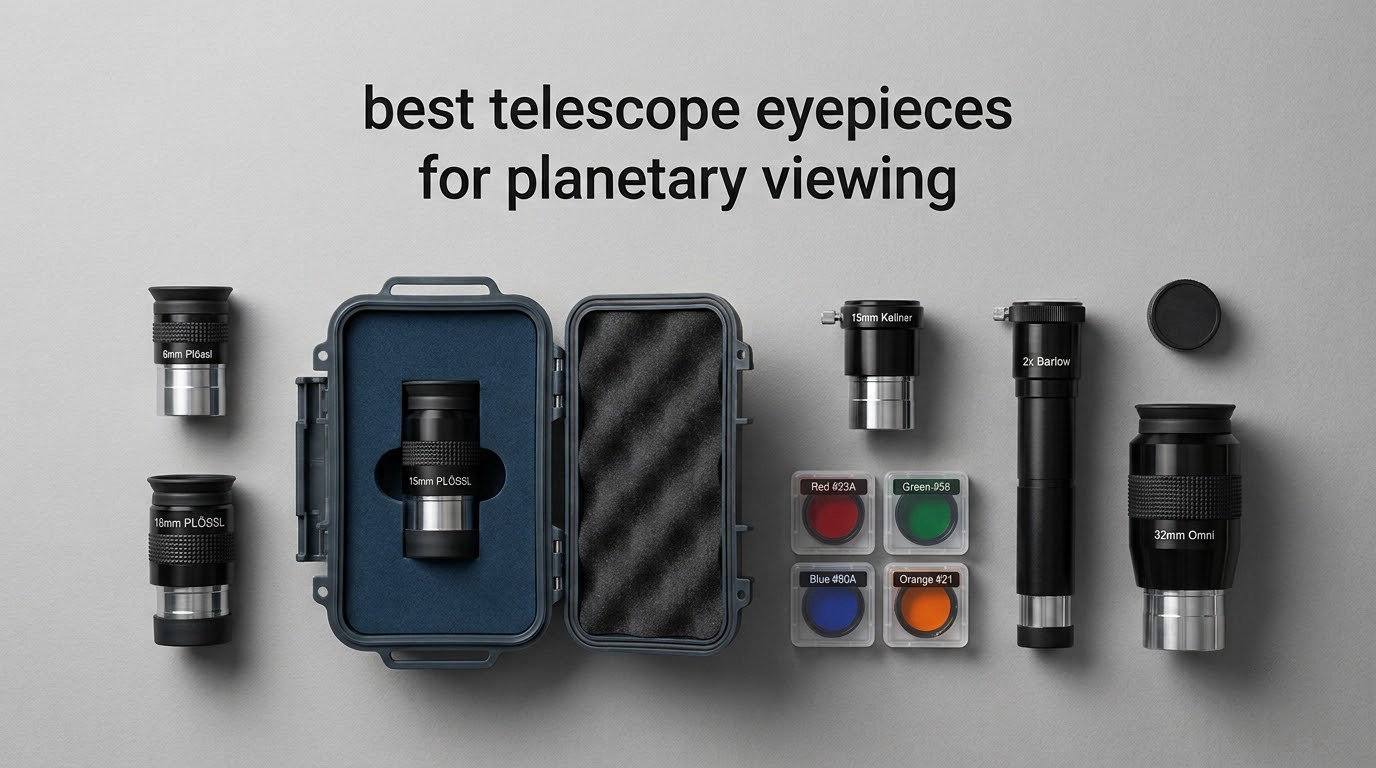
A planet is the hardest thing to see in a telescope. Stars are point sources that resolve at almost any power, but Jupiter, Saturn and Mars are small disks, and turning a smudge into a disk with visible bands takes the right combination of aperture, magnification and one very specific optical accessory. That accessory is the eyepiece, and picking the wrong one is the single most common reason a brand new telescope disappoints its owner on the first night out.
When I work out what to recommend, I stop and do the same two calculations every time: what magnification will this eyepiece give in the scope the reader actually owns, and is that magnification inside the range their aperture and tonight’s seeing can support. Those two numbers settle most of the argument before any brand preference enters into it. This guide to the best telescope eyepieces for planetary viewing applies that test to 12 eyepieces and kits, and it explains the math so you can do the same with whatever is in your hand.
One warning before we start. A surprising number of the eyepieces below are multi-piece kits, and kits are where beginners over-magnify. A 4mm eyepiece paired with a 3x Barlow can push a small tabletop scope past what the atmosphere will support, and the result is a dim, soft, grey image that looks worse than a lower power. I will flag that in each review, because the fix is usually choosing a shorter eyepiece rather than a stronger Barlow. If you are still building a first setup, our telescope picks for deep space viewing covers the other half of the hobby.
Table of Contents
Quick Picks: The 12 Best Telescope Eyepieces for Planetary Viewing in 2026
Here is the full lineup in one pass, with a one-line verdict for each. Scroll past this if you already know what you need.
Celestron Eyepiece, Barlow and Filter Kit (1.25 inch) – five Plossl eyepieces from 32mm down to 6mm, a 2x Barlow and a filter set. The most complete planetary ladder here, and the one kit that works on almost any 1.25-inch focuser. Best for: everything, in one case.
Celestron AstroMaster Accessory Kit – a 15mm Kellner, a 6mm Plossl, a 2x power lens and three filters. The cheapest sensible route to real planetary power. Best for: value.
Celestron 8-24mm Zoom – continuous 3:1 zoom in a 55-degree field. One eyepiece covers finding and high power. Best for: one-eyepiece setups.
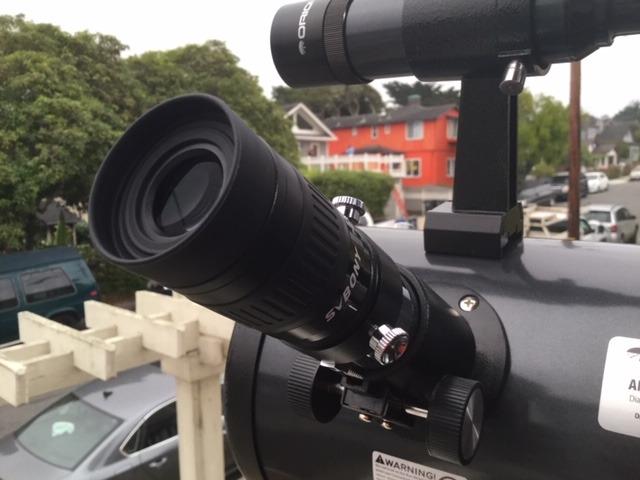
SVBONY SV135 7-21mm Zoom – roughly 16mm of eye relief in a full metal body, which is unusual at this focal length. Best for: eyeglass wearers who want zoom.
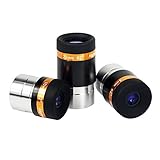
SVBONY 4mm, 10mm and 23mm Set – 62-degree apparent field on all three, genuinely wide for the money. Best for: a wide, forgiving first set.
Starboosa 1.25-Inch Set with 5x Barlow and Filters – three focal lengths plus polarizing and Moon filters. Best for: filter experiments.
Celestron Omni 6mm Plossl – a single 4-element Plossl that replaces the plastic eyepieces supplied with most beginner scopes. Best for: a first single upgrade.
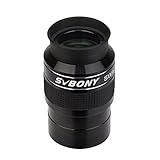
SVBONY SV154 26mm 2-inch SWA – a 70-degree field in a 2-inch barrel. Best for: wide low-power sky views, not planets.
CelticBird 8-Piece Kit – 6mm, 12.5mm and 20mm Plossl plus a 2x Barlow and four filters in a lockable metal case. Best for: Saturn and filter work.
CelticBird 13-Piece Kit – five Plossl eyepieces, seven filters and a 2x Barlow, with the highest average rating in this group. Best for: the widest filter selection.
Astromania 5mm 58-degree Planetary – 16mm eye relief and a 58-degree field in a machined aluminum body. Best for: maximum power on a large aperture.
Astromania 6mm 58-degree Planetary – the same design one step down in power, which is the more useful of the two on most nights. Best for: eyeglass wearers at high power.
Top 3 Picks for Planetary Viewing in 2026

Celestron Eyepiece, Barlow and Filter Kit
- Five Plossl eyepieces 32mm to 6mm
- 2x Barlow lens
- Moon and planetary color filters
- Foam-lined metal case

Celestron AstroMaster Accessory Kit
- 15mm Kellner and 6mm Plossl
- 2x power lens with T-threads
- Blue red and Moon filters

Celestron 8-24mm Zoom Eyepiece
- 8mm-24mm continuous zoom
- 55-degree apparent field
- Fully multi-coated optics
- Removable rubber eyecup
Best Telescope Eyepieces for Planetary Viewing at a Glance in 2026
Every eyepiece below, with the specs that decide whether it suits planets. Kits list what is inside the case.
| Product | Specifications | Action |
|---|---|---|
| Celestron Eyepiece, Barlow and Filter Kit |
|
Check Latest Price |
| Celestron AstroMaster Accessory Kit |
|
Check Latest Price |
| Celestron 8-24mm Zoom |
|
Check Latest Price |
 SVBONY SV135 7-21mm Zoom SVBONY SV135 7-21mm Zoom |
|
Check Latest Price |
 SVBONY 4mm 10mm 23mm Set SVBONY 4mm 10mm 23mm Set |
|
Check Latest Price |
 Starboosa 1.25-Inch Set with 5x Barlow Starboosa 1.25-Inch Set with 5x Barlow |
|
Check Latest Price |
 Celestron Omni 6mm Plossl Celestron Omni 6mm Plossl |
|
Check Latest Price |
 SVBONY SV154 2-inch SWA SVBONY SV154 2-inch SWA |
|
Check Latest Price |
 CelticBird 8-Piece Kit CelticBird 8-Piece Kit |
|
Check Latest Price |
 CelticBird 13-Piece Kit CelticBird 13-Piece Kit |
|
Check Latest Price |
 Astromania 5mm Planetary Astromania 5mm Planetary |
|
Check Latest Price |
 Astromania 6mm Planetary Astromania 6mm Planetary |
|
Check Latest Price |
What Focal Length Is Best for Planetary Viewing?
A focal length between 5mm and 15mm is the ideal range for planets, and 6mm to 9mm is where most of the useful work happens. Shorter eyepieces deliver more magnification, so they are only worth it on scopes with enough aperture to gather light and a night steady enough to support it.
The rule people forget is the ceiling. As a guide, the maximum useful magnification is about 2x per millimeter of aperture, so a 150mm Dobsonian tops out near 300x and a 70mm refractor near 140x. Past that point you are not resolving more detail, you are just enlarging the blur.
Exit pupil explains why. Divide the eyepiece focal length by the telescope focal ratio and you get the diameter of the light beam your eye receives. For planets you want that beam between 0.5mm and 1.0mm. A 6mm eyepiece in an f/8 refractor gives 0.75mm, which is comfortable. The same 6mm in an f/4 Newtonian gives 1.5mm, which is a pale, washed-out image no matter how good the glass is.
1. Celestron Eyepiece, Barlow and Filter Kit – The Most Complete Planetary Ladder
Celestron Eyepiece, Barlow & Filter Telescope Accessory Kit – 1.25″ Barrel
Five 1.25-inch Plossl eyepieces 32mm to 6mm
52-degree field
2x Barlow and color filters
Pros
- Five focal lengths cover most planetary powers from one kit
- 2x Barlow doubles the usable power of every eyepiece
- Fully multi-coated optics stay bright on the Moon and planets
- Near-parfocal so little refocusing is needed when switching
Cons
- Short eye relief on the 6mm and 8mm
- Plossl design gives up some contrast to orthoscopic designs
- The case lock key is awkward to operate
The thing that makes this kit work as a planetary set is the spacing between focal lengths. In a 1200mm scope, the 32mm gives 37x for finding, the 17mm gives 70x, the 13mm gives 92x, the 8mm gives 150x and the 6mm gives 200x. Those are five genuinely different views rather than five near-duplicates, which is the flaw in most cheap kits.
Owners most often reach for the 13mm and the Barlow combination, and reviewers consistently single out the neutral density Moon filter as the standout accessory because it keeps the Moon’s color while taming the glare that makes short focal lengths uncomfortable. With 3191 reviews averaging 4.7 stars, it is the most proven kit here.
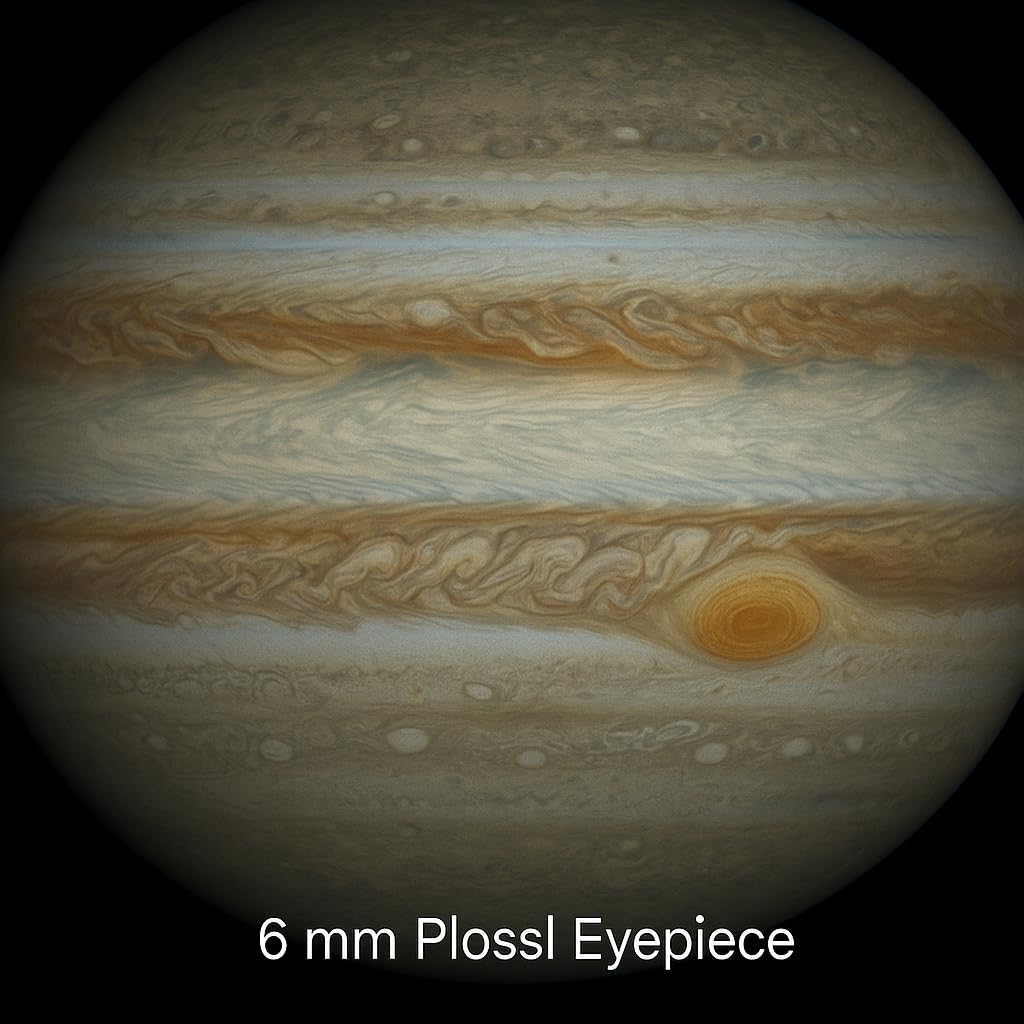
The recurring complaint lands in one place: eye relief on the 6mm and 8mm. At those focal lengths the eyecup sits close to the eye, and if you wear glasses you will spend the session cropping the field. Buy this kit, then keep the 8mm and 6mm for nights when your scope is well collimated and the atmosphere is calm.
There is a second, subtler problem. Several reviewers note that the smallest eyepieces push past the magnification limit of the smaller scopes this kit often gets paired with, and that the Plossl design gives up a little contrast against a premium orthoscopic. Neither is a dealbreaker, but both are reasons to treat the 13mm and 17mm as your everyday planets.

Who this kit suits best
It suits beginners who want a complete answer in one purchase and anyone whose telescope shipped with two or three cheap eyepieces. A 2x Barlow paired with the 13mm turns a modest 900mm scope into roughly 138x, which is where Jupiter’s belts and Saturn’s ring separation start to appear.
It also suits people who like having a case, because the foam-lined metal box keeps eyepieces and filters in one place instead of loose in a drawer. Filter threads seat cleanly, which matters more than it sounds when you are threading a red filter in the dark.
Where it falls short
If you wear glasses, the short focal lengths are genuinely uncomfortable, and this kit does not include any design with the 16-18mm of eye relief that solves it. The color filters are basic too, with reviewers reporting only a subtle effect on Jupiter.
Finally, this is a 1.25-inch kit. Telescopes with 0.965-inch focusers, which includes a lot of older tabletop refractors, need an adapter before anything here will fit.
2. Celestron AstroMaster Accessory Kit – The Cheapest Route to Real Planetary Power
Celestron AstroMaster Telescope Accessory Kit – 1.25″ Eyepieces & Filters
15mm Kellner and 6mm Plossl eyepieces
2x power lens with T-threads
#80A blue #25 red and Moon filters
Pros
- 6mm Plossl reaches genuine planetary power on small refractors
- 2x power lens carries T-threads for camera work
- Blue filter measurably lifts Jupiter's cloud bands
- Lowest cost per useful accessory here
Cons
- The plastic Moon filter tints the Moon greenish
- The 6mm exceeds what some small scopes can use sharply
- Doubling magnification dims faint deep-sky targets
This is the kit I recommend most often to someone who owns a 130mm reflector and a fistful of plastic 20mm and 9mm eyepieces. The 15mm Kellner is sharp enough for lunar work and Jupiter’s bands, and the 6mm Plossl is the piece that actually changes what you can see.
In a 1200mm scope the 15mm gives 80x, which resolves Jupiter as a disk with two or three belts, and the 6mm gives 200x, which is where the Great Red Spot and Saturn’s Cassini Division start to appear. Stack the 2x power lens on the 15mm for 160x and you have the two magnification steps most scopes need.
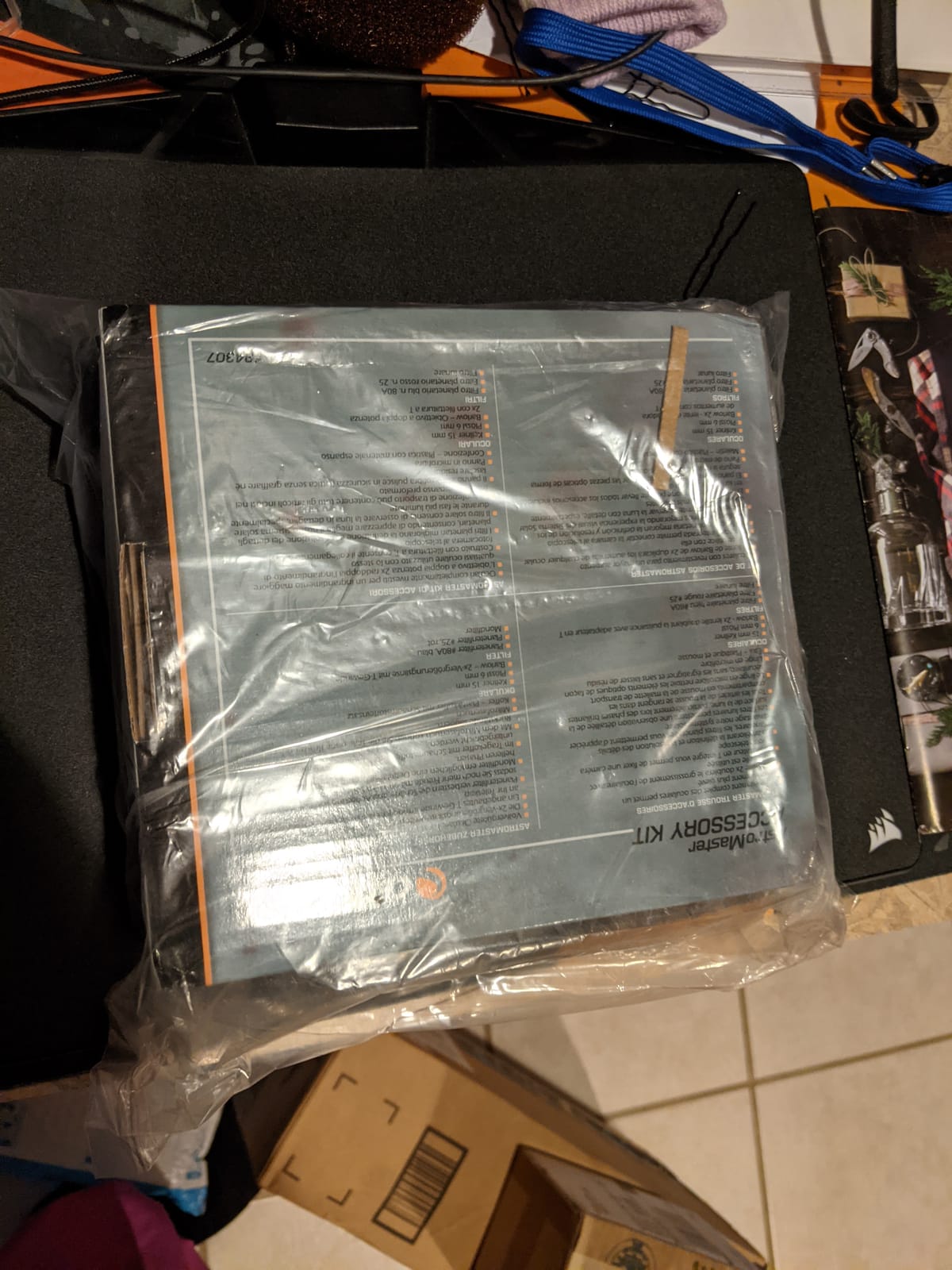
The blue filter earns the most praise in the reviews. Reviewers report that it measurably reduces glare and brings out Jupiter’s cloud bands, which is why planetary filters are worth threading into a 1.25-inch barrel in the first place. The T-threads on the power lens are a quiet bonus if you ever want to attach a camera.
What to watch: doubling magnification on faint deep-sky targets visibly dims them, and the Moon filter is thin plastic that leaves a greenish cast. Neither matters for planets, but both are reasons this is a planetary kit rather than an all-purpose one.
Who this kit suits best
It suits owners of small-to-mid aperture scopes who want more power without buying individual eyepieces. At 2678 reviews and 4.6 stars, it is also one of the most examined kits in the category, so the failure modes are well documented.
It suits anyone who wants one filter to try rather than a full set. A single blue filter on Jupiter is the cheapest way to find out whether you care about planetary filters at all before committing to a box of seven.
Where it falls short
The 6mm is more than some small beginner scopes can use sharply, and adding the 2x on top of it is where people convince themselves their telescope is faulty. If your aperture is 70mm or 80mm, stay with the 15mm.
The Moon filter also does not thread onto the 15mm Kellner without forcing it, and the carrying case is light duty. If you travel to a dark site, plan on protecting these in a padded bag instead.
3. Celestron 8-24mm Zoom – One Eyepiece for Finding and High Power
Celestron 8-24mm Zoom Telescope Eyepiece with Fully Multi-Coated Optics
Continuous 8mm-24mm zoom at a 3:1 ratio
55-degree apparent field
Fully multi-coated with removable eyecup
Pros
- Continuous zoom lets you frame a planet without swapping eyepieces
- Image quality compares well with equivalent fixed Plossl eyepieces
- The 24mm end is useful for finding objects and sweeping star fields
- Threaded barrel accepts 1.25-inch filters
Cons
- Heavier than a standard Plossl so light mounts may need rebalancing
- No click stops so you read magnification off the barrel
- Field narrows at the 8mm end and dims at high power
The case for a zoom is simple: in a dark field, swapping eyepieces means two hands, a red flashlight and a small metal object landing on the ground. Owners of this zoom overwhelmingly treat it as a permanent single-eyepiece solution for exactly that reason, and 2544 reviews averaging 4.6 confirms it is a popular one.
On planets the sweet spot sits in the lower half of the range. In a 1200mm scope, 24mm gives 50x for locating, 15mm gives 80x for the first resolved view, and 8mm gives 150x for belt structure on Jupiter. Reviewers report near-parfocal performance, so the image barely shifts focus as you zoom.
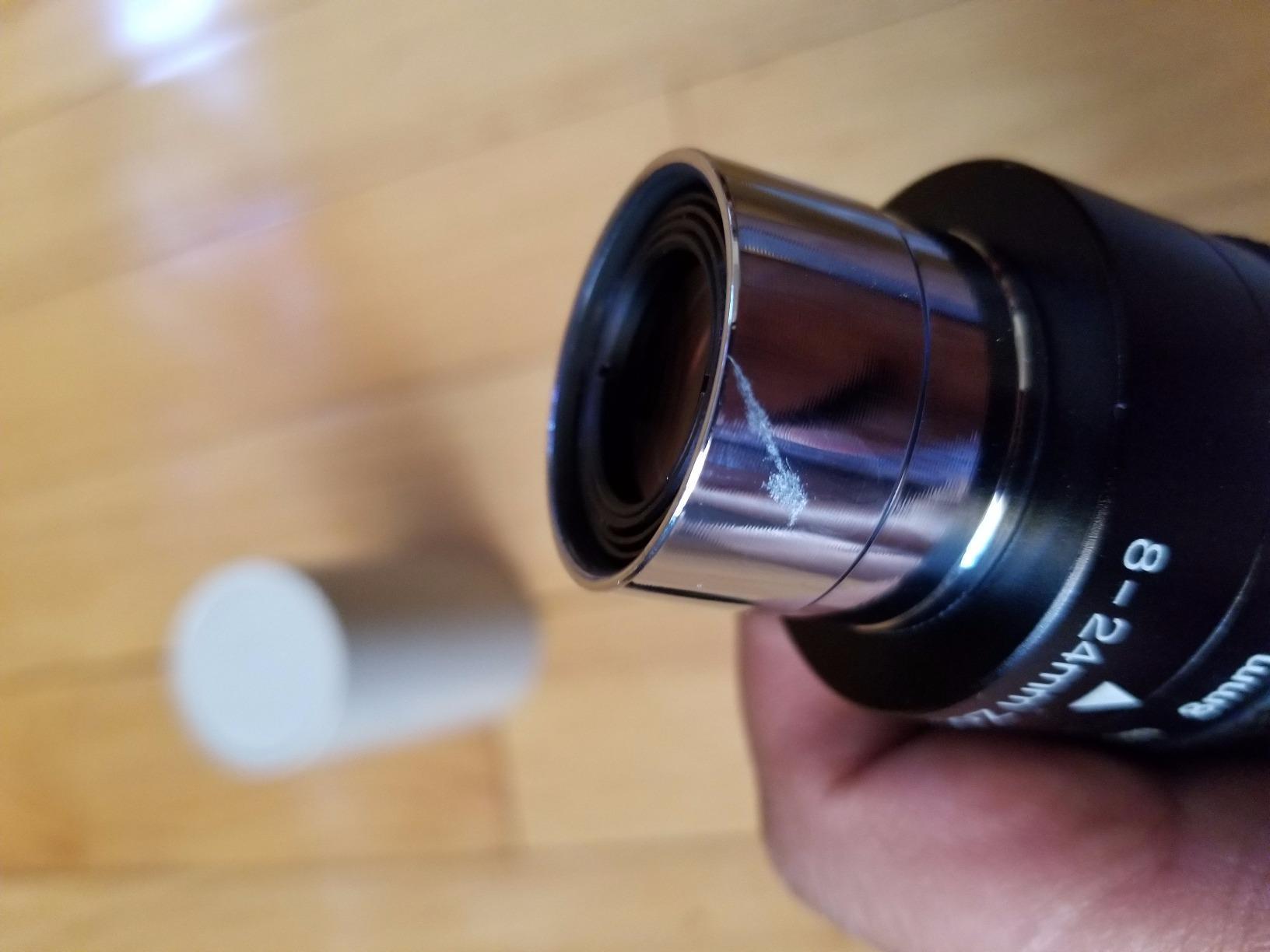
The fully multi-coated coatings are the reason the image holds up when compared with fixed Plossl eyepieces of the same focal length. Contrast on the gas giants is the thing that matters, and coatings are where cheap zoom designs usually give themselves away.
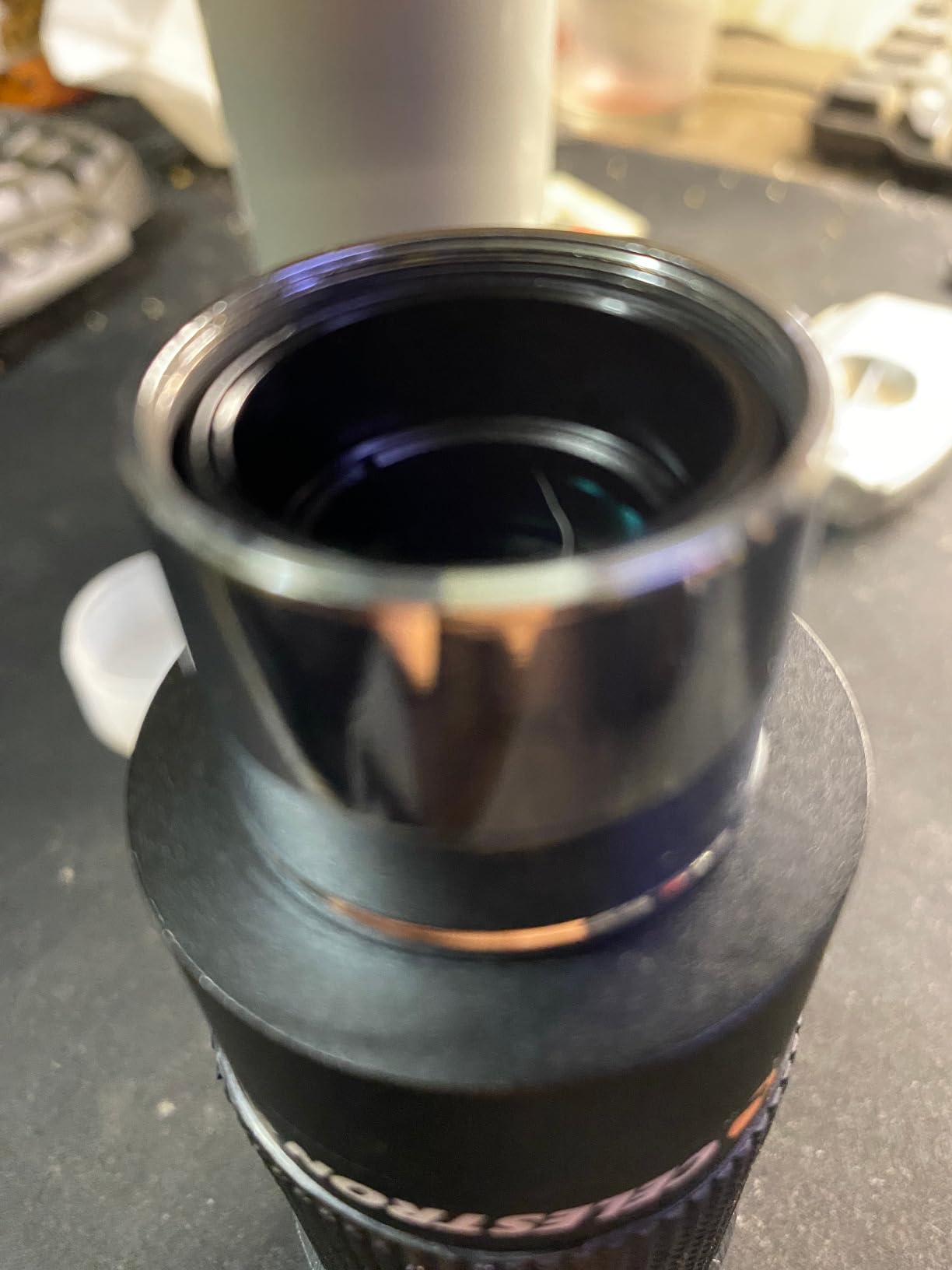
The drawback is the 8mm end. The field of view narrows there and drops further if you add a Barlow, and the image dims noticeably at the highest powers. For most planetary work that means stopping around 10mm rather than twisting it all the way down.
Who this zoom suits best
It suits anyone with one small telescope and no patience for an eyepiece case, and anyone who moves a lightweight scope between the car and the lawn. It also suits outreach work, where handing a beginner one eyepiece is easier than teaching them a focal length ladder.
The removable rubber eyecup helps too, because you can fold it down for eyeglass wearers and up for everyone else. Threaded for filters, so a blue or red filter still works on it.
Where it falls short
Experienced planetary observers tend to be skeptical of zooms, and the forum consensus is that dedicated short-focal-length designs hold contrast better at the highest powers. If your priority is the Cassini Division rather than convenience, this is not the last word.
The weight matters more than the specification suggests. On a small Dobsonian or a light equatorial mount, adding this much mass high on the axis can disturb balance, and there are no click stops to help you return to the same setting in the dark.
4. SVBONY SV135 7-21mm Zoom – Long Eye Relief in a Metal Barrel
SVBONY SV135 Zoom Eyepiece, Zoom 7 to 21mm 1.25 Inch Telescope Eyepiece, Telescope Accessories for Astronomic Visual Observation (40-57°)
7mm-21mm continuous zoom
6 elements in 4 groups fully multi-coated
40-57 degree field
About 16mm of eye relief
Pros
- Roughly 16mm of eye relief is rare at this focal length
- Low scatter and high contrast with sharpness to the field edge
- Full metal body with a rubber eyeguard blocks stray light
- Works for the Moon
- Jupiter and Orion Nebula detail
Cons
- Field is narrow at the 21mm end and not especially wide at 7mm
- No click stops so magnification cannot be read in the dark
- Marked focal lengths overstate the real focal length
Eye relief is the headline here and it is not marketing. At roughly 16mm, this zoom clears the 15-18mm threshold that eyeglass wearers need to see the full field without their lens clipping the edge. Almost nothing else in the 7-21mm range manages that, and it is the single most common complaint about short Plossl eyepieces.
Optically it behaves better than the price suggests. Reviewers report low scatter, high contrast and sharpness that holds toward the edge of the field, and the six-element four-group fully multi-coated design compares well against pricier zooms in side-by-side use. With 1574 reviews at 4.5 stars, that consistency is well documented.
For planets, dial it to the short end. A 1200mm scope at 7mm gives about 171x, which is a good Jupiter and Saturn power, while 10-12mm gives 100-120x for a steadier view on a mediocre night. The full metal body keeps it steady in the hand, which matters more than it sounds at high power.
One caveat worth repeating from the reviews: the marked focal lengths overstate the actual focal length, so you get more magnification than the barrel suggests. That is a pleasant surprise once, then an annoying one every time you try to work out what power you are at.
Who this zoom suits best
It suits eyeglass wearers who want the convenience of a zoom without giving up eye relief, and observers who use one eyepiece across a range of scopes. The rubber eyeguard also handles stray light from a laptop screen or a porch light, which is common at home.
Cloudy Nights regulars name the SV135 class of zoom as the single-eyepiece solution, and the metal construction here is the main reason this one holds up to that reputation over time.
Where it falls short
The field of view is the compromise. At 40-57 degrees it is not wide, and at the 21mm end reviewers single it out as fairly narrow. If you are used to a 68-degree eyepiece, the view feels cramped even though it is perfectly usable.
The zoom mechanism is also stiff, and without click stops you need a light to read the setting. On a cold night, plan on holding the barrel steady with one hand while turning with the other.
5. SVBONY 4mm, 10mm and 23mm Set – A Wide Field on a Budget
SVBONY Telescope Eyepiece Set, 4mm 10mm 23mm Telescope Lenses 62°Wide Angle
4mm, 10mm and 23mm eyepieces
62-degree apparent field on each
Aspherical elements reduce aberration
1.25-inch barrels with filter threads
Pros
- The 62-degree field is genuinely wide for a budget set
- The 4mm gives sharp well-defined lunar crater detail
- Lightweight 1.25-inch barrels fit almost any telescope
- Clearly upgrades the stock eyepieces on entry-level scopes
Cons
- The 10mm is the weak member
- dim and soft on faint targets
- Short eye relief especially on the 4mm
- No padded carry case and thin shipping boxes
A 62-degree apparent field across all three eyepieces is unusual in a set at this level, and it is the reason this one feels better than the specification list suggests. Finding Jupiter is a two-second job rather than a hunt, and a wide field makes keeping a planet centered far less tiring.
The 4mm is the piece reviewers use most, reporting sharp, well-defined lunar crater detail. In a 1200mm scope that is 300x, which is right at the magnification ceiling for a 150mm aperture, so it is a genuine limit rather than a marketing number.
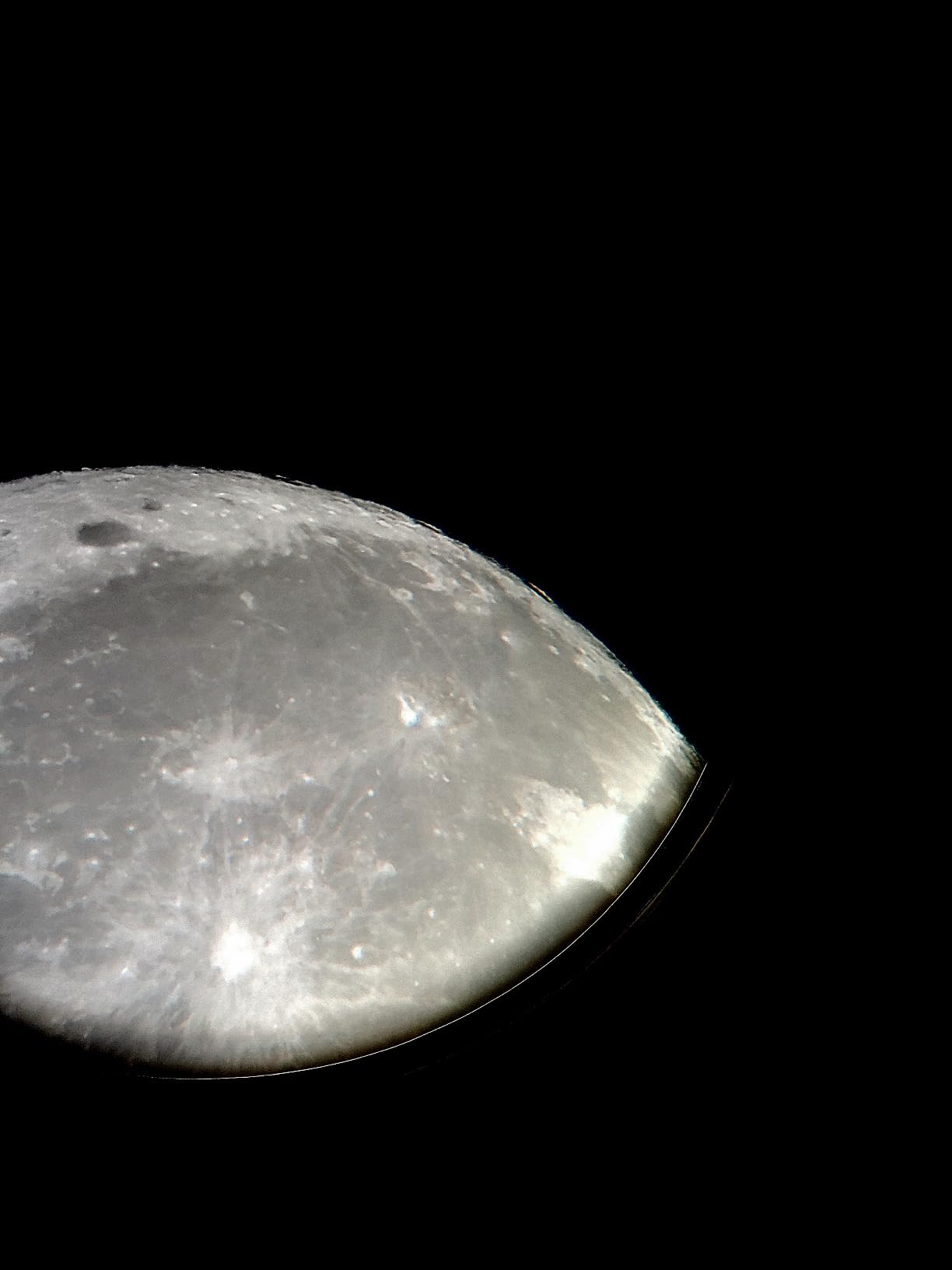
The aspherical elements are doing real work here. They reduce spherical aberration and coma, which is what keeps the field from turning mushy toward the edge, and the blackened internal surfaces cut stray light that would otherwise wash out low-contrast planetary detail.
The 10mm is the piece reviewers reach for least, describing it as dim and soft, and it is rarely the eyepiece anyone reaches for. The 23mm, by contrast, is widely praised as the standout of the set and is often compared favorably against far more expensive 24mm eyepieces.
Who this set suits best
It suits owners of entry-level refractors and Dobsonians who want to replace plastic stock eyepieces with something that feels like an upgrade. The light weight and standard barrels mean it will fit whatever you already have.
It also suits lunar observers, because crater detail at high power is the easiest kind of planetary detail to see and the 4mm delivers it well. If you can only buy one set and the Moon is a priority, this is a defensible choice.
Where it falls short
Short eye relief on the 4mm makes it a poor choice for eyeglass wearers, and build quality is thin enough that one reviewer reported a 23mm rattling after a drop. The lack of a padded case is a real annoyance for anyone traveling to a dark site.
With 391 reviews this is the least examined set here, so there is less long-term evidence about how the coatings hold up. If durability matters more than field width, the Celestron kits above are sturdier.
6. Starboosa 1.25-Inch Set with 5x Barlow and Four Filters
Starboosa 1.25-Inch Telescope Eyepiece Set with Barlow and Filters
4mm, 10mm and 20mm eyepieces
5x Barlow lens
Two Moon filters and two polarizing filters
Multi-coated glass with soft eyecups
Pros
- Bundles three focal lengths
- a 5x Barlow and four filters in one package
- Soft eyecups make long planetary sessions more comfortable
- Polarizing and Moon filters measurably lift contrast on the Moon and planets
Cons
- The 5x Barlow pushes past what many small scopes can use sharply
- Plasticky build relative to metal-barrel kits
- Specification listing is thin on field of view and eye relief
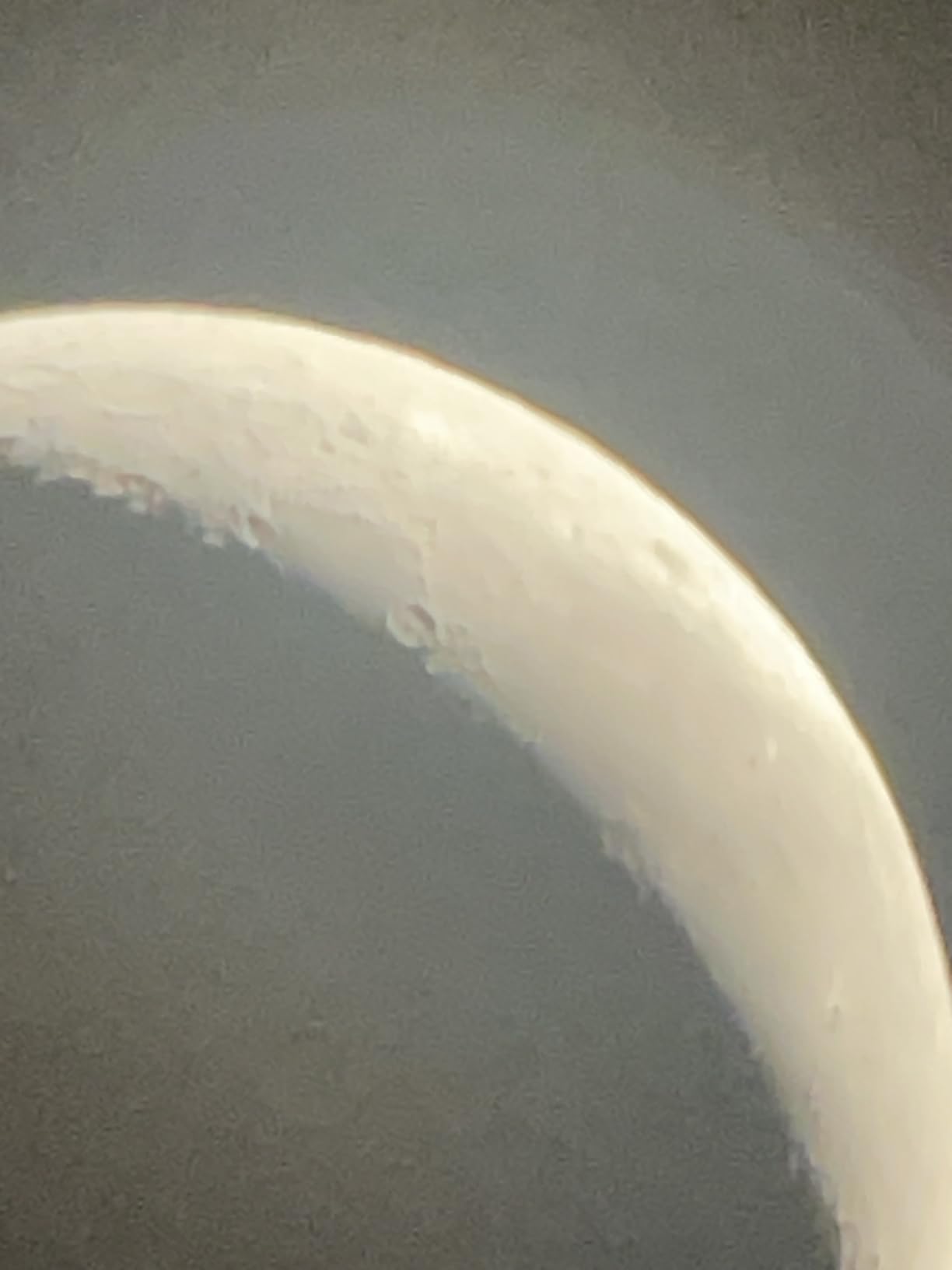
The polarizing filters are what make this set different. Reviewers report a measurable contrast lift on the Moon and on bright planets, and a polarizing filter is the one kind of planetary filter that helps with almost any target rather than only one planet. For 300 reviews at 4.5 stars, that is a consistent finding.
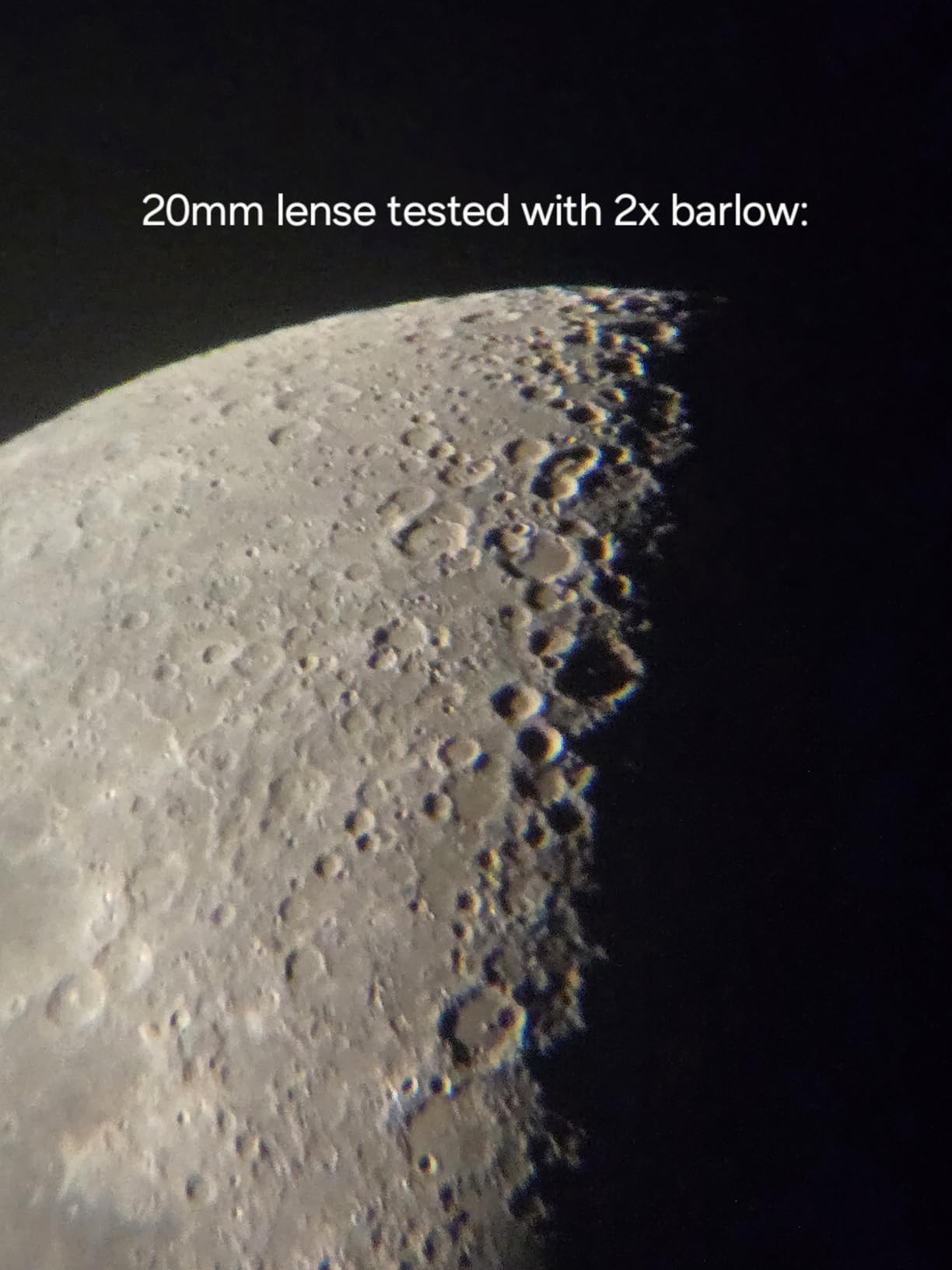
The 10mm and 20mm are the sensible everyday pair, and the 20mm doubles as a low-power finder. The 4mm is the high-power piece, and multi-coated optics produce sharp images with balanced color and minimal distortion according to the reviews.
Here is the honest caveat. This kit ships with a 5x Barlow, and 5x is far more than most scopes can use. Buyers who pair it with small apertures report softness, which is the same mistake people make with 3x Barlows: more magnification, less detail.
Use the 4mm and 10mm alone, and treat the Barlow as an occasional tool for a steady night on a large aperture. The spec listing is also thin on measurable detail, so you will not find a stated field of view or eye relief to plan around.
Who this set suits best
It suits observers who want to experiment with filters before committing to a dedicated filter set, and anyone who works on the Moon at high power. The soft eyecups also make long sessions more comfortable than bare plastic barrels.
The standard 1.25-inch barrels work with most reflector and refractor telescopes, so it is an easy companion to a first Dobsonian. The filters and the three focal lengths arrive in one order, which saves hunting for parts.
Where it falls short
Build quality is plasticky next to the metal kits in this list, and the 5x Barlow is a genuine liability for beginners. If you are not confident about your aperture’s magnification ceiling, a 2x Barlow is a safer place to start.
There is no carry case, so the pieces travel loose unless you add one. That is fine in a house but not what you want hauling to a field.
7. Celestron Omni 6mm Plossl – The Single First Upgrade
Celestron Omni 6mm Telescope Eyepiece for Detailed Moon & Planet Views
6mm four-element Plossl design
1.25-inch barrel threaded for filters
Fold-down rubber eyecup for eyeglass wearers
Pros
- Clear sharp views of lunar craters and Jupiter
- Far better than the SR and H eyepieces supplied with beginner telescopes
- Matte aluminum barrel feels more durable than plastic stock
- Compact and light so it does not upset mount balance
Cons
- Field of view is narrower than most of the user's other Celestron eyepieces
- Small barrel is harder to look through and keep steady
- Short eye relief compared with longer focal lengths
Almost every beginner telescope arrives with an SR eyepiece and a plastic Huygens. Swapping those for a single 6mm Plossl is the change that makes people decide astronomy is worth pursuing, and that is exactly what reviewers of this eyepiece report. Lunar craters go from suggestive to obviously three-dimensional.
In a 1200mm scope, 6mm gives 200x, which is squarely in planetary territory and comfortably inside the ceiling for anything from a 100mm refractor upward. It also pairs well with a 2x Barlow to reach useful power on a 70mm or 80mm scope, which is where most beginners start.
Who this eyepiece suits best
It suits someone who wants a single decisive purchase rather than a kit, and someone whose telescope came with two or three mediocre eyepieces. The fold-down rubber eyecup is designed for eyeglass wearers, which is more thoughtful than most single eyepieces at this focal length.
At 2.08 ounces it weighs almost nothing, so it will not disturb the balance of a light mount or a small Dobsonian. Reviewers who travel to dark sites appreciate that.
Where it falls short
The field of view is narrow by modern standards, and reviewers with a set of other Celestron eyepieces notice the step down in apparent field. It is also a small barrel, which some users find fiddly to position and harder to keep steady at high power.
Performance depends heavily on the telescope it is paired with. On a scope with a central obstruction or poor collimation, no eyepiece will rescue the view. The recurring advice in reviews is to collimate first, then judge the eyepiece.
8. SVBONY SV154 26mm 2-Inch SWA – Wide Low Power, Not a Planet Eyepiece
SVBONY SV154 Telescope Eyepiece 2 inch, Super Wide Angle SWA Eyepiece 70°
26mm focal length in a 2-inch barrel
70-degree apparent field
5 elements in 3 groups fully multi-coated
Foldable silicone rubber eye cup
Pros
- 70-degree field delivers an immersive view with stars floating in space
- Center of the field is sharp and crisp with good contrast
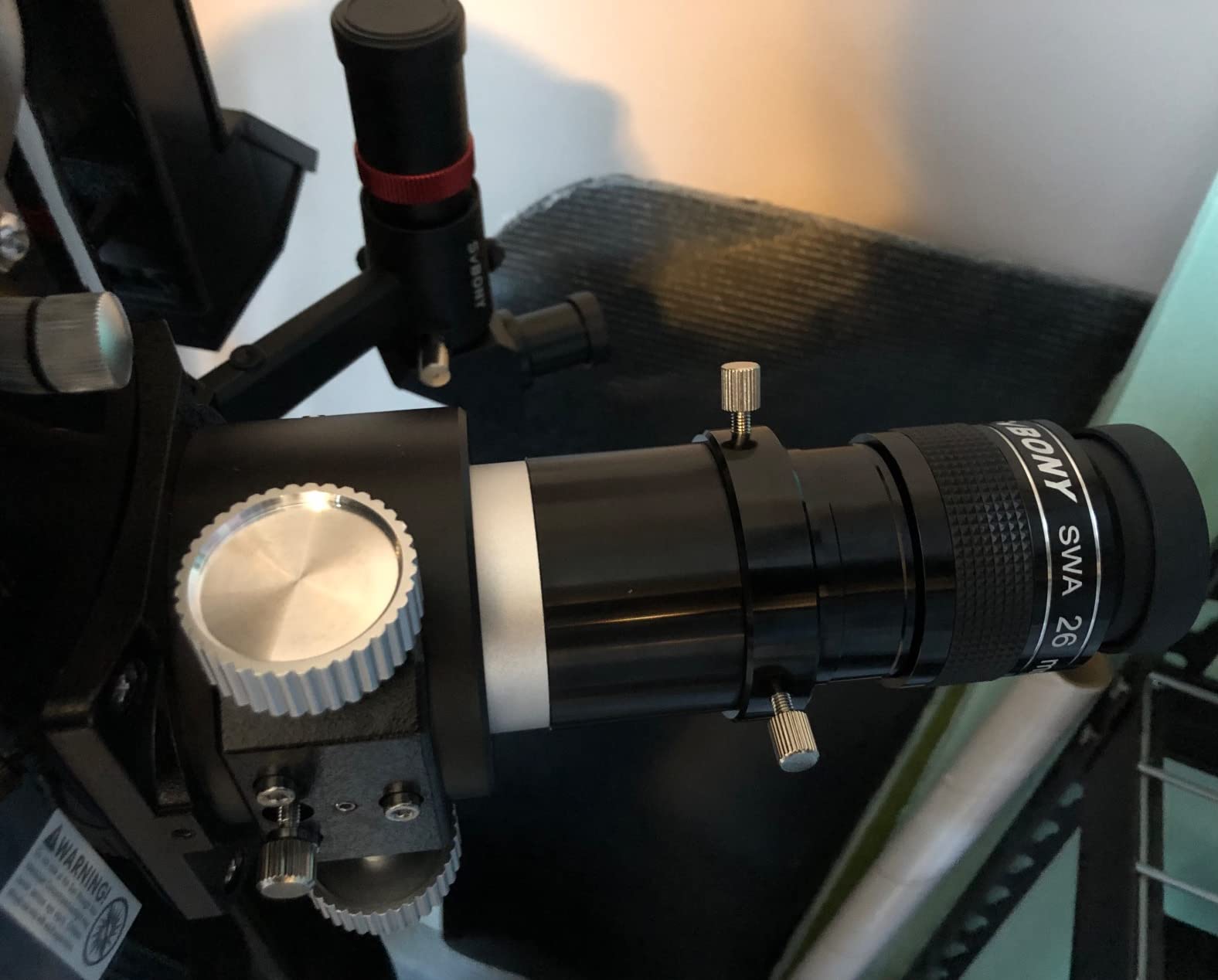
- Fits standard 2-inch diagonals and accepts a T-adapter
- Comfortable eye relief that works with glasses
Cons
- Sharpness falls off toward the edges with some coma on fast Newtonians
- Heavy for its size so small mounts need rebalancing
- 26mm means low magnification
- limited use for planetary detail
I want to be straight about this one. A 26mm eyepiece in a 2-inch barrel is a superb low-power and wide-field instrument, and reviewers happily compare its field to expensive wide-field designs. It is not a planetary eyepiece, and no amount of marketing changes that arithmetic.
In a 1200mm scope, 26mm gives 46x. At that power Saturn is an oval blob and Jupiter’s belts are suggestions. It earns its place in a kit as the finder and as the eyepiece you use to show someone why the sky looks the way it does.
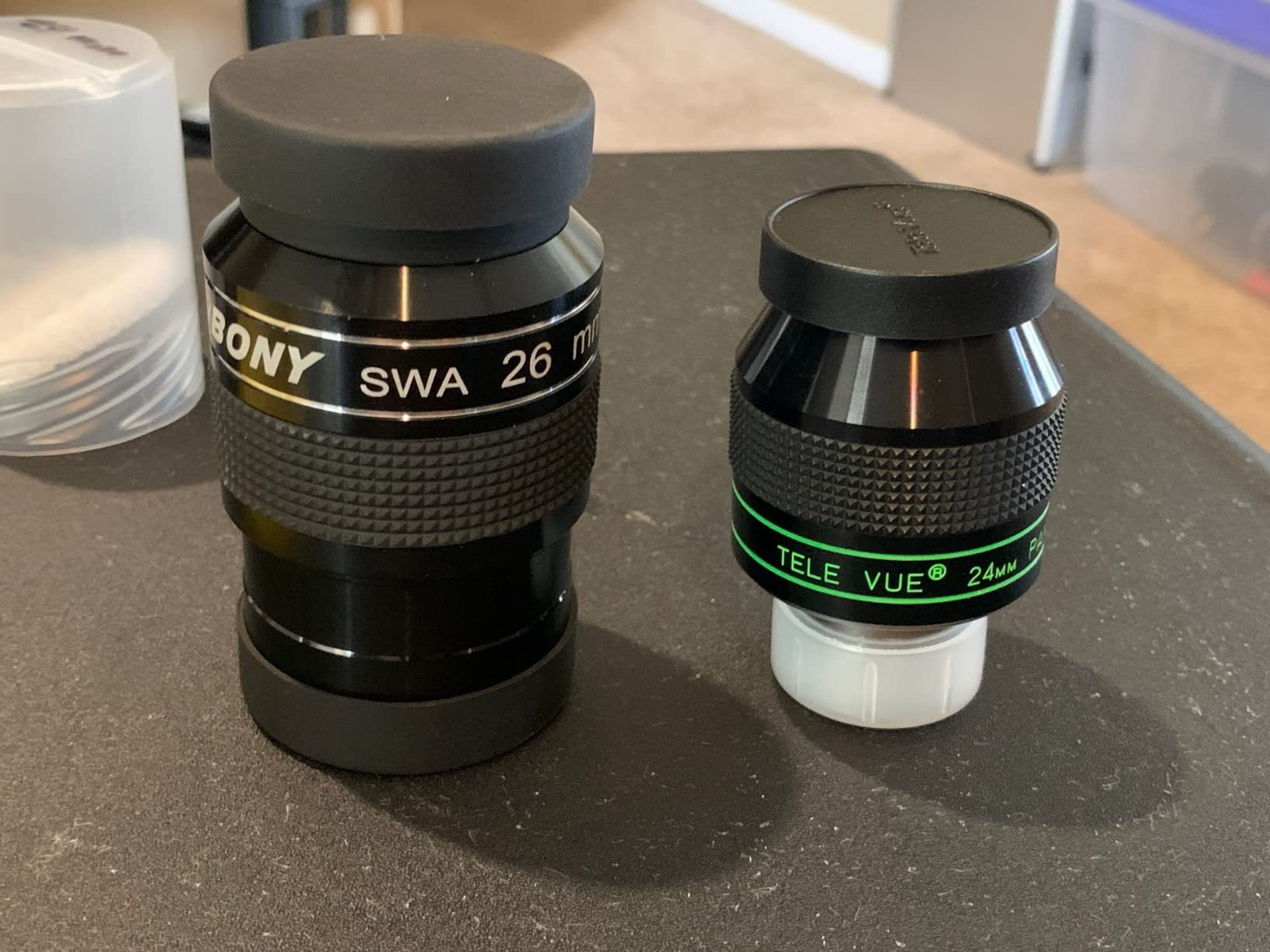
Where it does shine is the view itself. A 70-degree field with the stars appearing to float against black is the kind of thing that keeps beginners observing, and the foldable rubber eye cup works with or without glasses. The high-index glass with full multi-coating gives a clean, high-contrast center.
Reviewers also note it works with a T-adapter for imaging, which is not true of every budget wide-field design. The center-to-edge behavior is the honest limitation: sharpness falls off toward the edges, with visible coma on fast Newtonians.
Who this eyepiece suits best
It suits owners of 2-inch focusers who want one immersive wide-field view alongside a short-focal-length planetary eyepiece. Our binocular guide for lunar viewing covers the wide-field side of things if a 70-degree field is what you are chasing.
It also suits anyone whose current kit has nothing between 25mm and 4mm, since this fills the top of the range with a modern design rather than an old Huygens.
Where it falls short
It needs a 2-inch focuser or an adapter, and 2-inch filters cost more than 1.25-inch ones. On a Dobsonian it also adds noticeable weight high on the axis, so expect to rebalance.
Most importantly, do not buy it hoping it will show you Saturn’s rings. Pair it with a 6mm to 8mm planetary eyepiece for that, and treat this as the wide-field companion.
9. CelticBird 8-Piece Kit – Metal Parts and a Filter Selection That Works
Celticbird Astronomical Telescope Accessory Kit – with 3pcs Plossl Eyepieces Set, 4pcs Filter Set, a 2X Barlow Lens
6mm, 12.5mm and 20mm Plossl eyepieces
2x Barlow with T2 threads for cameras
Moon, red, blue and yellow filters
Lockable aluminum case with fitted foam
Pros
- Three useful Plossl focal lengths plus a 2x Barlow cover most planetary powers
- Eyepieces and Barlow are metal and feel durable
- Filters genuinely improved views of Saturn and the Moon
- Lockable metal case with individual filter compartments
Cons
- Requires a 1.25-inch focuser so 0.965-inch scopes need a reducer
- The 6mm is too powerful for some small-aperture telescopes
- One shipment arrived without the advertised cleaning cloth
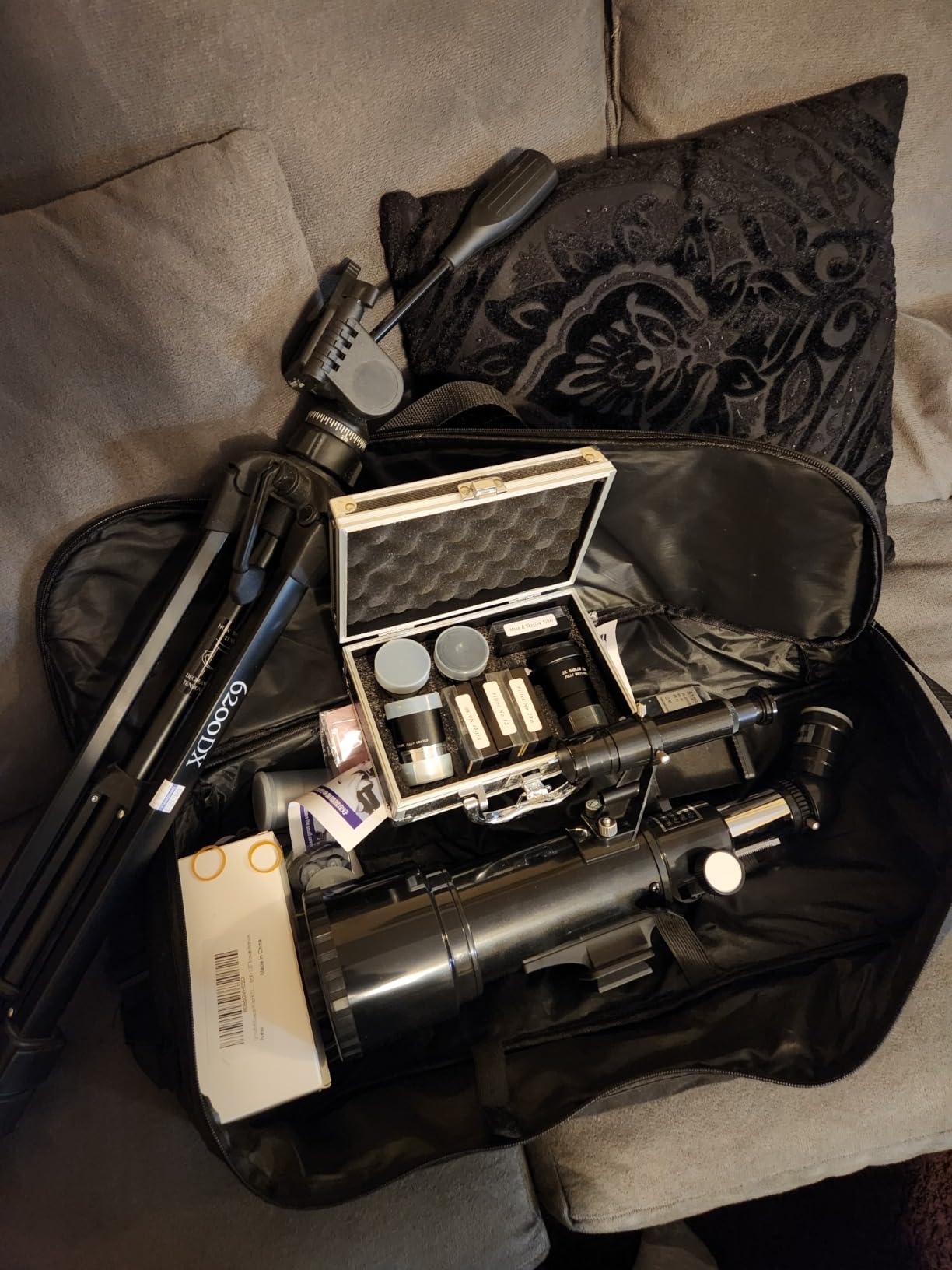
The 6mm, 12.5mm and 20mm trio is a well-chosen planetary ladder rather than an arbitrary one. In a 1200mm scope those give 200x, 96x and 60x, and the 2x Barlow adds 400x, 192x and 120x. That is a range that covers the Moon, Jupiter and Mars without any redundant steps.
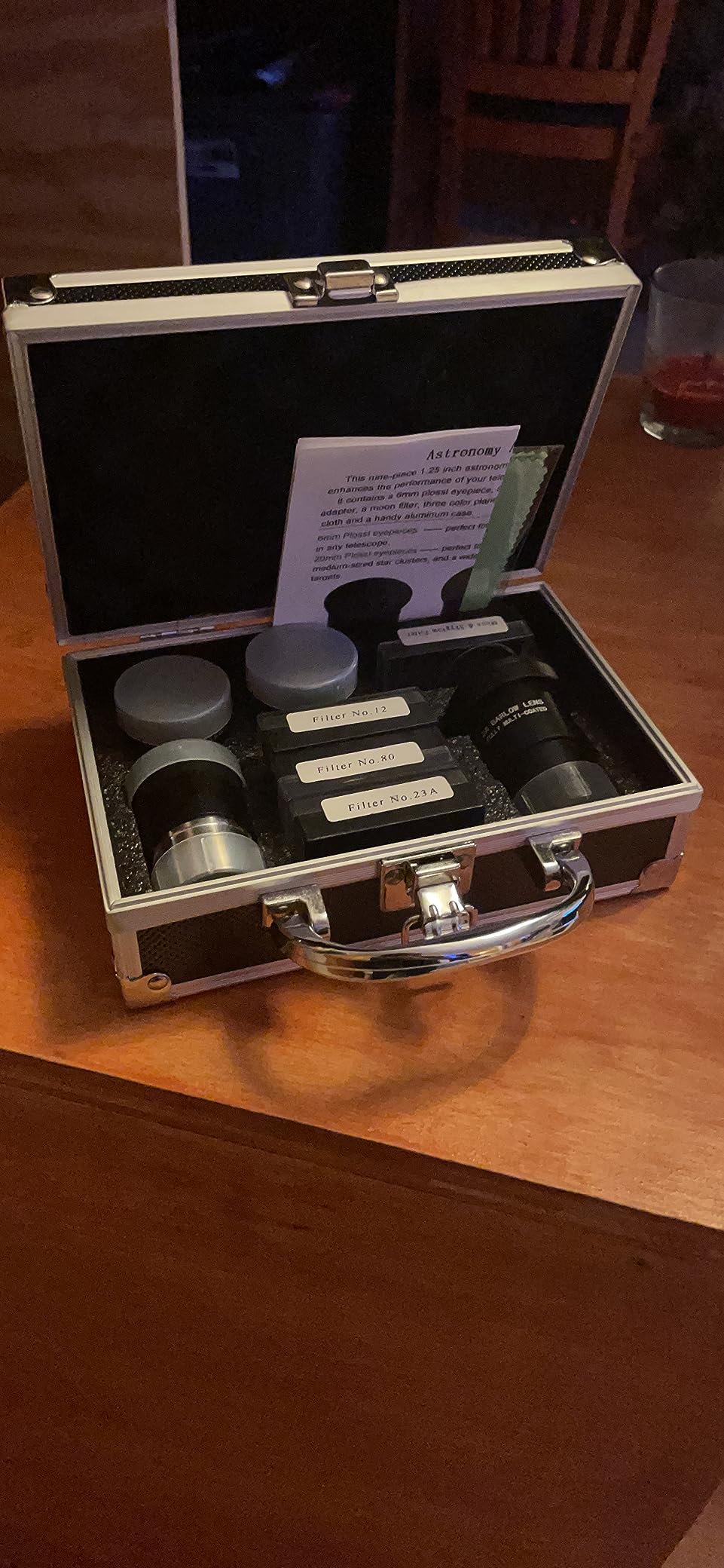
Reviewers specifically mention that the filters improved views of Saturn and a partial eclipse, and that the metal parts feel durable in the hand. The lockable aluminum case with form-fitted foam and separate filter compartments is a detail most kits at this level skip entirely.
Why this one for Saturn? Saturn rewards contrast more than resolution. A color filter darkens the planet’s disc and brightens the ring plane, so the rings separate more cleanly at the same magnification. A blue filter does the same job on Jupiter’s belts.
The 2x Barlow doubles as a prime focus T-adapter for DSLRs, which is a genuine second use rather than a marketing line. Dust caps on both ends of every eyepiece is another small thing you notice at midnight.
Who this kit suits best
It suits observers who want metal construction, a real case and a working filter set at a mid tier. The 20mm is a genuinely useful low-power eyepiece, which the shorter kits here often leave out.
It suits anyone with a 1.25-inch focuser who wants a second magnification step. Telescope owners with 0.965-inch focusers will need a reducer, which is the main compatibility caveat.
Where it falls short
The 6mm is too powerful for some small-aperture telescopes, and this kit makes it easy to reach for it by reflex. Check your aperture’s 2x-per-millimeter ceiling before you do.
At 161 reviews this is the second least examined kit in the group, and one delivery arrived without its cleaning cloth. Neither is serious, but the thin review pool means less long-term evidence about coating durability.
10. CelticBird 13-Piece Kit – The Highest Rated and Most Complete Set
CelticBird Telescope Accessory Kit – 1.25″ Telescope Eyepiece and Filter Set with a Sturdy Carry Case – Five Plossl Eyepieces, 2X Barlow Lens and Seven Filters
Five Plossl eyepieces 40mm 20mm 12.5mm 8mm 6mm
2x Barlow with T2 threads
Seven filters including a polarizing filter
Foam-lined metal case
Pros
- Largest and most complete eyepiece and filter selection here
- Seven filters including a polarizing filter meaningfully change contrast
- Five focal lengths plus a 2x Barlow give a full planetary ladder
- Sturdy metal case with foam lining protects the optics
Cons
- Costs more than the other kits here despite similar Plossl optics
- Plossl designs give up some contrast to orthoscopic eyepieces
- The 6mm and 8mm have short eye relief for eyeglass wearers
This kit carries the highest average rating of anything in our lineup at 4.8 stars, and owners justify it with breadth: five Plossl eyepieces from 40mm down to 6mm, a 2x Barlow and seven filters including a polarizing filter. That is thirteen pieces, and there is no obvious filler.
The focal length ladder is genuinely useful. In a 1200mm scope, 40mm gives 30x for finding, 20mm gives 60x, 12.5mm gives 96x, 8mm gives 150x and 6mm gives 200x, with the Barlow doubling any of them on a stable night. That covers every planetary target without repeating a magnification.
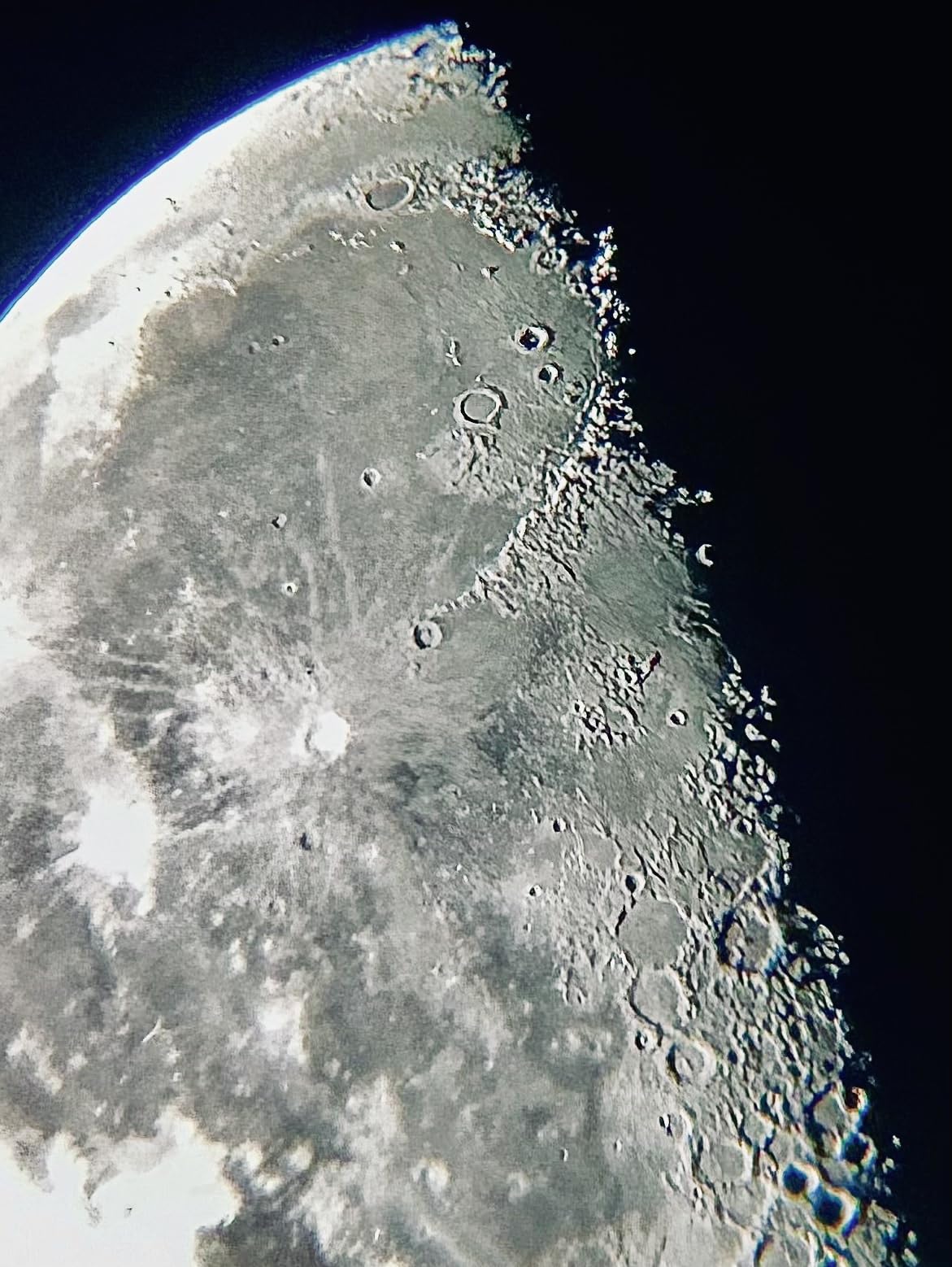
The polarizing filter is the sleeper here. Where color filters are planet-specific, a polarizing filter works on the Moon, Jupiter, Saturn and terrestrial targets alike, cutting haze and boosting contrast on whatever you point it at. Reviewers name it as a reason to buy.
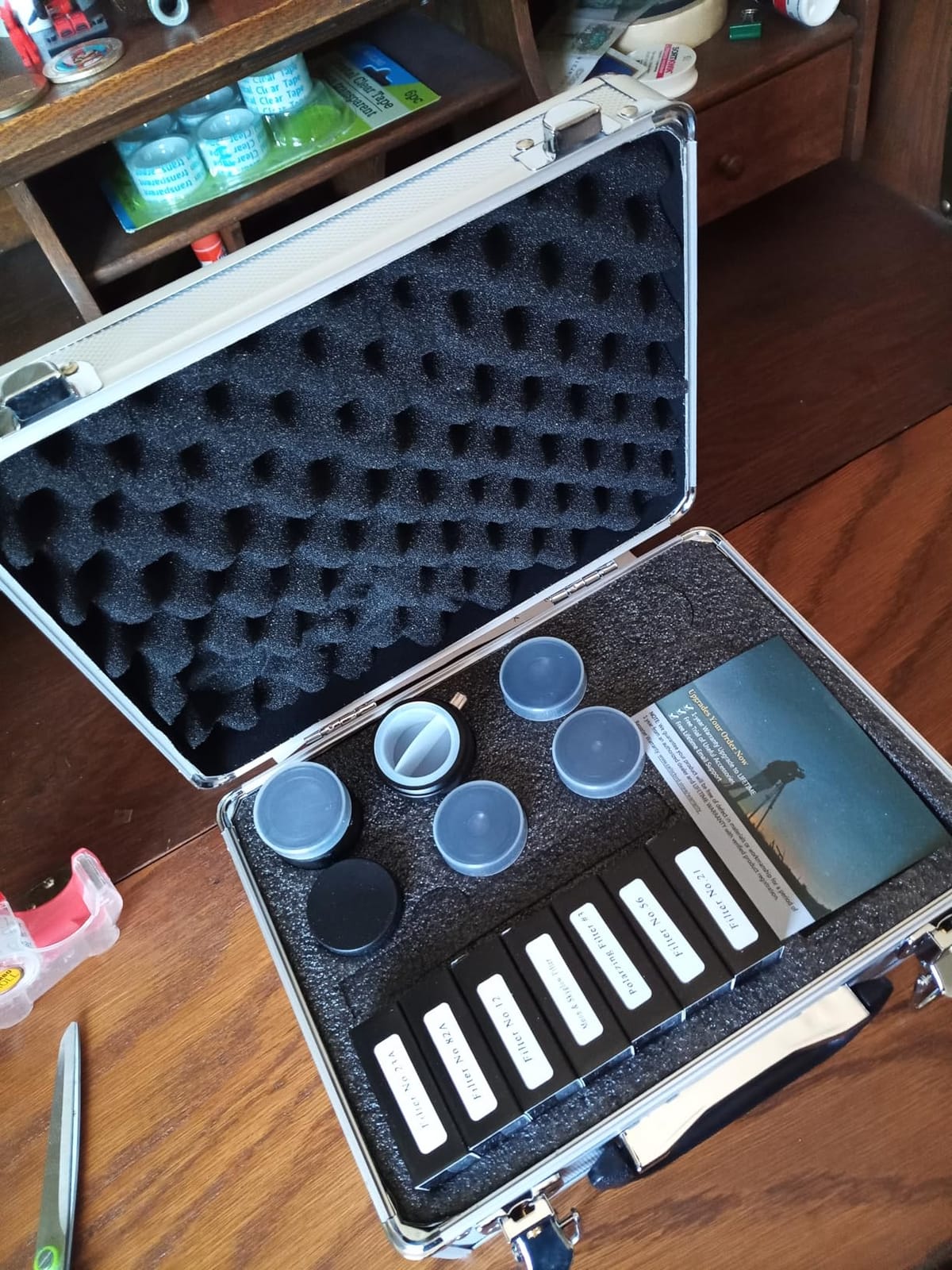
The metal case with foam lining and extra space is a real quality-of-life detail, and dust caps on the optics keep the lens faces clean between sessions, which matters more than most spec sheets admit.
Who this kit suits best
It suits observers who want one purchase to cover the whole hobby’s planetary side, and anyone who expects to keep the kit for years. The foam-lined case protects the optics in storage and in transit, which is where cheap kits usually lose pieces.
It also suits someone who wants to try filters seriously. Seven filters give you a month of experiments and enough material to learn which wavelengths suit which planet.
Where it falls short
It costs more than the smaller kits here even though the optics are the same Plossl design, and that is the honest trade-off: you are paying for breadth and the case, not for better glass. If you only need a 6mm and a 15mm, a smaller kit serves you better.
The short 6mm and 8mm still have short eye relief, and Plossl designs give up some contrast to premium orthoscopic eyepieces. With 135 reviews it also has the smallest review pool in the roundup, so treat the rating as encouraging rather than proven.
11. Astromania 5mm 58-Degree Planetary – Maximum Power with Real Eye Relief
Astromania Telescope Eyepiece 5mm, Wide Angle 58° Planetary Eyepiece 1.25″
5mm focal length
58-degree apparent field
16mm of eye relief
5 elements in 3 groups fully multi-coated
Pros
- 16mm of eye relief is excellent for eyeglass wearers and long sessions
- The 58-degree field stays wide even at such a short focal length
- Blackened lens edges and treated internals give clean high-contrast views
- Rotatable barrel and foldable eyecup block stray side light
Cons
- A few copies arrived with loose internal elements that rattled
- One report of flaking poorly applied coating
- Short focal length needs a large aperture or the image dims
A 5mm focal length at 58 degrees and 16mm of eye relief is an unusual combination, and it is the reason this eyepiece earns its place. Most sub-6mm designs squeeze the field down to keep the eye lens away from your lashes, and then eyeglass wearers lose half the view.
The astronomical detail is real. In a 1200mm scope, 5mm gives 240x, which is inside the ceiling of a 130mm aperture and comfortably inside it for a 150mm Dobsonian. At that power on Mars or on the lunar terminator, the field is what keeps you oriented.
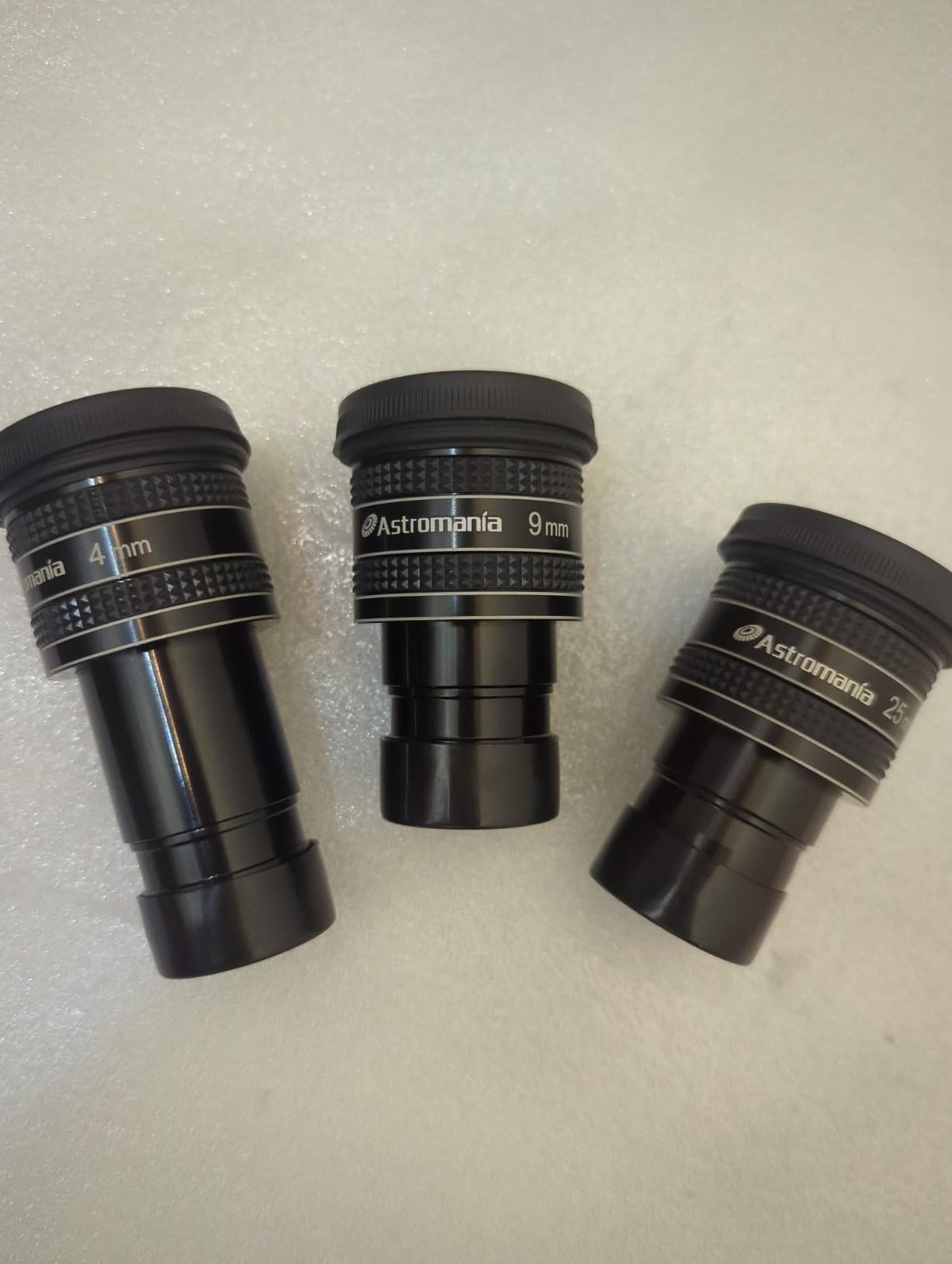
Reviewers who rate the optics highly describe sharp pinpoint stars, strong contrast and no false color, and say the finish compares favorably with eyepieces costing several times more. The rotatable barrel and foldable rubber eyecup do a real job of keeping stray light off the eye lens in a suburban sky.
The honest problem is aperture, not quality. At 5mm you are asking a scope to deliver a very small exit pupil, and if the aperture is modest the image simply dims. A 5mm on a 70mm refractor is a dim view, and no coating fixes that.
Who this eyepiece suits best
It suits observers with an aperture of roughly 130mm or more who want genuine high power, and it suits eyeglass wearers who would normally be pushed toward a friendlier design by short eye relief. Sixteen millimeters clears the threshold most people need.
It also suits anyone who likes an ordered layout. The rotatable barrel lets you dial the eyecup height to your own eye, and the 1.25-inch barrel with a female filter thread accepts standard planetary filters.
Where it falls short
Quality control is the recurring issue across 221 reviews. Some units arrived with loose internal elements that rattled, and one report described flaking, brush-applied coating. Inspect the barrel for rattle on arrival and return it if you find one.
Longer focal length variants in the same range show chromatic aberration toward the field edge, and short focal lengths need a large aperture to gather enough light. The 4.4 rating reflects that split.
12. Astromania 6mm 58-Degree Planetary – The More Useful of the Two Siblings
Astromania Telescope Eyepiece 6mm, Wide Angle 58° Planetary Eyepiece 1.25″
6mm focal length
58-degree apparent field
16mm of eye relief
5 elements in 3 groups fully multi-coated
Pros
- 16mm of eye relief stays comfortable for eyeglass wearers at high power
- 58-degree field keeps a wide immersive view even at 6mm
- Sharp to the edge with strong contrast on Jupiter and Saturn
- Knurled grip ring makes it easy to handle in the dark
Cons
- At 6mm the magnification needs a reasonably large aperture to stay bright
- Same quality-control reports of rattling elements and flaking coating
- Higher focal length variants show chromatic aberration in the outer field
If you own one of these two siblings, make it this one. The 6mm gives up a little magnification against the 5mm but gains a noticeably brighter image, and on a mediocre night that is the better trade. Our rule of thumb is that a 6mm beats a 4mm when the seeing is average.
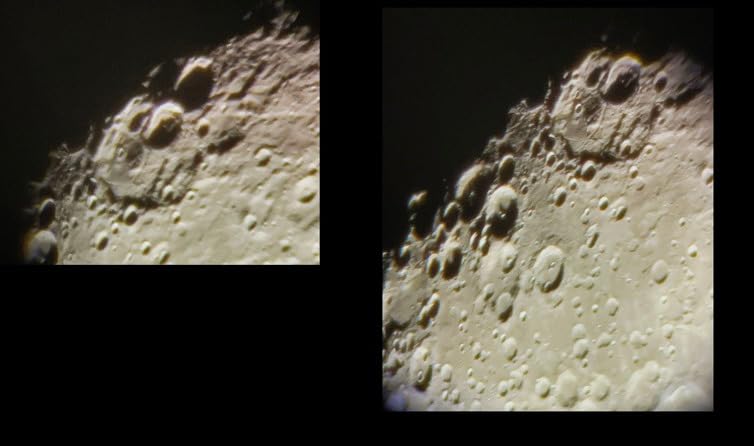
In a 1200mm scope it delivers 200x, which is the sweet spot for Jupiter’s belts, the Cassini Division on Saturn and craters along the lunar terminator. Reviewers report it sharp to the edge with strong contrast on all three targets.
The design details are the reason it works. Blackened lens edges and treated internal structure suppress the reflections that would otherwise scatter light and lower contrast, and the foldable rubber eyecup handles both eyeglass wearers and side light. The knurled grip ring is a small thing that matters with cold fingers.
This shares a review pool with the 5mm, which means the same pattern shows up: enthusiastic reports of optical quality rivaling premium eyepieces, alongside quality-control complaints about rattling elements and peeling coating accounting for most of the lower ratings.
Who this eyepiece suits best
It suits eyeglass wearers who refuse to give up high power, and anyone on an aperture where a 6mm sits right and a 5mm would be too dim. A 6-inch Dobsonian at 1200mm focal length is the classic pairing.
It suits observers who want one planetary eyepiece rather than a set. At 6mm with a 58-degree field, you have both a usable field and real power, and a standard 1.25-inch barrel that fits nearly every telescope.
Where it falls short
At 6mm the magnification demands a reasonably large aperture to stay bright, and on a 70mm refractor the image will be dim at 200x. Do the exit pupil calculation before you commit rather than after.
The same quality-control caveats apply: one unit arrived with a rattling internal element, one report of flaking coating, and one unit that would not focus at all. Check on arrival. The 4.4 rating is honest about the split.
Why Do Planets Look Like White Dots? A Five-Step Checklist
If your planets are featureless white disks, the problem is almost never the eyepiece. Work through these five in order before you spend anything.
Check collimation. A misaligned Newtonian or refractor spreads light across the planet instead of concentrating it. A star test at high power tells you in a minute whether this is your problem.
Check whether you are over-magnifying. Past about 2x per millimeter of aperture, and past what the atmosphere will support tonight, extra magnification produces a dimmer, softer, greyer image. Drop back to a shorter focal length and compare.
Check the exit pupil. Divide eyepiece focal length by the telescope focal ratio. Anything much above 1.0mm is washing out your contrast.
Check the central obstruction. A 6-inch or 8-inch short-tube Schmidt-Cassegrain with a large secondary will always look softer than a refractor of the same aperture. This is physics, not a defect.
Check the mount. A shaky tripod turns Jupiter’s bands into boiling water at high power. Tighten the legs, add a counterweight, and let the tube settle before judging the optics.
How to Choose a Planetary Eyepiece
Six criteria, in the order they actually matter.
Compute the magnification. Telescope focal length divided by eyepiece focal length. A 1000mm scope with a 25mm eyepiece gives 40x.
Stay inside the ceiling. Maximum useful magnification is roughly 2x per millimeter of aperture, or about 50x per inch.
Check the exit pupil. Eyepiece focal length divided by telescope focal ratio. Aim for 0.5-1.0mm on planets.
Demand enough eye relief. If you wear glasses you need 15-18mm, and that rules out most short Plossl designs.
Match the barrel. 1.25-inch is standard on modern scopes; 2-inch gives wider fields but needs a 2-inch focuser or adapter.
Check the diagonal too. A 2-inch prism or a quality star diagonal holds contrast far better at planetary power than a cheap erector. The diagonal is the last optical surface before the focuser, and a poor one throws away the work your eyepiece did.
On seeing versus aperture: on a night of poor atmospheric stability, a 6mm will beat a 4mm because the image stays steady. Aperture sets your ceiling, but the atmosphere sets your ceiling on any given night.
One more note on diminishing returns. Beyond a certain tier the improvement in a planetary view is small, and the community consensus on Astronomy StackExchange is blunt about it: aperture, not eyepiece, limits planetary detail. A cheap eyepiece in a good scope beats an expensive one in a bad scope.
Which Eyepiece for Each Planet?
Jupiter – the easiest target to reach. In a 1200mm scope, 13mm to 15mm gives 80-90x and shows the belts as bands; 8mm to 6mm gives 150-200x and brings out the Great Red Spot. A blue filter raises contrast noticeably.
Saturn – needs more, not less. The rings separate at around 60x and the Cassini Division needs 150x or better. A 6mm in an f/8 refractor at 200x is the classic setup, and a red or orange filter darkens the disc so the rings stand out.
Mars – the hardest. Surface albedo features and polar caps need 200x or more on an aperture of 130mm or above, and only around opposition. A red filter helps contrast when the disc is small.
Venus – the easiest of all, because phases show at surprisingly low power. 25mm to 20mm in a long-focus scope reveals the crescent, and no filter is needed.
The Moon – rewards everything. 25mm to 20mm for the whole disk, 10mm for craters, 6mm and below for rilles and the terminator. Terminator detail at low power is the single most satisfying thing in amateur astronomy.
Barlow note: if you want more power, a 2x Barlow is a reasonable choice because it adds one clean doubling step. A 3x Barlow on a small-aperture scope is the most repeated beginner mistake in forum discussions and usually does you no favors above the aperture limit.
Frequently Asked Questions
Which eyepiece is best for viewing planets?
A 6mm to 9mm eyepiece with a 60-68 degree apparent field is the best general choice for planets. It sits in the middle of the useful range, gives a wide enough field to keep a planet centered, and stays bright enough to show real contrast. Choose 4mm to 5mm only if your aperture is 130mm or larger, and 10mm to 15mm if you mostly want the Moon and the brighter targets.
What is the best magnification for viewing planets with a telescope?
Roughly 100x to 250x covers almost all planetary detail, with 150x to 200x the sweet spot for Jupiter and Saturn. Stay inside the ceiling of about 2x magnification per millimeter of aperture, so a 150mm telescope tops out near 300x. Above that you enlarge the blur rather than resolving more detail.
Can you see Jupiter with a 20mm eyepiece?
Yes, but only as a small disk. A 20mm eyepiece in a 1000mm telescope gives 50x, which is enough to see Jupiter as a bright disk and to follow its four Galilean moons as they change position night to night. It will not resolve the cloud belts. For bands you need roughly 80x, and for the Great Red Spot about 150x or more.
How do I calculate eyepiece magnification?
Divide the telescope focal length in millimeters by the eyepiece focal length in millimeters. A 1200mm telescope with a 6mm eyepiece gives 200x; a 750mm telescope with the same eyepiece gives 125x. To find your telescope focal length, multiply its aperture in millimeters by the f-ratio printed on the tube or spec sheet.
Why do the planets look like white dots through my telescope?
Usually one of five things: bad collimation, over-magnification, an exit pupil that is too large, a large central obstruction in your telescope, or an unsteady mount. Check collimation first with a star test, then drop to a shorter focal length and compare. If the image improves, you were past the useful magnification limit for that aperture or that night.
Is a 2x Barlow good for planets?
A 2x Barlow is generally worth it because it adds one clean doubling step and a 2x unit adds less degradation than a 3x. A 3x Barlow is where beginners get into trouble, because it pushes small-aperture scopes past their magnification ceiling and the image turns dim and grey. Add the Barlow to your mid-focal-length eyepiece rather than your shortest one.
Conclusion: Our Final Telescope Eyepiece Picks in 2026
For most people, the Celestron Eyepiece, Barlow and Filter Kit is the right answer because it covers every focal length a planetary observer needs and has 3191 reviews behind it. The AstroMaster kit is the value route, and the SV135 is the answer for anyone who wants one eyepiece with real eye relief. Whatever you choose, compute the magnification first, stay under 2x per millimeter of aperture, and pick a color filter. That is 2026‘s best telescope eyepieces for planetary viewing in one paragraph.