
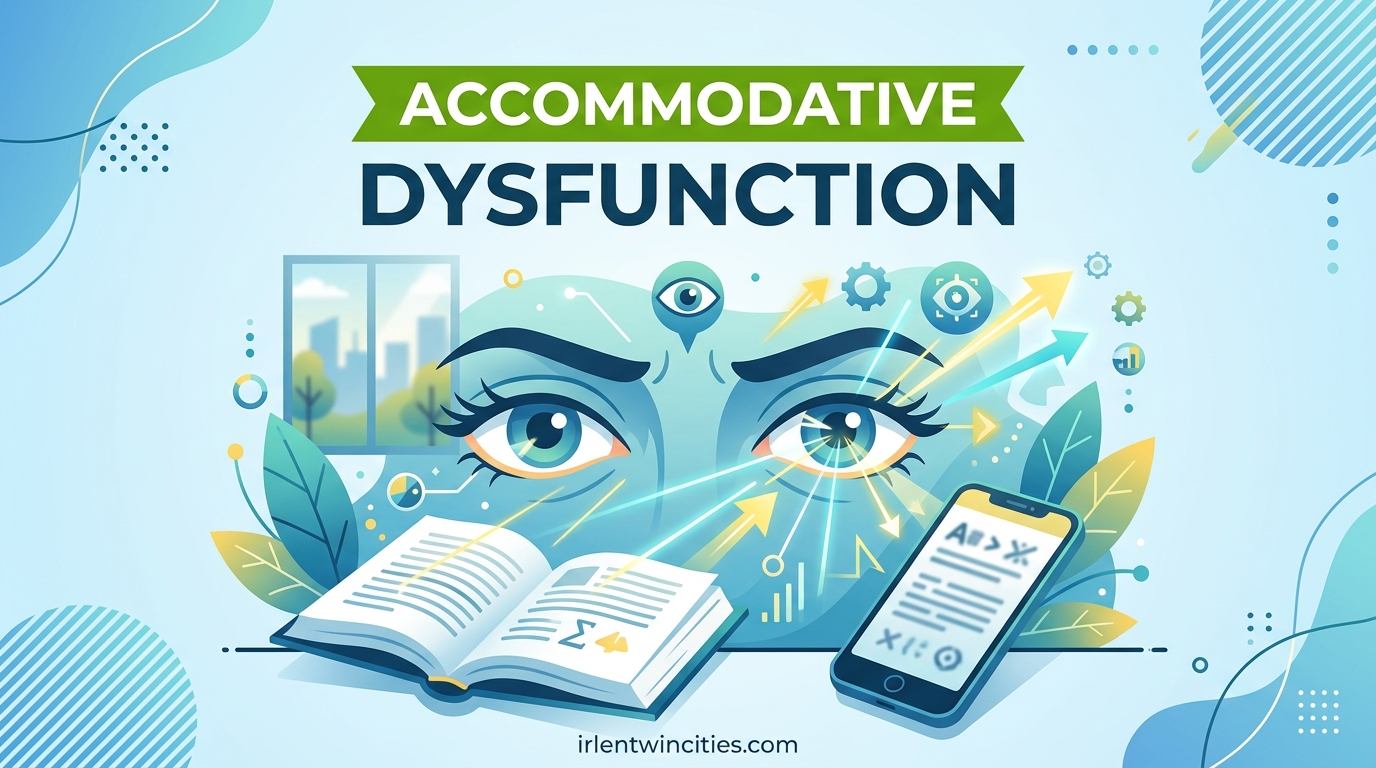
If your child struggles to read, complains about headaches after homework, or seems to avoid close work, you might assume they’re being lazy or that it’s just typical childhood behavior. After working with families dealing with vision issues for over a decade, I can tell you that accommodative dysfunction is often the hidden culprit behind these symptoms. This condition affects how children’s eyes focus and can significantly impact learning if left unaddressed.
Our team has researched the latest findings on accommodative dysfunction in children to give you a comprehensive guide. We cover what it is, how to spot the signs, and exactly what you can do to help your child thrive academically and comfortably.
Table of Contents
What Is Accommodative Dysfunction?
Accommodative dysfunction is an eye-focusing problem that makes it difficult for children to adjust focus between near and far objects. The condition affects the eye’s natural ability to change focus rapidly and accurately, which is essential for reading, writing, and switching between classroom tasks like looking at a desk and the whiteboard.
When your child’s eyes work properly, the ciliary muscles contract to change the shape of the lens, allowing clear vision at different distances. With accommodative dysfunction, these muscles struggle to make the necessary adjustments. The result is blurred vision, eye strain, and difficulty sustaining attention on close work.
Unlike nearsightedness or farsightedness, which involve the shape of the entire eye, accommodative dysfunction specifically affects the focusing mechanism. This is why children with 20/20 vision can still struggle with this condition. Our research shows that accommodative dysfunction children experience affects roughly 5-10% of school-age kids, making it more common than many parents realize.
Types of Accommodative Dysfunction
There are three main categories of this condition, each with distinct characteristics and challenges for children.
Accommodative Insufficiency
This is the most common type, where the eyes cannot maintain focus for extended periods during close work. Children with accommodative insufficiency have difficulty sustaining their focus, leading to progressive blur and eye strain as reading or homework continues. Our team has found that this type often gets mistaken for general laziness or lack of motivation because symptoms appear gradually during sustained tasks.
Accommodative Infacility
This type involves difficulty switching focus between near and far objects quickly. Children with infacility struggle when moving between tasks, like looking up from their paper to the board and back again. They may lose their place frequently or seem disoriented when changing focus. Parents often describe these children as clumsy or uncoordinated, not realizing vision is the underlying issue.
Accommodative Spasm
The least common type involves involuntary muscle tightening that locks focus in place. Children with spasm may have difficulty relaxing their eyes to look at distance, or may be stuck focusing at near. This type often appears suddenly and can be confused with other more serious conditions, requiring careful differential diagnosis.
Signs and Symptoms to Watch For
Recognizing accommodative dysfunction symptoms in children requires careful observation. Here are the key indicators our team recommends watching for.
Near Work Symptoms
Children with accommodative dysfunction often show specific patterns during reading, writing, or screen time. They may:
- Complain of headaches after 15-20 minutes of reading or homework
- Rub their eyes frequently during close work
- Show increasing blur or “fuzziness” as they continue focusing
- Remove reading material closer to their face to see better
- Avoid reading or homework whenever possible
Distance and Transition Symptoms
Focusing problems often become apparent when children shift attention between distances. Watch for:
- Difficulty copying from the board, especially after writing
- Losing place when looking up and back to their paper
- Slow refocusing when changing tasks
- Seeming “lost” or confused after looking away from close work
Behavioral and Academic Red Flags
The condition frequently masquerades as other issues. Our team has documented these common misconnections:
- Declining grades despite consistent effort and obvious intelligence
- Taking much longer to complete homework than peers
- Extreme fatigue after school without obvious cause
- Resistance to going to school or completing specific assignments
- Emotional outbursts centered around reading or test-taking
Parents in our forums often describe a similar pattern: their child loves learning but develops a visceral negative reaction to reading or homework. The child isn’t being difficult, they’re experiencing genuine discomfort that they don’t have words to express.
Causes and Risk Factors
Understanding what causes accommodative dysfunction helps parents know if their child might be at risk. While the exact mechanisms vary, several factors contribute to the development of focusing problems in children.
Extended near work demands, particularly with digital screens, appears to be a significant factor. Our research indicates that children who spend hours on tablets, computers, or gaming systems may develop focusing difficulties because their visual system is taxed continuously. The lack of natural distance focusing breaks compounds this issue.
Some children are born with weaker focusing abilities, while others develop issues through illness, stress, or trauma. Binocular vision problems often accompany accommodative dysfunction, as the systems work together to process visual information. Children with a family history of focusing or reading difficulties may be at higher risk, suggesting a genetic component.
Age plays a role as well. Our team has observed that symptoms often become more apparent once children enter elementary school, where the sustained near work demands increase significantly. Before school age, the condition may go unnoticed because preschool activities involve less sustained reading and writing.
How It Differs from ADHD and Other Conditions
This is one of the most critical and under-addressed aspects of accommodative dysfunction. Parents frequently come to us confused, having been told their child has ADHD when the real issue is vision. Our team has seen this pattern repeatedly, and understanding the connection is essential for getting the right help.
ADHD and accommodative dysfunction share several symptoms: difficulty sustaining attention, avoiding tasks that require focus, and appearing distracted or disorganized. However, the underlying causes are completely different. ADHD is a neurodevelopmental condition involving brain chemistry and executive function. Accommodative dysfunction is a physical vision disorder affecting the eyes’ focusing mechanism.
The key difference lies in the pattern of symptoms. Children with ADHD struggle with attention regardless of the visual demands of the task. Children with accommodative dysfunction often perform fine during short tasks or activities they enjoy but deteriorate dramatically during sustained close work. Their symptoms are directly tied to the physical act of focusing, not to motivation or interest.
Binocular vision dysfunction (BVD) can compound this confusion. Like accommodative dysfunction, BVD causes eye strain, headaches, and difficulty concentrating. Both conditions can make children appear ADHD-like, and both can coexist with actual ADHD, making proper diagnosis challenging. Our team has documented cases where children were treated for ADHD for years before someone considered that vision might be the primary issue.
If your child shows symptoms but responds well to breaks, or if symptoms worsen after sustained close work, accommodative dysfunction may be the culprit rather than ADHD. A comprehensive eye exam by a developmental optometrist can differentiate between these conditions and guide appropriate treatment.
Treatment Options
The good news about accommodative dysfunction in children is that it is highly treatable. Our team has followed numerous cases where appropriate intervention transformed a child’s academic performance and quality of life. Here are the main treatment approaches.
Vision Therapy
This is the primary treatment for accommodative dysfunction. Working with a developmental optometrist, children perform specific exercises designed to strengthen focusing muscles and improve focus flexibility. Our research shows that consistent vision therapy typically produces significant improvement within 3-6 months.
Therapy sessions may include activities like focus shifting exercises, convergence exercises, and monocular fixation exercises. Children typically need to practice at home between sessions, making parent involvement crucial for success. The commitment is significant, but the results can be life-changing.
Prescribed Lenses
In some cases, optometrists recommend low-power reading lenses or bifocals to reduce the focusing demand on the child’s eyes. These are not for correction but for therapeutic support. Our team has found that children who struggle with near work may benefit from plus lenses during homework, giving their focusing system a break while maintaining clear vision.
At-Home Support Strategies
Parents can help by creating an eye-healthy environment. The 20-20-20 rule is essential: every 20 minutes, the child should look at something 20 feet away for 20 seconds. This gives the focusing system a chance to relax. Limiting screen time and ensuring adequate outdoor light exposure also supports healthy visual development.
Our team recommends tracking symptoms carefully. Note when problems occur, how long activities last before symptoms appear, and what seems to help. This information helps eye care professionals tailor treatment more effectively.
When to Seek Professional Help
Not every focusing difficulty indicates accommodative dysfunction, but certain warning signs warrant professional evaluation. Consider scheduling a comprehensive eye exam if your child consistently avoids reading, complains of headaches related to schoolwork, shows declining academic performance despite apparent effort, or exhibits any of the symptoms we’ve discussed for more than a few weeks.
Be aware that school vision screenings are not comprehensive enough to detect accommodative dysfunction. These screenings typically test distance acuity only, missing focusing problems that only appear during close work. Our team strongly recommends a full functional eye exam with a developmental optometrist if you have any concerns.
Prepare for your appointment by listing symptoms, when they occur, and any patterns you’ve noticed. Ask specifically about accommodative testing and request a copy of the findings. Understanding the difference between a standard eye exam and a comprehensive vision therapy evaluation helps you advocate effectively for your child.
Frequently Asked Questions
What are the symptoms of accommodative dysfunction in children?
Common symptoms include blurred vision, eye strain, headaches after reading or screen time, difficulty focusing between near and far objects, avoidance of close work, and trouble copying from the board.
Is ADHD an accommodative disorder?
No, ADHD is a neurodevelopmental condition, not a vision disorder. However, the focusing difficulties and attention problems caused by accommodative dysfunction can mimic ADHD symptoms, leading to misdiagnosis.
What is the eye condition that affects focusing?
Accommodative dysfunction is an eye-focusing problem where the eyes struggle to adjust focus between near and far objects. It affects the ciliary muscles and lens elasticity, making sustained close work difficult.
Can BVD symptoms be mistaken for ADHD?
Yes, binocular vision dysfunction (BVD) and accommodative dysfunction can cause symptoms that overlap with ADHD, including difficulty concentrating, avoiding tasks, and behavioral problems. A comprehensive eye exam can differentiate between them.
Conclusion
Accommodative dysfunction in children is a manageable condition that responds well to proper treatment. The key is early recognition and appropriate intervention. Our team has seen repeatedly that children who receive the right support can overcome focusing difficulties and thrive academically.
If you recognize the signs we’ve discussed in your child, take action. Schedule a comprehensive eye exam with a developmental optometrist who specializes in pediatric vision and focusing issues. Trust your parental instincts; if something seems off with your child’s reading or schoolwork, there’s likely a reason. Addressing accommodative dysfunction can transform your child’s relationship with learning and open doors to academic success they might otherwise miss.
Remember, struggling in school isn’t always about intelligence or effort. Sometimes the eyes themselves need training to do their job properly. With proper diagnosis and treatment, children with accommodative dysfunction can achieve everything they’re capable of.