
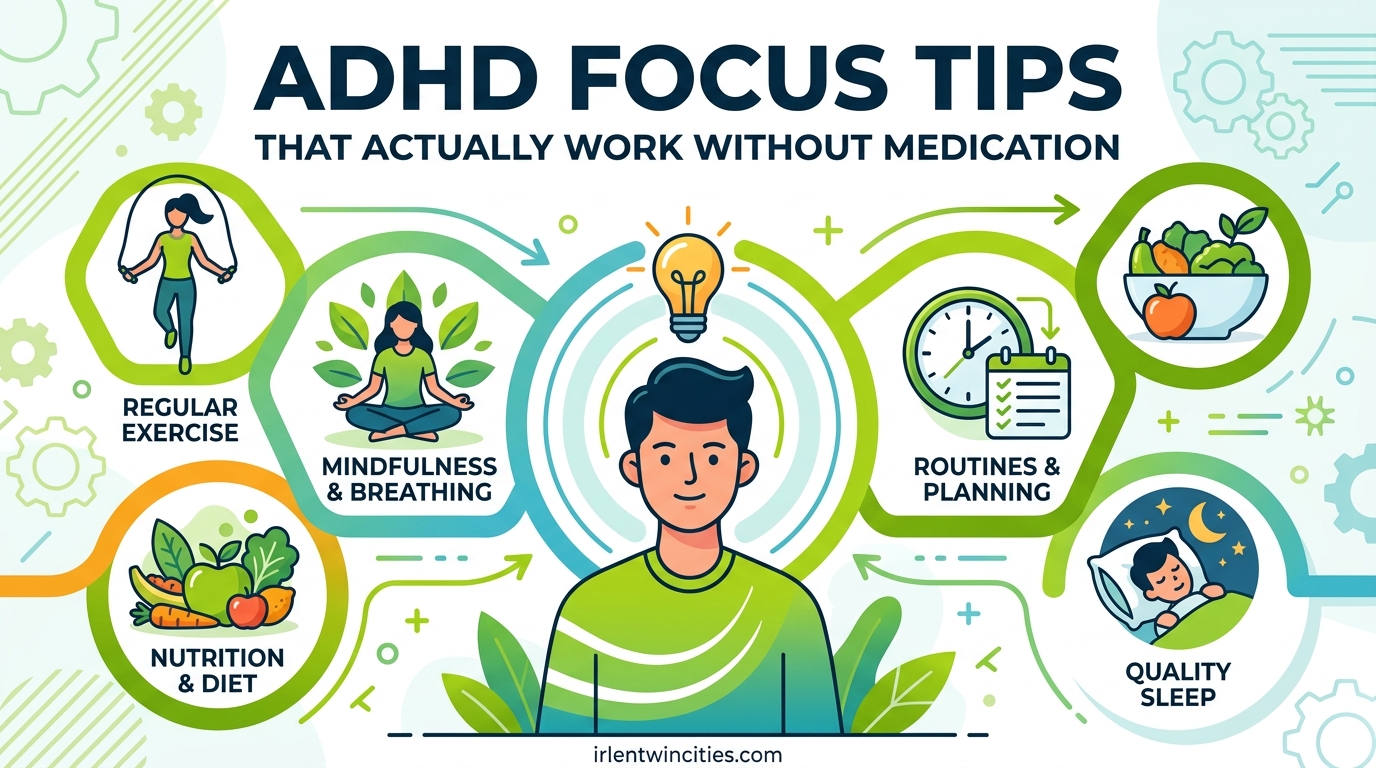
I spent years convinced that medication was my only hope for managing ADHD focus. Every morning felt like a battle against my own brain, and I genuinely believed I was broken because I couldn’t concentrate like everyone else seemed to.
The truth I discovered after testing dozens of approaches is this: you absolutely can improve ADHD focus without medication. It requires understanding how your brain actually works, then building external systems that compensate for executive dysfunction. This guide shares 15+ strategies that have helped thousands of people—including me—develop sustainable focus habits in 2026.
What you will learn here: time management techniques adapted specifically for ADHD brains, environmental design principles that reduce distractions, task organization systems that bypass working memory limits, lifestyle factors that naturally regulate dopamine, and emotional regulation tools for when focus strategies fail.
Before we dive in, I need to say something important: medication is a valid and often effective treatment option. The strategies here are not anti-medication. They are for people who cannot take stimulants, choose not to, or want complementary approaches. Different things work for different people, and that is perfectly okay.
Table of Contents
Why ADHD Makes Focus So Difficult
Understanding why focus feels impossible is the first step toward building systems that actually work. ADHD is not a character flaw or lack of willpower. It is a neurodevelopmental difference that affects how your brain regulates attention.
The Executive Function Connection
Executive function is the brain’s management system. It handles planning, prioritizing, starting tasks, sustaining attention, and switching between activities. For people with ADHD, these functions work differently—not broken, just different.
The ADHD brain struggles with what psychologists call “activation.” Getting started on tasks feels like pushing a boulder uphill because the brain’s reward system does not respond to delayed gratification the way neurotypical brains do. This is why you can hyperfocus on interesting video games for six hours but cannot start a five-minute email.
Time Blindness: Why Deadlines Sneak Up
One of the most frustrating aspects of ADHD is time blindness—the inability to sense time passing accurately. You sit down to work on something for “just a few minutes” and suddenly two hours have disappeared. Or you think you have plenty of time for a project, then panic when you realize it is due tomorrow.
Time blindness happens because the ADHD brain has trouble accessing the internal clock that most people use instinctively. Without external time markers, minutes and hours become abstract concepts rather than concrete realities. This is why external timers and visual cues become essential tools rather than optional accessories.
Dopamine Regulation and the Interest-Based Nervous System
The ADHD brain is essentially an interest-based nervous system. Tasks that are novel, challenging, urgent, or interesting trigger dopamine release that allows focus to happen. Boring, routine, or delayed-reward tasks do not provide that neurological stimulation.
This explains why traditional productivity advice like “just try harder” or “reward yourself afterward” often fails for ADHD brains. The reward is too distant to trigger the dopamine needed to start. Effective ADHD strategies work by either making tasks more interesting, creating artificial urgency, or bringing rewards into the immediate present.
ADHD Focus Tips: Time Management That Actually Works
Traditional time management assumes you can just decide to start working and follow through. ADHD time management acknowledges that willpower is not the solution—external structure is. Here are the techniques that have proven most effective across thousands of ADHD experiences.
1. The ADHD-Adapted Pomodoro Technique
The classic Pomodoro Technique suggests working for 25 minutes, then taking a five-minute break. For many with ADHD, 25 minutes feels like an eternity when focus is hard. The adaptation that works better is shorter work sprints with slightly longer breaks.
Try starting with 15-minute work blocks followed by 10-minute breaks. Some people find 10 minutes of work with 5-minute breaks works even better initially. The key is finding your personal threshold where focus feels achievable rather than overwhelming.
Using a visual timer rather than a phone alarm makes a significant difference. Seeing time pass helps combat time blindness. The Time Timer brand is popular in ADHD communities, but any analog kitchen timer with a visible dial works well.
2. Time Blocking with Reality Checks
Time blocking means assigning specific activities to specific time slots. The ADHD adaptation adds what I call “reality checks”—built-in buffer time because tasks almost always take longer than estimated.
When planning your day, block 50% more time than you think tasks need. If you estimate a report will take one hour, block 90 minutes. This accounts for the ADHD tendency to underestimate time and reduces the shame spiral when things run over.
Color-coding time blocks helps too. Use red for high-focus work, yellow for medium-focus tasks, and green for administrative activities. This visual organization engages the ADHD brain’s preference for visual information over text.
3. Body Doubling: The Secret Weapon for Task Initiation
Body doubling means having another person present while you work on tasks. They do not need to help with the task—just being in the same space creates external accountability that makes starting easier.
This technique works because the presence of another person provides gentle social pressure and reduces the isolation that often accompanies ADHD procrastination. It is particularly effective for boring administrative tasks like paying bills, doing laundry, or clearing email inboxes.
Virtual body doubling works too. Online co-working sessions through Zoom, Focusmate, or Discord channels allow you to work alongside others remotely. Many ADHD communities organize free body doubling sessions where members work silently on camera together.
4. Visual Timers and External Cues
Because ADHD brains struggle with internal time sense, external visual cues become essential. Beyond timers, this includes using visual schedules, checklists you can physically check off, and progress bars for longer projects.
One effective system is the “parking lot” method. Keep a whiteboard or large paper pad visible where you write tasks that pop into your head during focused work. This externalizes the working memory burden so you can return to the parking lot later instead of trying to hold thoughts in your head.
Implementation checklist for time management: Choose one technique from this section. Gather any needed supplies (timer, planner, apps). Start with just two 15-minute sessions tomorrow. Track what worked and what did not. Adjust timing after one week of practice.
Design Your Environment for Better Focus
Your environment shapes your focus more than most people realize. For ADHD brains, environmental design is not about aesthetics—it is about removing friction for good habits and adding friction for distractions.
Workspace Optimization Principles
Create a dedicated workspace that signals “focus mode” to your brain. This does not require a separate home office. Even a specific corner of a room or particular seat at the kitchen table can become your focus zone.
The key is consistency. Use this space only for focused work, not for social media scrolling or casual browsing. Over time, your brain begins associating that physical location with productivity, making focus easier to access.
Keep only what you need for your current task visible. Clutter competes for attention in the ADHD brain. Use drawers, boxes, or another room to hide visual distractions like bills, unread books, or hobby supplies.
Digital Boundaries That Actually Stick
Smartphones are focus kryptonite for ADHD brains because they provide constant dopamine hits through notifications. Simply deciding to use your phone less rarely works because the pull is neurological, not moral.
Physical distance is the most reliable strategy. Put your phone in another room during focus sessions. If that feels impossible, use app blockers like Freedom, Cold Turkey, or Forest that make accessing distracting apps deliberately difficult.
Turn off all non-essential notifications permanently. Every notification is an invitation to lose 20 minutes of focus. Batch communication checks at specific times rather than responding immediately to every message.
Sensory Tools for Regulation
Fidget tools are not toys or distractions—they are legitimate focus aids for ADHD. Having something to manipulate with your hands can actually improve concentration by providing just enough sensory input to satisfy the brain’s need for stimulation without pulling attention away from the task.
Popular options include stress balls, fidget cubes, tangle toys, or even just a paperclip to bend. The best fidget is one that requires no visual attention, meaning you can use it while reading or listening without looking at it.
Background noise can also help. Many people with ADHD focus better with white noise, brown noise, or ambient soundtracks than in complete silence. Apps like Brain.fm or Noisli provide audio designed specifically for focus. Some people prefer familiar TV shows or music they know well enough that it does not demand attention.
Visual Organization Systems
Clear visual organization reduces the cognitive load of finding things. Use transparent containers so you can see contents without opening them. Label everything with large, readable text. Group similar items together in designated zones.
Create “launch pads” near entry points where you keep items you need when leaving the house—keys, wallet, phone, mask if applicable. This reduces the morning chaos of searching for essentials when your brain is not fully online yet.
Task Organization Systems That Outsmart ADHD
ADHD affects working memory—the ability to hold information in mind while using it. This is why you walk into a room and forget why you are there. Externalizing task management is not optional for ADHD; it is essential.
The Two-Minute Rule for Task Initiation
David Allen’s Getting Things Done methodology includes a two-minute rule: if a task takes less than two minutes, do it immediately. For ADHD, this rule requires modification because our perception of “two minutes” is often inaccurate.
The ADHD-adapted version: if you genuinely believe a task takes under five minutes and you have the energy right now, do it immediately. But if there is any doubt about the time required, add it to your external system instead of attempting it immediately.
This prevents the common ADHD pattern of starting a “quick task” that balloons into a 45-minute distraction from your main priority.
Task Breakdown for ADHD Paralysis
ADHD paralysis happens when a task feels too big, undefined, or overwhelming to start. The solution is breaking tasks into absurdly small steps. Not “write report” but “open document,” then “write first sentence,” then “write second sentence.”
The first step should be so small it feels ridiculous. If “open document” feels hard, the first step is “sit at desk.” If that feels hard, the first step is “stand up.” Breaking the activation barrier into tiny pieces makes starting possible.
Write these micro-steps in your external system. Do not rely on your brain to break down tasks in the moment. The thinking happens during planning time so that execution time requires zero decision-making.
Visual Task Management with Kanban Boards
Kanban boards organize tasks visually using columns like “To Do,” “In Progress,” and “Done.” Moving tasks physically (or digitally) between columns provides dopamine feedback that the ADHD brain craves.
Physical Kanban boards use sticky notes on a wall or whiteboard. Digital options include Trello, Notion, or Asana. The visual nature of seeing all tasks at once reduces the anxiety of wondering what you might be forgetting.
Limit work-in-progress to three tasks maximum. ADHD brains want to start everything simultaneously. The Kanban structure forces completion or conscious decision-making about priorities before adding new work.
Working Memory Supports
Every time you rely on “I’ll remember that,” you are setting yourself up for failure. ADHD brains do not reliably hold information for later access. External capture systems are mandatory.
Carry a small notebook or use a notes app on your phone for capturing ideas immediately. The specific tool matters less than having it consistently available. The moment you think “I should remember that,” write it down.
Create checklists for recurring processes. Morning routines, work shutdown procedures, packing for trips—these benefit from written step-by-step lists that remove the working memory burden. Checklists prevent the “what am I forgetting?” anxiety that accompanies ADHD.
Natural Ways to Improve ADHD Focus Through Lifestyle
No lifestyle change eliminates ADHD, but certain habits significantly improve focus capacity by supporting the brain’s natural chemistry. These are foundational practices that make other strategies work better.
Sleep Hygiene for ADHD Brains
ADHD and sleep problems often go together. Many people with ADHD experience delayed sleep phase—feeling wired at night and exhausted in the morning. Poor sleep dramatically worsens focus, impulse control, and emotional regulation.
Create a wind-down routine that starts 60-90 minutes before bed. This is not optional pampering; it is necessary preparation for sleep. The routine should include dimming lights, stopping screens, and engaging in low-stimulation activities like reading paper books or gentle stretching.
Morning light exposure helps regulate circadian rhythms. Get outside within an hour of waking, even for just 10 minutes. This anchors your biological clock and can gradually shift bedtime earlier without medication.
Exercise Types That Improve Focus
Exercise increases dopamine and norepinephrine—neurotransmitters that ADHD medication also targets. Regular physical activity can improve focus for several hours afterward, making morning exercise particularly valuable for work or school days.
The most beneficial forms of exercise for ADHD combine physical movement with cognitive engagement. Martial arts, dance, rock climbing, and team sports require coordination, timing, and strategic thinking alongside cardiovascular effort.
Even brief movement breaks help. Ten jumping jacks between work sessions can reset focus. Walking meetings or phone calls allow movement during otherwise sedentary tasks. The key is finding exercise you will actually do consistently rather than the theoretically optimal workout.
Nutrition Basics for Sustained Attention
Protein is particularly important for ADHD focus. The brain needs protein to produce dopamine and other neurotransmitters. Starting the day with protein rather than carbohydrates can improve morning focus significantly.
Good protein sources include eggs, Greek yogurt, cottage cheese, nuts, nut butter, and lean meats. If you struggle with breakfast, even a handful of almonds is better than skipping eating entirely.
Omega-3 fatty acids show promise for ADHD support. These are found in fatty fish like salmon, sardines, and mackerel. If you do not eat fish regularly, an omega-3 supplement may be worth discussing with your healthcare provider.
Hydration matters too. Dehydration impairs cognitive function in everyone, and the distractible ADHD brain is more likely to forget to drink water. Keep a water bottle visible at your workspace as an environmental cue.
Circadian Rhythm Considerations
Many ADHDers are natural night owls, but modern work schedules rarely accommodate this preference. Gradually shifting your schedule earlier by 15 minutes every few days is more sustainable than dramatic changes.
Morning routines create structure that carries through the day. Even a simple sequence like “wake, drink water, stretch for five minutes, eat protein breakfast” provides the external framework that ADHD brains need.
Avoid caffeine after 2:00 PM. The ADHD brain already struggles with sleep, and afternoon caffeine worsens this even if you feel like it does not affect you. The half-life of caffeine means it can still impact sleep eight hours after consumption.
Managing RSD and Emotional Barriers to Focus
Rejection Sensitive Dysphoria (RSD) is the intense emotional pain triggered by perceived rejection, criticism, or failure. It affects many people with ADHD and creates invisible barriers to focus that productivity strategies cannot address alone.
Understanding RSD in Practical Terms
RSD is not “being too sensitive.” It is a neurological pattern where the ADHD brain processes negative feedback as an existential threat. A casual email correction can feel like catastrophic failure. A friend’s delayed text response can trigger abandonment fears.
This matters for focus because fear of failure often prevents task initiation. If starting a project risks facing criticism upon completion, the brain avoids starting to avoid the potential pain. This creates procrastination that looks like laziness but is actually self-protection.
Recognizing RSD as a neurological pattern rather than a character flaw is the first step. The feelings are real and valid, but they do not reflect objective reality. Learning to separate perceived rejection from actual rejection takes practice but is transformative.
Self-Compassion Strategies
Shame is the enemy of ADHD focus. When you berate yourself for struggling with basic tasks, you create emotional overwhelm that makes focus impossible. Self-compassion is not letting yourself off the hook—it is treating yourself with the kindness you would offer a friend.
When focus strategies fail, notice the self-criticism and consciously replace it with acknowledgment. Instead of “I am so lazy and broken,” try “Starting tasks is genuinely hard for my brain. That does not mean I am bad. It means I need different supports.”
Many people with ADHD internalized criticism from childhood when they were repeatedly told to “just try harder.” Recognizing that you were doing your best with the tools you had then—and extending that understanding to yourself now—reduces shame that blocks productivity.
CBT Techniques for ADHD Emotional Regulation
Cognitive Behavioral Therapy (CBT) offers tools for managing the thought patterns that derail focus. One core technique is identifying cognitive distortions—unhelpful thinking patterns that make emotions worse.
All-or-nothing thinking is common with ADHD. “I already missed my morning routine, so the whole day is ruined.” CBT teaches you to recognize this distortion and replace it with realistic thinking: “I missed the morning, but I can still have a productive afternoon.”
Mindfulness meditation, even just five minutes daily, strengthens the prefrontal cortex and improves emotional regulation. Apps like Headspace or Insight Timer offer ADHD-friendly guided meditations. Do not worry about “clearing your mind”—simply noticing when your attention wanders and returning to the breath builds the regulation skill.
Dealing with Shame When Strategies Fail
Sometimes you will try all the right strategies and still struggle. This is normal. ADHD is variable—hormones, sleep, stress, and even weather affect symptom severity. Strategy failure does not mean personal failure.
When techniques that usually work stop working, troubleshoot rather than shame yourself. Check basics first: Did you sleep? Have you eaten? Are you hydrated? Is there an underlying stressor? Often the solution is addressing these foundations rather than pushing harder with productivity techniques.
Building what I call a “low capacity plan” helps. Create a simplified version of your routine for difficult days. When full productivity is impossible, the low capacity plan keeps you moving forward without requiring full capability.
Age-Specific ADHD Focus Strategies
ADHD presents differently across life stages, and strategies must adapt accordingly. What works for a college student differs from what helps a parent or retiree. Here are age-specific adaptations based on developmental needs and life circumstances.
Strategies for Children with ADHD
Children need external structure provided by adults. Visual schedules with pictures help younger children understand routines. Break tasks into tiny steps and provide immediate, specific praise for each completion.
Movement breaks are essential, not rewards. A child cannot focus for 45 minutes without movement. Build in physical activity every 20-30 minutes of seated work. Fidget tools should be permitted in classrooms where possible.
Parents should focus on building systems rather than demanding performance. A child with organized morning systems will succeed more reliably than one expected to “just remember” what needs to happen.
Teen-Specific Approaches
Teenagers with ADHD face increasing academic demands while their brains are still developing executive function. They need more autonomy than children but still require scaffolding.
Body doubling works well for teens doing homework. Study groups or working at the kitchen table while parents cook provides presence without hovering. Let teens choose their own organizational systems rather than imposing parent preferences.
Sleep becomes a major issue in adolescence. The natural circadian shift combined with ADHD creates extreme night owl patterns. Advocating for later school start times or flexible morning attendance can be life-changing for teen focus.
Adult Workplace Adaptations
Adults with ADHD benefit from negotiating workplace accommodations. This might include noise-canceling headphones, permission to use fidget tools, or flexibility in when work happens. You do not necessarily need formal disability disclosure to request these.
Time blocking protects focus from the constant interruption of open office plans or Slack culture. Blocking “focus time” on your calendar makes it visible to colleagues and gives you permission to ignore interruptions during those periods.
Many adults benefit from external accountability through coaches, therapists, or accountability partnerships. The structure of checking in with someone regularly improves follow-through on professional and personal goals.
Older Adults Considerations
ADHD often becomes more noticeable in later life when retirement removes the external structure that jobs provided. Creating new routines becomes essential for maintaining focus and mental engagement.
Working memory naturally declines with age, which compounds ADHD challenges. Simplifying systems and relying more heavily on external tools becomes necessary. Smartphones with reminder apps and digital calendars are particularly valuable for this demographic.
Physical exercise remains crucial for older adults with ADHD. Movement supports cognitive function and emotional regulation. Walking groups combine social connection with physical activity, addressing multiple ADHD needs simultaneously.
Advanced Focus Techniques and the 5-3-1 Rule
Once foundational strategies are in place, advanced techniques can further refine focus management. These approaches address specific situations like hyperfocus redirection and strategy combination.
The 5-3-1 Rule Explained
The 5-3-1 rule is a decision-making framework that prevents overwhelm when facing multiple tasks. Choose five things you could do today, narrow to three you will actually do, and commit to one you will complete first.
This technique addresses ADHD paralysis by limiting options while still providing choice. Having five options prevents feeling trapped, while narrowing to three manageable items prevents overwhelm. Committing to one first task provides clear starting direction.
The rule works because it externalizes the prioritization process. Rather than trying to hold multiple competing priorities in your working memory, you write them down and make the decision visible and concrete.
The 30% Rule of ADHD
The 30% rule suggests that people with ADHD typically have executive function abilities approximately 30% below their chronological age. A 30-year-old with ADHD might have the organizational skills of a 21-year-old neurotypical person.
This is not about intelligence—it is about self-management skills. Understanding this rule helps set realistic expectations. If you are struggling with organization that peers seem to handle easily, the gap is neurological, not a reflection of your capability.
The 30% rule also explains why childhood ADHD support needs differ from adult needs. A 10-year-old with ADHD has the executive function of roughly a 7-year-old. They need age-appropriate support, not adult-level expectations.
Hyperfocus Redirection Strategies
Hyperfocus—the ability to concentrate intensely on interesting tasks—is often described as an ADHD superpower. But uncontrolled hyperfocus derails priorities when you spend six hours organizing your music library instead of completing work deadlines.
Redirecting hyperfocus requires planning ahead. Identify tasks that trigger hyperfocus and schedule them for appropriate times. Save the engrossing activity for after priority work is complete as a reward rather than letting it hijack your day.
Set external alarms to break hyperfocus when necessary. Regular alarms often get ignored during deep focus, so consider changing alarm sounds or using physical timers in different rooms that force you to get up and move.
When to Combine Multiple Strategies
Single strategies rarely solve complex ADHD challenges. Effective management usually requires layering multiple approaches simultaneously. You might use body doubling alongside Pomodoro timing in an optimized workspace after a morning exercise session.
Start with one strategy, master it, then add another. Trying to implement ten new systems simultaneously creates overwhelm that guarantees failure. Build your system progressively over weeks or months.
Keep a “focus toolkit” list of strategies that have worked for you. On difficult days, consult the list and choose techniques that address your current specific challenge. Having options prevents the despair of feeling like nothing works.
Troubleshooting When Strategies Fail
Even proven techniques stop working sometimes. Before abandoning a strategy, check these common failure points: Have you been using the technique long enough to form a habit? Are you implementing the technique fully or cutting corners? Has something in your environment or health changed?
Sleep deprivation destroys the effectiveness of most ADHD strategies. If your systems suddenly stop working, check your sleep first. The same applies to stress, illness, hormonal changes, and major life transitions.
Sometimes a strategy truly stops working and needs replacement. This is normal. ADHD brains crave novelty, and techniques can lose effectiveness through familiarity. Rotate strategies periodically to maintain engagement.
Frequently Asked Questions
How to increase focus with ADHD without medication?
Increase focus by using external structure rather than willpower. Implement time management techniques like adapted Pomodoro, use body doubling for accountability, design your environment to reduce distractions, break tasks into micro-steps, and support your brain with adequate sleep, exercise, and protein intake. Focus improvements come from working with your ADHD brain rather than against it.
What helps ADHD focus naturally?
Natural focus aids include regular exercise that increases dopamine, sufficient sleep to restore cognitive function, protein-rich meals that support neurotransmitter production, omega-3 fatty acids, external tools like visual timers and Kanban boards, body doubling for social accountability, and environmental modifications that reduce sensory overload.
What is the 5 3 1 rule for ADHD?
The 5 3 1 rule is a decision-making framework: choose 5 tasks you could do today, narrow to 3 you will actually attempt, and commit to 1 you will complete first. This prevents overwhelm by limiting options while providing structure for starting. It externalizes prioritization so you do not need to hold multiple competing demands in working memory.
What is the 30% rule of ADHD?
The 30% rule suggests people with ADHD typically demonstrate executive function skills approximately 30% below their chronological age. A 30-year-old with ADHD might have the organizational abilities of a 21-year-old neurotypical person. This helps explain why adult ADHDers may struggle with self-management skills peers handle easily.
Is it actually possible to manage ADHD without medication?
Yes, many people successfully manage ADHD without medication or use non-medication strategies alongside medication. Success requires building external systems that compensate for executive dysfunction, including time management techniques, environmental design, task organization tools, lifestyle optimization, and emotional regulation strategies. Results vary by individual and symptom severity.
How long before natural ADHD strategies show results?
Most people notice initial improvements within 2-3 weeks of consistent strategy implementation, with significant changes appearing after 6-8 weeks. Habit formation typically requires 60-90 days. Be patient with yourself—building effective systems takes time, and different strategies work for different people. Track small wins to maintain motivation during the adjustment period.
Start Small: Your Personal Action Plan for ADHD Focus Tips
You now have more than fifteen evidence-based strategies for improving ADHD focus without medication. Having options is valuable, but implementing everything simultaneously leads to overwhelm and failure. The key is starting small and building progressively.
Choose just three techniques to begin with: one time management method (try the adapted Pomodoro), one environmental change (remove your phone from your workspace), and one lifestyle foundation (establish a consistent sleep time). Master these before adding more.
Remember that different strategies work for different people, and what works may change over time. The goal is not perfect productivity every day. The goal is building a toolkit that helps you focus more often, with less struggle, and without the shame that so often accompanies ADHD.
Medication remains a valid and effective option for many people. These strategies complement medical treatment or stand alone depending on your situation. There is no wrong choice—only what works for your specific brain and circumstances.
ADHD focus tips that actually work share one quality: they work with your brain rather than against it. You are not broken. You simply need different supports than neurotypical productivity advice assumes. Start with one small change today, and build from there.