
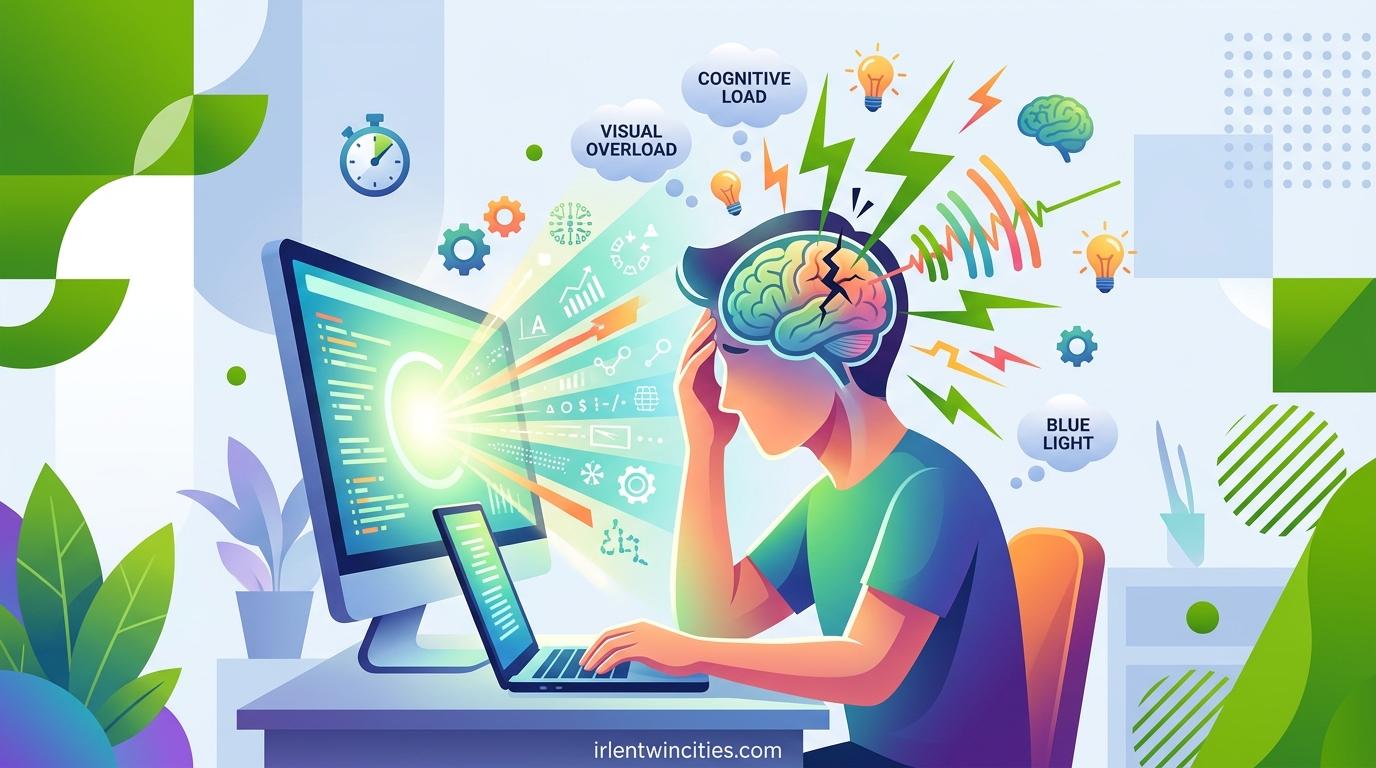
If you have ever tried to scroll through your phone or work on your computer after hitting your head, you know exactly how miserable this can feel. That pounding headache that seems to come out of nowhere, the eye strain that makes you want to close everything out, the dizziness that kicks in after just a few minutes of screen time. You are not imagining this. There is a real, medical reason why screens trigger headaches after a head injury, and understanding why it happens can help you recover faster.
After a concussion or other head injury, your brain goes into a state of heightened sensitivity. The same neural pathways that help you process visual information, handle light exposure, and sustain attention become easily overwhelmed. Screens—whether from phones, computers, tablets, or televisions—happen to be particularly good at activating all of these strained systems at once. That is why something as common as checking a text message can leave you with a splitting headache and needing to lie down in a dark room for an hour.
Table of Contents
Why Screens Trigger Headaches After a Head Injury
The short answer is that your brain is working differently after an injury. When you have a concussion, the delicate pathways that transmit signals between brain cells can become temporarily disrupted. This disruption affects how your brain processes sensory information, and visual information is some of the most demanding sensory input your brain handles every day.
Screens make this problem worse for several reasons that all stack on top of each other. First, screens emit light directly into your eyes, and after a head injury, the part of your nervous system that controls how your pupils respond to light often does not work properly. Second, screens require your eyes to constantly refocus and track moving images, which takes enormous effort when your visual system is healing. Third, the information on screens changes constantly, demanding sustained cognitive processing that exhausts your recovering brain.
One issue that many concussion survivors report is something called photophobia, or light sensitivity. This is not just a dislike of bright lights—it is a physical response where light actually causes pain signals to fire in your already sensitized nervous system. Screens that are too bright, too dark, or viewed in poor lighting conditions can all trigger this response and make your headache significantly worse.
Light Sensitivity After Concussion: Why Your Eyes Cannot Handle Screens
Light sensitivity after concussion is one of the most common and debilitating symptoms that people deal with. It happens because a head injury often disrupts the autonomic nervous system, which controls automatic functions in your body including pupil dilation and constriction. When this system is not working properly, your pupils may not narrow effectively in response to bright light, allowing too much light to flood your retina and overwhelm your visual system.
The part of your brain called the superior colliculus, which helps coordinate eye movements and responses to visual stimuli, can also be affected by concussion. This means that even if your pupils are working normally, the signals coordinating your visual response to changing light conditions are scrambled. The result is that normal indoor lighting or screen brightness feels like staring directly into the sun.
Many people find that screens in a dark room are particularly problematic. When you view a bright screen in a dark environment, your pupils dilate to let in more light, but then the changing brightness of content on the screen causes your pupils to constantly try to adjust. This rapid constriction and dilation fatigues the muscles controlling your iris and contributes to headache and eye strain.
The Role of Visual Processing and Cognitive Overload
Beyond light sensitivity, screens also cause headaches after head injury because of something called cognitive overload. When you look at a screen, your brain has to work constantly to interpret what you are seeing. Your eyes must focus on a fixed distance, track moving images, process color and contrast, and make sense of text and symbols—all at the same time.
After a concussion, these processing tasks take significantly more mental energy than they did before your injury. This is because the neural pathways used for visual processing are inflamed or temporarily not functioning optimally. The result is that even a short period of screen use can leave you feeling mentally exhausted, a phenomenon sometimes called screen fatigue in concussion recovery circles.
Computer screens tend to be worse than television screens for most people dealing with post-concussion screen sensitivity. This is because computer work typically involves reading text, processing information in columns or tables, and maintaining focus on a single close-up source for extended periods. Phones are often the worst culprit because the screens are small, the text is often poorly contrasted, and people tend to hold them at uncomfortable angles or distances.
One thing that many concussion survivors describe is what feels like mental exhaustion after just a few minutes of screen time. This is your brain’s way of telling you that the healing pathways are being overworked. Pushing through these signals rarely helps and can actually prolong your recovery. Listening to your body and stopping screen use when symptoms increase is one of the most important things you can do for your healing.
Screen Technology and Why LCD Screens Are Particularly Problematic
Not all screens are equal when it comes to triggering headaches after head injury. LCD screens, which are the most common type in modern devices, have a particular characteristic that makes them especially difficult for people with concussion-related light sensitivity. This is the flicker rate, or the frequency at which the backlight in LCD screens turns on and off to control brightness.
Most LCD screens flicker at a rate that is imperceptible to the conscious eye—usually around 60 Hertz. However, some people with post-concussion syndrome can perceive this flicker or feel its effects as a kind of strobe-like stimulation that triggers headache and nausea. The effect is similar to how some people with epilepsy are sensitive to flashing lights, though it occurs at much lower, non-dangerous flicker frequencies.
Blue light emission from screens is another factor that affects concussion recovery. Blue light suppresses melatonin production, which can interfere with the sleep you need to heal. After a head injury, getting good quality sleep is already challenging because of pain, discomfort, and the neurological changes happening in your brain. Adding screen-induced melatonin disruption on top of this creates a perfect storm for worsening both your sleep quality and your headache symptoms.
LED screens with high refresh rates and rapid motion handling can also cause problems because of how the images are processed and displayed. Fast-paced video content, scrolling, and animations all require your visual system to track rapid changes, which can trigger headache and dizziness in someone with an injured brain. Even if the content itself is calming, the technical way it is delivered on screen can cause symptoms.
Recovery Timeline: How Long Will This Last?
One of the most common questions people have after concussion is simply, “When will this stop?” The honest answer is that it varies widely from person to person, but there are some general patterns that can give you a roadmap for what to expect.
During the first 48 to 72 hours after a concussion, most healthcare providers recommend complete rest from screens, along with limited physical activity and plenty of sleep. This is the critical window when your brain is most sensitive to overstimulation, and exposing it to screens during this time can significantly worsen symptoms and prolong recovery. Many people make the mistake of trying to power through this period by checking their phones, and they end up setting their recovery back by days or weeks.
For most people with mild concussion, light sensitivity and screen intolerance improve steadily over the first one to two weeks. By the end of the second week, many concussion survivors find they can comfortably watch television or have short conversations on their phones without triggering significant headache. However, some people continue to struggle with screens for much longer.
If your screen sensitivity persists beyond a month, you may be dealing with post-concussion syndrome. This condition, which affects an estimated 10 to 15 percent of concussion patients, involves symptoms that linger for months or even longer. People with post-concussion syndrome often need specialized treatment from doctors who understand concussion recovery, including vision therapy, medication management, and graduated rehabilitation programs.
Factors that influence how long your screen sensitivity lasts include the severity of your initial injury, whether you have had concussions before, your age, and how well you rest during the early recovery period. People who return to demanding cognitive or physical activities too quickly often experience prolonged symptoms, including screen-related headaches.
Managing Screen Time During Concussion Recovery
While complete screen avoidance may be necessary for the first couple of days, most people eventually need to reintroduce screen use for work, school, and daily life. The key is doing this gradually and strategically, while monitoring your symptoms closely.
One helpful guideline is something called the 20-20-20 rule. This means that every 20 minutes of screen use, you should look at something 20 feet away for 20 seconds. This gives your eyes a chance to relax from the constant focusing effort that screen use requires. During concussion recovery, you may need to start with shorter intervals—perhaps 10 minutes of screen time followed by a 5-minute break in a dark room. As you heal, you can gradually extend these intervals.
Adjusting your screen settings can make a significant difference in how you tolerate screen use. Reduce the brightness to the lowest comfortable level—often much lower than you would normally use. Increase text size and contrast when possible. Enable blue light filters or night mode on your devices, especially in the evening. Some people find that dark mode settings help reduce eye strain, though the contrast required can sometimes make this worse for others.
Environmental modifications are equally important. Avoid using screens in dark rooms where the contrast between the bright screen and dark environment causes pupil strain. Use ambient lighting to reduce the contrast between your screen and its surroundings. Position your screen so that it is not reflecting windows or lights, which creates glare that forces your eyes to work harder.
It can also help to pre-plan your screen sessions. Instead of spontaneously checking your phone, schedule short, purposeful sessions for specific tasks like responding to essential messages or checking directions. Between these sessions, give yourself permission to be completely offline and allow your brain to rest without the constant pull of notifications and scrolling.
Frequently Asked Questions
Why are screens bad after a concussion?
Screens are problematic after concussion because the injured brain becomes hypersensitive to visual stimuli. The autonomic nervous system that controls pupil dilation and light processing is disrupted, making bright screens overwhelming. Additionally, screens require sustained cognitive effort to process rapidly changing information, which exhausts healing neural pathways.
What is the 20-20-20 rule for concussions?
The 20-20-20 rule recommends that every 20 minutes of screen use, you look at something 20 feet away for 20 seconds. This gives your eyes and brain a chance to rest from the constant focusing effort screens require. During concussion recovery, you may need to start with much shorter intervals and gradually increase as tolerated.
How long does light sensitivity last after a concussion?
Light sensitivity after concussion typically improves within 1-2 weeks for mild concussions, but can persist for months in some individuals, especially those with post-concussion syndrome. Each person’s recovery timeline is different, and pushing through symptoms can prolong recovery.
What triggers post-concussion headaches?
Post-concussion headaches can be triggered by multiple factors including bright or flickering light from screens, prolonged cognitive effort, physical activity, stress, and poor sleep. Screens are particularly problematic because they combine several triggers: bright light, cognitive demand, and often poor contrast or glare.
Why can’t you look at screens after a concussion?
After concussion, the brain’s visual processing centers and autonomic nervous system are often disrupted. Screens require your eyes to constantly refocus, process changing images, and interpret contrast and color, all tasks that become difficult when these pathways are injured. This leads to eye strain, headaches, and mental fatigue even after short use.
When can you watch TV after a concussion?
Most healthcare providers recommend avoiding screens entirely for the first 24-48 hours after a concussion during the critical rest period. After that, you can gradually reintroduce screens starting with short, comfortable sessions of 5-10 minutes. TV is generally easier on the eyes than computers or phones due to larger text and distance from the screen.
Moving Forward: Hope for Screen Tolerance Recovery
Dealing with screen sensitivity after a head injury is one of the most frustrating parts of the recovery process. Being unable to use your phone, computer, or watch your favorite show can make you feel isolated and cut off from the normal rhythms of daily life. It is completely understandable to feel impatient, frustrated, or even depressed about this limitation.
But here is the encouraging part: for the vast majority of people, screen sensitivity does improve. Your brain is remarkably resilient, and with proper rest and graduated rehabilitation, the pathways that process visual information will heal. Most concussion survivors are able to return to their normal screen use within a few weeks, and those who take their recovery seriously during the early period tend to heal faster than those who try to push through symptoms.
The key takeaways are these. First, understand why screens trigger headaches after head injury: your injured brain is temporarily hypersensitive to the combined demands of visual processing, light exposure, and cognitive effort that screens require. Second, respect the critical rest period in the first 48 to 72 hours by avoiding screens completely. Third, reintroduce screen use gradually, using the 20-20-20 rule, adjusted brightness settings, and environmental modifications to minimize strain.
If your screen sensitivity persists beyond a month or two, or if your symptoms are significantly interfering with your ability to work, study, or care for yourself, please seek help from a healthcare provider who specializes in concussion management. Vision therapy, medication, and specialized rehabilitation programs can make a real difference for people struggling with persistent post-concussion symptoms.
Recovery from concussion is not always linear, and there will likely be days when you feel worse than expected. Be patient with yourself, listen to your body, and remember that every day of proper rest brings you closer to being able to comfortably use screens again. You will get there.