
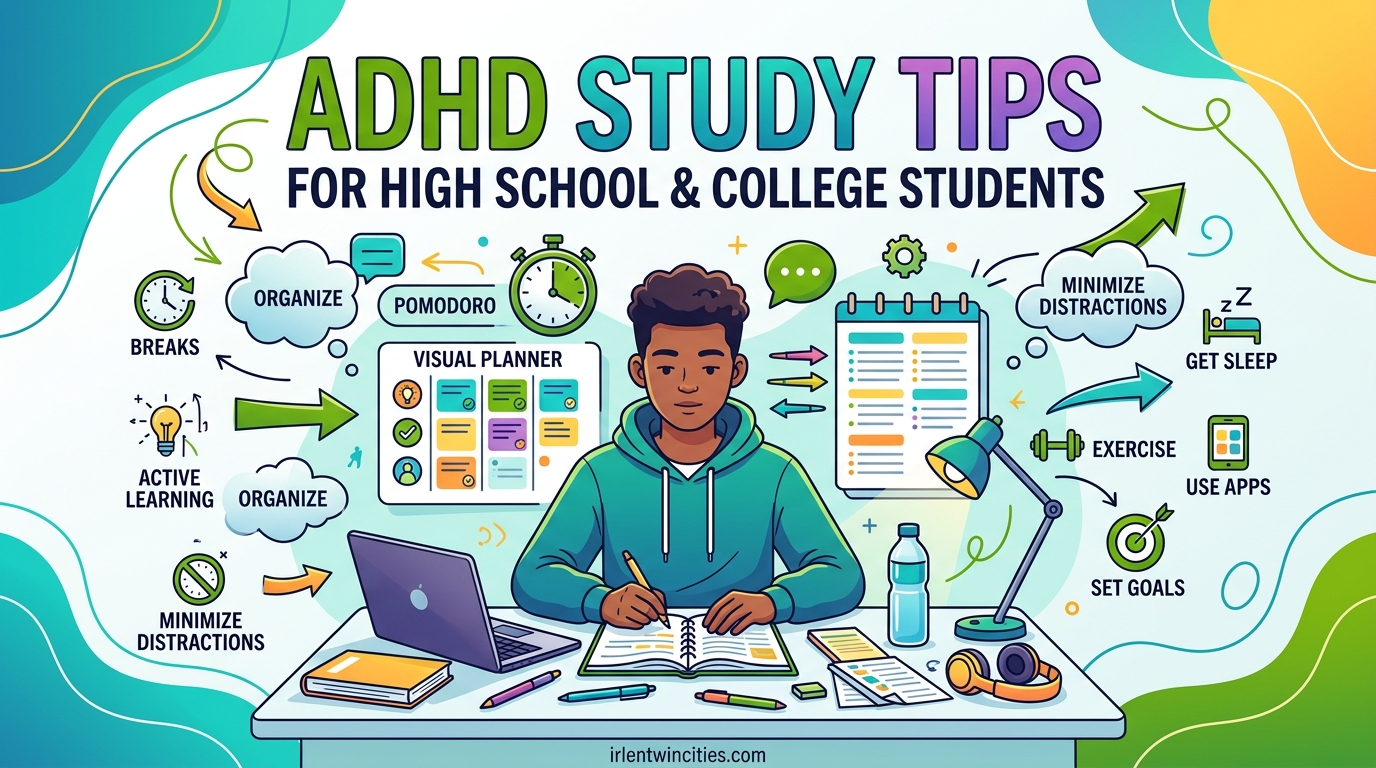
Studying with ADHD feels like trying to fill a bucket with holes in the bottom. You start with the best intentions, you know the material matters, and yet two hours later you are deep into a Wikipedia rabbit hole about medieval siege weapons instead of reviewing for your chemistry exam.
I have been there. Our team has worked with hundreds of ADHD students over the past three years, and we have learned that standard productivity advice fails ADHD brains because it was not designed for them. The Pomodoro technique sounds great until you spend 25 minutes just trying to start.
ADHD study tips for high school and college students require a different approach. These strategies work with your brain’s wiring rather than against it. You will learn time management techniques that account for task initiation challenges, active learning methods that leverage your brain’s need for novelty, and motivation systems that actually trigger dopamine.
Whether you are a high schooler juggling six classes and a part-time job, or a college student facing your first unsupervised finals week, this guide gives you practical, tested strategies that work in the real world.
Table of Contents
Why Studying With ADHD Feels Impossible
ADHD affects studying through executive function deficits, dopamine dysregulation, and working memory limitations that make traditional study methods ineffective. Your brain is not broken. It is running different software that requires different inputs.
The Executive Function Problem
Executive function is your brain’s CEO. It handles planning, prioritizing, starting tasks, and switching between them. For ADHD brains, this CEO is often out to lunch when you need it most.
You know you should study. You want to study. But the gap between knowing and doing feels like an ocean. This is not laziness. It is a neurological difference in how your brain initiates tasks and maintains motivation over time.
One Reddit user described it perfectly: “I have tried everything on these lists and nothing works for more than a few weeks.” That frustration comes from applying neurotypical strategies to a neurodivergent brain.
Dopamine and the Motivation Gap
Neurotypical brains produce dopamine steadily throughout task completion. ADHD brains produce dopamine in bursts, often only at the beginning or end of tasks, or when novelty is present.
This explains why you can hyperfocus on a new video game for eight hours but cannot focus on biology for twenty minutes. The game provides constant novelty and dopamine hits. The textbook does not.
Traditional study advice assumes consistent motivation. ADHD study tips must account for inconsistent dopamine and build systems that create artificial motivation when natural motivation fails.
Working Memory Limitations
Working memory is your brain’s scratch pad. It holds information temporarily while you work with it. ADHD brains often have smaller working memory capacity, which makes complex multi-step studying especially difficult.
You might read a paragraph, get to the end, and realize you absorbed nothing. This is not a comprehension problem. It is a working memory bandwidth issue. Information falls out of your mental scratch pad before you can process it.
ADHD Study Tips: Time Management That Actually Works
The best time management strategies for ADHD students include modified Pomodoro technique, time blocking, the 2-minute rule, and body doubling with accountability partners. Standard time management fails because it does not account for task initiation challenges.
The Problem With Standard Pomodoro
The Pomodoro technique suggests 25 minutes of work followed by 5 minutes of break. For many ADHD brains, 25 minutes feels like an eternity when you are starting. The resistance to beginning is too high.
We have found that shorter intervals work better for ADHD students. Try 10 minutes of work with 3 minutes of break. Or even 5 minutes with 2 minutes of break. The key is starting, not the duration.
Once you are in motion, you can often extend the work period. But do not require that of yourself upfront. Lower the barrier to entry until starting feels possible.
The 2-5 Minute Rule
This rule comes from forum discussions with ADHD students who found success with micro-commitments. Tell yourself you only need to work for 2 minutes. Or 5 minutes. That is it.
Set a timer for 2 minutes and start. You can stop when the timer goes off. Most of the time, you will keep going once you have overcome the initial resistance. But you gave yourself permission to stop, which removes the pressure that often triggers ADHD avoidance.
One college student told us this trick got her through an entire semester of chemistry. “I never committed to more than 5 minutes at a time. But I almost always kept going once I started.”
Time Blocking for ADHD
Time blocking means assigning specific tasks to specific time slots. For ADHD students, this works best with generous buffers and visual schedules.
Block out study sessions on a physical or digital calendar. Color code by subject. Build in 15-minute transition buffers between subjects. ADHD brains need time to shift gears.
The key difference from neurotypical time blocking: your blocks are flexible commitments, not rigid prisons. If chemistry at 2 PM does not happen, move it to 4 PM. The block serves as a prompt, not a demand.
Body Doubling: The Secret Weapon
Body doubling means having another person present while you work. They do not need to help. Their mere presence creates accountability and reduces the impulse to get up and do something else.
This technique comes up constantly in ADHD forums as one of the most effective strategies. Students report that having a friend in the room, even silently doing their own work, dramatically improves focus.
Virtual body doubling works too. Discord study groups, Zoom co-working sessions, or apps like Focusmate pair you with accountability partners. The presence of another human bridges the motivation gap.
Active Learning Techniques for ADHD Brains
Active learning techniques like spaced repetition, flashcards, the Feynman technique, and active recall work best for ADHD students because they engage multiple senses and create dopamine through variety. Passive reading is the enemy of ADHD retention.
Why Passive Reading Fails ADHD Students
Reading and highlighting feels productive but creates weak memory traces for ADHD brains. Your mind wanders. You reach the end of the chapter and retain almost nothing.
Active learning forces engagement. It requires your brain to process information deeply rather than just recognize it. This deeper processing builds stronger memories that survive the ADHD working memory limitations.
The Feynman Technique
Named after physicist Richard Feynman, this technique involves explaining a concept in simple terms as if teaching a beginner. If you get stuck, you identify exactly what you do not understand.
For ADHD students, this works because teaching creates stakes and novelty. You are not just reading. You are performing. The social component adds dopamine that plain studying lacks.
Practice explaining concepts out loud to yourself, a pet, or a study partner. Use analogies. Draw diagrams. The process of translating knowledge into teachable form strengthens your own understanding.
Spaced Repetition and Flashcards
Spaced repetition means reviewing information at increasing intervals. Review today, then in 3 days, then in a week, then in two weeks. This timing optimizes memory consolidation.
Apps like Quizlet, Anki, and Brainscape automate this process. They track what you know and schedule reviews accordingly. For ADHD students, this removes the executive function burden of planning what to review when.
Flashcards work particularly well because they create micro-dopamine hits. Each card is a quick win or a quick lesson. The variety keeps ADHD brains engaged longer than continuous text.
Active Recall Instead of Rereading
Active recall means testing yourself instead of reviewing notes. Close the book and try to write down what you remember. Then check.
This feels harder than rereading, which is exactly why it works. The effort of retrieval strengthens memory pathways. Rereading creates familiarity illusions. Active recall exposes what you actually know.
Turn your notes into questions. Instead of “The mitochondria is the powerhouse of the cell,” write “What is the function of mitochondria?” Then quiz yourself regularly.
Mind Mapping for Visual Thinkers
Many ADHD students are visual learners who think in connections rather than linear sequences. Mind mapping leverages this strength.
Start with a central concept in the middle of a page. Draw branches for related ideas. Use colors, images, and symbols. The visual organization matches how many ADHD brains store information.
Tools like MindMeister, XMind, or even pen and paper work well. The act of creating the map is itself a learning process. You are not just recording information. You are processing and organizing it.
How to Deal With Distractions When You Have ADHD
ADHD students can minimize distractions by creating a designated study space, using website blockers, implementing sensory tools like fidget items, and using the ‘parking lot’ method for intrusive thoughts. Willpower is not a strategy. Environment design is.
Creating a Distraction-Free Study Space
Your environment shapes your behavior more than your intentions do. A dedicated study space signals your brain that it is time to work.
Choose one specific location for studying. Use it only for studying. Do not eat there, scroll social media there, or nap there. The location itself becomes a cue that triggers focus mode.
If possible, study outside your bedroom. Bedrooms have too many associations with sleep and relaxation. Libraries, coffee shops, or dedicated desk spaces work better for many ADHD students.
Digital Distraction Management
Your phone is a dopamine slot machine designed by engineers to capture your attention. Fighting it with willpower is unfair and ineffective.
Use website blockers like Freedom, Cold Turkey, or Forest to restrict access to distracting sites during study sessions. Block social media, news sites, and anything else that pulls you away.
Put your phone in another room or use app blockers. One student told us she leaves her phone in her car when studying at the library. Extreme, but effective.
The Parking Lot Method
Intrusive thoughts derail ADHD study sessions constantly. A random thought about laundry becomes 45 minutes of research on washing machine brands.
The parking lot method gives those thoughts a place to go without derailing your session. Keep a blank piece of paper next to you. When a distracting thought appears, write it down and return to studying.
You are not ignoring the thought. You are parking it for later. Promise yourself you will address everything on that list when your study session ends. Most items will seem irrelevant by then.
Sensory Tools and Fidgets
Fidget toys are not toys. They are focus tools for ADHD brains that need sensory input to maintain attention.
The key is choosing fidgets that provide stimulation without demanding attention. Stress balls, fidget cubes, or textured items work well. Avoid anything with lights, sounds, or complex movements that become distractions themselves.
Some students study better with background noise. White noise apps, brown noise videos, or instrumental music can mask distracting environmental sounds. Lyrics often compete for verbal processing resources, so stick to instrumental.
ADHD Study Tips for Staying Motivated and Beating Procrastination
ADHD students can boost motivation by dopamine-hacking through gamification, micro-rewards, body doubling, and connecting material to personal interests to trigger hyperfocus states. Motivation is not a character trait. It is a neurochemical event you can engineer.
Dopamine Hacking 101
Your brain needs dopamine to initiate tasks. Neurotypical brains produce it naturally. ADHD brains need to manufacture it artificially.
Gamification turns studying into a game. Habitica, Forest, and similar apps reward study sessions with points, virtual pets, or real trees planted. The external reward system compensates for internal dopamine deficits.
Even simple gamification works. Set a timer and try to answer 20 flashcards before it goes off. Track your streaks. Compete with friends. The competitive or achievement element creates dopamine hits that fuel continued focus.
Micro-Rewards Throughout Study Sessions
Traditional advice suggests rewarding yourself after completing a large task. ADHD brains need rewards throughout the process.
Break study sessions into micro-tasks. After each micro-task, give yourself a micro-reward. A piece of candy. Two minutes of a favorite song. A quick stretch.
These tiny dopamine hits keep your motivation tank from hitting empty. One student reported that keeping a bowl of M&Ms next to her textbook and eating one after every paragraph got her through required reading she had been avoiding for weeks.
Weaponizing Hyperfixation
Hyperfixation is often treated as an ADHD symptom to manage. But what if you could redirect it toward studying?
The trick is connecting study material to something you already hyperfixate on. If you love video games, frame history lessons as understanding the real-world events that inspired your favorite games. If you love fashion, connect chemistry to textile science.
One forum user described how she got through her nursing prerequisites by pretending she was a character in her favorite medical drama. “I literally studied in character. It sounds ridiculous but it worked.”
The Power of Novelty
ADHD brains respond to novelty. Use this to your advantage by changing up your study routine regularly.
Study in different locations. Use different colored pens for notes each week. Switch between flashcards, videos, and practice problems. The variety itself maintains engagement.
Some students report that simply changing the font on their digital notes creates enough novelty to re-engage their brains. Small changes can have outsized effects on ADHD motivation.
Managing Energy, Brain Fog, and Mental Fatigue
Sleep, nutrition, and exercise form the foundation that makes all other ADHD study strategies possible. You cannot optimize a brain that is running on fumes.
Sleep Hygiene for ADHD Students
ADHD brains often struggle with sleep onset. Racing thoughts, delayed sleep phase, and screen stimulation keep you awake when you need rest.
Create a consistent sleep schedule, even on weekends. Wind down for an hour before bed without screens. Use melatonin if your doctor approves. Sleep deprivation destroys the executive function you need for studying.
One study found that ADHD students who slept less than 7 hours had significantly worse working memory performance. You are fighting an uphill battle if you are sleep-deprived.
Nutrition Basics
Your brain needs fuel. Skipping breakfast or relying on caffeine and sugar creates blood sugar crashes that mimic or worsen ADHD symptoms.
Protein at breakfast stabilizes blood sugar and provides amino acids needed for neurotransmitter production. Complex carbohydrates provide steady energy. Omega-3 fatty acids support brain health.
Stay hydrated. Even mild dehydration impairs cognitive function. Keep water at your study space and sip throughout sessions.
Exercise as Medicine
Exercise is one of the most effective non-medication interventions for ADHD. It increases dopamine, norepinephrine, and serotonin levels naturally.
Movement breaks during long study sessions restore focus. Even five minutes of jumping jacks, stretching, or walking can reset your attention span.
Some students study better right after exercise when their brains are flooded with focus-enhancing neurochemicals. Consider scheduling study sessions after gym class or morning workouts.
Recovering From Brain Fog
Brain fog happens. Sometimes you sit down to study and your brain feels like cotton. Forcing through rarely works.
Instead, use the 20-minute rule. Try studying for 20 minutes with the understanding that if it is not working, you will take a real break and try again later. Often the act of starting clears the fog. If not, honor the break and return refreshed.
High School vs College: ADHD Study Tips for Each Stage
High school ADHD students benefit from structured routines and 504 plans, while college students need self-advocacy skills, professor communication, and independent time management systems. The transition between stages requires strategy shifts.
ADHD Study Tips for High School Students
High school provides structure that college lacks. Teachers remind you of deadlines. Parents monitor progress. Use this structure while you have it.
Get a 504 plan or IEP if you do not have one. These accommodations provide extra time on tests, note-taking assistance, or modified assignment timelines. They are legal rights, not special favors.
Practice self-advocacy with teachers. Email them when you are struggling. Ask for extensions before deadlines pass. Most teachers want to help students who communicate proactively.
Use the BROIL method for note-taking: Beginnings, Relationships, Omissions, Illustrations, Lists. This framework helps ADHD students identify what matters in lectures and readings.
ADHD Study Tips for College Students
College is a shock for many ADHD students. The external structure disappears. You have four hours of class per day and are expected to manage the other twenty on your own.
Visit your disability services office in the first week of freshman year. Register for accommodations even if you are not sure you will use them. It is harder to set up mid-crisis.
Communicate with professors early. Send an email introducing yourself and mentioning your ADHD if you are comfortable. Ask about their office hours. Building relationships makes asking for help easier later.
Create artificial structure. Join study groups that meet at specific times. Schedule library sessions like they are classes. Build accountability systems that replace the structure you lost.
The Transition Challenge
The shift from high school to college is where many ADHD students struggle most. The skills that got you through high school may not transfer.
Start practicing independence before college. Manage your own medication if you take it. Set your own alarms. Handle your own scheduling. Build the habits while you still have safety nets.
Consider a lighter course load your first semester. Taking 12 credits instead of 15 gives you margin to figure out systems without crashing your GPA.
Best Apps and Technology for ADHD Students
The best apps for ADHD students include Forest for focus gamification, Freedom for website blocking, Quizlet for spaced repetition flashcards, and Notion for visual organization. Technology can be a distraction or a tool depending on how you use it.
Focus and Blocking Apps
Freedom blocks distracting websites across all your devices. Set a session and you cannot access social media even if you try. Cold Turkey offers similar functionality with more customization.
Forest gamifies focus by growing virtual trees that die if you leave the app. The visual representation of your focus streak creates accountability. One student reported that killing a virtual tree felt worse than expected, which kept her off her phone.
Focusmate pairs you with a real accountability partner for virtual body doubling sessions. You work silently with a stranger on camera. The social presence reduces ADHD wanderlust significantly.
Study and Organization Apps
Quizlet remains the gold standard for flashcards and spaced repetition. The free version handles most student needs. Create your own decks or use existing ones for your classes.
Notion works well for ADHD students who need visual organization. The block-based system lets you build custom study dashboards. Embed calendars, to-do lists, and notes in one place.
Todoist or TickTick handle task management with reminder functions. Break assignments into subtasks and set multiple reminders. The recurring task features help build study habits.
Medication and Health Tracking
If you take ADHD medication, tracking apps help monitor effectiveness and side effects. Medisafe sends medication reminders and tracks doses.
Sleep cycle apps track your sleep quality. Given how critical sleep is for ADHD management, understanding your patterns helps optimize your schedule.
FAQ
How do students with ADHD study effectively?
Students with ADHD study effectively by using modified time management techniques like shorter Pomodoro intervals, body doubling for accountability, active learning methods like flashcards and the Feynman technique, and dopamine-hacking strategies that create artificial motivation through gamification and micro-rewards.
What are the best study strategies for ADHD?
The best study strategies for ADHD include spaced repetition for memory retention, active recall instead of passive rereading, the Feynman technique for deep understanding, body doubling for focus maintenance, time blocking with flexible buffers, and sensory tools like fidgets to maintain attention during long sessions.
How can high school students with ADHD improve focus?
High school students with ADHD can improve focus by getting a 504 plan for accommodations, using the BROIL note-taking method, creating a dedicated study space away from their bedroom, using website blockers during homework, and communicating proactively with teachers about struggles before deadlines pass.
What Pomodoro technique alternatives work for ADHD?
Alternatives that work better than standard Pomodoro for ADHD include the 2-5 minute rule for task initiation, shorter intervals like 10 minutes work with 3 minutes break, body doubling sessions where you work alongside others, and time blocking with generous transition buffers between different subjects or tasks.
Conclusion: Your ADHD Study Action Plan
ADHD study tips for high school and college students work best when you treat your brain as different rather than defective. The strategies in this guide are not workarounds or coping mechanisms. They are optimal approaches for how your brain actually functions.
Start with one technique. Do not try to implement everything at once. Pick the strategy that resonates most and practice it for two weeks. Once it becomes habit, add another.
Here is your action checklist to get started today: Choose your study space and designate it for work only. Download one website blocker and set it up. Find a body doubling partner or app. Create one flashcard deck for your hardest subject. Set a consistent sleep alarm for tonight.
Remember that what works for neurotypical students may never work for you. That is not a failure on your part. It is a mismatch between method and brain type. The right strategies make ADHD studying not just possible but successful.
You have the intelligence, creativity, and capability to excel academically. You just need systems designed for how your brain works. Start today with one small change. Your future self will thank you.