
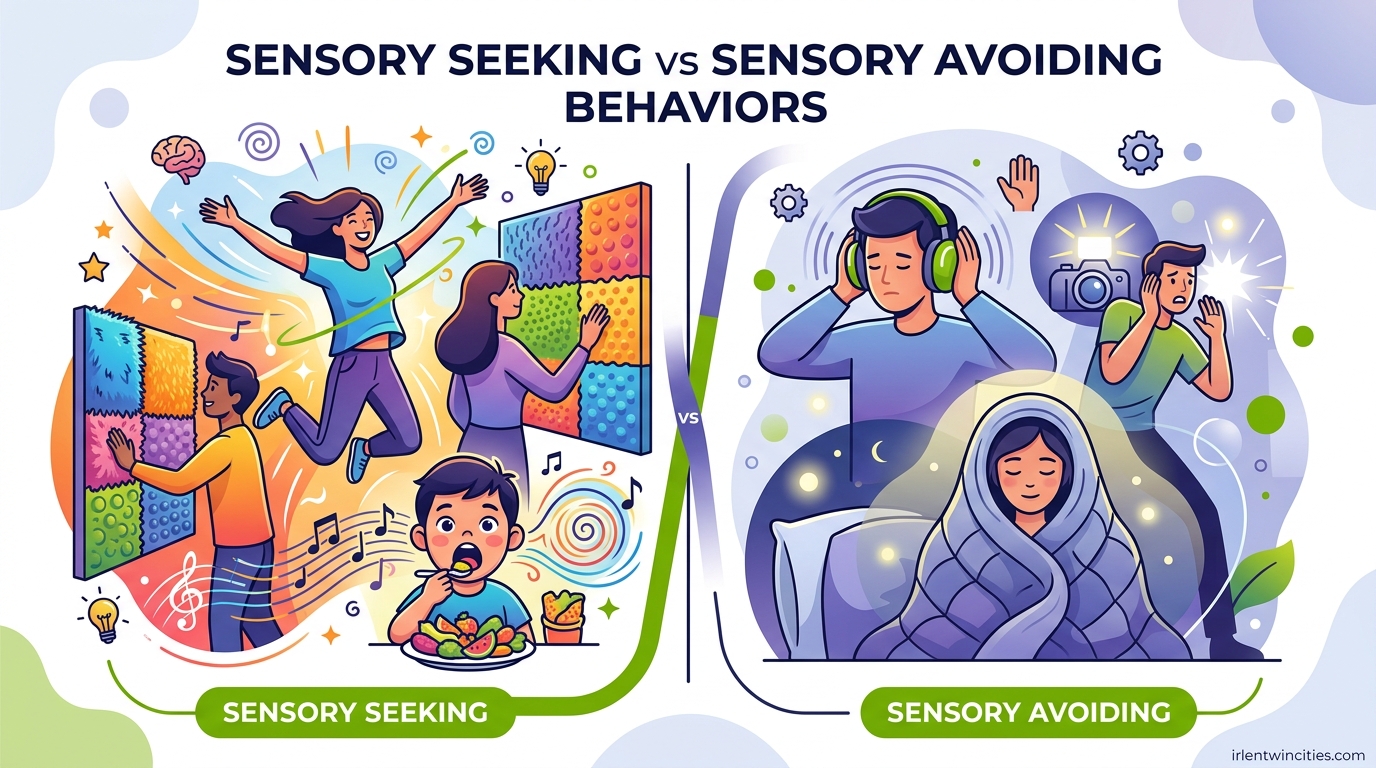
Some children crash into walls for fun. Others refuse to wear socks with seams. Both behaviors point to the same underlying reality: their brains process sensory information differently from most people. Understanding sensory seeking vs sensory avoiding behaviors helps parents, teachers, and caregivers support children who experience the world through a unique neurological lens.
In this guide, I will walk you through the key differences between these two sensory processing patterns. You will learn what drives each behavior type, see real examples across all seven senses, and discover practical strategies that help both sensory seekers and sensory avoiders feel regulated and safe.
Table of Contents
What Is Sensory Seeking vs Sensory Avoiding?
Sensory seeking and sensory avoiding represent opposite ends of the sensory processing spectrum. These terms describe how a person’s nervous system responds to sensory input from the environment.
Sensory seekers have what occupational therapists call a high sensory threshold or hyposensitivity. Their brains require intense, frequent sensory input to feel regulated and aware of their bodies. Without enough stimulation, they feel understimulated, disconnected, or anxious.
Sensory avoiders have a low sensory threshold or hypersensitivity. Their brains detect and process sensory information intensely. What feels normal to others can feel overwhelming, painful, or threatening to them.
Think of it like a volume knob. Sensory seekers need the volume turned up high to hear the music. Sensory avoiders hear the music clearly even when the volume sits at level one. Neither setting is wrong. Each simply requires different environmental adjustments.
The Seven Senses Affected
Most people know the five basic senses: touch, sight, sound, taste, and smell. Two additional senses play major roles in sensory processing differences.
Proprioception tells you where your body is in space without looking. It comes from feedback in your muscles and joints when you push, pull, or lift.
The vestibular system controls balance and movement through fluid-filled canals in your inner ear. It processes spinning, swinging, and changes in head position.
Both sensory seekers and sensory avoiders can have different thresholds for any combination of these seven senses. A child might seek intense movement while avoiding certain textures. Another might crave deep pressure but recoil from loud sounds.
Understanding Sensory Seeking Behaviors
Sensory seeking children often appear constantly in motion. They seem driven to touch, move, taste, or experience their environment intensely. These behaviors serve a genuine neurological need, not defiance or hyperactivity.
My friend Sarah described her sensory-seeking son perfectly: “He runs full speed into the couch and laughs. He climbs everything. He hums loudly while eating. At first I thought he was just wild, but his occupational therapist explained he’s trying to feel his body in space.”
Common Seeking Behaviors by Sense
Tactile seeking: Touching everything, rubbing textures between fingers, enjoying messy play, preferring tight hugs, seeking rough surfaces.
Auditory seeking: Making loud noises, humming constantly, enjoying music at high volumes, creating repetitive sounds.
Visual seeking: Staring at lights or spinning objects, watching things move, enjoying bright colors, seeking visual patterns.
Vestibular seeking: Constant spinning, jumping, running, rocking, swinging for extended periods, enjoying upside-down positions.
Proprioceptive seeking: Crashing into furniture, jumping on beds, squeezing into tight spaces, biting or chewing, enjoying heavy blankets.
Gustatory seeking: Putting non-food items in mouth, chewing on clothing or pencils, enjoying extreme flavors (very spicy, sour, or strong tastes).
Olfactory seeking: Smelling objects, people, or food intensely, enjoying strong scents, seeking specific smells.
Why Children Seek Sensory Input
The seeking behavior stems from under-responsiveness. The child’s nervous system needs more input than average to register sensation and maintain an optimal arousal level. Without adequate stimulation, these children may feel disconnected from their bodies or drowsy despite appearing energetic.
Seeking behaviors serve a self-regulation function. The child is not being naughty when they crash into walls or spin endlessly. They are attempting to meet a biological need for sensory input that their brain requires to feel calm and alert.
Understanding Sensory Avoiding Behaviors
Sensory avoiding children experience the world as too loud, too bright, too rough, or too unpredictable. They withdraw from stimulation that others barely notice. Their behaviors protect them from sensory input that feels overwhelming or painful.
A parent in an online forum shared this experience: “My daughter screams when the hand dryer turns on in public bathrooms. She covers her ears at birthday parties when people sing. She refuses to wear jeans because the fabric hurts her skin. We used to think she was dramatic. Now we understand her nervous system processes these sensations as actual pain.”
Common Avoiding Behaviors by Sense
Tactile avoiding: Refusing certain clothing textures, avoiding messy hands, disliking being touched unexpectedly, preferring specific fabrics, cutting tags from clothing.
Auditory avoiding: Covering ears at loud noises, distress from vacuum cleaners or hand dryers, preferring quiet environments, difficulty in crowded spaces.
Visual avoiding: Squinting at bright lights, preferring dim rooms, difficulty with fluorescent lighting, avoiding busy visual patterns.
Vestibular avoiding: Fear of swings or heights, dislike of spinning, motion sickness, anxiety on escalators or elevators, preferring stable ground.
Proprioceptive avoiding: Disliking rough play, avoiding tight spaces, preference for loose clothing, discomfort with deep pressure.
Gustatory avoiding: Limited food preferences based on texture, refusing mixed textures, strong reactions to food temperatures, eating only specific brands or preparations.
Olfactory avoiding: Distress from strong scents, avoiding perfume sections, noticing odors others miss, covering nose in certain environments.
Sensory Overload and Meltdowns
When sensory avoiders encounter too much stimulation, they experience sensory overload. This is not a tantrum. It is a neurological response to overwhelming input that the brain cannot filter or process effectively.
Signs of sensory overload include covering eyes or ears, rocking, attempting to hide or escape, increased anxiety, irritability, or complete shutdown. A meltdown occurs when the nervous system becomes so overwhelmed that the child loses the ability to regulate.
Removing the child from the overwhelming environment offers the fastest relief. Creating predictable, low-stimulation spaces helps prevent overload before it starts.
Can You Be Both Sensory Seeking and Avoiding?
Yes. Most people do not fit neatly into one category. Mixed sensory profiles are common and completely normal. A child might crave intense proprioceptive input while avoiding certain sounds. An adult might love spicy food but hate bright lights.
Therapists use the term mixed threshold to describe this pattern. The threshold varies by sense rather than being uniformly high or low across all sensory systems. This explains why a child who spins for hours might also refuse to walk on grass barefoot.
Some people also shift between seeking and avoiding based on their state. Stress, fatigue, illness, or environmental changes can temporarily lower sensory thresholds. A typically sensory-seeking child might become avoidant when exhausted or anxious.
Understanding that mixed profiles exist helps parents stop searching for a single label. Your child is not inconsistent or confusing. They simply have different thresholds for different types of sensory input.
Sensory Processing and ADHD
Sensory processing differences frequently accompany ADHD, though they are separate neurological conditions. Research suggests up to 50% of children with ADHD also have significant sensory processing challenges.
In ADHD, sensory seeking often connects to the need for stimulation that helps maintain focus. The child who chews pencils, fidgets constantly, or stands while working seeks sensory input that keeps their brain alert enough to concentrate.
ADHD-related sensory avoiding usually involves specific triggers that disrupt attention. A child might struggle to focus in classrooms with fluorescent lighting or loud HVAC systems. These sensory inputs compete with academic tasks for limited attention resources.
The key difference from autism-related sensory processing involves social communication patterns. While sensory differences overlap, autism includes distinct social-communication characteristics that ADHD does not. A professional evaluation helps clarify whether a child has ADHD, autism, both, or sensory processing disorder alone.
Heavy Work: The Calming Strategy for Both Types
Heavy work activities provide proprioceptive input that benefits both sensory seekers and sensory avoiders. This might seem surprising since the two types appear so different. However, proprioceptive input organizes and calms the nervous system regardless of baseline threshold.
Occupational therapists often recommend heavy work as the first intervention for any sensory processing difference. It acts as a regulatory reset button.
What Is Heavy Work?
Heavy work describes any activity that provides resistance to muscles and joints. Pushing, pulling, lifting, carrying, and compression activities all count. The key involves effort against gravity or resistance.
For sensory seekers, heavy work meets their craving for intense input in constructive ways. It fills their sensory cup so they need less crashing or chaotic movement.
For sensory avoiders, heavy work provides predictable, controllable input that grounds them in their bodies. It often reduces anxiety and increases tolerance for other sensory experiences.
Heavy Work Activity Examples
For young children: Pushing a laundry basket filled with books, wheelbarrow walking (adult holding ankles while child walks on hands), crawling through tunnels, pushing against walls, animal walks (bear walk, crab walk), carrying heavy grocery bags.
For older children: Raking leaves, shoveling snow, carrying firewood, pushing furniture to clean underneath, using resistance bands, wall push-ups, yoga poses that bear weight on hands, jumping on a trampoline, using a pogo stick.
Household activities: Moving wet laundry to the dryer, carrying water bottles to the car, pushing a shopping cart, helping with gardening, vacuuming, moving cushions to build forts.
Integrating heavy work naturally into daily routines works better than scheduled “sensory breaks.” A child who pushes the shopping cart at the store receives regulating input while completing a practical task.
How to Help Children With Different Sensory Needs
Supporting a child with sensory processing differences requires observation, flexibility, and advocacy. The goal is not to change the child’s neurology but to create environments where they can thrive.
For Sensory Seekers
Create safe opportunities for intense input. Install a swing indoors. Provide crash pads or piles of cushions. Allow jumping on a mini-trampoline. Stock chewy necklaces or crunchy snacks.
Build heavy work into transitions. Before sitting for a meal or starting homework, have your child push against the wall, do ten jumping jacks, or carry a weighted backpack around the house.
Establish boundaries around unsafe seeking. Teach that couches are for jumping but tables are not. Provide acceptable alternatives rather than simply prohibiting the behavior.
For Sensory Avoiders
Create predictable sensory environments. Use noise-canceling headphones in loud spaces. Offer sunglasses or hats for bright lights. Let the child preview new experiences so they know what sensory input to expect.
Build a sensory toolkit they can carry. Include fidget items, ear protection, comfort objects, and maybe a small bottle of a preferred scent. Having control over sensory input reduces anxiety significantly.
Respect their no. If a child says a texture hurts or a sound is too loud, believe them. Their nervous system experiences these sensations differently from yours. Forcing exposure often increases avoidance rather than reducing it.
When to Seek Professional Help
Consult an occupational therapist specializing in sensory processing if:
Sensory differences significantly interfere with daily routines, school participation, or family life.
The child experiences frequent meltdowns that you cannot prevent or shorten.
Sensory seeking leads to dangerous behaviors like climbing unsafe structures or putting harmful items in the mouth.
Sensory avoiding limits the child’s ability to attend school, participate in family activities, or maintain hygiene.
An occupational therapist can conduct a formal sensory profile assessment and design a personalized “sensory diet” of regulating activities.
FAQ
Am I sensory seeking or sensory avoiding?
You can identify your sensory profile by observing your natural reactions to sensory input. If you frequently seek intense experiences like loud music, spicy food, fast movement, or deep pressure, you likely have sensory seeking tendencies. If you often feel overwhelmed by bright lights, loud noises, certain textures, or crowded spaces, you likely have sensory avoiding tendencies. Many people have a mixed profile with different thresholds for different senses.
What is an example of sensory seeking and sensory avoiding?
A sensory seeking example is a child who spins repeatedly, jumps on furniture, makes loud noises, and enjoys messy play. They seek intense input to feel regulated. A sensory avoiding example is a child who covers their ears at hand dryers, refuses foods with certain textures, prefers dim lighting, and becomes distressed in crowded stores. They avoid input that feels overwhelming to their nervous system.
Can a child be both sensory seeking and avoiding?
Yes, mixed sensory profiles are very common. A child might crave intense proprioceptive input through jumping and crashing while avoiding certain sounds or textures. Different senses have different thresholds. This is called having a mixed threshold profile and is completely normal. Many children shift between seeking and avoiding depending on their stress level, fatigue, or the specific environment.
What is the difference between sensory seeking and sensory avoiding ADHD?
In ADHD, sensory seeking often involves fidgeting, chewing, or movement that helps maintain focus and alertness. The child needs stimulation to concentrate. Sensory avoiding in ADHD typically involves specific environmental triggers like fluorescent lights or humming sounds that compete with attention resources. Unlike autism, ADHD sensory differences usually do not include the social communication differences seen in autism spectrum conditions. However, ADHD and autism can co-occur, and both can involve sensory processing differences.
Conclusion
Understanding sensory seeking vs sensory avoiding behaviors transforms how we support children with different neurological wiring. These patterns are not behavioral problems to correct. They are biological differences to accommodate.
Whether a child crashes into walls or hides from hand dryers, they are communicating real neurological needs. By recognizing the seeking child who needs more input and the avoiding child who needs less, we create spaces where both can feel safe, regulated, and understood.
If you recognize these patterns in your child or yourself, consider consulting an occupational therapist for personalized strategies. The goal is not to change the person’s fundamental nature but to provide the right environmental supports so they can thrive exactly as they are.