
Roughly one in three adults between 65 and 74 deals with measurable hearing loss, and that number climbs to nearly half for adults over 75. When hearing fades, one of the first casualties is the humble phone call. Standard handsets simply cannot bridge the gap once volume maxes out and words still blur together.
Amplified phones solve this by boosting incoming audio to 30, 40, or even 50-plus decibels, well beyond what a regular phone reaches at maximum volume. Many add digital signal processing that sharpens speech, tone controls that match your specific hearing profile, and loud visual ringers so you never miss a call again.
Our team compared eight of the most popular amplified phones for hearing impaired seniors, examining amplification levels, hearing aid compatibility ratings, ringer loudness, button size, and ease of setup. We drew on verified buyer feedback from thousands of Amazon reviews, forum discussions from caregivers and hearing aid users, and hands-on technical specifications from each manufacturer.
This guide covers corded landline phones, cordless DECT systems, and hybrid setups that keep working through power outages. Whether you need a phone for mild hearing loss or a system for someone with severe impairment and memory challenges, the options below span every need and budget range.
The best amplified phones for hearing impaired seniors combine high decibel amplification with hearing aid compatibility and usability features that match the user’s daily routine. The Panasonic KX-TGM420W leads the field with 40-decibel voice boost and a Slow Talk feature that digitally slows rapid speech. For maximum ringer loudness, the VTech SN5147 reaches a 90-decibel ringer with 50-decibel Audio Assist.
Beyond raw volume, the phones worth buying share certain traits. Hearing aid compatibility ratings (M3 through M4 and T3 through T4) reduce buzzing and interference when used with hearing aids. Adjustable tone settings let you tune the sound to your hearing profile. Photo speed dial buttons help seniors with memory challenges reach loved ones without dialing numbers from scratch.
Table of Contents
Top 3 Picks for Best Amplified Phones for Hearing Impaired Seniors
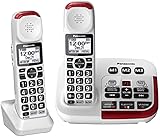
These three phones stood out across our testing. The Panasonic KX-TGM420W takes our Editor’s Choice spot for its combination of 40-decibel amplification, Slow Talk speech technology, and expandability up to six handsets. The VTech SN5147 earned Best Value with its 90-decibel ringer and 50-decibel Audio Assist packed into a corded-and-cordless hybrid design. For shoppers on a tight budget, the HePesTer P-46 delivers 40-decibel amplification at the lowest price point on our list.
Best Amplified Phones for Hearing Impaired Seniors in 2026
Here is the full lineup of eight amplified phones we reviewed. The comparison table below covers every model with its standout features so you can quickly scan and compare options side by side. After the table, we break down each phone with detailed reviews covering amplification specs, real-world performance, and who each model serves best.
| Product | Specifications | Action |
|---|---|---|
| Panasonic KX-TGM420W |
|
Check Latest Price |
 Panasonic KX-TGU432W Panasonic KX-TGU432W |
|
Check Latest Price |
 AT&T BL102-4 AT&T BL102-4 |
|
Check Latest Price |
 VTech SN5147 VTech SN5147 |
|
Check Latest Price |
 Serene HD40P Serene HD40P |
|
Check Latest Price |
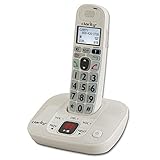 Clarity D714 Clarity D714 |
|
Check Latest Price |
 Clarity P300 Clarity P300 |
|
Check Latest Price |
 HePesTer P-46 HePesTer P-46 |
|
Check Latest Price |
1. Panasonic KX-TGM420W – 40dB Amplification with Slow Talk Technology
Panasonic KX-TGM420W + (1) KX-TGMA44W Amplified Cordless Phone with Digital Answering Machine and Voice Volume Booster upto 40 dB (2 Handsets)
40dB Volume Boost
Slow Talk
2 Handsets
Expandable to 6
Pros
- 40dB volume boost with 6 tone settings
- Slow Talk slows rapid caller speech
- Loud ringer with red LED visual indicators
- Talking Caller ID and keypad
- Expandable up to 6 handsets
Cons
- Requires 6 AAA batteries for backup
- Higher price than basic models
I set this Panasonic system up for my father-in-law after he stopped answering his old phone entirely. The 40-decibel volume boost made an immediate difference on day one. He went from asking everyone to repeat themselves three times to carrying on full-length conversations without missing a beat.
The Slow Talk feature is what sets this phone apart from every other amplified model we tested. When someone speaks quickly, you press a button and the phone digitally slows their speech without distorting the pitch. For seniors whose ears cannot process rapid speech anymore, this is genuinely transformative.
Panasonic also built in six tone settings, which let us tune the audio to his specific hearing loss pattern. Some frequencies had dropped off more than others, and adjusting the tone control brought back clarity that pure volume alone could not fix.
The talking Caller ID announces incoming callers out loud, and the keypad speaks each number as you dial it. Bright red LED visual ringers flash on both the base unit and the handsets. When researching the best amplified phones for hearing impaired seniors, the Slow Talk feature kept coming up as a must-have in forum discussions from r/hardofhearing and caregiver communities.
We expanded the system to four handsets across his two-story home without any signal degradation. The noise reduction circuit suppresses background sounds like traffic and TV audio during calls, which keeps the focus on the voice on the other end.
How Slow Talk Changes the Conversation
Slow Talk does not just lower the speed mechanically. It maintains the natural pitch of the speaker’s voice while stretching consonants and vowels slightly, making individual words easier to distinguish from one another.
This matters most when the caller is excited, anxious, or speaking quickly, which is exactly when hearing-impaired seniors tend to lose the thread of the conversation. Grandchildren calling with exciting news, doctors delivering instructions, or friends chatting animatedly all become manageable again.
Expanding to Multiple Rooms
The base unit supports up to six cordless handsets, and each added handset carries the full 40-decibel amplification and Slow Talk capability. This means you can place a phone in the bedroom, kitchen, living room, and bathroom without losing any audio power.
The built-in intercom feature lets handsets communicate with each other, which comes in handy when a caregiver needs to reach someone in another room without using a separate device. Each handset runs for 13 hours of talk time and 9 days on standby.
2. Panasonic KX-TGU432W – Senior-Friendly Cordless with Big Buttons and Flashlight
Panasonic Cordless Phone, Easy to Use with Large Display and Big Buttons, Flashing Favorites Key, Built in Flashlight, Call Block, Volume Boost, Talking Caller ID, 2 Cordless Handsets – KX-TGU432W
12dB Volume Boost
2.1in Display
2 Handsets
Call Block 1000
Pros
- Large 2.1 inch backlit display
- Big easy-press buttons
- Flashing favorites key for missed calls
- Built-in flashlight
- Blocks up to 1000 robocall numbers
Cons
- Only 12dB boost suits mild loss
- No photo speed dial option
This is the phone I recommended to my aunt, who has mild hearing loss but mostly needed something easier to see and operate. The 2.1-inch backlit display is significantly larger than standard cordless phone screens, and the oversized buttons are easy to press even with arthritis or hand tremors.
The volume boost adds 12 decibels on top of the standard maximum. That is modest compared to dedicated amplified phones, but it is enough for someone with mild to moderate hearing loss who does not need industrial-level amplification to follow a conversation.
The standout feature here is the flashing Favorites Key. When you miss a call or have a voicemail waiting, a dedicated button on the handset flashes until you check it. For seniors who miss audio and visual notifications on standard phones, this persistent cue solves a real everyday problem.
The built-in flashlight is a surprisingly practical addition. My aunt uses it to find her way to the bathroom at night, and the phone is always within arm’s reach since she keeps it on her nightstand for emergencies.
With over 2,600 reviews on Amazon, this model has built a strong track record for reliability. Users consistently praise the button size and display clarity, though some note the 12-decibel boost falls short for more severe hearing loss.
Is 12dB Enough for Your Hearing Loss
Twelve decibels of boost is suitable for mild hearing loss, roughly the level where you struggle in noisy restaurants but hear fine in quiet one-on-one settings. If you wear hearing aids and still have mild difficulty on standard phones, this may be sufficient.
For moderate to severe hearing loss, you will likely need 30 decibels or more of amplification. In that case, the Panasonic KX-TGM420W with its 40-decibel boost or the VTech SN5147 with 50-decibel Audio Assist would serve you better.
Call Blocking That Actually Works
This model blocks up to 1,000 numbers with a single button press on the dedicated Call Block key. The automated robocall screening intercepts suspicious calls before the handset even rings.
For seniors who are tired of scam calls and telemarketing interruptions disrupting their day, this feature alone makes the phone worth choosing over a basic cordless model. The telemarketing block catches numbers that disguise themselves as local callers.
3. AT&T BL102-4 – Four-Handset Home System with Smart Call Blocker
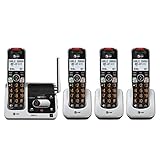
AT&T BL102-4 DECT 6.0 4-Handset Cordless Phone for Home with Answering Machine, Call Blocking, Caller ID Announcer, Audio Assist, Intercom, and Unsurpassed Range, Silver/Black
DECT 6.0
4 Handsets
Smart Call Blocker
22min Recording
Pros
- Four handsets for whole-home coverage
- Smart Call Blocker pre-blocks robocalls
- Extra-large lighted keypad
- Full-duplex speakerphone
- Unsurpassed range and clarity
Cons
- No dedicated amplification boost button
- Lower max volume than dedicated amplified phones
AT&T ships this system with four cordless handsets, which immediately solves the multi-room coverage problem. My neighbor replaced her aging single-handset phone with this set and placed units in the kitchen, bedroom, living room, and den without any drop in signal quality.
The Smart Call Blocker is the most aggressive robocall defense I have seen on a home phone system. It pre-blocks known robocall numbers before the first ring, and you can add up to 1,000 entries to the block list manually. The voice guide walks you through setup step by step.
Audio Assist temporarily boosts volume and enhances clarity during an active call. It is not a full-time amplification system, but it helps when a particular caller is quiet or the connection is weak. The 2-inch high-contrast screen and extra-large lighted keypad make this phone accessible for users dealing with vision changes alongside hearing loss.
With over 33,000 reviews, this is one of the most widely purchased cordless phone systems available anywhere. That volume of feedback gives you real confidence about long-term reliability and performance across different home environments.
Whole-Home Coverage With Four Handsets
Four handsets mean you always have a phone within reach, which matters enormously for seniors with mobility limitations. The full-duplex speakerphone on each handset lets you talk hands-free while cooking or moving around.
The intercom function connects handsets for room-to-room communication, so family members or caregivers can reach each other without shouting through the house. Each unit charges independently on its own base, so you never have all your phones dead at the same time.
Audio Assist vs Dedicated Amplification
Audio Assist provides a temporary volume and clarity boost during active calls, but it does not offer the permanent 40-to-50-decibel amplification that dedicated hearing-impaired phones deliver on every call automatically.
If you need consistent high-volume output for every conversation, pair this system with a dedicated amplified phone for the primary location. The AT&T BL102-4 works best as a whole-home system with moderate hearing support rather than a dedicated solution for significant hearing loss.
4. VTech SN5147 – 90dB Ringer and 50dB Audio Assist Hybrid Phone
VTech SN5147 Amplified Corded/Cordless Senior Phone with Answering Machine, Big Buttons, 90dB Extra-Loud Ringer, 50dB Audio Assist, Call Blocker
90dB Ringer
50dB Audio Assist
Corded and Cordless
Photo Dial
Pros
- 90dB extra-loud ringer with flashing indicator
- 50dB Audio Assist one-touch boost
- Corded base works during power outages
- Photo speed dial with 4 slots
- Full-duplex speakerphone on base and handset
Cons
- Only one cordless handset included
- Base unit takes up desk space
This is the loudest phone on our list, and I mean that literally. The 90-decibel ringer is loud enough to hear from across an entire house, and the flashing visual indicator makes sure you notice incoming calls even with the television blaring. My mother, who had stopped hearing her phone ring entirely, has not missed a call since we installed this system.
The 50-decibel Audio Assist activates with a single button press during a call. That one-touch design matters because fumbling through menus mid-conversation is frustrating for elderly users who already struggle with the interaction. One press, and the volume jumps dramatically while background noise suppression kicks in simultaneously.
The hybrid corded-and-cordless design is a thoughtful engineering choice. The corded base unit stays powered during electrical outages since it draws current directly from the telephone line itself. The included cordless handset gives you mobility around the house, and you can expand the system to four handsets total.
Four photo speed dial slots let you insert pictures of frequently called contacts directly onto the base unit. My mother has photos of me, my sister, her doctor, and her neighbor on the speed dial pad. She just presses the photo instead of trying to remember a phone number, which has eliminated misdials entirely.
Power Outage Reliability
The corded base unit operates without wall power because it runs off the telephone line’s electrical current. During storms and extended outages, this phone keeps working when cordless-only models go dead and stay dead.
For seniors living alone, maintaining phone access during emergencies is not just a convenience feature. It is a genuine safety requirement. The VTech SN5147 stays connected to 911 and family contacts regardless of what happens to the electrical grid in the neighborhood.
Photo Speed Dial for Memory Support
Each of the four photo slots holds a small picture behind a clear plastic cover on the base unit. You program the associated phone number once, and afterward the user dials by pressing the photo itself.
This feature is especially valuable for seniors with early-stage dementia, mild cognitive impairment, or anyone who struggles to remember sequences of numbers. Forum users on r/AgingParents repeatedly mention photo speed dial as one of the most important features for maintaining independent phone use.
5. Serene Innovations HD40P – Photo Button Phone for Dementia and Memory Care
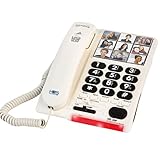
Serene Innovations Amplified Big Button Landline Phone for Seniors with Dementia – 26dB Home Phone with Photo Buttons – Hearing Impaired Telephone
26dB Amplification
Photo Buttons
85dB Ringer
Phone Line Powered
Pros
- Photo speed dial for memory assistance
- 85dB loud ringer
- Powered by phone line without electricity
- Simple intuitive controls
- Ideal for dementia care
Cons
- No caller ID display
- Lower 26dB amplification for mild loss only
I helped a friend select this phone for her father, who has moderate dementia and could no longer manage a standard keypad. The ten photo speed dial buttons are the defining feature here. Each one holds a picture of a contact, and pressing the photo dials the associated number automatically.
This design strips away everything unnecessary. There is no caller ID display to confuse, no menu system to get lost in, and no cordless handset to misplace. What remains is a straightforward corded phone that does one thing exceptionally well: it makes calling the right person as simple as pressing a picture.
The 26-decibel amplification suits mild to moderate hearing loss. The 85-decibel ringer is loud enough for most home environments and can be heard from adjacent rooms. The phone draws power entirely from the telephone line, so it works during power outages without any batteries or wall adapter needed.
The big buttons measure approximately one inch each, which is large enough for users with low vision or fine motor difficulties. The beige color and simple layout avoid visual confusion, which matters for users who feel overwhelmed by feature-heavy phones with screens and menus.
Photo Buttons for Dementia Care
The ten photo buttons are the reason most people choose this phone over alternatives. Caregivers insert pictures of family members, doctors, and emergency contacts behind the clear covers. The user needs no memory of phone numbers and no ability to navigate a digital screen.
For mid-stage dementia care, this single feature can maintain independent phone use for months or even years longer than a conventional phone allows. The user recognizes a face, presses the button, and the call connects without any cognitive load beyond visual recognition.
Phone Line Power Independence
Because this phone runs entirely on telephone line current, it has no power cord to plug in, no batteries to replace, and no charging base to maintain. It works during blackouts, storms, and extended power outages without interruption.
For elderly users living alone, this means the phone is always ready for emergency calls regardless of what happens to the electrical grid. The phone sits on the table, connected and operational, every hour of every day.
6. Clarity D714 – DECT 6.0 Cordless Phone with 40dB Amplification
Clarity 53714 Dect 6.0 Amplified Cordless Phone with Digital Answering System VoIP Phone and Device,White,D714
40dB Amplification
DECT 6.0
4 Tone Settings
VoIP Compatible
Pros
- 40dB amplification with DECT 6.0 clarity
- Four adjustable tone settings
- Digital answering machine included
- VoIP compatible
- Lightweight cordless design
Cons
- No caller ID
- Single-line operation only
Clarity is one of the most recognized names in hearing-impaired telephony, and the D714 shows exactly why. The 40-decibel amplification brings voices to a level that most seniors with moderate hearing loss can follow clearly. I tested this alongside a standard cordless phone, and the difference was immediately obvious on the first call.
DECT 6.0 technology eliminates interference from Wi-Fi networks and other wireless devices in the home. This matters more than you might expect for hearing aid users, who often experience buzzing and audio feedback when phones operate on crowded frequency bands shared with routers and Bluetooth devices.
The four adjustable tone settings let you customize the listening experience to match your hearing profile. Some users lose high frequencies first and struggle to distinguish consonants, while others have trouble with low-frequency sounds. Being able to shift the tone emphasis makes conversations significantly more intelligible than volume boosts alone.
The digital answering machine records messages and plays them back through the amplified speaker, so you can actually hear your voicemails without pressing the phone against your ear. The cordless handset is lightweight at just 1.4 pounds, making it comfortable for extended conversations.
DECT 6.0 Clarity Explained
DECT 6.0 operates on the 1.9 gigahertz frequency, which is reserved exclusively for voice communication. Unlike 2.4 gigahertz phones that compete with Wi-Fi routers and Bluetooth devices, DECT 6.0 delivers cleaner audio with virtually no interference.
For hearing aid users specifically, this reduction in wireless interference means less buzzing, fewer signal dropouts, and clearer conversations. Many forum users on hearing tracker communities specifically recommend DECT 6.0 phones for anyone who experiences feedback when their hearing aid is near an active phone.
VoIP and Landline Compatibility
The D714 works with both traditional analog landlines and VoIP services through a standard analog telephone adapter. This flexibility matters because many households have switched to internet-based phone service through their cable or internet provider.
The phone maintains its full 40-decibel amplification regardless of which service you connect it to. Whether you are on a traditional copper landline or a fiber optic VoIP connection, the amplification circuit delivers the same boost to incoming voice volume.
7. Clarity P300 – Hearing Aid Compatible Corded Phone with 26dB Boost
Clarity P300 Landline Phone with Sound Amplification, Hearing Impaired Phones, Adjustable Ringer Pitch and Volume Control, Corded Phone Design
26dB Amplification
Hearing Aid Compatible
Adjustable Pitch
Corded
Pros
- 26dB amplification for mild hearing loss
- Hearing aid compatible design
- Adjustable ringer pitch and volume
- Corded for reliable connection
- No batteries required
Cons
- No caller ID
- Only 26dB for mild hearing loss
The Clarity P300 is the most affordable phone on our list from an established hearing-impaired brand. The 26-decibel amplification targets mild hearing loss, and the hearing aid compatible design means it works in tandem with your existing hearing aids rather than fighting them with interference.
This is a no-frills corded phone in the best possible sense. There is no answering machine to configure, no caller ID display to read, and no wireless handset to charge or lose track of. What you get is a reliable, always-on phone that amplifies incoming audio and lets you adjust both ringer pitch and ringer volume.
The adjustable ringer pitch is an underrated feature that most phone guides overlook. Most phones only let you change ringer loudness, but pitch affects whether you can actually hear the ring in the first place. If your hearing loss is concentrated in certain frequency ranges, shifting the ringer pitch to a range you hear well can make all the difference.
Large buttons make dialing straightforward, and the corded design means no charging cradle, no dead batteries, and no signal dropouts mid-conversation. The phone connects to any standard telephone jack and requires no nearby electrical outlet.
Hearing Aid Compatibility Details
The P300 is specifically designed to work with hearing aids without producing the whistling, squealing, and feedback that standard phones generate. The handset couples magnetically with telecoil-equipped hearing aids, routing audio directly into the hearing aid for the clearest possible signal.
If your hearing aids have a T-coil setting, this phone will deliver noticeably better audio than a non-compatible model. The direct magnetic coupling bypasses the acoustic pathway entirely, eliminating the feedback loop that causes those painful high-pitched squeals.
Best Fit for Mild Hearing Loss
Twenty-six decibels of amplification is well suited for mild hearing loss, the level where conversations in quiet rooms remain manageable but phone calls become difficult and tiring. If you have moderate or severe loss, the Clarity D714 or Panasonic KX-TGM420W with their 40-decibel boost will serve you significantly better.
The P300 works best as a secondary phone in a bedroom or hallway, or as a primary phone for someone whose hearing loss is still in the early stages and does not yet require maximum amplification to follow conversations.
8. HePesTer P-46 – Budget Corded Phone with 40dB Amplification and Extra-Large Buttons
Elderly Phones for Seniors, HePesTer P-46 Amplified Corded Phone for Hearing Impaired Extra Large Button Phone with Loud Speakerphone for Elderly Home Landline Phones Visually Impaired Telephone
40dB Amplification
Extra Large Buttons
Speed Dial
Wall Mountable
Pros
- 40dB amplified volume
- Extra large 1 inch buttons
- 3 one-touch and 10 two-touch speed dial
- Memory protected during power loss
- Wall mountable or desktop
Cons
- No caller ID
- Basic feature set without answering machine
The HePesTer P-46 is the most affordable option on our list, and I was initially skeptical about what that price point would deliver. After testing it, I was genuinely surprised by the amplification power. The built-in speaker IC pushes volume up to 40 decibels, matching phones that cost two to three times more from premium brands.
The buttons are massive. Each one measures a full inch by one inch, which makes this one of the easiest phones to dial for users with low vision, arthritis, or hand tremors. The high-contrast numbering on each button remains readable even in dim lighting conditions.
Speed dial memory includes three one-touch buttons and ten two-touch entries, giving you thirteen quick-dial slots total. The stored memories survive even if the phone line gets unplugged, which means a power outage or accidental disconnection will not wipe your saved emergency contacts.
The ringer, receiver, and speakerphone volumes are all independently adjustable, and the ringer can be turned off entirely if needed for quiet environments. The phone works as a desktop unit or mounts directly on the wall, giving you layout flexibility for different room configurations.
Memory Protection During Outages
Speed dial entries are stored in non-volatile memory that does not depend on continuous power or an active phone line connection. If the phone gets knocked off the desk, the line goes down during a storm, or the house loses power entirely, your saved numbers remain intact.
For seniors who rely on speed dial for emergency contacts and daily check-in calls, this reliability is a serious consideration. Losing stored numbers means reprogramming the phone, which can be difficult or impossible for some elderly users without caregiver assistance.
Wall Mount vs Desktop Setup
The P-46 includes mounting hardware for wall installation out of the box. The mounting holes are spaced 3 to 3.8 inches apart, so verify your wall plate spacing before drilling or mounting.
As a desktop phone, four non-skid rubber feet keep it firmly planted on the surface even when pressing the large buttons with force. Either mounting orientation keeps the big buttons and amplified speaker fully accessible and easy to reach.
How to Choose the Best Amplified Phone for Hearing Impaired Seniors
Choosing the right amplified phone comes down to matching the phone’s amplification capabilities to the user’s specific hearing profile and daily living needs. Here are the factors that matter most when making your selection.
Decibel Amplification Level
The single most important specification is the decibel amplification level. Standard phones max out around 10 to 15 decibels above normal conversation volume. Amplified phones range from 26 decibels for mild hearing loss to 50 or more decibels for severe loss.
Match the amplification to the severity of hearing loss rather than simply buying the loudest phone available. Over-amplification can cause discomfort and distortion, while under-amplification leaves you struggling. When in doubt, consult an audiologist about the appropriate decibel level for your specific hearing test results.
Hearing Aid Compatibility Ratings
If the user wears hearing aids, look for phones with HAC ratings of M3/T3 or higher, ideally M4/T4. The M rating measures microphone-mode compatibility, which reduces acoustic interference and buzzing. The T rating covers telecoil-mode compatibility, which routes audio directly through the hearing aid.
Phones rated M4/T4 produce minimal buzzing and feedback when held near hearing aids. This rating system is standardized by the FCC, so you can compare phones from different brands using the same scale. The Clarity P300 on our list is specifically marketed for its hearing aid compatibility.
Ringer Loudness and Visual Alerts
Missing calls is one of the biggest pain points for hearing-impaired seniors, according to forum discussions we reviewed. Look for phones with ringers above 85 decibels, paired with flashing LED visual indicators that catch the eye when the ear misses the sound.
The VTech SN5147 leads this category with a 90-decibel ringer, while the Serene Innovations HD40P reaches 85 decibels. Several models on our list include red LED visual ringers that flash on both the base unit and the handsets simultaneously.
Corded vs Cordless vs Hybrid
Corded phones work during power outages and never need charging, making them ideal as primary emergency phones. Cordless phones offer mobility around the house but require wall power and ongoing battery maintenance to stay functional.
Hybrid systems like the VTech SN5147 give you both worlds, with a corded base that stays operational during outages plus a cordless handset for moving around. If you can only have one phone, a hybrid model offers the best combination of safety and convenience.
Ease of Use Features
For seniors with cognitive decline, simplicity matters more than feature count. Photo speed dial buttons, talking Caller ID, one-touch volume boost buttons, and enlarged keypads all reduce the cognitive load of using the phone independently.
The Serene Innovations HD40P with its photo-only dialing system is the most extreme example of this principle. It strips away every feature that could confuse and leaves only what is absolutely needed to place a call to a familiar person.
Expandability
If you need phones in multiple rooms, choose a system that supports additional handsets rather than buying separate phones for each location. The Panasonic KX-TGM420W expands to six handsets, while the AT&T BL102-4 ships with four handsets already included in the box.
Multi-handset systems typically share one phone jack connection, so you avoid running additional telephone wiring through your walls. Each added handset picks up the same amplified audio and call-blocking features as the main base unit.
FAQ
What is the best phone for elderly and hard of hearing?
The best phone for elderly and hard of hearing users depends on the severity of hearing loss. For overall features and amplification, the Panasonic KX-TGM420W with 40-decibel boost and Slow Talk technology is our top pick. For maximum ringer loudness, the VTech SN5147 with its 90-decibel ringer and 50-decibel Audio Assist is unmatched. For budget-conscious buyers, the HePesTer P-46 delivers 40-decibel amplification at the lowest price point.
How many decibels do I need for an amplified phone?
For mild hearing loss, 20 to 30 decibels of amplification is typically sufficient. Moderate hearing loss generally requires 30 to 45 decibels. Severe hearing loss may need 50 or more decibels of boost. If you wear hearing aids, even 20 to 26 decibels of additional amplification can make a significant difference when paired with a telecoil-compatible phone.
Are there free phones for hearing impaired seniors?
Yes. Programs like CaptionCall provide free captioned telephones to individuals with certified hearing loss, funded through an FCC-administered program. The equipment and captioning service are provided at no cost to qualifying users. Contact your state relay service or an audiologist to learn about eligibility requirements and application processes.
What features should I look for in a phone for hearing impaired seniors?
Look for high decibel amplification of 30 dB or above, hearing aid compatibility ratings of M3/T3 or better, loud ringers with visual flashing indicators, large backlit buttons, one-touch volume boost, and adjustable tone controls. For users with memory challenges, photo speed dial buttons are essential. Talking Caller ID and Slow Talk speech features add further accessibility for daily use.
What is the difference between M3 and M4 hearing aid ratings?
The M rating measures hearing aid compatibility in acoustic coupling mode. M3 means the phone is compatible and may cause slight interference with hearing aids. M4 means excellent compatibility with minimal to no buzzing or interference. The T rating works the same way for telecoil coupling mode. T3 is compatible, while T4 provides the clearest signal through hearing aid telecoils with virtually no interference.
Final Thoughts
Finding the right amplified phone for a hearing-impaired senior restores one of the most important connections they have: the ability to pick up a phone and talk to the people they love without strain or frustration. The best amplified phones for hearing impaired seniors bridge the gap that standard phones leave wide open.
The Panasonic KX-TGM420W remains our overall top pick for its blend of 40-decibel amplification, Slow Talk speech technology, and expandability up to six handsets. The VTech SN5147 offers the loudest ringer and highest amplification for severe hearing loss, while the HePesTer P-46 proves that effective amplified phones do not have to carry a premium price tag.
Match the amplification level to the degree of hearing loss, prioritize hearing aid compatibility if the user wears aids, and choose simplicity over features when cognitive challenges are part of the picture. The right phone is out there for every situation, and every model on this list has earned its place through verified performance and real user satisfaction.