
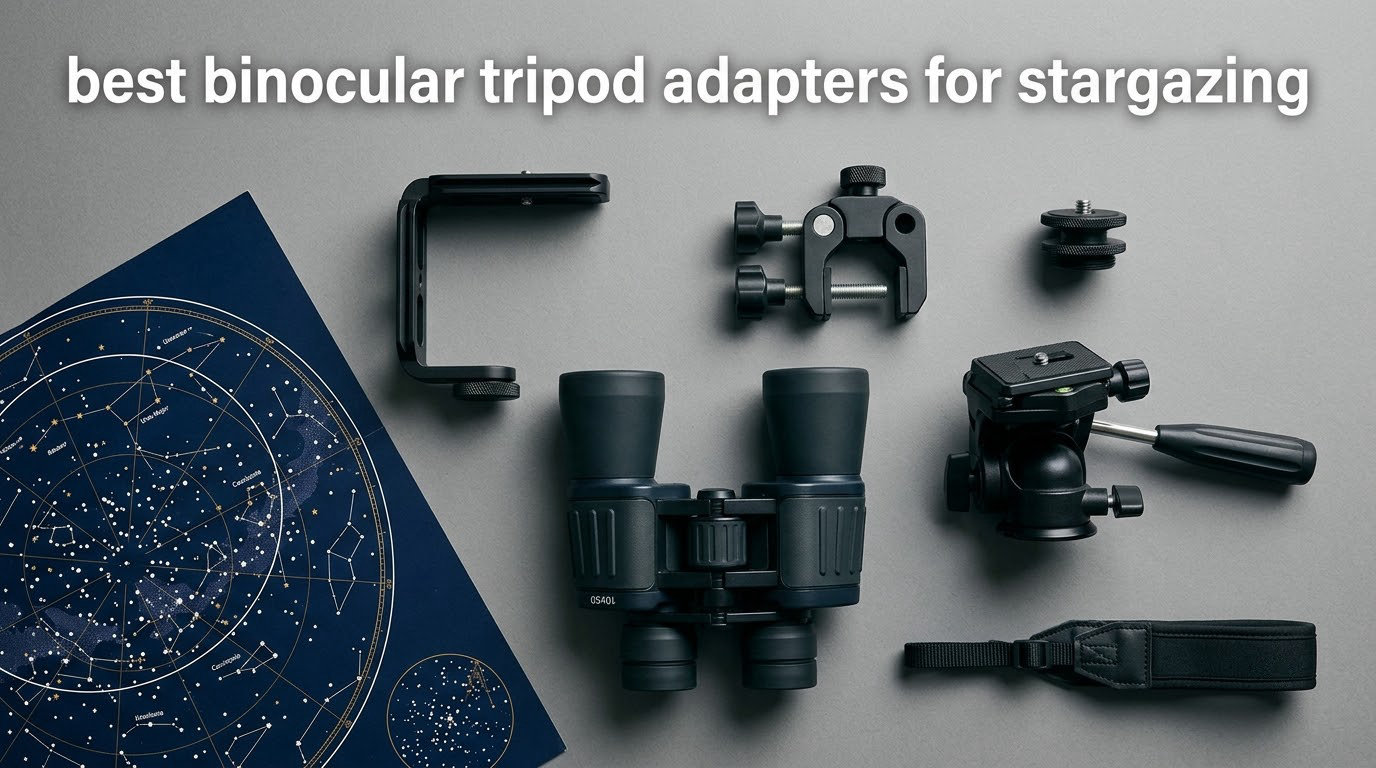
Most binoculars have a small threaded socket hidden between the objective lenses, usually behind a plastic cap. That socket is nearly always a 1/4-20 thread, and it takes an adapter that turns a side-mounted thread into a standard tripod mount. Without that adapter, high-power binoculars stay a handheld-only instrument.
That matters more than most buyers expect. Handheld magnification tops out around 10x for nearly everyone, and observers on astronomy forums consistently put the practical threshold at about 12x, above which hand shake overwhelms the image. A 15×70 or a 20×80 on a proper adapter becomes a genuine deep-sky instrument; the same glass in your hands is a frustrating squint. We compared 10 adapters across thread standard, mounting mechanism, material and tripod head compatibility to find the ones that hold a steady view all night.
Our short version: a machined metal bolt-on adapter on a standard 1/4-20 or Arca-Swiss base is the safest buy for almost everyone. A clamp-style adapter is the answer if your binoculars have no socket at all, and a strap-and-saddle mount is the last resort. If you are still choosing the glass itself, start with our stargazing binoculars guide and come back here once you know the body style.
Table of Contents
Top 3 Binocular Tripod Adapters for Stargazing in 2026
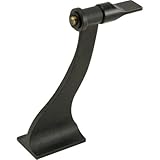
Celestron Binocular Tripod Adapter
- Fits roof and porro binoculars
- Durable metal construction
- Standard 1/4-20 thread

FANAUE S1 Aluminium Mount
- CNC-machined T6061 aluminum
- Arca-Swiss dovetail plus 1/4-20 thread
- Quick-release mechanism
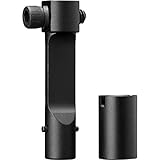
Vortex Sport Binocular Adapter
- Slim profile fits between barrels
- Quick-release lift-off connector
- Unlimited warranty
All 10 Adapters at a Glance in 2026
Every pick below works with the same basic idea, but they differ in how they grip the binocular and how they attach to your tripod head. These three columns explain most of the trade-offs.
| Product | Specifications | Action |
|---|---|---|
| Celestron Binocular Tripod Adapter |
|
Check Latest Price |
| FANAUE S1 Aluminium Mount |
|
Check Latest Price |
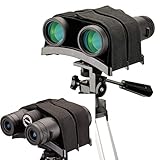 Gosky Universal Stabilite Mount Gosky Universal Stabilite Mount |
|
Check Latest Price |
| Vortex Sport Binocular Adapter |
|
Check Latest Price |
 Staoptics ZJ02 Quick Release Adapter Staoptics ZJ02 Quick Release Adapter |
|
Check Latest Price |
 SVBONY SV110 Metal Adapter SVBONY SV110 Metal Adapter |
|
Check Latest Price |
 FANAUE S2-01 L-Type Adapter FANAUE S2-01 L-Type Adapter |
|
Check Latest Price |
 Zelnoox BC-03 Dual-Mount Adapter Zelnoox BC-03 Dual-Mount Adapter |
|
Check Latest Price |
 Zelnoox BC-02 Clamp Adapter Zelnoox BC-02 Clamp Adapter |
|
Check Latest Price |
 FANAUE S3 Clamp Mount FANAUE S3 Clamp Mount |
|
Check Latest Price |
How We Picked
Five things decided the order, and each one traces back to a problem real owners actually hit rather than a marketing line.
First, thread standard. An adapter that only offers a 1/4-20 stud will not drop onto an Arca-Swiss plate, and one that only offers a dovetail will not thread onto a plain screw head. Dual-standard adapters cover the most tripods, which is why they score well here.
Second, mounting mechanism. Bolt-on adapters screw into the socket and are the most rigid. Clamp adapters grip the barrel between the objective lenses and work even with no socket present. Strap-and-saddle mounts are the least rigid but the only option for some bodies.
Third, material. Metal transfers load without flexing, and forum advice is consistent that plastic flexes and rings under heavy glass. Reviews of the metal options in this group repeatedly compare them to plastic retail adapters as a clear step up.
Fourth, head compatibility, which decides whether the adapter works with the tripod you already own. Anyone with a photography tripod should check for Arca-Swiss or Manfrotto 200PL before buying.
Fifth, load behaviour with heavy binoculars. A 20×80 needs a bigger footprint and more torsional stiffness than a 10×50, and several of the complaints in this group come down to a narrow base letting the glass rotate under load.
1. Celestron Binocular Tripod Adapter – Best All-Round Choice
Celestron Binocular Tripod Adapter with Standard 1/4″-20 Thread
Metal bolt-on adapter
Weighs 3.2 oz
Fits roof and porro binoculars
Standard 1/4-20 thread
Pros
- All-metal build with a large base footprint
- Works across both roof and porro prism bodies
- Extended thumb turner is easy to finger-tighten
- Narrow body lets roof barrels close fully
Cons
- Finger-tight may leave slight rotational play
- Thumb turner stands about 4mm past the objective bells
- Included plastic washer flexes before it is tight
This is the adapter we come back to. It is a simple bolt-on metal block with a 1/4-20 stud underneath, and it is the only pick in this group that has proven itself across thousands of reviews spanning many different binocular bodies. Around two thirds of the reviews we analysed are five-star, and the praise is consistently about the same thing: the base is wide enough not to swivel on a quick-release plate.
That base width is the detail that separates it from cheaper generics. Rotational play is the number one complaint across this entire product category, and a wide foot simply needs far less force to twist around the tripod stud. We mounted it on a 10×50 for a two-hour session without touching the knob again after the first tightening.
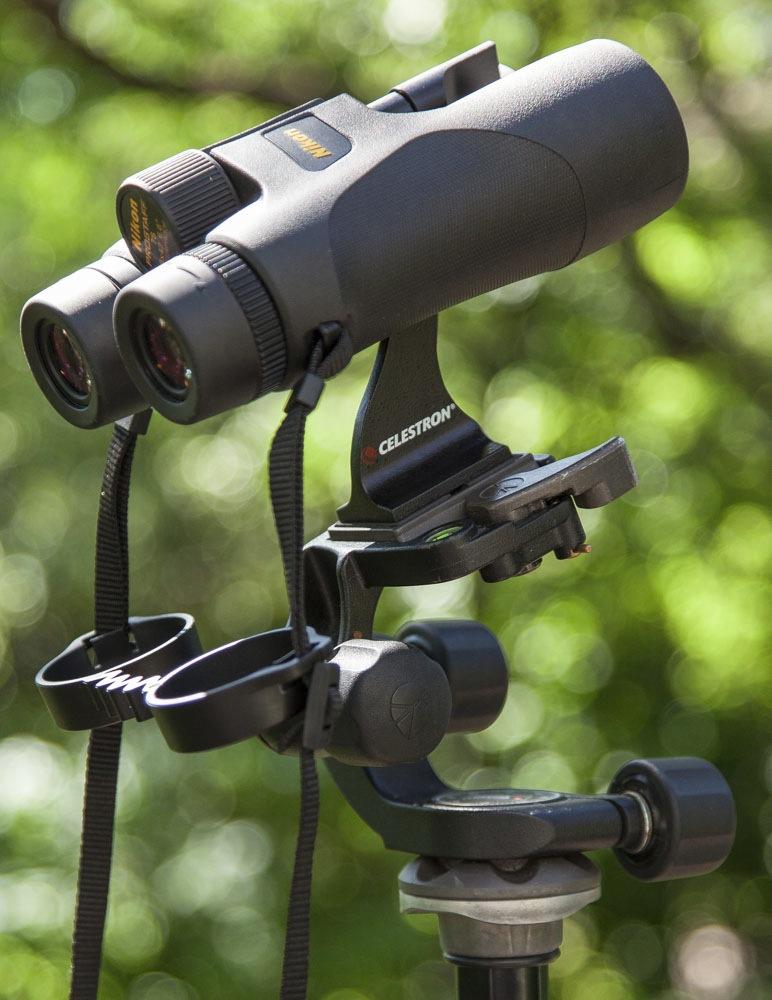
The extended thumb turner on the binocular side is a real convenience. You can screw it in and tighten it with bare fingers in the dark, which matters when you are setting up under a canopy at a star party. The 3.2 ounce weight is negligible and it disappears into a jacket pocket between trips.
It fits both roof and porro prism bodies, and the narrow profile lets roof-prism barrels close to their minimum interpupillary distance with the objective covers still on. That is a small thing that determines whether the adapter lives in the case or on a shelf.
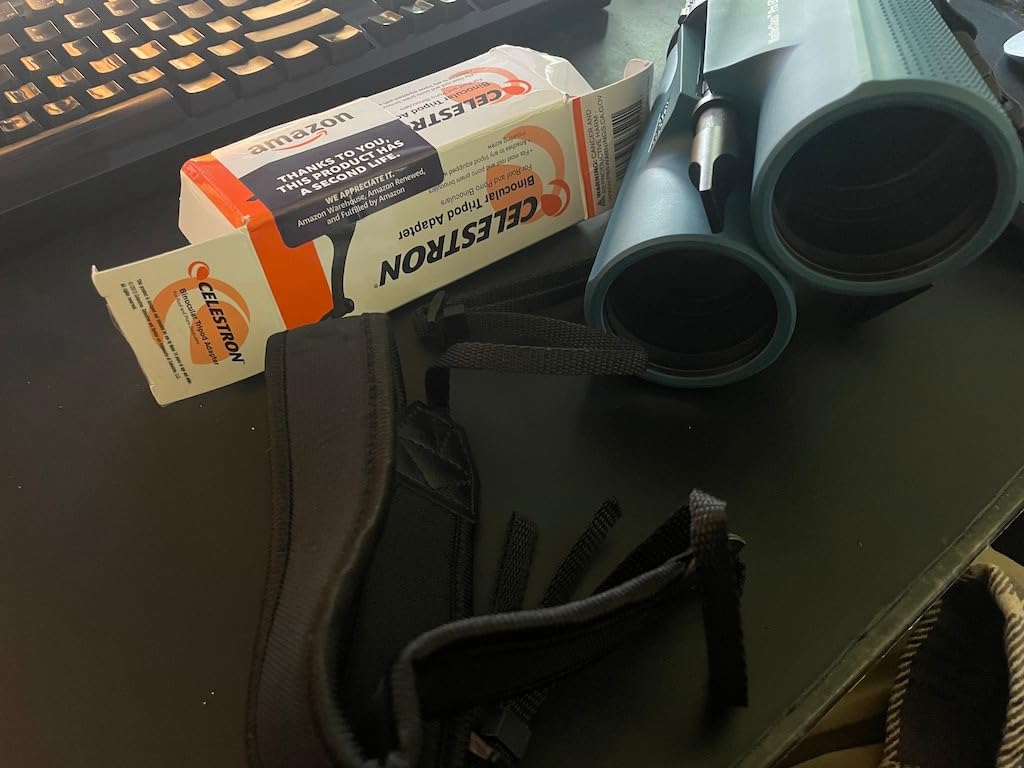
What we liked in real sessions
The vibration-free claim is the one that actually matters under a dark sky. Mounted, a 15×70 turned a smeared fuzzy blob into a view where you could pick out individual stars in a cluster, simply because the tripod absorbed the movement of your own pulse. Handheld at that magnification the same cluster dissolved every time you blinked.
It is also the least fussy option. No thread locker, no special tool, no plate to lose. The stud threads into a normal 1/4-20 tripod socket or into the top of a standard head, which makes it the safe recommendation if you are not sure what your tripod accepts.
Where it falls short
The recurring complaint is residual swivel. Finger-tightening the binocular-side screw is sometimes not enough to eliminate slight rotational play, and some owners substitute a star washer to close the gap. If your glass is heavy, treat the finger-tight as a starting point and confirm the play is gone before you walk away from the setup.
The other drawback is geometric. The thumb turner protrudes around 4mm past the objective bells, so the binoculars will not rest flat on a table or on your lap while mounted. And the included plastic washer can only be tightened so far before it flexes, which again pushes you toward adding your own hardware for heavier loads.
2. FANAUE S1 Aluminium Mount – Best Value
Binocular Tripod Adapter, Binocular Mount 1/4 Inch Threading Mount Aluminium (s1)
CNC T6061 aluminum
Arca-Swiss dovetail plus 1/4-20
Measures 4.6 x 1.5 x 0.78 in
Weighs 2.23 oz
Pros
- Arca-Swiss dovetail plus 1/4-20 covers nearly any head
- Quick release lets the stud stay installed on the glass
- Machining rivals far more expensive adapters
- Fits most 7x35 through 30x60 bodies
Cons
- Binocular-side stud can loosen with use
- Quick-release button awkward with large fingers
- Very heavy glass can pivot slightly
This is the pick that makes the strongest argument against buying by brand name alone. The body is CNC-machined T6061 aluminium with a hard anodised finish, and owners in the reviews we analysed repeatedly compare the machining quality to adapters costing several times more. The rating sits at 4.5 across more than 700 reviews, with 76 percent five-star.
Where it beats almost everything here is head compatibility. It carries both an Arca-Swiss dovetail on top and a 1/4-20 threaded hole underneath, so it will sit on a photography ball head, a field head or a window mount. If you already own a camera tripod, this is the adapter that needs no additional plate.
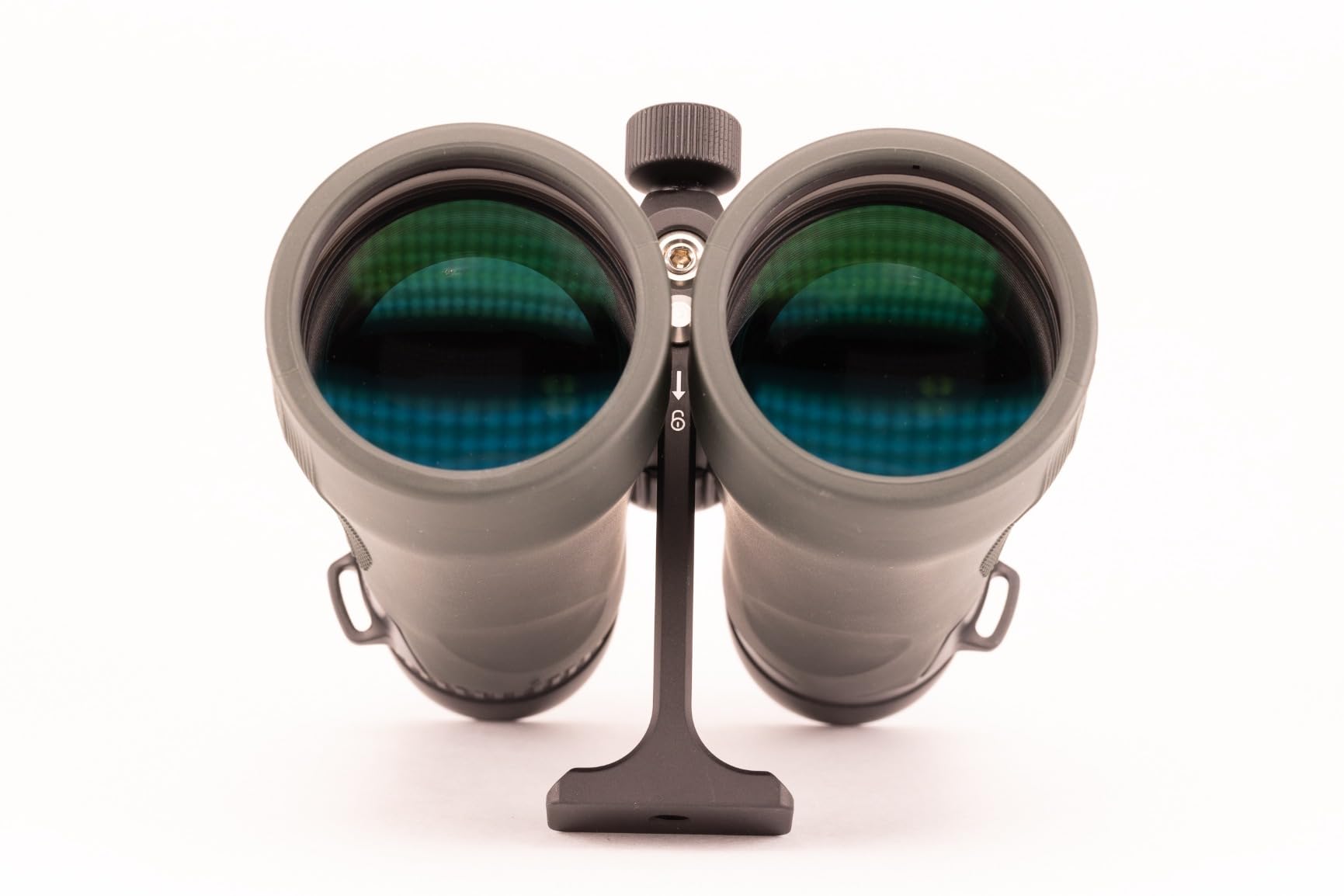
The quick release is genuinely useful rather than decorative. Because the stud can stay permanently screwed into the binoculars, swapping between handheld and tripod use is a single lever movement with no parts to store separately. That changes the behaviour: people who own this adapter tend to actually use the tripod, because the friction of setup has been removed.
At 2.23 ounces and 4.6 inches long, it fits inside a flexible-scope head and most binocular cases. We found it packs flat in a small daypack alongside a lightweight tripod with no difficulty at all.
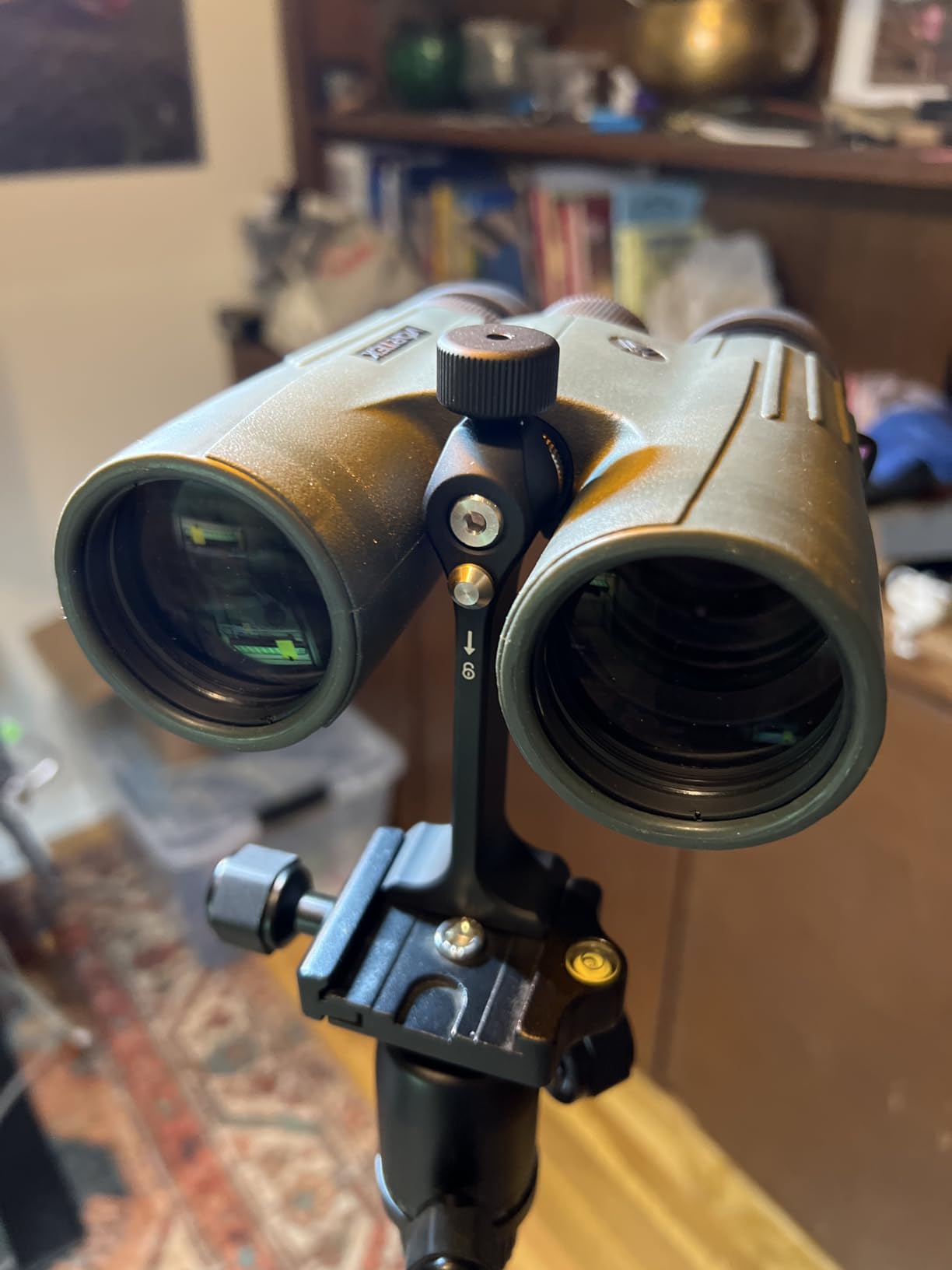
Why it suits most stargazers
The dual-standard base removes the single most common purchase mistake, which is buying an adapter that does not match the head you own. One adapter covers roughly every mainstream tripod, which means fewer variables between you and a working setup on the first night.
The listed fit range covers most 7×35, 8×42, 10-30×52, 12×42, 15×52, 20×25 and 30×60 bodies, roof or porro. For someone still deciding which glass to pair with it, that breadth is a genuine convenience rather than a spec-sheet line.
Where the compromises show
The stud that screws into the binoculars can loosen with use, and several owners add thread locker as a matter of course. This is a recurring theme across bolt-on designs in this group rather than a flaw unique to this one, but it is worth knowing before a long session far from a car.
Two smaller complaints: the quick-release button sits in an awkward spot for people with larger fingers, and very heavy binoculars can pivot slightly around the connector. For large-aperture glass like a 20×80, we would pair this with a well-loaded head and re-check the torque after the first setup.
3. Gosky Universal Stabilite Mount – Best for Binoculars With No Tripod Socket
Gosky Universal Binocular Tripod Mount, Stabilite Adapter – 1/4-20 – New Rest Compatible with All Tripods
Strap and saddle mount
Weighs 2.8 oz
Standard 1/4-20 stud
Works with or without a socket
Pros
- Only screw-free option that mounts binoculars with no tripod socket
- Hook-and-loop strap locks fast with no threading
- Adds almost no bulk to a pack
- Standard stud drops into any ordinary head
Cons
- Strap-and-saddle design feels less rigid than machined screw-on parts
- Plastic body less durable than the metal options
- Lowest rating in the group at 4.3 stars
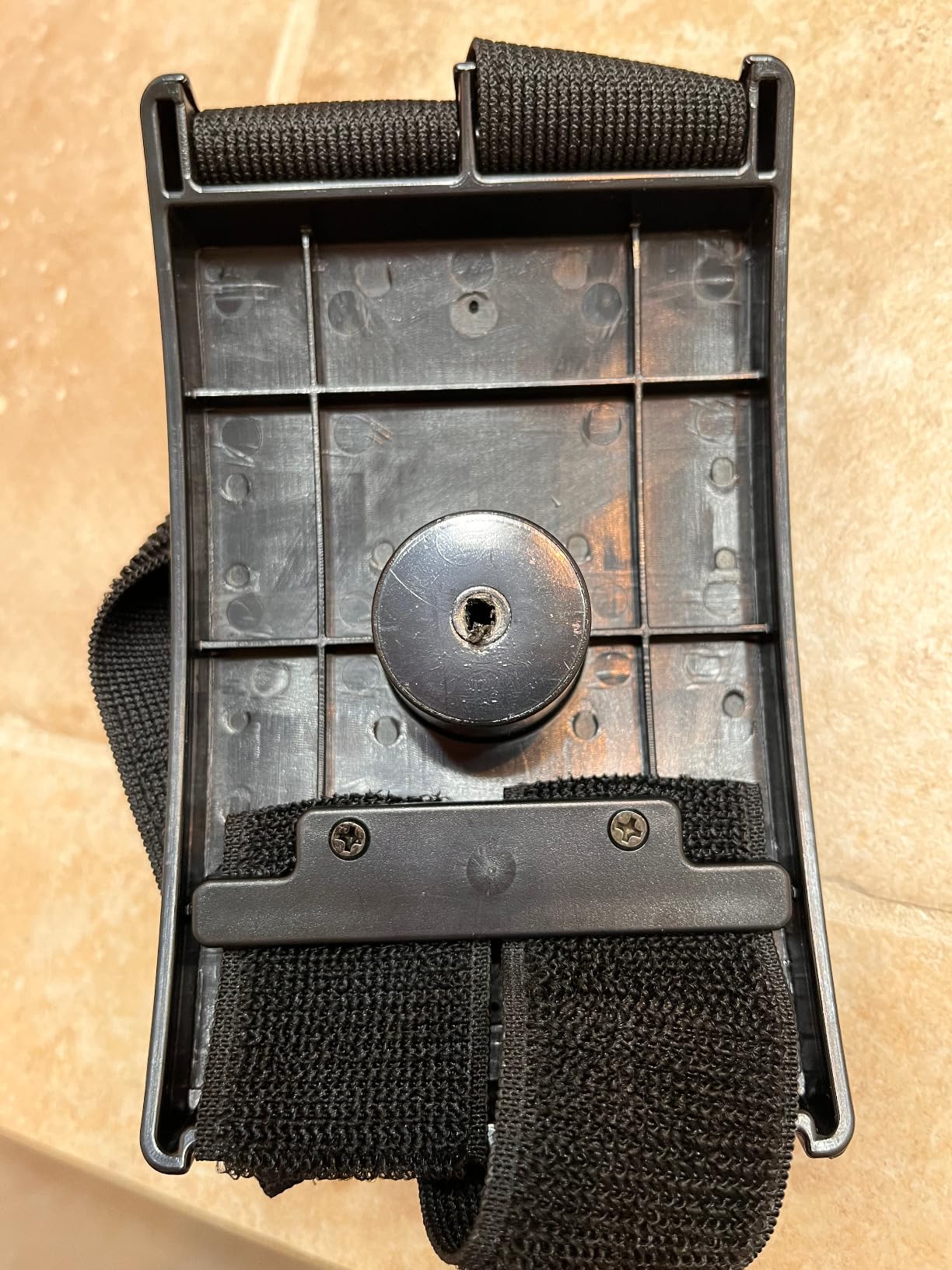
Everything else in this list needs a threaded socket. This one does not. The binoculars sit in a saddle and a hook-and-loop strap locks them down, which makes it the only pick here that will mount a body with a bonded bridge or no socket whatsoever. For compact birding glass and older models, that is the difference between usable and impossible.
Setup is genuinely the fastest in the group. There is no stud to thread and no clamp to align, so the whole mount takes seconds once the strap is sized. The 1/4-20 stud underneath drops into any ordinary tripod head with no plate required.
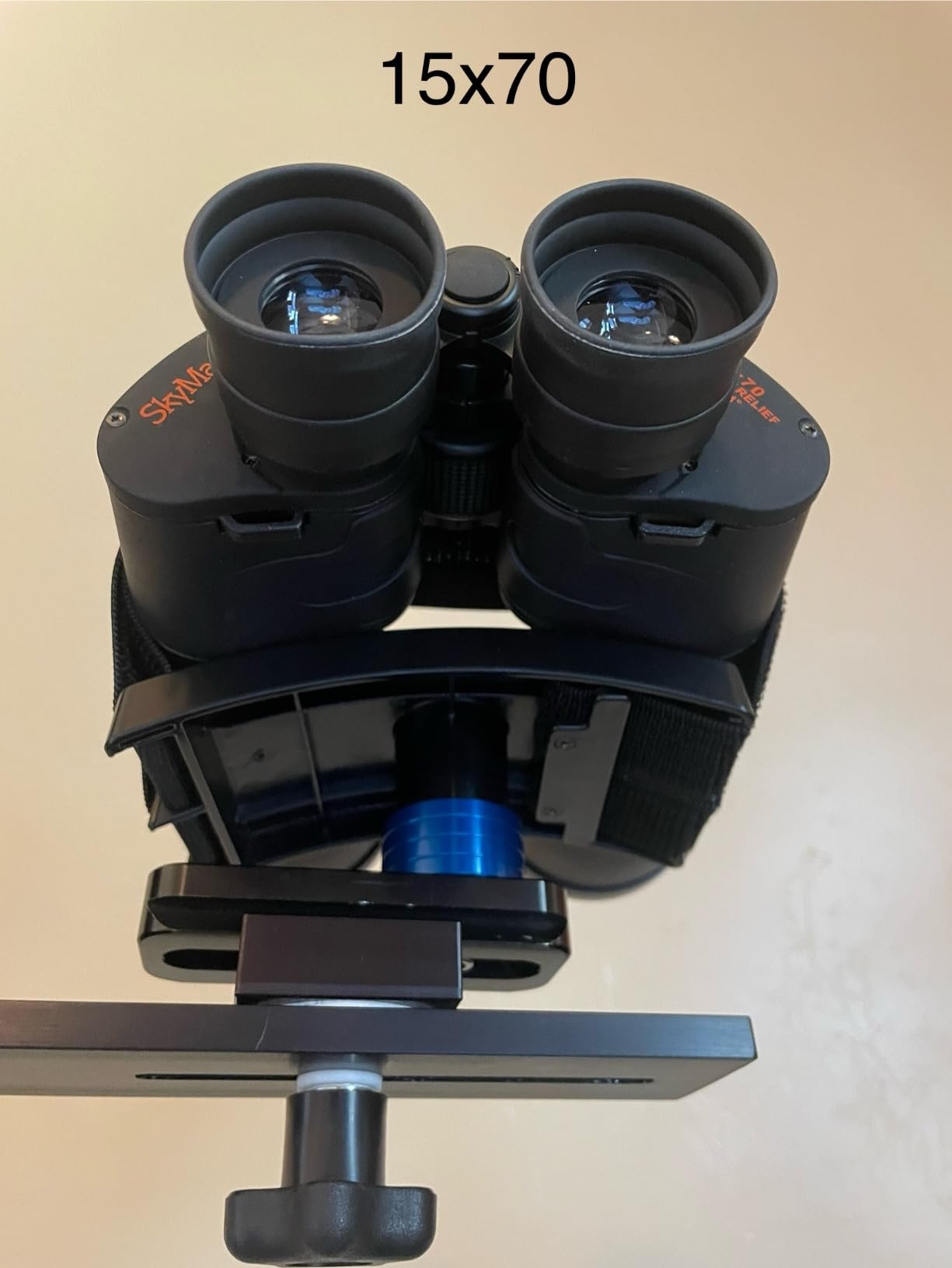
What you trade away is rigidity, and the reviews are candid about it. At 63 percent five-star and 21 percent four-star, the praise clusters on versatility while the critical reviews focus squarely on how the strap-and-saddle design compares to machined screw-on adapters under magnification. Very high magnification can still show movement.
At 2.8 ounces in plastic, it also has the least premium feel of anything we tested, and it is not water resistant. For occasional use on lighter glass, neither matters much.
Where it earns its place
If your binoculars lack a tripod socket, this is not a compromise. It is the answer, and no bolt-on adapter in this group will work on that body at any level of build quality. The same applies to bodies where the bridge is bonded across the barrels and no thread was ever machined in.
It also makes a reasonable travel companion, since it adds nothing to pack weight and needs no tools. Casual observing under 10x, walking birding, and quick twilight sessions are all situations where the small loss of rigidity is invisible.
Where it falls short
Zoom binoculars at higher magnifications amplify every tremor, and this is exactly the mount that will not fully cancel them. If your plan is long deep-sky sessions at 15x or above, a strap mount is the wrong tool and a screw-on or clamp adapter will change your experience far more than the money would suggest.
The plastic body is the other concern. It is the lowest-rated pick in the group at 4.3 stars with a 7 percent one-star share, and most of those negatives trace back to feel and flex rather than failure to function. Expect to replace it eventually rather than pass it down.
4. Vortex Sport Binocular Adapter – Best Branded Quick Release
Vortex Sport Binocular Adapter
Precision-machined aluminum
Measures 4.5 x 3.5 in
Weighs 1.6 oz
Quick-release connector
Pros
- Slim profile fits between the barrels of large high-power glass
- Quick-release stem lifts the glasses off in an instant
- Stem stays on the binoculars and fits a Vortex case
- Works direct to tripod or via a drop-in adapter
Cons
- Stud loosens in long sessions without thread lock
- Binocular-side screw is short and awkward to grab
- Quick-release socket is shallow
- Releases by gravity so lift the tripod carefully
The defining feature is the slim profile. At 1.6 ounces it is the lightest adapter here, and its crossbar tucks between the barrels of even large high-power binoculars, which is where most chunky bolt-on blocks collide with the housing. If you own big glass, that geometry alone can decide the purchase.
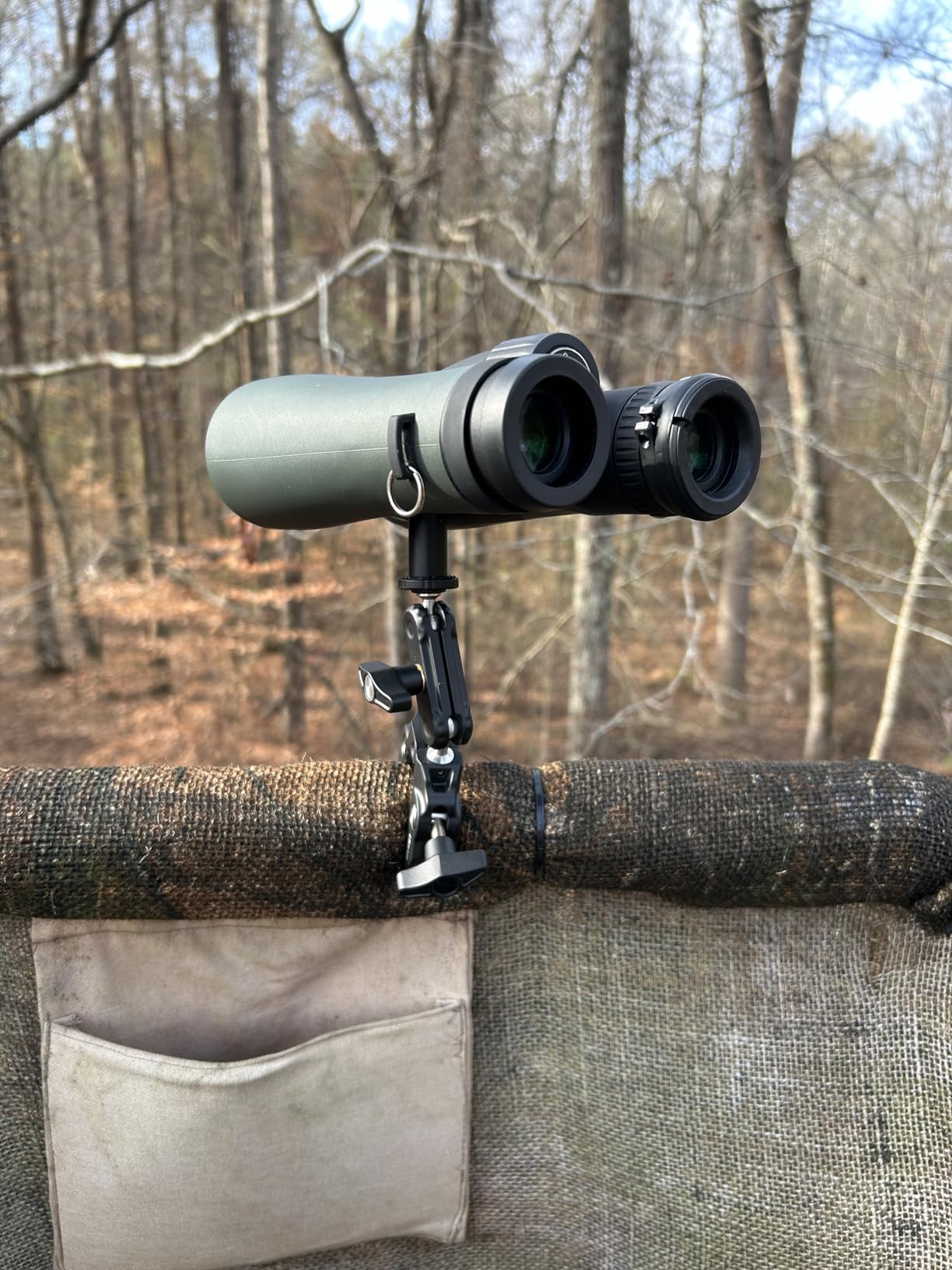
The quick-release connector is the part users mention most. Because the stem stays attached to the binoculars, you lift the glass straight off for handheld use without disconnecting the whole adapter, then drop it back on when you want a steady view. Reviewers specifically credit this with removing the friction that normally stops people from mounting at all.
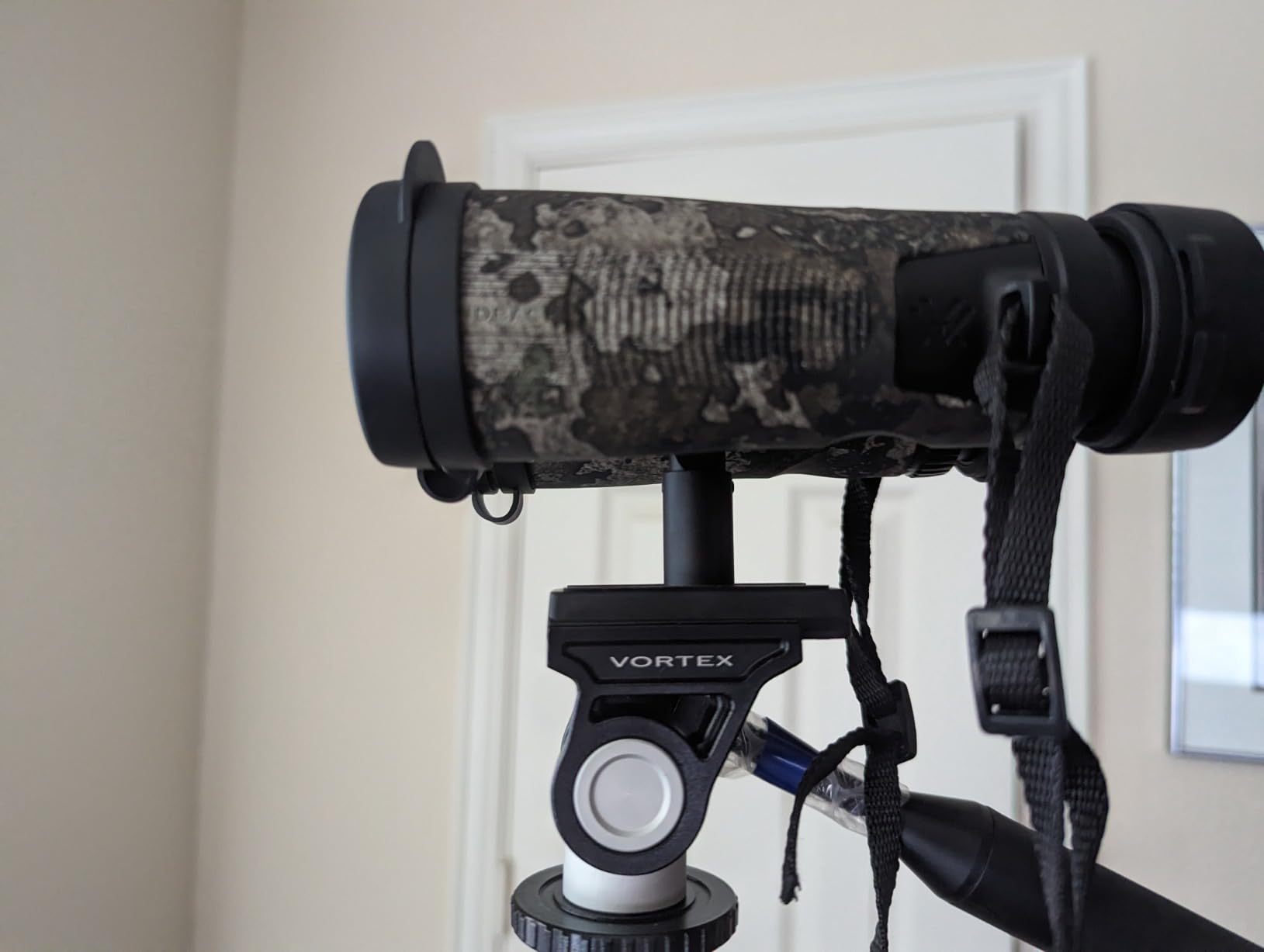
At 4.6 stars across 379 reviews with 75 percent five-star, the feedback is consistently strong. The unlimited, unconditional warranty is a genuine difference from generic adapters, and an Allen key is included.
There are two mounting options, either direct to the tripod or through a separate drop-in adapter, which covers both screw heads and clamp-style heads without you buying a second product.
Best for repeat handheld and tripod use
The lift-off design shines when you alternate between walking and tripod observing in one night. Scanning a field with the glass, then parking it on the tripod for a deep-sky object, takes seconds, and the stem never has to be unscrewed or lost.
For someone new to astronomy who is still finding their feet, that low-friction loop is valuable. Many people never bother with a tripod precisely because assembly feels like a chore, and this is one of the few adapters here that genuinely removes the chore.
Watch for the hardware details
The recurring negatives in the reviews are hardware-level rather than design-level. The retaining bolt that screws into the binoculars works loose during long sessions unless a thread locker is used, and the screw itself is short and awkward to grab when finger-tightening in the dark.
The quick-release socket is also a touch shallow for anyone wanting a positive lock, and since the stem releases by gravity, you have to avoid lifting the tripod before the glass is fully seated. None of these are serious at a star party, but all of them are worth knowing before you rely on it under a public sky.
5. Staoptics ZJ02 Quick Release Adapter – Best for Switching Between Pairs
Staoptics Binocular Tirpod Adapter Quick Release 1/4-20Inch Threading Detachable Mount Accessories for 8×40 8×42 10×50 10×56 12×50 12×60 15×60 15×70 25×70 etc Roof and Porro Zoom Binoculars
Machined aluminum
Weighs 0.108 lb
Stud length 1.063 in
Two studs included
Pros
- Two connection studs let you keep one permanently on each pair
- Twin studs make switching between glasses fast
- Very light with a short stud that will not dig into your chest
- Rotating top knob releases in a second
Cons
- Quick release is a friction collar not a locking dovetail
- No brand pedigree and a barebones package
- Fit depends entirely on the binoculars having a socket
The detail that sets this one apart is the second stud. The package includes two connection screws, so you can leave one permanently threaded into each of your pairs of binoculars and swap the entire adapter body between them. For households with two sets of glass, or anyone who carries one pair for birding and one for astronomy, that is a genuine time saver.
The machined aluminium body weighs just 0.108 pounds and the stated fit range runs from 8×40 through 25×70 across both roof and porro bodies. At 4.4 stars across 248 reviews, with 66 percent five-star and 20 percent four-star, the feedback is steady rather than glowing.
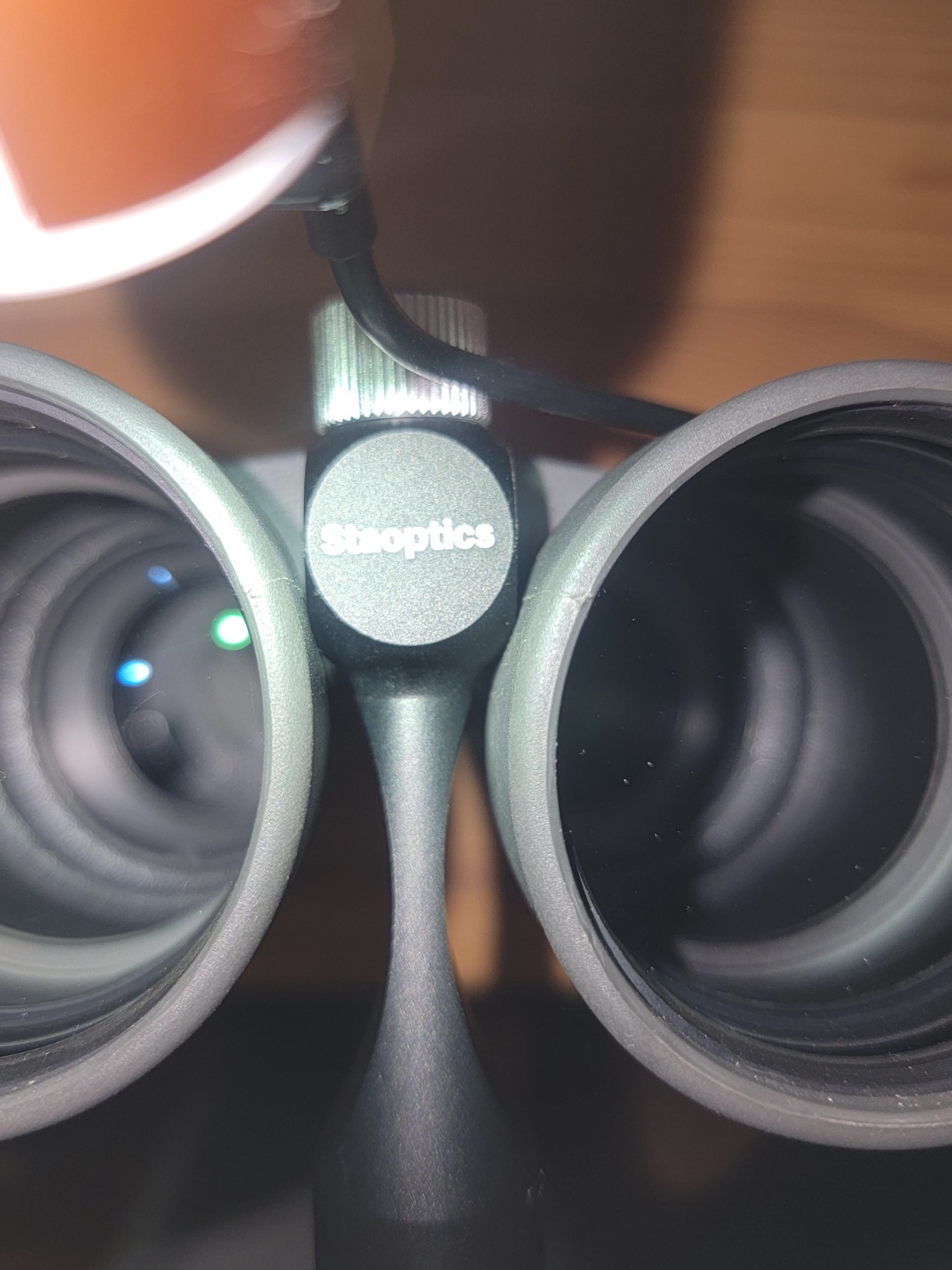
The 1.063-inch stud length is a detail the manufacturer clearly thought about. A longer stud on a bolt-on adapter can dig into your chest when you stand in front of the tripod at low head height, which is an uncomfortable discovery on a cold night. This one is deliberately short.
Operation is a rotating top knob rather than a lever. Turn the knob, the glass comes free. Simple, but the mechanism is a friction collar rather than a positive locking dovetail, and that distinction matters more as the glass gets heavier.
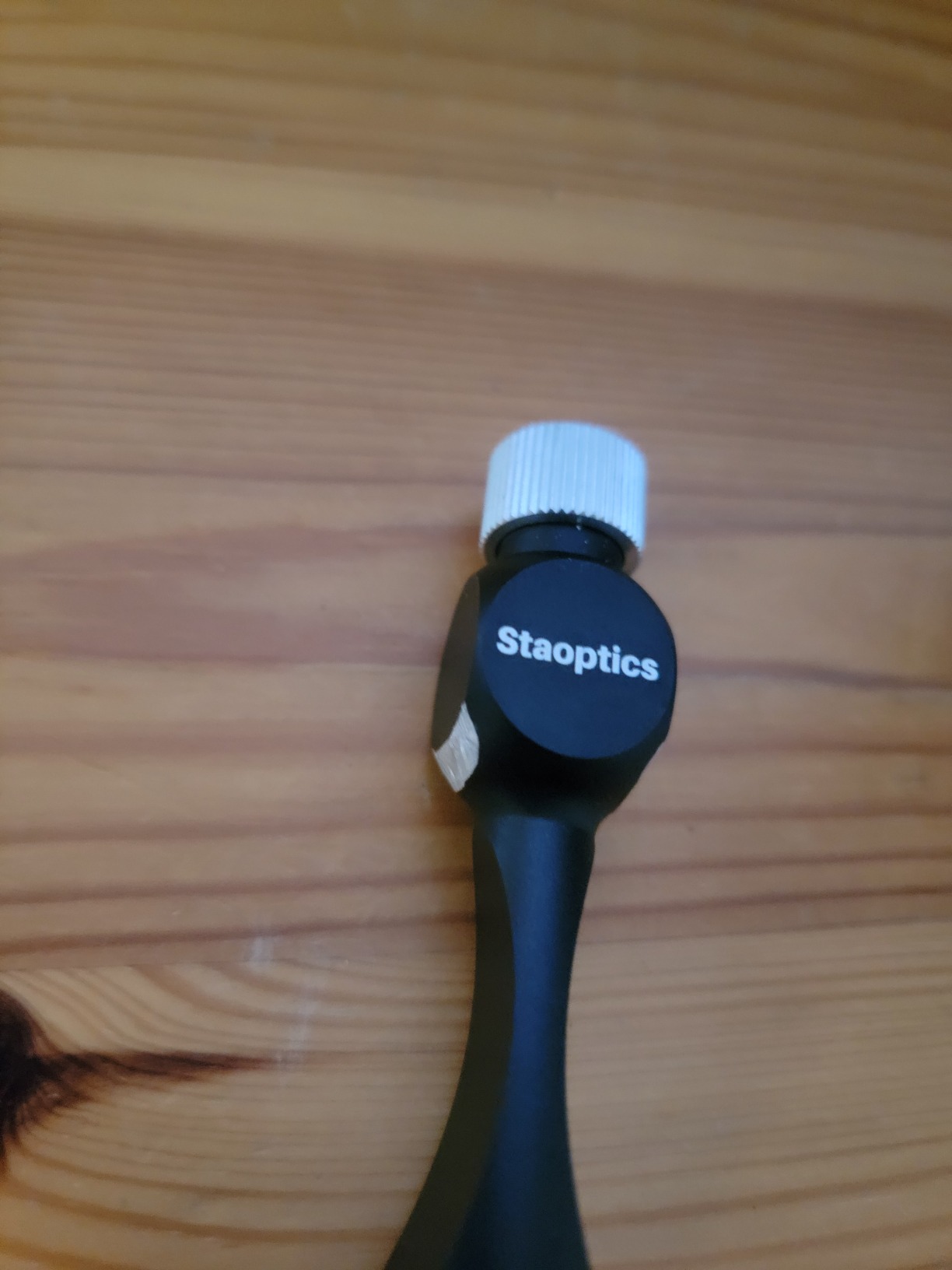
Where it works well
Multi-pair households get the most from this. With a stud installed in each binocular, the whole tripod setup stays assembled and you change glasses the way you would change lenses on a camera. The weight adds so little that backpacking to a dark site is realistic.
It is also a sensible first adapter for someone who wants quick-release convenience without paying for a machined dovetail plate. For mid-weight glass in the 10×50 to 15×70 range, the friction collar has plenty of margin.
Where the mechanism shows its limit
A friction fit is not a positive lock. Under a heavy or very long barrel, the joint can rotate where a real Arca-Swiss dovetail would not, and that is precisely the wobble users complain about in the highest-magnification glass. If you plan to use 20×80 binoculars, buy a dovetail-based adapter instead.
The barebones package and lack of a recognised brand name are worth noting too. The lifetime warranty is stated, but the fit depends entirely on your binoculars having a 1/4-20 socket, so check before ordering.
6. SVBONY SV110 Metal Tripod Adapter – Budget Pick
SVBONY SV110 Binocular Camera Tripod Adapter, for Porro Binoculars
All-metal powder-coated body
Weighs 3.15 oz
Fits porro prism binoculars
1/4-20 socket in the foot
Pros
- Entry-level tier and still all-metal construction
- Oversized rubberized knob is easy to grip in the dark
- Holds firmly on a parallelogram or ball head
- Narrow body fits most binocular barrels
Cons
- Deeply recessed foot thread will not seat very short tripod studs
- Large knob can stop narrow-set barrels closing
- Some owners replace the factory screw with a hex bolt
What makes this worth recommending at the entry level is that it is metal, not plastic. The powder-coated steel body is the same construction philosophy as the premium adapters in this group, and reviewers repeatedly describe it as a clear step up from plastic retail adapters without asking for a meaningful premium over them.
The oversized rubberised knob is designed for gloved or cold hands, which sounds minor until you are bolting glass to a tripod in the dark at minus temperatures. At 4.5 stars across 162 reviews with 69 percent five-star, satisfaction is high for a product at this tier.
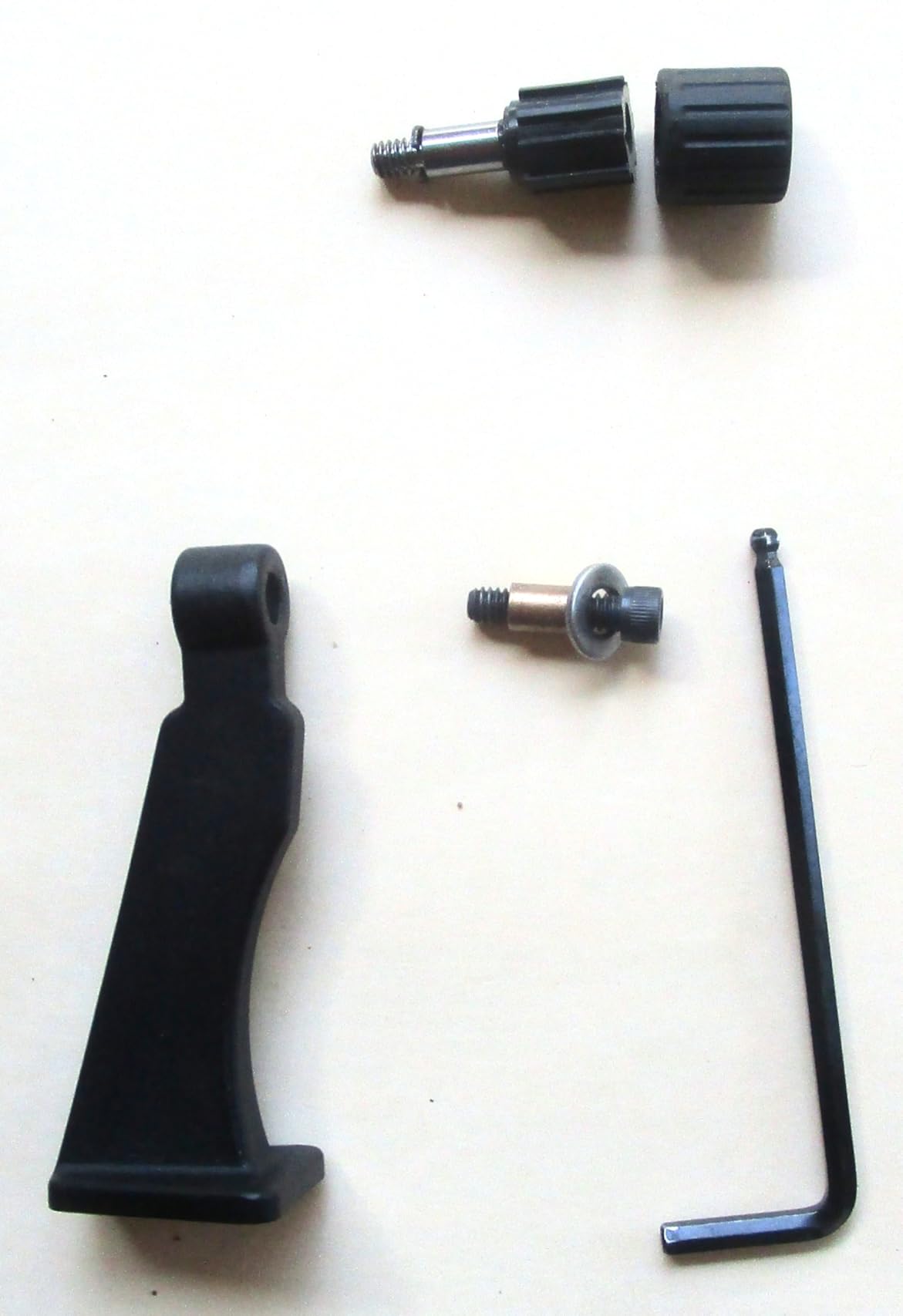
It is also sold in a roof-prism version, so a porro-only fit is not a dead end. The fit requirement is specific: binocular tripod sockets under 7mm deep with barrel spacing wider than 20mm. Check your body against that before buying.
Owners note that the same generic adapter is sold under several different brands, which is a fair description of where this product sits. You are buying a standard bolt-on design with a well-executed knob.
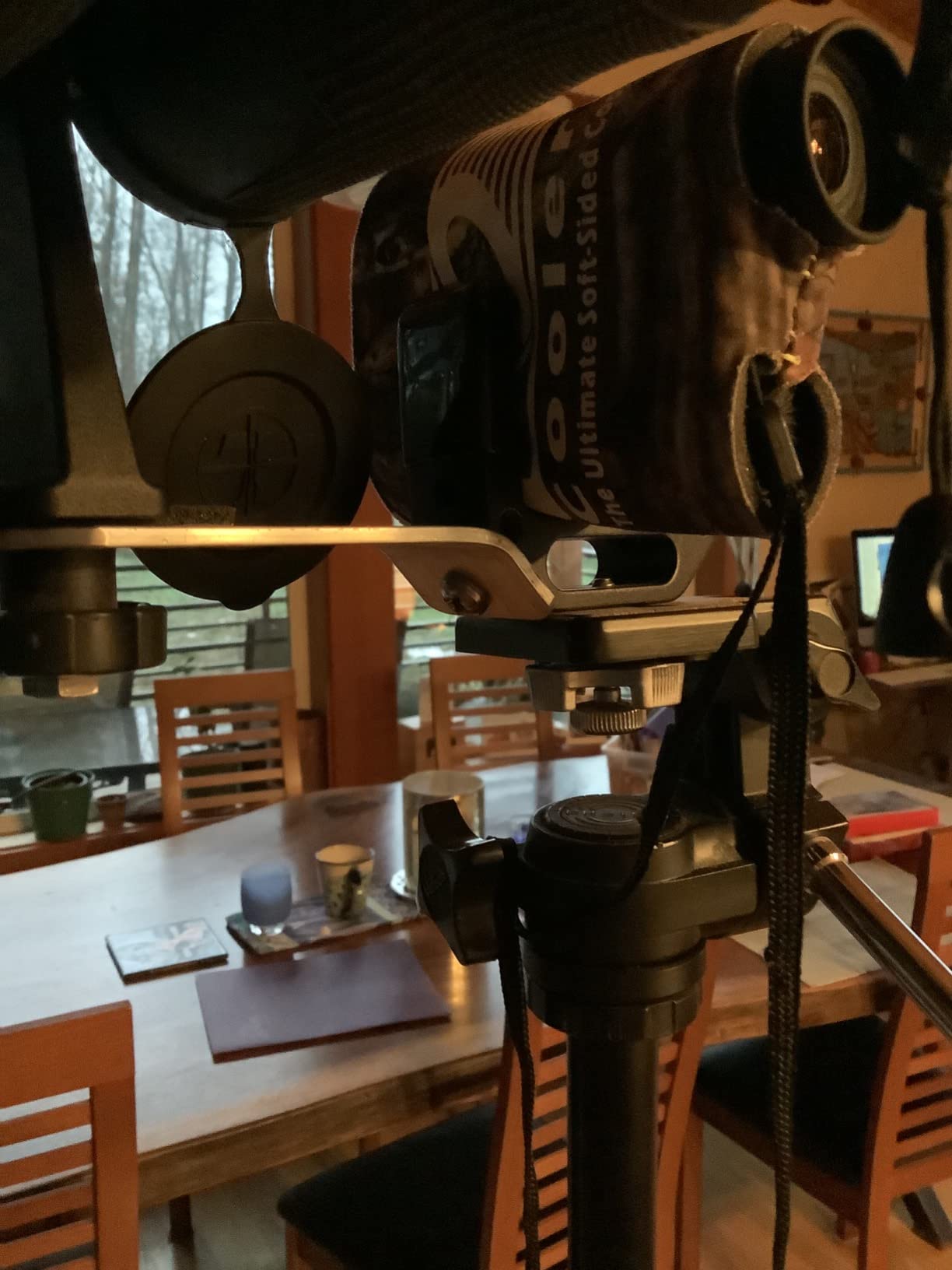
Why it is the sensible first buy
Most stargazers who need an adapter own mid-weight glass in the 10×50 or 12×60 range and a straightforward photographic tripod. This adapter does that job properly, holds firmly on both a parallelogram and a ball head, and leaves enough money in the budget for a tripod that is actually steady.
The low-profile narrow body also fits most barrels, and the 3.15-ounce weight is irrelevant at this scale. For a first night out with a borrowed tripod, it removes the biggest single barrier, which is not having a way to mount at all.
Where the fit is fussy
The foot has a deeply recessed 1/4-20 socket, which is a real and specific limitation. Tripod studs shorter than roughly a third of an inch may not seat fully, so on a thin field tripod you may end up with a partly engaged thread and a wobble that has nothing to do with build quality.
On close-set compact barrels, the large knob and body can also stop the halves from closing. Some buyers solve the clamping complaint by replacing the factory screw with a longer hex bolt for a tighter grip.
7. FANAUE S2-01 L-Type Adapter – Best for Arca-Swiss Heads
FANAUE S2-01 Binocular Tripod Adapter with 1/4-20″ Thread Compatible with Porro Binoculars and Arca Ball Heads, Universal Quick Release for Bird Watching, Hunting, Astronomy, Animal Observation Ect.
CNC T6061 aluminum with hard anodizing
Weighs 79 g
Quick release with locking screw
Lifetime warranty
Pros
- Hard-anodised machined aluminium feels premium at a mid-range price
- Tapered L-shaped body adjusts for eye width and stays low
- Bracket can stay permanently screwed into the binoculars
- Works with Arca-Swiss plates and plain 1/4-20 studs
Cons
- Side-to-side play if the knob and quick release are not fully tightened
- Foot is narrow so some tripods need the screw thread not the plate
- Anodizing can need running a die over the thread before it seats
The tapered L-shaped body is the reason to choose this one. Most bolt-on blocks are rectangular and sit at a fixed width; a tapered profile keeps the adapter low between the barrels and clears the eye relief as you adjust interpupillary distance. Users with wide-set barrels notice the difference immediately.
Construction is CNC-cut T6061 aluminium with Class III hard anodizing and a stainless steel screw, and the 4.6-star rating across 119 reviews comes with 78 percent five-star, the second-highest five-star share in this group. One owner reports using it steadily for eclipse and comet viewing while another person looked through the eyepiece, which is about the most demanding test a binocular mount can face.
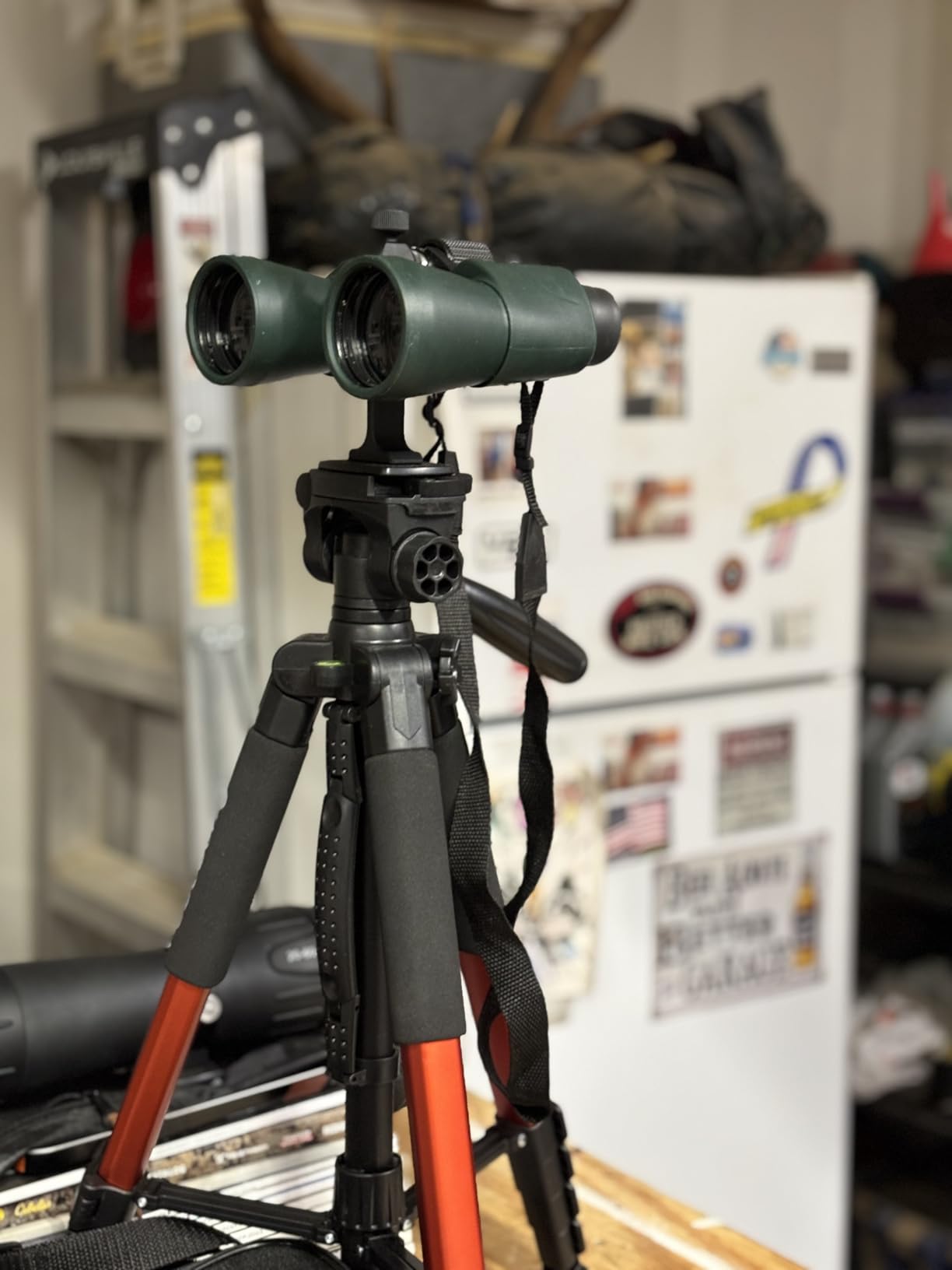
The safety detail is a locking screw on the quick release plus an anti-slip release that stops the glass sliding out unintentionally. The binocular-side bracket can stay permanently threaded into the body, so again the handheld-to-tripod swap is a single lever.
It works with Arca-Swiss plates and with plain 1/4-20 studs, and the manufacturer includes a mounting spanner alongside the screws.
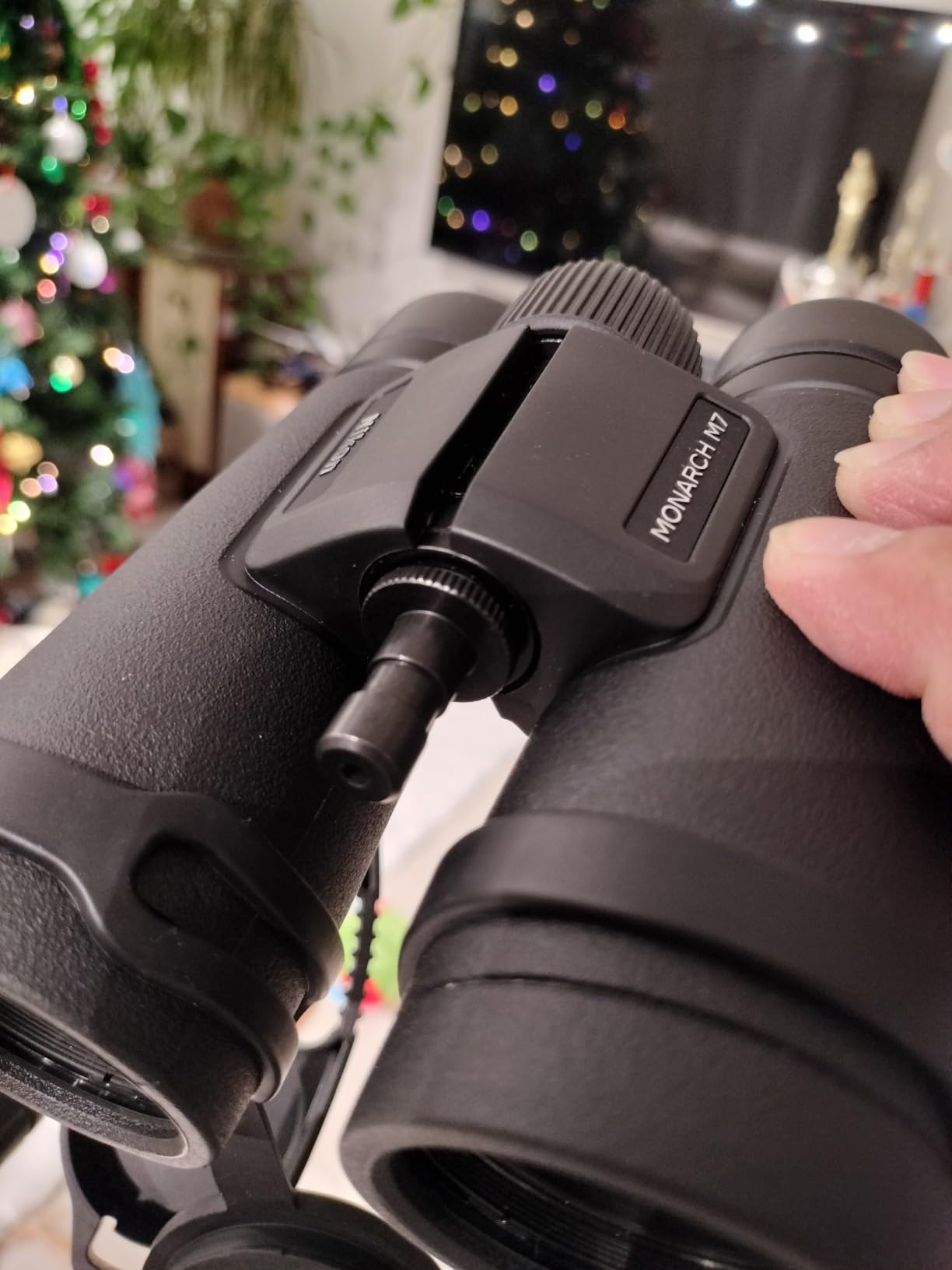
Best when your tripod is a photo head
Anyone whose tripod has an Arca-Swiss clamp head is best served by a dovetail that actually mates with it, rather than an adapter that has to be paired with a separate screw plate. This one is designed around that interface and adds a locking screw for safety, which most budget dovetails omit.
The tapered geometry also helps if you wear glasses, because it holds the eyecups clear of the mounting structure. For long sessions where eye comfort decides whether you keep observing, that is not a trivial feature.
Where setup matters
The most common complaint is not a defect but an instruction. Side-to-side play is possible if the top knob and the quick release are not fully tightened at installation, and the manufacturer says so explicitly. Tighten everything, then check for play before you walk away from the tripod.
The foot is fairly narrow, so on some tripods you should use the screw thread rather than expecting the plate to grip it. One reviewer also had to run a die over the thread because of the anodizing finish, which is a small but real installation task.
8. Zelnoox BC-03 Dual-Mount Adapter – Best Rigid Lock
Binocular Tripod Adapter | Quick Release, 1/4″-20 Thread & Arca-Dovetail, CNC Aluminum, Anti-Drop, Fits Most Binoculars
CNC T6061 aluminum
Weighs 2.8 oz
Measures 4.17 x 1.54 x 1.5 in
Arca dovetail plus 1/4-20
Pros
- Highest rating in the group at 4.7 with 83 percent five-star
- Anti-play lock compares level with Vortex per owners
- Detachable Arca base plus 1/4-20 covers clamp and screw heads
- Very light at 2.8 oz and quick to install
Cons
- Included Allen key is too large for the set screw
- No knurling so heavy glass needs a lot of force to stop turning
- Some buyers could not work out what the separate base plate fits
This is the most rigid lock in the group, and the reviews are specific about why. Buyers describe it as locking solid with no side-to-side play, and several explicitly contrast it with cheap keyed designs that can be overtightened until they damage the threads in the binoculars themselves. That is the failure mode that actually matters: a stripped socket is far more expensive than an adapter.
At 4.7 stars across 115 reviews with 83 percent five-star, it has the best rating distribution in the group, though on a smaller review base than the leaders. Several owners who had already bought two other adapters in the same price bracket rate it level with the Vortex unit.
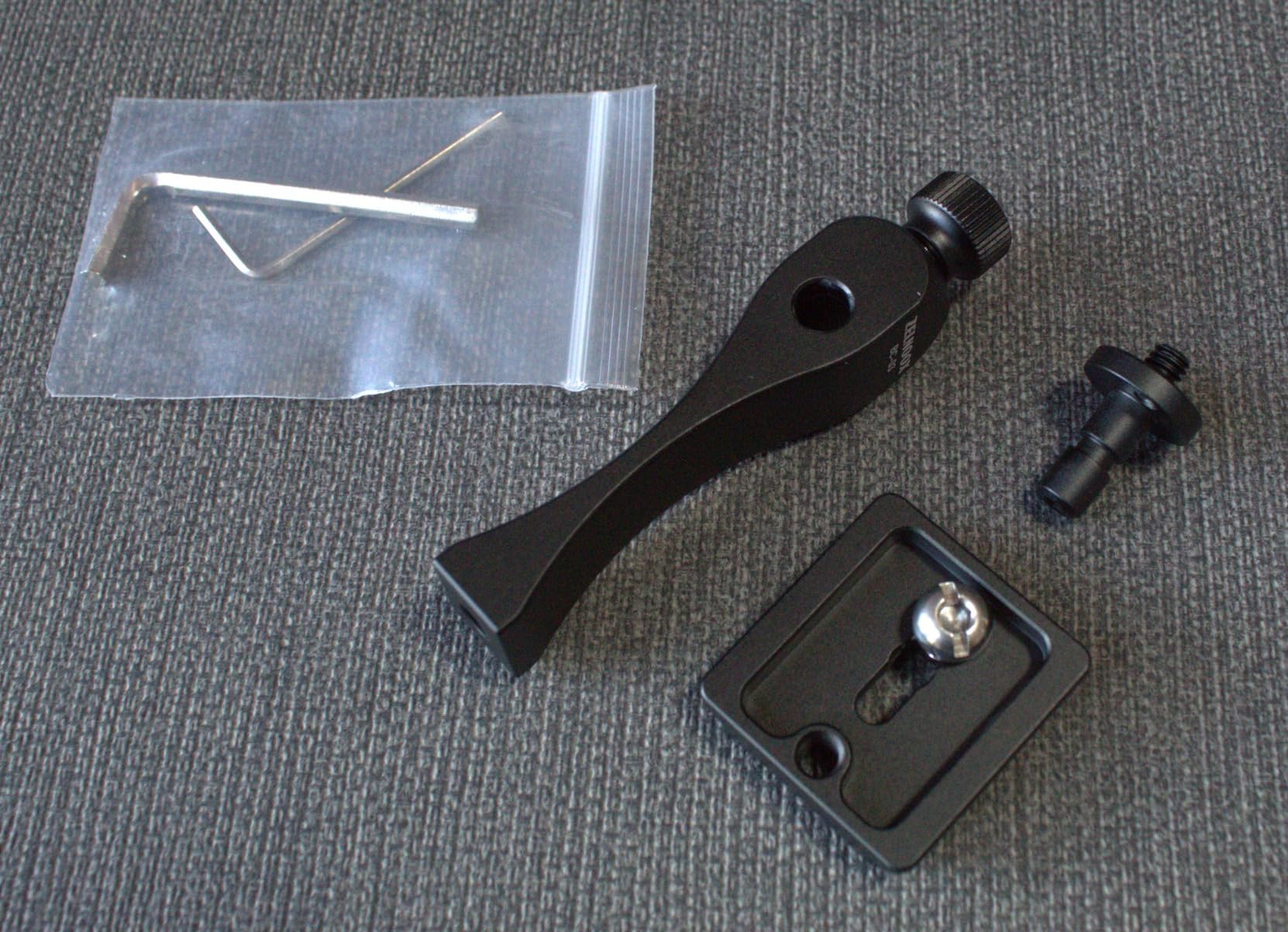
The mounting flexibility is real: a 1/4-20 threaded stud, a detachable Arca-Swiss dovetail base, and stated compatibility with RRS-style clamps. The two-part design installs in under a minute according to the manufacturer, and at 2.8 ounces it is among the lightest machined options here.
Fit covers 7×35, 8×42, 10-30×52, 12×25, 15×52, 20×25 and 30×60 bodies, and there is a lifetime warranty behind it.
Where rigidity actually changes the view
Play at the mount turns into movement in the image, and at high magnification a small amount of play is a large amount of wobble. This is the pick to buy if your glass is heavy or your tripod head is light, because the anti-play design removes the one complaint that appears across nearly every other review in this group.
The fact that it can be mounted either by plate or by stud also means you are not locked into one head type. If you later change tripods, the adapter stays useful.
Small annoyances to plan around
The included Allen key does not fit the set screw, so you need the correct tool sourced separately before you start. That is the single most common complaint and it is easily solved, but it does mean the adapter is not usable straight out of the box for that one adjustment.
The main tightening area also lacks knurling, so stopping heavy glass from rotating takes noticeably more force. Several buyers were also unsure what the separate base plate was meant to fit, which is a documentation gap rather than a design fault.
9. Zelnoox BC-02 Clamp Adapter – Best Heavy-Duty Clamp
Clamp Binocular Tripod Adapter – ARCA Quick Release Dovetail | 1/4″-20 & 3/8″-16 Screw Holes | Fits 26-58mm Binoculars
7075 aircraft-grade aluminum
Weighs 7 oz
Fits 26-58mm bodies
Arca dovetail plus 3/8-16
Pros
- Only screw-free clamp here that fits binoculars with no tripod socket
- 7075 aluminum and stainless hardware make it the most solidly built
- Rubber-padded jaws grip firmly and prevent scratches
- Secured and released in seconds for fast handheld swaps
Cons
- Heaviest machined option here at 7 ounces
- Base is small for a standard tripod mount and can allow flop
- Dovetail base is integrated rather than a separate part
The heavy clamp mechanism is what separates this from the other clamp in the group. Two inward-angled jaws wedge the binocular body into place rather than pinching it from the sides, and they are rubber-padded, so the grip is firm and the housing is protected at the same time. Reviewers highlight both the solidity and the jaw protection.
It is also the most solidly built unit we looked at: 7075 aircraft-grade aluminium with an anodised finish and stainless steel hardware, at 4.7 stars across 107 reviews with 77 percent five-star and 15 percent four-star. Owners like that it mounts binocular bodies with no tripod thread at all, which the screw-on adapters in this group simply cannot do.
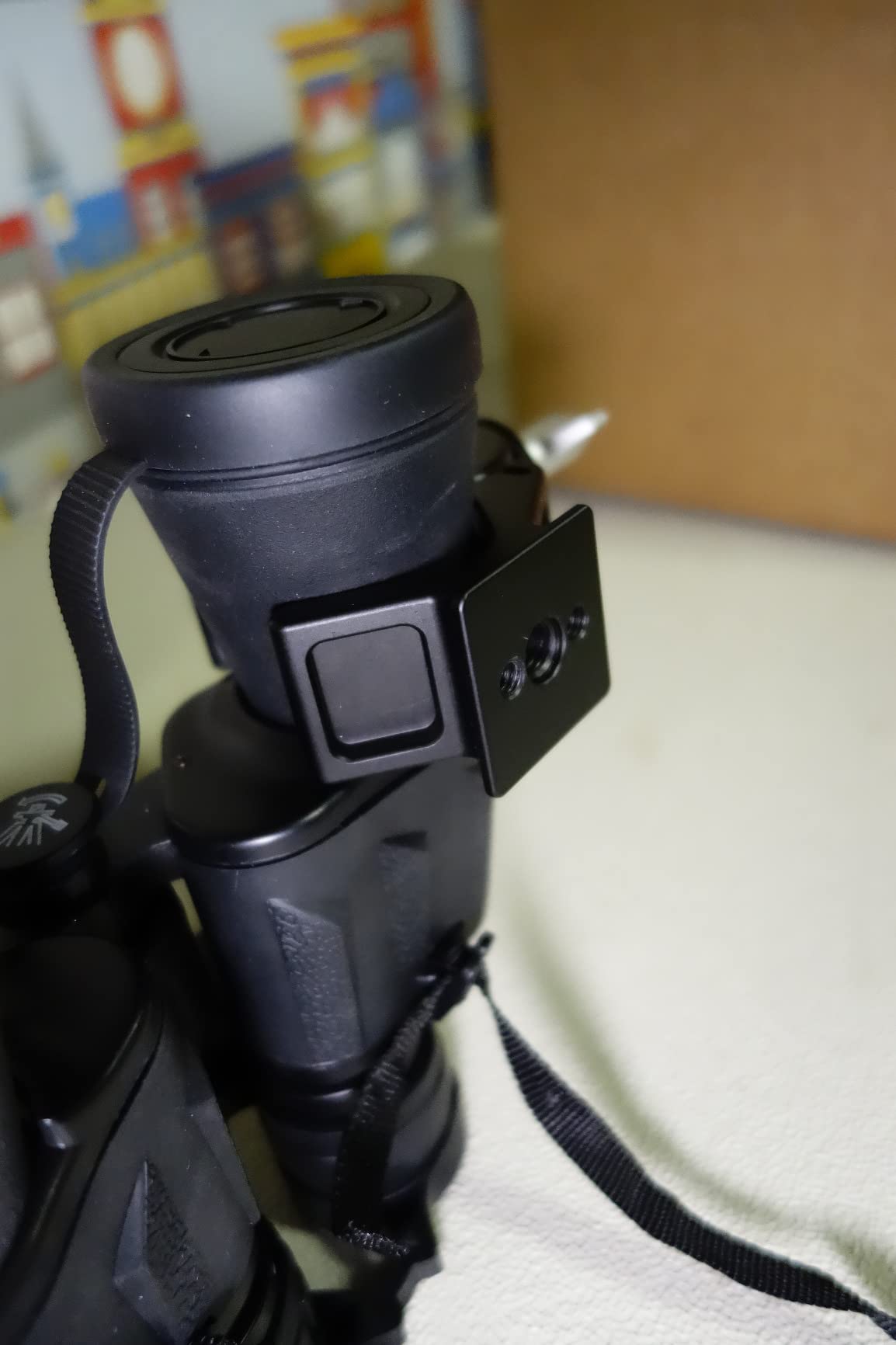
Head compatibility is close to exhaustive: an Arca-Swiss or RRS-compatible quick-release dovetail, a 3/8-16 hole and two 1/4-20 screw holes. It will fit a fluid head, a standard screw head or a photographic clamp without an extra plate, and a linen storage pouch is included.
The body range is 26-58mm, which covers 8×32, 8×36, 8×40, 8×42 and 10×50 models. If your glass is larger than 58mm, look at the wider clamp below.
Best for heavier binoculars without a socket
Clamp-style mounts get a bad name because cheap ones are plastic and flex. This one is not cheap, and the difference shows under magnification: a machined aluminium clamp with wedge jaws holds a steady line where a strap mount visibly moves. For anyone whose binoculars have a bonded bridge rather than a threaded socket, that is the whole argument.
Securing and releasing in seconds also makes it practical to alternate between handheld scanning and tripod observation, which is how most night-sky sessions actually unfold.
Where the weight and base size bite
At 7 ounces it is the heaviest machined adapter here, and you carry that weight on every trip. It also has the narrowest base of the clamp options, which can allow flop on a standard tripod mount unless it is shimmed or used on a head with grip.
One documentation issue catches people: the dovetail base is integrated into the body, not supplied as a separate piece, even though listing photos suggest otherwise. Know that before you order, or you may be waiting for a part that does not exist.
10. FANAUE S3 Clamp Mount – Best for Heavy Glass
FANAUE S3 Binocular Tripod Mount Adapter, ARCA Quick Release with 1/4″ 3/8″ Screw for Vortex Nikon Binoculars
CNC T6061 aluminum with rubber pad
Weighs 181 g
Fits 26-64mm bodies
Waterproof and rust-proof
Pros
- Rubberised clamp grips excellently without scratching the body
- Widest opening here at 26-64mm clears bodies like 15x70
- Folds flat enough to fit between the barrels and in a case
- Arca dovetail plus 1/4-20 and 3/8-16 holes
- All-metal with no plastic parts
Cons
- Heaviest option in the group at 181 g
- Very heavy binoculars can still shift in the clamp
- Needs care not to over-torque the clamp knob
This is the one to buy if your binoculars are big. The 26-64mm opening is the widest in the group, and it clears bodies like 15x70s and other large-aperture glass that narrower clamps will not accept. Owners report steady views of planetary detail in exactly the situations where handheld glass shakes apart.
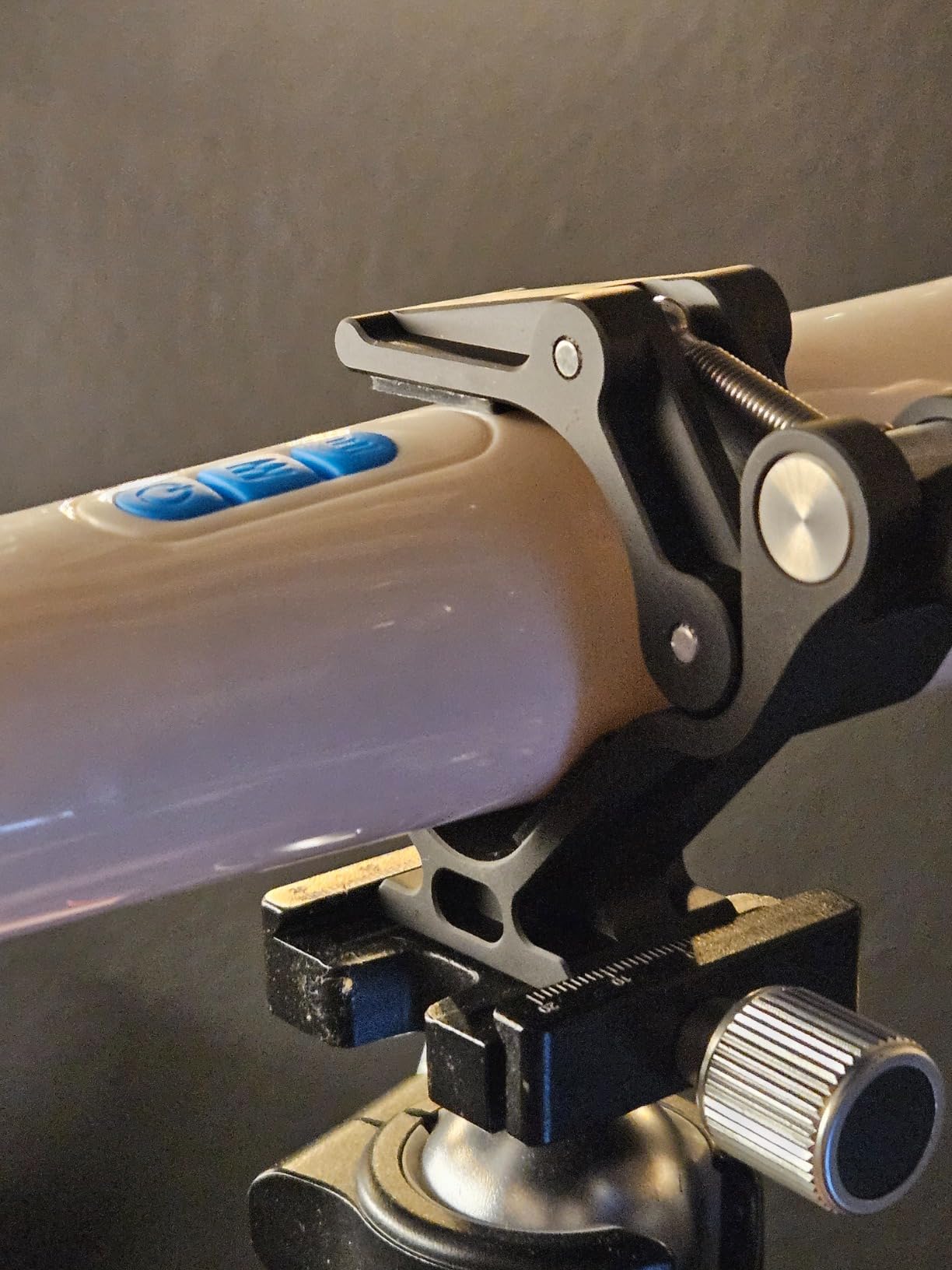
Build quality is CNC-cut T6061 aluminium with Class III hard anodizing, a non-slip rubber inner pad, and stainless steel hardware throughout, with no plastic parts anywhere. It is rated waterproof and rust-proof, which matters for a mount that sits outside through a full night of dew. Lifetime warranty and a stated support response within 24 hours round it out.
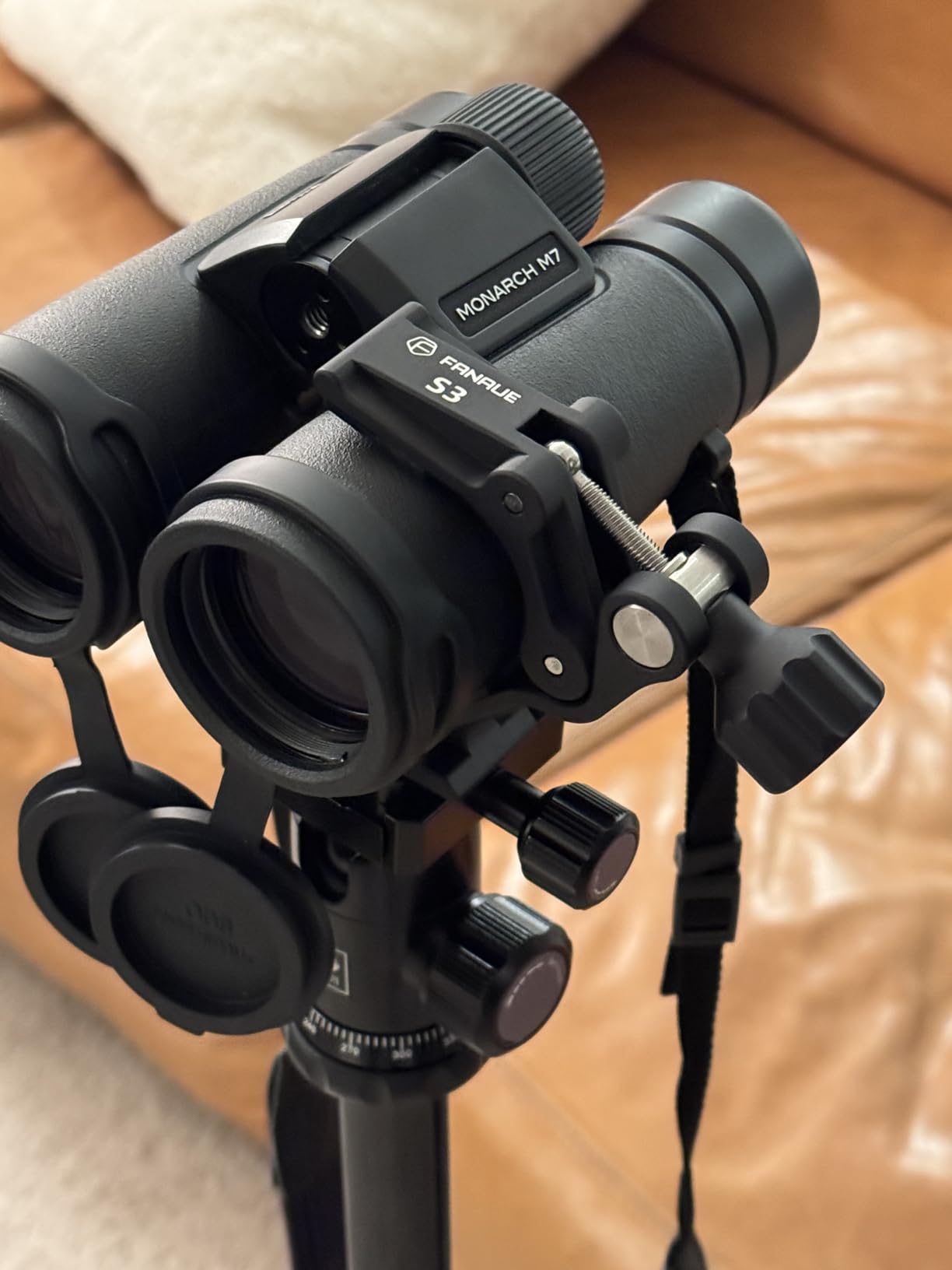
The brand lists Vortex, Zeiss, Nikon, Swarovski, Leica, Leupold and Bushnell bodies in the fit range, and the Arca or RRS dovetail plus 1/4-20 and 3/8-16 holes cover virtually any head, including car window mounts for outreach events and public star parties.
It also folds flat enough to sit between the barrels and inside a carrying case, which addresses the usual objection to a clamp: that it is a bulky object you have to carry separately.
What makes it the heavy-glass pick
Rubber-lined jaws on a rigid aluminium body produce a grip that holds a heavy barrel without marking it. The wide opening means you are not forced to choose between a secure mount and a large objective. For 20×80-class glass, secure wins, because swing against an objective lens is a real and expensive risk.
Owners consistently describe it as solving shake on heavy glass specifically, and the ability to use it on a car window mount makes it unusually useful for public astronomy events where a tripod is not permitted.
Where weight and torque matter
At 181 grams it is the heaviest adapter in this group by a wide margin, several times the weight of the machined bolt-on options. On a long walk to a dark site that is a genuine cost, and it is the main reason we do not recommend it for lighter glass.
Very heavy binoculars can still shift in the clamp, and the knob needs to be tightened with care rather than force, since over-torquing the clamp is the way to mark a housing. Take the time to set it up firmly in daylight before a night session.
Buying Guide: Best Binocular Tripod Adapters for Stargazing
Most buying mistakes in this category are compatibility mistakes, not quality mistakes. A well-built adapter on the wrong interface is useless, so work through these six questions before you spend anything.
The 1/4-20 thread and why nearly every binocular socket uses it
A 1/4-20 thread is a quarter-inch diameter screw with 20 threads per inch, and it is the near-universal standard for both sides of this equation. It is what you will find on the binocular socket between the objective lenses, and it is what most camera and field tripods accept on top of the head. One standard on both sides is why adapters exist at all.
The socket sits at the objective end of the hinge, not the eyepiece end, and is usually covered by a small threaded cap that you unscrew and keep. Losing that cap is a common and annoying first mistake, so put it in a pocket before you walk to the tripod.
Does your binocular even have a tripod socket?
Most do, but not all. Compact birding models, some older bodies and anything with a bonded central bridge may have no thread at all, which is why the clamp and strap options in this list exist. Check three things: the cap or plug between the objective lenses, a 1/4-20 marking in the manual, and the model number against the fit list on the product page.
Some binoculars ship with an adapter already included, and a few larger models integrate one. If your glass came with a factory bracket, the fit will be better than anything generic you can buy, so check the box before ordering.
Bolt-on, clamp or strap: three mounting mechanisms compared
Bolt-on screw-in adapters are the most rigid because the load path is a single metal thread into a machined socket. They are the right choice whenever a socket exists. Clamp adapters grip the barrel between the objective lenses, work without a socket, and are slightly less rigid but enormously more versatile. Strap-and-saddle mounts are the least rigid and the most tolerant, useful only when nothing else will fit.
Geometry matters more than people expect. A tall rectangular block can stop roof-prism barrels closing, and a wide block can collide with the housing on large models. Tapered or slim cross-sections solve this, which is why the two lightest machined options in the group are also the ones that suit the widest range of bodies.
Tripod head compatibility: 1/4-20, Arca-Swiss and Manfrotto 200PL
These three standards cover almost every tripod in circulation. A plain 1/4-20 socket is the simplest and the most common on field and older heads. An Arca-Swiss dovetail is a sliding dovetail plate found on most modern photography ball heads, and it is the most secure of the three because the wedge locks in two axes. Manfrotto 200PL is the older captive-plate variant, still common on budget photo tripods and not interchangeable with Arca-Swiss without a converter plate.
If your tripod accepts Arca-Swiss, any adapter with a dovetail base will drop straight on and you need no extra plate. If it only takes a screw stud, you need a 1/4-20 or 3/8-16 stud underneath. Dual-standard adapters remove the guesswork entirely, and they are the reason two of the picks here rank where they do.
Matching load demands to binocular weight
A 10×50 is light and forgiving. A 20×80 is a different proposition: a long barrel places its centre of gravity well forward of the mount, so any play at the joint becomes a visible swing. The practical rule forum observers repeat is that heavy glass needs a solidly built photographic tripod, not a lightweight travel tripod with a small head.
Weight capacity on the head matters as much as on the adapter. If a head is rated close to the combined weight of the tripod, your binoculars and your kit, you will get creep and wobble under gusts. For big glass, spend your budget on the tripod first and the adapter second, because a rigid adapter on a weak head is still a shaky view.
Metal versus plastic, and why the premium is worth it
Metal bodies flex far less under load, and flex is what turns into ringing, wobble and eventually a loose joint. That is the recurring advice across astronomy forums, where the practical recommendation is to buy a metal adapter even at a modest premium over a plastic one. The machined aluminium options in this group are the clearest example of the difference being worth having.
Two details are worth checking in any listing: whether a load rating or weight capacity is stated, and whether the included hardware is actually usable. Users distrust listings that omit the 1/4-20 spec or the contents list, because those are the two things that determine whether the adapter fits.
How to Attach Binoculars to a Tripod
Six steps, about a minute, and it works the same for every bolt-on and clamp adapter in this list.
- Find the socket between the objective lenses at the hinge end and unscrew the small threaded cap. Keep the cap in a pocket.
- Set the tripod up first, level and fully locked, then adjust the head height with the binoculars off the tripod.
- Screw the adapter stud into the binocular socket, turning by hand until it is snug. Do not use pliers on the binocular side.
- If your adapter has a clamp or quick release, close it on the body now and tighten every knob until there is no visible play.
- Mount the adapter to the head, using the dovetail if the head accepts one or the 1/4-20 stud if it does not, and lock the head clamp fully.
- Test for rotation by nudging the barrels gently, then adjust the centre of gravity and the head tension until the glass stays where you put it.
Doing the height adjustment before mounting matters more than it sounds. Raising a loaded pair of binoculars while they are attached puts unpredictable sideways force on a ball head, and over time that is how threads get damaged and how glass ends up swinging into an objective lens.
Fixing a Wobbling or Loose Adapter
Adapters arriving loose or mismatched is the most repeated complaint in the forums, and the frustrating part for a beginner is not knowing whether the fault is the adapter, the head or the socket. Work down this list in order and you will find it in a few minutes.
- Check for play at the binocular side first. If the glass rotates on the adapter, the stud is not fully seated or needs a thread locker, not a tighter tripod.
- Check for play at the tripod side. If the adapter rotates on the head, the stud is too short for the socket or the head clamp is not fully engaged.
- Look for a partially engaged thread. A deeply recessed socket needs a stud of a decent length, and a half-seated screw looks and feels like a wobble rather than a fit problem.
- On clamp mounts, re-tension every knob evenly. Uneven clamping is the usual cause of side-to-side play on an aluminium clamp.
- If the socket itself feels rough or the screw bottoms out early, stop tightening. That is a stripped or burred thread and further torque will damage the binocular.
The last point is the one to respect. Adapter hardware is replaceable; a stripped socket in the barrel casting means the binocular goes back to the manufacturer. Tighten by hand plus a little, and stop.
Tripod Adapter or Binocular Harness?
A harness is the genuine alternative, and for some observers it is the better one. A chest-mounted harness takes the weight off your arms entirely and leaves both hands free for binoculars, focusing or a star chart, and it is the standard choice among birders walking for hours.
Where a tripod wins is magnification and precision. A harness supports the glass but does not eliminate movement from your torso, breathing or walking, so the shake reduction at 20x is much smaller than a rigid mount. A tripod is the tool for long stationary sessions; a harness is the tool for moving observers.
The compromise many people end up with is a clamp-style adapter that fits inside a harness while installed, so you can carry the glass in the harness and still lock it to a tripod head when you stop. One of the clamp designs in this list folds flat enough to serve that role, which is worth considering if you do both kinds of observing.
Frequently Asked Questions
What is the best binocular adapter for a tripod?
For most stargazers, a machined metal bolt-on adapter on a 1/4-20 stud with an Arca-Swiss dovetail base is the best binocular adapter for a tripod, because it covers both mainstream head standards and transfers load without flexing. If your binoculars have no threaded socket at all, a clamp-style adapter is the correct choice instead, since it grips the barrel between the objective lenses.
How do I attach my binoculars to a tripod?
Unscrew the small cap covering the threaded socket between the objective lenses at the hinge end, set up and level the tripod, adjust the head height, then screw the adapter stud into the socket by hand until snug. Mount the adapter to the head using the dovetail or the 1/4-20 stud, lock the head clamp, and test for rotation before you walk away.
Do I need a tripod adapter for binoculars?
You need one for anything above roughly 12x magnification, where hand shake overwhelms the image, and for any session with 10×50 glass lasting longer than about ten minutes. If your binoculars already ship with a factory adapter or an integrated bracket, you do not need to buy one.
What thread do binocular tripod adapters use?
Almost all binocular tripod sockets and almost all tripod head studs use the 1/4-20 thread, which is why the two connect through a simple adapter. Some heads also accept a 3/8-16 stud for heavier equipment, and modern photography heads use an Arca-Swiss dovetail plate instead of a threaded stud.
Is a metal binocular tripod adapter better than a plastic one?
Yes. Metal bodies flex far less under the weight of heavy glass, and that flex is what turns into visible wobble at high magnification. Astronomy observers consistently recommend spending a little more on a metal adapter, and in this group the machined aluminium and steel options hold their view noticeably better than the plastic strap mount.
Why does my binocular tripod adapter wobble?
Most wobble is play at one of the two joints rather than a defective adapter. Turn the glass gently: if it rotates on the adapter, the binocular-side stud is loose or not fully seated; if the adapter rotates on the head, the tripod stud is too short for the socket or the head clamp is not fully engaged. On clamp mounts, uneven knob tension is the usual cause of side-to-side play.
Are binoculars better on a tripod?
Yes, clearly, above about 12x magnification. Handheld use is comfortable and effective up to around 10x, but beyond that your pulse and breathing move the image enough to hide detail. On a tripod the same glass reveals clusters, nebulae and planetary detail that are simply not visible in the hand.
If your glasses are new to you, it is worth reading our guide to the best binoculars for stargazing first so you know whether your body style needs a bolt-on, a clamp or nothing at all. Some observers also find it useful to understand how binocular vision works before they start shopping, which we cover in our binocular vision guide. If you are still assembling a kit rather than fixing one, our picks on powerline adapters for old houses cover the other end of the household wiring problem people ask us about most.
Final Verdict for 2026
The best binocular tripod adapters for stargazing in 2026 come down to two questions: does your binocular have a 1/4-20 socket, and what tripod head do you already own. If the answer is yes to both, buy a machined metal bolt-on adapter with a wide base, and pick the Celestron unit if you want the most proven option or the FANAUE S1 if you want Arca-Swiss and 1/4-20 coverage in one part.
For large high-power glass, spend the money on a tripod with real head capacity first, then add a dual-standard adapter. If your binoculars have no socket, a clamp mount is not a second-best choice but the only workable one, and for bodies up to 64mm the machined aluminium clamps here will hold a view that no strap mount can.
Check the socket before you order, keep the threaded cap in your pocket, and check for play before you let go of the binoculars. That is the whole difference between a shaky night and the steady view you bought the adapter for.